INDUSTRIAL
REVOLUTION
PRESENTED BY –
ABHINANDAN THIKEKAR
INTRODUCTION
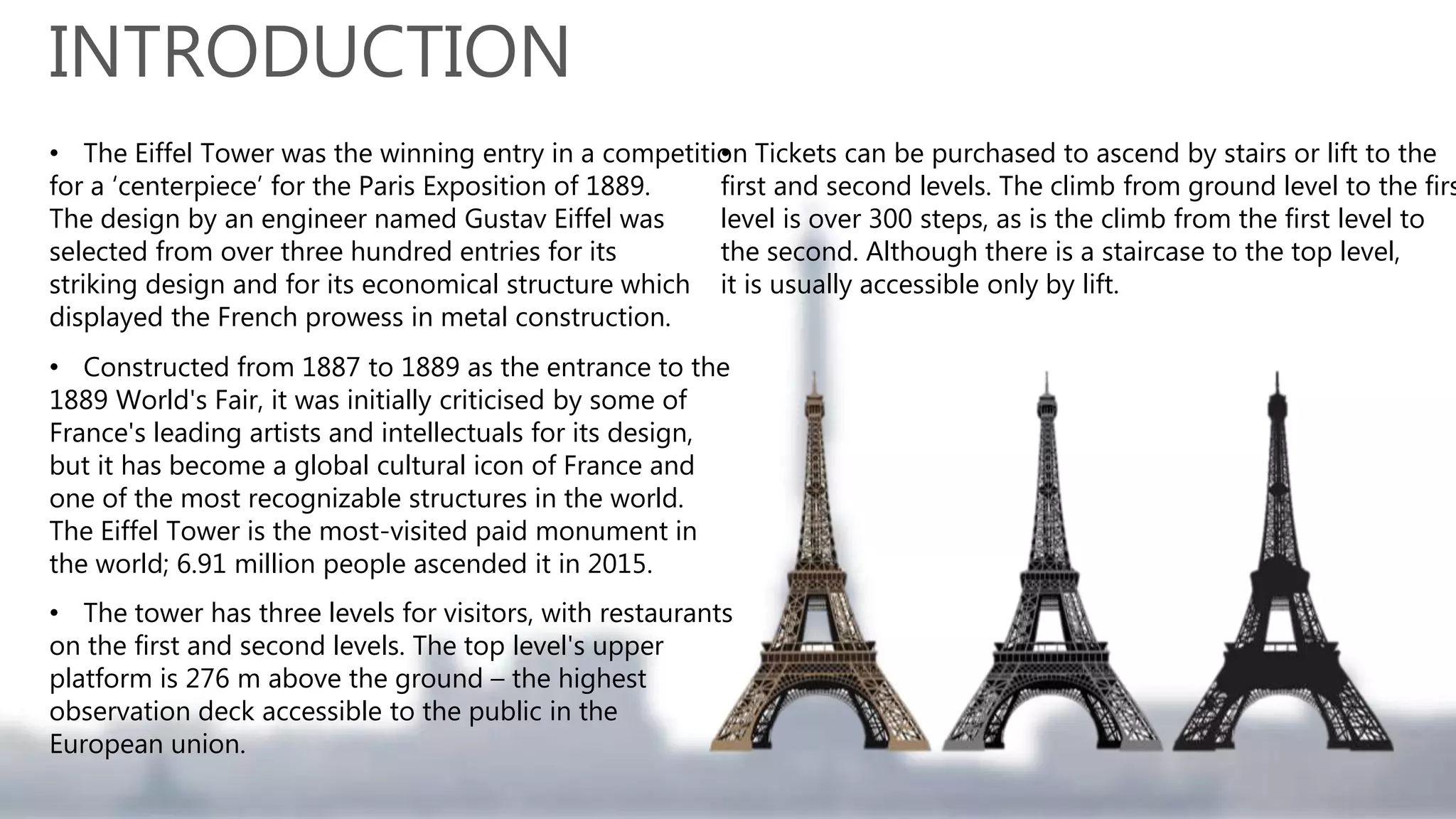
• Constructed from 1887 to 1889 as the entrance to the
1889 World's Fair, it was initially criticised by some of
France's leading artists and intellectuals for its design,
but it has become a global cultural icon of France and
one of the most recognizable structures in the world.
The Eiffel Tower is the most-visited paid monument in
the world; 6.91 million people ascended it in 2015.
• The tower has three levels for visitors, with restaurants
on the first and second levels. The top level's upper
platform is 276 m above the ground – the highest
observation deck accessible to the public in the
European union.
• The Eiffel Tower was the winning entry in a competition
for a ‘centerpiece’ for the Paris Exposition of 1889.
The design by an engineer named Gustav Eiffel was
selected from over three hundred entries for its
striking design and for its economical structure which
displayed the French prowess in metal construction.
• Tickets can be purchased to ascend by stairs or lift to the
first and second levels. The climb from ground level to the firs
level is over 300 steps, as is the climb from the first level to
the second. Although there is a staircase to the top level,
it is usually accessible only by lift.
HISTORY
• The design of the Eiffel Tower is attributed to Maurice
Koechlin and Émile Nouguier, two senior engineers working
for the Compagnie des Établissements Eiffel. It was envisioned
after discussion about a suitable centrepiece for the
proposed 1889 Exposition Universelle, a world's fair to
celebrate the centennial of the French Revolution.
• Eiffel openly acknowledged that inspiration for a tower came
from the Latting Observatory built in New York City in 1853. In
May 1884, working at home, Koechlin made a sketch of their
idea, described by him as "a great pylon, consisting of four
lattice girders standing apart at the base and coming together
at the top, joined together by metal trusses at regular
intervals".
• Eiffel initially showed little enthusiasm, but he did approve
further study, and the two engineers then asked Stephen
Sauvestre, the head of company's architectural department, to
contribute to the design. Sauvestre added decorative arches
to the base of the tower, a glass pavilion to the first level, and
other embellishments.
WHO BUILT THE EIFFEL TOWER?
The Eiffel Tower was named after Gustave Eiffel,
whose company was in charge of the project. Gustave
Eiffel was not, however, the primary designer of the
famous iron structure. Eiffel had the help of engineers
that worked for him in the Compagnie des
Établissements Eiffel – Maurice Koechlin , Émile
Nouguier, and architect Stephen Sauvestre.
In recognition of the engineers, scientists and
mathematicians who contributed to the construction
of the tower, the names of these persons were
engraved on the side of tower. 72 names, to be exact.
WHY WAS EIFFEL TOWER BUILT? At the time of the construction of the Eiffel Tower, the
architecture became industrial. The industry and the
creativity were combined for the construction of the
monument.
The Eiffel Tower was built in 1889 to celebrate the
French Revolution’s centennial year during
the Exposition Universelle at the Champs de Mars. The
purpose was to show the other nations the power and
the industrial abilities of France. The tower was
constructed by the Seine and its rounded shape was
used as the entry to the exhibition. The Eiffel
Tower was entrance to the Exposition Universelle.
The iron structure marked the beginning of a new form
of architecture. In 1884, two important engineers that
worked in the Eiffel Enterprise, which was founded by
Gustave Eiffel, Maurice Koechlin and Émile Nouguier,
started making plans for the 1889 Exposition
Universelle. They proposed the project of a 300 meters
tall tower. Then, Gustave Eiffel asked Stephen Sauvestre
to redesign and refine the tower. Sauvestre added a
few arcs and decorations. He beautified the project.
DID THE PARISIANS LIKE THE IRON STRUCTURE?
Today, the Parisians are proud of the
impressive Eiffel Tower. It stands tall
above the city and definitely became
the most emblematic monument of the
city! But when the construction was
over, most Parisians hated it!
In a letter signed by artists of reference,
such as Guy de Maupassant, the critics
were very harsh. They thought the iron
structure outshone the classic and
elegant city of Paris. Parisians talked
about the Eiffel Tower as “grid” and
“factory chimney”.
Despite the criticisms, the Eiffel
Tower established itself as one of the
highlights of the city.
WAS THE EIFFEL TOWER MEANT TO BE DESTROYED?
The Eiffel Tower was to be a temporary structure. Its
sole purpose was for the Exposition Universelle. After
the exhibition, it was to stay for twenty years and then
be destroyed.
In 1897, the first broadcasts of radio began. So,
the Eiffel Tower became a strategic point for the city.
It wasn’t a simple place to visit, it gained a strategic
and military purpose. This is what convinced the city
of Paris to keep the Eiffel Tower. During the first
World War, the tower captured important telegrams,
precious information was deciphered, and spies were
exposed. Today, the tower contains 120 antennas. 32
radio stations and 40 TV channels broadcast from the
top of the monument.
ARCHITECTURE
• The Eiffel Tower is unquestionably modern in its shape, which is distinct
from the Neo-Gothic, Neo-Renaissance and Neo-Baroque styles that were
popular in the 18th and 19th centuries, according to Gudek Snajdar. But its
material truly made it stand out.
• "The Eiffel Tower was one of the first examples of the modern architecture
because of the iron," said Gudek Snajdar. "And the fact that the building
didn't have any purpose in particular." It existed purely to demonstrate
French architectural creativity and skill with materials to the world; it was
imbued with meaning but not utility.
• The Eiffel Tower is also a more democratic, and therefore modern,
structure than other monuments of the time, according to Gudek Snajdar.
Gustave Eiffel insisted that elevators be included in the tower, but they
had to be imported from an American company because no French
company could meet the quality standards, Gudek Snajdar said. "Because
of the escalators, the building could be used as a tower from which
Parisians and their visitors could enjoy a view on their city. That was
something that was before only accessible to a few wealthy people that
could afford flying in a hot air balloon. But now, it was rather cheap and
anyone could enjoy the view on a city from it," she explained.
• "That's why it's a great example of a modern architecture. It's democratic and
not only available to a few of a wealthy people. But people of a different social
background could use it and enjoy it."
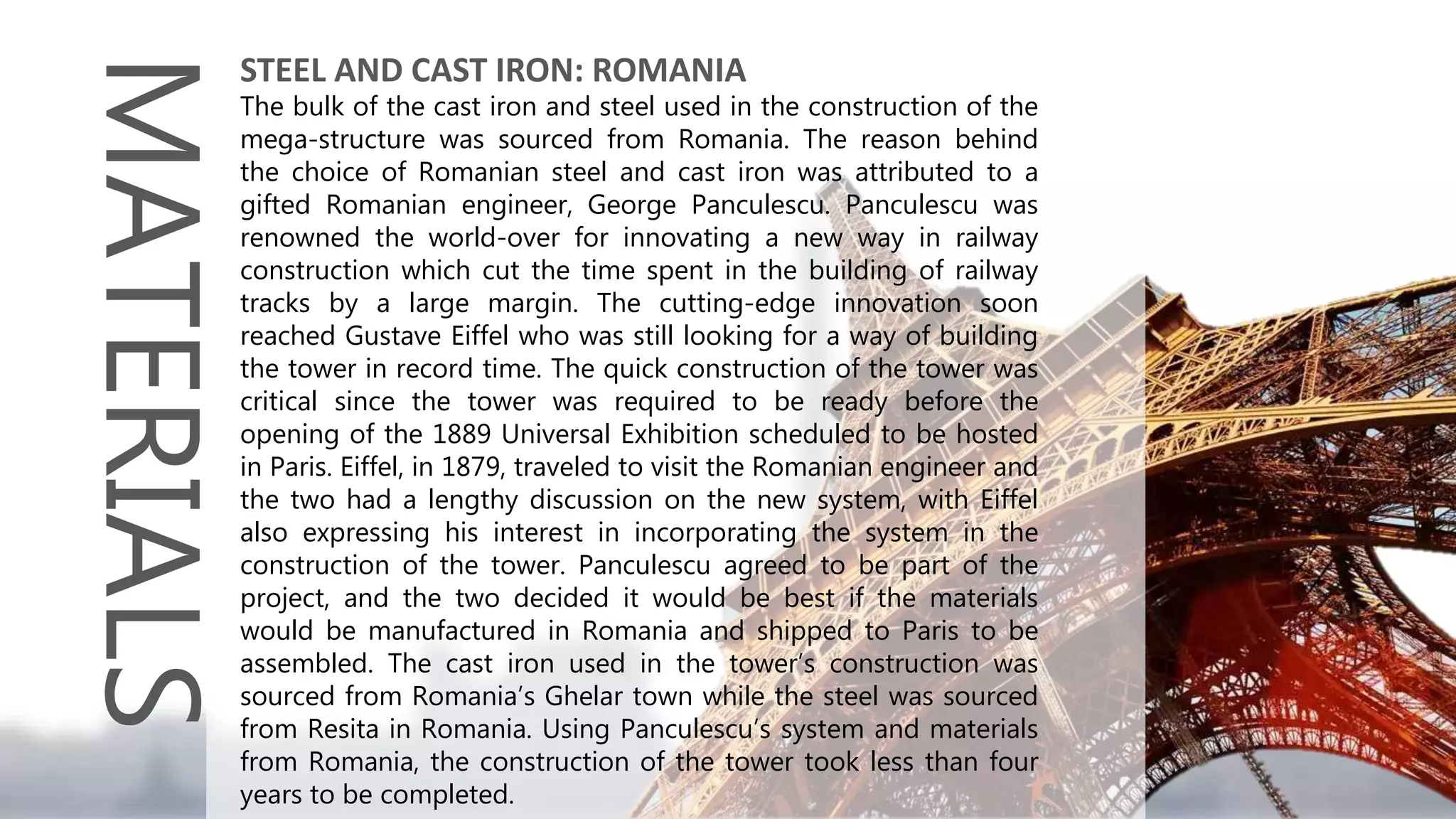
MATERIALSSTEEL AND CAST IRON: ROMANIA
The bulk of the cast iron and steel used in the construction of the
mega-structure was sourced from Romania. The reason behind
the choice of Romanian steel and cast iron was attributed to a
gifted Romanian engineer, George Panculescu. Panculescu was
renowned the world-over for innovating a new way in railway
construction which cut the time spent in the building of railway
tracks by a large margin. The cutting-edge innovation soon
reached Gustave Eiffel who was still looking for a way of building
the tower in record time. The quick construction of the tower was
critical since the tower was required to be ready before the
opening of the 1889 Universal Exhibition scheduled to be hosted
in Paris. Eiffel, in 1879, traveled to visit the Romanian engineer and
the two had a lengthy discussion on the new system, with Eiffel
also expressing his interest in incorporating the system in the
construction of the tower. Panculescu agreed to be part of the
project, and the two decided it would be best if the materials
would be manufactured in Romania and shipped to Paris to be
assembled. The cast iron used in the tower’s construction was
sourced from Romania’s Ghelar town while the steel was sourced
from Resita in Romania. Using Panculescu’s system and materials
from Romania, the construction of the tower took less than four
years to be completed.
LABOR: FRANCE
The workforce was predominantly sourced
from France and Paris in particular. The
laborforce sourced locally in Paris ranged
from the assemblers to the project’s chief
structural engineers (Emile Nouguier and
Maurice Koechlin) and the tower’s architect
(Stephen Sauvestre). The construction of the
tower required a maximum of 250 laborers.
The most sought-after skills in the tower’s
construction included riveters, assemblers,
blacksmiths, and carpenters to name a few.
The project experienced its first setback
regarding labor in 1888 after the employees
went on strike demanding for better
remuneration and improved working
conditions. The workers also complained
about the dangers posed by working at
great heights. The strike was well-publicized
and was picked up by opponents of the
project. However, the workers went back to
work after Eiffel considered their grievances.
PAINT
The tower’s construction also
consumed a huge amount of paint. The
choice of color was primary for
aesthetics with reddish brown being
the selected color for the tower’s
painting. Three shades of the color
were painted on the tower with the
light shade being on the upper
sections of the Eiffel Tower to
complement the sky. The tower is
entirely painted by hand and it is done
after every seven years and only
brushes are used; spray guns and
rollers are not permitted. It consumes
approximately 60 tons of paint and
takes between 15 and 18 months to
paint all over without closing the
structure to the public.
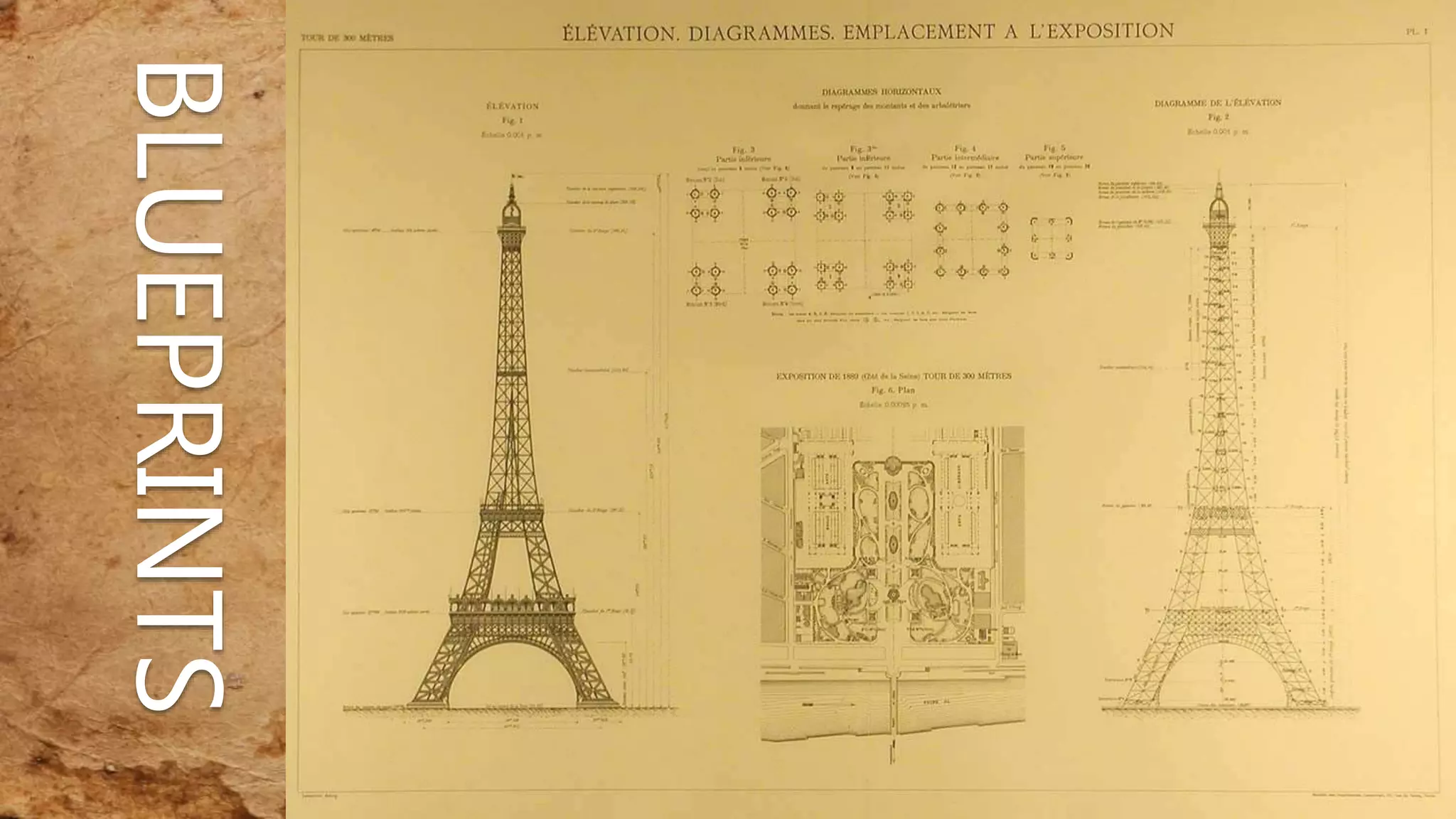
BLUEPRINTS
industrial revolution  Eiffel Tower

industrial revolution Eiffel Tower

  • 1.
  • 2.
    INTRODUCTION • Constructed from1887 to 1889 as the entrance to the 1889 World's Fair, it was initially criticised by some of France's leading artists and intellectuals for its design, but it has become a global cultural icon of France and one of the most recognizable structures in the world. The Eiffel Tower is the most-visited paid monument in the world; 6.91 million people ascended it in 2015. • The tower has three levels for visitors, with restaurants on the first and second levels. The top level's upper platform is 276 m above the ground – the highest observation deck accessible to the public in the European union. • The Eiffel Tower was the winning entry in a competition for a ‘centerpiece’ for the Paris Exposition of 1889. The design by an engineer named Gustav Eiffel was selected from over three hundred entries for its striking design and for its economical structure which displayed the French prowess in metal construction. • Tickets can be purchased to ascend by stairs or lift to the first and second levels. The climb from ground level to the firs level is over 300 steps, as is the climb from the first level to the second. Although there is a staircase to the top level, it is usually accessible only by lift.
  • 3.
    HISTORY • The designof the Eiffel Tower is attributed to Maurice Koechlin and Émile Nouguier, two senior engineers working for the Compagnie des Établissements Eiffel. It was envisioned after discussion about a suitable centrepiece for the proposed 1889 Exposition Universelle, a world's fair to celebrate the centennial of the French Revolution. • Eiffel openly acknowledged that inspiration for a tower came from the Latting Observatory built in New York City in 1853. In May 1884, working at home, Koechlin made a sketch of their idea, described by him as "a great pylon, consisting of four lattice girders standing apart at the base and coming together at the top, joined together by metal trusses at regular intervals". • Eiffel initially showed little enthusiasm, but he did approve further study, and the two engineers then asked Stephen Sauvestre, the head of company's architectural department, to contribute to the design. Sauvestre added decorative arches to the base of the tower, a glass pavilion to the first level, and other embellishments.
  • 4.
    WHO BUILT THEEIFFEL TOWER? The Eiffel Tower was named after Gustave Eiffel, whose company was in charge of the project. Gustave Eiffel was not, however, the primary designer of the famous iron structure. Eiffel had the help of engineers that worked for him in the Compagnie des Établissements Eiffel – Maurice Koechlin , Émile Nouguier, and architect Stephen Sauvestre. In recognition of the engineers, scientists and mathematicians who contributed to the construction of the tower, the names of these persons were engraved on the side of tower. 72 names, to be exact.
  • 5.
    WHY WAS EIFFELTOWER BUILT? At the time of the construction of the Eiffel Tower, the architecture became industrial. The industry and the creativity were combined for the construction of the monument. The Eiffel Tower was built in 1889 to celebrate the French Revolution’s centennial year during the Exposition Universelle at the Champs de Mars. The purpose was to show the other nations the power and the industrial abilities of France. The tower was constructed by the Seine and its rounded shape was used as the entry to the exhibition. The Eiffel Tower was entrance to the Exposition Universelle. The iron structure marked the beginning of a new form of architecture. In 1884, two important engineers that worked in the Eiffel Enterprise, which was founded by Gustave Eiffel, Maurice Koechlin and Émile Nouguier, started making plans for the 1889 Exposition Universelle. They proposed the project of a 300 meters tall tower. Then, Gustave Eiffel asked Stephen Sauvestre to redesign and refine the tower. Sauvestre added a few arcs and decorations. He beautified the project.
  • 6.
    DID THE PARISIANSLIKE THE IRON STRUCTURE? Today, the Parisians are proud of the impressive Eiffel Tower. It stands tall above the city and definitely became the most emblematic monument of the city! But when the construction was over, most Parisians hated it! In a letter signed by artists of reference, such as Guy de Maupassant, the critics were very harsh. They thought the iron structure outshone the classic and elegant city of Paris. Parisians talked about the Eiffel Tower as “grid” and “factory chimney”. Despite the criticisms, the Eiffel Tower established itself as one of the highlights of the city.
  • 7.
    WAS THE EIFFELTOWER MEANT TO BE DESTROYED? The Eiffel Tower was to be a temporary structure. Its sole purpose was for the Exposition Universelle. After the exhibition, it was to stay for twenty years and then be destroyed. In 1897, the first broadcasts of radio began. So, the Eiffel Tower became a strategic point for the city. It wasn’t a simple place to visit, it gained a strategic and military purpose. This is what convinced the city of Paris to keep the Eiffel Tower. During the first World War, the tower captured important telegrams, precious information was deciphered, and spies were exposed. Today, the tower contains 120 antennas. 32 radio stations and 40 TV channels broadcast from the top of the monument.
  • 8.
    ARCHITECTURE • The EiffelTower is unquestionably modern in its shape, which is distinct from the Neo-Gothic, Neo-Renaissance and Neo-Baroque styles that were popular in the 18th and 19th centuries, according to Gudek Snajdar. But its material truly made it stand out. • "The Eiffel Tower was one of the first examples of the modern architecture because of the iron," said Gudek Snajdar. "And the fact that the building didn't have any purpose in particular." It existed purely to demonstrate French architectural creativity and skill with materials to the world; it was imbued with meaning but not utility. • The Eiffel Tower is also a more democratic, and therefore modern, structure than other monuments of the time, according to Gudek Snajdar. Gustave Eiffel insisted that elevators be included in the tower, but they had to be imported from an American company because no French company could meet the quality standards, Gudek Snajdar said. "Because of the escalators, the building could be used as a tower from which Parisians and their visitors could enjoy a view on their city. That was something that was before only accessible to a few wealthy people that could afford flying in a hot air balloon. But now, it was rather cheap and anyone could enjoy the view on a city from it," she explained. • "That's why it's a great example of a modern architecture. It's democratic and not only available to a few of a wealthy people. But people of a different social background could use it and enjoy it."
  • 9.
    MATERIALSSTEEL AND CASTIRON: ROMANIA The bulk of the cast iron and steel used in the construction of the mega-structure was sourced from Romania. The reason behind the choice of Romanian steel and cast iron was attributed to a gifted Romanian engineer, George Panculescu. Panculescu was renowned the world-over for innovating a new way in railway construction which cut the time spent in the building of railway tracks by a large margin. The cutting-edge innovation soon reached Gustave Eiffel who was still looking for a way of building the tower in record time. The quick construction of the tower was critical since the tower was required to be ready before the opening of the 1889 Universal Exhibition scheduled to be hosted in Paris. Eiffel, in 1879, traveled to visit the Romanian engineer and the two had a lengthy discussion on the new system, with Eiffel also expressing his interest in incorporating the system in the construction of the tower. Panculescu agreed to be part of the project, and the two decided it would be best if the materials would be manufactured in Romania and shipped to Paris to be assembled. The cast iron used in the tower’s construction was sourced from Romania’s Ghelar town while the steel was sourced from Resita in Romania. Using Panculescu’s system and materials from Romania, the construction of the tower took less than four years to be completed.
  • 10.
    LABOR: FRANCE The workforcewas predominantly sourced from France and Paris in particular. The laborforce sourced locally in Paris ranged from the assemblers to the project’s chief structural engineers (Emile Nouguier and Maurice Koechlin) and the tower’s architect (Stephen Sauvestre). The construction of the tower required a maximum of 250 laborers. The most sought-after skills in the tower’s construction included riveters, assemblers, blacksmiths, and carpenters to name a few. The project experienced its first setback regarding labor in 1888 after the employees went on strike demanding for better remuneration and improved working conditions. The workers also complained about the dangers posed by working at great heights. The strike was well-publicized and was picked up by opponents of the project. However, the workers went back to work after Eiffel considered their grievances.
  • 11.
    PAINT The tower’s constructionalso consumed a huge amount of paint. The choice of color was primary for aesthetics with reddish brown being the selected color for the tower’s painting. Three shades of the color were painted on the tower with the light shade being on the upper sections of the Eiffel Tower to complement the sky. The tower is entirely painted by hand and it is done after every seven years and only brushes are used; spray guns and rollers are not permitted. It consumes approximately 60 tons of paint and takes between 15 and 18 months to paint all over without closing the structure to the public.
  • 12.