Film & Reality
Taken from 2nd part of Film Theory & Criticism (6th
        Ed. by Leo Braudy & Marshall Cohen)
Art Imitates nature?
• Aristotle
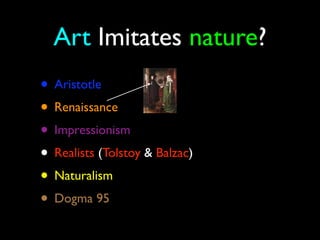
• Renaissance
• Impressionism
• Realists (Tolstoy & Balzac)
• Naturalism
• Dogma 95
Anti-realist Tradition
• Abstract Art
• Avant garde
• Modernism
• Post-Modernism
• ‘Why should these images not liberate the
  imagination from the tedium of reality,
  introducing us to the world of abstractions
  or of dreams instead?’
Siegfried Kracauer
• A leading exponent of realism in cinema
• ‘Kracauer argues that because film literally
  photographs reality it alone is capable of
  holding the mirror up to nature.’
• His seminal work ‘From Caligari to Hitler’
  is an analysis of Caligari’s landscapes as
  German cinema turning away from a reality
  which is ‘haphazard, incalculable and
  uncontrollable.’
Kracauer Realism &
   Leni
Riefenstahl
                   Ideology
         • Interestingly, Kracauer argues that by
              adopting fantasy rather than realism,
              German cinema helped fuel the rise of the
              Nazis by not attempting to mirror the
              reality of what was going on in society.
         • ‘German cinema achieved the damnation,
              not the redemption of German life.’
Bazin- Cahiers du
         Cinema
• Founded the crucial French film magazine
• Pinpointed the technological power of the
  camera (still and motion-picture) to satisfy
  a human desire throughout time to
  ‘recreate the world in its own image.‘
Bazin- Realist Aesthetic
• Jean Renoir
• Orson Welles & William Wyler
• Italian Neorealism
 • Non professional actors (normal people)
 • Natural Setting
 • Simple, believable narrative
Rudolf Arnheim- Art?

• Questioned whether mere mechanical
  reproduction of reality is art.
• Describes the true artistic urge as- ‘not
  simply to copy, but to originate, interpret
  and to mold.’
Independent, Experimental
     or Avant Garde
• Maya Deren & Stan Brakhage
• Deren fused both traditions together by
  photographing reality and then using slow
  motion, reverse motion and the freeze
  frame.
• ‘She attempts to undermine what we know
  about these realities.’
Brakhage- ‘Liberation of
       the Eye’
• ‘An act of seeing previously unimagined and
  defined by conventions of representation.’
• Described cinema as ‘new, unrealised
  magic,’ and subsequently challenged the
  realist tradition.
Jean-Louis Baudry- Film
       as Dream
• Observes that film resembles a dream
 • Audience’s movements are inhibited
 • Sits in a darkened room
 • Images projected on a screen
 • Psychoanalysts refer to this as a
    ‘regression to a state of primitive
    narcissism.’
Noel Carroll

• Challenges Baudry by pointing out that
  many spectators leave the cinema for a
  smoke and that images are publicly available
  not individual.
• He also points out that we understand film
  far better than dreams
Gilles Deluze
• Points to post WW2 cinema and in
  particularly neorealism as more important
  than the advent of sound.
• Rational cuts are ignored in favour of a new
  art which is more concerned with
  fragmentation and discontinuity of the
  narrative structure. (ASA structure-
  ‘Actions create situations which create new
  situations, rather than in traditional
  Hollywood where SAS dominates)
Stephen Prince- The Coming of
             CGI
• So how do we provide CGI within the
  context of this debate? ‘When faced with
  digitised images, will we need to discard
  notions of realism in the cinema?’
• Prince believes that actually, we need both.
  The links between fictional reality visual/
  social co-ordinates of our own 3D world
  are crucial. ‘Unreal images have never
  seemed so real.’

Film & Reality

  • 1.
    Film & Reality Takenfrom 2nd part of Film Theory & Criticism (6th Ed. by Leo Braudy & Marshall Cohen)
  • 2.
    Art Imitates nature? •Aristotle • Renaissance • Impressionism • Realists (Tolstoy & Balzac) • Naturalism • Dogma 95
  • 3.
    Anti-realist Tradition • AbstractArt • Avant garde • Modernism • Post-Modernism • ‘Why should these images not liberate the imagination from the tedium of reality, introducing us to the world of abstractions or of dreams instead?’
  • 4.
    Siegfried Kracauer • Aleading exponent of realism in cinema • ‘Kracauer argues that because film literally photographs reality it alone is capable of holding the mirror up to nature.’ • His seminal work ‘From Caligari to Hitler’ is an analysis of Caligari’s landscapes as German cinema turning away from a reality which is ‘haphazard, incalculable and uncontrollable.’
  • 5.
    Kracauer Realism & Leni Riefenstahl Ideology • Interestingly, Kracauer argues that by adopting fantasy rather than realism, German cinema helped fuel the rise of the Nazis by not attempting to mirror the reality of what was going on in society. • ‘German cinema achieved the damnation, not the redemption of German life.’
  • 6.
    Bazin- Cahiers du Cinema • Founded the crucial French film magazine • Pinpointed the technological power of the camera (still and motion-picture) to satisfy a human desire throughout time to ‘recreate the world in its own image.‘
  • 7.
    Bazin- Realist Aesthetic •Jean Renoir • Orson Welles & William Wyler • Italian Neorealism • Non professional actors (normal people) • Natural Setting • Simple, believable narrative
  • 8.
    Rudolf Arnheim- Art? •Questioned whether mere mechanical reproduction of reality is art. • Describes the true artistic urge as- ‘not simply to copy, but to originate, interpret and to mold.’
  • 9.
    Independent, Experimental or Avant Garde • Maya Deren & Stan Brakhage • Deren fused both traditions together by photographing reality and then using slow motion, reverse motion and the freeze frame. • ‘She attempts to undermine what we know about these realities.’
  • 10.
    Brakhage- ‘Liberation of the Eye’ • ‘An act of seeing previously unimagined and defined by conventions of representation.’ • Described cinema as ‘new, unrealised magic,’ and subsequently challenged the realist tradition.
  • 11.
    Jean-Louis Baudry- Film as Dream • Observes that film resembles a dream • Audience’s movements are inhibited • Sits in a darkened room • Images projected on a screen • Psychoanalysts refer to this as a ‘regression to a state of primitive narcissism.’
  • 12.
    Noel Carroll • ChallengesBaudry by pointing out that many spectators leave the cinema for a smoke and that images are publicly available not individual. • He also points out that we understand film far better than dreams
  • 13.
    Gilles Deluze • Pointsto post WW2 cinema and in particularly neorealism as more important than the advent of sound. • Rational cuts are ignored in favour of a new art which is more concerned with fragmentation and discontinuity of the narrative structure. (ASA structure- ‘Actions create situations which create new situations, rather than in traditional Hollywood where SAS dominates)
  • 14.
    Stephen Prince- TheComing of CGI • So how do we provide CGI within the context of this debate? ‘When faced with digitised images, will we need to discard notions of realism in the cinema?’ • Prince believes that actually, we need both. The links between fictional reality visual/ social co-ordinates of our own 3D world are crucial. ‘Unreal images have never seemed so real.’