Auteur Theory:
• 'Auteur' is the French word for 'author'.

•    In film criticism, auteur theory holds that a director's reflects
    the director's personal creative vision.

•    Sometimes the auteur's creative voice can be distinct enough to
    shine through even with all of the studio interference and through
    the group process of making a film.

•    In law, the auteur is the one who originally holds the copyright, as
    they are the creator of the film.

•    As a result of the auteur theory, under European
    law, the director is considered the author or one
    of the authors in a film.

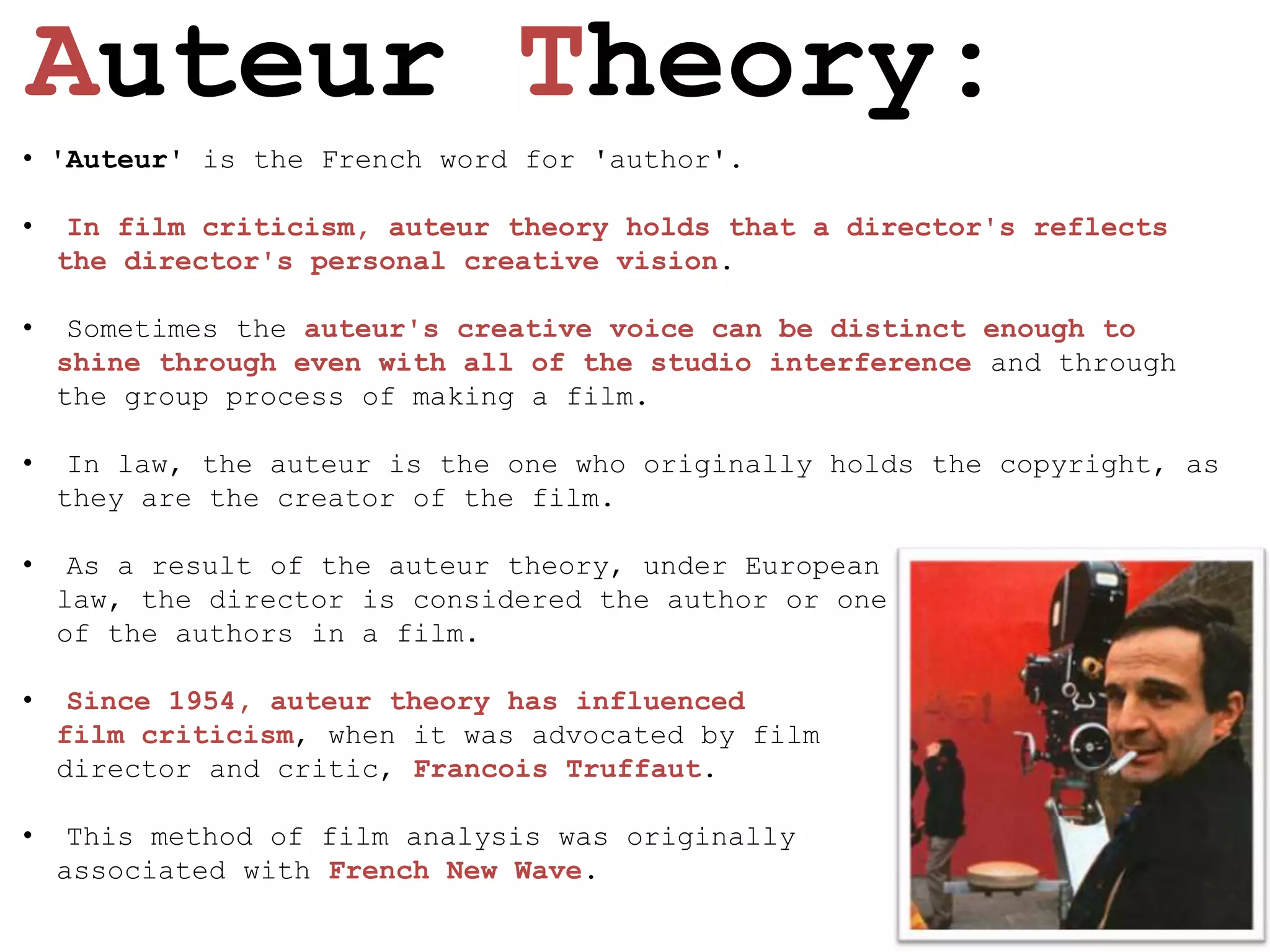
•    Since 1954, auteur theory has influenced
    film criticism, when it was advocated by film
    director and critic, Francois Truffaut.

•    This method of film analysis was originally
    associated with French New Wave.
Auteur Theory:
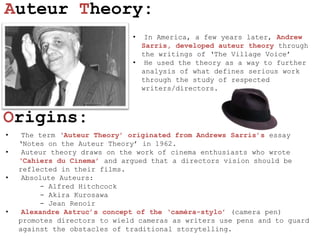
                              •  In America, a few years later, Andrew
                                Sarris, developed auteur theory through
                                the writings of ‘The Village Voice’
                              • He used the theory as a way to further
                                analysis of what defines serious work
                                through the study of respected
                                writers/directors.


Origins:
•    The term „Auteur Theory‟ originated from Andrews Sarris‟s essay
    ‘Notes on the Auteur Theory’ in 1962.
•    Auteur theory draws on the work of cinema enthusiasts who wrote
    „Cahiers du Cinema‟ and argued that a directors vision should be
    reflected in their films.
•    Absolute Auteurs:
         - Alfred Hitchcock
         - Akira Kurosawa
         - Jean Renoir
•    Alexandre Astruc‟s concept of the „caméra-stylo‟ (camera pen)
    promotes directors to wield cameras as writers use pens and to guard
    against the obstacles of traditional storytelling.
Origins:
•    Truffaut expressed that directors should use the mise-en-scène to
    imprint their vision on their work.
•    Andre Bazin and Roger Leenhardt also expressed that the director
    brings the film to life and uses it to express their feelings on the
    subject matter.
•    An auteur can also use lighting, setting, staging, and editing to
    add to their vision.
•    According to Andrew Sarris in his ‘Notes on the Auteur Theory’, a
    director must accomplish technical competence in their technique,
    personal style in terms of how the movie looks and feels, and
    interior meaning.

Criticism:
•    Starting in the 1960s film critics began to
    criticise the auteur theory‟s focus on the authorial
    role of the director.
•    One reason for this is the collaborative aspect of
    film making.
•    Aljean Harmetz argued that the auteur theory
    “collapses against the reality of the studio system”.
•    The New Critics argued that speculation about an
    author’s intention was secondary to the words on the
    page as the basis of the experience of reading
    literature.

Auteur theory

  • 1.
    Auteur Theory: • 'Auteur'is the French word for 'author'. • In film criticism, auteur theory holds that a director's reflects the director's personal creative vision. • Sometimes the auteur's creative voice can be distinct enough to shine through even with all of the studio interference and through the group process of making a film. • In law, the auteur is the one who originally holds the copyright, as they are the creator of the film. • As a result of the auteur theory, under European law, the director is considered the author or one of the authors in a film. • Since 1954, auteur theory has influenced film criticism, when it was advocated by film director and critic, Francois Truffaut. • This method of film analysis was originally associated with French New Wave.
  • 2.
    Auteur Theory: • In America, a few years later, Andrew Sarris, developed auteur theory through the writings of ‘The Village Voice’ • He used the theory as a way to further analysis of what defines serious work through the study of respected writers/directors. Origins: • The term „Auteur Theory‟ originated from Andrews Sarris‟s essay ‘Notes on the Auteur Theory’ in 1962. • Auteur theory draws on the work of cinema enthusiasts who wrote „Cahiers du Cinema‟ and argued that a directors vision should be reflected in their films. • Absolute Auteurs: - Alfred Hitchcock - Akira Kurosawa - Jean Renoir • Alexandre Astruc‟s concept of the „caméra-stylo‟ (camera pen) promotes directors to wield cameras as writers use pens and to guard against the obstacles of traditional storytelling.
  • 3.
    Origins: • Truffaut expressed that directors should use the mise-en-scène to imprint their vision on their work. • Andre Bazin and Roger Leenhardt also expressed that the director brings the film to life and uses it to express their feelings on the subject matter. • An auteur can also use lighting, setting, staging, and editing to add to their vision. • According to Andrew Sarris in his ‘Notes on the Auteur Theory’, a director must accomplish technical competence in their technique, personal style in terms of how the movie looks and feels, and interior meaning. Criticism: • Starting in the 1960s film critics began to criticise the auteur theory‟s focus on the authorial role of the director. • One reason for this is the collaborative aspect of film making. • Aljean Harmetz argued that the auteur theory “collapses against the reality of the studio system”. • The New Critics argued that speculation about an author’s intention was secondary to the words on the page as the basis of the experience of reading literature.