
Global Age-friendly Cities:
                  A Guide
AGEING AND LIFE COURSE, FAMILY AND COMMUNITY HEALTH


Global Age-friendly Cities:
                  A Guide
WHO Library Cataloguing-in-Publication Data
          Global age-friendly cities : a guide.

          1.Aged - statistics. 2.Aging. 3.Urban health. 4.City planning. 5.Residence characteristics. 6.Quality of life.
          7.Consumer participation. 8.Strategic planning. I.World Health Organization.

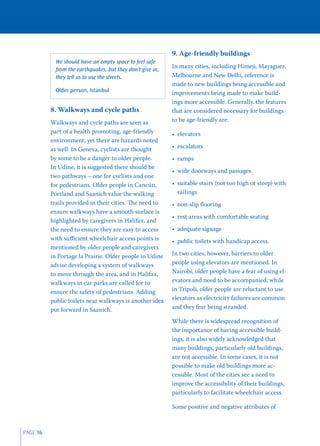
          ISBN 978 92 4 154730 7                              (NLM classification: WT 31)

          © World Health Organization 2007

          All rights reserved. Publications of the World Health Organization can be obtained from WHO Press, World
          Health Organization, 20 Avenue Appia, 1211 Geneva 27, Switzerland (tel.: +41 22 791 3264; fax: +41 22 791
          4857; e-mail: bookorders@who.int). Requests for permission to reproduce or translate WHO publications
          – whether for sale or for noncommercial distribution – should be addressed to WHO Press, at the above ad-
          dress (fax: +41 22 791 4806; e-mail: permissions@who.int).

          The designations employed and the presentation of the material in this publication do not imply the expres-
          sion of any opinion whatsoever on the part of the World Health Organization concerning the legal status
          of any country, territory, city or area or of its authorities, or concerning the delimitation of its frontiers or
          boundaries. Dotted lines on maps represent approximate border lines for which there may not yet be full
          agreement.
          The mention of specific companies or of certain manufacturers’ products does not imply that they are
          endorsed or recommended by the World Health Organization in preference to others of a similar nature that
          are not mentioned. Errors and omissions excepted, the names of proprietary products are distinguished by
          initial capital letters.

          All reasonable precautions have been taken by the World Health Organization to verify the information
          contained in this publication. However, the published material is being distributed without warranty of any
          kind, either expressed or implied. The responsibility for the interpretation and use of the material lies with
          the reader. In no event shall the World Health Organization be liable for damages arising from its use.


          Design: Langfeldesigns.com
          Illustration: © Ann Feild/Didyk


          Printed in France


PAGE iI
AGEING AND LIFE COURSE, FAMILY AND COMMUNITY HEALTH


Table of Contents

Acknowledgements                                                                iv

Introduction: about this Guide                                                  1

Part 1. Global ageing and urbanization: meeting the challenge of                3
     humanity’s success

Part 2. Active ageing: a framework for age-friendly cities                      5

Part 3. How the Guide was developed                                             7

Part 4. How to use the Guide                                                   11

Part 5. Outdoor spaces and buildings                                           12

Part 6. Transportation                                                         20

Part 7. Housing                                                                30

Part 8. Social participation                                                   38

Part 9. Respect and social inclusion                                           45

Part 10. Civic participation and employment                                    51

Part 11. Communication and information                                         60

Part 12. Community support and health services                                 66

Part 13. Wrapping up and moving forward                                        72

References                                                                     76


                                                                                        PAGE iII
Acknowledgements
          This project was conceived in June 2005 at the opening session of the XVIII IAGG World Congress of
          Gerontology and Geriatrics in Rio de Janeiro, Brazil. It immediately attracted enthusiastic interest, which
          has translated into generous contributions from many partners. We gratefully acknowledge the funding and
          in-kind support provided by the Public Health Agency of Canada, which was crucial for implementing the
          research, the participation of several cities and the publication of this Guide.

          We also extend our appreciation to the Ministry of Health of British Columbia for supporting the initial
          meeting of collaborating cities in May, 2006 in Vancouver, Canada; to 2010 Legacies Now for funding the
          publication of a promotional pamphlet; to Help the Aged for enabling the participation of two cities and for
          supporting the second meeting of collaborating cities in London, United Kingdom, in March 2007; and to the
          City of Ottawa, Canada, for pilot testing the research protocol. The implementation of the research project
          and attendance at project meetings was made possible by government and local funding in most of the col-
          laborating cities.

          The project benefited at all phases from the guidance of an advisory group, the members of which we warm-
          ly thank: Margaret Gillis, Public Health Agency of Canada; James Goodwin, Help the Aged, United Kingdom;
          Tessa Graham, Ministry of Health of British Columbia, Canada; Gloria Gutman, Simon Fraser University,
          Canada; Jim Hamilton, Healthy Aging Secretariat of Manitoba, Canada; Nabil Kronful, Lebanese Healthcare
          Management Association, Lebanon; Laura Machado, Inter-Age Consulting in Gerontology, Brazil; and Elena
          Subirats-Simon, Acción para la Salud, Mexico.

          The Global Age-Friendly Cities project was developed by Alexandre Kalache and Louise Plouffe, WHO head-
          quarters, Geneva, Switzerland, and the report was produced under their overall direction. Substantial intel-
          lectual contributions in the data analysis and preparation of the report were made by Louise Plouffe; Karen
          Purdy, Office for Seniors Interests and Volunteering, Government of Western Australia; Julie Netherland, Ana
          Krieger and Ruth Finkelstein, New York Academy of Medicine; Donelda Eve, Winnie Yu and Jennifer MacKay,
          Ministry of Health of British Columbia; and Charles Petitot, WHO headquarters.

          The research protocol was implemented in the following 33 cities thanks to the efforts of governments,
          nongovernmental organizations and academic groups:

          Amman, Jordan                La Plata, Argentina           New Delhi, India             San José, Costa Rica
          Cancún, Mexico               London, United                Ponce, Puerto Rico           Shanghai, China
          Dundalk, Ireland             Kingdom                       Portage la Prairie,          Sherbrooke, Canada
          Geneva, Switzerland          Mayaguez, Puerto Rico         Canada                       Tokyo, Japan
          Halifax, Canada              Melbourne, Australia          Portland, Oregon,            Tripoli, Lebanon
          Himeji, Japan                Melville, Australia           United States of America     Tuymazy, Russian
          Islamabad, Pakistan          Mexico City, Mexico           Rio de Janeiro, Brazil       Federation
          Istanbul, Turkey             Moscow, Russian               Ruhr metropolitan            Udaipur, India
          Kingston and Montego         Federation                    region, Germany              Udine, Italy
          Bay (combined), Jamaica      Nairobi, Kenya                Saanich, Canada


          Finally, special gratitude is expressed to the older people in all research locations, as well as to the caregiv-
          ers and service providers who were also consulted in many sites. In focus groups, these people articulated
          the model of an age-friendly city based on their experience that is at the heart of this Guide. These older
          people and those who interact with them in significant ways will continue to play a critical role as commu-
          nity advocates and overseers of action to make their cities more age-friendly.


PAGE iV
AGEING AND LIFE COURSE, FAMILY AND COMMUNITY HEALTH


Introduction: about this Guide

Population ageing and urbanization are         and barriers they experience in eight areas
two global trends that together comprise       of city living. In most cities, the reports
major forces shaping the 21st century. At      from older people were complemented by
the same time as cities are growing, their     evidence from focus groups of caregivers
share of residents aged 60 years and more is   and service providers in the public, volun-
increasing. Older people are a resource for    tary and private sectors. The results from
their families, communities and economies      the focus groups led to the development of
in supportive and enabling living environ-     a set of age-friendly city checklists.
ments. WHO regards active ageing as a life-
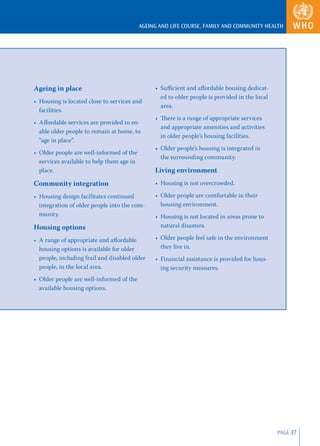
                                               • Part 1 describes the converging trends
long process shaped by several factors that,
                                                 of rapid growth of the population over
alone and acting together, favour health,
                                                 60 years of age and of urbanization, and
participation and security in older adult
                                                 outlines the challenge facing cities.
life. Informed by WHO’s approach to ac-
tive ageing, the purpose of this Guide is to   • Part 2 presents the “active ageing” con-
engage cities to become more age-friendly        cept as a model to guide the development
so as to tap the potential that older people     of age-friendly cities.
represent for humanity.
                                               • Part 3 summarizes the research process
An age-friendly city encourages active age-      that led to identifying the core features of
ing by optimizing opportunities for health,      an age-friendly city.
participation and security in order to en-     • Part 4 describes how the Guide should be
hance quality of life as people age.             used by individuals and groups to stimu-
                                                 late action in their own cities.
 In practical terms, an age-friendly city
adapts its structures and services to be       • Parts 5–12 highlight the issues and con-
accessible to and inclusive of older people      cerns voiced by older people and those
with varying needs and capacities.               who serve older people in each of eight
                                                 areas of urban living: outdoor spaces and
To understand the characteristics of an          buildings; transportation; housing; social
age-friendly city, it is essential to go to      participation; respect and social inclu-
the source – older city dwellers. By work-       sion; civic participation and employment;
ing with groups in 33 cities in all WHO          communication and information; and
regions, WHO has asked older people in           community support and health services.
focus groups to describe the advantages          In each part, the description of the find-
                                                 ings concludes with a checklist of core
                                                 age-friendly city features obtained by
                                                 analysing the reports from all cities.


                                                                                                PAGE 1
• Part 13 integrates the findings within          undertaking initiatives to translate the
           the WHO active ageing perspective and          research into local action, to expand the
           highlights strong connections between the      scope beyond cities, and to spread it to
           age-friendly city topics. These reveal the     more communities. An age-friendly com-
           principal traits of the “ideal” age-friendly   munity movement is growing for which
           city and show how changing one aspect          this Guide is the starting point.
           of the city can have positive effects on the
           lives of older people in other areas. Seized
           by the promise of more age-friendly com-
           munities, WHO collaborators are now


PAGE 2
AGEING AND LIFE COURSE, FAMILY AND COMMUNITY HEALTH


Part 1. Global ageing and urbanization:
meeting the challenge of
humanity’s success
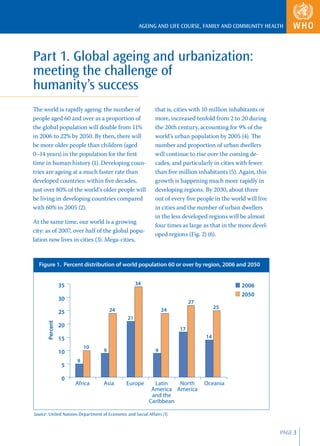
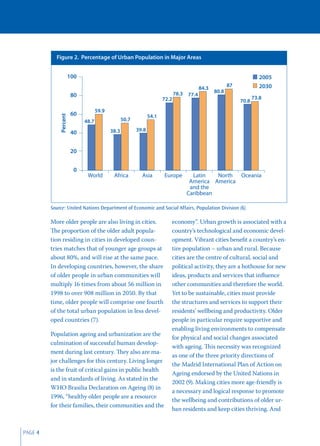
The world is rapidly ageing: the number of                    that is, cities with 10 million inhabitants or
people aged 60 and over as a proportion of                    more, increased tenfold from 2 to 20 during
the global population will double from 11%                    the 20th century, accounting for 9% of the
in 2006 to 22% by 2050. By then, there will                   world’s urban population by 2005 (4). The
be more older people than children (aged                      number and proportion of urban dwellers
0–14 years) in the population for the first                    will continue to rise over the coming de-
time in human history (1). Developing coun-                   cades, and particularly in cities with fewer
tries are ageing at a much faster rate than                   than five million inhabitants (5). Again, this
developed countries: within five decades,                      growth is happening much more rapidly in
just over 80% of the world’s older people will                developing regions. By 2030, about three
be living in developing countries compared                    out of every five people in the world will live
with 60% in 2005 (2).                                         in cities and the number of urban dwellers
                                                              in the less developed regions will be almost
At the same time, our world is a growing
                                                              four times as large as that in the more devel-
city: as of 2007, over half of the global popu-
                                                              oped regions (Fig. 2) (6).
lation now lives in cities (3). Mega-cities,


  Figure 1. Percent distribution of world population 60 or over by region, 2006 and 2050


                 35                                  34                                          2006
                                                                                                 2050
                 30
                                                                             27
                                                                                       25
                 25                    24                         24
                                                21
       Percent


                 20
                                                                        17
                 15                                                               14
                          10
                 10                9                          9
                      9
                  5

                  0
                      Africa       Asia        Europe       Latin   North         Oceania
                                                           America America
                                                           and the
                                                          Caribbean

Source: United Nations Department of Economic and Social Affairs (1).


                                                                                                               PAGE 3
Figure 2. Percentage of Urban Population in Major Areas


                       100                                                                                             2005
                                                                                                        87             2030
                                                                                          84.3
                                                                              78.3 77.4          80.8
                       80                                                                                           73.8
                                                                       72.2                                  70.8
                                    59.9
                       60
             Percent


                                                                54.1
                             48.7                 50.7

                                           38.3          39.8
                       40


                       20


                        0
                              World         Africa         Asia        Europe       Latin   North Oceania
                                                                                   America America
                                                                                   and the
                                                                                  Caribbean

         Source: United Nations Department of Economic and Social Affairs, Population Division (6).

         More older people are also living in cities.                     economy”. Urban growth is associated with a
         The proportion of the older adult popula-                        country’s technological and economic devel-
         tion residing in cities in developed coun-                       opment. Vibrant cities benefit a country’s en-
         tries matches that of younger age groups at                      tire population – urban and rural. Because
         about 80%, and will rise at the same pace.                       cities are the centre of cultural, social and
         In developing countries, however, the share                      political activity, they are a hothouse for new
         of older people in urban communities will                        ideas, products and services that influence
         multiply 16 times from about 56 million in                       other communities and therefore the world.
         1998 to over 908 million in 2050. By that                        Yet to be sustainable, cities must provide
         time, older people will comprise one fourth                      the structures and services to support their
         of the total urban population in less devel-                     residents’ wellbeing and productivity. Older
         oped countries (7).                                              people in particular require supportive and
                                                                          enabling living environments to compensate
         Population ageing and urbanization are the
                                                                          for physical and social changes associated
         culmination of successful human develop-
                                                                          with ageing. This necessity was recognized
         ment during last century. They also are ma-
                                                                          as one of the three priority directions of
         jor challenges for this century. Living longer
                                                                          the Madrid International Plan of Action on
         is the fruit of critical gains in public health
                                                                          Ageing endorsed by the United Nations in
         and in standards of living. As stated in the
                                                                          2002 (9). Making cities more age-friendly is
         WHO Brasilia Declaration on Ageing (8) in
                                                                          a necessary and logical response to promote
         1996, “healthy older people are a resource
                                                                          the wellbeing and contributions of older ur-
         for their families, their communities and the
                                                                          ban residents and keep cities thriving. And


PAGE 4
AGEING AND LIFE COURSE, FAMILY AND COMMUNITY HEALTH


Part 2. Active ageing:
a framework for age-friendly cities
The idea of an age-friendly city presented in    • protecting those who are most vulner-
this Guide builds on WHO’s active ageing           able; and
framework (10).
                                                 • promoting their inclusion in and contri-
Active ageing is the process of optimizing         bution to all areas of community life.
opportunities for health, participation and      Active ageing depends on a variety of influ-
security in order to enhance quality of life     ences or determinants that surround indi-
as people age.                                   viduals, families and nations. They include
                                                 material conditions as well as social factors
In an age-friendly city, policies, services,
                                                 that affect individual types of behaviour
settings and structures support and enable
                                                 and feelings (11). All of these factors, and
people to age actively by:
                                                 the interaction between them, play an im-
• recognizing the wide range of capacities       portant role in affecting how well individu-
  and resources among older people;              als age. Many aspects of urban settings and
                                                 services reflect these determinants and are
• anticipating and responding flexibly to
                                                 included in the characteristic features of an
  ageing-related needs and preferences;
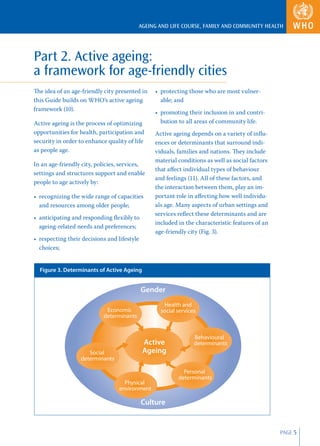
                                                 age-friendly city (Fig. 3).
• respecting their decisions and lifestyle
  choices;


  Figure 3. Determinants of Active Ageing


                                             Gender
                                                    Health and
                            Economic               social services
                           determinants


                                                                 Behavioural
                                             Active              determinants
                     Social                  Ageing
                  determinants

                                                            Personal
                                                          determinants
                                    Physical
                                  environment

                                             Culture


                                                                                                 PAGE 5
These determinants have to be understood                    Because active ageing is a lifelong process,
         from a life course perspective that recog-                  an age-friendly city is not just “elderly-
         nizes that older people are not a homoge-                   friendly”. Barrier-free buildings and streets
         neous group and that individual diversity                   enhance the mobility and independence of
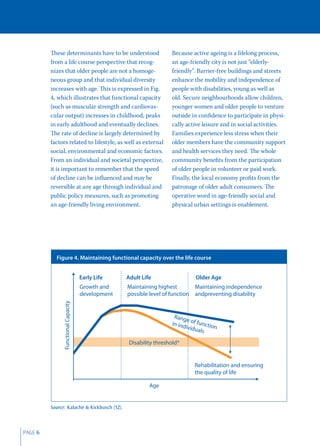
         increases with age. This is expressed in Fig.               people with disabilities, young as well as
         4, which illustrates that functional capacity               old. Secure neighbourhoods allow children,
         (such as muscular strength and cardiovas-                   younger women and older people to venture
         cular output) increases in childhood, peaks                 outside in confidence to participate in physi-
         in early adulthood and eventually declines.                 cally active leisure and in social activities.
         The rate of decline is largely determined by                Families experience less stress when their
         factors related to lifestyle, as well as external           older members have the community support
         social, environmental and economic factors.                 and health services they need. The whole
         From an individual and societal perspective,                community benefits from the participation
         it is important to remember that the speed                  of older people in volunteer or paid work.
         of decline can be influenced and may be                      Finally, the local economy profits from the
         reversible at any age through individual and                patronage of older adult consumers. The
         public policy measures, such as promoting                   operative word in age-friendly social and
         an age-friendly living environment.                         physical urban settings is enablement.


           Figure 4. Maintaining functional capacity over the life course


                                     Early Life    Adult Life                  Older Age
                                     Growth and    Maintaining highest        Maintaining independence
                                     development   possible level of function andpreventing disability
               Functional Capacity


                                                                      Rang
                                                                            e
                                                                     in ind of functio
                                                                           ividu       n
                                                                                 als

                                                    Disability threshold*


                                                                              Rehabilitation and ensuring
                                                                              the quality of life

                                                            Age


         Source: Kalache & Kickbusch (12).


PAGE 6
AGEING AND LIFE COURSE, FAMILY AND COMMUNITY HEALTH


Part 3. How the Guide was developed

Cities in all WHO Regions                                    each city have involved older people as full
                                                             participants in the project. Project leaders
A total of 35 cities from all continents par-
                                                             sought the first-hand experience of older
ticipated in the WHO project leading to the
                                                             people. What are the age-friendly features
Guide, and 33 of these cities participated in
                                                             of the city they live in? What problems do
focus group research thanks to the collabo-
                                                             they encounter? What is missing from the
ration of government officials and nongov-
                                                             city that would enhance their health, par-
ernmental and academic groups (1). These
                                                             ticipation and security?
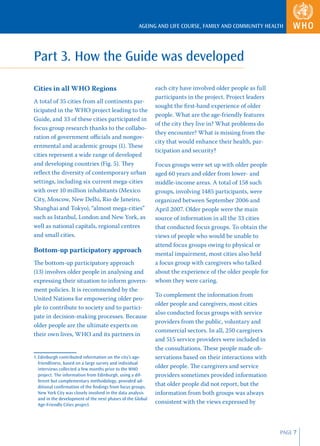
cities represent a wide range of developed
and developing countries (Fig. 5). They                      Focus groups were set up with older people
reflect the diversity of contemporary urban                   aged 60 years and older from lower- and
settings, including six current mega-cities                  middle-income areas. A total of 158 such
with over 10 million inhabitants (Mexico                     groups, involving 1485 participants, were
City, Moscow, New Delhi, Rio de Janeiro,                     organized between September 2006 and
Shanghai and Tokyo), “almost mega-cities”                    April 2007. Older people were the main
such as Istanbul, London and New York, as                    source of information in all the 33 cities
well as national capitals, regional centres                  that conducted focus groups. To obtain the
and small cities.                                            views of people who would be unable to
                                                             attend focus groups owing to physical or
Bottom-up participatory approach                             mental impairment, most cities also held
The bottom-up participatory approach                         a focus group with caregivers who talked
(13) involves older people in analysing and                  about the experience of the older people for
expressing their situation to inform govern-                 whom they were caring.
ment policies. It is recommended by the
                                                             To complement the information from
United Nations for empowering older peo-
                                                             older people and caregivers, most cities
ple to contribute to society and to partici-
                                                             also conducted focus groups with service
pate in decision-making processes. Because
                                                             providers from the public, voluntary and
older people are the ultimate experts on
                                                             commercial sectors. In all, 250 caregivers
their own lives, WHO and its partners in
                                                             and 515 service providers were included in
                                                             the consultations. These people made ob-
1. Edinburgh contributed information on the city’s age-      servations based on their interactions with
   friendliness, based on a large survey and individual
   interviews collected a few months prior to the WHO
                                                             older people. The caregivers and service
   project. The information from Edinburgh, using a dif-     providers sometimes provided information
   ferent but complementary methodology, provided ad-
   ditional confirmation of the findings from focus groups.
                                                             that older people did not report, but the
   New York City was closely involved in the data analysis   information from both groups was always
   and in the development of the next phases of the Global
   Age-Friendly Cities project.
                                                             consistent with the views expressed by


                                                                                                            PAGE 7
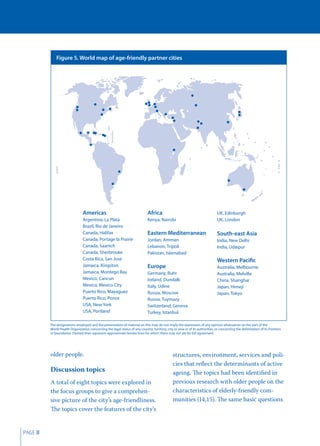
Figure 5. World map of age-friendly partner cities


                                Americas                                      Africa                                           UK, Edinburgh
                                Argentina, La Plata                           Kenya, Nairobi                                   UK, London
                                Brazil, Rio de Janeiro
                                Canada, Halifax                               Eastern Mediterranean                            South-east Asia
                                Canada, Portage la Prairie                    Jordan, Amman                                    India, New Delhi
                                Canada, Saanich                               Lebanon, Tripoli                                 India, Udaipur
                                Canada, Sherbrooke                            Pakistan, Islamabad
                                Costa Rica, San Jose                                                                           Western Pacific
                                Jamaica, Kingston                             Europe                                           Australia, Melbourne
                                Jamaica, Montego Bay                          Germany, Ruhr                                    Australia, Melville
                                Mexico, Cancun                                Ireland, Dundalk                                 China, Shanghai
                                Mexico, Mexico City                           Italy, Udine                                     Japan, Himeji
                                Puerto Rico, Mayaguez                         Russia, Moscow                                   Japan, Tokyo
                                Puerto Rico, Ponce                            Russia, Tuymazy
                                USA, New York                                 Switzerland, Geneva
                                USA, Portland                                 Turkey, Istanbul

         The designations employed and the presentation of material on this map do not imply the expression of any opinion whatsoever on the part of the
         World Health Organization concerning the legal status of any country, territory, city or area or of its authorities, or concerning the delimitation of its frontiers
         or boundaries. Dashed lines represent approximate border lines for which there may not yet be full agreement.


         older people.                                                                          structures, environment, services and poli-
                                                                                                cies that reflect the determinants of active
         Discussion topics                                                                      ageing. The topics had been identified in
         A total of eight topics were explored in                                               previous research with older people on the
         the focus groups to give a comprehen-                                                  characteristics of elderly-friendly com-
         sive picture of the city’s age-friendliness.                                           munities (14,15). The same basic questions
         The topics cover the features of the city’s


PAGE 8
AGEING AND LIFE COURSE, FAMILY AND COMMUNITY HEALTH


about each area were asked in the focus                 social environment and to the economic
groups in all cities.                                   determinants of active ageing. The last two
                                                        topic areas, communication and informa-
The first three topics were outdoor spaces
                                                        tion and community support and health
and buildings, transportation, and housing.
                                                        services, involve both social environments
As key features of a city’s physical envi-
                                                        and health and social service determinants.
ronment, they have a strong influence on
                                                        The cross-cutting active ageing determi-
personal mobility, safety from injury, secu-
                                                        nants of culture and gender were included
rity from crime, health behaviour and social
                                                        only indirectly in this project, because
participation. Another three topics reflect
                                                        their influence on active ageing extends far
different aspects of the social environment
                                                        beyond urban living. Owing to their over-
and of culture that affect participation and
                                                        riding influence, these determinants merit
mental wellbeing. Respect and social inclu-
                                                        specially focused initiatives.
sion deals with the attitudes, behaviour and
messages of other people and of the commu-              As with the determinants of active age-
nity as a whole towards older people. Social            ing, these eight aspects of city life overlap
participation refers to the engagement of               and interact. Respect and social inclusion
older people in recreation, socialization, and          are reflected in the accessibility of the
cultural, educational and spiritual activities.         buildings and spaces and in the range of
Civic participation and employment ad-                  opportunities that the city offers to older
dresses opportunities for citizenship, unpaid           people for social participation, entertain-
work and paid work; it is related to both the           ment or employment. Social participation,
                                                        in turn, influences social inclusion, as well


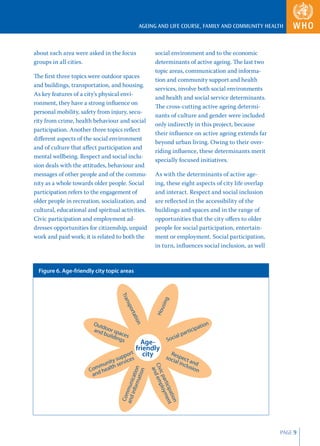
  Figure 6. Age-friendly city topic areas
                                    Tra


                                                              g
                                       nsp


                                                           usin
                                          ort


                                                         Ho
                                             atio


                        Out                                                        tion
                                                 n


                           d
                        and oor sp                                             cipa
                            buil aces                                    lparti
                                ding
                                     s                           S   ocia
                                            Age-
                                          friendly
                                        rt city                  R
                                 su ppo
                                      es                       soc espect
                             nity rvic                            ial i
                          mu alth se                                    ncluand
                                                     Civ d em


                                                                            sion
                       Com he
                                           rma n

                                                       an
                                              tion
                                       info icatio


                        and
                                                        ic p plo
                                                            arti yme
                                    and mun


                                                                cip nt
                                     Com


                                                                   atio
                                                                       n


                                                                                                        PAGE 9
as access to information. Housing affects         aspects of the city, the barriers and gaps,
          needs for community support services,            and the suggestions for improvement
          while social, civic and economic participa-      voiced by focus group participants in all
          tion partly depend on the accessibility and      cities were transcribed and grouped into
          safety of outdoor spaces and public build-       themes. The themes that were mentioned
          ings. Transportation and communication           in each city were recorded to form a picture
          and information particularly interact with       of what was most important overall and in
          the other areas: without transportation or       different regions and cities. Based on the
          adequate means of obtaining information to       themes, a checklist of the core features of
          allow people to meet and connect, other ur-      an age-friendly city was developed in each
          ban facilities and services that could support   area of city living. The checklist is a faith-
          active ageing are simply inaccessible. Fig. 6    ful summary of the views expressed by the
          depicts the age-friendly city topic areas.       focus group participants worldwide.

          Identifying age-friendly features
          For each topic, the reports of age-friendly


PAGE 10
AGEING AND LIFE COURSE, FAMILY AND COMMUNITY HEALTH


Part 4. How to use the Guide

Core age-friendly features                         Who will use the Guide?
The purpose of this Guide is to help cit-          The Guide is intended to be used by indi-
ies see themselves from the perspective of         viduals and groups interested in making
older people, in order to identify where and       their city more age-friendly, including gov-
how they can become more age-friendly.             ernments, voluntary organizations, the pri-
The following parts of the Guide describe,         vate sector and citizens’ groups. The same
for every area of city life, the advantages        principle followed in creating the Guide ap-
and barriers that older people experience          plies to using it; that is: involve older people
in cities at different stages of development.       as full partners at all stages. In assessing
The checklist of core age-friendly features        the city’s strengths and gaps, older people
concluding each part applies to less devel-        will describe how the checklist of features
oped as well as more developed cities. It is       matches their own experiences. They will
intended to provide a universal standard for       provide suggestions for change and they
an age-friendly city.                              may participate in implementing improve-
                                                   ment projects. The situation of older people
The age-friendly features checklist is not a
                                                   articulated through this bottom-up ap-
system for ranking one city’s age-friendli-
                                                   proach provides the essential information
ness against another’s; rather, it is a tool for
                                                   to be distilled and analysed by gerontology
a city’s self-assessment and a map to chart
                                                   experts and decision-makers in developing
progress. No city is too far behind to make
                                                   or adapting interventions and policies. In
some significant improvements based on
                                                   the follow-up stages of “age-friendly” local
the checklist. Going beyond the checklist
                                                   action, it is imperative that older people
is possible, and indeed some cities already
                                                   continue to be involved in monitoring the
have features that exceed the core. These
                                                   city’s progress and acting as age-friendly
good practices provide ideas that other cities
                                                   city advocates and advisers.
can adapt and adopt. Nevertheless, no city
provides a “gold standard” in every area.

The checklists of age-friendly urban fea-
tures are neither technical guidelines nor
design specifications. Other technical doc-
umentation is available to help implement
changes that may be required in individual
cities (16,17).


                                                                                                      PAGE 11
Part 5. Outdoor spaces and buildings

          Overview of findings
                                                            You get out of your bed at four o’clock in the
          The outside environment and public build-         morning instead of six o’clock because there
          ings have a major impact on the mobility,         is too much noise outside.
          independence and quality of life of older
                                                            Older person, Istanbul
          people and affect their ability to “age in
          place”. In the WHO project consultation,
                                                          In Tripoli, the smell of smoke from nar-
          older people and others who interact sig-
                                                          guileh (oriental water pipes) is said to be
          nificantly with them describe a broad range
                                                          “suffocating”, especially in the evenings and
          of characteristics of the urban landscape
                                                          during Ramadan. In Jamaica, concern is
          and built environment that contribute to
                                                          expressed at the loudness of music, com-
          age-friendliness. The recurring themes in
                                                          pounded by the explicit language used in
          cities around the world are quality of life,
                                                          the songs. In a number of cities, the per-
          access and safety. Improvements that have
                                                          ceived dirtiness of the city detracts from
          been made or that are under way in cities at
                                                          older residents’ quality of life. To address
          all stages of development are welcomed by
                                                          these problems, people in Mexico City
          those consulted, who also point out other
                                                          suggest that a “clean street” campaign be
          changes that ought to be made.
                                                          organized, while in Jamaica, regulations ad-
          1. Pleasant and clean environment               dressing noise levels are recommended.

          The beauty of the city’s natural surround-      The size of the city is thought to be a prob-
          ings is a feature that people in many cities    lem in some cities. The increasing numbers
          mention spontaneously as an age-friendly        of people in Tokyo are thought to be linked
          feature. For example, in Rio de Janeiro and     to a reduction in community cohesiveness.
          Cancún, living close to the ocean is seen       Nairobi is considered to be overcrowded
          as a definite advantage, as is living close to   and difficult for older people to get around.
          the river in Melville and London. In Himeji,
          older people value the quiet and peaceful-
          ness of their environment. At the same
          time, older people do express complaints
          with respect to their city’s cleanliness and
          to disturbing noise levels and odours.


PAGE 12
AGEING AND LIFE COURSE, FAMILY AND COMMUNITY HEALTH


2. Importance of green spaces                      3. Somewhere to rest
Having green spaces is one the most com-           The availability of seating areas is gener-
monly mentioned age-friendly features.             ally viewed as a necessary urban feature for
However, in many cities there are barriers         older people: it is difficult for many older
that prevent older people from using green         people to walk around their local area with-
spaces. In New Delhi, for example, some            out somewhere to rest.
green spaces are said to be poorly main-
tained and have become “dumps”, and in               There are very few seating areas … you get
Himeji, some parks are considered to be              tired and need to sit down.
unsafe. Concern is expressed in Melville
                                                     Older person, Melville
about the inadequate toilet facilities and
lack of seating. In Moscow it is reported
                                                   Older people and caregivers in Shanghai
that there is no protection from the weath-
                                                   appreciate the relaxing rest areas in their
er, while in Udaipur difficulties in getting
                                                   city. In Melbourne, the redevelopment of
to the parks are highlighted. Another issue
                                                   outdoor seating areas is viewed positively.
of concern is hazards resulting from shared
                                                   Yet there is some concern about encroach-
use of the park.
                                                   ment into public seating areas by people or
                                                   groups who are intimidating or who dis-
  It may be a limiting factor to an older person
                                                   play antisocial behaviour. In Tuymazy, for
  going into a park that might be a shared
  activity area with bikes whizzing by, or         example, it was requested that the public
  skateboards or roller-bladers, or large bound-   seating be removed for this very reason.
  ing four-legged beasts.
                                                   4. Age-friendly pavements
  Service provider, Melbourne
                                                   The condition of pavements has an obvious
                                                   impact on the ability to walk in the local
Different suggestions are offered to resolve
                                                   area. Pavements that are narrow, uneven,
these problems. Caregivers in Halifax see
                                                   cracked, have high curbs, are congested or
a need for small, quieter, contained green
                                                   have obstructions present potential hazards
spaces in the fringe areas of the city rather
                                                   and affect the ability of older people to walk
than the large busy parks used by children
                                                   around.
and skateboarders. Older people in Amman
recommend special gardens for their age
                                                     I had a fall due to the pavement. I broke my
group, while older people in New Delhi
                                                     shoulder.
suggest demarcated areas in parks for older
people. Better park maintenance is called            Older person, Dundalk
for in several locations.
                                                   Inadequate pavements are reported as an
                                                   almost universal problem. In many cities,
                                                   such as Mexico City, Rio de Janeiro and
                                                   those in Jamaica, pedestrians are forced to


                                                                                                    PAGE 13
share the pavements with street vendors.              5. Safe pedestrian crossings
          In other cities, such as La Plata, Moscow,
                                                                The ability to cross the road safely is an
          Ponce and the Ruhr metropolitan region,
                                                                often mentioned concern, and it is reported
          cars parked on the pavement force pedes-
                                                                that several cities have taken steps to im-
          trians to walk on the road. The weather
                                                                prove the conditions for people crossing the
          may compound the difficulties experi-
                                                                road: traffic lights at pedestrian crossings in
          enced by older people using pavements. In
                                                                Cancún; traffic islands in La Plata; pedes-
          Sherbrooke, for example, concern is ex-
                                                                trian crossings in Mayaguez, and non-slip
          pressed about snow not being cleared from
                                                                strips on pedestrian crossings in Portland.
          the pavements and in Portage la Prairie, the
                                                                Amman has built bridges and tunnels to
          risk of falls is considered greater after it has
                                                                assist pedestrians to cross roads.
          snowed.
                                                                In quite a few cities, it is reported that
          Approval is expressed for improvements
                                                                the pedestrian crossing lights change too
          that some cities are making to the design
                                                                quickly. In Melville, it is suggested that the
          and maintenance of pavements. The follow-
                                                                crossing lights have a visual “countdown” so
          ing features to make pavements age-friend-
                                                                that pedestrians know how much time they
          ly are often suggested:
                                                                have to cross the road. The auditory signals
          • a smooth, level, non-slip surface;                  at pedestrian crossings are much appreciat-
                                                                ed in Istanbul, and in Portland and Udine,
          • sufficient width to accommodate wheel-
                                                                auditory as well as visual cues at crossings
            chairs;
                                                                are recommended.
          • dropped curbs that taper off to be level
            with the road;                                        Cross lights are made for Olympic runners.
          • clearance from obstructions such as                   Older person, Halifax
            street vendors, parked cars and trees; and
          • priority of access for pedestrians.                 Another common concern is that drivers
                                                                fail to follow traffic signals and do not give
            I don’t live downtown, I live in La Loma, but       way to pedestrians.
            we have the same problem with the side-
            walks and stuff. It is hard for me to walk,
                                                                  … there are pedestrian crossings but motor-
            I use a cane, and I’m all the time looking
                                                                  ists have no respect for pedestrians. They
            down, as a friend of mine used to say. Now
                                                                  see you on the thing and they come right up
            when I’m walking round downtown and ask
                                                                  on you. If your heart is not strong you drop
            for help to go across 7th street, I always see if
                                                                  down.
            I can find a young person or so, and people
            come to me, so I can’t complain about that,           Older person, Jamaica
            about people helping.

            Older person, La Plata


PAGE 14
AGEING AND LIFE COURSE, FAMILY AND COMMUNITY HEALTH


In most of the cities, the volume and speed       7. A secure environment
of road traffic is said to present barriers for
                                                  Feeling secure in one’s living environment
older people, both as pedestrians and as
                                                  strongly affects people’s willingness to
drivers. In Udaipur, it is reported that the
                                                  move about in the local community, which
traffic is chaotic and older people fear going
                                                  in turn affects their independence, physi-
out because of heavy traffic; some will not
                                                  cal health, social integration and emotional
go out unless they are accompanied. (The
                                                  well-being. Many cities are considered to
difficulties encountered by older drivers are
                                                  be generally safe from harm by others, but
discussed in Part 7.)
                                                  others clearly are not. Regardless of the ac-
6. Accessibility                                  tual level of danger, concerns about security
                                                  are expressed nearly everywhere, including
In both developed and developing coun-
                                                  matters such as street lighting, violence,
tries, people think that their city was not
                                                  crime, drugs and homelessness in public
designed for older people.
                                                  places. Going out at night is especially fear-
                                                  ful for many older people.
  I only go into town when I have something
  specific to do. I go there and finish what I am
                                                    We are not going out in the evenings. I don’t
  doing and come straight back home. Why
                                                    go anywhere … they might kill you.
  would I want to walk around the city? I am
  not a young person.                               Older person, Tuymazy
  Older person, Nairobi
                                                  It is acknowledged that some cities have
In many cities, reference is made to barri-       taken measures to improve security; for
ers to physical access, which can discour-        example, it is pointed out that Geneva and
age older people from leaving their homes.        Sherbrooke have installed surveillance
In Rio de Janeiro, it is pointed out that the     cameras.
concrete ladders to access the favela (shanty
                                                  A suggestion made in La Plata to improve
town) are difficult for older people to use.
                                                  security is to involve the community, such
The lack of ramps in some areas is an issue
                                                  as promoting self-organized groups among
in Sherbrooke. The common recommenda-
                                                  older people for greater outdoor safety as
tion for addressing these concerns is educa-
                                                  well as providing more police. In Dundalk,
tion, particularly for urban planners and
                                                  it is suggested that the government provide
architects, about the needs of older people.
                                                  a grant to enable older people to improve
                                                  their personal security.

                                                  Earthquakes occur frequently in Turkey,
                                                  and older people in Istanbul are concerned
                                                  that the city is not designed to minimize
                                                  the risk of injury resulting from earth-
                                                  quakes.


                                                                                                    PAGE 15
9. Age-friendly buildings
           We should have an empty space to feel safe
                                                           In many cities, including Himeji, Mayaguez,
           from the earthquakes, but they don’t give us,
           they tell us to use the streets.                Melbourne and New Delhi, reference is
                                                           made to new buildings being accessible and
           Older person, Istanbul                          improvements being made to make build-
                                                           ings more accessible. Generally, the features
          8. Walkways and cycle paths                      that are considered necessary for buildings
          Walkways and cycle paths are seen as             to be age-friendly are:
          part of a health promoting, age-friendly         • elevators
          environment, yet there are hazards noted
          as well. In Geneva, cyclists are thought         • escalators
          by some to be a danger to older people.          • ramps
          In Udine, it is suggested there should be
                                                           • wide doorways and passages
          two pathways – one for cyclists and one
          for pedestrians. Older people in Cancún,         • suitable stairs (not too high or steep) with
          Portland and Saanich value the walking             railings
          trails provided in their cities. The need to     • non-slip flooring
          ensure walkways have a smooth surface is
                                                           • rest areas with comfortable seating
          highlighted by caregivers in Halifax, and
          the need to ensure they are easy to access       • adequate signage
          with sufficient wheelchair access points is        • public toilets with handicap access.
          mentioned by older people and caregivers
          in Portage la Prairie. Older people in Udine     In two cities, however, barriers to older
          advise developing a system of walkways           people using elevators are mentioned. In
          to move through the area, and in Halifax,        Nairobi, older people have a fear of using el-
          walkways in car parks are called for to          evators and need to be accompanied; while
          ensure the safety of pedestrians. Adding         in Tripoli, older people are reluctant to use
          public toilets near walkways is another idea     elevators as electricity failures are common
          put forward in Saanich.                          and they fear being stranded.

                                                           While there is widespread recognition of
                                                           the importance of having accessible build-
                                                           ings, it is also widely acknowledged that
                                                           many buildings, particularly old buildings,
                                                           are not accessible. In some cases, it is not
                                                           possible to make old buildings more ac-
                                                           cessible. Most of the cities see a need to
                                                           improve the accessibility of their buildings,
                                                           particularly to facilitate wheelchair access.

                                                           Some positive and negative attributes of


PAGE 16
AGEING AND LIFE COURSE, FAMILY AND COMMUNITY HEALTH


large shopping centres are also mentioned.        11. Older customers
In Dundalk and Melville, some shop-
                                                  Good customer service that appreciates the
ping centres provide wheelchairs for their
                                                  needs of older people is considered to be an
customers and have wheelchair access. In
                                                  age-friendly feature. Preferential treatment
Melbourne, the need to walk long distances
                                                  is given to older people in Cancún, and in
is seen as a barrier to using large shopping
                                                  Jamaica, some businesses provide wheel-
centres. In Istanbul, shopping centres have
                                                  chairs for older customers. In Mexico City,
escalators but older people find them dif-
                                                  priority service is provided to older people
ficult to use.
                                                  by law. In Portland, an “elderly-friendly”
It is considered that buildings, including        business guide and audit system has been
shops, should be located close to where           developed by a voluntary group.
older people live to enable them to have
                                                  One of the barriers identified in a number
easy access to these services and facilities.
                                                  of cities is the long queues or waiting times
Older people in Tuymazy appreciate living
                                                  older people face to be served. It is sug-
close to stores and markets. The clustering
                                                  gested that special service arrangements
of businesses in Sherbrooke allows older
                                                  be made for older people, such as separate
people to do their transactions within a
                                                  queues or service counters. Older people in
small radius of their homes.
                                                  Islamabad recommend giving older women
10. Adequate public toilets                       priority in queues. In Sherbrooke, it is sug-
                                                  gested that seats be placed in businesses,
The availability of clean, conveniently locat-
                                                  such as banks, where older people are
ed, well-signed, handicap-accessible toilets
                                                  required to wait.
is generally regarded as an important age-
friendly feature of the built environment. In     Another barrier identified in some cities,
Islamabad, appreciation is expressed for the      including London and Tokyo, is the disap-
recently introduced public toilets, which         pearance of the local shop or convenience
are increasing in number.                         store. With their closing, older people lose
                                                  a potential source of social contact and are
A number of barriers are identified in rela-
                                                  required to travel further to shop.
tion to public toilets. In Halifax, it is noted
that the toilet doors are heavy. In Himeji,
public toilets are small and not all are the
type with seats. In La Plata, caregivers point
out that there are no toilets accessible to
people with disabilities.


                                                                                                  PAGE 17
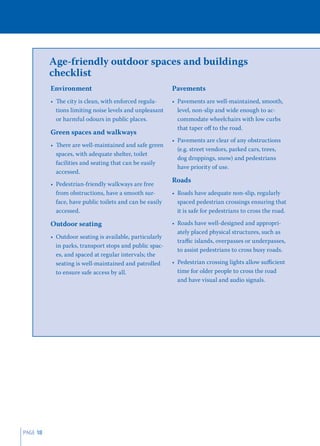
Age-friendly outdoor spaces and buildings
          checklist
          Environment                                     Pavements
          • The city is clean, with enforced regula-      • Pavements are well-maintained, smooth,
            tions limiting noise levels and unpleasant      level, non-slip and wide enough to ac-
            or harmful odours in public places.             commodate wheelchairs with low curbs
                                                            that taper off to the road.
          Green spaces and walkways
                                                          • Pavements are clear of any obstructions
          • There are well-maintained and safe green
                                                            (e.g. street vendors, parked cars, trees,
            spaces, with adequate shelter, toilet
                                                            dog droppings, snow) and pedestrians
            facilities and seating that can be easily
                                                            have priority of use.
            accessed.
                                                          Roads
          • Pedestrian-friendly walkways are free
            from obstructions, have a smooth sur-         • Roads have adequate non-slip, regularly
            face, have public toilets and can be easily     spaced pedestrian crossings ensuring that
            accessed.                                       it is safe for pedestrians to cross the road.

          Outdoor seating                                 • Roads have well-designed and appropri-
                                                            ately placed physical structures, such as
          • Outdoor seating is available, particularly
                                                            traffic islands, overpasses or underpasses,
            in parks, transport stops and public spac-
                                                            to assist pedestrians to cross busy roads.
            es, and spaced at regular intervals; the
            seating is well-maintained and patrolled      • Pedestrian crossing lights allow sufficient
            to ensure safe access by all.                   time for older people to cross the road
                                                            and have visual and audio signals.


PAGE 18
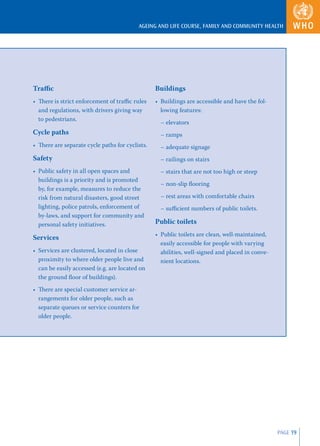
AGEING AND LIFE COURSE, FAMILY AND COMMUNITY HEALTH


Traffic                                            Buildings
• There is strict enforcement of traffic rules     • Buildings are accessible and have the fol-
  and regulations, with drivers giving way         lowing features:
  to pedestrians.
                                                   – elevators
Cycle paths                                        – ramps
• There are separate cycle paths for cyclists.     – adequate signage
Safety                                             – railings on stairs
• Public safety in all open spaces and             – stairs that are not too high or steep
  buildings is a priority and is promoted
                                                   – non-slip flooring
  by, for example, measures to reduce the
  risk from natural disasters, good street         – rest areas with comfortable chairs
  lighting, police patrols, enforcement of         – sufficient numbers of public toilets.
  by-laws, and support for community and
  personal safety initiatives.                   Public toilets
                                                 • Public toilets are clean, well-maintained,
Services
                                                   easily accessible for people with varying
• Services are clustered, located in close         abilities, well-signed and placed in conve-
  proximity to where older people live and         nient locations.
  can be easily accessed (e.g. are located on
  the ground floor of buildings).
• There are special customer service ar-
  rangements for older people, such as
  separate queues or service counters for
  older people.


                                                                                                 PAGE 19
Part 6. Transportation

          Overview of findings                               disabled or frail older people, taxis, and
                                                            personal drivers. Yet in cities at all stages of
          Transportation, including accessible and
                                                            development, there are gaps reported that
          affordable public transport, is a key factor
                                                            need to be addressed to make the commu-
          influencing active ageing. It is a theme run-
                                                            nity more age-friendly.
          ning through many other areas of discus-
          sion. In particular, being able to move           2. Affordability
          about the city determines social and civic
                                                            Cost is viewed as a significant factor affect-
          participation and access to community and
                                                            ing older people’s use of public transport.
          health services.
                                                            In some cities, free or subsidized public
          People consulted in the WHO project               transport for older people is said to be pro-
          therefore have a lot to say on the topic, cov-    vided. Geneva reportedly offers free trans-
          ering every aspect of infrastructure, equip-      port for someone accompanying an older
          ment and service for all means of urban           person, and in Dundalk, people 75 years
          transportation.                                   and older are entitled to a Companion Pass.
                                                            In some cities, however, the cost of public
            For many older people, their lives are guided   transport is considered to be too expensive.
            by the available transport system.              Older people in Nairobi complain about the
            Service provider, Dundalk                       arbitrary price increases charged because of
                                                            bad weather, public holidays and peak travel
                                                            periods. Difficulties getting subsidized or
          1. Availability
                                                            free fares are mentioned. In Himeji, it is
          Public transport services are said to be          said that the eligibility age for the com-
          available in almost all of the cities, although   plimentary pass is too high, while in New
          not in all areas. Cities in developed coun-       Delhi, the application process for conces-
          tries and those with a transition economy         sion travel is considered to be cumbersome.
          (e.g. the Russian Federation) are more            In Rio de Janeiro, free transport is not
          likely to indicate that their public transport    provided to the older people who live in the
          system is well-developed or satisfactory. A       favela, as public transport does not service
          range of transport services are available in      this area. In Geneva, discounted travel can
          many cities, including buses (private and         only be obtained if older people purchase a
          public), trains, trams, trolleybuses, rick-       railway season ticket. Subsidized fares can-
          shaws (private and public), shuttle buses
          and minibuses, community (voluntary)
          transport services, services specifically for


PAGE 20
AGEING AND LIFE COURSE, FAMILY AND COMMUNITY HEALTH


not be used for private transport services       In a few cities, such as Geneva, London,
in some cities, although in Dundalk, free        Moscow and Tokyo, people indicate that
travel passes are accepted on some private       their public transport services are reli-
bus services.                                    able but this is not always the case in other
                                                 similarly developed cities. This was not an
People in some cities suggest that free
                                                 age-friendly feature reported in develop-
transport or subsidized transport be
                                                 ing cities. In Amman, there is no fi xed
provided or extended for older people. In
                                                 timetable for the buses, and in Islamabad,
Mexico City, it is suggested that free trans-
                                                 there is no fi xed timetable for public service
port be provided for older people to attend
                                                 vehicles. In La Plata, the buses are unreli-
specific events.
                                                 able as the routes are often changed.
3. Reliability and frequency                     4. Travel destinations
Having frequent and reliable public trans-
                                                 The ability to use public transport depends
port services is identified as an age-friendly
                                                 very much on being able to get to where
feature. Some older people, especially in de-
                                                 you want to go. People in quite a few cities
veloped countries, indicate that the frequen-
                                                 state that their public transport services
cy of their city transport services is good.
                                                 provide good coverage of at least some ar-
Nevertheless, there are a number of reports      eas, enabling people to get to their desired
from cities at varying stages of develop-        destination. But concern is expressed in
ment that public transport services are not      other cities in both developed and develop-
frequent or reliable enough. In Istanbul,        ing countries about the adequacy of public
older people indicate that travelling by         transport routes; people complain that sev-
public transport takes a very long time          eral areas of the city are not covered, or it is
as it is not frequent. In Melbourne, some        difficult to cross the entire city, or there are
areas are said to have no bus service from       poor connections between buses and other
Saturday afternoon until Monday morning.         means of transport. In addition, important
In the Ruhr metropolitan area, older people      destinations of older people are not well-
consider that public transport to the outer      served. For instance, the bus in Dundalk
areas of the city and at night is not frequent   does not travel to one of the nursing homes,
enough. In some cities, it is suggested that     and in Mayaguez, there is limited transpor-
public transport be more frequent, particu-      tation to the seniors’ centres. In Tuymazy,
larly at night and at weekends.                  access by public transport to public gardens
                                                 is considered insufficient.


                                                                                                    PAGE 21
6. Specialized services for older
            The thing with public transit, there are big
                                                            people
            holes ... if you want to go downtown you’re
            in great shape, if you want to go across town   Older people who have difficulties using
            you’re going to have to struggle.               public transport need to have specially
            Older person, Portland                          adapted means of transport. These are
                                                            mentioned as an age-friendly feature in
                                                            some cities in developed countries, but in
          5. Age-friendly vehicles
                                                            others there are few such options available.
          Boarding and disembarking from vehicles is        Recommendations are made to provide
          another major issue raised. A number of cit-      services for people with disabilities. For
          ies are reported to have some public trans-       example, in Rio de Janeiro, caregivers men-
          port vehicles that are modified to provide         tion that taxis are the only available means
          easier access for older people: in Shanghai,      of transport for older people with disabili-
          modified seating is provided; in Saanich,          ties, but that their wheelchairs cannot fit
          there are some accessible buses; and in           into the boot of the vehicle because the
          Udaipur, a public bus service is starting soon    petrol tank is located there. In Mexico City,
          with low-floor buses. In Geneva, some buses        caregivers suggest the provision of adapted
          have raised platforms and low floors.              buses specifically for disabled people and
                                                            their caregivers.
          People commonly observe that the design
          of public transport vehicles presents barri-      7. Priority seating and passenger
          ers to older people. In Udine, for example,       courtesy
          the older people say that it is difficult to use
                                                            A few cities indicate that having priority
          buses owing to the high steps on the buses,
                                                            seating on public transport for older people
          and in Ponce, buses are not adapted for
                                                            is an age-friendly feature and in some cities,
          wheelchair access.
                                                            such as Islamabad, passengers do respect
          Residents in a small number of cities also        the priority seating for older people. This
          mention other features that discourage            courtesy is not common, however, and pub-
          the use of public transport. In New Delhi,        lic education on courtesy in public trans-
          older people point out that the bus route         portation is recommended by, for example,
          numbers are not clearly displayed on public       older people in Moscow.
          service buses. The service providers in
          Dundalk question the roadworthiness of            8. Transport drivers
          some buses, and in La Plata, older people         In some cities, courteous transport driv-
          express concern about the deteriorated            ers are described as an age-friendly feature
          condition of some buses.                          facilitating the use of public transport. In
                                                            many others, however, concern is expressed
                                                            about the insensitivity of drivers, particu-
                                                            larly bus drivers, towards older people.


PAGE 22
AGEING AND LIFE COURSE, FAMILY AND COMMUNITY HEALTH


One of the major concerns raised is that          A final issue identified in a few develop-
drivers do not wait for older people to be        ing cities is exploitation by drivers. For
seated before starting off.                        example, in New Delhi, some rickshaw
                                                  drivers overcharge their passengers, and in
  I can get on the bus but the minute the man     Nairobi, fares are changed very arbitrarily.
  takes off the bus rocks and I’m flat on my
  face.                                           Not surprisingly, in quite a few cities it is
                                                  suggested that drivers should be educated
  Older person, Saanich
                                                  to be sensitive to the needs of older people.
                                                  The driver training programme that has
In Rio de Janeiro, it is pointed out that         been implemented in Sherbrooke is regard-
many middle class older people take a taxi        ed as a benefit for older passengers.
or the metro rather than ride in a bus, be-
cause they are afraid of falling in a bus.        In a small number of cities, it is suggested
                                                  other transport staff, for example counter
A particular problem identified in devel-          staff, should also be educated about the
oping cities, such as Amman, is drivers’          needs of older people and how this affects
reluctance to pick up older people. In Delhi      their use of transport services.
and Geneva, older people highlight the
difficulties caused when bus drivers do not         9. Safety and comfort
stop close enough to the curb to enable
                                                  Whether or not people feel safe using pub-
them to get on and off the bus safely. People
                                                  lic transport has a significant effect on their
in Dundalk mention that bus drivers stop at
                                                  willingness to use these services. In a few
unmarked locations, which is often danger-
                                                  cities, it is reported that public transport is
ous, particularly at road corners. In Geneva
                                                  safe. In Cancún it was mentioned that there
and Ponce, some bus drivers are said to be
                                                  is less crime on public transport services
to be impolite.
                                                  than in other cities, and in Melbourne and
Other identified barriers include careless driv-   Moscow, public transport is deemed to be
ing and disregard for the rules of the road.      safe. Yet even in places where some people
                                                  consider public transport safe to use, for
  They drive like mad … with very loud music.     example London, it is still suggested that
                                                  steps be taken to further improve safety. In
  Older person, Mexico City                       the many cities where reservations about
                                                  the safety of public transport are expressed,
                                                  the issues are theft or antisocial behaviour.


                                                                                                    PAGE 23
10. Transport stops and stations
            The main problem is getting on and off the
            buses. Which of your pockets are you going        The design, location and condition of
            to control? While you are looking after your      transport stops and stations are significant
            pocket, you see that your purse has gone.         features as well. In Shanghai, older people
            Older person, Istanbul.                           and caregivers value the benches, shelter
                                                              and lighting provided at some transport
          In many cities, crowded public transport,           stops. In Ponce, the bus stops and terminal
          particularly during peak times (the “rush           are kept in good condition. In Portland,
          hour”), also presents safety issues for older       convenient access to transport stops is
          people. This problem is more commonly               viewed with satisfaction.
          identified in developing cities and in the           The location of transport stops presents
          Russian cities. For example, in Jamaica,            some difficulties for older people. Problems
          pushing and shoving is reported to be a             are encountered in Melbourne when there
          problem for older people at bus stops and           are few bus stops and the distance between
          on boarding buses. In Moscow, it is pointed         the stops is too great. In Melville, older
          out that crowding makes it difficult to               people express concern about having to
          breathe in the railway station.                     cross a major road to get to the bus stop. In
          A few developed cities, like Dundalk,               Saanich, some older people mention that
          Portland and Saanich, also mention dif-             bus stops are too far from their homes.
          ficulties related to overcrowded public              In some cities, there are issues of safety at
          transport.                                          transport stops. In Moscow, it is reported
                                                              that there are pickpockets in the crowds
            You can’t breathe on it [train from Dublin]. If   at the transport stops, and in Melbourne,
            you collapsed nobody would know – you’re
                                                              there are complaints about vandalism at
            wedged up!
                                                              bus stops. In Melville, a programme by
            Older person, Dundalk                             which children decorate bus stops is be-
                                                              lieved to have reduced vandalism.
          In Nairobi, older people note with satis-
                                                              In San José, the lack of shelter at transport
          faction that overcrowding problems have
                                                              stops is perceived as a disadvantage, as is
          significantly improved since the introduc-
                                                              the lack of seating at transport stops in
          tion of legislation, the Michuki Rules, to
                                                              Shanghai. In Tokyo, however, it is pointed
          ensure the required seating capacity is not
                                                              out that placing benches at bus stops makes
          exceeded. In Tuymazy, providing more
                                                              it difficult for people with disabilities to
          buses during peak times is suggested, while
                                                              walk around them, because the streets are
          in Saanich, it is recommended that older
                                                              very narrow.
          people be encouraged to use public trans-
          port outside peak times.


PAGE 24
AGEING AND LIFE COURSE, FAMILY AND COMMUNITY HEALTH


People in many cities consider that railway       12. Community transport
stations and bus terminals should be easy
                                                  The availability of community transport
to get to and should have an age-friendly
                                                  services (i.e. free transportation pro-
design with ramps, escalators, elevators,
                                                  vided by the voluntary or private sector)
public toilets and clearly visible signage. In
                                                  is considered to be an age-friendly service
Tokyo, older people and caregivers value
                                                  more often mentioned by people in devel-
the lift that was installed in the metro
                                                  oped than in developing cities. In Ponce,
station. In the Ruhr metropolitan region,
                                                  for example, there is free transportation
older people consider the lack of facilities
                                                  provided by seniors’ centres to attend medi-
as the main railway station to be a barrier
                                                  cal appointments, and in Portage la Prairie
to transporting luggage and wheelchairs
                                                  community volunteer drivers and the
up to the platforms. In New Delhi, older
                                                  shuttle service provided by grocery stores
people point out that the metro station is
                                                  are valued services. In London, a suggested
not located close to where they live and that
                                                  service is community transport with fully
signage at the station is inadequate.
                                                  accessible buses and drivers trained to
11. Taxis                                         serve older people.

Taxi services are viewed as an age-friendly       13. Information
transportation option in a number of cit-
                                                  In a few cities, there is mention of the
ies. In Cancún, taxis are considered to be
                                                  importance of having information on
affordable. In Dundalk, older people value
                                                  transport options, on how to use transport
the discounted fares provided by taxi
                                                  services, and on timetables. In Portland, for
services. In Melville, caregivers appreciate
                                                  example, programmes are provided to teach
the government subsidy scheme for the use
                                                  older people how to use public transport.
of taxis. In Halifax, it is said that some taxi
                                                  In Melville, it is suggested that older people
drivers are very helpful to older people, and
                                                  who can no longer drive be offered a course
in Tripoli, it is reported that taxis provide a
                                                  on how to use public transport. In Himeji,
good and convenient service.
                                                  it is suggested that bus timetables indicate
In other cities, barriers are identified in the    whether the bus is one that is accessible to
use of taxis. Cost is one barrier and lack of     people with disabilities. Older people in
disability access is another. In Portage la       Tokyo identify the need for timetables to be
Prairie, caregivers are concerned that taxi       in larger print and conveniently located.
drivers will not take wheelchair customers.
In Halifax, the design of the taxi is a prob-
lem because there is no room to transport a
walking frame. In Tuymazy, it is suggested
that taxis should have large boots to ac-
commodate wheelchairs.


                                                                                                   PAGE 25
14. Driving conditions                            traffic rules and regulations. For example,
                                                            in Rio de Janeiro, the heavy traffic is viewed
          Driving as an essential transportation op-
                                                            as a barrier. In Cancún the older people
          tion for older people is discussed in a few
                                                            complain that the roads have holes and are
          locations. For example, it is observed that
                                                            generally in a bad condition. In Melville,
          Melville is a city designed for cars, and in
                                                            concerns are raised about ineffective traf-
          Himeji, cars are considered a necessity in
                                                            fic calming devices such as roundabouts,
          the suburbs. In Ponce, cars are viewed as
                                                            which are either too small or are placed in
          necessary because of the limited transport
                                                            inappropriate places. In Mayaguez, older
          options available.
                                                            people report that streets are not well-lit. In
          People in a few cities indicate that it is easy   Halifax, the street signage is considered too
          to drive around the city, a feature more          small, too high and often obscured. Older
          likely to be mentioned by those in devel-         people in Udine report that drivers do not
          oped countries. In Portage la Prairie, the        respect traffic regulations. In Sherbrooke,
          traffic is said to be light and driving easy.       other drivers are said to be often aggressive.
          In Saanich, the older people appreciate the
          advance warnings of crossroads. In Tokyo,
                                                            15. Courtesy towards older drivers
          older people mention that the road signals        In addition to the barriers identified above,
          and signs are easy to see. The streets of         the disrespect shown to older drivers dis-
          Tripoli are considered to be well-marked,         courages a number of them.
          and in Shanghai, the traffic management is
          viewed as good.                                     I dislike driving. People curse you, make signs
                                                              at you if you go slow. They are impolite.
          People in many more cities in countries at
          all stages of development report barriers           Older person, Tripoli
          to city driving. These include heavy traffic,
          poor condition of roads, ineffective traffic         In La Plata, it is stated that older drivers
          calming devices, inadequate street light-         are abused because they drive too slowly.
          ing, inadequate signage that is obscured          In Cancún, older people feel unsafe when
          or poorly positioned, and the disregard for       driving owing to their own vision problems
                                                            and the aggressive traffic. In Tuymazy, ser-
                                                            vice providers comment that older people
                                                            are not confident driving on the roads.


PAGE 26
AGEING AND LIFE COURSE, FAMILY AND COMMUNITY HEALTH


                                                 In many cities, however, inadequate and
In some cities, such as Portage la Prairie,
                                                 costly parking facilities are identified as
where driving is an essential transport op-
                                                 barriers for older people. Other problems
tion, concerns are raised about the difficul-
                                                 are mentioned too. In Mayaguez, it is said
ties that older people face when giving up
                                                 that there are not enough drop-off and
their licences. To ensure older people are
                                                 pick-up points for older people with dis-
confident drivers, refresher courses are rec-
                                                 abilities, while in Portage la Prairie, it is
ommended in some cities such as including
                                                 pointed out that the parking bays are not
Geneva and Portland. The special lessons
                                                 wide enough for loading wheelchairs. In
given to older people in Himeji when they
                                                 Saanich, the lack of handicap parking bays
need to renew their licence is viewed as an
                                                 is raised as an issue. In Melbourne, con-
age-friendly advantage.
                                                 cern is expressed about the inability to
16. Parking                                      find parking close to buildings. One other
                                                 concern expressed is the lack of respect for
Priority parking bays for older and handi-       priority handicap parking bays.
capped people in close proximity to build-
ings, together with drop-off and pick-up            They make disabled bays that are totally and
bays, were seen as age-friendly features.          utterly ignored.
In Amman, older people value the bays
                                                   Older person, London
for the handicapped provided by stores. In
Dundalk, free parking is appreciated. In
Portage la Prairie, the large car park is con-
sidered an age-friendly asset for drivers.


                                                                                                  PAGE 27
Age-friendly transportation checklist

          Affordability                                   Specialized services
          • Public transportation is affordable to all    • Sufficient specialized transport services
            older people.                                  are available for people with disabilities.
          • Consistent and well-displayed transpor-      Priority seating
            tation rates are charged.
                                                         • Priority seating for older people is provid-
          Reliability and frequency                        ed, and is respected by other passengers.
          • Public transport is reliable and frequent    Transport drivers
            (including services at night and at week-
                                                         • Drivers are courteous, obey traffic rules,
            ends).
                                                           stop at designated transport stops, wait
          Travel destinations                              for passengers to be seated before driving
                                                           off, and park alongside the curb so that
          • Public transport is available for older
                                                           it is easier for older people to step off the
            people to reach key destinations such as
                                                           vehicle.
            hospitals, health centres, public parks,
            shopping centres, banks and seniors’         Safety and comfort
            centres.
                                                         • Public transport is safe from crime and is
          • All areas are well-serviced with adequate,     not overcrowded.
            well-connected transport routes within
            the city (including the outer areas) and     Transport stops and stations
            between neighbouring cities.                 • Designated transport stops are located
          • Transport routes are well-connected            in close proximity to where older people
            between the various transport options.         live, are provided with seating and with
                                                           shelter from the weather, are clean and
          Age-friendly vehicles                            safe, and are adequately lit.
          • Vehicles are accessible, with floors that     • Stations are accessible, with ramps, esca-
            lower, low steps, and wide and high seats.     lators, elevators, appropriate platforms,
          • Vehicles are clean and well-maintained.        public toilets, and legible and well-placed
                                                           signage.
          • Vehicles have clear signage indicating the
            vehicle number and destination.              • Transport stops and stations are easy to
                                                           access and are located conveniently.
                                                         • Station staff are courteous and helpful.


PAGE 28
AGEING AND LIFE COURSE, FAMILY AND COMMUNITY HEALTH


Information                                     • Roads are free of obstructions that might
                                                  block a driver’s vision.
• Information is provided to older people
  on how to use public transport and about      • The rules of the road are strictly enforced
  the range of transport options available.       and drivers are educated to follow the
                                                  rules.
• Timetables are legible and easy to access.
• Timetables clearly indicate the routes of
                                                Driving competence
  buses accessible to disabled people.          • Refresher driving courses are provided
                                                  and promoted.
Community transport
• Community transport services, including
                                                Parking
  volunteer drivers and shuttle services, are   • Affordable parking is available.
  available to take older people to specific
                                                • Priority parking bays are provided for
  events and places.
                                                  older people close to buildings and trans-
Taxis                                             port stops.

• Taxis are affordable, with discounts or        • Priority parking bays for disabled people
  subsidized taxi fares provided for older        are provided close to buildings and trans-
  people with low incomes.                        port stops, the use of which are moni-
                                                  tored.
• Taxis are comfortable and accessible,
  with room for wheelchairs and/or walk-        • Drop-off and pick-up bays close to build-
  ing frames.                                     ings and transport stops are provided for
                                                  handicapped and older people.
• Taxi drivers are courteous and helpful.

Roads
• Roads are well-maintained, wide and
  well-lit, have appropriately designed and
  placed traffic calming devices, have traffic
  signals and lights at intersections, have
  intersections that are clearly marked,
  have covered drains, and have consistent,
  clearly visible and well-placed signage.
• The traffic flow is well-regulated.


                                                                                                PAGE 29
Part 7. Housing

          Overview of findings                               For example, in Geneva it is reported that
                                                            some older people are living in houses that
          Housing is essential to safety and well-be-
                                                            are too big for them but, because they are
          ing. Not surprisingly, people consulted
                                                            pensioners, they cannot afford to move.
          by WHO in all regions have much to say
                                                            Similarly, in Tuymazy, it is stated that the
          on different aspects of housing structure,
                                                            cost of moving house is too expensive and
          design, location and choice. There is a link
                                                            not possible for retirees. Free or low-cost
          between appropriate housing and access to
                                                            public housing is regarded as a definite age-
          community and social services in influenc-
                                                            friendly advantage in some cities, such as
          ing the independence and quality of life of
                                                            London. In other cities, such as Islamabad,
          older people. It is clear that housing and
                                                            the lack of low-income housing is seen as
          support that allow older people to age com-
                                                            a barrier. The need to have information
          fortably and safely within the community
                                                            about subsidized housing is highlighted in
          to which they belong are universally valued.
                                                            Portage la Prairie.
          1. Affordability
                                                              I’ve got a terraced house, council, rent-free.
          There is general agreement among the cities         I love it.
          that the cost of housing is a major factor
          influencing where older people live and their        Older person, London
          quality of life. While in some cities the cost
          of housing, including rent, is considered to      In cities in countries at all stages of devel-
          be affordable, in others housing is regarded       opment, it is recommended that affordable
          as expensive, making it difficult for older         housing be available for older person. Ideas
          people to move to more appropriate housing.       include a lower level of tax on housing for
                                                            older people in Amman, and having a hous-
            I have my retirement salary but how can I       ing subsidy for public and private housing
            live with this little money? It comes into my   in Himeji.
            house and it goes away in a few seconds.

            Older person, Istanbul


PAGE 30
AGEING AND LIFE COURSE, FAMILY AND COMMUNITY HEALTH


2. Essential services                               has even surfaces; has an elevator if it is
                                                    multi-level accommodation; has appropri-
In a small number of cities, essential ser-
                                                    ate bathroom and kitchen facilities; is large
vices are found to be inadequate or very
                                                    enough to move about in; has adequate
expensive. In Islamabad, houses in low-
                                                    storage space; has passages and doorways
income areas have no electricity, gas or
                                                    large enough to accommodate a wheelchair;
water supply. In Moscow, the public utility
                                                    and is appropriately equipped to meet the
services are considered to be expensive.
                                                    ambient environmental conditions.
In Dundalk and Istanbul, older people are
concerned by the high costs of heating and          Problems with housing construction are
think that the government should assist             mentioned in a few cities. In Mexico City,
with heating costs. In Jamaica, older people        people identify the need for supervised
on a low income find it difficult to pay the           construction to ensure that the housing is
high utility costs and suggest that these           structurally sound. Poverty is said to result
costs should be reduced.                            in poorly constructed or maintained hous-
                                                    ing in Istanbul, and in Nairobi, the lack of
  When they send me the water bill it costs         available construction materials is a source
  me $1000. I can’t afford it so I don’t use the    of concern. In Islamabad, some housing is
  shower and sometimes there is no water.
                                                    not earthquake-proof.
  Older person, Jamaica
                                                    A number of structural features are identi-
                                                    fied as barriers. Home layout that impedes
In Rio de Janeiro, older people value the im-
                                                    mobility is a problem identified in Dundalk.
provements that have been made in water,
                                                    In La Plata, stairs and uneven floors are ex-
sanitation and electricity services, and in
                                                    perienced as barriers. In Moscow, the need
Istanbul, the older people appreciate the
                                                    for purpose-built bathrooms and toilets for
good water supply.
                                                    older people is reported. In New Delhi, it is
3. Design                                           considered that kitchens need to be better
                                                    designed. In Mexico City, the need to have
Several aspects of housing design are con-          railings and elevators in multi-level build-
sidered to affect the ability of older people        ings is mentioned, and people in Tokyo
to live comfortably at home. In general, it         point out the need for passages and door-
is considered important for older people to         ways to accommodate wheelchairs.
live in accommodation that is built from
adequate materials and structurally sound;          In a small number of cities, housing is not
                                                    appropriately equipped for the weather
                                                    conditions. In particular, air-conditioning
                                                    is a reported need in Cancún and in some
                                                    areas of Melville, where the roof design of
                                                    new houses makes it hotter inside.


                                                                                                    PAGE 31
In many cities, there is recognition of the     A number of difficulties are identified in
          measures that have been taken to improve        relation to home modifications. In Halifax,
          housing design to accommodate older             retrofitting a home is considered to be ex-
          people. In Mexico City, for example, 1% of      pensive and difficult. Restrictions on the re-
          all houses built must be suitable for older     modelling of public housing are mentioned
          people. In Halifax, some condominiums           in Himeji and New Delhi. In Portland,
          are age-friendly and have access ramps,         rented accommodation that has been
          elevators, parking, gym facilities and wide     remodelled is required to be returned to its
          doorways.                                       original state. In Melbourne, it is pointed
                                                          out that assistance equipment is not used
          Nevertheless, people frequently feel that
                                                          because it does not fit into the home and
          more needs to be done to ensure housing
                                                          many caregivers are unable to afford the
          is appropriate for older people. In Himeji,
                                                          necessary renovations. In Sherbrooke, the
          more age-friendly housing is recom-
                                                          need to adapt housing for specific condi-
          mended, while in Melbourne, incentives to
                                                          tions is mentioned.
          encourage architects and property develop-
          ers to build age-friendly housing are sug-      Besides identifying the need to ensure older
          gested. People in New Delhi recommend           people are aware of the possible options
          that age-friendly features be incorporated      for modifying their homes, it is suggested
          into building by-laws. In Saanich, builders     in many cities that older people need to
          include adapted or adaptable features into      be able to obtain the necessary equip-
          their plans, such as lower placement of light   ment. In Tuymazy, caregivers identify their
          switches, installation of showers rather        need for information on different types of
          than bathtubs, and stairways that can be        equipment and possible adaptations and
          converted to accommodate a chairlift.           on equipment that is easy to obtain. In
                                                          Udaipur, difficulties in obtaining hand rails,
          4. Modifications                                 ramps and toilets are mentioned.
          The ability to modify one’s house or
                                                          5. Maintenance
          apartment also affects the ability of older
          people to continue to live comfortably at       Being unable to maintain one’s home is as
          home. Caregivers in Dundalk appreciate          a major barrier for some older people. In
          the chairlifts that were installed to assist    Cancún, older people say they are unable
          older people. In Mayaguez, apartments for       to make repairs owing to the cost involved.
          disabled older people have the adaptations      In Melbourne, they are likewise concerned
          required. In a small number of cities, such     about costs of maintenance and suggest
          as Himeji and Dundalk, financial assistance      that the local municipality provide a home
          is provided for home modifications.              maintenance service for a nominal fee. In
                                                          Rio de Janeiro, the high cost of condomin-
                                                          ium maintenance fees is considered to be a


PAGE 32
AGEING AND LIFE COURSE, FAMILY AND COMMUNITY HEALTH


barrier, although it is pointed out that it is    mentioned the importance of the concierge
possible to sublet condominiums to assist         in establishing contact among residents and
with the cost of the maintenance fees.            taking care of repairs.

In Dundalk, the older people value the            6. Access to services
grants provided for home repairs but com-
                                                  The provision of services to older people
plain about difficulties in organizing the
                                                  in their homes is particularly important.
service people to undertake the repairs.
                                                  In Udine, it is stated that older people do
                                                  not consider moving house. In Tuymazy,
  Went away in the middle of it and didn’t
                                                  the service providers similarly indicate
  come back for months to finish it.
                                                  that older people are very attached to
  Older person, Dundalk                           their homes and do not want to move. In
                                                  Saanich, receiving home assistance is con-
In Melville, concern is raised about hav-         sidered preferable to moving house.
ing strangers coming into the home to do
maintenance work, and it is suggested that        In a few cities, difficulty in obtaining
the local municipality maintain a list of de-     services at home, including their cost, is
pendable repair services that are prepared        considered a disadvantage. In the Ruhr
to deal with older people. In Portland,           metropolitan region, services such as clean-
caregivers appreciate the system used for         ing and gardening are seen to be scarce and
screening contractors and other repair and        expensive. Older people in Saanich report
maintenance services.                             that there are not enough cleaning and
                                                  gardening services available.
Problems are also identified regarding the
maintenance provided in public housing            Living close to services and facilities is also
and rented accommodation. In London,              seen as an age-friendly feature. This is more
concern is raised about repairs not being         commonly mentioned by people in cities
done in a timely manner. In Tripoli, older        in developed countries, such as Melville,
people indicate that landlords purposely          Portage La Prairie and Tokyo. In San José,
neglect maintenance so that the older             older people valued living in close proximity
people leave. In Delhi, it is reported that       to public, commercial and religious ser-
common areas like staircases are often            vices. In a number of cities, such as Nairobi,
neglected, dirty and dark.                        Udaipur and Udine, not living in close prox-
                                                  imity to such services is seen as a problem.
Nevertheless, staff in collective dwellings,
such as concierges and caretakers, some-
times play an important role in ensuring
well-being. In Geneva, the older people


                                                                                                    PAGE 33
Nevertheless, caution is also expressed         the lack of contact with younger people in
          about remaining at home and being unable        apartment buildings is seen as a disadvan-
          to look after oneself adequately. In Mexico     tage. In Udaipur, caregivers are concerned
          City, the need to educate older people about    that modern flats without front verandas
          the risks of living at home is raised, and in   leave no room for community interaction.
          Saanich, the idea is advanced on provid-        The importance of design that facilitates
          ing information on home services for older      community interaction is mentioned in
          people by publishing a directory of home        Dundalk as well, where it is suggested that
          support services                                houses should overlook communal facilities
                                                          to reduce the sense of isolation.
          7. Community and family
          connections                                     8. Housing options
          Familiar surroundings, whereby people feel      A range of housing options in the local area
          part of the local community, contribute         to accommodate changing needs is regard-
          to the age-friendliness of a city. For this     ed as an important age-friendly feature.
          reason, older people are reluctant to move.     In some cities, there are a number of such
          In Udine, older people mention they have        housing options. In Melville, for example,
          a kind of “psychological safety” in their       older people have the choice of moving into
          environment. In Tripoli, older people high-     smaller accommodation, seniors’ housing
          light the importance of their neighbours. In    or care facilities. In many locations, how-
          Dundalk, service providers recognize the        ever, the need for more housing options
          need to locate new homes close to where         for older people is stressed. In Halifax, for
          older people have lived in order to retain      example, it was mentioned that some older
          links with family and the community. In         people were concerned about not being able
          Himeji, concern is expressed that older         to find accommodation in their local area
          people lose their connection with the com-      and did not have good knowledge about the
          munity when they move to another facility.      housing options in their area.

          Changes to the city affect these feelings of     In some cities, dedicated seniors’ housing
          familiarity with the community. In Tokyo,       options are provided. In Melville, seniors’
          the lack of personal contact with neigh-        housing complexes provide a range of ser-
          bours that results from the development of      vices, amenities and activities.
          high-rise buildings is regarded as an age-
          friendly barrier. In Sherbrooke, older people     You've got a lot of social activities, you can
          express concern about the lack of multigen-       be busy the whole time or you can just close
          erational spaces for interaction. In Geneva,      your door and not join in, it's your choice.

                                                            Older person, Melville


PAGE 34
AGEING AND LIFE COURSE, FAMILY AND COMMUNITY HEALTH


Dedicated seniors’ housing seems to be in       Feeling safe in the home environment is
short supply in many cities and waiting         another theme. In many cities, older people
times can be long, as mentioned in Halifax      feel insecure and particularly fear living
and Himeji. Seniors’ housing also needs         alone. Measures have been taken in some
to be affordable to be age-friendly. Older       cities to improve the security in older
people in Saanich express concern about         people’s homes. In Dundalk, for example,
the cost of seniors’ housing. There is also a   surveillance cameras are used in some
clearly expressed preference in a few cities    homes; in Geneva, there is secure access
for seniors’ housing to be integrated into      to apartment buildings; in Saanich, older
the local community. In Melville, it is sug-    people are provided with free home secu-
gested that small clusters of seniors’ hous-    rity checks; and in Shanghai, there is a local
ing with small gardens be made available        security patrol. In Himeji, some apartments
throughout the city, so that older people       have emergency call monitoring devices to
are not isolated from the community and         keep older people safe.
particularly from children. In Portland,
                                                Nevertheless, there is an expressed need for
the need for multigenerational housing is
                                                more to be done to ensure that older people
identified. In the Ruhr metropolitan region
                                                feel secure at home. In Udaipur, more
and Sherbrooke, concern is expressed about
                                                information about home security is recom-
creating ghettos of older people in large
                                                mended, and in Saanich, it is suggested that
seniors’ housing complexes.
                                                emergency alarms be installed.
9. Living environment
                                                In some cities, the homes of older people
It is important for older people to have        are not located in environments that are
sufficient space and privacy at home.             safe from natural disasters. In La Plata,
In a handful of developing cities and in        some homes are in flood-prone areas, and
Tuymazy, overcrowding is identified as a         in Islamabad, older people are concerned
barrier for older people. In Delhi, for exam-   about earthquakes.
ple, as the average family size has increased
houses have become overcrowded and older
people do not have sufficient space. In San
José, overcrowding has resulted from the
high housing costs that forces family mem-
bers to live together.


                                                                                                 PAGE 35
Age-friendly housing checklist

          Affordability                                  Modifications
          • Affordable housing is available for all      • Housing is modified for older people as
            older people.                                 needed.

          Essential services                            • Housing modifications are affordable.

          • Essential services are provided that are    • Equipment for housing modifications is
            affordable to all.                             readily available.

          Design                                        • Financial assistance is provided for home
                                                          modifications.
          • Housing is made of appropriate materials
            and well-structured.                        • There is a good understanding of how
                                                          housing can be modified to meet the
          • There is sufficient space to enable older       needs of older people.
            people to move around freely.
                                                        Maintenance
          • Housing is appropriately equipped to
            meet environmental conditions (e.g. ap-     • Maintenance services are affordable for
            propriate air-conditioning or heating).       older people.

          • Housing is adapted for older people, with   • There are appropriately qualified and
            even surfaces, passages wide enough for       reliable service providers to undertake
            wheelchairs, and appropriately designed       maintenance work.
            bathrooms, toilets and kitchens.            • Public housing, rented accommodation
                                                          and common areas are well-maintained.


PAGE 36
AGEING AND LIFE COURSE, FAMILY AND COMMUNITY HEALTH


Ageing in place                                 • Sufficient and affordable housing dedicat-
                                                  ed to older people is provided in the local
• Housing is located close to services and
                                                  area.
  facilities.
                                                • There is a range of appropriate services
• Affordable services are provided to en-
                                                  and appropriate amenities and activities
  able older people to remain at home, to
                                                  in older people’s housing facilities.
  “age in place”.
                                                • Older people’s housing is integrated in
• Older people are well-informed of the
                                                  the surrounding community.
  services available to help them age in
  place.                                        Living environment
Community integration                           • Housing is not overcrowded.

• Housing design facilitates continued          • Older people are comfortable in their
  integration of older people into the com-       housing environment.
  munity.                                       • Housing is not located in areas prone to
Housing options                                   natural disasters.

• A range of appropriate and affordable          • Older people feel safe in the environment
  housing options is available for older          they live in.
  people, including frail and disabled older    • Financial assistance is provided for hous-
  people, in the local area.                      ing security measures.
• Older people are well-informed of the
  available housing options.


                                                                                                PAGE 37
Part 8. Social participation

          Overview of findings                               mobility issues, is important everywhere,
                                                            and even more so in developing countries
          Social participation and social support
                                                            and those with economies in transition.
          are strongly connected to good health and
          well-being throughout life. Participating in      1. Accessible opportunities
          leisure, social, cultural and spiritual activi-
                                                            Older people may be aware of events and
          ties in the community, as well as with the
                                                            activities that exist in their community, but
          family, allows older people to continue to
                                                            in the experience of many participants in
          exercise their competence, to enjoy respect
                                                            the project these activities are inaccessible.
          and esteem, and to maintain or establish
                                                            Personal safety, particularly at night, is
          supportive and caring relationships. It
                                                            mentioned as one barrier in both developed
          fosters social integration and is the key
                                                            and developing cities, including Halifax,
          to staying informed. Yet the older people
                                                            La Plata, London and Rio de Janeiro. In
          consulted by WHO indicate clearly that the
                                                            many cities, the locations are too distant
          capacity to participate in formal and infor-
                                                            and transportation is difficult. Another
          mal social life depends not only on the offer
                                                            common problem is the accessibility of the
          of activities, but also on having adequate
                                                            buildings, especially for people with im-
          access to transportation and facilities and
                                                            paired mobility, and the lack of adequate
          on getting information about activities.
                                                            facilities such as toilets, appropriate seating
                                                            or smoke-free air. Another barrier men-
            When I see my group colleagues, I feel very
            well.                                           tioned is restricted admission, such as the
                                                            requirement to be a member of an organi-
            Older person, Mexico City                       zation.

          In most cities, older people report that they       They [older people with disabilities] find
          participate actively in their communities           it difficult to adjust as there are no proper
          but feel there could be more possibilities          arrangements for their sitting, toilet, etc.
          for participation. They suggest having more         Recreation for most of them would be talk-
          and varied activities closer to where they          ing to their friends or relatives on the phone
                                                              or occasional visits.
          live. They would like activities that foster
          integration within the community and with           Caregiver, New Delhi
          other age groups and cultures. The biggest
          concerns are affordability and accessibility,      Efforts in several cities to accommodate
          especially for people with disabilities, and      older people are recognized by the older
          awareness of activities and events. Having        people themselves and those who interact
          appropriate support in place to enable
          accessibility, particularly for people with


PAGE 38
AGEING AND LIFE COURSE, FAMILY AND COMMUNITY HEALTH


with them. The municipal government in            fewer opportunities exist for people who
Mayaguez reportedly organizes a variety of        live outside those centres. There may also
activities at hours that are suitable for older   be fewer options for people who are frail
people and provides transportation. An            or disabled. Sometimes the schedules of
older person in Geneva notes that ameni-          activities are rigid and older people need
ties are provided for people who are hard         to make a choice between meeting their
of hearing. The availability of community         personal needs, such as a regular nap in the
transport is reported from both Melbourne         afternoon, and participating in an activ-
and Melville, conveniently located activi-        ity. Locations where activities do occur
ties from Portland, and convenient tim-           may not appeal to older people because of
ing of events and activities from Tripoli.        noise levels or an emphasis on youth pro-
Participants in Dundalk suggest that allow-       grammes. A variety of both targeted and
ing older people to bring a friend to events      integrated activities provides a broad and
would help them participate.                      diverse range of choice for more people.
                                                  The range can include organized events
2. Affordable activities                           such as those in Himeiji, which are tar-
Activities that are free or at least af-          geted to people over 80. In Jamaica, older
fordable facilitate participation by older        people mention sporting events in which
adults. The cost of activities is a frequently    older people can compete at various levels.
mentioned problem, especially in cities           Portage La Prairie offers communal meals
in developing countries and those with            and social contact as part of the attrac-
economies in transition. In some areas,           tion. Outdoor activities, such as a walk in a
a variety of options exist only for people        garden in Nairobi and a fine-weather stroll
with adequate incomes, and recreation             in Moscow, are seen as simple and low cost
and leisure activities are only available to      ways of encouraging social participation
the rich. Participants in Islamabad note,
                                                  It is reported from Udine that buildings are
however, that participation in activities is
                                                  offered to older people for activities such
affordable. Rio de Janeiro offers many free
                                                  as theatre, clubs, and Third Age University.
leisure activities, and Mexico City has free
                                                  In Tuymazy, there is a chess club, a histori-
or low-cost cultural events. In Dundalk,
                                                  cal re-enactment society and a club for the
Geneva and London, it is mentioned that
                                                  over-60s. Participants from Cancún say
because of high insurance costs, non-profit
                                                  they enjoy a “golden age” club, craft classes
organizations are obliged to charge prices
                                                  at the local monastery, and talks, music and
for activities that they know may discour-
                                                  dancing. All of the larger cities in the devel-
age participation.
                                                  oped regions, and the majority of cities in
3. Range of opportunities                         the developing countries, are said to offer a
                                                  variety of activities.
The existence of a variety of opportunities
that interest a broad range of older people
encourages more participation. Many cities
offer activities in major urban centres, but


                                                                                                    PAGE 39
Religious activities and socializing within
                                                             I think where it falls down is on awareness
          faith communities is an important form
                                                             – people knowing about what options are
          of participation for older people in most of
                                                             out there.
          the cities. Older people may be well-known
          and esteemed within their local faith com-         Service provider, Saanich
          munity. These communities are usually
          welcoming and inclusive too, facilitating        In Dundalk, it is reported that organiza-
          participation by people who may be at risk       tions promote their activities by sending in-
          of becoming isolated. It is reported from        formation to older people before they retire.
          Halifax, for example, that churches contrib-     People who attend religious services and
          ute to older people’s lives through activities   other scheduled activities regularly tend to
          such as card games, group meals, drives to       hear about other activities through word of
          church, and outreach to isolated people. In      mouth. In San José, occupational associa-
          Islamabad, it is noted that going to mosque      tions promote their activities. A service
          more than once a day contributes to social       provider in Shanghai suggests more older
          participation.                                   people can be engaged if there is enough
                                                           publicity to attract participants.
            At church we are listened to because of our
            experience. People look up to us.              5. Encouraging participation and
                                                           addressing isolation
            Older person, Jamaica
                                                           A consistent message from cities around
                                                           the world is that social participation is
          Cultural, educational and traditional activi-
                                                           easier when the opportunities are close to
          ties also remain important to older people
                                                           home and there are many of them. People
          in many locations. Continuing education
                                                           in La Plata are dissatisfied with the lack
          through Third Age Universities or through
                                                           of community centres in all neighbour-
          courses at local community or seniors’
                                                           hoods, and in Udaipur, it is suggested that
          centres provides ongoing engagement and
                                                           community centres be provided within
          learning. Going to weddings and funerals
                                                           distances that are walkable for older people.
          are opportunities to socialize. Older people
                                                           Participants in Dundalk and Shanghai
          in Islamabad report enjoying frequent tra-
                                                           advise using facilities in the community,
          ditional events such as weddings.
                                                           such as schools and recreation centres,
          4. Awareness of activities and events            for all community members, including
                                                           older people. This suggestion is echoed in
          Several participants point out that older
                                                           Islamabad: a greater variety of leisure time
          people need to know about activities and
                                                           activities in more locations.
          opportunities in order to participate.


PAGE 40
AGEING AND LIFE COURSE, FAMILY AND COMMUNITY HEALTH


Concerted efforts to encourage and mo-
                                                      I think there are lots of opportunities if
tivate older people to participate can
                                                      people are connected and have someone to
sometimes make the difference between
                                                      go with, but I think we can hear from the
participation and isolation. Many people              lonely people and the marginalized through
who are involved with groups and clubs for            organizations to rebuild social networks or
older people are very satisfied with their             make some connections.
activities. However, some people express
                                                      Service provider, Halifax
reluctance to join associations and clubs
for a variety of reasons: they may not know
                                                    Caregivers, many of whom are older people
anyone, they may feel that they have to as-
                                                    themselves, are particularly vulnerable to
sociate with a particular political view, or
                                                    feeling isolated because their world is so
they find that the activities of that club are
                                                    centred on the person for whom they care.
not appealing.
                                                    Participants suggest more programmes and
                                                    options whereby older people with disabili-
  Older people are reluctant to do anything.
                                                    ties can socialize outside the home without
  Many were asked to join the club and
  refused.                                          requiring the presence of their caregiver.
                                                    Provision of day programmes and respite
  Service provider, Himeji                          options are suggested as ways of helping
                                                    older caregivers and their charges to con-
Various reasons are given to explain why            tinue to connect with society.
isolated older people find it more difficult
to associate with others. Their social con-           Few men participate; they do not accept
tacts have become eroded after the death              their age and/or they feel uncomfortable sur-
of their spouse and then gradually other              rounded by so many women.
family members and friends. Their health
                                                      Older person, Cancún
may be declining, limiting their ability to
participate. Owing to societal changes,
                                                    The lack of social participation by men is
more women are in the workforce and
                                                    raised in several cities, including Cancún
are therefore not at home during the day
                                                    and Geneva. In some cities, nevertheless,
to visit older people. Outreach to isolated
                                                    there are activities intended to appeal to
older people in their homes provides a
                                                    men: in Melville, for example, there is a
social connection and a way of encouraging
                                                    “Men’s Shed” offering activities for men of
them to participate. In both Melbourne and
                                                    various ages. Older people in Istanbul men-
Shanghai, it is reported that organizations
                                                    tion that mosques are good places for men
take the initiative to seek out older people
                                                    to participate in society. Participants in
and invite them to activities.
                                                    Mexico City suggest more activities specifi-
                                                    cally for men, such as workshops or playing
                                                    dominos or cards.


                                                                                                      PAGE 41
Some older people choose not to participate,     If older people are unable to participate in
          and respect for those who prefer to disen-       activities outside of their homes, watching
          gage is advised by participants in Portland.     television remains their only source of lei-
                                                           sure and connection with society. The need
          6. Integrating generations, cultures             to integrate options for all generations and
          and communities                                  ages is reflected in the concerns of older
          Older people want opportunities to social-       people in some cities about the poor range
          ize and integrate with other age groups and      of programming choices available on televi-
          cultures in their communities, activities        sion, with little that appeals to them.
          and families.
                                                             TV viewing is one option, but the kinds of
            Older people feel they can participate in        programmes that are being dished out these
            different areas and with people of all ages,     days on TV are not meant for family audi-
            depending on the personal initiative and         ences.
            desire.
                                                             Older person, Udaipur
            La Plata, Argentina
                                                           Older people in many areas want to partici-
          Intergenerational activities are considered      pate in their families in a meaningful way.
          to be more desirable than activities for         In Amman, for example, older people state
          older people alone. These opportunities can      that they do not want to be isolated from
          be provided by sharing spaces and facili-        their families. However, families may not
          ties, such as in Saanich, where a seniors’       give enough consideration to older people,
          centre is located in an unused part of an        especially if there are expectations for
          elementary school. In Ponce, some activi-        grandparents to care for grandchildren or
          ties involve older people in school settings.    if there is little time to devote to activities
          Programmes provided at community and             with or for an older family member.
          recreation centres are suggested for encour-
                                                           Better integration of generations is seen as
          aging participation by people of different
                                                           a way to counter ageism in society, which
          ages and levels of ability.
                                                           can also mar older people’s experience
                                                           when participating, or even discourage
                                                           their participation. Older people express
                                                           the desire for more public education about
                                                           their experiences and the reality of aging,
                                                           and consider that other generations would
                                                           be more patient and respectful if they un-
                                                           derstood each other better.


PAGE 42
AGEING AND LIFE COURSE, FAMILY AND COMMUNITY HEALTH


Intergenerational opportunities enrich the           An open and welcoming neighbourhood
experience for all ages. Older people pass           in the Ruhr metropolitan region pro-
on traditional practices and knowledge and           vides a basis for newcomers to integrate.
experiences, while younger people offer               Newcomers in cities around the world are
information about newer practices and help           at risk of becoming isolated, and older
older people navigate in a rapidly chang-            people in this project recognize the need
ing society. Older people in Nairobi are             to better integrate their activities to en-
engaged in traditional dances and skills,            courage more participation by people from
enabling them to pass that knowledge to              other places and cultures.
others.
                                                       I wish there were a way to foster more mul-
 [Older people] are a source of “lived tradi-          ticultural community activities in neighbour-
 tion”.                                                hoods where there’s a diverse population.

 Caregiver, Nairobi                                    Older person, Portland


The constitution and design of a neigh-
                                                       The solution must be for older residents to
bourhood can encourage the integration of
                                                       strive to accept new residents as their com-
people from various backgrounds, ages and              panions. Also, it will be good for neighbours
cultures. Many neighbourhoods in cities                to exchange greetings among themselves.
around the world are changing. Younger
                                                       Older person, Tokyo
people may not live in the same neigh-
bourhood as their older family members.
People may not have the same neighbours
throughout their lifetimes, and many cities
have growing populations of immigrants
who may not share the same language and
background as the majority population.

 Villages became empty. They moved to the
 cities. Now the villagers become older in
 cities.

 Older person, Istanbul


                                                                                                       PAGE 43
Age-friendly social participation checklist

          Accessibility of events and activities                 recreation centres, schools, libraries, com-
                                                                 munity centres in residential neighbour-
          • The location is convenient to older people in
                                                                 hoods, parks and gardens.
            their neighbourhoods, with affordable, flex-
            ible transportation.                               • Facilities are accessible and equipped to en-
                                                                 able participation by people with disabilities
          • Older people have the option of participat-
                                                                 or by those who require care.
            ing with a friend or caregiver.
          • Times of events are convenient for older
                                                               Promotion and awareness of activities
            people during the day.                             • Activities and events are well-communi-
          • Admission to an event is open (e.g. no               cated to older people, including informa-
            membership required) and admission, such             tion about the activity, its accessibility and
            as ticket purchasing, is a quick, one-stop           transportation options.
            process that does not require older people to      Addressing isolation
            queue for a long time.
                                                               • Personal invitations are sent to promote
          Affordability                                           activities and encourage participation.
          • Events and activities and local attractions        • Events are easy to attend, and no special
            are affordable for older participants, with no        skills (including literacy) are required.
            hidden or additional costs (such as transpor-
                                                               • A club member who no longer attends
            tation costs).
                                                                 activities is kept on the club’s mailing and
          • Voluntary organizations are supported by             telephone lists unless the member asks to be
            the public and private sectors to keep the           taken off.
            costs of activities for older people affordable.
                                                               • Organizations make efforts to engage iso-
          Range of events and activities                         lated seniors through, for example, personal
                                                                 visits or telephone calls.
          • A wide variety of activities is available to ap-
            peal to a diverse population of older people,      Fostering community integration
            each of whom has many potential interests.
                                                               • Community facilities promote shared and
          • Community activities encourage the partici-          multipurpose use by people of different ages
            pation of people of different ages and cul-           and interests and foster interaction among
            tural backgrounds                                    user groups.

          Facilities and settings                              • Local gathering places and activities pro-
                                                                 mote familiarity and exchange among
          • Gatherings, including older people, occur
                                                                 neighbourhood residents.
            in a variety of community locations, such as


PAGE 44
AGEING AND LIFE COURSE, FAMILY AND COMMUNITY HEALTH


Part 9. Respect and social inclusion

Overview of findings
                                                     You walk down the street and people smile
Older people report experiencing conflict-            at you, you go into a shop and you’re served,
ing types of behaviour and attitudes towards         the kids even say hello to you even if they
them. On the one hand, many feel they are            don’t know you.
often respected, recognized and included,            Older person, Melbourne
while on the other, they experience lack of
consideration in the community, in services        In Jamaica and in Ponce, for example,
and in the family. This clash is explained in      older people feel they are given priority
terms of a changing society and behavioural        service in businesses and public places.
norms, lack of contact between generations,        In Islamabad and Moscow, it is said that
and widespread ignorance about ageing and          people give up their seats on buses to older
older people. It is clear from the consulta-       adults. Examples of age-friendly services
tion that the respect and social inclusion of      are mentioned in some cities: in Portage
older people depend on more than societal          la Prairie, ballot papers are taken to the
change: factors such as culture, gender,           homes of older people who are unable to go
health status and economic status play a           to polling stations, and headsets are pro-
large role. The extent to which older people       vided in churches for people with hearing
participate in the social, civic and economic      impairments. In Mexico City, there is men-
life of the city is also closely linked to their   tion of a bank whose employees are trained
experience of inclusion.                           to treat older people well, and at the end
                                                   of each month time is reserved exclusively
1. Respectful and disrespectful
behaviour                                          to serve older people. It is also reported
                                                   that in some businesses in Jamaica, older
Project participants primarily comment on          people can sit and wait to be served directly
the behaviour of people towards them that          by employees assigned to the sitting areas.
shows respect and courtesy, or the oppo-           Also, in Tokyo, older people note that busi-
site. As a whole, older people are respected       nesses treat them well because most cus-
in the cities that have been studied: most         tomers are older. In addition, older people
of the older people and other participants         feel particularly respected and included in
in the focus groups recall the respect and         seniors’ clubs. It is also noted that when
kindness expressed in everyday life towards        older people themselves are respectful
older adults.                                      and pleasant, they often receive the same
                                                   response from others.


                                                                                                     PAGE 45
Nevertheless, participants in several cit-
                                                              Some old people keep going from one office
          ies also report disrespectful behaviour
                                                              to another without getting the information
          towards older people. People are seen to
                                                              they are looking for because nobody takes
          be impatient with older people who are              time and has the courtesy to listen to them.
          slower doing things, and rude gestures are
          made towards older drivers. In Sherbrooke,          Service provider, Mayaguez
          they feel they are treated like children.
          Older adults in Amman also feel they are          Suggestions for promoting age-friendly
          criticized by young people for their dif-         services focus on training service providers
          ferent clothes and way of talking. Some           to understand how they can better respond
          young people are said to lack good man-           to the needs of older people.
          ners (Tokyo and Udine), not to give up their
                                                            2. Ageism and ignorance
          seats on buses (Portland) and to be verbally
          or physically aggressive towards older            In a society that glorifies youth and change
          people (Halifax, New Delhi and San José).         in its popular imagery, the common nega-
                                                            tive images of age and ageing are often
            They look at you as if your “use-by” date has   evoked to explain disrespectful behaviour.
            passed and they don’t want to serve you.        Among the ageist biases reported, older
                                                            people are considered to be useless, less
            Older person, Melville
                                                            intelligent, stingy and a burden. As a group,
                                                            there is a perception in developed coun-
          Commercial and professional services are
                                                            tries that they are demanding and a drain
          also said to be disrespectful or inconsider-
                                                            on public resources. Older people who are
          ate of older people’s needs in some cities.
                                                            ill or who have disabilities are more likely
          A caregiver in Amman noted that food in
                                                            than those who are healthy to be viewed
          restaurants is not suitable for older people.
                                                            negatively.
          Poor service in shops is noted in Melville.
          In La Plata and Mayaguez, banks clerks
                                                              You are far more respected if you are healthy
          and employees in public agencies are said
                                                              and not dependent on anyone, even by your
          to not listen to the needs and complaints           own child.
          of older people. In San José, the example is
          given of doctors having their prescriptions         Older person, Tripoli
          prepared even before seeing older patients.
          Other concerns about service providers are        Disrespectful behaviour and ageism are
          expressed in, for instance, Nairobi, Ponce        believed to result from ignorance of good
          and Saanich.                                      manners in some cities, the impersonal-
                                                            ity of large and growing cities, the lack of
                                                            interaction between generations, and the
                                                            general lack of public knowledge about


PAGE 46
AGEING AND LIFE COURSE, FAMILY AND COMMUNITY HEALTH


ageing and older people. In Melbourne and
                                                         What you run into is the attitude towards
New Delhi, it is also recognized that there
                                                         seniors that needs to be readjusted. I find
is a gap between contemporary norms of
                                                         that’s the biggest problem, and I don’t know
individualism and the expectations of older              how to educate younger people to respect
people.                                                  seniors.

3. Intergenerational interactions                        Older person, Portage la Prairie
and public education
                                                       Many express the opinion that community
  There is a big disadvantage today … kids             education should begin in primary school,
  don’t have that privilege, getting to be with        so that people learn cultural values and
  old people … it pays an awful price.
                                                       to appreciate older people. In the view of
  Older person, Portland                               participants, education about ageing should
                                                       include acquiring some understanding of
In nearly all the cities in the project, par-          the difficulties caused by physical aging and
ticipants underlined the great need to                 common impairments. As stated in Jamaica,
facilitate and organize encounters between             people would be able to prepare themselves
the generations, such as: working together;            for that period of life by means of such edu-
participating in intergenerational planned             cation. Almost all of the focus groups insist
events; older people participating in civic            on the importance of inculcating respect
or historical education at school, or taking           for older adults; in Udaipur, summer camps
care of children in public spaces; and young           concentrating on social values are sug-
people helping of old people on a voluntary            gested as a way to do this. Education about
basis. Every solution that promotes inter-             ageing through age-friendly advertising in
generational activities is welcomed in most            the media is proposed as well; examples are
cities. In Geneva, older people mention that           given in Melville of a television programme
they themselves should take the first step in           showing a young person relating to an older
meeting the younger generation.                        person, or of newspapers writing profiles of
                                                       local older people who have done a lot for
A common view is that public awareness                 the community. Advertisements and posters
about ageing and its issues is greatly lack-           with attractive depictions of ageing are also
ing, and that education about ageing should            mentioned, as well as presentations of older
begin early and extend to all groups in                people in realistic and non-caricatured ways.
society.


                                                                                                        PAGE 47
4. Place within the community
                                                                We rely on … the elderly as volunteers and
                                                                we certainly value their opinion and their
            We don’t listen to the voices of the elderly in
                                                                input.
            our societies.
                                                                Service provider, Saanich
            Caregiver, Sherbrooke

                                                              Older adults are sometimes on committees
          The role that older people play in the commu-
                                                              and boards of associations and organiza-
          nity contributes to the respect and inclusion
                                                              tions, although in Sherbrooke it is said that
          they enjoy. In a few cities, such as Moscow and
                                                              they still need to be better represented in
          Tokyo, it is reported that they still maintain an
                                                              these areas. A point that is often raised is
          active local leadership role and have an impact
                                                              that older people, their capacities and their
          on public decisions. More often, however, par-
                                                              life experience have to be trusted and used
          ticipants talk about the loss of these leadership
                                                              in decision-making. Their resources have to
          responsibilities, and even reluctance to listen
                                                              be valued by the community, as suggested
          to advice from older people, as reported in
                                                              in Dundalk and Mexico City. Service pro-
          Melville. In Mayaguez, participants note that
                                                              viders in Portland add that older people can
          the community is no longer used to taking
                                                              be important eyes and ears of a community.
          older people’s opinions into account, and now
          even decisions concerning older people are          5. Helpfulness of the community
          taken without consulting them.
                                                                You know, people know one another, it’s not
          Social engagement by older people positively
                                                                a big city. And this is it, when you know one
          contributes to their esteem in the community.         another, you help one another.
          Older people seem to be very often involved
          in volunteer services, in which they may play         Older person, Portage la Prairie
          an active role, as in Halifax and Melbourne.
          Some jobs are reserved for older people, such       Many comments concern the helpfulness
          as in the supermarkets in Cancún. In Himeji,        of people in the city towards older people
          a programme called “Ask Older People” is            and the reasons why communities are more
          cited as an example of age-friendly inclu-          or less inclusive. Smaller communities,
          sion: this programme involves older people in       where people have lived for a long time and
          activities in which they have experience, such      know each other, are seen to be friendlier
          as gardening, organizing events or talking at       and more inclusive: examples are Dundalk,
          elementary schools. In Saanich, programmes          Portage la Prairie and the Copacabana dis-
          that connect older people with schools are          trict of Rio de Janeiro.
          reported.
                                                                People would notice if you weren’t at mass.

                                                                Older person, Dundalk


PAGE 48
AGEING AND LIFE COURSE, FAMILY AND COMMUNITY HEALTH


In other, larger cities, comments are made       gradually marginalized in their own fami-
to the effect that the city is “too big” and      lies. In Islamabad, older people report that
impersonal, as in Istanbul. Neighbourhoods       older women are not always consulted in
are seen to not be cohesive in Islamabad         family matters. In New Delhi, grandparents
and Mexico City, and in London, the neigh-       are said to become reduced to the state of
bours seem to change so quickly that people      servants of their grandchildren. In San José,
no longer have the time to meet and get to       some families even require the grandpar-
know one another. Nevertheless, more inclu-      ents to work for money. Service providers in
sive communities can be fostered. Some of        a few cities mention problems of abandon-
the focus groups propose promoting better        ment or abuse of older people.
organized neighbourhoods with, for ex-
ample, local street committees (San José and     7. Economic exclusion
Tuymazy). The creation of places for neigh-
                                                   I’m feeling intimidated when I am in a store
bourhood meetings is suggested in Istanbul;
                                                   because I cannot afford to buy what I need.
this is reported to be already in place in La
Plata, where a part of the city hall is desig-     Older person, Tuymazy
nated for older people’s meetings.
                                                 In several countries, the majority of older
6. Place in the family                           people have rather low incomes, and
In some cities, such as Amman and                poverty at any age excludes people from so-
Udaipur, it is considered an advantage           ciety. In the Russian Federation, many older
for older people to live with their family.      people report that they feel excluded from
Remaining with the family signifies being         the society because of their low income:
cared for, having affection and maintain-         retired people fully depend on the small
ing social status in the view of people          government allowances. It is reported in
from Tripoli. In Udaipur, older people are       Jamaica and Mexico City that people often
not only consulted by their families when        get very little personal financial aid from
decisions are made, but their views are          the government, and that there is too much
accepted. Some older people mention that         bureaucracy involved in obtaining entitle-
they have left their community of origin to      ments. In Cancún, older people say that
go and live with their children in Cancún.       they do not feel included in government
Family members are said to be helpful            programmes.
and supportive, but at the same time it is
noted that family relationships are chang-         For the first time, somebody thought about
ing. Comments are made, for instance in            the needs of those who don’t have any
                                                   income [about the “Si Vale card”].
Istanbul and New Delhi, that families are
more scattered because children move               Older person, Mexico City
away, and that younger generations do not
have much time to spend with older family        In Mexico City, people highly appreci-
members. As a consequence, it is reported
from New Delhi that older people are


                                                                                                  PAGE 49
ate the economic support adapted to the        to lower prices and even free services, and a
          economic condition of older people. This       “Si Vale card” guaranteeing the poorest an
          includes an ID card allowing them access       income of US$ 80 per month.


          Age-friendly respect and social inclusion checklist
          Respectful and inclusive services              Public education
          • Older people are consulted by public, vol-   • Learning about ageing and older people
            untary and commercial services on ways         is included in primary and secondary
            to serve them better.                          school curricula.
          • Public and commercial services provide       • Older people are actively and regularly
            services and products adapted to older         involved in local school activities with
            people’s needs and preferences.                children and teachers.
          • Services have helpful and courteous staff     • Older people are provided opportunities
            trained to respond to older people.            to share their knowledge, history and
                                                           expertise with other generations.
          Public images of ageing
                                                         Community inclusion
          • The media include older people in public
            imagery, depicting them positively and       • Older people are included as full partners
            without stereotypes.                           in community decision-making affecting
                                                           them.
          Intergenerational and family
          interactions                                   • Older people are recognized by the com-
                                                           munity for their past as well as their pres-
          • Community-wide settings, activities
                                                           ent contributions.
            and events attract people of all ages by
            accommodating age-specific needs and          • Community action to strengthen neigh-
            preferences.                                   bourhood ties and support include older
                                                           residents as key informants, advisers,
          • Older people are specifically included in
                                                           actors and beneficiaries.
            community activities for “families”.
          • Activities that bring generations together   Economic inclusion
            for mutual enjoyment and enrichment          • Economically disadvantaged older people
            are regularly held.                            enjoy access to public, voluntary and
                                                           private services and events.


PAGE 50
AGEING AND LIFE COURSE, FAMILY AND COMMUNITY HEALTH


Part 10. Civic participation and
employment
Overview of findings                             1. Volunteering options for older
                                                people
Older people do not stop contributing to
their communities on retirement. Many
                                                  It’s been scientifically proven that volunteer-
continue to provide unpaid and voluntary          ing can help you stay healthy and live longer.
work for their families and communities. In
some areas, economic circumstances force          Older person, Halifax
older people to take paid work long after
they should have retired. An age-friendly       In many of the participating cities, older
community provides options for older            people are very actively involved in vol-
people to continue to contribute to their       untary activities and enjoy many benefits
communities, through paid employment or         from volunteering, including a sense of self
voluntary work if they so choose, and to be     worth, of feeling active, and of maintain-
engaged in the political process.               ing their health and social connections.
                                                Participants in some cities report that there
Many older people would like to continue        is a well-developed volunteer infrastruc-
working and some, in fact, do so. In ad-        ture, such as volunteer resource centres or
dition, older people participating in the       well-established voluntary organizations. In
WHO project expressed a desire and a            most cities, participants say there are many
willingness to work as a volunteer in their     opportunities to volunteer.
communities. Older people in most cities
have access to employment and volunteer         In Ponce, older people like feeling useful
opportunities and in general feel respected     through volunteering, and in Udine it is
for their contributions. Older people would     noted that voluntary work is rewarding and
like to have more opportunities for em-         prevents isolation. Older people in Geneva
ployment, and would like to see current         volunteer within clubs and organizations.
employment and volunteer opportunities
better tailored to their needs and interests.
They would also like to see more efforts
made to encourage civic participation and
feel there are barriers to participation,
including physical barriers and cultural
stigmatization, surrounding participation
by older people.


                                                                                                   PAGE 51
Despite the importance of volunteering,          Several participants mention a general
          participants note many barriers for older        decline or change in the voluntary sector
          people, such as finding out about volun-          that affects older volunteers. This includes
          teer opportunities, particularly those that      a feeling that the ethic of volunteering is
          would be most suited to them. Participants       diminishing and that younger people are
          want more opportunities and a greater            failing to replace older people. In Halifax,
          range of options. Creating central registers     an older person considers that increasing
          is suggested as a way to address this. In        paperwork and insurance costs are contrib-
          Melbourne, there is a project under way          uting to the decline in the body of volun-
          to use the Internet to match volunteers to       teers. In Dundalk, it is suggested that insur-
          opportunities, and a site that lists volunteer   ance costs be waived for older volunteers.
          opportunities exists in Portland. Older
                                                           Suggestions for improving volunteering
          residents in Melville and Udaipur suggest
                                                           call for strengthening voluntary organiza-
          creating a central database or register of
                                                           tions generally, establishing elderly volun-
          volunteers, and participants in New Delhi
                                                           teer corps, and reimbursing volunteers for
          suggest this could be run by an organiza-
                                                           expenses related to their work. Participants
          tion such as HelpAge India. .
                                                           in Islamabad call for establishing a volun-
          In addition, older people face problems get-     teer corps of older people to work with the
          ting to and from voluntary jobs, and some        disadvantaged. In Mayaguez, incentives for
          report physical limitations in completing        older volunteers are suggested, and a ser-
          the tasks assigned to them. In more devel-       vice provider in Mexico City recommends
          oped countries, some older people and ser-       that volunteers should be reimbursed for
          vice providers report that un-reimbursed         their expenses. In Himeji, financial support
          expenses (such as for petrol) or liability       for voluntary organizations is suggested.
          issues (on the part of the voluntary organi-     In Shanghai, it is felt that a rewarding
          zations) impede their ability or willingness     and supportive social atmosphere would
          to volunteer.                                    encourage more people to volunteer. In
                                                           Tokyo, invitations are suggested as a way to
                                                           encourage older people to volunteer.


PAGE 52
AGEING AND LIFE COURSE, FAMILY AND COMMUNITY HEALTH


2. Better employment options and                      families by caring for grandchildren, and in
more opportunities                                    Mexico City it is felt that doing this kind of
                                                      work prevents older people from obtaining
  My mother often talks about working, but            proper employment.
  I know she can’t manage. It’s just that they
  like their own money.                               In places of low income and limited govern-
                                                      ment support, some older people feel that
  Caregiver, Jamaica
                                                      they need to work whether they want to or
                                                      not. In some cities (e.g. Moscow, Nairobi
  We need to assist the old people to remain          and Ponce), focus group participants com-
  employed. To work is a gift of health and of        ment that the general level of unemploy-
  life.                                               ment and competition for jobs affect their
                                                      ability to find work.
  Service provider, Tripoli

                                                        I cannot think of working. Why? Because you
Participants in many cities report that they
                                                        know, unemployment is high even in youth,
are eager and willing to work and have                  so how can I want to work?
the experience and qualifications to work.
However, older people face a variety of bar-            Older person, Istanbul
riers in finding work or staying employed.
Policies that make retirement mandatory by            Despite these barriers, older people are still
a certain arbitrary age, which varies among           working in a number of cities. Older people
countries, are rejected by focus group                in Tripoli note many benefits of continu-
participants. Some countries have policies            ing to work, including income, combating
whereby any money earned after the “re-               attitudes that older people are dependent,
tirement” age is deducted from government             and continued social connections. Many
income support programmes or pensions,                older people in Himeji are willing to work,
thus creating another barrier for older               and would like to see more opportunities
people who want to continue working.                  for employment. Older people in Amman
                                                      suggest that the time and experience of
In several places, older people report that           older people should be used as long as they
they are simply too frail to work, have               are able to work, and that incentives be
difficulty getting to and from work, or do              provided to encourage participation.
not feel safe travelling to or while at work.
Several cities note that the only job oppor-
tunities available to older people are often
menial, low-paid or generally undesirable.
In some areas, older people assist their


                                                                                                       PAGE 53
A few places, largely in developed coun-          There were also a number of suggestions
          tries, do have policies, and some mention         for improving the type or conditions of
          specific companies that promote and value          work. In some places, respondents feel that
          older workers. In Mayaguez, service pro-          the problem was not having the informa-
          viders note that there is little absenteeism      tion and tools to match the skills and needs
          among older workers, and they also tend to        of older workers with those of employers.
          be punctual. In Melville, it is felt that work-   Suggestions to remedy the situation include
          places are changing and that there is a more      better advertising of positions, creating
          positive attitude to retaining older workers.     databases to match older worker with jobs,
                                                            and developing a register listing older peo-
          Participants have a number of sugges-
                                                            ple’s skills for potential employers to con-
          tions for how to improve and create new
                                                            sult. In Istanbul, it is felt there should be
          opportunities for employment for older
                                                            more support for women working at home,
          people. These include offering incentives
                                                            and in New Delhi, sensitizing employers to
          to employers who hire older people, having
                                                            the needs of older people is suggested.
          government-sponsored employment pro-
          grammes, creating public/private partner-         3. Flexibility to accommodate older
          ships, and hiring older people to do public       workers and volunteers
          sector jobs.
                                                              I don’t want something I have to be there
          Eliminating mandatory retirement, or age            every week at 9:00; I got enough of that
          restrictions for employment, is suggested           working.
          in the places where such legislation ex-
                                                              Older person, Portland
          ists. Allowing people to work beyond the
          retirement age is suggested in Dundalk, and
                                                            Flexibility in opportunities for older people
          eliminating the legal age restriction for em-
                                                            in paid and voluntary work is cited as a way
          ployment is proposed in Islamabad. Service
                                                            to better tailor such opportunities to older
          providers in Sherbrooke feel there should
                                                            people.
          be greater flexibility in legislation and poli-
          cies to enable retired people to return to        There are reports of rigid schedules, and a
          work. One older person in Istanbul suggests       feeling that voluntary jobs have become too
          banning early retirement.                         professionalized. Participants propose that
                                                            opportunities for paid and voluntary work
                                                            should be structured in ways that accommo-
                                                            date older workers. Volunteering should be
                                                            more flexible and better suited to the needs
                                                            of older people. At several places, there is a
                                                            mention of more flexibility from employers
                                                            in terms of hours and seasonal or temporary
                                                            employment, and adjustment according to
                                                            the physical demands of the job.


PAGE 54
AGEING AND LIFE COURSE, FAMILY AND COMMUNITY HEALTH


Older people in Geneva feel that voluntary        Despite these reports of civic engage-
opportunities should be flexible and match         ment, a significant proportion of cities also
the ability of those volunteering, taking         report that opportunities for older people
into account the needs of older people who        to engage in civic affairs are limited. Some
may tire more quickly. Service providers          cities mention logistical barriers, such as
in Himeji feel that corporations should de-       lack of transportation to civic functions,
velop an environment whereby older people         lack of physical accommodation, and safety
can work without difficulty, and many cor-          concerns at large civic events.
porations have this as a goal for the future.
                                                  Suggestions for improving civic engage-
Lighter workloads and more flexible sick           ment include reserving seats for older peo-
leave for older employees are suggested in        ple, improving accessibility at civic events
Halifax. Participants in London suggest           (e.g. physical accessibility and providing
small projects that are interesting to older      aids for the hard of hearing) and develop-
people and that make use of their skills. In      ing or reinstating community boards and
Nairobi, Ponce and Tuymazy, participants          other participatory bodies. Participants in
call for part-time opportunities. In Tokyo,       Dundalk consider that better information
there is a human resource service for             about civic activities would lead to more
temporary work, which may suit the needs          participation. In Portland, it is suggested
of older people. Older people in Tuymazy          that older people become involved by voic-
consider that consulting work is particu-         ing their concerns to government officials.
larly suited to older people.                     Older people in La Plata call for more
                                                  opportunities for political participation by
4. Encouraging civic participation                older people, and a role for older people in
Reports about the level of civic engagement       solving the problems of the community. In
vary. In general, older people are interested     Tokyo, it is suggested that older people be
in and willing to participate in civic func-      allocated the specific civic role of taking
tions. In some places, elders already have an     care of the concerns of other older people,
active voice through community boards or          and participants in Saanich suggest that
seniors’ boards. Some cultures reportedly         older people be engaged in planning for
value the experience and expertise of se-         older people.
niors and routinely put them in positions of
authority, though some felt these positions
were largely symbolic. In Melville, there
are special-interest groups in which older
people participate, and in Mayaguez, there
is a high proportion of elders in the city leg-
islature. Participants in Tripoli report that
older people serve on boards of trustees,
and in Halifax, older people are involved in
helping with elections.


                                                                                                 PAGE 55
5. Training                                       6. Entrepreneurial opportunities
                                                            Some participants suggest creating entrepre-
            Now volunteering is a professionalized thing.
            To be a volunteer you have to go through        neurial opportunities for older people as a
            training.                                       way for them to earn money and participate
                                                            in the workforce. Financing or otherwise
            Service provider, London
                                                            supporting self-employment opportunities
                                                            are suggested as ways of helping to sup-
          Training is seen as a way to enable older         port older people, and such ideas tend to
          people to connect with the workforce and          come from cities that also report general
          to participate as volunteers. Some cities re-     unemployment or low-income support for
          port that elders feel they lack the job skills    older people (e.g. Cancún, Mexico City, New
          (largely surrounding the use of technology)       Delhi, Ponce, Tripoli, Tuymazy and Udine).
          needed to compete in the workplace. A few
          cities report that older people would like        Older people in several cities are actively
          opportunities for training or retraining (al-     involved in a variety of self-employed ac-
          though this is a suggestion more commonly         tivities, such as handicrafts and gardening.
          made by service providers than the elderly        In San José, older people find opportunities
          themselves). In New Delhi, pre-retirement         as street vendors. There are opportunities
          training and retraining is suggested. In          for selling hand-made crafts in Cancún,
          Amman, training older people for light jobs       although older people there suggest that
          that can provide some pay is called for. In       having a location for a market would assist
          Tuymazy, it is felt that training for older       them. In Tripoli, it is suggested that non-
          workers should focus on self-employment           governmental organizations could assist
          and small business opportunities.                 older people with small and home-based
                                                            businesses, and that farming could be
                                                            encouraged as an option for older people,
                                                            while in Tuymazy, farmers’ markets are
                                                            proposed as a way for older people to gener-
                                                            ate income.


PAGE 56
AGEING AND LIFE COURSE, FAMILY AND COMMUNITY HEALTH


7. Valuing older peoples’                      The degree to which older volunteers feel
contributions                                  their contributions are appreciated and rec-
                                               ognized also varies. Certificates of appre-
Reports of age discrimination in the work-
                                               ciation are given out in Geneva. In Nairobi,
force are widespread. This is manifested in
                                               service providers feel that older people are
a variety of ways, ranging from feelings of
                                               seen as leaders because of their experience
disrespect by other workers to a flat refusal
                                               and trustworthiness.
by employers to hire older workers. In some
cities it is apparently culturally unaccept-   In Udine, it is considered that there should
able for older people to work after the        be more appreciation for the experience of
retirement age. Some of these prejudices       elders. Some suggest sensitivity training for
come from the older people themselves;         employers about the needs and qualifica-
some report that they simply do not want to    tion of older workers. In Mexico City, it is
work after having worked all their lives       felt that societal recognition of the value
                                               of older peoples’ expertise and presence in
There are reports of older people being
                                               the workforce should be increased. Older
treated disrespectfully. Others men-
                                               people in Jamaica suggest employing older
tion that it is difficult to work for people
                                               people to teach younger people about the
younger than themselves, to take positions
                                               culture of aging, addressing both participa-
that they consider to be beneath them, or to
                                               tion and ageism.
work in environments where they feel they
are being patronized.


                                                                                               PAGE 57
Age-friendly civic participation and employment
          checklist
          Volunteering options                            • Employee organizations (e.g. trade
                                                            unions) support flexible options, such as
          • There is a range of options for older vol-
                                                            part-time and voluntary work, to enable
            unteers to participate.
                                                            more participation by older workers.
          • Voluntary organizations are well-devel-
                                                          • Employers are encouraged to employ and
            oped, with infrastructure, training pro-
                                                            retain older workers.
            grammes and a workforce of volunteers.
          • The skills and interests of volunteers are
                                                          Training
            matched to positions (e.g. register or        • Training in post-retirement opportuni-
            database).                                      ties is provided for older workers.
          • Volunteers are supported in their volun-      • Retraining opportunities, such as train-
            tary work, for example by being provided        ing in new technologies, is available to
            with transportation or having the cost of       older workers.
            parking reimbursed.
                                                          • Voluntary organizations provide training
          Employment options                                for their positions.

          • There is a range of opportunities for older   Accessibility
            people to work.
                                                          • Opportunities for voluntary or paid work
          • Policy and legislation prevent discrimina-      are known and promoted.
            tion on the basis of age.
                                                          • Transportation to work is available.
          • Retirement is a choice, not mandatory.
                                                          • Workplaces are adapted to meet the
          • There are flexible opportunities, with           needs of disabled people.
            options for part-time or seasonal employ-
                                                          • There is no cost to the worker of partici-
            ment for older people.
                                                            pating in paid or voluntary work.
          • There are employment programmes and
                                                          • There is support for organizations (e.g.
            agencies for older workers.
                                                            funding or reduced insurance costs) to
                                                            recruit, train and retain older volunteers.


PAGE 58
AGEING AND LIFE COURSE, FAMILY AND COMMUNITY HEALTH


Civic participation                             Entrepreneurship
• Advisory councils, boards of organiza-        • There is support for older entrepreneurs
  tions, etc. include older people.               and opportunities for self-employment
                                                  (e.g. markets to sell farm produce and
• Support exists to enable older people to
                                                  crafts, small business training, and mi-
  participate in meetings and civic events,
                                                  cro-financing for older workers).
  such as reserved seating, support for
  people with disabilities, aids for the hard   • Information designed to support small
  of hearing, and transportation.                 and home-based business is in a formats
                                                  suitable for older workers.
• Policies, programmes and plans for older
  people include contributions from older       Pay
  people.
                                                • Older workers are fairly remunerated for
• Older people are encouraged to partici-         their work.
  pate.
                                                • Volunteers are reimbursed for expenses
Valued contributions                              they incur while working.
• Older people are respected and acknowl-       • Older workers’ earnings are not deducted
  edged for their contributions.                  from pensions and other forms of income
                                                  support to which they are entitled.
• Employers and organizations are sensitive
  to the needs of older workers.
• The benefits of employing older workers
  are promoted among employers.


                                                                                             PAGE 59
Part 11. Communication and information

          Overview of findings                              1. Widespread distribution
          Focus group participants strongly agree          In all cities, local community-wide media are
          that staying connected with events and           singled out as providers of useful information.
          people and getting timely, practical infor-      In developing countries and in the Russian
          mation to manage life and meet personal          Federation, the communication media famil-
          needs is vital for active ageing. Participants   iar to older people tend to be limited to radio,
          in most cities in the developed world say        television and newspapers. In developed
          there is a variety of information from many      countries, an abundance of general and tar-
          different general and specialized media           geted information of interest to older people
          for older people, while in cities in develop-    is described, from diverse sources including
          ing countries, people in the focus groups        the Internet. Valued everywhere is informa-
          emphasize a few community-wide media,            tion that reaches older people in their daily
          mostly television, radio and newspapers.         lives and activities, through direct personal
          Yet the fear of missing information and          delivery, telephone and distribution in key
          of being left out of the mainstream is           locations: community centres and bulletin
          voiced almost everywhere. Rapidly evolv-         boards, public services, libraries, stores, doc-
          ing information and communication                tors’ offices and health clinics. Older people in
          technologies are both welcomed as use-           Istanbul report that the telephone is the most
          ful tools and criticized as instruments of       universal and reliable way of communicat-
          social exclusion. Regardless of the variety of   ing with them. Governments and voluntary
          communication choices and the volume of          organizations are seen to have a major role
          information available, the central concern       in ensuring that information is widely avail-
          expressed in the focus groups is to have         able: systematic, effective public distribution
          relevant information that is readily acces-      services are valued as an age-friendly feature.
          sible to older people with varying capacities    In Himeji, there is said to be a well-structured
          and resources.                                   distribution of municipal information to resi-
                                                           dents’ associations, who pass it on to district
            It becomes worst [sic] as you get older …      leaders who then deliver it to every house-
            as your faculties begin to fade, this kind     hold. In cities where the private sector has yet
            of thing appears to cause more in terms of     to become aware of this growing grey market,
            stress.
                                                           such as Tripoli, business too is mentioned as
            Older person, Halifax                          a potential funder of information dissemi-
                                                           nation for older people. Distributing a local
                                                           directory of “age-friendly” services, suggested
                                                           by older people in Saanich, could appeal to a
                                                           chamber of commerce, for example.


PAGE 60
AGEING AND LIFE COURSE, FAMILY AND COMMUNITY HEALTH


Affordable access to communication chan-           ers in developing countries more often
nels and information is essential. Radio is       face the problem of insufficient up-to-date
the mainstay of communication for older           information on important matters, such as
people in Nairobi because it is cheap; in         health, legal rights, benefit entitlements,
Udaipur, local notice boards are important        services and community events. It is noted
in reaching people from lower socioeco-           in La Plata that the general community me-
nomic groups. To ensure information ac-           dia do not cover topics important for older
cess in Tuymazy, free newspaper subscrip-         people in enough detail to be useful.
tions are provided to retirees by former
                                                  A frequent suggestion for making com-
employers. In Dundalk, the cost of a home
                                                  munication more age-friendly is to provide
telephone line is publicly subsidized for
                                                  more information targeted to older people
people over the age of 70. Free publications
                                                  through dedicated newspapers or regular
and public access to newspapers, computers
                                                  columns in the general press, as well as
and the Internet in community centres and
                                                  through specialized radio and television
libraries, at no or minimal cost, are age-
                                                  programmes. Another idea is to have com-
friendly features in other cities..
                                                  munication channels broaden their pro-
2. The right information at the right             gramming and coverage of issues to include
time                                              the interests of an older adult audience.
                                                  Older people in some cities complain that
 Much information is available, but finding        television in particular seems to exclude
 needed information is complicated.               their interests and tastes.
 Caregiver, Moscow
                                                  People want information to be coordinated
                                                  in one easy-to-access service that is widely
Regardless of the number and variety of in-       known throughout the community. In
formation sources, the preoccupation with         Portland, the local county has a live 24-
getting relevant and timely information is        hour telephone information service. Older
shared in cities at varying stages of devel-      people consulted in New Delhi suggest that
opment. In some developed cities, such as         a central and respected voluntary organi-
Geneva, managing the information over-            zation, such as HelpAge India, collect and
load is difficult and important information         organize a database of information relevant
may be missed. A frequent barrier is lack of      to older people and make it available by
awareness of available information or ser-        telephone. In Islamabad, a community
vices, or not knowing how to locate needed        information room with newspapers and
information. The result is that older people      television is recommended.
may not receive benefits or services to
which they are entitled or learn about them
too late to apply. Knowing how to deal with
intrusive telemarketing and identify frauds
and scams is another concern, voiced in a
few developed cities only. Older city dwell-


                                                                                                 PAGE 61
3. Will someone speak to me?                       the attention of a real person who is helpful,
                                                             clear and unhurried is highly valued by older
            Older people call into radio programmes at       people around the world.
            all hours.

            Service provider, Mayaguez                         Every district has a mosque. The Arabic word
                                                               for mosque is a synonym for the place that
                                                               brings people together.
          No matter how developed the city, word of
          mouth is the principal and preferred means           Older person, Tripoli
          of communication for older people, both
          through informal contacts with family and          Age-friendly communication everywhere
          friends and through clubs, associations,           recognizes and uses these informal chan-
          public meetings, community centres and             nels to reach older people. One way is to
          places of worship. Radio is a very popular         regularly provide relevant information in
          information source in many cities, with            places where older people normally gather;
          broadcasting in vernacular languages or            another is to create social occasions to offer
          with open-line programmes whereby call-            information of interest to them. In Rio de
          ers ask questions to experts or participate        Janeiro, for instance, it is proposed using
          in on-line discussions. The interpersonal          the auditorium of the health care centre for
          dimension of communication is very impor-          educational lectures. A third strategy is to
          tant, and it is repeated that staying active       inform individuals who will in turn pass
          and involved in the community is the best          on the information to others, one-to-one.
          way to remain informed. Regret is expressed        These “key informants” can be volunteers,
          about losing opportunities to interact with        as suggested in Jamaica, social and health
          others as a result of changes, such as new         service providers or people in service
          high-rise buildings in the neighbourhood,          industries – estate agents, hairdressers,
          the closing of community post offices, and           postal workers, or the doormen in apart-
          automating banking and other services. Oral        ment buildings in Rio de Janeiro who know
          communication is especially important for          each resident and are a recognized source
          older people who are visually impaired and         of informal information and support.
          for those who are not literate. Illiteracy rates
                                                             The problem of reaching those who are
          are very high in the older adult population
                                                             socially isolated – older people who are out
          in developing countries, and in developed
                                                             of touch with the world because they live
          countries, older people on average have a
                                                             alone with significant impairments and
          lower level of literacy than younger people.
                                                             have minimal family support – arises in
          The “grapevine” works too because people
                                                             richer and poorer cities alike. E-mail and
          trust the person providing the information
                                                             the Internet is one solution that is men-
          and because they can ask questions until
          they get what they want to know. Receiving


PAGE 62
AGEING AND LIFE COURSE, FAMILY AND COMMUNITY HEALTH


tioned, but rarely. One-to-one outreach by          Service automation adds a further layer of
trusted individuals is the favoured ap-             complexity to daily transactions. Visual
proach, through volunteers who visit or             displays and buttons on mobile telephones
telephone or through social service work-           and electronic equipment are too small,
ers. Anticipating the locations outside the         while automated banking, postal, parking
home where older people at risk of social           and other ticket machines are all different,
isolation may be found is also suggested:           are poorly lit and have unclear instructions.
the use of the district health clinic as a          For people in a wheelchair, the panels are
distribution point for information about            too high to reach. To make telephones ac-
services for older people with health prob-         cessible to illiterate older people so they can
lems is suggested in San José.                      call family or services, a suggestion made
                                                    in Amman, is to colour-code the telephone
4. Age-friendly formats and design                  buttons and the telephone numbers.

  I got a letter yesterday. They’re checking up,    Automated answering services are a gen-
  apparently, on what benefits you’re getting        eral source of complaint: there is too much
  …You’ve got to read it about four times to        information given too quickly, the choices
  really understand.
                                                    are confusing, and there is often no oppor-
  Older person, London                              tunity to speak to a live person.


The single biggest universal barrier to com-
                                                    5. Information technology: boon
                                                    and bane
municating with older people is the visual
and auditory presentation of information.           Information technology, especially comput-
Font size on text materials, mainly hard            ers and the Internet, is appreciated by some
copy but also visual displays such as televi-       older people for its comprehensiveness and
sion, is too small to read. Product labels and      convenience. In Tripoli, older people say
instructions, particularly for medications,         the Internet is a good way for them to stay
are hard to decipher. Page layout is often          in touch with children who live far away,
confusing, with too much information in a           perhaps in other countries.
small space. Auditory information is spo-
                                                    Nevertheless, many older people experience
ken too quickly and commercials on radio
                                                    a sense of exclusion because they do not use
and television make older people lose their
                                                    computers and the Internet. The conver-
train of thought. The language used is often
                                                    sion of direct services and documentation
too complicated, with many unfamiliar
                                                    to computer technology increases feelings
terms. Official forms – which are vital for
                                                    of exclusion. In developing countries and
receiving services and benefits – are espe-
cially difficult to understand.

  Write simple, short with big letters.

  Service provider, Mexico City


                                                                                                      PAGE 63
the Russian Federation, computers are too
          costly for many older people or just not
          widely available in the community. In other      Age-friendly communication
          places, physical access to computers is pos-
          sible but older people are totally unfamiliar    Information offer
          with the technology and are afraid they
                                                           • A basic, universal communications sys-
          cannot learn. Affordable public access to
                                                             tem of written and broadcast media and
          computers for older people in community
                                                             telephone reaches every resident.
          centres, older people’s clubs, public services
          and libraries is an important age-friendly       • Regular and reliable distribution of
          feature. Computer training, preferably             information is assured by government or
          adapted to individual needs and pace of            voluntary organizations.
          learning and given by a trusted person, is       • Information is disseminated to reach
          strongly advised. In Halifax, for example,         older people close to their homes and
          older people mention a permanent Internet          where they conduct their usual activities
          tutor who is available to help out older           of daily life.
          people individually, visiting them in their
                                                           • Information dissemination is coordinated
          homes if requested.
                                                             in an accessible community service that
          6. A Personal and collective                       is well-publicized – a “one-stop” informa-
          responsibility                                     tion centre.

          Like other citizens, older people have a         • Regular information and programme
          personal responsibility to keep abreast of         broadcasts of interest to older people
          new information by staying involved in             are offered in both regular and targeted
          community activities, and to make an ef-           media.
          fort to adapt to change and take the risk to
                                                           Oral communication
          learn. Collectively, governments, voluntary
          organizations and the private sector are         • Oral communication accessible to
          responsible for removing the communica-            older people is preferred, for instance
          tion barriers that progressively cut older         through public meetings, community
          people off from others, particularly barriers
          related to poverty, low literacy and dimin-
          ished capacity.


PAGE 64
AGEING AND LIFE COURSE, FAMILY AND COMMUNITY HEALTH


and information checklist
        centres, clubs and the broadcast media,       Automated communication and
        and through individuals responsible for       equipment
        spreading the word one-to-one.
                                                      • Telephone answering services give
      • People at risk of social isolation get          instructions slowly and clearly and tell
        information from trusted individuals            callers how to repeat the message at any
        with whom they may interact, such as            time.
        volunteer callers and visitors, home sup-
                                                      • Users have the choice of speaking to a
        port workers, hairdressers, doormen or
                                                        real person or of leaving a message for
        caretakers.
                                                        someone to call back.
      • Individuals in public offices and busi-
                                                      • Electronic equipment, such as mobile
        nesses provide friendly, person-to-person
                                                        telephones, radios, televisions, and bank
        service on request.
                                                        and ticket machines, has large buttons
      Printed information                               and big lettering.

      • Printed information – including official        • The display panel of bank, postal and
        forms, television captions and text on vi-      other service machines is well-illumi-
        sual displays – has large lettering and the     nated and can be reached by people of
        main ideas are shown by clear headings          different heights.
        and bold-face type.
                                                      Computers and the Internet
      Plain language                                  • There is wide public access to comput-
      • Print and spoken communication uses             ers and the Internet, at no or minimal
        simple, familiar words in short, straight-      charge, in public places such as govern-
        forward sentences.                              ment offices, community centres and
                                                        libraries.
                                                      • Tailored instructions and individual as-
                                                        sistance for users are readily available.


                                                                                                    PAGE 65
Part 12. Community support and health
          services

          Overview of findings                             with existing services, it also shows that
                                                          older people in these cities have a level of
          Health and support services are vital to
                                                          access to services that may be lacking in
          maintaining health and independence in
                                                          other parts of the world.
          the community. Many of the concerns
          raised by older people, caregivers and          In most collaborating cities, the supply,
          service providers in the focus groups deal      organization and financing of many health
          with the availability of sufficient good          and social services are decided by the state
          quality, appropriate and accessible care.       or national government rather than the city.
          Participants in the WHO consultation            Also, the supply and professional training
          report their experiences from the context       of health and social workers are outside
          of very different systems with very different     the city’s control. Nevertheless, health and
          expectations; but nevertheless older people     social services are delivered within a city
          everywhere voice a clear desire for basic       by local people in local establishments, and
          health and income support. Health care          community-based for-profit and voluntary
          costs are perceived as too high everywhere,     groups play an important role in delivering
          and the desire for affordable care is consis-    support and care. Public decision-makers
          tently expressed.                               and the private and voluntary sectors at the
                                                          city level do have an influence on the num-
            I’ve run into so many seniors that put off    ber, range and location of services and on
            going to the doctor, and their health just    other aspects of the accessibility of facilities
            deteriorates and deteriorates, because they
                                                          and services in their territory. Local service
            don’t have the money.
                                                          authorities also provide staff training and
            Older person, Portland                        set service performance standards. Civil
                                                          society plays a role in providing financial
          In many cities in developing countries, a       support and voluntary work. In reporting
          basic shortage of necessary services and        the findings and developing a checklist of
          supplies is observed, and in others, services   community and health service features in
          are found to be poorly distributed. Some of     an age-friendly city, the Guide focuses on
          the most developed countries have, at the       those aspects of community support and
          same time, the greatest volume and range        health services that are within the scope of
          of health and community support services        an age-friendly city’s influence.
          and the greatest number of complaints.
          While this certainly reflects dissatisfaction


PAGE 66
AGEING AND LIFE COURSE, FAMILY AND COMMUNITY HEALTH


Health service issues dominate the focus         Barrier-free structures and mobility within
group discussions in the majority of cit-        health facilities is important, as is the safety
ies, reflecting their importance for active       of the buildings. Among the barriers noted
ageing. Access to health care as well as to a    are poorly maintained elevators and ramps
range of health services that are not strictly   in Udaipur, poor building access for people
medical are major themes. Although less          with disabilities and a lack of wheelchairs
attention is paid in general to commu-           or walking frames for patients in Cancún,
nity support and social services, the key        and overcrowded facilities in many other
attributes of an age-friendly city can be        cities. Safety concerns or lack of space in
identified from the comments made by the          nursing homes are raised in Amman, La
participants.                                    Plata and Portage la Prairie.

1. Accessible care                               Another frequently mentioned barrier to
                                                 accessing care is insufficient knowledge
Having well-located, easily accessible health
                                                 about the health services available in the
services is fundamentally important for
                                                 city. As observed in Melbourne, if services
older people in every collaborating city.
                                                 are not known about they are not used.
Older people in cities such as Amman, Rio
                                                 Better advertising of local health services,
de Janeiro, Sherbrooke and Tokyo value
                                                 educating older people on the health
having health services near by, and in
                                                 system, coordination of information, and
Geneva and Shanghai, older people appre-
                                                 health information telephone services are
ciate good transportation to health facili-
                                                 suggested as possible solutions.
ties. Services that are far away or difficult
to reach are often seen as barriers. Public      Finally, the attitudes of health service pro-
transportation is considered inadequate in       viders towards older people are frequently
some places and in others, such as Delhi         mentioned. Tuymazy is one of the few
and Mexico City, transportation for people       places reporting the polite and friendly be-
with disabilities is reported to be a par-       haviour of clinic receptionists and nurses.
ticular problem. Access to health care in        Negative attitudes and poor communica-
emergency situations is a frequent concern.      tion by health providers are common com-
Besides particular complaints, such as a         plaints about care. Problems voiced include
lack of emergency care in some cities, those     indifference, disrespect, uncaring attitudes,
consulted also mention that ambulance            and treating older people as a burden or
services are either insufficient (Ponce) or        as a drain on resources. General sugges-
too slow because of heavy traffic (Moscow).        tions offered for improving the attitudes
Ways to minimize geographical barriers           and behaviour of service providers are to
include the idea of co-locating or decentral-    improve their communication skills and
izing services so they are available in all      to train health professionals to treat older
neighbourhoods. Other ideas are to offer          people better. In Amman, it is suggested
transportation by volunteers and to provide      that young people be encouraged to do vol-
health emergency telephone services, as in       untary work caring for older people.
Himeji, for older people living alone.


                                                                                                    PAGE 67
at home. Older people in Mexico City are
            When they came to wash and change her
                                                              pleased with the targeted vaccination cam-
            they treated her like a piece of furniture – no
                                                              paign and free eyeglasses. Participants in
            dignity, no respect.
                                                              Saanich suggest expanding seniors’ cen-
            Older person, London                              tres into community wellness centres, and
                                                              people in Tuymazy propose providing older
          2. A wider range of health services                 people with subsidized access to health re-
                                                              sorts (spas). In Islamabad and Mexico City,
          In all cities, people’s views reflect the need
                                                              it is seen as a good idea to provide services
          for a wide range of health services for older
                                                              in the local neighbourhoods rather that at a
          people. The availability of various specific
                                                              central point.
          forms of care for older people emerges
          either as an asset or as a gap in the urban         4. Home care
          landscape: geriatric clinic services and
          hospital beds, adult day centres, care for the      One very consistent theme is the need for
          demented, mental health services, respite           a wide range of home support and care
          care and training for caregivers, rehabili-         services – from help with shopping and/or
          tation and palliative care are mentioned.           providing meals to home visits from doc-
          Along with services, a greater supply of            tors and other service providers. With few
          equipment is recommended, such as wheel-            exceptions, the focus group participants
          chairs, walking frames and hearing aids.            want services that would allow them to tend
          However, the health services that receive           to their health and personal care needs in
          the most attention worldwide are disease            their own homes. Barriers experienced in
          prevention and health promotion, home               getting home care services include a gen-
          care, and nursing (long-term care) homes.           eral lack of such services, poor organization
                                                              of services, restrictive eligibility criteria,
          3. Ageing well services                             high cost, and high turnover in home care
                                                              staff. Suggestions for improving home care
          Older people and others in several cities
                                                              services depend very much on the context.
          either report a lack of services or pro-
                                                              In several cities, especially in developing
          grammes for disease prevention and health
                                                              countries, the message is simply “provide
          promotion or include them in their sugges-
                                                              home care”. In other cities, comments focus
          tions for improvement. In the list of im-
                                                              on how to improve the number or range of
          portant services are preventive screening,
                                                              services (e.g. physiotherapy and psychologi-
          physical activity, education on injury pre-
                                                              cal counselling) or their quality (e.g. provid-
          vention, nutritional guidance, and mental
                                                              ing care soon after discharge from hospital,
          health counselling. Age-friendly features
                                                              increasing the number of case managers,
          reported in the Ruhr metropolitan area
                                                              and always being cared for by the same
          include self-help groups or organizations
                                                              person). In some places, comments deal with
          offering sports activities for fitness and
                                                              ways of managing costs, such as through
          rehabilitation, and regular health checks
                                                              insurance coverage or by using the services
                                                              of a housekeeping cooperative enterprise,


PAGE 68
AGEING AND LIFE COURSE, FAMILY AND COMMUNITY HEALTH


as mentioned in Sherbrooke. In Shanghai,        are reported to be provided primarily by
caregivers report that people over 80 years     families, religious institutions, charitable
of age, the widowed, people on a low income     organizations or community groups.
and the disabled are entitled to one hour per   Among the appreciated services offered by
day of free housekeeping.                       the community are cheaper meals for older
                                                people in restaurants in Rio de Janeiro
5. Residential facilities for people            and Geneva, help with pensions and other
unable to live at home                          entitlements in Jamaica, and a system for
A common concern is the lack of adequate        screening contractors and handyman ser-
and affordable options in the city to care       vices in Portland to ensure they are legiti-
for older people no longer able to live in      mate. Community centres and centres for
their own homes. Lack of vacancies and          older people are regarded as ideal locations
high cost are the most frequent complaints.     for social services because of their conve-
Caregivers in Portage la Prairie observe        nience, familiarity and accessibility.
that there is insufficient storage space for
                                                Several barriers are noted, with more
personal effects in nursing homes, and
                                                frequent and more acute problems in less
older people in Geneva suggest that nursing
                                                developed regions: services are insufficient,
homes be located in the centre of the city
                                                too costly, difficult to access or of poor
or have easy access to the centre. Serious
                                                quality. As with health services, some par-
concerns are expressed in a few cities about
                                                ticipants say that they simply do not have
safety, substandard care in homes for poor
                                                good information about what is available
older people, insufficient personnel, and
                                                or how to access it. Lack of coordination
suspected general sedation of residents.
                                                among services, causing needlessly com-
Ideas for alternative models are proposed:
                                                plicated application formalities and gaps in
caregivers in Amman suggest establishing
                                                services, is also frequently raised as a prob-
small homes housing a few residents in-
                                                lem. Suggestions for improving commu-
stead of the “huge” nursing homes; service
                                                nity social services are varied. Improving
providers in Jamaica and older people in
                                                coordination among services, adding more
Udine similarly call for such group homes
                                                case managers and integrating service
offering housekeeping and some health and
                                                teams are ideas proposed in cities with
personal care.
                                                well-developed but somewhat fragmented
6. A network of community services              service networks. Reducing or facilitating
                                                administrative formalities are mentioned in
The scope of community social services and
                                                the majority of cities, regardless of region.
the way in which they are provided vary
                                                Co-locating social and health services in
enormously among cities. In some cities,
                                                community or older people’s centres and
particularly in developed countries, social
                                                providing more funding for services are
services are delivered, or funded, by the
                                                other recommendations.
government. Elsewhere, support services


                                                                                                 PAGE 69
Many social services are said to be needed
                                                              The doorman is really nice, he looks after
          or improved, often to protect and care for
                                                              four older people in my building. He bathes
          older people with low incomes who consti-
                                                              them, he is a cleaning man and in his lunch
          tute the majority in many cities. In addition       time he helps people.
          to enhancing basic income support, older
          people think their cities should establish          Older person, Rio de Janeiro
          or strengthen: shelter and protection for
          homeless and destitute older people and           8. Other issues
          people who have been abused; meals ser-           Two other concerns are raised in a few cit-
          vices and programmes; discounts on utili-         ies: taking account of older people in emer-
          ties for people with low incomes; registers       gency situations and the lack of cemetery
          of older people living alone; assistance in       space. Although these issues are seldom
          obtaining pensions and other entitlements;        mentioned, they are nevertheless important
          and spiritual support. A good example             in expanding cities. Participants in two
          described in Mexico City is an ID card for        locations perceive a gap in support for older
          older people, giving the holder access to         people in emergencies, such as natural
          lower prices and some free services.              disasters and human conflicts. In Jamaica,
                                                            where hurricanes are frequent, older people
          7. Volunteers wanted
                                                            comment that churches play a vital role in
          A consistent theme is the need for vol-           providing care during disasters. Service
          unteers to help fill gaps in the health and        providers in Amman suggest that the city
          social services. More volunteers are wanted       develop emergency and disaster plans that
          to assist older people in clinics and hospi-      include older people. Although it is not pro-
          tals, as well as to deliver social services and   posed in this context, a useful suggestion
          home care, to provide transportation for          for emergencies made in Dundalk is to have
          shopping and appointments, or simply to           a community register of older people living
          walk the pets of older people who are no          alone. The lack of sufficient cemetery space
          longer able to do so themselves. Suggested        is mentioned very briefly in Cancún and
          sources of voluntary help are the “50+”           Melbourne; as a solution, service providers
          associations of young retirees, students in       in the latter city suggest having a “vertical”
          social and health services, and schoolchil-       or layered cemetery.
          dren. Intergenerational volunteering is an
          idea repeated in several cities. Strong vol-
          untary networks are easier to mobilize in
          established communities where people feel
          socially connected: a barrier mentioned in
          Islamabad is that the city is relatively new
          and people do not know each other well.


PAGE 70
AGEING AND LIFE COURSE, FAMILY AND COMMUNITY HEALTH


Age-friendly community and health services
checklist
Service accessibility                            Offer of services
• Health and social services are well-dis-       • An adequate range of health and com-
  tributed throughout the city, are conve-         munity support services is offered for
  niently co-located, and can be reached           promoting, maintaining and restoring
  readily by all means of transportation.          health.
• Residential care facilities, such as retire-   • Home care services are offered that
  ment homes and nursing homes, are                include health services, personal care and
  located close to services and residential        housekeeping.
  areas so that residents remain integrated
                                                 • Health and social services offered address
  in the larger community.
                                                   the needs and concerns of older people.
• Service facilities are safely constructed
                                                 • Service professionals have appropriate
  and are fully accessible for people with
                                                   skills and training to communicate with
  disabilities.
                                                   and effectively serve older people.
• Clear and accessible information is pro-
                                                 Voluntary support
  vided about the health and social services
  for older people.                              • Volunteers of all ages are encouraged and
                                                   supported to assist older people in a wide
• Delivery of individual services is coor-
                                                   range of health and community settings.
  dinated and with a minimum of bureau-
  cracy.                                         Emergency planning and care
• Administrative and service personnel           • Emergency planning includes older peo-
  treat older people with respect and sensi-       ple, taking into account their needs and
  tivity.                                          capacities in preparing for and respond-
• Economic barriers impeding access to             ing to emergencies.
  health and community support services
  are minimal.
• There is adequate access to designated
  burial sites.


                                                                                                PAGE 71
Part 13. Wrapping up and moving
          forward

          Active ageing in an age-friendly city            determinants of active ageing, more impor-
                                                           tant still are policies that reduce economic
          The starting point for this Guide was the
                                                           inequalities in access to all the city’s struc-
          concept that an age-friendly city encour-
                                                           tures, services and opportunities.
          ages active ageing by optimizing opportuni-
          ties for health, participation and security      Design for diversity has emerged as a prime
          in order to enhance quality of life as people    characteristic of an age-friendly city that
          age. The assets and barriers reported by         is repeated often across many topic areas.
          approximately 1500 older people and 750          Within the WHO life course perspective
          caregivers and service providers consulted       for active ageing described in Part 2, design
          in this global project confirm this idea and      for diversity is the key to supporting opti-
          provide many examples to show how the            mal capacity among high-functioning indi-
          features of city reflect the determinants of      viduals and enabling older people to func-
          active ageing in many interconnected ways.       tion who would otherwise become depen-
          The city’s landscape, buildings, transpor-       dent. According to the project participants,
          tation system and housing contribute to          it should be normal in an age-friendly city
          confident mobility, healthy behaviour,            for the natural and built environment to
          social participation and self-determination      anticipate users with different capacities
          or, conversely, to fearful isolation, inactiv-   instead of designing for the mythical “aver-
          ity and social exclusion. A wide range of        age” (i.e. young) person. An age-friendly
          opportunities for age-integrated as well as      city emphasizes enablement rather than
          age-targeted social participation fosters        disablement; it is friendly for all ages and
          strong social connections and personal em-       not just “elder-friendly”. There should be
          powerment. Empowerment and self-worth            enough public seating and toilet facilities;
          are reinforced by a culture that recognizes,     dropped curbs and ramps to buildings
          respects and includes older people. Relevant     should be standard features, and lights at
          information in appropriate formats also          pedestrian crossings should be safely timed.
          contributes to personal empowerment,             Building and housing design should be bar-
          as well as to healthy types of behaviour.        rier-free. Information materials and com-
          Accessible and well-coordinated health           munication technologies should be adapted
          services have an obvious influence on older       to suit diverse perceptual, intellectual and
          people’s health status and health behaviour.     cultural needs. In a word, spaces and struc-
          Although opportunities for paid work in          tures must be accessible.
          urban settings are related to the economic


PAGE 72
AGEING AND LIFE COURSE, FAMILY AND COMMUNITY HEALTH


Acknowledging and respecting diversity           should watch out for each other’s safety
should characterize social and service           and help and inform each other. Thanks to
relationships no less than physical struc-       a network of trusted family, friends, neigh-
tures and materials. The participants in this    bours and service providers, older members
WHO project make it clear that respect and       of the community should feel integrated
consideration for the individual should be       and safe. Moreover, there should be per-
major values on the street, at home and on       sonalized outreach to older people at risk of
the road, in public and commercial servic-       being socially isolated, and the economic,
es, in employment and in care settings. In       linguistic or cultural barriers experienced
an age-friendly city, users of public spaces     by many older people should be minimized.
should be considerate in sharing the ameni-
ties, and priority seating in public transport   Integrated and mutually enhancing
and special needs stopping and parking           urban features
areas should be respected. Services should        The strong connections among the differ-
employ friendly staff who take the time           ent aspects of city living made by people
to give personal assistance. Tradespeople        consulted in the WHO project clearly show
should serve older people as well and as         that an age-friendly city can only result
promptly as other clients. Employers and         from an integrated approach centred on
agencies should offer flexible conditions          how older people live. Taking this approach
and training to older workers and volun-         means coordinating actions across differ-
teers. Communities should recognize older        ent areas of city policy and services so that
people for their past contributions, not only    they are mutually reinforcing. Based on the
for their current ones. Because education        reports of the older people and others in
fosters awareness, schoolchildren should be      the project, joint action that respects the
taught about ageing and older people and         following relationships appears especially
the media should portray them in realistic       important.
and non-stereotypical ways.
                                                 • Housing must be considered in connec-
The life course approach includes all ages         tion with outdoor spaces and the rest of
within the process of promoting active             the built environment such that older
ageing. It also embraces the value of in-          people’s homes are located in areas safe
tergenerational solidarity. In the view of         from natural hazards and are close to
the project participants, another impor-           services, other age groups and civic at-
tant characteristic of an age-friendly city        tractions that keep them integrated in the
is that it should foster solidarity between        community, mobile and fit.
generations and within communities. An
                                                 • Transportation services and infrastruc-
age-friendly city should facilitate social
                                                   tures must always be linked to opportu-
relationships – in local services and in the
                                                   nities for social, civic and economic par-
activities that bring together people of all
                                                   ticipation, as well as to access to essential
ages. Opportunities for neighbours to get
                                                   health services.
to know each other should be fostered; they


                                                                                                   PAGE 73
• Social inclusion of older people must         Guide and checklists to initiate age-friendly
            target social arenas and roles that carry     city development. Currently being consid-
            power and status in society, such as deci-    ered are country-level networks, for exam-
            sion-making in civic life, paid work and      ple in Japan and Spain, as well as regional
            media programming.                            “hubs” in the Middle East, in Canada and
                                                          in Latin America and the Caribbean. To
          • Because knowledge is key to empower-
                                                          facilitate the spread of age-friendly cities,
            ment, information about all aspects of
                                                          translation of the Guide into several lan-
            city living must be accessible to everyone
                                                          guages is under way, including Chinese,
            at all times.
                                                          French, German, Japanese, Portuguese and
          Beyond the age-friendly city guide              Spanish. Because the age-friendly cities idea
          and checklists                                  has much in common with the successful
          This project is a starting point for many       and effective Healthy Cities concept, an
          more community development and re-              active and mutually beneficial link between
          search activities, as well as for the estab-    the two networks is being pursued. Within
          lishment of a larger global network of          WHO, the Ageing and Life Course pro-
          age-friendly communities. The next steps        gramme will continue to provide an insti-
          for collaborating cities and for WHO will       tutional “home” for the WHO age-friendly
          be to confirm the validity of the checklists.    city initiative.
          One city has already conducted site visits to
                                                          Focus group participants reported several
          verify the barriers in the natural and built
                                                          examples of age-friendly practices in their
          environments and in services that were re-
                                                          cities. Some of these have been very briefly
          ported by older people. Others are return-
                                                          mentioned in this Guide. Another impor-
          ing to the original focus group participants
                                                          tant step will be to obtain further informa-
          to determine whether the features in the
                                                          tion about these initiatives from the project
          Guide accurately capture what they said,
                                                          leaders and to publish an inventory of these
          or are setting up focus groups with older
                                                          good practices. A conference to exchange
          people in other locations to assess the level
                                                          local and international age-friendly city ini-
          of agreement between their views and the
                                                          tiatives was held in June 2007 in the Ruhr
          checklists. Another approach to validation
                                                          metropolitan area, sponsored by the State
          will involve experts in the field of ageing,
                                                          Government of North Rhine Westphalia,
          who will compare the checklists based on
                                                          to mark the selection of the city of Essen
          the views of older people with evidence
                                                          as a European Capital of Culture for 2010.
          from gerontological research and practice.
                                                          A further best practices meeting is being
          At the same time, many other cities have        planned for Istanbul, also in connection
          expressed an interest in using the WHO          with the selection of this city as the other
                                                          2010 European Capital of Culture. To gen-
                                                          erate more good practices from the WHO
                                                          research, experts and service providers will


PAGE 74
AGEING AND LIFE COURSE, FAMILY AND COMMUNITY HEALTH


be invited to identify interventions corre-     cities in different regions of the world, will
sponding to the age-friendly features in the    be conducted to address these specific de-
checklists. The current checklists also will    terminants, beginning with an initiative led
be tested in at least one location for their    by the New York Academy of Medicine on
usefulness in creating age-friendly inter-      the theme of “ageing in a foreign land”.
ventions.
                                                Finally, non-urban communities must
The research leading to the Guide has yield-    also become more age-friendly. In many
ed many rich findings worldwide, as well as      countries, older people constitute a high
connections among researchers concerned         percentage of the population in rural and
with ageing and the environment. With           remote areas as a consequence of the emi-
the support of the Institute of Aging of the    gration of younger people. Canadian federal
Canadian Institutes of Health Research,         and provincial governments are leading a
collaboration among researchers is being        project to identify the age-friendly com-
encouraged to advance knowledge about           munity features in several small towns and
ageing in urban settings. Technical re-         villages, and the results will eventually be
search papers are planned that will describe    shared worldwide.
more fully the concept and methodology
                                                There is already much enthusiasm for dis-
of the WHO-led research, more closely
                                                seminating and adopting the Guide and
examine age-friendly settings in relation
                                                checklist. New initiatives and collabora-
to active ageing, and reveal evidence of the
                                                tors in a worldwide network are welcome.
convergences between ageing, urbanization
                                                Active ageing in supportive, enabling cities
and globalization – the major forces shap-
                                                will serve as one of the most effective ap-
ing the 21st century that are central to this
                                                proaches to maintaining quality of life and
project.
                                                prosperity in an increasingly older and
As stated earlier, the present research did     more urban world.
not focus specifically on the cross-cut-
ting active ageing determinants of gender
and culture, although their effects are
mentioned sporadically in this Guide. For
example, it is observed in many cities that
men are less engaged in social activities
than women, and the situation of many old-
er women is described in the barriers faced
by economically disadvantaged groups in
many areas of urban living. Further focused
research, involving collaboration among


                                                                                                PAGE 75
References

          1.   Population Ageing 2006. New York, United              9.    Report of the Second World Assembly on Ageing,
               Nations Department of Economic and Social                   Madrid, 8–12 April 2002. New York, United
               Affairs, Population Division, 2006 (http://                  Nations, 2002.
               www.un.org/esa/population/publications/               10. Active ageing: a policy framework. Geneva, World
               ageing/ageing2006.htm, accessed 10 July                   Health Organization, 2002 (http://whqlibdoc.
               2007).                                                    who.int/hq/2002/WHO_NMH_NPH_
          2.   Population issues: meeting development goals.             02.8.pdf, accessed 26 June 2007).
               Fast facts 2005. New York, United Nations             11. Marmot M. Health in an unequal world. The
               Population Fund, 2007 (www.unfpa.org/pds/                 Harveian Oration. London, Royal College of
               facts.htm, accessed 26 June 2007).                        Physicians of London, 2006.
          3.   Urbanization: a majority in cities. New York,         12. Kalache A, Kickbusch I. A global strategy for
               United Nations Population Fund, 2007 (www.                healthy ageing World Health, 1997, No. 4:4–5.
               unfpa.org/pds/urbanization.htm, accessed 26
                                                                     13. Guidelines for review and appraisal of the Madrid
               June, 2007).
                                                                         International Plan of Action on Ageing. Bottom-
          4.   World urbanization prospects: the 2005                    up participatory approach. New York, United
               revision. Fact sheet 7. Mega-cities. New York,            Nations, 2006 (http://www.un.org/esa/socdev/
               United Nations Department of Economic                     ageing/documents/MIPAA/GuidelinesAgei
               and Social Affairs, Population Division, 2006              ngfinal13%20Dec2006.pdf, accessed 26 June
               (www.un.org/esa/population/publications/                  2007).
               WUP2005/2005wup.htm, accessed 26 June
                                                                     14. Livable communities: an evaluation guide.
               2007).
                                                                         Washington, DC, AARP Public Policy
          5.   A billion voices: listening and responding to the         Institute, 2005 (www.aarp.org/research/
               health needs of slum dwellers and informal settlers       housing-mobility/indliving/d18311_
               in new urban settings. Kobe, WHO Kobe Centre,             communities.html, accessed 26 June 2007).
               2005 (www.who.int/social_determinants/
                                                                     15. The AdvantAge initiative. Improving communities
               resources/urban_settings.pdf, accessed 26
                                                                         for an aging society. New York, Visiting Nurse
               June 2007).
                                                                         Service of New York, 2004 (http://www.vnsny.
          6.   World urbanization prospects: the 2005 revision.          org/advantage, accessed 26 June 2007).
               New York, United Nations Department of
                                                                     16. Improving the quality of life of the elderly and
               Economic and Social Affairs, Population
                                                                         disabled people in human settlements. Nairobi,
               Division, 2006 (www.un.org/esa/population/
                                                                         United Nations Human Settlements
               publications/WUP2005/2005wup.htm,
                                                                         Programme, 1993 (www.unhabitat.org/list.
               accessed 26 June 2007).
                                                                         asp?typeid=15&catid=298&RecsPerPage=ALL,
          7.   Living conditions of low-income older people in           accessed 26 June 2007).
               human settlements. A global survey in connection
                                                                     17.   Inclusive design for getting outdoors. Design
               with the International Year of Older People 1999.
                                                                           guidance. Edinburgh, I’DGO Consortium, 2007
               Nairobi, United Nations Human Settlements
                                                                           (http://www.idgo.ac.uk/design_guidance/
               Programme, 2006 (http://ww2.unhabitat.
                                                                           index.htm, accessed 26 June 2007).
               org/programmes/housingpolicy/pubvul.asp,
               accessed 26 June 2007).
          8.   Brasilia Declaration on Ageing. World Health,
               1997, No. 4: 21.


PAGE 76
For further information, please contact:   ISBN 978 92 4 154730 7

Ageing and Life Course
Family and Community Health
World Health Organization
Avenue Appia 20
CH-1211 Geneva 27
Switzerland
E-mail: activeageing@who.int
www.who.int/ageing/en
Fax: + 41 (0) 22 791 4839

Global Age Friendly Cities Guide English

  • 1.
  • 2.
    AGEING AND LIFECOURSE, FAMILY AND COMMUNITY HEALTH Global Age-friendly Cities: A Guide
  • 3.
    WHO Library Cataloguing-in-PublicationData Global age-friendly cities : a guide. 1.Aged - statistics. 2.Aging. 3.Urban health. 4.City planning. 5.Residence characteristics. 6.Quality of life. 7.Consumer participation. 8.Strategic planning. I.World Health Organization. ISBN 978 92 4 154730 7 (NLM classification: WT 31) © World Health Organization 2007 All rights reserved. Publications of the World Health Organization can be obtained from WHO Press, World Health Organization, 20 Avenue Appia, 1211 Geneva 27, Switzerland (tel.: +41 22 791 3264; fax: +41 22 791 4857; e-mail: bookorders@who.int). Requests for permission to reproduce or translate WHO publications – whether for sale or for noncommercial distribution – should be addressed to WHO Press, at the above ad- dress (fax: +41 22 791 4806; e-mail: permissions@who.int). The designations employed and the presentation of the material in this publication do not imply the expres- sion of any opinion whatsoever on the part of the World Health Organization concerning the legal status of any country, territory, city or area or of its authorities, or concerning the delimitation of its frontiers or boundaries. Dotted lines on maps represent approximate border lines for which there may not yet be full agreement. The mention of specific companies or of certain manufacturers’ products does not imply that they are endorsed or recommended by the World Health Organization in preference to others of a similar nature that are not mentioned. Errors and omissions excepted, the names of proprietary products are distinguished by initial capital letters. All reasonable precautions have been taken by the World Health Organization to verify the information contained in this publication. However, the published material is being distributed without warranty of any kind, either expressed or implied. The responsibility for the interpretation and use of the material lies with the reader. In no event shall the World Health Organization be liable for damages arising from its use. Design: Langfeldesigns.com Illustration: © Ann Feild/Didyk Printed in France PAGE iI
  • 4.
    AGEING AND LIFECOURSE, FAMILY AND COMMUNITY HEALTH Table of Contents Acknowledgements iv Introduction: about this Guide 1 Part 1. Global ageing and urbanization: meeting the challenge of 3 humanity’s success Part 2. Active ageing: a framework for age-friendly cities 5 Part 3. How the Guide was developed 7 Part 4. How to use the Guide 11 Part 5. Outdoor spaces and buildings 12 Part 6. Transportation 20 Part 7. Housing 30 Part 8. Social participation 38 Part 9. Respect and social inclusion 45 Part 10. Civic participation and employment 51 Part 11. Communication and information 60 Part 12. Community support and health services 66 Part 13. Wrapping up and moving forward 72 References 76 PAGE iII
  • 5.
    Acknowledgements This project was conceived in June 2005 at the opening session of the XVIII IAGG World Congress of Gerontology and Geriatrics in Rio de Janeiro, Brazil. It immediately attracted enthusiastic interest, which has translated into generous contributions from many partners. We gratefully acknowledge the funding and in-kind support provided by the Public Health Agency of Canada, which was crucial for implementing the research, the participation of several cities and the publication of this Guide. We also extend our appreciation to the Ministry of Health of British Columbia for supporting the initial meeting of collaborating cities in May, 2006 in Vancouver, Canada; to 2010 Legacies Now for funding the publication of a promotional pamphlet; to Help the Aged for enabling the participation of two cities and for supporting the second meeting of collaborating cities in London, United Kingdom, in March 2007; and to the City of Ottawa, Canada, for pilot testing the research protocol. The implementation of the research project and attendance at project meetings was made possible by government and local funding in most of the col- laborating cities. The project benefited at all phases from the guidance of an advisory group, the members of which we warm- ly thank: Margaret Gillis, Public Health Agency of Canada; James Goodwin, Help the Aged, United Kingdom; Tessa Graham, Ministry of Health of British Columbia, Canada; Gloria Gutman, Simon Fraser University, Canada; Jim Hamilton, Healthy Aging Secretariat of Manitoba, Canada; Nabil Kronful, Lebanese Healthcare Management Association, Lebanon; Laura Machado, Inter-Age Consulting in Gerontology, Brazil; and Elena Subirats-Simon, Acción para la Salud, Mexico. The Global Age-Friendly Cities project was developed by Alexandre Kalache and Louise Plouffe, WHO head- quarters, Geneva, Switzerland, and the report was produced under their overall direction. Substantial intel- lectual contributions in the data analysis and preparation of the report were made by Louise Plouffe; Karen Purdy, Office for Seniors Interests and Volunteering, Government of Western Australia; Julie Netherland, Ana Krieger and Ruth Finkelstein, New York Academy of Medicine; Donelda Eve, Winnie Yu and Jennifer MacKay, Ministry of Health of British Columbia; and Charles Petitot, WHO headquarters. The research protocol was implemented in the following 33 cities thanks to the efforts of governments, nongovernmental organizations and academic groups: Amman, Jordan La Plata, Argentina New Delhi, India San José, Costa Rica Cancún, Mexico London, United Ponce, Puerto Rico Shanghai, China Dundalk, Ireland Kingdom Portage la Prairie, Sherbrooke, Canada Geneva, Switzerland Mayaguez, Puerto Rico Canada Tokyo, Japan Halifax, Canada Melbourne, Australia Portland, Oregon, Tripoli, Lebanon Himeji, Japan Melville, Australia United States of America Tuymazy, Russian Islamabad, Pakistan Mexico City, Mexico Rio de Janeiro, Brazil Federation Istanbul, Turkey Moscow, Russian Ruhr metropolitan Udaipur, India Kingston and Montego Federation region, Germany Udine, Italy Bay (combined), Jamaica Nairobi, Kenya Saanich, Canada Finally, special gratitude is expressed to the older people in all research locations, as well as to the caregiv- ers and service providers who were also consulted in many sites. In focus groups, these people articulated the model of an age-friendly city based on their experience that is at the heart of this Guide. These older people and those who interact with them in significant ways will continue to play a critical role as commu- nity advocates and overseers of action to make their cities more age-friendly. PAGE iV
  • 6.
    AGEING AND LIFECOURSE, FAMILY AND COMMUNITY HEALTH Introduction: about this Guide Population ageing and urbanization are and barriers they experience in eight areas two global trends that together comprise of city living. In most cities, the reports major forces shaping the 21st century. At from older people were complemented by the same time as cities are growing, their evidence from focus groups of caregivers share of residents aged 60 years and more is and service providers in the public, volun- increasing. Older people are a resource for tary and private sectors. The results from their families, communities and economies the focus groups led to the development of in supportive and enabling living environ- a set of age-friendly city checklists. ments. WHO regards active ageing as a life- • Part 1 describes the converging trends long process shaped by several factors that, of rapid growth of the population over alone and acting together, favour health, 60 years of age and of urbanization, and participation and security in older adult outlines the challenge facing cities. life. Informed by WHO’s approach to ac- tive ageing, the purpose of this Guide is to • Part 2 presents the “active ageing” con- engage cities to become more age-friendly cept as a model to guide the development so as to tap the potential that older people of age-friendly cities. represent for humanity. • Part 3 summarizes the research process An age-friendly city encourages active age- that led to identifying the core features of ing by optimizing opportunities for health, an age-friendly city. participation and security in order to en- • Part 4 describes how the Guide should be hance quality of life as people age. used by individuals and groups to stimu- late action in their own cities. In practical terms, an age-friendly city adapts its structures and services to be • Parts 5–12 highlight the issues and con- accessible to and inclusive of older people cerns voiced by older people and those with varying needs and capacities. who serve older people in each of eight areas of urban living: outdoor spaces and To understand the characteristics of an buildings; transportation; housing; social age-friendly city, it is essential to go to participation; respect and social inclu- the source – older city dwellers. By work- sion; civic participation and employment; ing with groups in 33 cities in all WHO communication and information; and regions, WHO has asked older people in community support and health services. focus groups to describe the advantages In each part, the description of the find- ings concludes with a checklist of core age-friendly city features obtained by analysing the reports from all cities. PAGE 1
  • 7.
    • Part 13integrates the findings within undertaking initiatives to translate the the WHO active ageing perspective and research into local action, to expand the highlights strong connections between the scope beyond cities, and to spread it to age-friendly city topics. These reveal the more communities. An age-friendly com- principal traits of the “ideal” age-friendly munity movement is growing for which city and show how changing one aspect this Guide is the starting point. of the city can have positive effects on the lives of older people in other areas. Seized by the promise of more age-friendly com- munities, WHO collaborators are now PAGE 2
  • 8.
    AGEING AND LIFECOURSE, FAMILY AND COMMUNITY HEALTH Part 1. Global ageing and urbanization: meeting the challenge of humanity’s success The world is rapidly ageing: the number of that is, cities with 10 million inhabitants or people aged 60 and over as a proportion of more, increased tenfold from 2 to 20 during the global population will double from 11% the 20th century, accounting for 9% of the in 2006 to 22% by 2050. By then, there will world’s urban population by 2005 (4). The be more older people than children (aged number and proportion of urban dwellers 0–14 years) in the population for the first will continue to rise over the coming de- time in human history (1). Developing coun- cades, and particularly in cities with fewer tries are ageing at a much faster rate than than five million inhabitants (5). Again, this developed countries: within five decades, growth is happening much more rapidly in just over 80% of the world’s older people will developing regions. By 2030, about three be living in developing countries compared out of every five people in the world will live with 60% in 2005 (2). in cities and the number of urban dwellers in the less developed regions will be almost At the same time, our world is a growing four times as large as that in the more devel- city: as of 2007, over half of the global popu- oped regions (Fig. 2) (6). lation now lives in cities (3). Mega-cities, Figure 1. Percent distribution of world population 60 or over by region, 2006 and 2050 35 34 2006 2050 30 27 25 25 24 24 21 Percent 20 17 15 14 10 10 9 9 9 5 0 Africa Asia Europe Latin North Oceania America America and the Caribbean Source: United Nations Department of Economic and Social Affairs (1). PAGE 3
  • 9.
    Figure 2. Percentageof Urban Population in Major Areas 100 2005 87 2030 84.3 78.3 77.4 80.8 80 73.8 72.2 70.8 59.9 60 Percent 54.1 48.7 50.7 38.3 39.8 40 20 0 World Africa Asia Europe Latin North Oceania America America and the Caribbean Source: United Nations Department of Economic and Social Affairs, Population Division (6). More older people are also living in cities. economy”. Urban growth is associated with a The proportion of the older adult popula- country’s technological and economic devel- tion residing in cities in developed coun- opment. Vibrant cities benefit a country’s en- tries matches that of younger age groups at tire population – urban and rural. Because about 80%, and will rise at the same pace. cities are the centre of cultural, social and In developing countries, however, the share political activity, they are a hothouse for new of older people in urban communities will ideas, products and services that influence multiply 16 times from about 56 million in other communities and therefore the world. 1998 to over 908 million in 2050. By that Yet to be sustainable, cities must provide time, older people will comprise one fourth the structures and services to support their of the total urban population in less devel- residents’ wellbeing and productivity. Older oped countries (7). people in particular require supportive and enabling living environments to compensate Population ageing and urbanization are the for physical and social changes associated culmination of successful human develop- with ageing. This necessity was recognized ment during last century. They also are ma- as one of the three priority directions of jor challenges for this century. Living longer the Madrid International Plan of Action on is the fruit of critical gains in public health Ageing endorsed by the United Nations in and in standards of living. As stated in the 2002 (9). Making cities more age-friendly is WHO Brasilia Declaration on Ageing (8) in a necessary and logical response to promote 1996, “healthy older people are a resource the wellbeing and contributions of older ur- for their families, their communities and the ban residents and keep cities thriving. And PAGE 4
  • 10.
    AGEING AND LIFECOURSE, FAMILY AND COMMUNITY HEALTH Part 2. Active ageing: a framework for age-friendly cities The idea of an age-friendly city presented in • protecting those who are most vulner- this Guide builds on WHO’s active ageing able; and framework (10). • promoting their inclusion in and contri- Active ageing is the process of optimizing bution to all areas of community life. opportunities for health, participation and Active ageing depends on a variety of influ- security in order to enhance quality of life ences or determinants that surround indi- as people age. viduals, families and nations. They include material conditions as well as social factors In an age-friendly city, policies, services, that affect individual types of behaviour settings and structures support and enable and feelings (11). All of these factors, and people to age actively by: the interaction between them, play an im- • recognizing the wide range of capacities portant role in affecting how well individu- and resources among older people; als age. Many aspects of urban settings and services reflect these determinants and are • anticipating and responding flexibly to included in the characteristic features of an ageing-related needs and preferences; age-friendly city (Fig. 3). • respecting their decisions and lifestyle choices; Figure 3. Determinants of Active Ageing Gender Health and Economic social services determinants Behavioural Active determinants Social Ageing determinants Personal determinants Physical environment Culture PAGE 5
  • 11.
    These determinants haveto be understood Because active ageing is a lifelong process, from a life course perspective that recog- an age-friendly city is not just “elderly- nizes that older people are not a homoge- friendly”. Barrier-free buildings and streets neous group and that individual diversity enhance the mobility and independence of increases with age. This is expressed in Fig. people with disabilities, young as well as 4, which illustrates that functional capacity old. Secure neighbourhoods allow children, (such as muscular strength and cardiovas- younger women and older people to venture cular output) increases in childhood, peaks outside in confidence to participate in physi- in early adulthood and eventually declines. cally active leisure and in social activities. The rate of decline is largely determined by Families experience less stress when their factors related to lifestyle, as well as external older members have the community support social, environmental and economic factors. and health services they need. The whole From an individual and societal perspective, community benefits from the participation it is important to remember that the speed of older people in volunteer or paid work. of decline can be influenced and may be Finally, the local economy profits from the reversible at any age through individual and patronage of older adult consumers. The public policy measures, such as promoting operative word in age-friendly social and an age-friendly living environment. physical urban settings is enablement. Figure 4. Maintaining functional capacity over the life course Early Life Adult Life Older Age Growth and Maintaining highest Maintaining independence development possible level of function andpreventing disability Functional Capacity Rang e in ind of functio ividu n als Disability threshold* Rehabilitation and ensuring the quality of life Age Source: Kalache & Kickbusch (12). PAGE 6
  • 12.
    AGEING AND LIFECOURSE, FAMILY AND COMMUNITY HEALTH Part 3. How the Guide was developed Cities in all WHO Regions each city have involved older people as full participants in the project. Project leaders A total of 35 cities from all continents par- sought the first-hand experience of older ticipated in the WHO project leading to the people. What are the age-friendly features Guide, and 33 of these cities participated in of the city they live in? What problems do focus group research thanks to the collabo- they encounter? What is missing from the ration of government officials and nongov- city that would enhance their health, par- ernmental and academic groups (1). These ticipation and security? cities represent a wide range of developed and developing countries (Fig. 5). They Focus groups were set up with older people reflect the diversity of contemporary urban aged 60 years and older from lower- and settings, including six current mega-cities middle-income areas. A total of 158 such with over 10 million inhabitants (Mexico groups, involving 1485 participants, were City, Moscow, New Delhi, Rio de Janeiro, organized between September 2006 and Shanghai and Tokyo), “almost mega-cities” April 2007. Older people were the main such as Istanbul, London and New York, as source of information in all the 33 cities well as national capitals, regional centres that conducted focus groups. To obtain the and small cities. views of people who would be unable to attend focus groups owing to physical or Bottom-up participatory approach mental impairment, most cities also held The bottom-up participatory approach a focus group with caregivers who talked (13) involves older people in analysing and about the experience of the older people for expressing their situation to inform govern- whom they were caring. ment policies. It is recommended by the To complement the information from United Nations for empowering older peo- older people and caregivers, most cities ple to contribute to society and to partici- also conducted focus groups with service pate in decision-making processes. Because providers from the public, voluntary and older people are the ultimate experts on commercial sectors. In all, 250 caregivers their own lives, WHO and its partners in and 515 service providers were included in the consultations. These people made ob- 1. Edinburgh contributed information on the city’s age- servations based on their interactions with friendliness, based on a large survey and individual interviews collected a few months prior to the WHO older people. The caregivers and service project. The information from Edinburgh, using a dif- providers sometimes provided information ferent but complementary methodology, provided ad- ditional confirmation of the findings from focus groups. that older people did not report, but the New York City was closely involved in the data analysis information from both groups was always and in the development of the next phases of the Global Age-Friendly Cities project. consistent with the views expressed by PAGE 7
  • 13.
    Figure 5. Worldmap of age-friendly partner cities Americas Africa UK, Edinburgh Argentina, La Plata Kenya, Nairobi UK, London Brazil, Rio de Janeiro Canada, Halifax Eastern Mediterranean South-east Asia Canada, Portage la Prairie Jordan, Amman India, New Delhi Canada, Saanich Lebanon, Tripoli India, Udaipur Canada, Sherbrooke Pakistan, Islamabad Costa Rica, San Jose Western Pacific Jamaica, Kingston Europe Australia, Melbourne Jamaica, Montego Bay Germany, Ruhr Australia, Melville Mexico, Cancun Ireland, Dundalk China, Shanghai Mexico, Mexico City Italy, Udine Japan, Himeji Puerto Rico, Mayaguez Russia, Moscow Japan, Tokyo Puerto Rico, Ponce Russia, Tuymazy USA, New York Switzerland, Geneva USA, Portland Turkey, Istanbul The designations employed and the presentation of material on this map do not imply the expression of any opinion whatsoever on the part of the World Health Organization concerning the legal status of any country, territory, city or area or of its authorities, or concerning the delimitation of its frontiers or boundaries. Dashed lines represent approximate border lines for which there may not yet be full agreement. older people. structures, environment, services and poli- cies that reflect the determinants of active Discussion topics ageing. The topics had been identified in A total of eight topics were explored in previous research with older people on the the focus groups to give a comprehen- characteristics of elderly-friendly com- sive picture of the city’s age-friendliness. munities (14,15). The same basic questions The topics cover the features of the city’s PAGE 8
  • 14.
    AGEING AND LIFECOURSE, FAMILY AND COMMUNITY HEALTH about each area were asked in the focus social environment and to the economic groups in all cities. determinants of active ageing. The last two topic areas, communication and informa- The first three topics were outdoor spaces tion and community support and health and buildings, transportation, and housing. services, involve both social environments As key features of a city’s physical envi- and health and social service determinants. ronment, they have a strong influence on The cross-cutting active ageing determi- personal mobility, safety from injury, secu- nants of culture and gender were included rity from crime, health behaviour and social only indirectly in this project, because participation. Another three topics reflect their influence on active ageing extends far different aspects of the social environment beyond urban living. Owing to their over- and of culture that affect participation and riding influence, these determinants merit mental wellbeing. Respect and social inclu- specially focused initiatives. sion deals with the attitudes, behaviour and messages of other people and of the commu- As with the determinants of active age- nity as a whole towards older people. Social ing, these eight aspects of city life overlap participation refers to the engagement of and interact. Respect and social inclusion older people in recreation, socialization, and are reflected in the accessibility of the cultural, educational and spiritual activities. buildings and spaces and in the range of Civic participation and employment ad- opportunities that the city offers to older dresses opportunities for citizenship, unpaid people for social participation, entertain- work and paid work; it is related to both the ment or employment. Social participation, in turn, influences social inclusion, as well Figure 6. Age-friendly city topic areas Tra g nsp usin ort Ho atio Out tion n d and oor sp cipa buil aces lparti ding s S ocia Age- friendly rt city R su ppo es soc espect nity rvic ial i mu alth se ncluand Civ d em sion Com he rma n an tion info icatio and ic p plo arti yme and mun cip nt Com atio n PAGE 9
  • 15.
    as access toinformation. Housing affects aspects of the city, the barriers and gaps, needs for community support services, and the suggestions for improvement while social, civic and economic participa- voiced by focus group participants in all tion partly depend on the accessibility and cities were transcribed and grouped into safety of outdoor spaces and public build- themes. The themes that were mentioned ings. Transportation and communication in each city were recorded to form a picture and information particularly interact with of what was most important overall and in the other areas: without transportation or different regions and cities. Based on the adequate means of obtaining information to themes, a checklist of the core features of allow people to meet and connect, other ur- an age-friendly city was developed in each ban facilities and services that could support area of city living. The checklist is a faith- active ageing are simply inaccessible. Fig. 6 ful summary of the views expressed by the depicts the age-friendly city topic areas. focus group participants worldwide. Identifying age-friendly features For each topic, the reports of age-friendly PAGE 10
  • 16.
    AGEING AND LIFECOURSE, FAMILY AND COMMUNITY HEALTH Part 4. How to use the Guide Core age-friendly features Who will use the Guide? The purpose of this Guide is to help cit- The Guide is intended to be used by indi- ies see themselves from the perspective of viduals and groups interested in making older people, in order to identify where and their city more age-friendly, including gov- how they can become more age-friendly. ernments, voluntary organizations, the pri- The following parts of the Guide describe, vate sector and citizens’ groups. The same for every area of city life, the advantages principle followed in creating the Guide ap- and barriers that older people experience plies to using it; that is: involve older people in cities at different stages of development. as full partners at all stages. In assessing The checklist of core age-friendly features the city’s strengths and gaps, older people concluding each part applies to less devel- will describe how the checklist of features oped as well as more developed cities. It is matches their own experiences. They will intended to provide a universal standard for provide suggestions for change and they an age-friendly city. may participate in implementing improve- ment projects. The situation of older people The age-friendly features checklist is not a articulated through this bottom-up ap- system for ranking one city’s age-friendli- proach provides the essential information ness against another’s; rather, it is a tool for to be distilled and analysed by gerontology a city’s self-assessment and a map to chart experts and decision-makers in developing progress. No city is too far behind to make or adapting interventions and policies. In some significant improvements based on the follow-up stages of “age-friendly” local the checklist. Going beyond the checklist action, it is imperative that older people is possible, and indeed some cities already continue to be involved in monitoring the have features that exceed the core. These city’s progress and acting as age-friendly good practices provide ideas that other cities city advocates and advisers. can adapt and adopt. Nevertheless, no city provides a “gold standard” in every area. The checklists of age-friendly urban fea- tures are neither technical guidelines nor design specifications. Other technical doc- umentation is available to help implement changes that may be required in individual cities (16,17). PAGE 11
  • 17.
    Part 5. Outdoorspaces and buildings Overview of findings You get out of your bed at four o’clock in the The outside environment and public build- morning instead of six o’clock because there ings have a major impact on the mobility, is too much noise outside. independence and quality of life of older Older person, Istanbul people and affect their ability to “age in place”. In the WHO project consultation, In Tripoli, the smell of smoke from nar- older people and others who interact sig- guileh (oriental water pipes) is said to be nificantly with them describe a broad range “suffocating”, especially in the evenings and of characteristics of the urban landscape during Ramadan. In Jamaica, concern is and built environment that contribute to expressed at the loudness of music, com- age-friendliness. The recurring themes in pounded by the explicit language used in cities around the world are quality of life, the songs. In a number of cities, the per- access and safety. Improvements that have ceived dirtiness of the city detracts from been made or that are under way in cities at older residents’ quality of life. To address all stages of development are welcomed by these problems, people in Mexico City those consulted, who also point out other suggest that a “clean street” campaign be changes that ought to be made. organized, while in Jamaica, regulations ad- 1. Pleasant and clean environment dressing noise levels are recommended. The beauty of the city’s natural surround- The size of the city is thought to be a prob- ings is a feature that people in many cities lem in some cities. The increasing numbers mention spontaneously as an age-friendly of people in Tokyo are thought to be linked feature. For example, in Rio de Janeiro and to a reduction in community cohesiveness. Cancún, living close to the ocean is seen Nairobi is considered to be overcrowded as a definite advantage, as is living close to and difficult for older people to get around. the river in Melville and London. In Himeji, older people value the quiet and peaceful- ness of their environment. At the same time, older people do express complaints with respect to their city’s cleanliness and to disturbing noise levels and odours. PAGE 12
  • 18.
    AGEING AND LIFECOURSE, FAMILY AND COMMUNITY HEALTH 2. Importance of green spaces 3. Somewhere to rest Having green spaces is one the most com- The availability of seating areas is gener- monly mentioned age-friendly features. ally viewed as a necessary urban feature for However, in many cities there are barriers older people: it is difficult for many older that prevent older people from using green people to walk around their local area with- spaces. In New Delhi, for example, some out somewhere to rest. green spaces are said to be poorly main- tained and have become “dumps”, and in There are very few seating areas … you get Himeji, some parks are considered to be tired and need to sit down. unsafe. Concern is expressed in Melville Older person, Melville about the inadequate toilet facilities and lack of seating. In Moscow it is reported Older people and caregivers in Shanghai that there is no protection from the weath- appreciate the relaxing rest areas in their er, while in Udaipur difficulties in getting city. In Melbourne, the redevelopment of to the parks are highlighted. Another issue outdoor seating areas is viewed positively. of concern is hazards resulting from shared Yet there is some concern about encroach- use of the park. ment into public seating areas by people or groups who are intimidating or who dis- It may be a limiting factor to an older person play antisocial behaviour. In Tuymazy, for going into a park that might be a shared activity area with bikes whizzing by, or example, it was requested that the public skateboards or roller-bladers, or large bound- seating be removed for this very reason. ing four-legged beasts. 4. Age-friendly pavements Service provider, Melbourne The condition of pavements has an obvious impact on the ability to walk in the local Different suggestions are offered to resolve area. Pavements that are narrow, uneven, these problems. Caregivers in Halifax see cracked, have high curbs, are congested or a need for small, quieter, contained green have obstructions present potential hazards spaces in the fringe areas of the city rather and affect the ability of older people to walk than the large busy parks used by children around. and skateboarders. Older people in Amman recommend special gardens for their age I had a fall due to the pavement. I broke my group, while older people in New Delhi shoulder. suggest demarcated areas in parks for older people. Better park maintenance is called Older person, Dundalk for in several locations. Inadequate pavements are reported as an almost universal problem. In many cities, such as Mexico City, Rio de Janeiro and those in Jamaica, pedestrians are forced to PAGE 13
  • 19.
    share the pavementswith street vendors. 5. Safe pedestrian crossings In other cities, such as La Plata, Moscow, The ability to cross the road safely is an Ponce and the Ruhr metropolitan region, often mentioned concern, and it is reported cars parked on the pavement force pedes- that several cities have taken steps to im- trians to walk on the road. The weather prove the conditions for people crossing the may compound the difficulties experi- road: traffic lights at pedestrian crossings in enced by older people using pavements. In Cancún; traffic islands in La Plata; pedes- Sherbrooke, for example, concern is ex- trian crossings in Mayaguez, and non-slip pressed about snow not being cleared from strips on pedestrian crossings in Portland. the pavements and in Portage la Prairie, the Amman has built bridges and tunnels to risk of falls is considered greater after it has assist pedestrians to cross roads. snowed. In quite a few cities, it is reported that Approval is expressed for improvements the pedestrian crossing lights change too that some cities are making to the design quickly. In Melville, it is suggested that the and maintenance of pavements. The follow- crossing lights have a visual “countdown” so ing features to make pavements age-friend- that pedestrians know how much time they ly are often suggested: have to cross the road. The auditory signals • a smooth, level, non-slip surface; at pedestrian crossings are much appreciat- ed in Istanbul, and in Portland and Udine, • sufficient width to accommodate wheel- auditory as well as visual cues at crossings chairs; are recommended. • dropped curbs that taper off to be level with the road; Cross lights are made for Olympic runners. • clearance from obstructions such as Older person, Halifax street vendors, parked cars and trees; and • priority of access for pedestrians. Another common concern is that drivers fail to follow traffic signals and do not give I don’t live downtown, I live in La Loma, but way to pedestrians. we have the same problem with the side- walks and stuff. It is hard for me to walk, … there are pedestrian crossings but motor- I use a cane, and I’m all the time looking ists have no respect for pedestrians. They down, as a friend of mine used to say. Now see you on the thing and they come right up when I’m walking round downtown and ask on you. If your heart is not strong you drop for help to go across 7th street, I always see if down. I can find a young person or so, and people come to me, so I can’t complain about that, Older person, Jamaica about people helping. Older person, La Plata PAGE 14
  • 20.
    AGEING AND LIFECOURSE, FAMILY AND COMMUNITY HEALTH In most of the cities, the volume and speed 7. A secure environment of road traffic is said to present barriers for Feeling secure in one’s living environment older people, both as pedestrians and as strongly affects people’s willingness to drivers. In Udaipur, it is reported that the move about in the local community, which traffic is chaotic and older people fear going in turn affects their independence, physi- out because of heavy traffic; some will not cal health, social integration and emotional go out unless they are accompanied. (The well-being. Many cities are considered to difficulties encountered by older drivers are be generally safe from harm by others, but discussed in Part 7.) others clearly are not. Regardless of the ac- 6. Accessibility tual level of danger, concerns about security are expressed nearly everywhere, including In both developed and developing coun- matters such as street lighting, violence, tries, people think that their city was not crime, drugs and homelessness in public designed for older people. places. Going out at night is especially fear- ful for many older people. I only go into town when I have something specific to do. I go there and finish what I am We are not going out in the evenings. I don’t doing and come straight back home. Why go anywhere … they might kill you. would I want to walk around the city? I am not a young person. Older person, Tuymazy Older person, Nairobi It is acknowledged that some cities have In many cities, reference is made to barri- taken measures to improve security; for ers to physical access, which can discour- example, it is pointed out that Geneva and age older people from leaving their homes. Sherbrooke have installed surveillance In Rio de Janeiro, it is pointed out that the cameras. concrete ladders to access the favela (shanty A suggestion made in La Plata to improve town) are difficult for older people to use. security is to involve the community, such The lack of ramps in some areas is an issue as promoting self-organized groups among in Sherbrooke. The common recommenda- older people for greater outdoor safety as tion for addressing these concerns is educa- well as providing more police. In Dundalk, tion, particularly for urban planners and it is suggested that the government provide architects, about the needs of older people. a grant to enable older people to improve their personal security. Earthquakes occur frequently in Turkey, and older people in Istanbul are concerned that the city is not designed to minimize the risk of injury resulting from earth- quakes. PAGE 15
  • 21.
    9. Age-friendly buildings We should have an empty space to feel safe In many cities, including Himeji, Mayaguez, from the earthquakes, but they don’t give us, they tell us to use the streets. Melbourne and New Delhi, reference is made to new buildings being accessible and Older person, Istanbul improvements being made to make build- ings more accessible. Generally, the features 8. Walkways and cycle paths that are considered necessary for buildings Walkways and cycle paths are seen as to be age-friendly are: part of a health promoting, age-friendly • elevators environment, yet there are hazards noted as well. In Geneva, cyclists are thought • escalators by some to be a danger to older people. • ramps In Udine, it is suggested there should be • wide doorways and passages two pathways – one for cyclists and one for pedestrians. Older people in Cancún, • suitable stairs (not too high or steep) with Portland and Saanich value the walking railings trails provided in their cities. The need to • non-slip flooring ensure walkways have a smooth surface is • rest areas with comfortable seating highlighted by caregivers in Halifax, and the need to ensure they are easy to access • adequate signage with sufficient wheelchair access points is • public toilets with handicap access. mentioned by older people and caregivers in Portage la Prairie. Older people in Udine In two cities, however, barriers to older advise developing a system of walkways people using elevators are mentioned. In to move through the area, and in Halifax, Nairobi, older people have a fear of using el- walkways in car parks are called for to evators and need to be accompanied; while ensure the safety of pedestrians. Adding in Tripoli, older people are reluctant to use public toilets near walkways is another idea elevators as electricity failures are common put forward in Saanich. and they fear being stranded. While there is widespread recognition of the importance of having accessible build- ings, it is also widely acknowledged that many buildings, particularly old buildings, are not accessible. In some cases, it is not possible to make old buildings more ac- cessible. Most of the cities see a need to improve the accessibility of their buildings, particularly to facilitate wheelchair access. Some positive and negative attributes of PAGE 16
  • 22.
    AGEING AND LIFECOURSE, FAMILY AND COMMUNITY HEALTH large shopping centres are also mentioned. 11. Older customers In Dundalk and Melville, some shop- Good customer service that appreciates the ping centres provide wheelchairs for their needs of older people is considered to be an customers and have wheelchair access. In age-friendly feature. Preferential treatment Melbourne, the need to walk long distances is given to older people in Cancún, and in is seen as a barrier to using large shopping Jamaica, some businesses provide wheel- centres. In Istanbul, shopping centres have chairs for older customers. In Mexico City, escalators but older people find them dif- priority service is provided to older people ficult to use. by law. In Portland, an “elderly-friendly” It is considered that buildings, including business guide and audit system has been shops, should be located close to where developed by a voluntary group. older people live to enable them to have One of the barriers identified in a number easy access to these services and facilities. of cities is the long queues or waiting times Older people in Tuymazy appreciate living older people face to be served. It is sug- close to stores and markets. The clustering gested that special service arrangements of businesses in Sherbrooke allows older be made for older people, such as separate people to do their transactions within a queues or service counters. Older people in small radius of their homes. Islamabad recommend giving older women 10. Adequate public toilets priority in queues. In Sherbrooke, it is sug- gested that seats be placed in businesses, The availability of clean, conveniently locat- such as banks, where older people are ed, well-signed, handicap-accessible toilets required to wait. is generally regarded as an important age- friendly feature of the built environment. In Another barrier identified in some cities, Islamabad, appreciation is expressed for the including London and Tokyo, is the disap- recently introduced public toilets, which pearance of the local shop or convenience are increasing in number. store. With their closing, older people lose a potential source of social contact and are A number of barriers are identified in rela- required to travel further to shop. tion to public toilets. In Halifax, it is noted that the toilet doors are heavy. In Himeji, public toilets are small and not all are the type with seats. In La Plata, caregivers point out that there are no toilets accessible to people with disabilities. PAGE 17
  • 23.
    Age-friendly outdoor spacesand buildings checklist Environment Pavements • The city is clean, with enforced regula- • Pavements are well-maintained, smooth, tions limiting noise levels and unpleasant level, non-slip and wide enough to ac- or harmful odours in public places. commodate wheelchairs with low curbs that taper off to the road. Green spaces and walkways • Pavements are clear of any obstructions • There are well-maintained and safe green (e.g. street vendors, parked cars, trees, spaces, with adequate shelter, toilet dog droppings, snow) and pedestrians facilities and seating that can be easily have priority of use. accessed. Roads • Pedestrian-friendly walkways are free from obstructions, have a smooth sur- • Roads have adequate non-slip, regularly face, have public toilets and can be easily spaced pedestrian crossings ensuring that accessed. it is safe for pedestrians to cross the road. Outdoor seating • Roads have well-designed and appropri- ately placed physical structures, such as • Outdoor seating is available, particularly traffic islands, overpasses or underpasses, in parks, transport stops and public spac- to assist pedestrians to cross busy roads. es, and spaced at regular intervals; the seating is well-maintained and patrolled • Pedestrian crossing lights allow sufficient to ensure safe access by all. time for older people to cross the road and have visual and audio signals. PAGE 18
  • 24.
    AGEING AND LIFECOURSE, FAMILY AND COMMUNITY HEALTH Traffic Buildings • There is strict enforcement of traffic rules • Buildings are accessible and have the fol- and regulations, with drivers giving way lowing features: to pedestrians. – elevators Cycle paths – ramps • There are separate cycle paths for cyclists. – adequate signage Safety – railings on stairs • Public safety in all open spaces and – stairs that are not too high or steep buildings is a priority and is promoted – non-slip flooring by, for example, measures to reduce the risk from natural disasters, good street – rest areas with comfortable chairs lighting, police patrols, enforcement of – sufficient numbers of public toilets. by-laws, and support for community and personal safety initiatives. Public toilets • Public toilets are clean, well-maintained, Services easily accessible for people with varying • Services are clustered, located in close abilities, well-signed and placed in conve- proximity to where older people live and nient locations. can be easily accessed (e.g. are located on the ground floor of buildings). • There are special customer service ar- rangements for older people, such as separate queues or service counters for older people. PAGE 19
  • 25.
    Part 6. Transportation Overview of findings disabled or frail older people, taxis, and personal drivers. Yet in cities at all stages of Transportation, including accessible and development, there are gaps reported that affordable public transport, is a key factor need to be addressed to make the commu- influencing active ageing. It is a theme run- nity more age-friendly. ning through many other areas of discus- sion. In particular, being able to move 2. Affordability about the city determines social and civic Cost is viewed as a significant factor affect- participation and access to community and ing older people’s use of public transport. health services. In some cities, free or subsidized public People consulted in the WHO project transport for older people is said to be pro- therefore have a lot to say on the topic, cov- vided. Geneva reportedly offers free trans- ering every aspect of infrastructure, equip- port for someone accompanying an older ment and service for all means of urban person, and in Dundalk, people 75 years transportation. and older are entitled to a Companion Pass. In some cities, however, the cost of public For many older people, their lives are guided transport is considered to be too expensive. by the available transport system. Older people in Nairobi complain about the Service provider, Dundalk arbitrary price increases charged because of bad weather, public holidays and peak travel periods. Difficulties getting subsidized or 1. Availability free fares are mentioned. In Himeji, it is Public transport services are said to be said that the eligibility age for the com- available in almost all of the cities, although plimentary pass is too high, while in New not in all areas. Cities in developed coun- Delhi, the application process for conces- tries and those with a transition economy sion travel is considered to be cumbersome. (e.g. the Russian Federation) are more In Rio de Janeiro, free transport is not likely to indicate that their public transport provided to the older people who live in the system is well-developed or satisfactory. A favela, as public transport does not service range of transport services are available in this area. In Geneva, discounted travel can many cities, including buses (private and only be obtained if older people purchase a public), trains, trams, trolleybuses, rick- railway season ticket. Subsidized fares can- shaws (private and public), shuttle buses and minibuses, community (voluntary) transport services, services specifically for PAGE 20
  • 26.
    AGEING AND LIFECOURSE, FAMILY AND COMMUNITY HEALTH not be used for private transport services In a few cities, such as Geneva, London, in some cities, although in Dundalk, free Moscow and Tokyo, people indicate that travel passes are accepted on some private their public transport services are reli- bus services. able but this is not always the case in other similarly developed cities. This was not an People in some cities suggest that free age-friendly feature reported in develop- transport or subsidized transport be ing cities. In Amman, there is no fi xed provided or extended for older people. In timetable for the buses, and in Islamabad, Mexico City, it is suggested that free trans- there is no fi xed timetable for public service port be provided for older people to attend vehicles. In La Plata, the buses are unreli- specific events. able as the routes are often changed. 3. Reliability and frequency 4. Travel destinations Having frequent and reliable public trans- The ability to use public transport depends port services is identified as an age-friendly very much on being able to get to where feature. Some older people, especially in de- you want to go. People in quite a few cities veloped countries, indicate that the frequen- state that their public transport services cy of their city transport services is good. provide good coverage of at least some ar- Nevertheless, there are a number of reports eas, enabling people to get to their desired from cities at varying stages of develop- destination. But concern is expressed in ment that public transport services are not other cities in both developed and develop- frequent or reliable enough. In Istanbul, ing countries about the adequacy of public older people indicate that travelling by transport routes; people complain that sev- public transport takes a very long time eral areas of the city are not covered, or it is as it is not frequent. In Melbourne, some difficult to cross the entire city, or there are areas are said to have no bus service from poor connections between buses and other Saturday afternoon until Monday morning. means of transport. In addition, important In the Ruhr metropolitan area, older people destinations of older people are not well- consider that public transport to the outer served. For instance, the bus in Dundalk areas of the city and at night is not frequent does not travel to one of the nursing homes, enough. In some cities, it is suggested that and in Mayaguez, there is limited transpor- public transport be more frequent, particu- tation to the seniors’ centres. In Tuymazy, larly at night and at weekends. access by public transport to public gardens is considered insufficient. PAGE 21
  • 27.
    6. Specialized servicesfor older The thing with public transit, there are big people holes ... if you want to go downtown you’re in great shape, if you want to go across town Older people who have difficulties using you’re going to have to struggle. public transport need to have specially Older person, Portland adapted means of transport. These are mentioned as an age-friendly feature in some cities in developed countries, but in 5. Age-friendly vehicles others there are few such options available. Boarding and disembarking from vehicles is Recommendations are made to provide another major issue raised. A number of cit- services for people with disabilities. For ies are reported to have some public trans- example, in Rio de Janeiro, caregivers men- port vehicles that are modified to provide tion that taxis are the only available means easier access for older people: in Shanghai, of transport for older people with disabili- modified seating is provided; in Saanich, ties, but that their wheelchairs cannot fit there are some accessible buses; and in into the boot of the vehicle because the Udaipur, a public bus service is starting soon petrol tank is located there. In Mexico City, with low-floor buses. In Geneva, some buses caregivers suggest the provision of adapted have raised platforms and low floors. buses specifically for disabled people and their caregivers. People commonly observe that the design of public transport vehicles presents barri- 7. Priority seating and passenger ers to older people. In Udine, for example, courtesy the older people say that it is difficult to use A few cities indicate that having priority buses owing to the high steps on the buses, seating on public transport for older people and in Ponce, buses are not adapted for is an age-friendly feature and in some cities, wheelchair access. such as Islamabad, passengers do respect Residents in a small number of cities also the priority seating for older people. This mention other features that discourage courtesy is not common, however, and pub- the use of public transport. In New Delhi, lic education on courtesy in public trans- older people point out that the bus route portation is recommended by, for example, numbers are not clearly displayed on public older people in Moscow. service buses. The service providers in Dundalk question the roadworthiness of 8. Transport drivers some buses, and in La Plata, older people In some cities, courteous transport driv- express concern about the deteriorated ers are described as an age-friendly feature condition of some buses. facilitating the use of public transport. In many others, however, concern is expressed about the insensitivity of drivers, particu- larly bus drivers, towards older people. PAGE 22
  • 28.
    AGEING AND LIFECOURSE, FAMILY AND COMMUNITY HEALTH One of the major concerns raised is that A final issue identified in a few develop- drivers do not wait for older people to be ing cities is exploitation by drivers. For seated before starting off. example, in New Delhi, some rickshaw drivers overcharge their passengers, and in I can get on the bus but the minute the man Nairobi, fares are changed very arbitrarily. takes off the bus rocks and I’m flat on my face. Not surprisingly, in quite a few cities it is suggested that drivers should be educated Older person, Saanich to be sensitive to the needs of older people. The driver training programme that has In Rio de Janeiro, it is pointed out that been implemented in Sherbrooke is regard- many middle class older people take a taxi ed as a benefit for older passengers. or the metro rather than ride in a bus, be- cause they are afraid of falling in a bus. In a small number of cities, it is suggested other transport staff, for example counter A particular problem identified in devel- staff, should also be educated about the oping cities, such as Amman, is drivers’ needs of older people and how this affects reluctance to pick up older people. In Delhi their use of transport services. and Geneva, older people highlight the difficulties caused when bus drivers do not 9. Safety and comfort stop close enough to the curb to enable Whether or not people feel safe using pub- them to get on and off the bus safely. People lic transport has a significant effect on their in Dundalk mention that bus drivers stop at willingness to use these services. In a few unmarked locations, which is often danger- cities, it is reported that public transport is ous, particularly at road corners. In Geneva safe. In Cancún it was mentioned that there and Ponce, some bus drivers are said to be is less crime on public transport services to be impolite. than in other cities, and in Melbourne and Other identified barriers include careless driv- Moscow, public transport is deemed to be ing and disregard for the rules of the road. safe. Yet even in places where some people consider public transport safe to use, for They drive like mad … with very loud music. example London, it is still suggested that steps be taken to further improve safety. In Older person, Mexico City the many cities where reservations about the safety of public transport are expressed, the issues are theft or antisocial behaviour. PAGE 23
  • 29.
    10. Transport stopsand stations The main problem is getting on and off the buses. Which of your pockets are you going The design, location and condition of to control? While you are looking after your transport stops and stations are significant pocket, you see that your purse has gone. features as well. In Shanghai, older people Older person, Istanbul. and caregivers value the benches, shelter and lighting provided at some transport In many cities, crowded public transport, stops. In Ponce, the bus stops and terminal particularly during peak times (the “rush are kept in good condition. In Portland, hour”), also presents safety issues for older convenient access to transport stops is people. This problem is more commonly viewed with satisfaction. identified in developing cities and in the The location of transport stops presents Russian cities. For example, in Jamaica, some difficulties for older people. Problems pushing and shoving is reported to be a are encountered in Melbourne when there problem for older people at bus stops and are few bus stops and the distance between on boarding buses. In Moscow, it is pointed the stops is too great. In Melville, older out that crowding makes it difficult to people express concern about having to breathe in the railway station. cross a major road to get to the bus stop. In A few developed cities, like Dundalk, Saanich, some older people mention that Portland and Saanich, also mention dif- bus stops are too far from their homes. ficulties related to overcrowded public In some cities, there are issues of safety at transport. transport stops. In Moscow, it is reported that there are pickpockets in the crowds You can’t breathe on it [train from Dublin]. If at the transport stops, and in Melbourne, you collapsed nobody would know – you’re there are complaints about vandalism at wedged up! bus stops. In Melville, a programme by Older person, Dundalk which children decorate bus stops is be- lieved to have reduced vandalism. In Nairobi, older people note with satis- In San José, the lack of shelter at transport faction that overcrowding problems have stops is perceived as a disadvantage, as is significantly improved since the introduc- the lack of seating at transport stops in tion of legislation, the Michuki Rules, to Shanghai. In Tokyo, however, it is pointed ensure the required seating capacity is not out that placing benches at bus stops makes exceeded. In Tuymazy, providing more it difficult for people with disabilities to buses during peak times is suggested, while walk around them, because the streets are in Saanich, it is recommended that older very narrow. people be encouraged to use public trans- port outside peak times. PAGE 24
  • 30.
    AGEING AND LIFECOURSE, FAMILY AND COMMUNITY HEALTH People in many cities consider that railway 12. Community transport stations and bus terminals should be easy The availability of community transport to get to and should have an age-friendly services (i.e. free transportation pro- design with ramps, escalators, elevators, vided by the voluntary or private sector) public toilets and clearly visible signage. In is considered to be an age-friendly service Tokyo, older people and caregivers value more often mentioned by people in devel- the lift that was installed in the metro oped than in developing cities. In Ponce, station. In the Ruhr metropolitan region, for example, there is free transportation older people consider the lack of facilities provided by seniors’ centres to attend medi- as the main railway station to be a barrier cal appointments, and in Portage la Prairie to transporting luggage and wheelchairs community volunteer drivers and the up to the platforms. In New Delhi, older shuttle service provided by grocery stores people point out that the metro station is are valued services. In London, a suggested not located close to where they live and that service is community transport with fully signage at the station is inadequate. accessible buses and drivers trained to 11. Taxis serve older people. Taxi services are viewed as an age-friendly 13. Information transportation option in a number of cit- In a few cities, there is mention of the ies. In Cancún, taxis are considered to be importance of having information on affordable. In Dundalk, older people value transport options, on how to use transport the discounted fares provided by taxi services, and on timetables. In Portland, for services. In Melville, caregivers appreciate example, programmes are provided to teach the government subsidy scheme for the use older people how to use public transport. of taxis. In Halifax, it is said that some taxi In Melville, it is suggested that older people drivers are very helpful to older people, and who can no longer drive be offered a course in Tripoli, it is reported that taxis provide a on how to use public transport. In Himeji, good and convenient service. it is suggested that bus timetables indicate In other cities, barriers are identified in the whether the bus is one that is accessible to use of taxis. Cost is one barrier and lack of people with disabilities. Older people in disability access is another. In Portage la Tokyo identify the need for timetables to be Prairie, caregivers are concerned that taxi in larger print and conveniently located. drivers will not take wheelchair customers. In Halifax, the design of the taxi is a prob- lem because there is no room to transport a walking frame. In Tuymazy, it is suggested that taxis should have large boots to ac- commodate wheelchairs. PAGE 25
  • 31.
    14. Driving conditions traffic rules and regulations. For example, in Rio de Janeiro, the heavy traffic is viewed Driving as an essential transportation op- as a barrier. In Cancún the older people tion for older people is discussed in a few complain that the roads have holes and are locations. For example, it is observed that generally in a bad condition. In Melville, Melville is a city designed for cars, and in concerns are raised about ineffective traf- Himeji, cars are considered a necessity in fic calming devices such as roundabouts, the suburbs. In Ponce, cars are viewed as which are either too small or are placed in necessary because of the limited transport inappropriate places. In Mayaguez, older options available. people report that streets are not well-lit. In People in a few cities indicate that it is easy Halifax, the street signage is considered too to drive around the city, a feature more small, too high and often obscured. Older likely to be mentioned by those in devel- people in Udine report that drivers do not oped countries. In Portage la Prairie, the respect traffic regulations. In Sherbrooke, traffic is said to be light and driving easy. other drivers are said to be often aggressive. In Saanich, the older people appreciate the advance warnings of crossroads. In Tokyo, 15. Courtesy towards older drivers older people mention that the road signals In addition to the barriers identified above, and signs are easy to see. The streets of the disrespect shown to older drivers dis- Tripoli are considered to be well-marked, courages a number of them. and in Shanghai, the traffic management is viewed as good. I dislike driving. People curse you, make signs at you if you go slow. They are impolite. People in many more cities in countries at all stages of development report barriers Older person, Tripoli to city driving. These include heavy traffic, poor condition of roads, ineffective traffic In La Plata, it is stated that older drivers calming devices, inadequate street light- are abused because they drive too slowly. ing, inadequate signage that is obscured In Cancún, older people feel unsafe when or poorly positioned, and the disregard for driving owing to their own vision problems and the aggressive traffic. In Tuymazy, ser- vice providers comment that older people are not confident driving on the roads. PAGE 26
  • 32.
    AGEING AND LIFECOURSE, FAMILY AND COMMUNITY HEALTH In many cities, however, inadequate and In some cities, such as Portage la Prairie, costly parking facilities are identified as where driving is an essential transport op- barriers for older people. Other problems tion, concerns are raised about the difficul- are mentioned too. In Mayaguez, it is said ties that older people face when giving up that there are not enough drop-off and their licences. To ensure older people are pick-up points for older people with dis- confident drivers, refresher courses are rec- abilities, while in Portage la Prairie, it is ommended in some cities such as including pointed out that the parking bays are not Geneva and Portland. The special lessons wide enough for loading wheelchairs. In given to older people in Himeji when they Saanich, the lack of handicap parking bays need to renew their licence is viewed as an is raised as an issue. In Melbourne, con- age-friendly advantage. cern is expressed about the inability to 16. Parking find parking close to buildings. One other concern expressed is the lack of respect for Priority parking bays for older and handi- priority handicap parking bays. capped people in close proximity to build- ings, together with drop-off and pick-up They make disabled bays that are totally and bays, were seen as age-friendly features. utterly ignored. In Amman, older people value the bays Older person, London for the handicapped provided by stores. In Dundalk, free parking is appreciated. In Portage la Prairie, the large car park is con- sidered an age-friendly asset for drivers. PAGE 27
  • 33.
    Age-friendly transportation checklist Affordability Specialized services • Public transportation is affordable to all • Sufficient specialized transport services older people. are available for people with disabilities. • Consistent and well-displayed transpor- Priority seating tation rates are charged. • Priority seating for older people is provid- Reliability and frequency ed, and is respected by other passengers. • Public transport is reliable and frequent Transport drivers (including services at night and at week- • Drivers are courteous, obey traffic rules, ends). stop at designated transport stops, wait Travel destinations for passengers to be seated before driving off, and park alongside the curb so that • Public transport is available for older it is easier for older people to step off the people to reach key destinations such as vehicle. hospitals, health centres, public parks, shopping centres, banks and seniors’ Safety and comfort centres. • Public transport is safe from crime and is • All areas are well-serviced with adequate, not overcrowded. well-connected transport routes within the city (including the outer areas) and Transport stops and stations between neighbouring cities. • Designated transport stops are located • Transport routes are well-connected in close proximity to where older people between the various transport options. live, are provided with seating and with shelter from the weather, are clean and Age-friendly vehicles safe, and are adequately lit. • Vehicles are accessible, with floors that • Stations are accessible, with ramps, esca- lower, low steps, and wide and high seats. lators, elevators, appropriate platforms, • Vehicles are clean and well-maintained. public toilets, and legible and well-placed signage. • Vehicles have clear signage indicating the vehicle number and destination. • Transport stops and stations are easy to access and are located conveniently. • Station staff are courteous and helpful. PAGE 28
  • 34.
    AGEING AND LIFECOURSE, FAMILY AND COMMUNITY HEALTH Information • Roads are free of obstructions that might block a driver’s vision. • Information is provided to older people on how to use public transport and about • The rules of the road are strictly enforced the range of transport options available. and drivers are educated to follow the rules. • Timetables are legible and easy to access. • Timetables clearly indicate the routes of Driving competence buses accessible to disabled people. • Refresher driving courses are provided and promoted. Community transport • Community transport services, including Parking volunteer drivers and shuttle services, are • Affordable parking is available. available to take older people to specific • Priority parking bays are provided for events and places. older people close to buildings and trans- Taxis port stops. • Taxis are affordable, with discounts or • Priority parking bays for disabled people subsidized taxi fares provided for older are provided close to buildings and trans- people with low incomes. port stops, the use of which are moni- tored. • Taxis are comfortable and accessible, with room for wheelchairs and/or walk- • Drop-off and pick-up bays close to build- ing frames. ings and transport stops are provided for handicapped and older people. • Taxi drivers are courteous and helpful. Roads • Roads are well-maintained, wide and well-lit, have appropriately designed and placed traffic calming devices, have traffic signals and lights at intersections, have intersections that are clearly marked, have covered drains, and have consistent, clearly visible and well-placed signage. • The traffic flow is well-regulated. PAGE 29
  • 35.
    Part 7. Housing Overview of findings For example, in Geneva it is reported that some older people are living in houses that Housing is essential to safety and well-be- are too big for them but, because they are ing. Not surprisingly, people consulted pensioners, they cannot afford to move. by WHO in all regions have much to say Similarly, in Tuymazy, it is stated that the on different aspects of housing structure, cost of moving house is too expensive and design, location and choice. There is a link not possible for retirees. Free or low-cost between appropriate housing and access to public housing is regarded as a definite age- community and social services in influenc- friendly advantage in some cities, such as ing the independence and quality of life of London. In other cities, such as Islamabad, older people. It is clear that housing and the lack of low-income housing is seen as support that allow older people to age com- a barrier. The need to have information fortably and safely within the community about subsidized housing is highlighted in to which they belong are universally valued. Portage la Prairie. 1. Affordability I’ve got a terraced house, council, rent-free. There is general agreement among the cities I love it. that the cost of housing is a major factor influencing where older people live and their Older person, London quality of life. While in some cities the cost of housing, including rent, is considered to In cities in countries at all stages of devel- be affordable, in others housing is regarded opment, it is recommended that affordable as expensive, making it difficult for older housing be available for older person. Ideas people to move to more appropriate housing. include a lower level of tax on housing for older people in Amman, and having a hous- I have my retirement salary but how can I ing subsidy for public and private housing live with this little money? It comes into my in Himeji. house and it goes away in a few seconds. Older person, Istanbul PAGE 30
  • 36.
    AGEING AND LIFECOURSE, FAMILY AND COMMUNITY HEALTH 2. Essential services has even surfaces; has an elevator if it is multi-level accommodation; has appropri- In a small number of cities, essential ser- ate bathroom and kitchen facilities; is large vices are found to be inadequate or very enough to move about in; has adequate expensive. In Islamabad, houses in low- storage space; has passages and doorways income areas have no electricity, gas or large enough to accommodate a wheelchair; water supply. In Moscow, the public utility and is appropriately equipped to meet the services are considered to be expensive. ambient environmental conditions. In Dundalk and Istanbul, older people are concerned by the high costs of heating and Problems with housing construction are think that the government should assist mentioned in a few cities. In Mexico City, with heating costs. In Jamaica, older people people identify the need for supervised on a low income find it difficult to pay the construction to ensure that the housing is high utility costs and suggest that these structurally sound. Poverty is said to result costs should be reduced. in poorly constructed or maintained hous- ing in Istanbul, and in Nairobi, the lack of When they send me the water bill it costs available construction materials is a source me $1000. I can’t afford it so I don’t use the of concern. In Islamabad, some housing is shower and sometimes there is no water. not earthquake-proof. Older person, Jamaica A number of structural features are identi- fied as barriers. Home layout that impedes In Rio de Janeiro, older people value the im- mobility is a problem identified in Dundalk. provements that have been made in water, In La Plata, stairs and uneven floors are ex- sanitation and electricity services, and in perienced as barriers. In Moscow, the need Istanbul, the older people appreciate the for purpose-built bathrooms and toilets for good water supply. older people is reported. In New Delhi, it is 3. Design considered that kitchens need to be better designed. In Mexico City, the need to have Several aspects of housing design are con- railings and elevators in multi-level build- sidered to affect the ability of older people ings is mentioned, and people in Tokyo to live comfortably at home. In general, it point out the need for passages and door- is considered important for older people to ways to accommodate wheelchairs. live in accommodation that is built from adequate materials and structurally sound; In a small number of cities, housing is not appropriately equipped for the weather conditions. In particular, air-conditioning is a reported need in Cancún and in some areas of Melville, where the roof design of new houses makes it hotter inside. PAGE 31
  • 37.
    In many cities,there is recognition of the A number of difficulties are identified in measures that have been taken to improve relation to home modifications. In Halifax, housing design to accommodate older retrofitting a home is considered to be ex- people. In Mexico City, for example, 1% of pensive and difficult. Restrictions on the re- all houses built must be suitable for older modelling of public housing are mentioned people. In Halifax, some condominiums in Himeji and New Delhi. In Portland, are age-friendly and have access ramps, rented accommodation that has been elevators, parking, gym facilities and wide remodelled is required to be returned to its doorways. original state. In Melbourne, it is pointed out that assistance equipment is not used Nevertheless, people frequently feel that because it does not fit into the home and more needs to be done to ensure housing many caregivers are unable to afford the is appropriate for older people. In Himeji, necessary renovations. In Sherbrooke, the more age-friendly housing is recom- need to adapt housing for specific condi- mended, while in Melbourne, incentives to tions is mentioned. encourage architects and property develop- ers to build age-friendly housing are sug- Besides identifying the need to ensure older gested. People in New Delhi recommend people are aware of the possible options that age-friendly features be incorporated for modifying their homes, it is suggested into building by-laws. In Saanich, builders in many cities that older people need to include adapted or adaptable features into be able to obtain the necessary equip- their plans, such as lower placement of light ment. In Tuymazy, caregivers identify their switches, installation of showers rather need for information on different types of than bathtubs, and stairways that can be equipment and possible adaptations and converted to accommodate a chairlift. on equipment that is easy to obtain. In Udaipur, difficulties in obtaining hand rails, 4. Modifications ramps and toilets are mentioned. The ability to modify one’s house or 5. Maintenance apartment also affects the ability of older people to continue to live comfortably at Being unable to maintain one’s home is as home. Caregivers in Dundalk appreciate a major barrier for some older people. In the chairlifts that were installed to assist Cancún, older people say they are unable older people. In Mayaguez, apartments for to make repairs owing to the cost involved. disabled older people have the adaptations In Melbourne, they are likewise concerned required. In a small number of cities, such about costs of maintenance and suggest as Himeji and Dundalk, financial assistance that the local municipality provide a home is provided for home modifications. maintenance service for a nominal fee. In Rio de Janeiro, the high cost of condomin- ium maintenance fees is considered to be a PAGE 32
  • 38.
    AGEING AND LIFECOURSE, FAMILY AND COMMUNITY HEALTH barrier, although it is pointed out that it is mentioned the importance of the concierge possible to sublet condominiums to assist in establishing contact among residents and with the cost of the maintenance fees. taking care of repairs. In Dundalk, the older people value the 6. Access to services grants provided for home repairs but com- The provision of services to older people plain about difficulties in organizing the in their homes is particularly important. service people to undertake the repairs. In Udine, it is stated that older people do not consider moving house. In Tuymazy, Went away in the middle of it and didn’t the service providers similarly indicate come back for months to finish it. that older people are very attached to Older person, Dundalk their homes and do not want to move. In Saanich, receiving home assistance is con- In Melville, concern is raised about hav- sidered preferable to moving house. ing strangers coming into the home to do maintenance work, and it is suggested that In a few cities, difficulty in obtaining the local municipality maintain a list of de- services at home, including their cost, is pendable repair services that are prepared considered a disadvantage. In the Ruhr to deal with older people. In Portland, metropolitan region, services such as clean- caregivers appreciate the system used for ing and gardening are seen to be scarce and screening contractors and other repair and expensive. Older people in Saanich report maintenance services. that there are not enough cleaning and gardening services available. Problems are also identified regarding the maintenance provided in public housing Living close to services and facilities is also and rented accommodation. In London, seen as an age-friendly feature. This is more concern is raised about repairs not being commonly mentioned by people in cities done in a timely manner. In Tripoli, older in developed countries, such as Melville, people indicate that landlords purposely Portage La Prairie and Tokyo. In San José, neglect maintenance so that the older older people valued living in close proximity people leave. In Delhi, it is reported that to public, commercial and religious ser- common areas like staircases are often vices. In a number of cities, such as Nairobi, neglected, dirty and dark. Udaipur and Udine, not living in close prox- imity to such services is seen as a problem. Nevertheless, staff in collective dwellings, such as concierges and caretakers, some- times play an important role in ensuring well-being. In Geneva, the older people PAGE 33
  • 39.
    Nevertheless, caution isalso expressed the lack of contact with younger people in about remaining at home and being unable apartment buildings is seen as a disadvan- to look after oneself adequately. In Mexico tage. In Udaipur, caregivers are concerned City, the need to educate older people about that modern flats without front verandas the risks of living at home is raised, and in leave no room for community interaction. Saanich, the idea is advanced on provid- The importance of design that facilitates ing information on home services for older community interaction is mentioned in people by publishing a directory of home Dundalk as well, where it is suggested that support services houses should overlook communal facilities to reduce the sense of isolation. 7. Community and family connections 8. Housing options Familiar surroundings, whereby people feel A range of housing options in the local area part of the local community, contribute to accommodate changing needs is regard- to the age-friendliness of a city. For this ed as an important age-friendly feature. reason, older people are reluctant to move. In some cities, there are a number of such In Udine, older people mention they have housing options. In Melville, for example, a kind of “psychological safety” in their older people have the choice of moving into environment. In Tripoli, older people high- smaller accommodation, seniors’ housing light the importance of their neighbours. In or care facilities. In many locations, how- Dundalk, service providers recognize the ever, the need for more housing options need to locate new homes close to where for older people is stressed. In Halifax, for older people have lived in order to retain example, it was mentioned that some older links with family and the community. In people were concerned about not being able Himeji, concern is expressed that older to find accommodation in their local area people lose their connection with the com- and did not have good knowledge about the munity when they move to another facility. housing options in their area. Changes to the city affect these feelings of In some cities, dedicated seniors’ housing familiarity with the community. In Tokyo, options are provided. In Melville, seniors’ the lack of personal contact with neigh- housing complexes provide a range of ser- bours that results from the development of vices, amenities and activities. high-rise buildings is regarded as an age- friendly barrier. In Sherbrooke, older people You've got a lot of social activities, you can express concern about the lack of multigen- be busy the whole time or you can just close erational spaces for interaction. In Geneva, your door and not join in, it's your choice. Older person, Melville PAGE 34
  • 40.
    AGEING AND LIFECOURSE, FAMILY AND COMMUNITY HEALTH Dedicated seniors’ housing seems to be in Feeling safe in the home environment is short supply in many cities and waiting another theme. In many cities, older people times can be long, as mentioned in Halifax feel insecure and particularly fear living and Himeji. Seniors’ housing also needs alone. Measures have been taken in some to be affordable to be age-friendly. Older cities to improve the security in older people in Saanich express concern about people’s homes. In Dundalk, for example, the cost of seniors’ housing. There is also a surveillance cameras are used in some clearly expressed preference in a few cities homes; in Geneva, there is secure access for seniors’ housing to be integrated into to apartment buildings; in Saanich, older the local community. In Melville, it is sug- people are provided with free home secu- gested that small clusters of seniors’ hous- rity checks; and in Shanghai, there is a local ing with small gardens be made available security patrol. In Himeji, some apartments throughout the city, so that older people have emergency call monitoring devices to are not isolated from the community and keep older people safe. particularly from children. In Portland, Nevertheless, there is an expressed need for the need for multigenerational housing is more to be done to ensure that older people identified. In the Ruhr metropolitan region feel secure at home. In Udaipur, more and Sherbrooke, concern is expressed about information about home security is recom- creating ghettos of older people in large mended, and in Saanich, it is suggested that seniors’ housing complexes. emergency alarms be installed. 9. Living environment In some cities, the homes of older people It is important for older people to have are not located in environments that are sufficient space and privacy at home. safe from natural disasters. In La Plata, In a handful of developing cities and in some homes are in flood-prone areas, and Tuymazy, overcrowding is identified as a in Islamabad, older people are concerned barrier for older people. In Delhi, for exam- about earthquakes. ple, as the average family size has increased houses have become overcrowded and older people do not have sufficient space. In San José, overcrowding has resulted from the high housing costs that forces family mem- bers to live together. PAGE 35
  • 41.
    Age-friendly housing checklist Affordability Modifications • Affordable housing is available for all • Housing is modified for older people as older people. needed. Essential services • Housing modifications are affordable. • Essential services are provided that are • Equipment for housing modifications is affordable to all. readily available. Design • Financial assistance is provided for home modifications. • Housing is made of appropriate materials and well-structured. • There is a good understanding of how housing can be modified to meet the • There is sufficient space to enable older needs of older people. people to move around freely. Maintenance • Housing is appropriately equipped to meet environmental conditions (e.g. ap- • Maintenance services are affordable for propriate air-conditioning or heating). older people. • Housing is adapted for older people, with • There are appropriately qualified and even surfaces, passages wide enough for reliable service providers to undertake wheelchairs, and appropriately designed maintenance work. bathrooms, toilets and kitchens. • Public housing, rented accommodation and common areas are well-maintained. PAGE 36
  • 42.
    AGEING AND LIFECOURSE, FAMILY AND COMMUNITY HEALTH Ageing in place • Sufficient and affordable housing dedicat- ed to older people is provided in the local • Housing is located close to services and area. facilities. • There is a range of appropriate services • Affordable services are provided to en- and appropriate amenities and activities able older people to remain at home, to in older people’s housing facilities. “age in place”. • Older people’s housing is integrated in • Older people are well-informed of the the surrounding community. services available to help them age in place. Living environment Community integration • Housing is not overcrowded. • Housing design facilitates continued • Older people are comfortable in their integration of older people into the com- housing environment. munity. • Housing is not located in areas prone to Housing options natural disasters. • A range of appropriate and affordable • Older people feel safe in the environment housing options is available for older they live in. people, including frail and disabled older • Financial assistance is provided for hous- people, in the local area. ing security measures. • Older people are well-informed of the available housing options. PAGE 37
  • 43.
    Part 8. Socialparticipation Overview of findings mobility issues, is important everywhere, and even more so in developing countries Social participation and social support and those with economies in transition. are strongly connected to good health and well-being throughout life. Participating in 1. Accessible opportunities leisure, social, cultural and spiritual activi- Older people may be aware of events and ties in the community, as well as with the activities that exist in their community, but family, allows older people to continue to in the experience of many participants in exercise their competence, to enjoy respect the project these activities are inaccessible. and esteem, and to maintain or establish Personal safety, particularly at night, is supportive and caring relationships. It mentioned as one barrier in both developed fosters social integration and is the key and developing cities, including Halifax, to staying informed. Yet the older people La Plata, London and Rio de Janeiro. In consulted by WHO indicate clearly that the many cities, the locations are too distant capacity to participate in formal and infor- and transportation is difficult. Another mal social life depends not only on the offer common problem is the accessibility of the of activities, but also on having adequate buildings, especially for people with im- access to transportation and facilities and paired mobility, and the lack of adequate on getting information about activities. facilities such as toilets, appropriate seating or smoke-free air. Another barrier men- When I see my group colleagues, I feel very well. tioned is restricted admission, such as the requirement to be a member of an organi- Older person, Mexico City zation. In most cities, older people report that they They [older people with disabilities] find participate actively in their communities it difficult to adjust as there are no proper but feel there could be more possibilities arrangements for their sitting, toilet, etc. for participation. They suggest having more Recreation for most of them would be talk- and varied activities closer to where they ing to their friends or relatives on the phone or occasional visits. live. They would like activities that foster integration within the community and with Caregiver, New Delhi other age groups and cultures. The biggest concerns are affordability and accessibility, Efforts in several cities to accommodate especially for people with disabilities, and older people are recognized by the older awareness of activities and events. Having people themselves and those who interact appropriate support in place to enable accessibility, particularly for people with PAGE 38
  • 44.
    AGEING AND LIFECOURSE, FAMILY AND COMMUNITY HEALTH with them. The municipal government in fewer opportunities exist for people who Mayaguez reportedly organizes a variety of live outside those centres. There may also activities at hours that are suitable for older be fewer options for people who are frail people and provides transportation. An or disabled. Sometimes the schedules of older person in Geneva notes that ameni- activities are rigid and older people need ties are provided for people who are hard to make a choice between meeting their of hearing. The availability of community personal needs, such as a regular nap in the transport is reported from both Melbourne afternoon, and participating in an activ- and Melville, conveniently located activi- ity. Locations where activities do occur ties from Portland, and convenient tim- may not appeal to older people because of ing of events and activities from Tripoli. noise levels or an emphasis on youth pro- Participants in Dundalk suggest that allow- grammes. A variety of both targeted and ing older people to bring a friend to events integrated activities provides a broad and would help them participate. diverse range of choice for more people. The range can include organized events 2. Affordable activities such as those in Himeiji, which are tar- Activities that are free or at least af- geted to people over 80. In Jamaica, older fordable facilitate participation by older people mention sporting events in which adults. The cost of activities is a frequently older people can compete at various levels. mentioned problem, especially in cities Portage La Prairie offers communal meals in developing countries and those with and social contact as part of the attrac- economies in transition. In some areas, tion. Outdoor activities, such as a walk in a a variety of options exist only for people garden in Nairobi and a fine-weather stroll with adequate incomes, and recreation in Moscow, are seen as simple and low cost and leisure activities are only available to ways of encouraging social participation the rich. Participants in Islamabad note, It is reported from Udine that buildings are however, that participation in activities is offered to older people for activities such affordable. Rio de Janeiro offers many free as theatre, clubs, and Third Age University. leisure activities, and Mexico City has free In Tuymazy, there is a chess club, a histori- or low-cost cultural events. In Dundalk, cal re-enactment society and a club for the Geneva and London, it is mentioned that over-60s. Participants from Cancún say because of high insurance costs, non-profit they enjoy a “golden age” club, craft classes organizations are obliged to charge prices at the local monastery, and talks, music and for activities that they know may discour- dancing. All of the larger cities in the devel- age participation. oped regions, and the majority of cities in 3. Range of opportunities the developing countries, are said to offer a variety of activities. The existence of a variety of opportunities that interest a broad range of older people encourages more participation. Many cities offer activities in major urban centres, but PAGE 39
  • 45.
    Religious activities andsocializing within I think where it falls down is on awareness faith communities is an important form – people knowing about what options are of participation for older people in most of out there. the cities. Older people may be well-known and esteemed within their local faith com- Service provider, Saanich munity. These communities are usually welcoming and inclusive too, facilitating In Dundalk, it is reported that organiza- participation by people who may be at risk tions promote their activities by sending in- of becoming isolated. It is reported from formation to older people before they retire. Halifax, for example, that churches contrib- People who attend religious services and ute to older people’s lives through activities other scheduled activities regularly tend to such as card games, group meals, drives to hear about other activities through word of church, and outreach to isolated people. In mouth. In San José, occupational associa- Islamabad, it is noted that going to mosque tions promote their activities. A service more than once a day contributes to social provider in Shanghai suggests more older participation. people can be engaged if there is enough publicity to attract participants. At church we are listened to because of our experience. People look up to us. 5. Encouraging participation and addressing isolation Older person, Jamaica A consistent message from cities around the world is that social participation is Cultural, educational and traditional activi- easier when the opportunities are close to ties also remain important to older people home and there are many of them. People in many locations. Continuing education in La Plata are dissatisfied with the lack through Third Age Universities or through of community centres in all neighbour- courses at local community or seniors’ hoods, and in Udaipur, it is suggested that centres provides ongoing engagement and community centres be provided within learning. Going to weddings and funerals distances that are walkable for older people. are opportunities to socialize. Older people Participants in Dundalk and Shanghai in Islamabad report enjoying frequent tra- advise using facilities in the community, ditional events such as weddings. such as schools and recreation centres, 4. Awareness of activities and events for all community members, including older people. This suggestion is echoed in Several participants point out that older Islamabad: a greater variety of leisure time people need to know about activities and activities in more locations. opportunities in order to participate. PAGE 40
  • 46.
    AGEING AND LIFECOURSE, FAMILY AND COMMUNITY HEALTH Concerted efforts to encourage and mo- I think there are lots of opportunities if tivate older people to participate can people are connected and have someone to sometimes make the difference between go with, but I think we can hear from the participation and isolation. Many people lonely people and the marginalized through who are involved with groups and clubs for organizations to rebuild social networks or older people are very satisfied with their make some connections. activities. However, some people express Service provider, Halifax reluctance to join associations and clubs for a variety of reasons: they may not know Caregivers, many of whom are older people anyone, they may feel that they have to as- themselves, are particularly vulnerable to sociate with a particular political view, or feeling isolated because their world is so they find that the activities of that club are centred on the person for whom they care. not appealing. Participants suggest more programmes and options whereby older people with disabili- Older people are reluctant to do anything. ties can socialize outside the home without Many were asked to join the club and refused. requiring the presence of their caregiver. Provision of day programmes and respite Service provider, Himeji options are suggested as ways of helping older caregivers and their charges to con- Various reasons are given to explain why tinue to connect with society. isolated older people find it more difficult to associate with others. Their social con- Few men participate; they do not accept tacts have become eroded after the death their age and/or they feel uncomfortable sur- of their spouse and then gradually other rounded by so many women. family members and friends. Their health Older person, Cancún may be declining, limiting their ability to participate. Owing to societal changes, The lack of social participation by men is more women are in the workforce and raised in several cities, including Cancún are therefore not at home during the day and Geneva. In some cities, nevertheless, to visit older people. Outreach to isolated there are activities intended to appeal to older people in their homes provides a men: in Melville, for example, there is a social connection and a way of encouraging “Men’s Shed” offering activities for men of them to participate. In both Melbourne and various ages. Older people in Istanbul men- Shanghai, it is reported that organizations tion that mosques are good places for men take the initiative to seek out older people to participate in society. Participants in and invite them to activities. Mexico City suggest more activities specifi- cally for men, such as workshops or playing dominos or cards. PAGE 41
  • 47.
    Some older peoplechoose not to participate, If older people are unable to participate in and respect for those who prefer to disen- activities outside of their homes, watching gage is advised by participants in Portland. television remains their only source of lei- sure and connection with society. The need 6. Integrating generations, cultures to integrate options for all generations and and communities ages is reflected in the concerns of older Older people want opportunities to social- people in some cities about the poor range ize and integrate with other age groups and of programming choices available on televi- cultures in their communities, activities sion, with little that appeals to them. and families. TV viewing is one option, but the kinds of Older people feel they can participate in programmes that are being dished out these different areas and with people of all ages, days on TV are not meant for family audi- depending on the personal initiative and ences. desire. Older person, Udaipur La Plata, Argentina Older people in many areas want to partici- Intergenerational activities are considered pate in their families in a meaningful way. to be more desirable than activities for In Amman, for example, older people state older people alone. These opportunities can that they do not want to be isolated from be provided by sharing spaces and facili- their families. However, families may not ties, such as in Saanich, where a seniors’ give enough consideration to older people, centre is located in an unused part of an especially if there are expectations for elementary school. In Ponce, some activi- grandparents to care for grandchildren or ties involve older people in school settings. if there is little time to devote to activities Programmes provided at community and with or for an older family member. recreation centres are suggested for encour- Better integration of generations is seen as aging participation by people of different a way to counter ageism in society, which ages and levels of ability. can also mar older people’s experience when participating, or even discourage their participation. Older people express the desire for more public education about their experiences and the reality of aging, and consider that other generations would be more patient and respectful if they un- derstood each other better. PAGE 42
  • 48.
    AGEING AND LIFECOURSE, FAMILY AND COMMUNITY HEALTH Intergenerational opportunities enrich the An open and welcoming neighbourhood experience for all ages. Older people pass in the Ruhr metropolitan region pro- on traditional practices and knowledge and vides a basis for newcomers to integrate. experiences, while younger people offer Newcomers in cities around the world are information about newer practices and help at risk of becoming isolated, and older older people navigate in a rapidly chang- people in this project recognize the need ing society. Older people in Nairobi are to better integrate their activities to en- engaged in traditional dances and skills, courage more participation by people from enabling them to pass that knowledge to other places and cultures. others. I wish there were a way to foster more mul- [Older people] are a source of “lived tradi- ticultural community activities in neighbour- tion”. hoods where there’s a diverse population. Caregiver, Nairobi Older person, Portland The constitution and design of a neigh- The solution must be for older residents to bourhood can encourage the integration of strive to accept new residents as their com- people from various backgrounds, ages and panions. Also, it will be good for neighbours cultures. Many neighbourhoods in cities to exchange greetings among themselves. around the world are changing. Younger Older person, Tokyo people may not live in the same neigh- bourhood as their older family members. People may not have the same neighbours throughout their lifetimes, and many cities have growing populations of immigrants who may not share the same language and background as the majority population. Villages became empty. They moved to the cities. Now the villagers become older in cities. Older person, Istanbul PAGE 43
  • 49.
    Age-friendly social participationchecklist Accessibility of events and activities recreation centres, schools, libraries, com- munity centres in residential neighbour- • The location is convenient to older people in hoods, parks and gardens. their neighbourhoods, with affordable, flex- ible transportation. • Facilities are accessible and equipped to en- able participation by people with disabilities • Older people have the option of participat- or by those who require care. ing with a friend or caregiver. • Times of events are convenient for older Promotion and awareness of activities people during the day. • Activities and events are well-communi- • Admission to an event is open (e.g. no cated to older people, including informa- membership required) and admission, such tion about the activity, its accessibility and as ticket purchasing, is a quick, one-stop transportation options. process that does not require older people to Addressing isolation queue for a long time. • Personal invitations are sent to promote Affordability activities and encourage participation. • Events and activities and local attractions • Events are easy to attend, and no special are affordable for older participants, with no skills (including literacy) are required. hidden or additional costs (such as transpor- • A club member who no longer attends tation costs). activities is kept on the club’s mailing and • Voluntary organizations are supported by telephone lists unless the member asks to be the public and private sectors to keep the taken off. costs of activities for older people affordable. • Organizations make efforts to engage iso- Range of events and activities lated seniors through, for example, personal visits or telephone calls. • A wide variety of activities is available to ap- peal to a diverse population of older people, Fostering community integration each of whom has many potential interests. • Community facilities promote shared and • Community activities encourage the partici- multipurpose use by people of different ages pation of people of different ages and cul- and interests and foster interaction among tural backgrounds user groups. Facilities and settings • Local gathering places and activities pro- mote familiarity and exchange among • Gatherings, including older people, occur neighbourhood residents. in a variety of community locations, such as PAGE 44
  • 50.
    AGEING AND LIFECOURSE, FAMILY AND COMMUNITY HEALTH Part 9. Respect and social inclusion Overview of findings You walk down the street and people smile Older people report experiencing conflict- at you, you go into a shop and you’re served, ing types of behaviour and attitudes towards the kids even say hello to you even if they them. On the one hand, many feel they are don’t know you. often respected, recognized and included, Older person, Melbourne while on the other, they experience lack of consideration in the community, in services In Jamaica and in Ponce, for example, and in the family. This clash is explained in older people feel they are given priority terms of a changing society and behavioural service in businesses and public places. norms, lack of contact between generations, In Islamabad and Moscow, it is said that and widespread ignorance about ageing and people give up their seats on buses to older older people. It is clear from the consulta- adults. Examples of age-friendly services tion that the respect and social inclusion of are mentioned in some cities: in Portage older people depend on more than societal la Prairie, ballot papers are taken to the change: factors such as culture, gender, homes of older people who are unable to go health status and economic status play a to polling stations, and headsets are pro- large role. The extent to which older people vided in churches for people with hearing participate in the social, civic and economic impairments. In Mexico City, there is men- life of the city is also closely linked to their tion of a bank whose employees are trained experience of inclusion. to treat older people well, and at the end of each month time is reserved exclusively 1. Respectful and disrespectful behaviour to serve older people. It is also reported that in some businesses in Jamaica, older Project participants primarily comment on people can sit and wait to be served directly the behaviour of people towards them that by employees assigned to the sitting areas. shows respect and courtesy, or the oppo- Also, in Tokyo, older people note that busi- site. As a whole, older people are respected nesses treat them well because most cus- in the cities that have been studied: most tomers are older. In addition, older people of the older people and other participants feel particularly respected and included in in the focus groups recall the respect and seniors’ clubs. It is also noted that when kindness expressed in everyday life towards older people themselves are respectful older adults. and pleasant, they often receive the same response from others. PAGE 45
  • 51.
    Nevertheless, participants inseveral cit- Some old people keep going from one office ies also report disrespectful behaviour to another without getting the information towards older people. People are seen to they are looking for because nobody takes be impatient with older people who are time and has the courtesy to listen to them. slower doing things, and rude gestures are made towards older drivers. In Sherbrooke, Service provider, Mayaguez they feel they are treated like children. Older adults in Amman also feel they are Suggestions for promoting age-friendly criticized by young people for their dif- services focus on training service providers ferent clothes and way of talking. Some to understand how they can better respond young people are said to lack good man- to the needs of older people. ners (Tokyo and Udine), not to give up their 2. Ageism and ignorance seats on buses (Portland) and to be verbally or physically aggressive towards older In a society that glorifies youth and change people (Halifax, New Delhi and San José). in its popular imagery, the common nega- tive images of age and ageing are often They look at you as if your “use-by” date has evoked to explain disrespectful behaviour. passed and they don’t want to serve you. Among the ageist biases reported, older people are considered to be useless, less Older person, Melville intelligent, stingy and a burden. As a group, there is a perception in developed coun- Commercial and professional services are tries that they are demanding and a drain also said to be disrespectful or inconsider- on public resources. Older people who are ate of older people’s needs in some cities. ill or who have disabilities are more likely A caregiver in Amman noted that food in than those who are healthy to be viewed restaurants is not suitable for older people. negatively. Poor service in shops is noted in Melville. In La Plata and Mayaguez, banks clerks You are far more respected if you are healthy and employees in public agencies are said and not dependent on anyone, even by your to not listen to the needs and complaints own child. of older people. In San José, the example is given of doctors having their prescriptions Older person, Tripoli prepared even before seeing older patients. Other concerns about service providers are Disrespectful behaviour and ageism are expressed in, for instance, Nairobi, Ponce believed to result from ignorance of good and Saanich. manners in some cities, the impersonal- ity of large and growing cities, the lack of interaction between generations, and the general lack of public knowledge about PAGE 46
  • 52.
    AGEING AND LIFECOURSE, FAMILY AND COMMUNITY HEALTH ageing and older people. In Melbourne and What you run into is the attitude towards New Delhi, it is also recognized that there seniors that needs to be readjusted. I find is a gap between contemporary norms of that’s the biggest problem, and I don’t know individualism and the expectations of older how to educate younger people to respect people. seniors. 3. Intergenerational interactions Older person, Portage la Prairie and public education Many express the opinion that community There is a big disadvantage today … kids education should begin in primary school, don’t have that privilege, getting to be with so that people learn cultural values and old people … it pays an awful price. to appreciate older people. In the view of Older person, Portland participants, education about ageing should include acquiring some understanding of In nearly all the cities in the project, par- the difficulties caused by physical aging and ticipants underlined the great need to common impairments. As stated in Jamaica, facilitate and organize encounters between people would be able to prepare themselves the generations, such as: working together; for that period of life by means of such edu- participating in intergenerational planned cation. Almost all of the focus groups insist events; older people participating in civic on the importance of inculcating respect or historical education at school, or taking for older adults; in Udaipur, summer camps care of children in public spaces; and young concentrating on social values are sug- people helping of old people on a voluntary gested as a way to do this. Education about basis. Every solution that promotes inter- ageing through age-friendly advertising in generational activities is welcomed in most the media is proposed as well; examples are cities. In Geneva, older people mention that given in Melville of a television programme they themselves should take the first step in showing a young person relating to an older meeting the younger generation. person, or of newspapers writing profiles of local older people who have done a lot for A common view is that public awareness the community. Advertisements and posters about ageing and its issues is greatly lack- with attractive depictions of ageing are also ing, and that education about ageing should mentioned, as well as presentations of older begin early and extend to all groups in people in realistic and non-caricatured ways. society. PAGE 47
  • 53.
    4. Place withinthe community We rely on … the elderly as volunteers and we certainly value their opinion and their We don’t listen to the voices of the elderly in input. our societies. Service provider, Saanich Caregiver, Sherbrooke Older adults are sometimes on committees The role that older people play in the commu- and boards of associations and organiza- nity contributes to the respect and inclusion tions, although in Sherbrooke it is said that they enjoy. In a few cities, such as Moscow and they still need to be better represented in Tokyo, it is reported that they still maintain an these areas. A point that is often raised is active local leadership role and have an impact that older people, their capacities and their on public decisions. More often, however, par- life experience have to be trusted and used ticipants talk about the loss of these leadership in decision-making. Their resources have to responsibilities, and even reluctance to listen be valued by the community, as suggested to advice from older people, as reported in in Dundalk and Mexico City. Service pro- Melville. In Mayaguez, participants note that viders in Portland add that older people can the community is no longer used to taking be important eyes and ears of a community. older people’s opinions into account, and now even decisions concerning older people are 5. Helpfulness of the community taken without consulting them. You know, people know one another, it’s not Social engagement by older people positively a big city. And this is it, when you know one contributes to their esteem in the community. another, you help one another. Older people seem to be very often involved in volunteer services, in which they may play Older person, Portage la Prairie an active role, as in Halifax and Melbourne. Some jobs are reserved for older people, such Many comments concern the helpfulness as in the supermarkets in Cancún. In Himeji, of people in the city towards older people a programme called “Ask Older People” is and the reasons why communities are more cited as an example of age-friendly inclu- or less inclusive. Smaller communities, sion: this programme involves older people in where people have lived for a long time and activities in which they have experience, such know each other, are seen to be friendlier as gardening, organizing events or talking at and more inclusive: examples are Dundalk, elementary schools. In Saanich, programmes Portage la Prairie and the Copacabana dis- that connect older people with schools are trict of Rio de Janeiro. reported. People would notice if you weren’t at mass. Older person, Dundalk PAGE 48
  • 54.
    AGEING AND LIFECOURSE, FAMILY AND COMMUNITY HEALTH In other, larger cities, comments are made gradually marginalized in their own fami- to the effect that the city is “too big” and lies. In Islamabad, older people report that impersonal, as in Istanbul. Neighbourhoods older women are not always consulted in are seen to not be cohesive in Islamabad family matters. In New Delhi, grandparents and Mexico City, and in London, the neigh- are said to become reduced to the state of bours seem to change so quickly that people servants of their grandchildren. In San José, no longer have the time to meet and get to some families even require the grandpar- know one another. Nevertheless, more inclu- ents to work for money. Service providers in sive communities can be fostered. Some of a few cities mention problems of abandon- the focus groups propose promoting better ment or abuse of older people. organized neighbourhoods with, for ex- ample, local street committees (San José and 7. Economic exclusion Tuymazy). The creation of places for neigh- I’m feeling intimidated when I am in a store bourhood meetings is suggested in Istanbul; because I cannot afford to buy what I need. this is reported to be already in place in La Plata, where a part of the city hall is desig- Older person, Tuymazy nated for older people’s meetings. In several countries, the majority of older 6. Place in the family people have rather low incomes, and In some cities, such as Amman and poverty at any age excludes people from so- Udaipur, it is considered an advantage ciety. In the Russian Federation, many older for older people to live with their family. people report that they feel excluded from Remaining with the family signifies being the society because of their low income: cared for, having affection and maintain- retired people fully depend on the small ing social status in the view of people government allowances. It is reported in from Tripoli. In Udaipur, older people are Jamaica and Mexico City that people often not only consulted by their families when get very little personal financial aid from decisions are made, but their views are the government, and that there is too much accepted. Some older people mention that bureaucracy involved in obtaining entitle- they have left their community of origin to ments. In Cancún, older people say that go and live with their children in Cancún. they do not feel included in government Family members are said to be helpful programmes. and supportive, but at the same time it is noted that family relationships are chang- For the first time, somebody thought about ing. Comments are made, for instance in the needs of those who don’t have any income [about the “Si Vale card”]. Istanbul and New Delhi, that families are more scattered because children move Older person, Mexico City away, and that younger generations do not have much time to spend with older family In Mexico City, people highly appreci- members. As a consequence, it is reported from New Delhi that older people are PAGE 49
  • 55.
    ate the economicsupport adapted to the to lower prices and even free services, and a economic condition of older people. This “Si Vale card” guaranteeing the poorest an includes an ID card allowing them access income of US$ 80 per month. Age-friendly respect and social inclusion checklist Respectful and inclusive services Public education • Older people are consulted by public, vol- • Learning about ageing and older people untary and commercial services on ways is included in primary and secondary to serve them better. school curricula. • Public and commercial services provide • Older people are actively and regularly services and products adapted to older involved in local school activities with people’s needs and preferences. children and teachers. • Services have helpful and courteous staff • Older people are provided opportunities trained to respond to older people. to share their knowledge, history and expertise with other generations. Public images of ageing Community inclusion • The media include older people in public imagery, depicting them positively and • Older people are included as full partners without stereotypes. in community decision-making affecting them. Intergenerational and family interactions • Older people are recognized by the com- munity for their past as well as their pres- • Community-wide settings, activities ent contributions. and events attract people of all ages by accommodating age-specific needs and • Community action to strengthen neigh- preferences. bourhood ties and support include older residents as key informants, advisers, • Older people are specifically included in actors and beneficiaries. community activities for “families”. • Activities that bring generations together Economic inclusion for mutual enjoyment and enrichment • Economically disadvantaged older people are regularly held. enjoy access to public, voluntary and private services and events. PAGE 50
  • 56.
    AGEING AND LIFECOURSE, FAMILY AND COMMUNITY HEALTH Part 10. Civic participation and employment Overview of findings 1. Volunteering options for older people Older people do not stop contributing to their communities on retirement. Many It’s been scientifically proven that volunteer- continue to provide unpaid and voluntary ing can help you stay healthy and live longer. work for their families and communities. In some areas, economic circumstances force Older person, Halifax older people to take paid work long after they should have retired. An age-friendly In many of the participating cities, older community provides options for older people are very actively involved in vol- people to continue to contribute to their untary activities and enjoy many benefits communities, through paid employment or from volunteering, including a sense of self voluntary work if they so choose, and to be worth, of feeling active, and of maintain- engaged in the political process. ing their health and social connections. Participants in some cities report that there Many older people would like to continue is a well-developed volunteer infrastruc- working and some, in fact, do so. In ad- ture, such as volunteer resource centres or dition, older people participating in the well-established voluntary organizations. In WHO project expressed a desire and a most cities, participants say there are many willingness to work as a volunteer in their opportunities to volunteer. communities. Older people in most cities have access to employment and volunteer In Ponce, older people like feeling useful opportunities and in general feel respected through volunteering, and in Udine it is for their contributions. Older people would noted that voluntary work is rewarding and like to have more opportunities for em- prevents isolation. Older people in Geneva ployment, and would like to see current volunteer within clubs and organizations. employment and volunteer opportunities better tailored to their needs and interests. They would also like to see more efforts made to encourage civic participation and feel there are barriers to participation, including physical barriers and cultural stigmatization, surrounding participation by older people. PAGE 51
  • 57.
    Despite the importanceof volunteering, Several participants mention a general participants note many barriers for older decline or change in the voluntary sector people, such as finding out about volun- that affects older volunteers. This includes teer opportunities, particularly those that a feeling that the ethic of volunteering is would be most suited to them. Participants diminishing and that younger people are want more opportunities and a greater failing to replace older people. In Halifax, range of options. Creating central registers an older person considers that increasing is suggested as a way to address this. In paperwork and insurance costs are contrib- Melbourne, there is a project under way uting to the decline in the body of volun- to use the Internet to match volunteers to teers. In Dundalk, it is suggested that insur- opportunities, and a site that lists volunteer ance costs be waived for older volunteers. opportunities exists in Portland. Older Suggestions for improving volunteering residents in Melville and Udaipur suggest call for strengthening voluntary organiza- creating a central database or register of tions generally, establishing elderly volun- volunteers, and participants in New Delhi teer corps, and reimbursing volunteers for suggest this could be run by an organiza- expenses related to their work. Participants tion such as HelpAge India. . in Islamabad call for establishing a volun- In addition, older people face problems get- teer corps of older people to work with the ting to and from voluntary jobs, and some disadvantaged. In Mayaguez, incentives for report physical limitations in completing older volunteers are suggested, and a ser- the tasks assigned to them. In more devel- vice provider in Mexico City recommends oped countries, some older people and ser- that volunteers should be reimbursed for vice providers report that un-reimbursed their expenses. In Himeji, financial support expenses (such as for petrol) or liability for voluntary organizations is suggested. issues (on the part of the voluntary organi- In Shanghai, it is felt that a rewarding zations) impede their ability or willingness and supportive social atmosphere would to volunteer. encourage more people to volunteer. In Tokyo, invitations are suggested as a way to encourage older people to volunteer. PAGE 52
  • 58.
    AGEING AND LIFECOURSE, FAMILY AND COMMUNITY HEALTH 2. Better employment options and families by caring for grandchildren, and in more opportunities Mexico City it is felt that doing this kind of work prevents older people from obtaining My mother often talks about working, but proper employment. I know she can’t manage. It’s just that they like their own money. In places of low income and limited govern- ment support, some older people feel that Caregiver, Jamaica they need to work whether they want to or not. In some cities (e.g. Moscow, Nairobi We need to assist the old people to remain and Ponce), focus group participants com- employed. To work is a gift of health and of ment that the general level of unemploy- life. ment and competition for jobs affect their ability to find work. Service provider, Tripoli I cannot think of working. Why? Because you Participants in many cities report that they know, unemployment is high even in youth, are eager and willing to work and have so how can I want to work? the experience and qualifications to work. However, older people face a variety of bar- Older person, Istanbul riers in finding work or staying employed. Policies that make retirement mandatory by Despite these barriers, older people are still a certain arbitrary age, which varies among working in a number of cities. Older people countries, are rejected by focus group in Tripoli note many benefits of continu- participants. Some countries have policies ing to work, including income, combating whereby any money earned after the “re- attitudes that older people are dependent, tirement” age is deducted from government and continued social connections. Many income support programmes or pensions, older people in Himeji are willing to work, thus creating another barrier for older and would like to see more opportunities people who want to continue working. for employment. Older people in Amman suggest that the time and experience of In several places, older people report that older people should be used as long as they they are simply too frail to work, have are able to work, and that incentives be difficulty getting to and from work, or do provided to encourage participation. not feel safe travelling to or while at work. Several cities note that the only job oppor- tunities available to older people are often menial, low-paid or generally undesirable. In some areas, older people assist their PAGE 53
  • 59.
    A few places,largely in developed coun- There were also a number of suggestions tries, do have policies, and some mention for improving the type or conditions of specific companies that promote and value work. In some places, respondents feel that older workers. In Mayaguez, service pro- the problem was not having the informa- viders note that there is little absenteeism tion and tools to match the skills and needs among older workers, and they also tend to of older workers with those of employers. be punctual. In Melville, it is felt that work- Suggestions to remedy the situation include places are changing and that there is a more better advertising of positions, creating positive attitude to retaining older workers. databases to match older worker with jobs, and developing a register listing older peo- Participants have a number of sugges- ple’s skills for potential employers to con- tions for how to improve and create new sult. In Istanbul, it is felt there should be opportunities for employment for older more support for women working at home, people. These include offering incentives and in New Delhi, sensitizing employers to to employers who hire older people, having the needs of older people is suggested. government-sponsored employment pro- grammes, creating public/private partner- 3. Flexibility to accommodate older ships, and hiring older people to do public workers and volunteers sector jobs. I don’t want something I have to be there Eliminating mandatory retirement, or age every week at 9:00; I got enough of that restrictions for employment, is suggested working. in the places where such legislation ex- Older person, Portland ists. Allowing people to work beyond the retirement age is suggested in Dundalk, and Flexibility in opportunities for older people eliminating the legal age restriction for em- in paid and voluntary work is cited as a way ployment is proposed in Islamabad. Service to better tailor such opportunities to older providers in Sherbrooke feel there should people. be greater flexibility in legislation and poli- cies to enable retired people to return to There are reports of rigid schedules, and a work. One older person in Istanbul suggests feeling that voluntary jobs have become too banning early retirement. professionalized. Participants propose that opportunities for paid and voluntary work should be structured in ways that accommo- date older workers. Volunteering should be more flexible and better suited to the needs of older people. At several places, there is a mention of more flexibility from employers in terms of hours and seasonal or temporary employment, and adjustment according to the physical demands of the job. PAGE 54
  • 60.
    AGEING AND LIFECOURSE, FAMILY AND COMMUNITY HEALTH Older people in Geneva feel that voluntary Despite these reports of civic engage- opportunities should be flexible and match ment, a significant proportion of cities also the ability of those volunteering, taking report that opportunities for older people into account the needs of older people who to engage in civic affairs are limited. Some may tire more quickly. Service providers cities mention logistical barriers, such as in Himeji feel that corporations should de- lack of transportation to civic functions, velop an environment whereby older people lack of physical accommodation, and safety can work without difficulty, and many cor- concerns at large civic events. porations have this as a goal for the future. Suggestions for improving civic engage- Lighter workloads and more flexible sick ment include reserving seats for older peo- leave for older employees are suggested in ple, improving accessibility at civic events Halifax. Participants in London suggest (e.g. physical accessibility and providing small projects that are interesting to older aids for the hard of hearing) and develop- people and that make use of their skills. In ing or reinstating community boards and Nairobi, Ponce and Tuymazy, participants other participatory bodies. Participants in call for part-time opportunities. In Tokyo, Dundalk consider that better information there is a human resource service for about civic activities would lead to more temporary work, which may suit the needs participation. In Portland, it is suggested of older people. Older people in Tuymazy that older people become involved by voic- consider that consulting work is particu- ing their concerns to government officials. larly suited to older people. Older people in La Plata call for more opportunities for political participation by 4. Encouraging civic participation older people, and a role for older people in Reports about the level of civic engagement solving the problems of the community. In vary. In general, older people are interested Tokyo, it is suggested that older people be in and willing to participate in civic func- allocated the specific civic role of taking tions. In some places, elders already have an care of the concerns of other older people, active voice through community boards or and participants in Saanich suggest that seniors’ boards. Some cultures reportedly older people be engaged in planning for value the experience and expertise of se- older people. niors and routinely put them in positions of authority, though some felt these positions were largely symbolic. In Melville, there are special-interest groups in which older people participate, and in Mayaguez, there is a high proportion of elders in the city leg- islature. Participants in Tripoli report that older people serve on boards of trustees, and in Halifax, older people are involved in helping with elections. PAGE 55
  • 61.
    5. Training 6. Entrepreneurial opportunities Some participants suggest creating entrepre- Now volunteering is a professionalized thing. To be a volunteer you have to go through neurial opportunities for older people as a training. way for them to earn money and participate in the workforce. Financing or otherwise Service provider, London supporting self-employment opportunities are suggested as ways of helping to sup- Training is seen as a way to enable older port older people, and such ideas tend to people to connect with the workforce and come from cities that also report general to participate as volunteers. Some cities re- unemployment or low-income support for port that elders feel they lack the job skills older people (e.g. Cancún, Mexico City, New (largely surrounding the use of technology) Delhi, Ponce, Tripoli, Tuymazy and Udine). needed to compete in the workplace. A few cities report that older people would like Older people in several cities are actively opportunities for training or retraining (al- involved in a variety of self-employed ac- though this is a suggestion more commonly tivities, such as handicrafts and gardening. made by service providers than the elderly In San José, older people find opportunities themselves). In New Delhi, pre-retirement as street vendors. There are opportunities training and retraining is suggested. In for selling hand-made crafts in Cancún, Amman, training older people for light jobs although older people there suggest that that can provide some pay is called for. In having a location for a market would assist Tuymazy, it is felt that training for older them. In Tripoli, it is suggested that non- workers should focus on self-employment governmental organizations could assist and small business opportunities. older people with small and home-based businesses, and that farming could be encouraged as an option for older people, while in Tuymazy, farmers’ markets are proposed as a way for older people to gener- ate income. PAGE 56
  • 62.
    AGEING AND LIFECOURSE, FAMILY AND COMMUNITY HEALTH 7. Valuing older peoples’ The degree to which older volunteers feel contributions their contributions are appreciated and rec- ognized also varies. Certificates of appre- Reports of age discrimination in the work- ciation are given out in Geneva. In Nairobi, force are widespread. This is manifested in service providers feel that older people are a variety of ways, ranging from feelings of seen as leaders because of their experience disrespect by other workers to a flat refusal and trustworthiness. by employers to hire older workers. In some cities it is apparently culturally unaccept- In Udine, it is considered that there should able for older people to work after the be more appreciation for the experience of retirement age. Some of these prejudices elders. Some suggest sensitivity training for come from the older people themselves; employers about the needs and qualifica- some report that they simply do not want to tion of older workers. In Mexico City, it is work after having worked all their lives felt that societal recognition of the value of older peoples’ expertise and presence in There are reports of older people being the workforce should be increased. Older treated disrespectfully. Others men- people in Jamaica suggest employing older tion that it is difficult to work for people people to teach younger people about the younger than themselves, to take positions culture of aging, addressing both participa- that they consider to be beneath them, or to tion and ageism. work in environments where they feel they are being patronized. PAGE 57
  • 63.
    Age-friendly civic participationand employment checklist Volunteering options • Employee organizations (e.g. trade unions) support flexible options, such as • There is a range of options for older vol- part-time and voluntary work, to enable unteers to participate. more participation by older workers. • Voluntary organizations are well-devel- • Employers are encouraged to employ and oped, with infrastructure, training pro- retain older workers. grammes and a workforce of volunteers. • The skills and interests of volunteers are Training matched to positions (e.g. register or • Training in post-retirement opportuni- database). ties is provided for older workers. • Volunteers are supported in their volun- • Retraining opportunities, such as train- tary work, for example by being provided ing in new technologies, is available to with transportation or having the cost of older workers. parking reimbursed. • Voluntary organizations provide training Employment options for their positions. • There is a range of opportunities for older Accessibility people to work. • Opportunities for voluntary or paid work • Policy and legislation prevent discrimina- are known and promoted. tion on the basis of age. • Transportation to work is available. • Retirement is a choice, not mandatory. • Workplaces are adapted to meet the • There are flexible opportunities, with needs of disabled people. options for part-time or seasonal employ- • There is no cost to the worker of partici- ment for older people. pating in paid or voluntary work. • There are employment programmes and • There is support for organizations (e.g. agencies for older workers. funding or reduced insurance costs) to recruit, train and retain older volunteers. PAGE 58
  • 64.
    AGEING AND LIFECOURSE, FAMILY AND COMMUNITY HEALTH Civic participation Entrepreneurship • Advisory councils, boards of organiza- • There is support for older entrepreneurs tions, etc. include older people. and opportunities for self-employment (e.g. markets to sell farm produce and • Support exists to enable older people to crafts, small business training, and mi- participate in meetings and civic events, cro-financing for older workers). such as reserved seating, support for people with disabilities, aids for the hard • Information designed to support small of hearing, and transportation. and home-based business is in a formats suitable for older workers. • Policies, programmes and plans for older people include contributions from older Pay people. • Older workers are fairly remunerated for • Older people are encouraged to partici- their work. pate. • Volunteers are reimbursed for expenses Valued contributions they incur while working. • Older people are respected and acknowl- • Older workers’ earnings are not deducted edged for their contributions. from pensions and other forms of income support to which they are entitled. • Employers and organizations are sensitive to the needs of older workers. • The benefits of employing older workers are promoted among employers. PAGE 59
  • 65.
    Part 11. Communicationand information Overview of findings 1. Widespread distribution Focus group participants strongly agree In all cities, local community-wide media are that staying connected with events and singled out as providers of useful information. people and getting timely, practical infor- In developing countries and in the Russian mation to manage life and meet personal Federation, the communication media famil- needs is vital for active ageing. Participants iar to older people tend to be limited to radio, in most cities in the developed world say television and newspapers. In developed there is a variety of information from many countries, an abundance of general and tar- different general and specialized media geted information of interest to older people for older people, while in cities in develop- is described, from diverse sources including ing countries, people in the focus groups the Internet. Valued everywhere is informa- emphasize a few community-wide media, tion that reaches older people in their daily mostly television, radio and newspapers. lives and activities, through direct personal Yet the fear of missing information and delivery, telephone and distribution in key of being left out of the mainstream is locations: community centres and bulletin voiced almost everywhere. Rapidly evolv- boards, public services, libraries, stores, doc- ing information and communication tors’ offices and health clinics. Older people in technologies are both welcomed as use- Istanbul report that the telephone is the most ful tools and criticized as instruments of universal and reliable way of communicat- social exclusion. Regardless of the variety of ing with them. Governments and voluntary communication choices and the volume of organizations are seen to have a major role information available, the central concern in ensuring that information is widely avail- expressed in the focus groups is to have able: systematic, effective public distribution relevant information that is readily acces- services are valued as an age-friendly feature. sible to older people with varying capacities In Himeji, there is said to be a well-structured and resources. distribution of municipal information to resi- dents’ associations, who pass it on to district It becomes worst [sic] as you get older … leaders who then deliver it to every house- as your faculties begin to fade, this kind hold. In cities where the private sector has yet of thing appears to cause more in terms of to become aware of this growing grey market, stress. such as Tripoli, business too is mentioned as Older person, Halifax a potential funder of information dissemi- nation for older people. Distributing a local directory of “age-friendly” services, suggested by older people in Saanich, could appeal to a chamber of commerce, for example. PAGE 60
  • 66.
    AGEING AND LIFECOURSE, FAMILY AND COMMUNITY HEALTH Affordable access to communication chan- ers in developing countries more often nels and information is essential. Radio is face the problem of insufficient up-to-date the mainstay of communication for older information on important matters, such as people in Nairobi because it is cheap; in health, legal rights, benefit entitlements, Udaipur, local notice boards are important services and community events. It is noted in reaching people from lower socioeco- in La Plata that the general community me- nomic groups. To ensure information ac- dia do not cover topics important for older cess in Tuymazy, free newspaper subscrip- people in enough detail to be useful. tions are provided to retirees by former A frequent suggestion for making com- employers. In Dundalk, the cost of a home munication more age-friendly is to provide telephone line is publicly subsidized for more information targeted to older people people over the age of 70. Free publications through dedicated newspapers or regular and public access to newspapers, computers columns in the general press, as well as and the Internet in community centres and through specialized radio and television libraries, at no or minimal cost, are age- programmes. Another idea is to have com- friendly features in other cities.. munication channels broaden their pro- 2. The right information at the right gramming and coverage of issues to include time the interests of an older adult audience. Older people in some cities complain that Much information is available, but finding television in particular seems to exclude needed information is complicated. their interests and tastes. Caregiver, Moscow People want information to be coordinated in one easy-to-access service that is widely Regardless of the number and variety of in- known throughout the community. In formation sources, the preoccupation with Portland, the local county has a live 24- getting relevant and timely information is hour telephone information service. Older shared in cities at varying stages of devel- people consulted in New Delhi suggest that opment. In some developed cities, such as a central and respected voluntary organi- Geneva, managing the information over- zation, such as HelpAge India, collect and load is difficult and important information organize a database of information relevant may be missed. A frequent barrier is lack of to older people and make it available by awareness of available information or ser- telephone. In Islamabad, a community vices, or not knowing how to locate needed information room with newspapers and information. The result is that older people television is recommended. may not receive benefits or services to which they are entitled or learn about them too late to apply. Knowing how to deal with intrusive telemarketing and identify frauds and scams is another concern, voiced in a few developed cities only. Older city dwell- PAGE 61
  • 67.
    3. Will someonespeak to me? the attention of a real person who is helpful, clear and unhurried is highly valued by older Older people call into radio programmes at people around the world. all hours. Service provider, Mayaguez Every district has a mosque. The Arabic word for mosque is a synonym for the place that brings people together. No matter how developed the city, word of mouth is the principal and preferred means Older person, Tripoli of communication for older people, both through informal contacts with family and Age-friendly communication everywhere friends and through clubs, associations, recognizes and uses these informal chan- public meetings, community centres and nels to reach older people. One way is to places of worship. Radio is a very popular regularly provide relevant information in information source in many cities, with places where older people normally gather; broadcasting in vernacular languages or another is to create social occasions to offer with open-line programmes whereby call- information of interest to them. In Rio de ers ask questions to experts or participate Janeiro, for instance, it is proposed using in on-line discussions. The interpersonal the auditorium of the health care centre for dimension of communication is very impor- educational lectures. A third strategy is to tant, and it is repeated that staying active inform individuals who will in turn pass and involved in the community is the best on the information to others, one-to-one. way to remain informed. Regret is expressed These “key informants” can be volunteers, about losing opportunities to interact with as suggested in Jamaica, social and health others as a result of changes, such as new service providers or people in service high-rise buildings in the neighbourhood, industries – estate agents, hairdressers, the closing of community post offices, and postal workers, or the doormen in apart- automating banking and other services. Oral ment buildings in Rio de Janeiro who know communication is especially important for each resident and are a recognized source older people who are visually impaired and of informal information and support. for those who are not literate. Illiteracy rates The problem of reaching those who are are very high in the older adult population socially isolated – older people who are out in developing countries, and in developed of touch with the world because they live countries, older people on average have a alone with significant impairments and lower level of literacy than younger people. have minimal family support – arises in The “grapevine” works too because people richer and poorer cities alike. E-mail and trust the person providing the information the Internet is one solution that is men- and because they can ask questions until they get what they want to know. Receiving PAGE 62
  • 68.
    AGEING AND LIFECOURSE, FAMILY AND COMMUNITY HEALTH tioned, but rarely. One-to-one outreach by Service automation adds a further layer of trusted individuals is the favoured ap- complexity to daily transactions. Visual proach, through volunteers who visit or displays and buttons on mobile telephones telephone or through social service work- and electronic equipment are too small, ers. Anticipating the locations outside the while automated banking, postal, parking home where older people at risk of social and other ticket machines are all different, isolation may be found is also suggested: are poorly lit and have unclear instructions. the use of the district health clinic as a For people in a wheelchair, the panels are distribution point for information about too high to reach. To make telephones ac- services for older people with health prob- cessible to illiterate older people so they can lems is suggested in San José. call family or services, a suggestion made in Amman, is to colour-code the telephone 4. Age-friendly formats and design buttons and the telephone numbers. I got a letter yesterday. They’re checking up, Automated answering services are a gen- apparently, on what benefits you’re getting eral source of complaint: there is too much …You’ve got to read it about four times to information given too quickly, the choices really understand. are confusing, and there is often no oppor- Older person, London tunity to speak to a live person. The single biggest universal barrier to com- 5. Information technology: boon and bane municating with older people is the visual and auditory presentation of information. Information technology, especially comput- Font size on text materials, mainly hard ers and the Internet, is appreciated by some copy but also visual displays such as televi- older people for its comprehensiveness and sion, is too small to read. Product labels and convenience. In Tripoli, older people say instructions, particularly for medications, the Internet is a good way for them to stay are hard to decipher. Page layout is often in touch with children who live far away, confusing, with too much information in a perhaps in other countries. small space. Auditory information is spo- Nevertheless, many older people experience ken too quickly and commercials on radio a sense of exclusion because they do not use and television make older people lose their computers and the Internet. The conver- train of thought. The language used is often sion of direct services and documentation too complicated, with many unfamiliar to computer technology increases feelings terms. Official forms – which are vital for of exclusion. In developing countries and receiving services and benefits – are espe- cially difficult to understand. Write simple, short with big letters. Service provider, Mexico City PAGE 63
  • 69.
    the Russian Federation,computers are too costly for many older people or just not widely available in the community. In other Age-friendly communication places, physical access to computers is pos- sible but older people are totally unfamiliar Information offer with the technology and are afraid they • A basic, universal communications sys- cannot learn. Affordable public access to tem of written and broadcast media and computers for older people in community telephone reaches every resident. centres, older people’s clubs, public services and libraries is an important age-friendly • Regular and reliable distribution of feature. Computer training, preferably information is assured by government or adapted to individual needs and pace of voluntary organizations. learning and given by a trusted person, is • Information is disseminated to reach strongly advised. In Halifax, for example, older people close to their homes and older people mention a permanent Internet where they conduct their usual activities tutor who is available to help out older of daily life. people individually, visiting them in their • Information dissemination is coordinated homes if requested. in an accessible community service that 6. A Personal and collective is well-publicized – a “one-stop” informa- responsibility tion centre. Like other citizens, older people have a • Regular information and programme personal responsibility to keep abreast of broadcasts of interest to older people new information by staying involved in are offered in both regular and targeted community activities, and to make an ef- media. fort to adapt to change and take the risk to Oral communication learn. Collectively, governments, voluntary organizations and the private sector are • Oral communication accessible to responsible for removing the communica- older people is preferred, for instance tion barriers that progressively cut older through public meetings, community people off from others, particularly barriers related to poverty, low literacy and dimin- ished capacity. PAGE 64
  • 70.
    AGEING AND LIFECOURSE, FAMILY AND COMMUNITY HEALTH and information checklist centres, clubs and the broadcast media, Automated communication and and through individuals responsible for equipment spreading the word one-to-one. • Telephone answering services give • People at risk of social isolation get instructions slowly and clearly and tell information from trusted individuals callers how to repeat the message at any with whom they may interact, such as time. volunteer callers and visitors, home sup- • Users have the choice of speaking to a port workers, hairdressers, doormen or real person or of leaving a message for caretakers. someone to call back. • Individuals in public offices and busi- • Electronic equipment, such as mobile nesses provide friendly, person-to-person telephones, radios, televisions, and bank service on request. and ticket machines, has large buttons Printed information and big lettering. • Printed information – including official • The display panel of bank, postal and forms, television captions and text on vi- other service machines is well-illumi- sual displays – has large lettering and the nated and can be reached by people of main ideas are shown by clear headings different heights. and bold-face type. Computers and the Internet Plain language • There is wide public access to comput- • Print and spoken communication uses ers and the Internet, at no or minimal simple, familiar words in short, straight- charge, in public places such as govern- forward sentences. ment offices, community centres and libraries. • Tailored instructions and individual as- sistance for users are readily available. PAGE 65
  • 71.
    Part 12. Communitysupport and health services Overview of findings with existing services, it also shows that older people in these cities have a level of Health and support services are vital to access to services that may be lacking in maintaining health and independence in other parts of the world. the community. Many of the concerns raised by older people, caregivers and In most collaborating cities, the supply, service providers in the focus groups deal organization and financing of many health with the availability of sufficient good and social services are decided by the state quality, appropriate and accessible care. or national government rather than the city. Participants in the WHO consultation Also, the supply and professional training report their experiences from the context of health and social workers are outside of very different systems with very different the city’s control. Nevertheless, health and expectations; but nevertheless older people social services are delivered within a city everywhere voice a clear desire for basic by local people in local establishments, and health and income support. Health care community-based for-profit and voluntary costs are perceived as too high everywhere, groups play an important role in delivering and the desire for affordable care is consis- support and care. Public decision-makers tently expressed. and the private and voluntary sectors at the city level do have an influence on the num- I’ve run into so many seniors that put off ber, range and location of services and on going to the doctor, and their health just other aspects of the accessibility of facilities deteriorates and deteriorates, because they and services in their territory. Local service don’t have the money. authorities also provide staff training and Older person, Portland set service performance standards. Civil society plays a role in providing financial In many cities in developing countries, a support and voluntary work. In reporting basic shortage of necessary services and the findings and developing a checklist of supplies is observed, and in others, services community and health service features in are found to be poorly distributed. Some of an age-friendly city, the Guide focuses on the most developed countries have, at the those aspects of community support and same time, the greatest volume and range health services that are within the scope of of health and community support services an age-friendly city’s influence. and the greatest number of complaints. While this certainly reflects dissatisfaction PAGE 66
  • 72.
    AGEING AND LIFECOURSE, FAMILY AND COMMUNITY HEALTH Health service issues dominate the focus Barrier-free structures and mobility within group discussions in the majority of cit- health facilities is important, as is the safety ies, reflecting their importance for active of the buildings. Among the barriers noted ageing. Access to health care as well as to a are poorly maintained elevators and ramps range of health services that are not strictly in Udaipur, poor building access for people medical are major themes. Although less with disabilities and a lack of wheelchairs attention is paid in general to commu- or walking frames for patients in Cancún, nity support and social services, the key and overcrowded facilities in many other attributes of an age-friendly city can be cities. Safety concerns or lack of space in identified from the comments made by the nursing homes are raised in Amman, La participants. Plata and Portage la Prairie. 1. Accessible care Another frequently mentioned barrier to accessing care is insufficient knowledge Having well-located, easily accessible health about the health services available in the services is fundamentally important for city. As observed in Melbourne, if services older people in every collaborating city. are not known about they are not used. Older people in cities such as Amman, Rio Better advertising of local health services, de Janeiro, Sherbrooke and Tokyo value educating older people on the health having health services near by, and in system, coordination of information, and Geneva and Shanghai, older people appre- health information telephone services are ciate good transportation to health facili- suggested as possible solutions. ties. Services that are far away or difficult to reach are often seen as barriers. Public Finally, the attitudes of health service pro- transportation is considered inadequate in viders towards older people are frequently some places and in others, such as Delhi mentioned. Tuymazy is one of the few and Mexico City, transportation for people places reporting the polite and friendly be- with disabilities is reported to be a par- haviour of clinic receptionists and nurses. ticular problem. Access to health care in Negative attitudes and poor communica- emergency situations is a frequent concern. tion by health providers are common com- Besides particular complaints, such as a plaints about care. Problems voiced include lack of emergency care in some cities, those indifference, disrespect, uncaring attitudes, consulted also mention that ambulance and treating older people as a burden or services are either insufficient (Ponce) or as a drain on resources. General sugges- too slow because of heavy traffic (Moscow). tions offered for improving the attitudes Ways to minimize geographical barriers and behaviour of service providers are to include the idea of co-locating or decentral- improve their communication skills and izing services so they are available in all to train health professionals to treat older neighbourhoods. Other ideas are to offer people better. In Amman, it is suggested transportation by volunteers and to provide that young people be encouraged to do vol- health emergency telephone services, as in untary work caring for older people. Himeji, for older people living alone. PAGE 67
  • 73.
    at home. Olderpeople in Mexico City are When they came to wash and change her pleased with the targeted vaccination cam- they treated her like a piece of furniture – no paign and free eyeglasses. Participants in dignity, no respect. Saanich suggest expanding seniors’ cen- Older person, London tres into community wellness centres, and people in Tuymazy propose providing older 2. A wider range of health services people with subsidized access to health re- sorts (spas). In Islamabad and Mexico City, In all cities, people’s views reflect the need it is seen as a good idea to provide services for a wide range of health services for older in the local neighbourhoods rather that at a people. The availability of various specific central point. forms of care for older people emerges either as an asset or as a gap in the urban 4. Home care landscape: geriatric clinic services and hospital beds, adult day centres, care for the One very consistent theme is the need for demented, mental health services, respite a wide range of home support and care care and training for caregivers, rehabili- services – from help with shopping and/or tation and palliative care are mentioned. providing meals to home visits from doc- Along with services, a greater supply of tors and other service providers. With few equipment is recommended, such as wheel- exceptions, the focus group participants chairs, walking frames and hearing aids. want services that would allow them to tend However, the health services that receive to their health and personal care needs in the most attention worldwide are disease their own homes. Barriers experienced in prevention and health promotion, home getting home care services include a gen- care, and nursing (long-term care) homes. eral lack of such services, poor organization of services, restrictive eligibility criteria, 3. Ageing well services high cost, and high turnover in home care staff. Suggestions for improving home care Older people and others in several cities services depend very much on the context. either report a lack of services or pro- In several cities, especially in developing grammes for disease prevention and health countries, the message is simply “provide promotion or include them in their sugges- home care”. In other cities, comments focus tions for improvement. In the list of im- on how to improve the number or range of portant services are preventive screening, services (e.g. physiotherapy and psychologi- physical activity, education on injury pre- cal counselling) or their quality (e.g. provid- vention, nutritional guidance, and mental ing care soon after discharge from hospital, health counselling. Age-friendly features increasing the number of case managers, reported in the Ruhr metropolitan area and always being cared for by the same include self-help groups or organizations person). In some places, comments deal with offering sports activities for fitness and ways of managing costs, such as through rehabilitation, and regular health checks insurance coverage or by using the services of a housekeeping cooperative enterprise, PAGE 68
  • 74.
    AGEING AND LIFECOURSE, FAMILY AND COMMUNITY HEALTH as mentioned in Sherbrooke. In Shanghai, are reported to be provided primarily by caregivers report that people over 80 years families, religious institutions, charitable of age, the widowed, people on a low income organizations or community groups. and the disabled are entitled to one hour per Among the appreciated services offered by day of free housekeeping. the community are cheaper meals for older people in restaurants in Rio de Janeiro 5. Residential facilities for people and Geneva, help with pensions and other unable to live at home entitlements in Jamaica, and a system for A common concern is the lack of adequate screening contractors and handyman ser- and affordable options in the city to care vices in Portland to ensure they are legiti- for older people no longer able to live in mate. Community centres and centres for their own homes. Lack of vacancies and older people are regarded as ideal locations high cost are the most frequent complaints. for social services because of their conve- Caregivers in Portage la Prairie observe nience, familiarity and accessibility. that there is insufficient storage space for Several barriers are noted, with more personal effects in nursing homes, and frequent and more acute problems in less older people in Geneva suggest that nursing developed regions: services are insufficient, homes be located in the centre of the city too costly, difficult to access or of poor or have easy access to the centre. Serious quality. As with health services, some par- concerns are expressed in a few cities about ticipants say that they simply do not have safety, substandard care in homes for poor good information about what is available older people, insufficient personnel, and or how to access it. Lack of coordination suspected general sedation of residents. among services, causing needlessly com- Ideas for alternative models are proposed: plicated application formalities and gaps in caregivers in Amman suggest establishing services, is also frequently raised as a prob- small homes housing a few residents in- lem. Suggestions for improving commu- stead of the “huge” nursing homes; service nity social services are varied. Improving providers in Jamaica and older people in coordination among services, adding more Udine similarly call for such group homes case managers and integrating service offering housekeeping and some health and teams are ideas proposed in cities with personal care. well-developed but somewhat fragmented 6. A network of community services service networks. Reducing or facilitating administrative formalities are mentioned in The scope of community social services and the majority of cities, regardless of region. the way in which they are provided vary Co-locating social and health services in enormously among cities. In some cities, community or older people’s centres and particularly in developed countries, social providing more funding for services are services are delivered, or funded, by the other recommendations. government. Elsewhere, support services PAGE 69
  • 75.
    Many social servicesare said to be needed The doorman is really nice, he looks after or improved, often to protect and care for four older people in my building. He bathes older people with low incomes who consti- them, he is a cleaning man and in his lunch tute the majority in many cities. In addition time he helps people. to enhancing basic income support, older people think their cities should establish Older person, Rio de Janeiro or strengthen: shelter and protection for homeless and destitute older people and 8. Other issues people who have been abused; meals ser- Two other concerns are raised in a few cit- vices and programmes; discounts on utili- ies: taking account of older people in emer- ties for people with low incomes; registers gency situations and the lack of cemetery of older people living alone; assistance in space. Although these issues are seldom obtaining pensions and other entitlements; mentioned, they are nevertheless important and spiritual support. A good example in expanding cities. Participants in two described in Mexico City is an ID card for locations perceive a gap in support for older older people, giving the holder access to people in emergencies, such as natural lower prices and some free services. disasters and human conflicts. In Jamaica, where hurricanes are frequent, older people 7. Volunteers wanted comment that churches play a vital role in A consistent theme is the need for vol- providing care during disasters. Service unteers to help fill gaps in the health and providers in Amman suggest that the city social services. More volunteers are wanted develop emergency and disaster plans that to assist older people in clinics and hospi- include older people. Although it is not pro- tals, as well as to deliver social services and posed in this context, a useful suggestion home care, to provide transportation for for emergencies made in Dundalk is to have shopping and appointments, or simply to a community register of older people living walk the pets of older people who are no alone. The lack of sufficient cemetery space longer able to do so themselves. Suggested is mentioned very briefly in Cancún and sources of voluntary help are the “50+” Melbourne; as a solution, service providers associations of young retirees, students in in the latter city suggest having a “vertical” social and health services, and schoolchil- or layered cemetery. dren. Intergenerational volunteering is an idea repeated in several cities. Strong vol- untary networks are easier to mobilize in established communities where people feel socially connected: a barrier mentioned in Islamabad is that the city is relatively new and people do not know each other well. PAGE 70
  • 76.
    AGEING AND LIFECOURSE, FAMILY AND COMMUNITY HEALTH Age-friendly community and health services checklist Service accessibility Offer of services • Health and social services are well-dis- • An adequate range of health and com- tributed throughout the city, are conve- munity support services is offered for niently co-located, and can be reached promoting, maintaining and restoring readily by all means of transportation. health. • Residential care facilities, such as retire- • Home care services are offered that ment homes and nursing homes, are include health services, personal care and located close to services and residential housekeeping. areas so that residents remain integrated • Health and social services offered address in the larger community. the needs and concerns of older people. • Service facilities are safely constructed • Service professionals have appropriate and are fully accessible for people with skills and training to communicate with disabilities. and effectively serve older people. • Clear and accessible information is pro- Voluntary support vided about the health and social services for older people. • Volunteers of all ages are encouraged and supported to assist older people in a wide • Delivery of individual services is coor- range of health and community settings. dinated and with a minimum of bureau- cracy. Emergency planning and care • Administrative and service personnel • Emergency planning includes older peo- treat older people with respect and sensi- ple, taking into account their needs and tivity. capacities in preparing for and respond- • Economic barriers impeding access to ing to emergencies. health and community support services are minimal. • There is adequate access to designated burial sites. PAGE 71
  • 77.
    Part 13. Wrappingup and moving forward Active ageing in an age-friendly city determinants of active ageing, more impor- tant still are policies that reduce economic The starting point for this Guide was the inequalities in access to all the city’s struc- concept that an age-friendly city encour- tures, services and opportunities. ages active ageing by optimizing opportuni- ties for health, participation and security Design for diversity has emerged as a prime in order to enhance quality of life as people characteristic of an age-friendly city that age. The assets and barriers reported by is repeated often across many topic areas. approximately 1500 older people and 750 Within the WHO life course perspective caregivers and service providers consulted for active ageing described in Part 2, design in this global project confirm this idea and for diversity is the key to supporting opti- provide many examples to show how the mal capacity among high-functioning indi- features of city reflect the determinants of viduals and enabling older people to func- active ageing in many interconnected ways. tion who would otherwise become depen- The city’s landscape, buildings, transpor- dent. According to the project participants, tation system and housing contribute to it should be normal in an age-friendly city confident mobility, healthy behaviour, for the natural and built environment to social participation and self-determination anticipate users with different capacities or, conversely, to fearful isolation, inactiv- instead of designing for the mythical “aver- ity and social exclusion. A wide range of age” (i.e. young) person. An age-friendly opportunities for age-integrated as well as city emphasizes enablement rather than age-targeted social participation fosters disablement; it is friendly for all ages and strong social connections and personal em- not just “elder-friendly”. There should be powerment. Empowerment and self-worth enough public seating and toilet facilities; are reinforced by a culture that recognizes, dropped curbs and ramps to buildings respects and includes older people. Relevant should be standard features, and lights at information in appropriate formats also pedestrian crossings should be safely timed. contributes to personal empowerment, Building and housing design should be bar- as well as to healthy types of behaviour. rier-free. Information materials and com- Accessible and well-coordinated health munication technologies should be adapted services have an obvious influence on older to suit diverse perceptual, intellectual and people’s health status and health behaviour. cultural needs. In a word, spaces and struc- Although opportunities for paid work in tures must be accessible. urban settings are related to the economic PAGE 72
  • 78.
    AGEING AND LIFECOURSE, FAMILY AND COMMUNITY HEALTH Acknowledging and respecting diversity should watch out for each other’s safety should characterize social and service and help and inform each other. Thanks to relationships no less than physical struc- a network of trusted family, friends, neigh- tures and materials. The participants in this bours and service providers, older members WHO project make it clear that respect and of the community should feel integrated consideration for the individual should be and safe. Moreover, there should be per- major values on the street, at home and on sonalized outreach to older people at risk of the road, in public and commercial servic- being socially isolated, and the economic, es, in employment and in care settings. In linguistic or cultural barriers experienced an age-friendly city, users of public spaces by many older people should be minimized. should be considerate in sharing the ameni- ties, and priority seating in public transport Integrated and mutually enhancing and special needs stopping and parking urban features areas should be respected. Services should The strong connections among the differ- employ friendly staff who take the time ent aspects of city living made by people to give personal assistance. Tradespeople consulted in the WHO project clearly show should serve older people as well and as that an age-friendly city can only result promptly as other clients. Employers and from an integrated approach centred on agencies should offer flexible conditions how older people live. Taking this approach and training to older workers and volun- means coordinating actions across differ- teers. Communities should recognize older ent areas of city policy and services so that people for their past contributions, not only they are mutually reinforcing. Based on the for their current ones. Because education reports of the older people and others in fosters awareness, schoolchildren should be the project, joint action that respects the taught about ageing and older people and following relationships appears especially the media should portray them in realistic important. and non-stereotypical ways. • Housing must be considered in connec- The life course approach includes all ages tion with outdoor spaces and the rest of within the process of promoting active the built environment such that older ageing. It also embraces the value of in- people’s homes are located in areas safe tergenerational solidarity. In the view of from natural hazards and are close to the project participants, another impor- services, other age groups and civic at- tant characteristic of an age-friendly city tractions that keep them integrated in the is that it should foster solidarity between community, mobile and fit. generations and within communities. An • Transportation services and infrastruc- age-friendly city should facilitate social tures must always be linked to opportu- relationships – in local services and in the nities for social, civic and economic par- activities that bring together people of all ticipation, as well as to access to essential ages. Opportunities for neighbours to get health services. to know each other should be fostered; they PAGE 73
  • 79.
    • Social inclusionof older people must Guide and checklists to initiate age-friendly target social arenas and roles that carry city development. Currently being consid- power and status in society, such as deci- ered are country-level networks, for exam- sion-making in civic life, paid work and ple in Japan and Spain, as well as regional media programming. “hubs” in the Middle East, in Canada and in Latin America and the Caribbean. To • Because knowledge is key to empower- facilitate the spread of age-friendly cities, ment, information about all aspects of translation of the Guide into several lan- city living must be accessible to everyone guages is under way, including Chinese, at all times. French, German, Japanese, Portuguese and Beyond the age-friendly city guide Spanish. Because the age-friendly cities idea and checklists has much in common with the successful This project is a starting point for many and effective Healthy Cities concept, an more community development and re- active and mutually beneficial link between search activities, as well as for the estab- the two networks is being pursued. Within lishment of a larger global network of WHO, the Ageing and Life Course pro- age-friendly communities. The next steps gramme will continue to provide an insti- for collaborating cities and for WHO will tutional “home” for the WHO age-friendly be to confirm the validity of the checklists. city initiative. One city has already conducted site visits to Focus group participants reported several verify the barriers in the natural and built examples of age-friendly practices in their environments and in services that were re- cities. Some of these have been very briefly ported by older people. Others are return- mentioned in this Guide. Another impor- ing to the original focus group participants tant step will be to obtain further informa- to determine whether the features in the tion about these initiatives from the project Guide accurately capture what they said, leaders and to publish an inventory of these or are setting up focus groups with older good practices. A conference to exchange people in other locations to assess the level local and international age-friendly city ini- of agreement between their views and the tiatives was held in June 2007 in the Ruhr checklists. Another approach to validation metropolitan area, sponsored by the State will involve experts in the field of ageing, Government of North Rhine Westphalia, who will compare the checklists based on to mark the selection of the city of Essen the views of older people with evidence as a European Capital of Culture for 2010. from gerontological research and practice. A further best practices meeting is being At the same time, many other cities have planned for Istanbul, also in connection expressed an interest in using the WHO with the selection of this city as the other 2010 European Capital of Culture. To gen- erate more good practices from the WHO research, experts and service providers will PAGE 74
  • 80.
    AGEING AND LIFECOURSE, FAMILY AND COMMUNITY HEALTH be invited to identify interventions corre- cities in different regions of the world, will sponding to the age-friendly features in the be conducted to address these specific de- checklists. The current checklists also will terminants, beginning with an initiative led be tested in at least one location for their by the New York Academy of Medicine on usefulness in creating age-friendly inter- the theme of “ageing in a foreign land”. ventions. Finally, non-urban communities must The research leading to the Guide has yield- also become more age-friendly. In many ed many rich findings worldwide, as well as countries, older people constitute a high connections among researchers concerned percentage of the population in rural and with ageing and the environment. With remote areas as a consequence of the emi- the support of the Institute of Aging of the gration of younger people. Canadian federal Canadian Institutes of Health Research, and provincial governments are leading a collaboration among researchers is being project to identify the age-friendly com- encouraged to advance knowledge about munity features in several small towns and ageing in urban settings. Technical re- villages, and the results will eventually be search papers are planned that will describe shared worldwide. more fully the concept and methodology There is already much enthusiasm for dis- of the WHO-led research, more closely seminating and adopting the Guide and examine age-friendly settings in relation checklist. New initiatives and collabora- to active ageing, and reveal evidence of the tors in a worldwide network are welcome. convergences between ageing, urbanization Active ageing in supportive, enabling cities and globalization – the major forces shap- will serve as one of the most effective ap- ing the 21st century that are central to this proaches to maintaining quality of life and project. prosperity in an increasingly older and As stated earlier, the present research did more urban world. not focus specifically on the cross-cut- ting active ageing determinants of gender and culture, although their effects are mentioned sporadically in this Guide. For example, it is observed in many cities that men are less engaged in social activities than women, and the situation of many old- er women is described in the barriers faced by economically disadvantaged groups in many areas of urban living. Further focused research, involving collaboration among PAGE 75
  • 81.
    References 1. Population Ageing 2006. New York, United 9. Report of the Second World Assembly on Ageing, Nations Department of Economic and Social Madrid, 8–12 April 2002. New York, United Affairs, Population Division, 2006 (http:// Nations, 2002. www.un.org/esa/population/publications/ 10. Active ageing: a policy framework. Geneva, World ageing/ageing2006.htm, accessed 10 July Health Organization, 2002 (http://whqlibdoc. 2007). who.int/hq/2002/WHO_NMH_NPH_ 2. Population issues: meeting development goals. 02.8.pdf, accessed 26 June 2007). Fast facts 2005. New York, United Nations 11. Marmot M. Health in an unequal world. The Population Fund, 2007 (www.unfpa.org/pds/ Harveian Oration. London, Royal College of facts.htm, accessed 26 June 2007). Physicians of London, 2006. 3. Urbanization: a majority in cities. New York, 12. Kalache A, Kickbusch I. A global strategy for United Nations Population Fund, 2007 (www. healthy ageing World Health, 1997, No. 4:4–5. unfpa.org/pds/urbanization.htm, accessed 26 13. Guidelines for review and appraisal of the Madrid June, 2007). International Plan of Action on Ageing. Bottom- 4. World urbanization prospects: the 2005 up participatory approach. New York, United revision. Fact sheet 7. Mega-cities. New York, Nations, 2006 (http://www.un.org/esa/socdev/ United Nations Department of Economic ageing/documents/MIPAA/GuidelinesAgei and Social Affairs, Population Division, 2006 ngfinal13%20Dec2006.pdf, accessed 26 June (www.un.org/esa/population/publications/ 2007). WUP2005/2005wup.htm, accessed 26 June 14. Livable communities: an evaluation guide. 2007). Washington, DC, AARP Public Policy 5. A billion voices: listening and responding to the Institute, 2005 (www.aarp.org/research/ health needs of slum dwellers and informal settlers housing-mobility/indliving/d18311_ in new urban settings. Kobe, WHO Kobe Centre, communities.html, accessed 26 June 2007). 2005 (www.who.int/social_determinants/ 15. The AdvantAge initiative. Improving communities resources/urban_settings.pdf, accessed 26 for an aging society. New York, Visiting Nurse June 2007). Service of New York, 2004 (http://www.vnsny. 6. World urbanization prospects: the 2005 revision. org/advantage, accessed 26 June 2007). New York, United Nations Department of 16. Improving the quality of life of the elderly and Economic and Social Affairs, Population disabled people in human settlements. Nairobi, Division, 2006 (www.un.org/esa/population/ United Nations Human Settlements publications/WUP2005/2005wup.htm, Programme, 1993 (www.unhabitat.org/list. accessed 26 June 2007). asp?typeid=15&catid=298&RecsPerPage=ALL, 7. Living conditions of low-income older people in accessed 26 June 2007). human settlements. A global survey in connection 17. Inclusive design for getting outdoors. Design with the International Year of Older People 1999. guidance. Edinburgh, I’DGO Consortium, 2007 Nairobi, United Nations Human Settlements (http://www.idgo.ac.uk/design_guidance/ Programme, 2006 (http://ww2.unhabitat. index.htm, accessed 26 June 2007). org/programmes/housingpolicy/pubvul.asp, accessed 26 June 2007). 8. Brasilia Declaration on Ageing. World Health, 1997, No. 4: 21. PAGE 76
  • 82.
    For further information,please contact: ISBN 978 92 4 154730 7 Ageing and Life Course Family and Community Health World Health Organization Avenue Appia 20 CH-1211 Geneva 27 Switzerland E-mail: activeageing@who.int www.who.int/ageing/en Fax: + 41 (0) 22 791 4839