On SDN Research Topics
24/02/2014
Prof. Christian Esteve Rothenberg
FEEC/UNICAMP
chesteve@dca.fee.unicamp.br
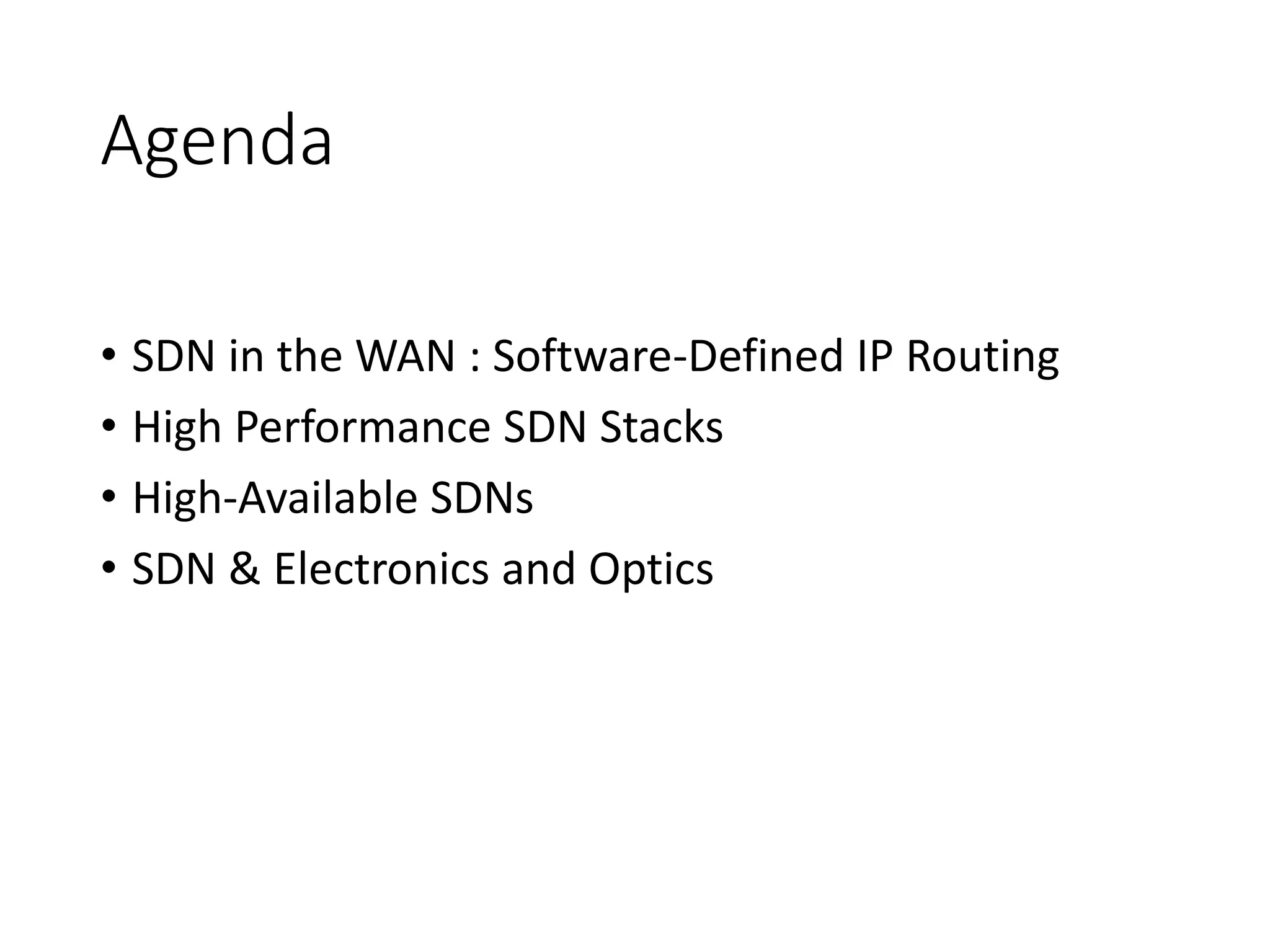
Agenda
• SDN in the WAN : Software-Defined IP Routing
• High Performance SDN Stacks
• High-Available SDNs
• SDN & Electronics and Optics
Christian Esteve Rothenberg
• PhD (FEEC/UNICAMP, 2010), MSc (Darmstadt University, 2006),
Telecom Eng. (Universidad Politécnica de Madrid, 2004)
• (2008) Visiting researcher at Ericsson Research Nomadic Lab,
participated in EU Publish/Subscribe Internet Routing Paradigm (PSIRP)
• Assistant Professor at FEEC/Unicamp since August 2013
• Research Scientist at CPqD (2010-2013)
• ONF Research Associate since April 2013
• Technical Lead of
• RouteFlow (Virtual IP Routing Services over SDN)
• Ofsoftswitch13 (OpenFlow 1.3 controller, softswitch, and testing)
• Mini-CCNx
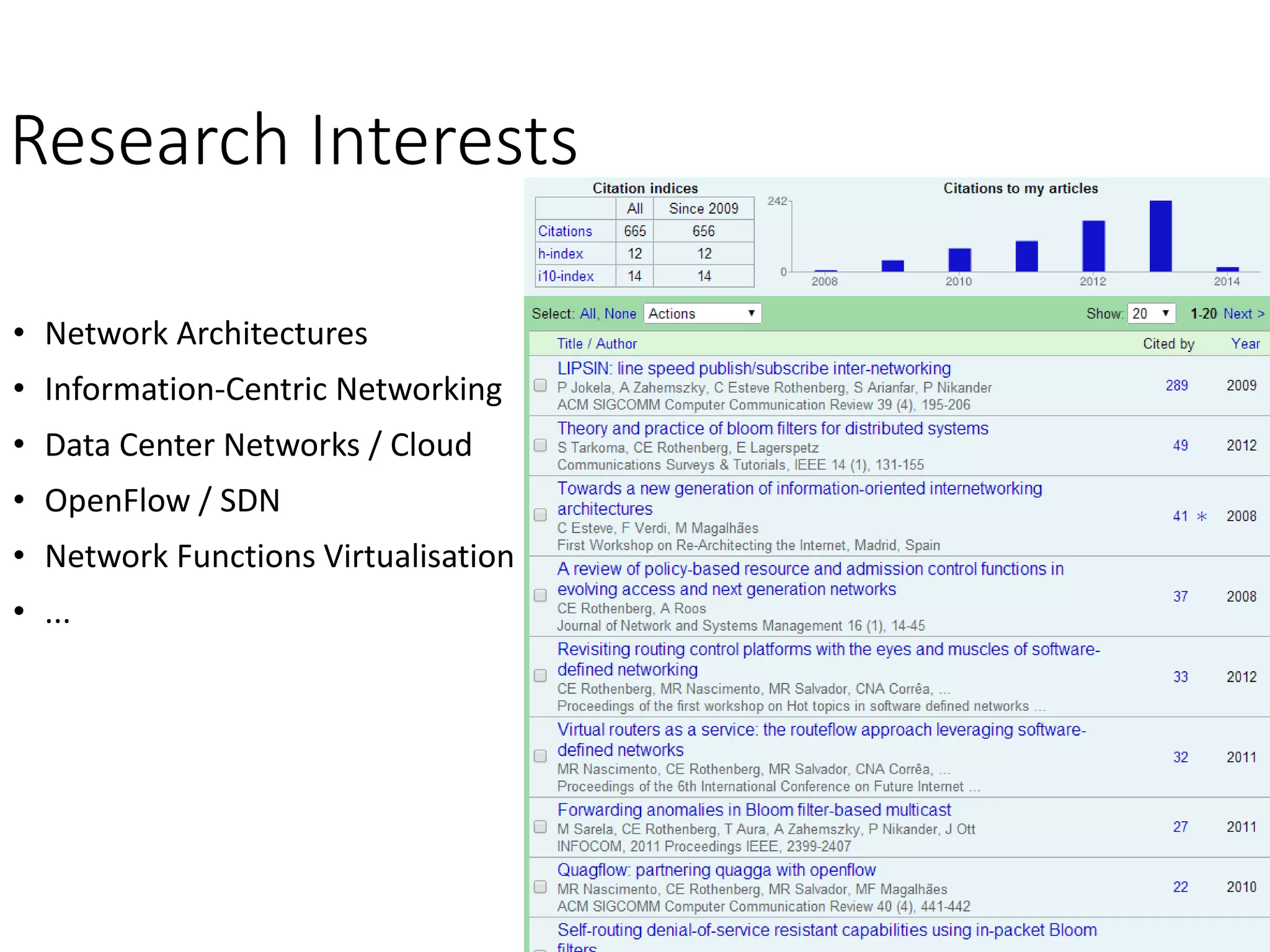
Research Interests
• Network Architectures
• Information-Centric Networking
• Data Center Networks / Cloud
• OpenFlow / SDN
• Network Functions Virtualisation
• ...
SDN in the WAN
Research Topics on Software-Defined IP Routing
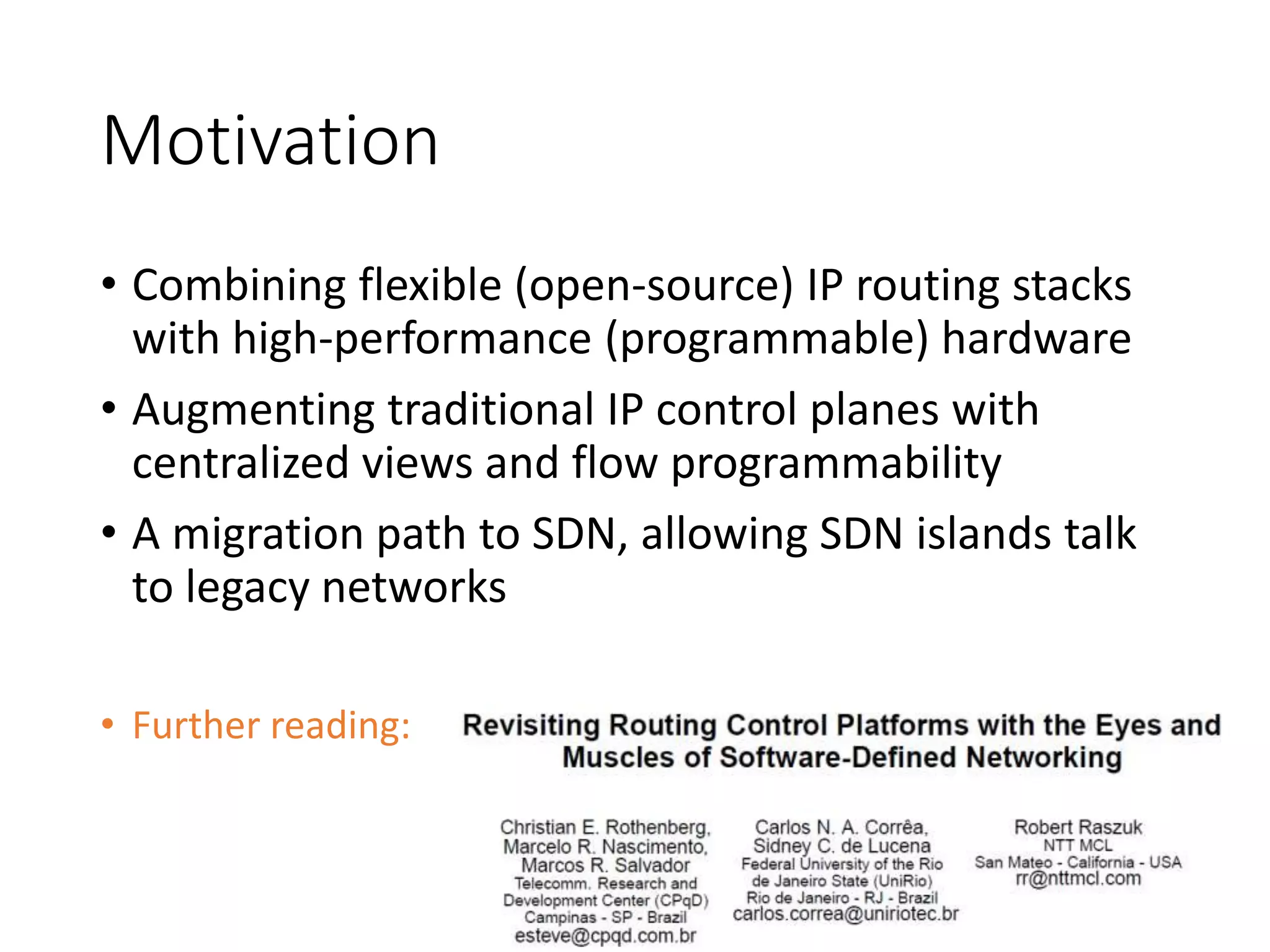
Motivation
• Combining flexible (open-source) IP routing stacks
with high-performance (programmable) hardware
• Augmenting traditional IP control planes with
centralized views and flow programmability
• A migration path to SDN, allowing SDN islands talk
to legacy networks
• Further reading:
Controller
High cost
Specialized config.
Closed source
Slow innovation
BGP
Low cost (commodity)
Multi-vendor modularity
Open source
Rapid innovation
Controller
Open interface
OpenFlow Switches
Open interface
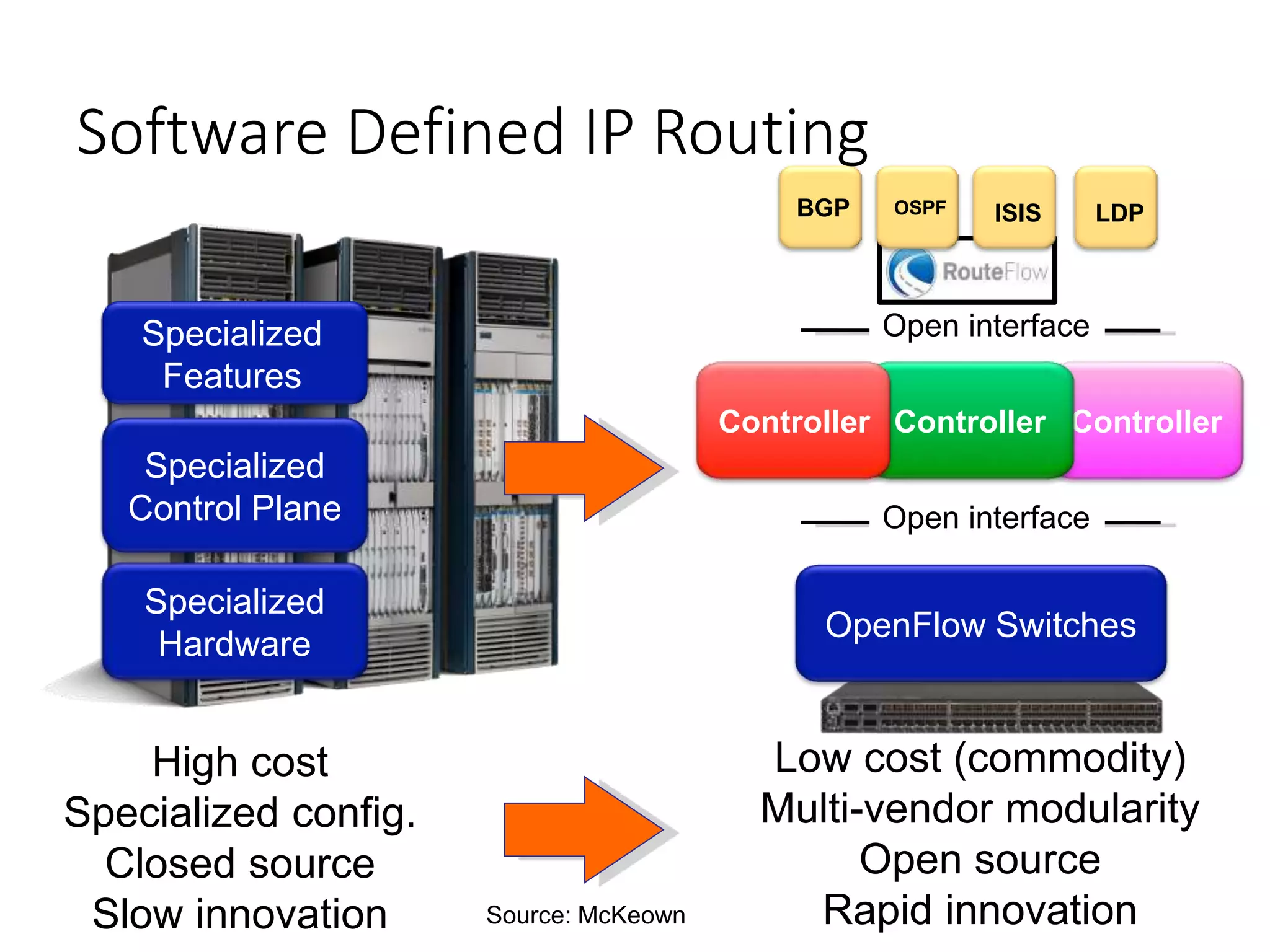
Software Defined IP Routing
OSPF ISIS LDP
Specialized
Control Plane
Specialized
Hardware
Specialized
Features
Controller
Source: McKeown
Research on SDN Route Control
• Early work on Routing Control Platforms (RCP)
[Ramjee 2006, Feamster 2004, Van der Merwe 2006, Wang 2009]
– In operation at AT&T, considered a differentiator for "dynamic
connectivity management".
• Research Question:
– Re-examine the concept of RCP with the visibility
(i.e., network-wide, multi-layer, flow and topology maps, full RIBs)
and direct control capabilities
(i.e., actual FIB installation, rich matching and instruction set)
of the SDN abstraction set and the specifics of the OpenFlow
choice
• RouteFlow glues virtualized IP routing stacks with
OpenFlow
• RouteFlow acts as a new indirection layer for
– routing protocol messages (e.g. BGP session terminates in servers)
– RIB-(to-FIB)-to-OpenFlow transformations
Routing-centric research use cases
• Engineered path selection
– Think Google WAN, performance-based routing, etc.
• Optimal best path reflection
– Per ingress/customer [draft-ietf-idr-bgp-optimal-route-reflection-01]
• Path protection with prefix independent convergence
– Hierarchical FIBs w/ OF 1.X Tables + LFA route-precomputation
• Security
– Data plane blackholes and middlebox injections,
– Secure Inter-domain routing ideas (crypto intense S*-BGP, etc..)
• Simplifying customer multi-homing
– Easy to set and control cost/performance/policy-based routing
• IPv6 migration
– Flow matching for service termination in v4-v6 migration solutions
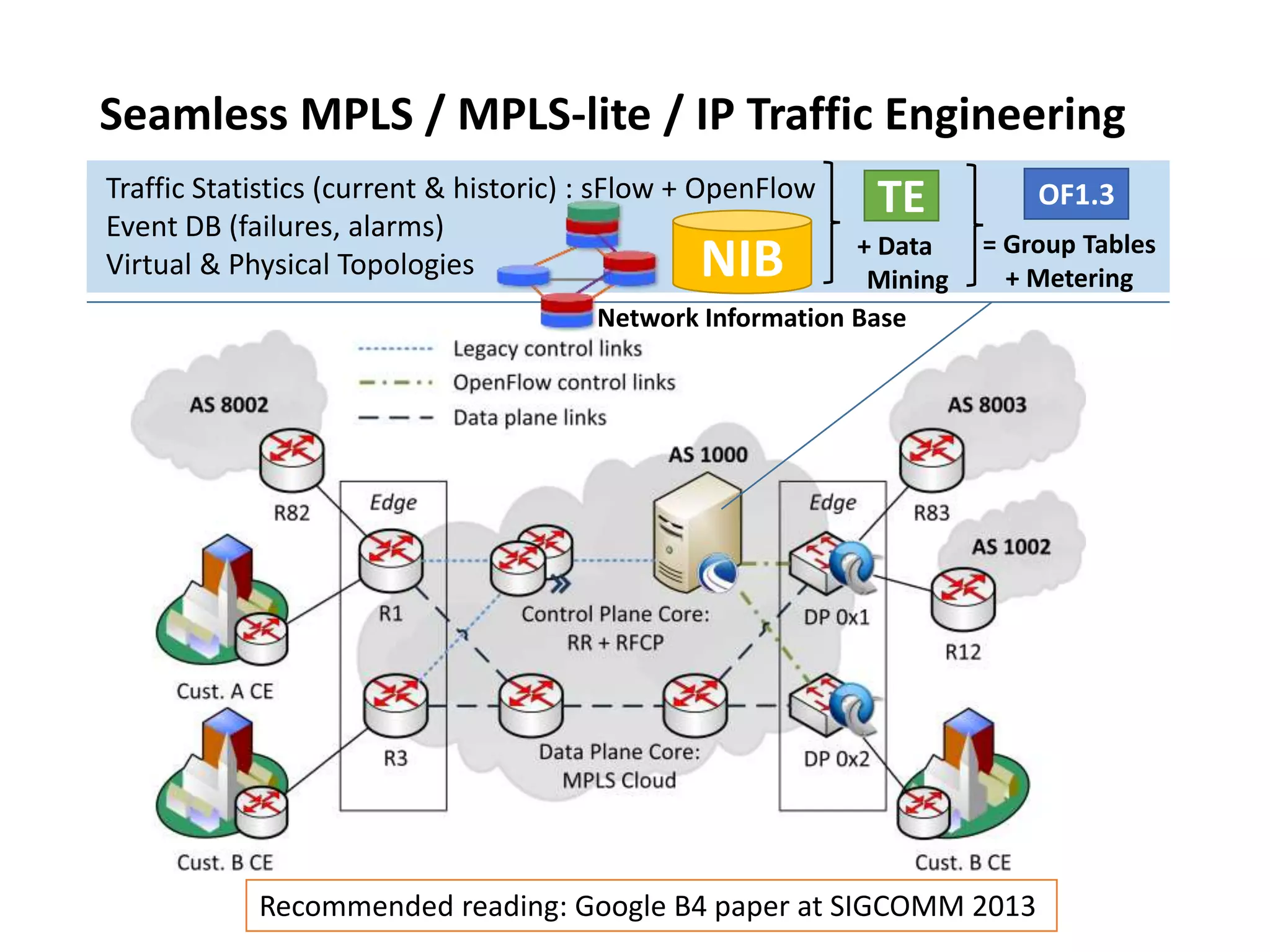
Seamless MPLS / MPLS-lite / IP Traffic Engineering
TE
NIB
Traffic Statistics (current & historic) : sFlow + OpenFlow
Event DB (failures, alarms)
Virtual & Physical Topologies
+ Data
Mining
OF1.3
= Group Tables
+ Metering
Network Information Base
Recommended reading: Google B4 paper at SIGCOMM 2013
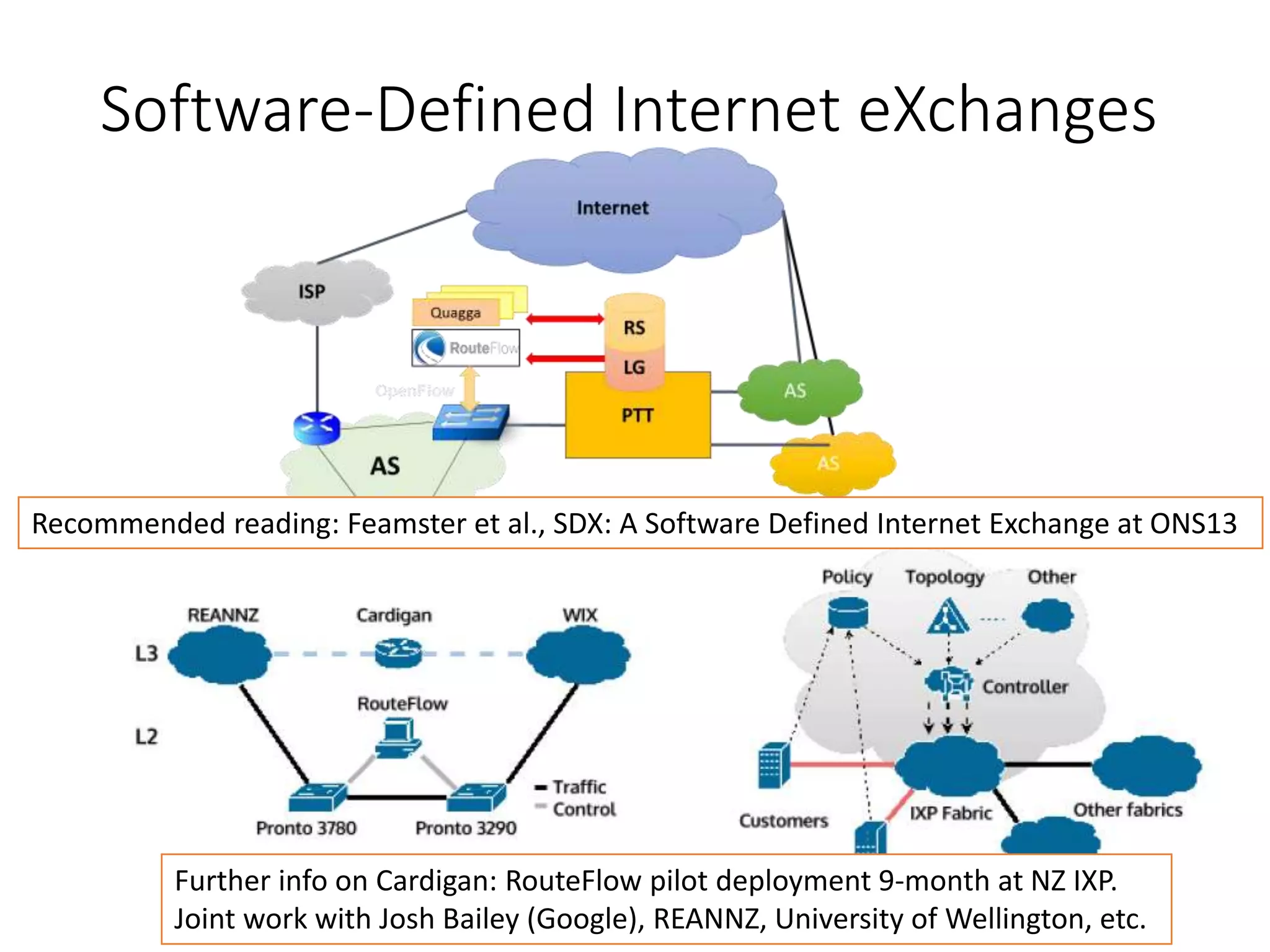
Software-Defined Internet eXchanges
Recommended reading: Feamster et al., SDX: A Software Defined Internet Exchange at ONS13
Further info on Cardigan: RouteFlow pilot deployment 9-month at NZ IXP.
Joint work with Josh Bailey (Google), REANNZ, University of Wellington, etc.
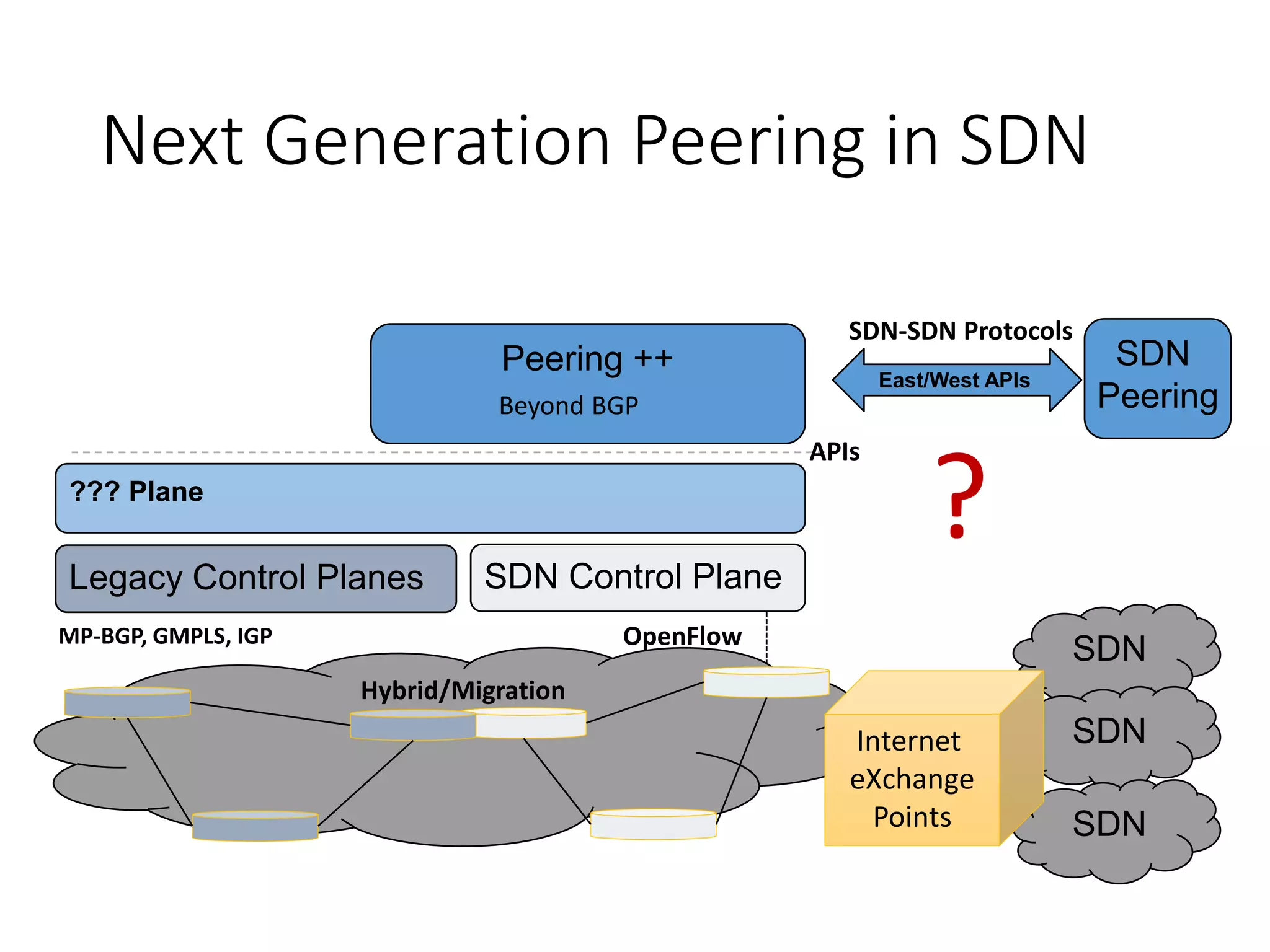
Next Generation Peering in SDN
??? Plane
Peering ++
SDN Control PlaneLegacy Control Planes
SDN
SDN
SDN
APIs
Internet
eXchange
Points
SDN
Peering
SDN-SDN Protocols
Beyond BGP
OpenFlowMP-BGP, GMPLS, IGP
Hybrid/Migration
East/West APIs
?
High Performance SDN Stacks
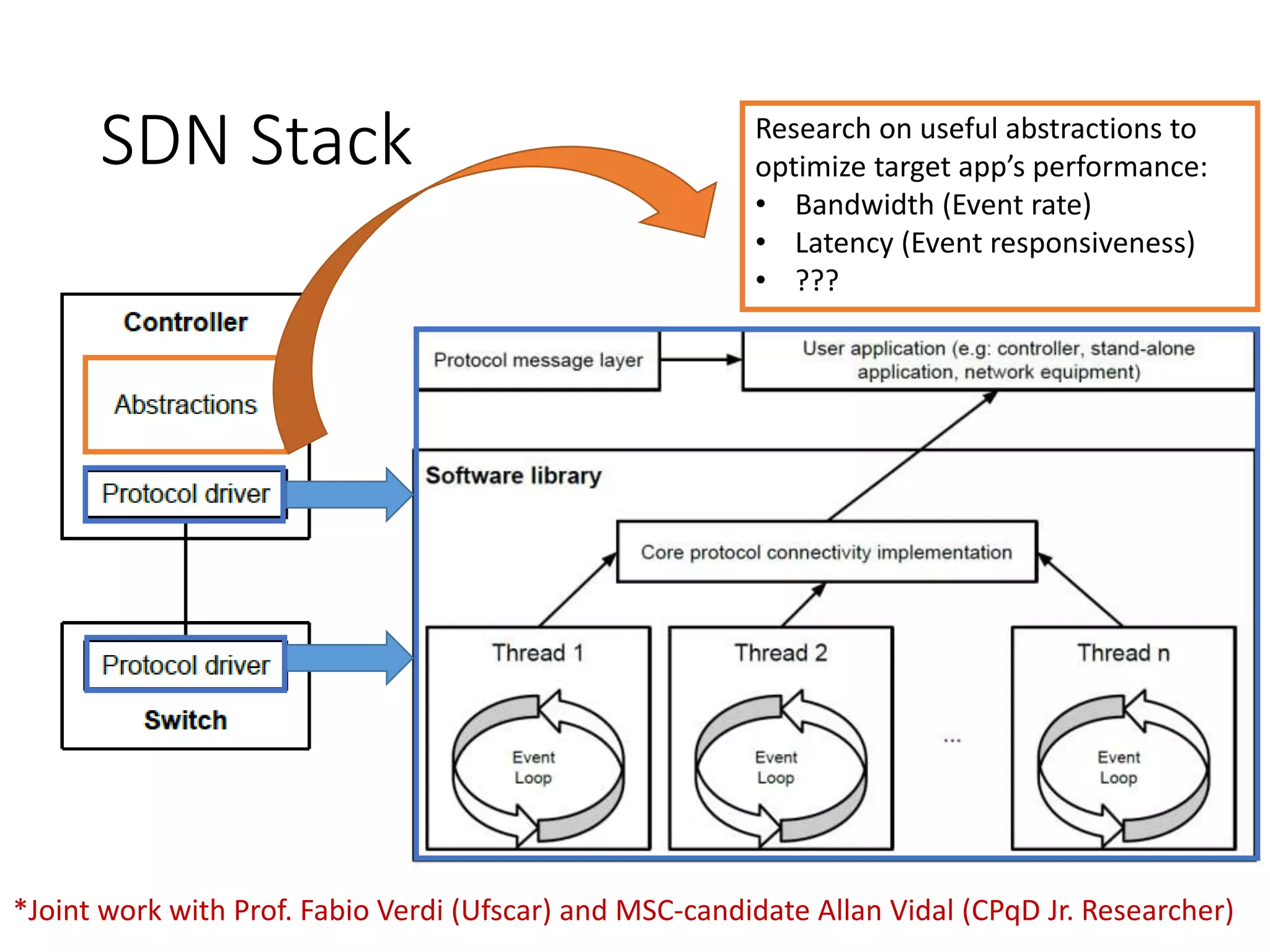
SDN Stack Research on useful abstractions to
optimize target app’s performance:
• Bandwidth (Event rate)
• Latency (Event responsiveness)
• ???
*Joint work with Prof. Fabio Verdi (Ufscar) and MSC-candidate Allan Vidal (CPqD Jr. Researcher)
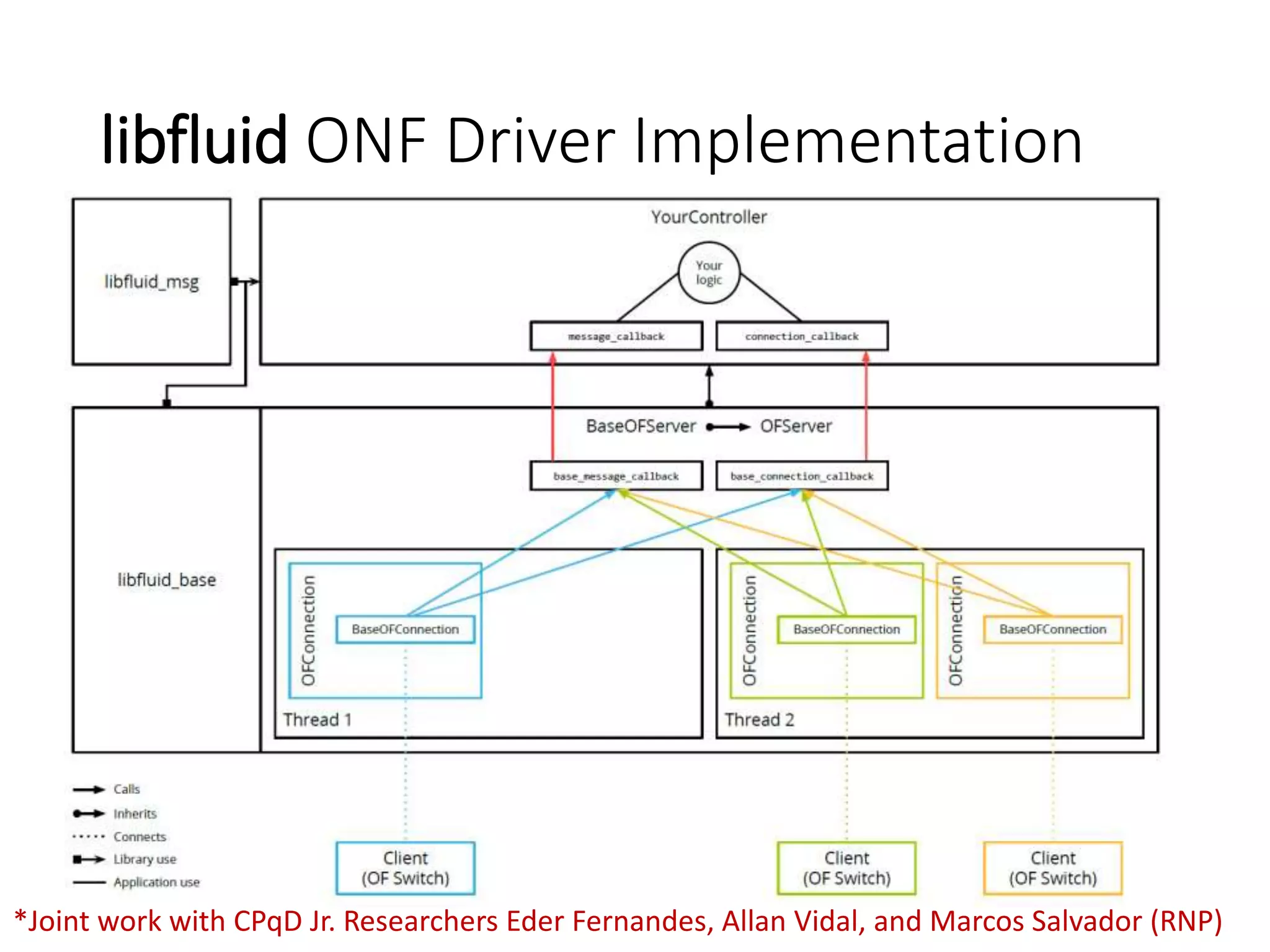
libfluid ONF Driver Implementation
*Joint work with CPqD Jr. Researchers Eder Fernandes, Allan Vidal, and Marcos Salvador (RNP)
High-Available SDNs
A critical issue for the success of SDN technology
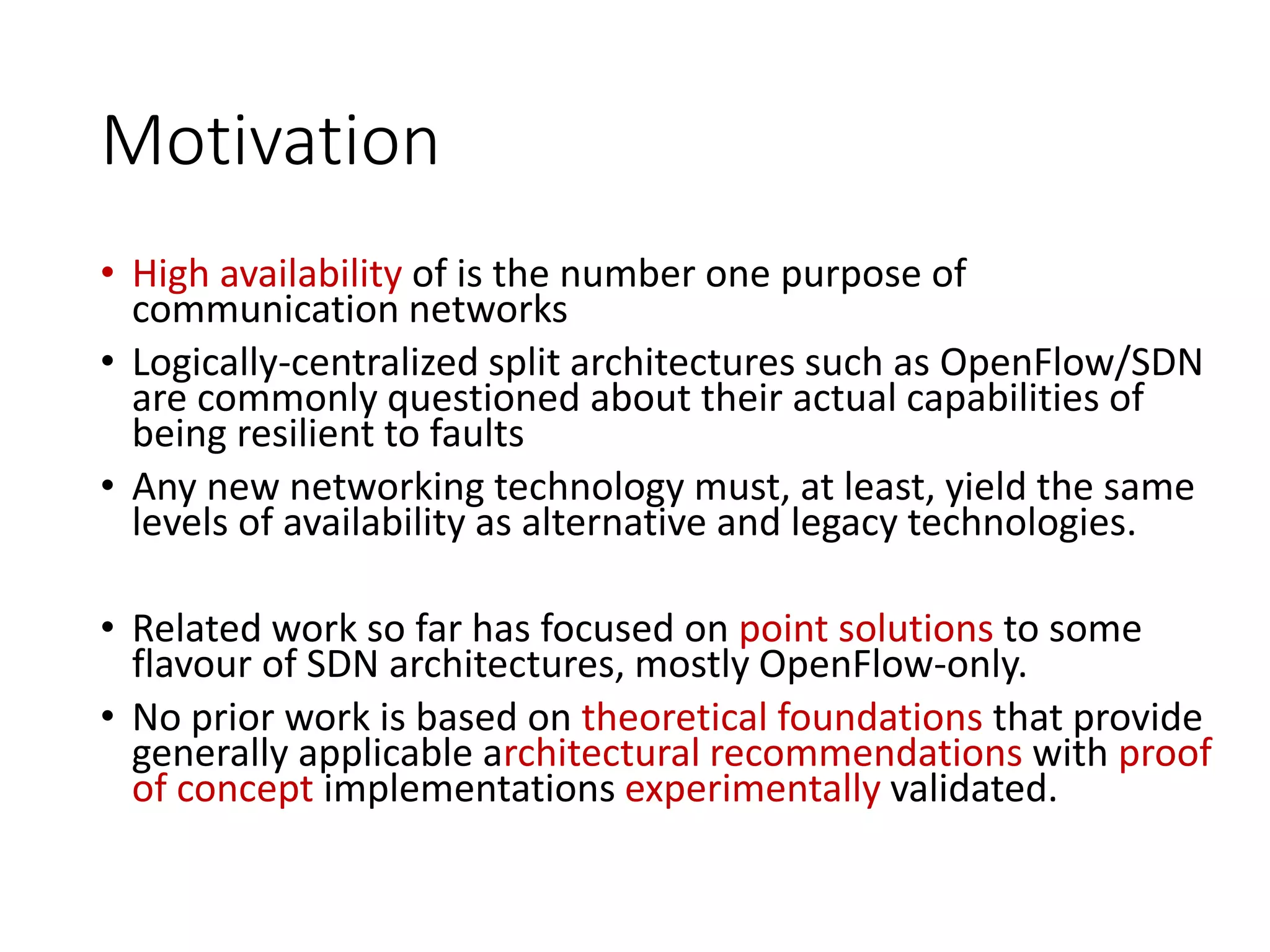
Motivation
• High availability of is the number one purpose of
communication networks
• Logically-centralized split architectures such as OpenFlow/SDN
are commonly questioned about their actual capabilities of
being resilient to faults
• Any new networking technology must, at least, yield the same
levels of availability as alternative and legacy technologies.
• Related work so far has focused on point solutions to some
flavour of SDN architectures, mostly OpenFlow-only.
• No prior work is based on theoretical foundations that provide
generally applicable architectural recommendations with proof
of concept implementations experimentally validated.
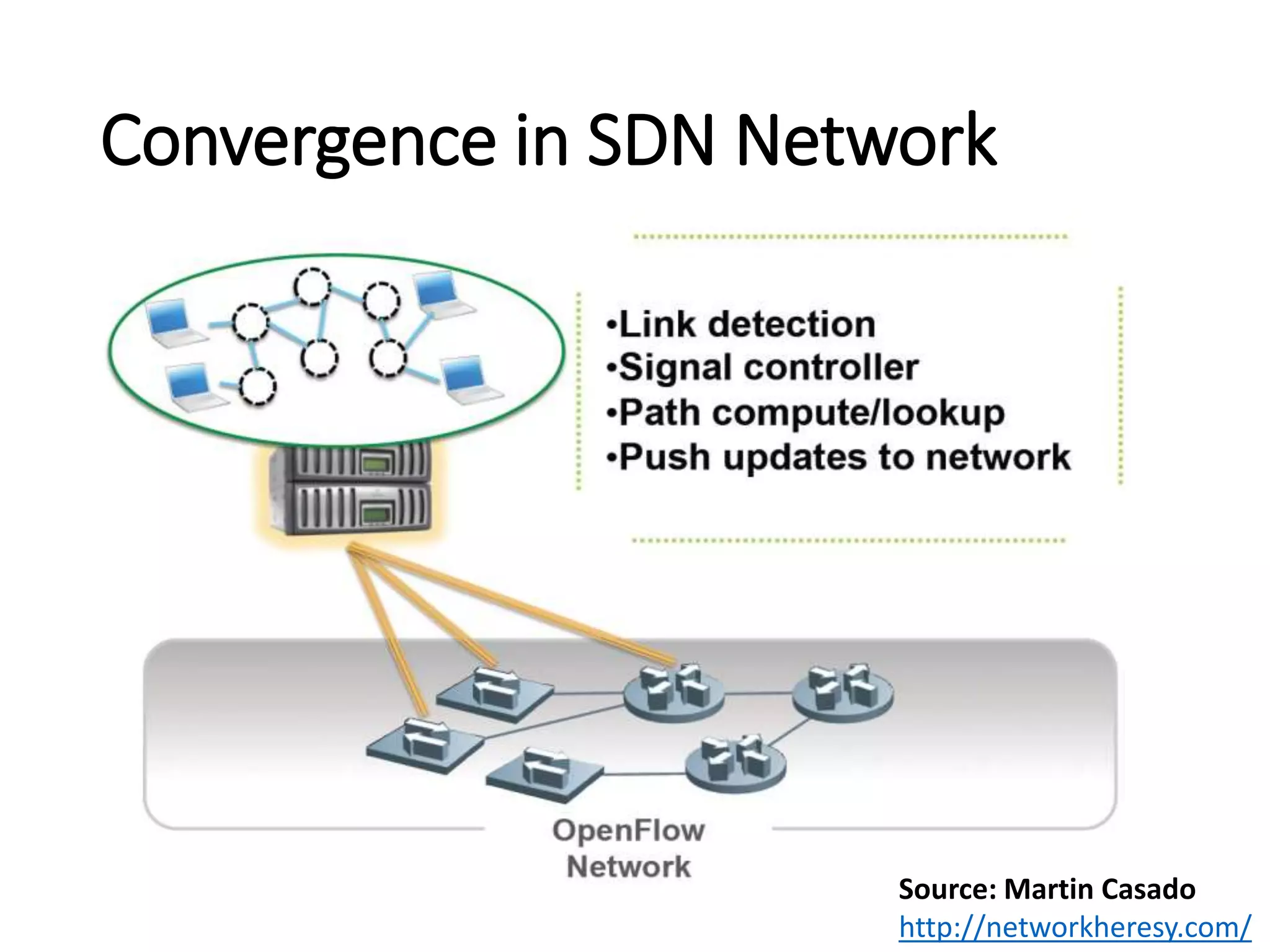
Convergence in SDN Network
Source: Martin Casado
http://networkheresy.com/
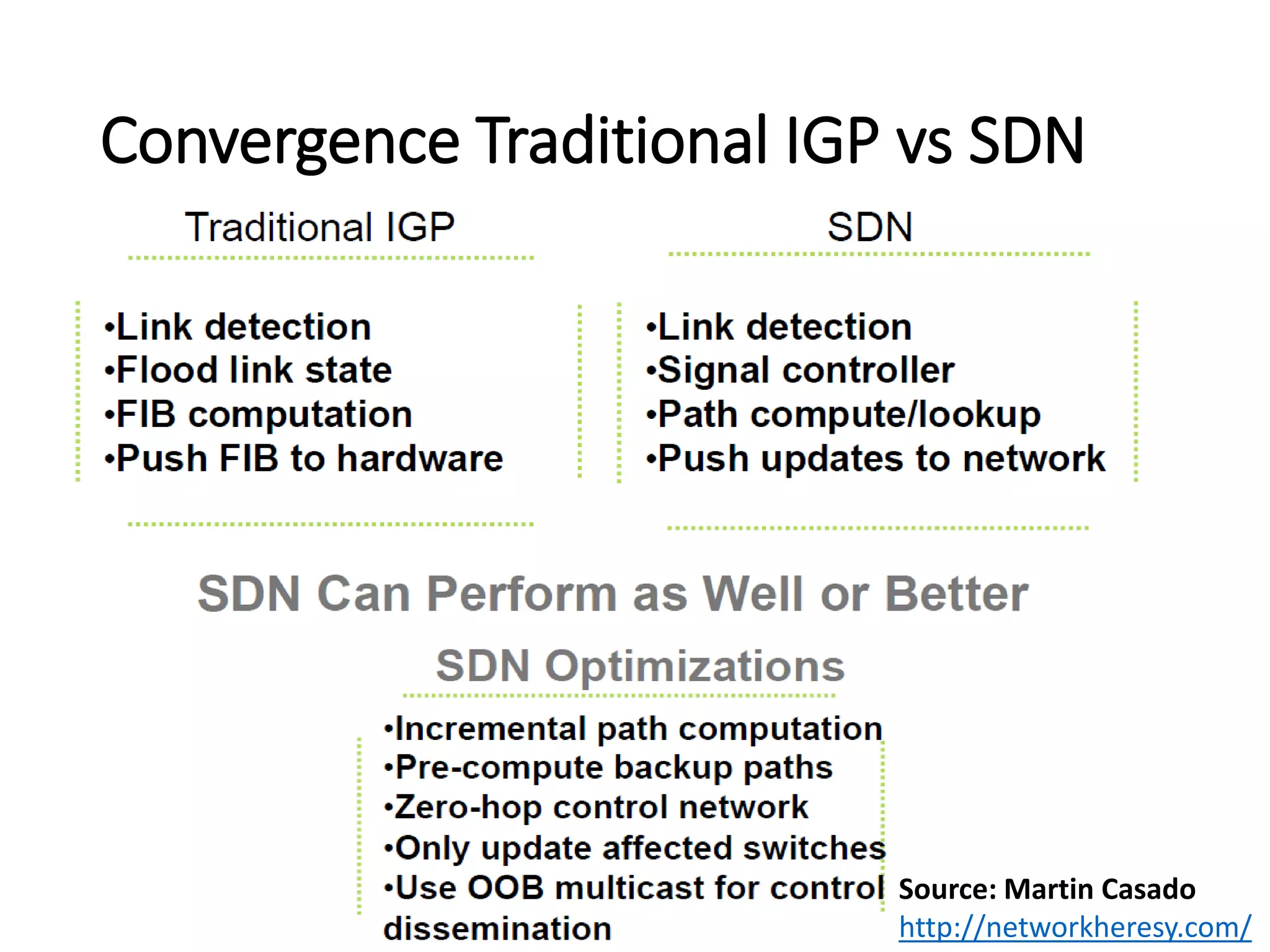
Convergence Traditional IGP vs SDN
Source: Martin Casado
http://networkheresy.com/
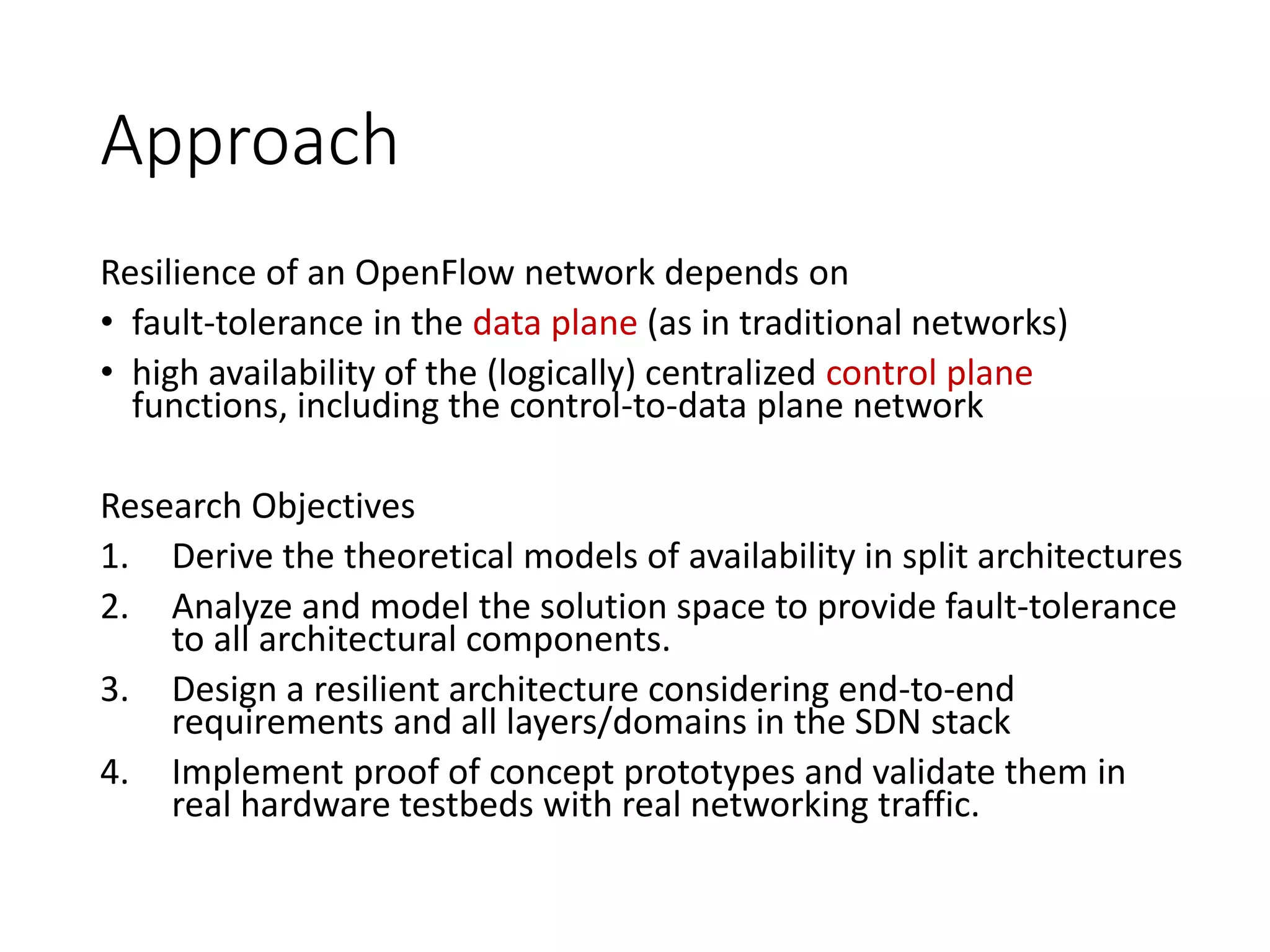
Approach
Resilience of an OpenFlow network depends on
• fault-tolerance in the data plane (as in traditional networks)
• high availability of the (logically) centralized control plane
functions, including the control-to-data plane network
Research Objectives
1. Derive the theoretical models of availability in split architectures
2. Analyze and model the solution space to provide fault-tolerance
to all architectural components.
3. Design a resilient architecture considering end-to-end
requirements and all layers/domains in the SDN stack
4. Implement proof of concept prototypes and validate them in
real hardware testbeds with real networking traffic.
Early results and ongoing work
Towards high-availability in SDN
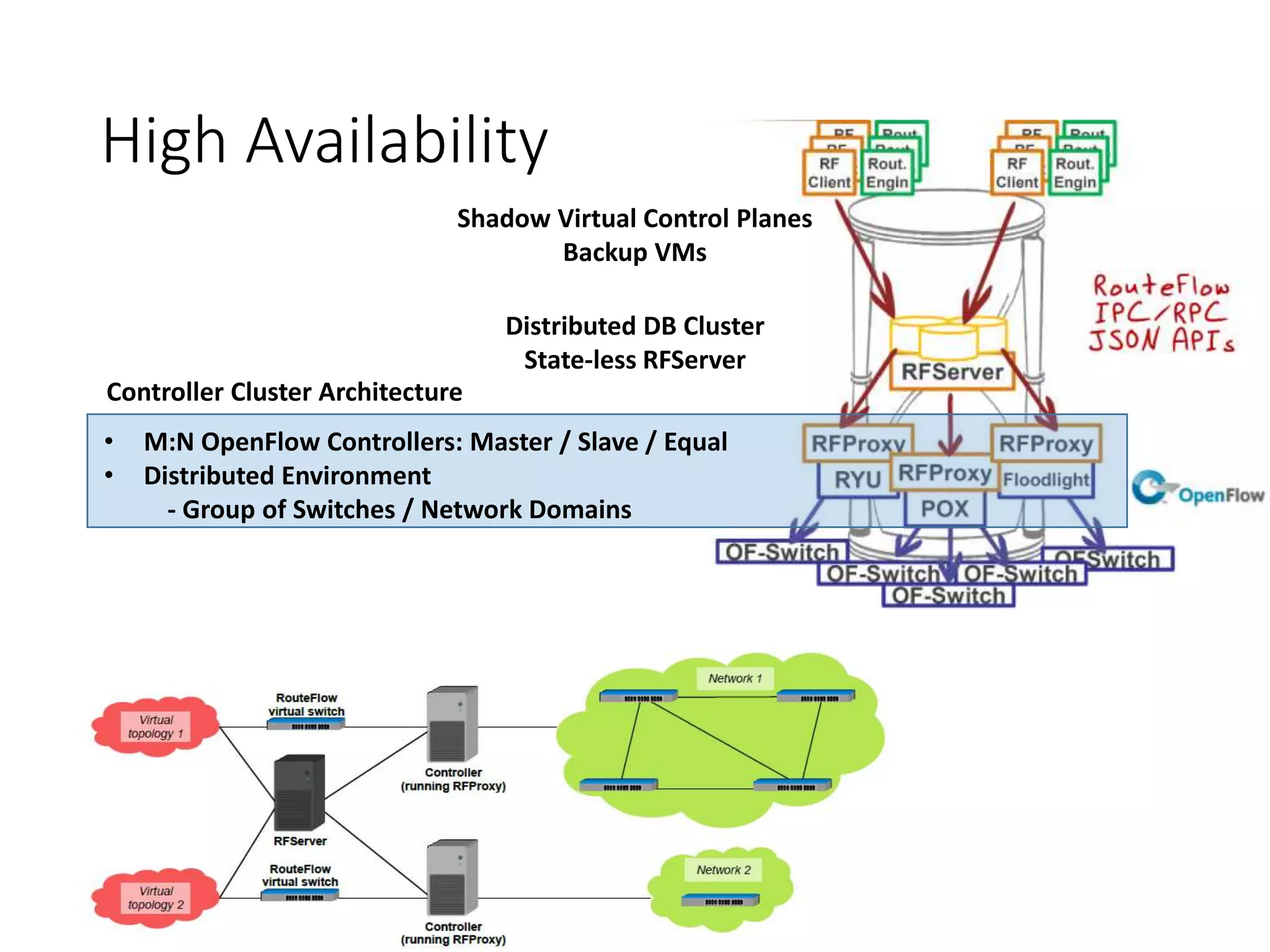
High Availability
• M:N OpenFlow Controllers: Master / Slave / Equal
• Distributed Environment
- Group of Switches / Network Domains
Distributed DB Cluster
State-less RFServer
Controller Cluster Architecture
Shadow Virtual Control Planes
Backup VMs
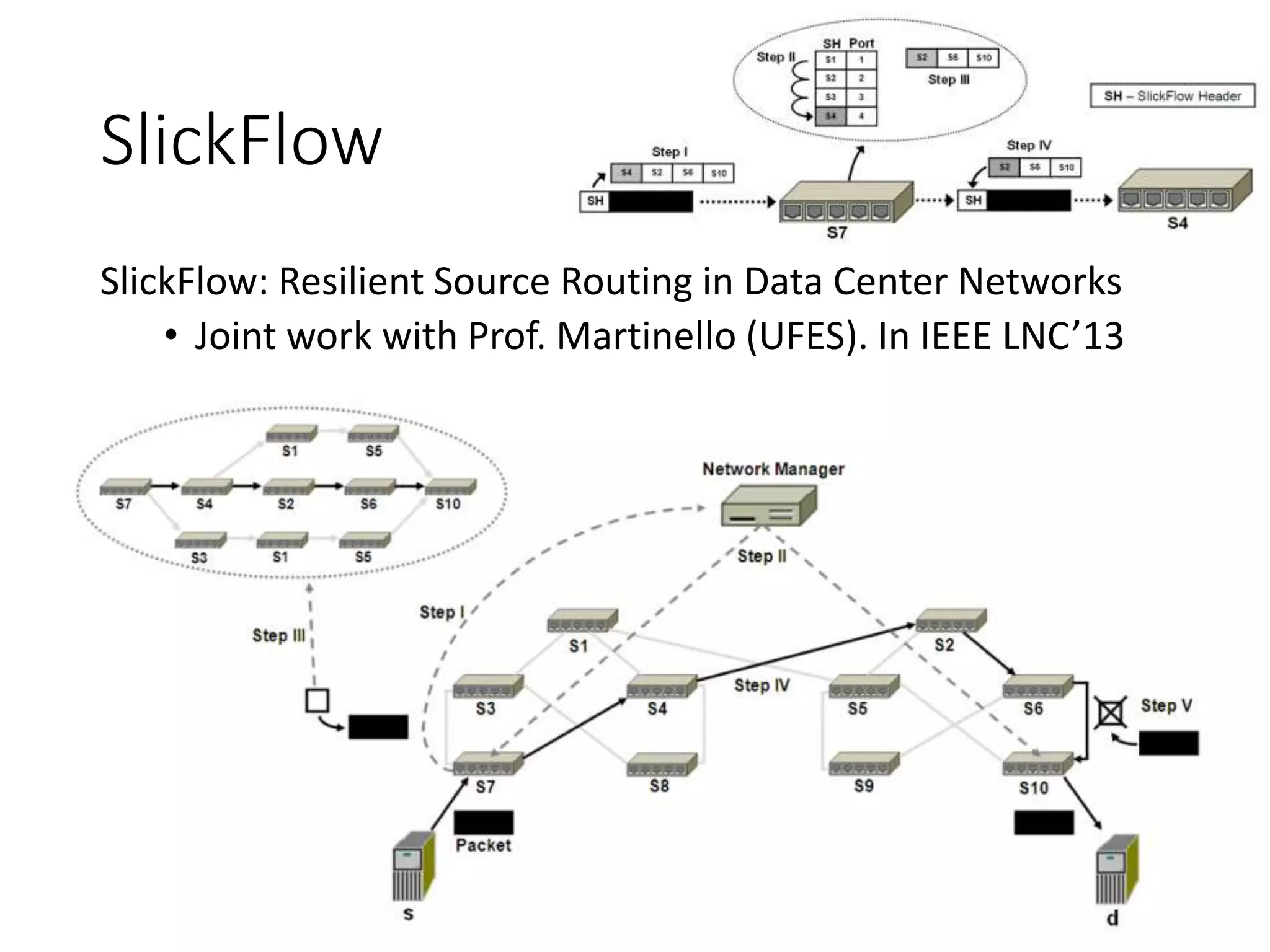
SlickFlow
SlickFlow: Resilient Source Routing in Data Center Networks
• Joint work with Prof. Martinello (UFES). In IEEE LNC’13
SDN and the evolution of
Optics & Electronics
Abstractions and Datapath Programmability
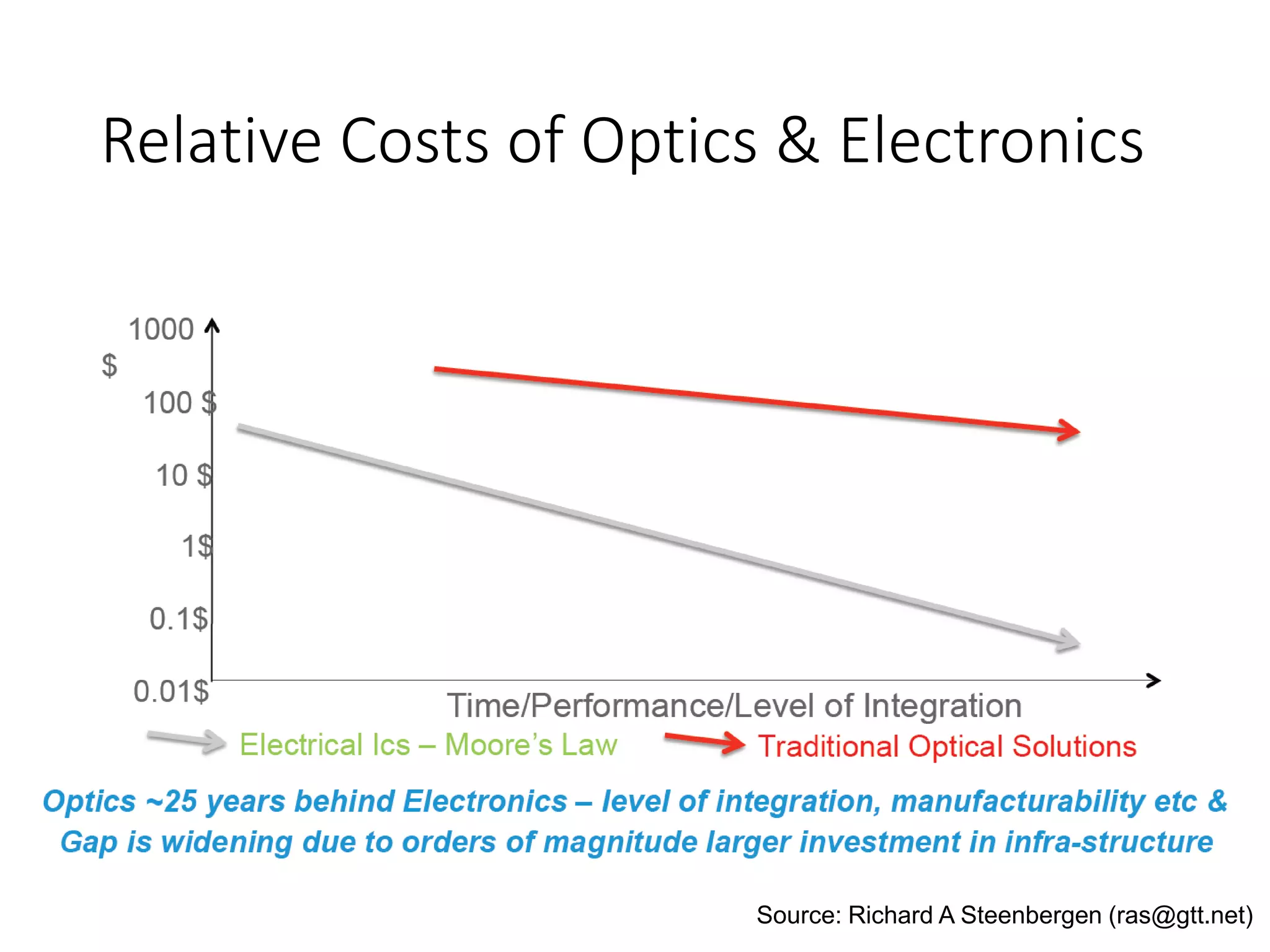
Relative Costs of Optics & Electronics
Source: Richard A Steenbergen (ras@gtt.net)
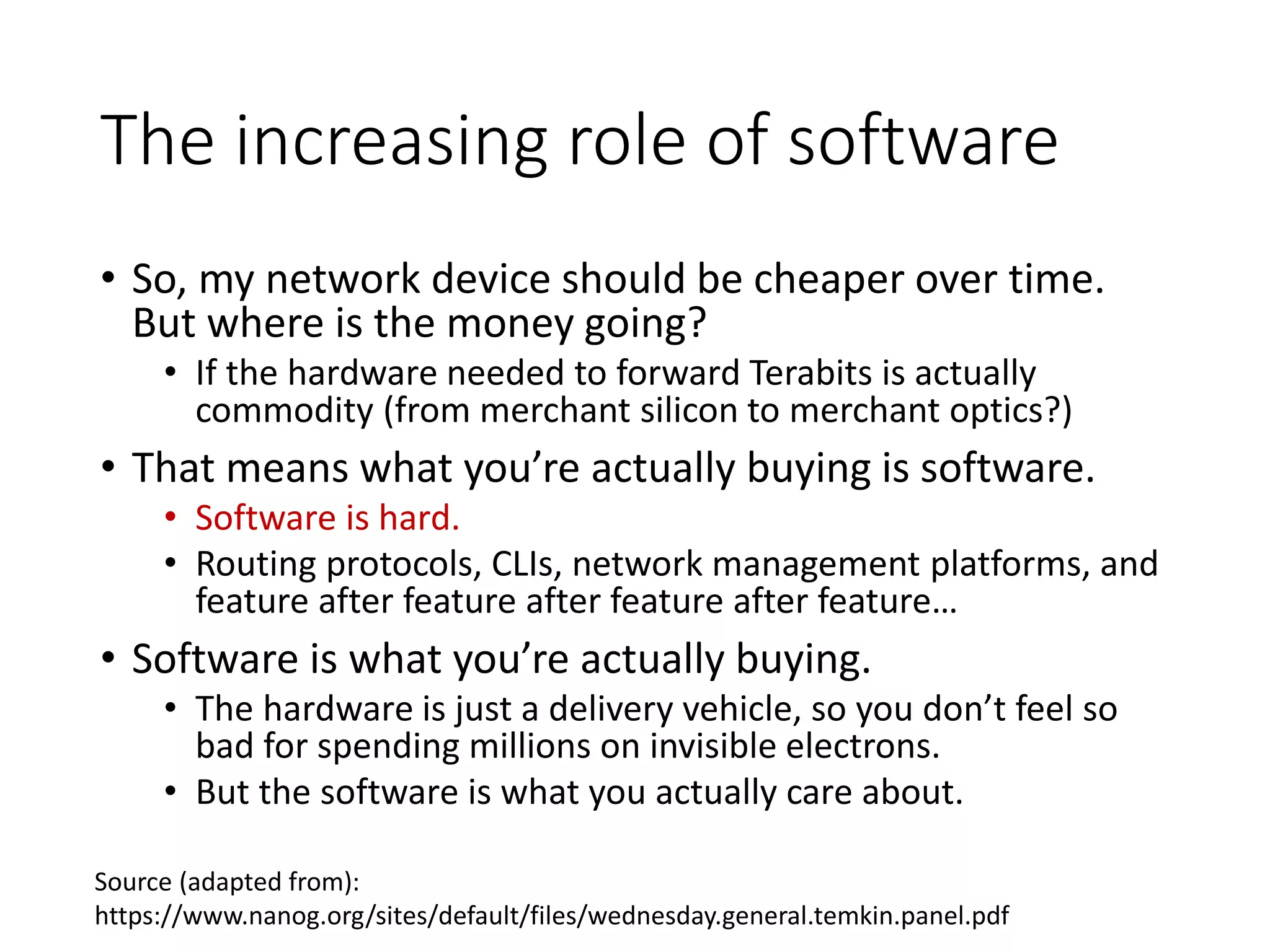
The increasing role of software
• So, my network device should be cheaper over time.
But where is the money going?
• If the hardware needed to forward Terabits is actually
commodity (from merchant silicon to merchant optics?)
• That means what you’re actually buying is software.
• Software is hard.
• Routing protocols, CLIs, network management platforms, and
feature after feature after feature after feature…
• Software is what you’re actually buying.
• The hardware is just a delivery vehicle, so you don’t feel so
bad for spending millions on invisible electrons.
• But the software is what you actually care about.
Source (adapted from):
https://www.nanog.org/sites/default/files/wednesday.general.temkin.panel.pdf
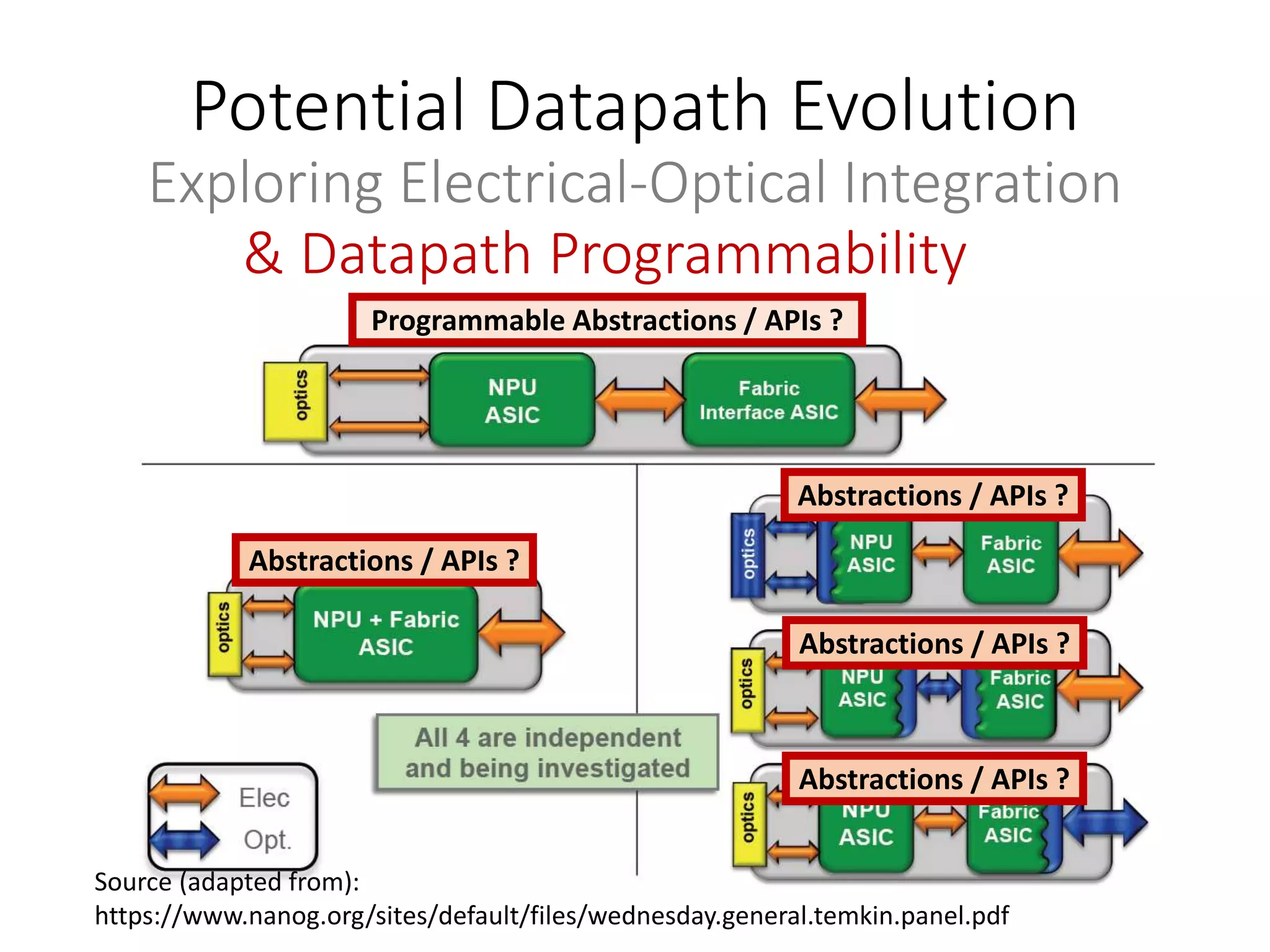
Potential Datapath Evolution
Exploring Electrical-Optical Integration
Programmable Abstractions / APIs ?
Abstractions / APIs ?
& Datapath Programmability
Source (adapted from):
https://www.nanog.org/sites/default/files/wednesday.general.temkin.panel.pdf
Thanks!
Questions?

On SDN Research Topics - Christian Esteve Rothenberg

  • 1.
    On SDN ResearchTopics 24/02/2014 Prof. Christian Esteve Rothenberg FEEC/UNICAMP chesteve@dca.fee.unicamp.br
  • 2.
    Agenda • SDN inthe WAN : Software-Defined IP Routing • High Performance SDN Stacks • High-Available SDNs • SDN & Electronics and Optics
  • 3.
    Christian Esteve Rothenberg •PhD (FEEC/UNICAMP, 2010), MSc (Darmstadt University, 2006), Telecom Eng. (Universidad Politécnica de Madrid, 2004) • (2008) Visiting researcher at Ericsson Research Nomadic Lab, participated in EU Publish/Subscribe Internet Routing Paradigm (PSIRP) • Assistant Professor at FEEC/Unicamp since August 2013 • Research Scientist at CPqD (2010-2013) • ONF Research Associate since April 2013 • Technical Lead of • RouteFlow (Virtual IP Routing Services over SDN) • Ofsoftswitch13 (OpenFlow 1.3 controller, softswitch, and testing) • Mini-CCNx
  • 4.
    Research Interests • NetworkArchitectures • Information-Centric Networking • Data Center Networks / Cloud • OpenFlow / SDN • Network Functions Virtualisation • ...
  • 5.
    SDN in theWAN Research Topics on Software-Defined IP Routing
  • 6.
    Motivation • Combining flexible(open-source) IP routing stacks with high-performance (programmable) hardware • Augmenting traditional IP control planes with centralized views and flow programmability • A migration path to SDN, allowing SDN islands talk to legacy networks • Further reading:
  • 7.
    Controller High cost Specialized config. Closedsource Slow innovation BGP Low cost (commodity) Multi-vendor modularity Open source Rapid innovation Controller Open interface OpenFlow Switches Open interface Software Defined IP Routing OSPF ISIS LDP Specialized Control Plane Specialized Hardware Specialized Features Controller Source: McKeown
  • 8.
    Research on SDNRoute Control • Early work on Routing Control Platforms (RCP) [Ramjee 2006, Feamster 2004, Van der Merwe 2006, Wang 2009] – In operation at AT&T, considered a differentiator for "dynamic connectivity management". • Research Question: – Re-examine the concept of RCP with the visibility (i.e., network-wide, multi-layer, flow and topology maps, full RIBs) and direct control capabilities (i.e., actual FIB installation, rich matching and instruction set) of the SDN abstraction set and the specifics of the OpenFlow choice • RouteFlow glues virtualized IP routing stacks with OpenFlow • RouteFlow acts as a new indirection layer for – routing protocol messages (e.g. BGP session terminates in servers) – RIB-(to-FIB)-to-OpenFlow transformations
  • 9.
    Routing-centric research usecases • Engineered path selection – Think Google WAN, performance-based routing, etc. • Optimal best path reflection – Per ingress/customer [draft-ietf-idr-bgp-optimal-route-reflection-01] • Path protection with prefix independent convergence – Hierarchical FIBs w/ OF 1.X Tables + LFA route-precomputation • Security – Data plane blackholes and middlebox injections, – Secure Inter-domain routing ideas (crypto intense S*-BGP, etc..) • Simplifying customer multi-homing – Easy to set and control cost/performance/policy-based routing • IPv6 migration – Flow matching for service termination in v4-v6 migration solutions
  • 10.
    Seamless MPLS /MPLS-lite / IP Traffic Engineering TE NIB Traffic Statistics (current & historic) : sFlow + OpenFlow Event DB (failures, alarms) Virtual & Physical Topologies + Data Mining OF1.3 = Group Tables + Metering Network Information Base Recommended reading: Google B4 paper at SIGCOMM 2013
  • 11.
    Software-Defined Internet eXchanges Recommendedreading: Feamster et al., SDX: A Software Defined Internet Exchange at ONS13 Further info on Cardigan: RouteFlow pilot deployment 9-month at NZ IXP. Joint work with Josh Bailey (Google), REANNZ, University of Wellington, etc.
  • 12.
    Next Generation Peeringin SDN ??? Plane Peering ++ SDN Control PlaneLegacy Control Planes SDN SDN SDN APIs Internet eXchange Points SDN Peering SDN-SDN Protocols Beyond BGP OpenFlowMP-BGP, GMPLS, IGP Hybrid/Migration East/West APIs ?
  • 13.
  • 14.
    SDN Stack Researchon useful abstractions to optimize target app’s performance: • Bandwidth (Event rate) • Latency (Event responsiveness) • ??? *Joint work with Prof. Fabio Verdi (Ufscar) and MSC-candidate Allan Vidal (CPqD Jr. Researcher)
  • 15.
    libfluid ONF DriverImplementation *Joint work with CPqD Jr. Researchers Eder Fernandes, Allan Vidal, and Marcos Salvador (RNP)
  • 16.
    High-Available SDNs A criticalissue for the success of SDN technology
  • 17.
    Motivation • High availabilityof is the number one purpose of communication networks • Logically-centralized split architectures such as OpenFlow/SDN are commonly questioned about their actual capabilities of being resilient to faults • Any new networking technology must, at least, yield the same levels of availability as alternative and legacy technologies. • Related work so far has focused on point solutions to some flavour of SDN architectures, mostly OpenFlow-only. • No prior work is based on theoretical foundations that provide generally applicable architectural recommendations with proof of concept implementations experimentally validated.
  • 18.
    Convergence in SDNNetwork Source: Martin Casado http://networkheresy.com/
  • 19.
    Convergence Traditional IGPvs SDN Source: Martin Casado http://networkheresy.com/
  • 20.
    Approach Resilience of anOpenFlow network depends on • fault-tolerance in the data plane (as in traditional networks) • high availability of the (logically) centralized control plane functions, including the control-to-data plane network Research Objectives 1. Derive the theoretical models of availability in split architectures 2. Analyze and model the solution space to provide fault-tolerance to all architectural components. 3. Design a resilient architecture considering end-to-end requirements and all layers/domains in the SDN stack 4. Implement proof of concept prototypes and validate them in real hardware testbeds with real networking traffic.
  • 21.
    Early results andongoing work Towards high-availability in SDN
  • 22.
    High Availability • M:NOpenFlow Controllers: Master / Slave / Equal • Distributed Environment - Group of Switches / Network Domains Distributed DB Cluster State-less RFServer Controller Cluster Architecture Shadow Virtual Control Planes Backup VMs
  • 23.
    SlickFlow SlickFlow: Resilient SourceRouting in Data Center Networks • Joint work with Prof. Martinello (UFES). In IEEE LNC’13
  • 24.
    SDN and theevolution of Optics & Electronics Abstractions and Datapath Programmability
  • 25.
    Relative Costs ofOptics & Electronics Source: Richard A Steenbergen (ras@gtt.net)
  • 26.
    The increasing roleof software • So, my network device should be cheaper over time. But where is the money going? • If the hardware needed to forward Terabits is actually commodity (from merchant silicon to merchant optics?) • That means what you’re actually buying is software. • Software is hard. • Routing protocols, CLIs, network management platforms, and feature after feature after feature after feature… • Software is what you’re actually buying. • The hardware is just a delivery vehicle, so you don’t feel so bad for spending millions on invisible electrons. • But the software is what you actually care about. Source (adapted from): https://www.nanog.org/sites/default/files/wednesday.general.temkin.panel.pdf
  • 27.
    Potential Datapath Evolution ExploringElectrical-Optical Integration Programmable Abstractions / APIs ? Abstractions / APIs ? Abstractions / APIs ? Abstractions / APIs ? Abstractions / APIs ? & Datapath Programmability Source (adapted from): https://www.nanog.org/sites/default/files/wednesday.general.temkin.panel.pdf
  • 28.