Formulation of National Adaptation Plan
in Japan
OKANO Shohei
Climate Change Adaptation Office
Global Environment Bureau
Ministry of the Environment, Japan
(MOEJ)
2
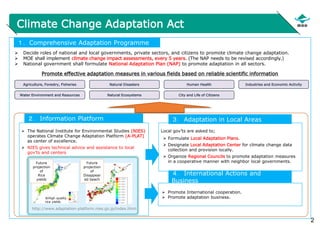
Climate Change Adaptation Act
 Decide roles of national and local governments, private sectors, and citizens to promote climate change adaptation.
 MOE shall implement climate change impact assessments, every 5 years. (The NAP needs to be revised accordingly.)
 National government shall formulate National Adaptation Plan (NAP) to promote adaptation in all sectors.
1.Comprehensive Adaptation Programme
 The National Institute for Environmental Studies (NIES)
operates Climate Change Adaptation Platform (A-PLAT)
as center of excellence.
 NIES gives technical advice and assistance to local
gov’ts and centers
2.Information Platform
Local gov’ts are asked to;
 Formulate Local Adaptation Plans.
 Designate Local Adaptation Center for climate change data
collection and provision locally.
 Organize Regional Councils to promote adaptation measures
in a cooperative manner with neighbor local governments.
3.Adaptation in Local Areas
Promote effective adaptation measures in various fields based on reliable scientific information
 Promote International cooperation.
 Promote adaptation business.
4.International Actions and
Business
http://www.adaptation-platform.nies.go.jp/index.html
Future
projection
of
Rice
yields
Future
projection
of
Disappear
ed beach
※High quality
rice yields
Agriculture, Forestry, Fisheries
Water Environment and Resources Natural Ecosystems
Natural Disasters Human Health Industries and Economic Activity
City and Life of Citizens
3
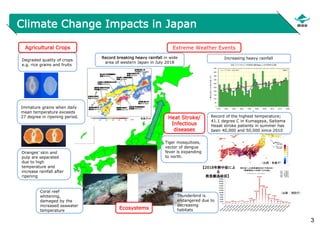
Climate Change Impacts in Japan
Extreme Weather Events
Record breaking heavy rainfall in wide
area of western Japan in July 2018
(出典:気候変動監視レポート2017(気象庁))
【2018年7月23日の日最高
気温】
(出典:気象庁)
【2018年熱中症によ
る
救急搬送状況】
(出典:消防庁)
Agricultural Crops
Degraded quality of crops
e.g. rice grains and fruits
Immature grains when daily
mean temperature exceeds
27 degree in ripening period.
Oranges’ skin and
pulp are separated
due to high
temperature and
increase rainfall after
ripening
Increasing heavy rainfall
Heat Stroke/
Infectious
diseases
Tiger mosquitoes,
vector of dengue
fever is expanding
to north.
Record of the highest temperature;
41.1 degree C in Kumagaya, Saitama
Heaat stroke patients in summer has
been 40,000 and 50,000 since 2010
Ecosystems
Coral reef
whitening,
damaged by the
increased seawater
temperature
Thunderbird is
endangered due to
decreasing
habitats
4
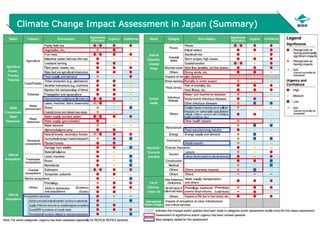
Climate Change Impact Assessment in Japan (Summary)
5
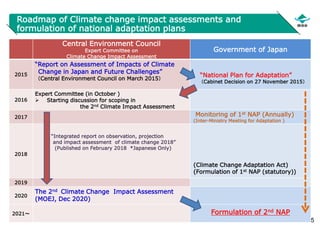
Roadmap of Climate change impact assessments and
formulation of national adaptation plans
5
Central Environment Council
Expert Committee on
Climate Change Impact Assessment
Government of Japan
2015
“Report on Assessment of Impacts of Climate
Change in Japan and Future Challenges”
(Central Environment Council on March 2015)
“National Plan for Adaptation”
(Cabinet Decision on 27 November 2015)
2016
Expert Committee (in October )
 Starting discussion for scoping in
the 2nd Climate Impact Assessment
2017 Monitoring of 1st NAP (Annually)
(Inter-Ministry Meeting for Adaptation )
2018
(Climate Change Adaptation Act)
(Formulation of 1st NAP (statutory))
2019
2020
The 2nd Climate Change Impact Assessment
(MOEJ, Dec 2020)
2021~ Formulation of 2nd NAP
“Integrated report on observation, projection
and impact assessment of climate change 2018”
(Published on February 2018 *Japanese Only)
6
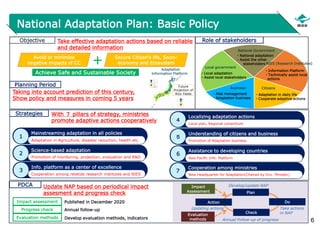
National Adaptation Plan: Basic Policy
Avoid or minimize
negative impacts of CC
Mainstreaming adaptation in all policies
Objective
Strategies
1
Adaptation in Agriculture, disaster reduction, health etc.
Science-based adaptation
2
Promotion of monitoring, projection, evaluation and R&D
Info. platform as a center of excellence
3
Cooperation among relatide research institutes and NIES
Localizing adaptation actions
Local plan, Regional consortium
Understanding of citizens and business
Promotion of Adaptation business
Assistance to developing countries
6
Asia Pacific Info. Platform
Cooperation among ministries
7
New Headquarter for Adaptation(Chaired by Env. Minister)
Citizens
Business
National Government
Local government
・Local adaptation
・Assist local stakeholders
・Adaptation in daily life
・Cooperate adaptive actions
・Risk management
・Adaptation business
NIES (Research Institutes)
・Information Platform
・Technically assist local
actions
・National adaptation
・Assist the other
stakeholders
Role of stakeholders
Impact assessment
Progress check
Evaluation methods
Published in December 2020
PDCA
5
4
Future
Projection of
Rice Yields
Adaptation
Information Platform
Take effective adaptation actions based on reliable
and detailed information
Secure Citizen’s life, Socio-
economy and Ecosystem
+
Achieve Safe and Sustainable Society
Planning Period
Taking into account prediction of this century,
Show policy and measures in coming 5 years
With 7 pillars of strategy, ministries
promote adaptive actions cooperatively
Develop/update NAP
Take actions
in NAP
Annual Follow-up of progress
Updating actions
Impact
Assessment Plan
Do
Check
Action
Evaluation
methods
Update NAP based on periodical impact
assesment and progress check
Annual follow-up
Develop evaluation methods, indicators
7
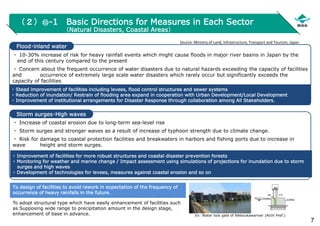
(2)②-1 Basic Directions for Measures in Each Sector
(Natural Disasters, Coastal Areas)
・ 10-30% increase of risk for heavy rainfall events which might cause floods in major river basins in Japan by the
end of this century compared to the present
・ Concern about the frequent occurrence of water disasters due to natural hazards exceeding the capacity of facilities
and occurrence of extremely large scale water disasters which rarely occur but significantly exceeds the
capacity of facilities
・ Increase of coastal erosion due to long-term sea-level rise
・ Storm surges and stronger waves as a result of increase of typhoon strength due to climate change.
・ Risk for damage to coastal protection facilities and breakwaters in harbors and fishing ports due to increase in
wave height and storm surges.
・ Stead improvement of facilities including levees, flood control structures and sewer systems
・ Reduction of inundation/ Restrain of flooding area expand in cooperation with Urban Development/Local Development
・ Improvement of institutional arrangements for Disaster Response through collaboration among All Stakeholders.
Flood・inland water
Storm surges・High waves
・ Improvement of facilities for more robust structures and coastal disaster prevention forests
・ Monitoring for weather and marine change / Impact assessment using simulations of projections for inundation due to storm
surges and high waves
・ Development of technologies for levees, measures against coastal erosion and so on
Source: Ministry of Land, Infrastructure, Transport and Tourism, Japan
To design of facilities to avoid rework in expectation of the frequency of
occurrence of heavy rainfalls in the future.
To adopt structural type which have easily enhancement of facilities such
as Supposing wide range to precipitation amount in the design stage,
enhancement of base in advance. Ex: Water lock gate of Nikkoukawariver (Aichi Pref.)
8
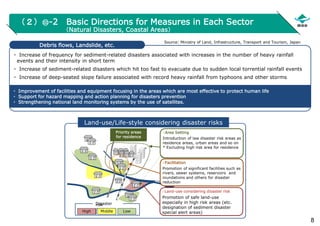
(2)②-2 Basic Directions for Measures in Each Sector
(Natural Disasters, Coastal Areas)
・ Improvement of facilities and equipment focusing in the areas which are most effective to protect human life
・ Support for hazard mapping and action planning for disasters prevention
・ Strengthening national land monitoring systems by the use of satellites.
Debris flows, Landslide, etc.
○居住等を誘導すべき区域等の設定
居住等を誘導
すべき区域等
中
高 低
災害リスク
災害リスクの低い地域へ居住や都市機能を
誘導
○施設の整備
居住等を誘導すべき区域等において、河川
や下水道等の整備、雨水貯留施設、浸透施
設等の整備を重点的に推進
○災害リスクを考慮した土地利用
※災害リスクの高い地域は居住等を誘導すべき区
域等から除外
災害リスクが特に高い地域について、土砂災
害特別警戒区域の指定等により、安全な土
地利用を促す。
災害リスクを考慮した土地利用、住まい方
Land-use/Life-style considering disaster risks
Priority areas
for residence
○Facilitation
Promotion of significant facilities such as
rivers, sewer systems, reservoirs and
inundations and others for disaster
reduction
○Land-use considering disaster risk
Promotion of safe land-use
especially in high risk areas (etc.
designation of sediment disaster
special alert areas)
Disaster
risk
High Middle Low
Source: Ministry of Land, Infrastructure, Transport and Tourism, Japan
・ Increase of frequency for sediment-related disasters associated with increases in the number of heavy rainfall
events and their intensity in short term
・ Increase of sediment-related disasters which hit too fast to evacuate due to sudden local torrential rainfall events
・ Increase of deep-seated slope failure associated with record heavy rainfall from typhoons and other storms
○Area Setting
Introduction of law disaster risk areas as
residence areas, urban areas and so on
* Excluding high risk area for residence
9
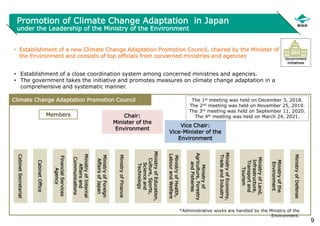
Promotion of Climate Change Adaptation in Japan
under the Leadership of the Ministry of the Environment
• Establishment of a new Climate Change Adaptation Promotion Council, chaired by the Minister of
the Environment and consists of top officials from concerned ministries and agencies
• Establishment of a close coordination system among concerned ministries and agencies.
• The government takes the initiative and promotes measures on climate change adaptation in a
comprehensive and systematic manner.
Government
initiatives
Chair:
Minister of the
Environment
Ministry
of
Land,
Infrastructure,
Transport
and
Tourism
Ministry
of
Economy,
Trade
and
Industry
Ministry
of
Agriculture,
Forestry
and
Fisheries
Ministry
of
Health,
Labour
and
Welfare
Ministry
of
Education,
Culture,
Sports,
Science
and
Technology
Ministry
of
Finance
Ministry
of
Foreign
Affairs
of
Japan
Ministry
of
Internal
Affairs
and
Communications
Financial
Services
Agency
Cabinet
Office
Cabinet
Secretariat
Vice Chair:
Vice-Minister of the
Environment
Ministry
of
the
Environment
Climate Change Adaptation Promotion Council
*Administrative works are handled by the Ministry of the
Environment.
Members
The 1st meeting was held on December 3, 2018.
The 2nd meeting was held on November 25, 2019.
The 3rd meeting was held on September 11, 2020.
The 4th meeting was held on March 24, 2021.
Ministry
of
Defense
10
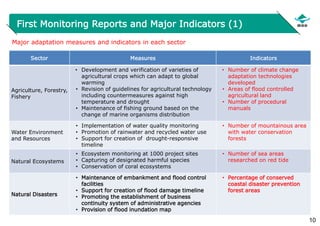
First Monitoring Reports and Major Indicators (1)
Sector Measures Indicators
Agriculture, Forestry,
Fishery
• Development and verification of varieties of
agricultural crops which can adapt to global
warming
• Revision of guidelines for agricultural technology
including countermeasures against high
temperature and drought
• Maintenance of fishing ground based on the
change of marine organisms distribution
• Number of climate change
adaptation technologies
developed
• Areas of flood controlled
agricultural land
• Number of procedural
manuals
Water Environment
and Resources
• Implementation of water quality monitoring
• Promotion of rainwater and recycled water use
• Support for creation of drought-responsive
timeline
• Number of mountainous area
with water conservation
forests
Natural Ecosystems
• Ecosystem monitoring at 1000 project sites
• Capturing of designated harmful species
• Conservation of coral ecosystems
• Number of sea areas
researched on red tide
Natural Disasters
• Maintenance of embankment and flood control
facilities
• Support for creation of flood damage timeline
• Promoting the establishment of business
continuity system of administrative agencies
• Provision of flood inundation map
• Percentage of conserved
coastal disaster prevention
forest areas
Major adaptation measures and indicators in each sector
11
Local Adaptation Planning Manuals
[STEP 2]
Summarization of the impacts of climate change up until now
Field Item
2-1 2-2
Summary of the
climate change
impacts that have
occurred up until now
Summary of
meteorological
phenomena leading
to 2-1
• Local governments can collect and compile information in accordance with the steps described in the Manual.
• Draft local adaptation plan can be created by describing information provided in the Template.
Item Contents described in local adaptation plans
Basic information about
the plan
- Background and objectives - Covered period & review period
- Institutional arrangement for implementation
- Methods for progress check
Local characteristics
- Geographical conditions - Socioeconomic conditions
- Climate characteristics
Climate change impacts
- Meteorological disasters occurred
- Emerging impacts of climate change
- Projections of future impacts of climate change
- Assessments results on the impacts of climate change
Adaptation measures
- Prioority measures in the area
- Specific adaptation measures in each field
Collect and
compile
necessary
information
Procedure
Describes methods for
information collection and
contents to be described
according to the standard
procedures to formulate the local
adaptation plans
Template
Draft local adaptation plan can be
created by describing information
collected according to the
Procedure
Local Climate Change Adaptation Plan
Formulation Manual
<Examples of items described in local adaptation plans>
Creation of draft local adaptation plan
<Information Summary Sheet (partial excerpt)>
List
consolidated
information on
the template
*See slide No. 3 for STEP
*The formulation and revision of local
adaptation plans does not necessarily
have to be done according to the
procedure and methods described in
the manual.
Local adaptation plan can be
formulated by referencing local
conditions as appropriate, including
past adaptation measures, institutional
arrangement, the status of scientific
data collection, and etc.
Consolidate information into
Information Summary Sheet (Excel)
Manuals (procedure and template), and information summary
sheet files are available from A-PLAT website
http://www.adaptation-
platform.nies.go.jp/jichitai/plan/index.html
12
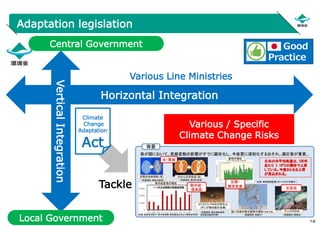
Adaptation legislation
Horizontal Integration
Vertical
Integration
Local Government
Various Line Ministries
Various / Specific
Climate Change Risks
Climate
Change
Adaptation
Act
Tackle
Central Government
13
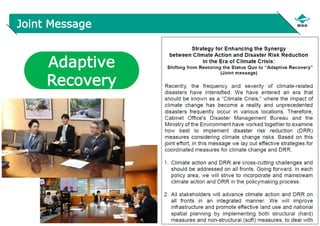
Joint Message
Adaptive
Recovery
14
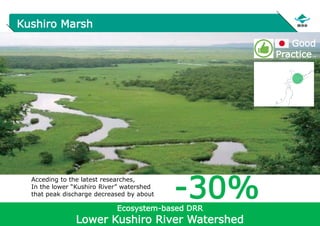
Kushiro Marsh
Ecosystem-based DRR
Lower Kushiro River Watershed
Acceding to the latest researches,
In the lower “Kushiro River” watershed
that peak discharge decreased by about -30%
Good
Practice
15
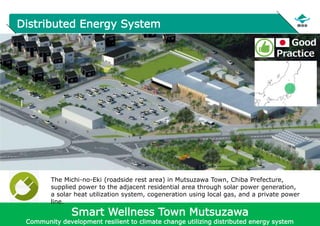
Distributed Energy System
Smart Wellness Town Mutsuzawa
Community development resilient to climate change utilizing distributed energy system
The Michi-no-Eki (roadside rest area) in Mutsuzawa Town, Chiba Prefecture,
supplied power to the adjacent residential area through solar power generation,
a solar heat utilization system, cogeneration using local gas, and a private power
line.
16
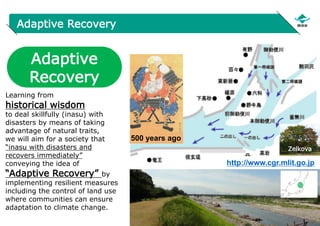
Adaptive Recovery
http://www.cgr.mlit.go.jp
Adaptive
Recovery
Learning from
historical wisdom
to deal skillfully (inasu) with
disasters by means of taking
advantage of natural traits,
we will aim for a society that
“inasu with disasters and
recovers immediately”
conveying the idea of
“Adaptive Recovery” by
implementing resilient measures
including the control of land use
where communities can ensure
adaptation to climate change.
500 years ago
Zelkova

Japan KE4CAP Session 1_may 11p

  • 1.
    Formulation of NationalAdaptation Plan in Japan OKANO Shohei Climate Change Adaptation Office Global Environment Bureau Ministry of the Environment, Japan (MOEJ)
  • 2.
    2 Climate Change AdaptationAct  Decide roles of national and local governments, private sectors, and citizens to promote climate change adaptation.  MOE shall implement climate change impact assessments, every 5 years. (The NAP needs to be revised accordingly.)  National government shall formulate National Adaptation Plan (NAP) to promote adaptation in all sectors. 1.Comprehensive Adaptation Programme  The National Institute for Environmental Studies (NIES) operates Climate Change Adaptation Platform (A-PLAT) as center of excellence.  NIES gives technical advice and assistance to local gov’ts and centers 2.Information Platform Local gov’ts are asked to;  Formulate Local Adaptation Plans.  Designate Local Adaptation Center for climate change data collection and provision locally.  Organize Regional Councils to promote adaptation measures in a cooperative manner with neighbor local governments. 3.Adaptation in Local Areas Promote effective adaptation measures in various fields based on reliable scientific information  Promote International cooperation.  Promote adaptation business. 4.International Actions and Business http://www.adaptation-platform.nies.go.jp/index.html Future projection of Rice yields Future projection of Disappear ed beach ※High quality rice yields Agriculture, Forestry, Fisheries Water Environment and Resources Natural Ecosystems Natural Disasters Human Health Industries and Economic Activity City and Life of Citizens
  • 3.
    3 Climate Change Impactsin Japan Extreme Weather Events Record breaking heavy rainfall in wide area of western Japan in July 2018 (出典:気候変動監視レポート2017(気象庁)) 【2018年7月23日の日最高 気温】 (出典:気象庁) 【2018年熱中症によ る 救急搬送状況】 (出典:消防庁) Agricultural Crops Degraded quality of crops e.g. rice grains and fruits Immature grains when daily mean temperature exceeds 27 degree in ripening period. Oranges’ skin and pulp are separated due to high temperature and increase rainfall after ripening Increasing heavy rainfall Heat Stroke/ Infectious diseases Tiger mosquitoes, vector of dengue fever is expanding to north. Record of the highest temperature; 41.1 degree C in Kumagaya, Saitama Heaat stroke patients in summer has been 40,000 and 50,000 since 2010 Ecosystems Coral reef whitening, damaged by the increased seawater temperature Thunderbird is endangered due to decreasing habitats
  • 4.
    4 Climate Change ImpactAssessment in Japan (Summary)
  • 5.
    5 Roadmap of Climatechange impact assessments and formulation of national adaptation plans 5 Central Environment Council Expert Committee on Climate Change Impact Assessment Government of Japan 2015 “Report on Assessment of Impacts of Climate Change in Japan and Future Challenges” (Central Environment Council on March 2015) “National Plan for Adaptation” (Cabinet Decision on 27 November 2015) 2016 Expert Committee (in October )  Starting discussion for scoping in the 2nd Climate Impact Assessment 2017 Monitoring of 1st NAP (Annually) (Inter-Ministry Meeting for Adaptation ) 2018 (Climate Change Adaptation Act) (Formulation of 1st NAP (statutory)) 2019 2020 The 2nd Climate Change Impact Assessment (MOEJ, Dec 2020) 2021~ Formulation of 2nd NAP “Integrated report on observation, projection and impact assessment of climate change 2018” (Published on February 2018 *Japanese Only)
  • 6.
    6 National Adaptation Plan:Basic Policy Avoid or minimize negative impacts of CC Mainstreaming adaptation in all policies Objective Strategies 1 Adaptation in Agriculture, disaster reduction, health etc. Science-based adaptation 2 Promotion of monitoring, projection, evaluation and R&D Info. platform as a center of excellence 3 Cooperation among relatide research institutes and NIES Localizing adaptation actions Local plan, Regional consortium Understanding of citizens and business Promotion of Adaptation business Assistance to developing countries 6 Asia Pacific Info. Platform Cooperation among ministries 7 New Headquarter for Adaptation(Chaired by Env. Minister) Citizens Business National Government Local government ・Local adaptation ・Assist local stakeholders ・Adaptation in daily life ・Cooperate adaptive actions ・Risk management ・Adaptation business NIES (Research Institutes) ・Information Platform ・Technically assist local actions ・National adaptation ・Assist the other stakeholders Role of stakeholders Impact assessment Progress check Evaluation methods Published in December 2020 PDCA 5 4 Future Projection of Rice Yields Adaptation Information Platform Take effective adaptation actions based on reliable and detailed information Secure Citizen’s life, Socio- economy and Ecosystem + Achieve Safe and Sustainable Society Planning Period Taking into account prediction of this century, Show policy and measures in coming 5 years With 7 pillars of strategy, ministries promote adaptive actions cooperatively Develop/update NAP Take actions in NAP Annual Follow-up of progress Updating actions Impact Assessment Plan Do Check Action Evaluation methods Update NAP based on periodical impact assesment and progress check Annual follow-up Develop evaluation methods, indicators
  • 7.
    7 (2)②-1 Basic Directionsfor Measures in Each Sector (Natural Disasters, Coastal Areas) ・ 10-30% increase of risk for heavy rainfall events which might cause floods in major river basins in Japan by the end of this century compared to the present ・ Concern about the frequent occurrence of water disasters due to natural hazards exceeding the capacity of facilities and occurrence of extremely large scale water disasters which rarely occur but significantly exceeds the capacity of facilities ・ Increase of coastal erosion due to long-term sea-level rise ・ Storm surges and stronger waves as a result of increase of typhoon strength due to climate change. ・ Risk for damage to coastal protection facilities and breakwaters in harbors and fishing ports due to increase in wave height and storm surges. ・ Stead improvement of facilities including levees, flood control structures and sewer systems ・ Reduction of inundation/ Restrain of flooding area expand in cooperation with Urban Development/Local Development ・ Improvement of institutional arrangements for Disaster Response through collaboration among All Stakeholders. Flood・inland water Storm surges・High waves ・ Improvement of facilities for more robust structures and coastal disaster prevention forests ・ Monitoring for weather and marine change / Impact assessment using simulations of projections for inundation due to storm surges and high waves ・ Development of technologies for levees, measures against coastal erosion and so on Source: Ministry of Land, Infrastructure, Transport and Tourism, Japan To design of facilities to avoid rework in expectation of the frequency of occurrence of heavy rainfalls in the future. To adopt structural type which have easily enhancement of facilities such as Supposing wide range to precipitation amount in the design stage, enhancement of base in advance. Ex: Water lock gate of Nikkoukawariver (Aichi Pref.)
  • 8.
    8 (2)②-2 Basic Directionsfor Measures in Each Sector (Natural Disasters, Coastal Areas) ・ Improvement of facilities and equipment focusing in the areas which are most effective to protect human life ・ Support for hazard mapping and action planning for disasters prevention ・ Strengthening national land monitoring systems by the use of satellites. Debris flows, Landslide, etc. ○居住等を誘導すべき区域等の設定 居住等を誘導 すべき区域等 中 高 低 災害リスク 災害リスクの低い地域へ居住や都市機能を 誘導 ○施設の整備 居住等を誘導すべき区域等において、河川 や下水道等の整備、雨水貯留施設、浸透施 設等の整備を重点的に推進 ○災害リスクを考慮した土地利用 ※災害リスクの高い地域は居住等を誘導すべき区 域等から除外 災害リスクが特に高い地域について、土砂災 害特別警戒区域の指定等により、安全な土 地利用を促す。 災害リスクを考慮した土地利用、住まい方 Land-use/Life-style considering disaster risks Priority areas for residence ○Facilitation Promotion of significant facilities such as rivers, sewer systems, reservoirs and inundations and others for disaster reduction ○Land-use considering disaster risk Promotion of safe land-use especially in high risk areas (etc. designation of sediment disaster special alert areas) Disaster risk High Middle Low Source: Ministry of Land, Infrastructure, Transport and Tourism, Japan ・ Increase of frequency for sediment-related disasters associated with increases in the number of heavy rainfall events and their intensity in short term ・ Increase of sediment-related disasters which hit too fast to evacuate due to sudden local torrential rainfall events ・ Increase of deep-seated slope failure associated with record heavy rainfall from typhoons and other storms ○Area Setting Introduction of law disaster risk areas as residence areas, urban areas and so on * Excluding high risk area for residence
  • 9.
    9 Promotion of ClimateChange Adaptation in Japan under the Leadership of the Ministry of the Environment • Establishment of a new Climate Change Adaptation Promotion Council, chaired by the Minister of the Environment and consists of top officials from concerned ministries and agencies • Establishment of a close coordination system among concerned ministries and agencies. • The government takes the initiative and promotes measures on climate change adaptation in a comprehensive and systematic manner. Government initiatives Chair: Minister of the Environment Ministry of Land, Infrastructure, Transport and Tourism Ministry of Economy, Trade and Industry Ministry of Agriculture, Forestry and Fisheries Ministry of Health, Labour and Welfare Ministry of Education, Culture, Sports, Science and Technology Ministry of Finance Ministry of Foreign Affairs of Japan Ministry of Internal Affairs and Communications Financial Services Agency Cabinet Office Cabinet Secretariat Vice Chair: Vice-Minister of the Environment Ministry of the Environment Climate Change Adaptation Promotion Council *Administrative works are handled by the Ministry of the Environment. Members The 1st meeting was held on December 3, 2018. The 2nd meeting was held on November 25, 2019. The 3rd meeting was held on September 11, 2020. The 4th meeting was held on March 24, 2021. Ministry of Defense
  • 10.
    10 First Monitoring Reportsand Major Indicators (1) Sector Measures Indicators Agriculture, Forestry, Fishery • Development and verification of varieties of agricultural crops which can adapt to global warming • Revision of guidelines for agricultural technology including countermeasures against high temperature and drought • Maintenance of fishing ground based on the change of marine organisms distribution • Number of climate change adaptation technologies developed • Areas of flood controlled agricultural land • Number of procedural manuals Water Environment and Resources • Implementation of water quality monitoring • Promotion of rainwater and recycled water use • Support for creation of drought-responsive timeline • Number of mountainous area with water conservation forests Natural Ecosystems • Ecosystem monitoring at 1000 project sites • Capturing of designated harmful species • Conservation of coral ecosystems • Number of sea areas researched on red tide Natural Disasters • Maintenance of embankment and flood control facilities • Support for creation of flood damage timeline • Promoting the establishment of business continuity system of administrative agencies • Provision of flood inundation map • Percentage of conserved coastal disaster prevention forest areas Major adaptation measures and indicators in each sector
  • 11.
    11 Local Adaptation PlanningManuals [STEP 2] Summarization of the impacts of climate change up until now Field Item 2-1 2-2 Summary of the climate change impacts that have occurred up until now Summary of meteorological phenomena leading to 2-1 • Local governments can collect and compile information in accordance with the steps described in the Manual. • Draft local adaptation plan can be created by describing information provided in the Template. Item Contents described in local adaptation plans Basic information about the plan - Background and objectives - Covered period & review period - Institutional arrangement for implementation - Methods for progress check Local characteristics - Geographical conditions - Socioeconomic conditions - Climate characteristics Climate change impacts - Meteorological disasters occurred - Emerging impacts of climate change - Projections of future impacts of climate change - Assessments results on the impacts of climate change Adaptation measures - Prioority measures in the area - Specific adaptation measures in each field Collect and compile necessary information Procedure Describes methods for information collection and contents to be described according to the standard procedures to formulate the local adaptation plans Template Draft local adaptation plan can be created by describing information collected according to the Procedure Local Climate Change Adaptation Plan Formulation Manual <Examples of items described in local adaptation plans> Creation of draft local adaptation plan <Information Summary Sheet (partial excerpt)> List consolidated information on the template *See slide No. 3 for STEP *The formulation and revision of local adaptation plans does not necessarily have to be done according to the procedure and methods described in the manual. Local adaptation plan can be formulated by referencing local conditions as appropriate, including past adaptation measures, institutional arrangement, the status of scientific data collection, and etc. Consolidate information into Information Summary Sheet (Excel) Manuals (procedure and template), and information summary sheet files are available from A-PLAT website http://www.adaptation- platform.nies.go.jp/jichitai/plan/index.html
  • 12.
    12 Adaptation legislation Horizontal Integration Vertical Integration LocalGovernment Various Line Ministries Various / Specific Climate Change Risks Climate Change Adaptation Act Tackle Central Government
  • 13.
  • 14.
    14 Kushiro Marsh Ecosystem-based DRR LowerKushiro River Watershed Acceding to the latest researches, In the lower “Kushiro River” watershed that peak discharge decreased by about -30% Good Practice
  • 15.
    15 Distributed Energy System SmartWellness Town Mutsuzawa Community development resilient to climate change utilizing distributed energy system The Michi-no-Eki (roadside rest area) in Mutsuzawa Town, Chiba Prefecture, supplied power to the adjacent residential area through solar power generation, a solar heat utilization system, cogeneration using local gas, and a private power line.
  • 16.
    16 Adaptive Recovery http://www.cgr.mlit.go.jp Adaptive Recovery Learning from historicalwisdom to deal skillfully (inasu) with disasters by means of taking advantage of natural traits, we will aim for a society that “inasu with disasters and recovers immediately” conveying the idea of “Adaptive Recovery” by implementing resilient measures including the control of land use where communities can ensure adaptation to climate change. 500 years ago Zelkova