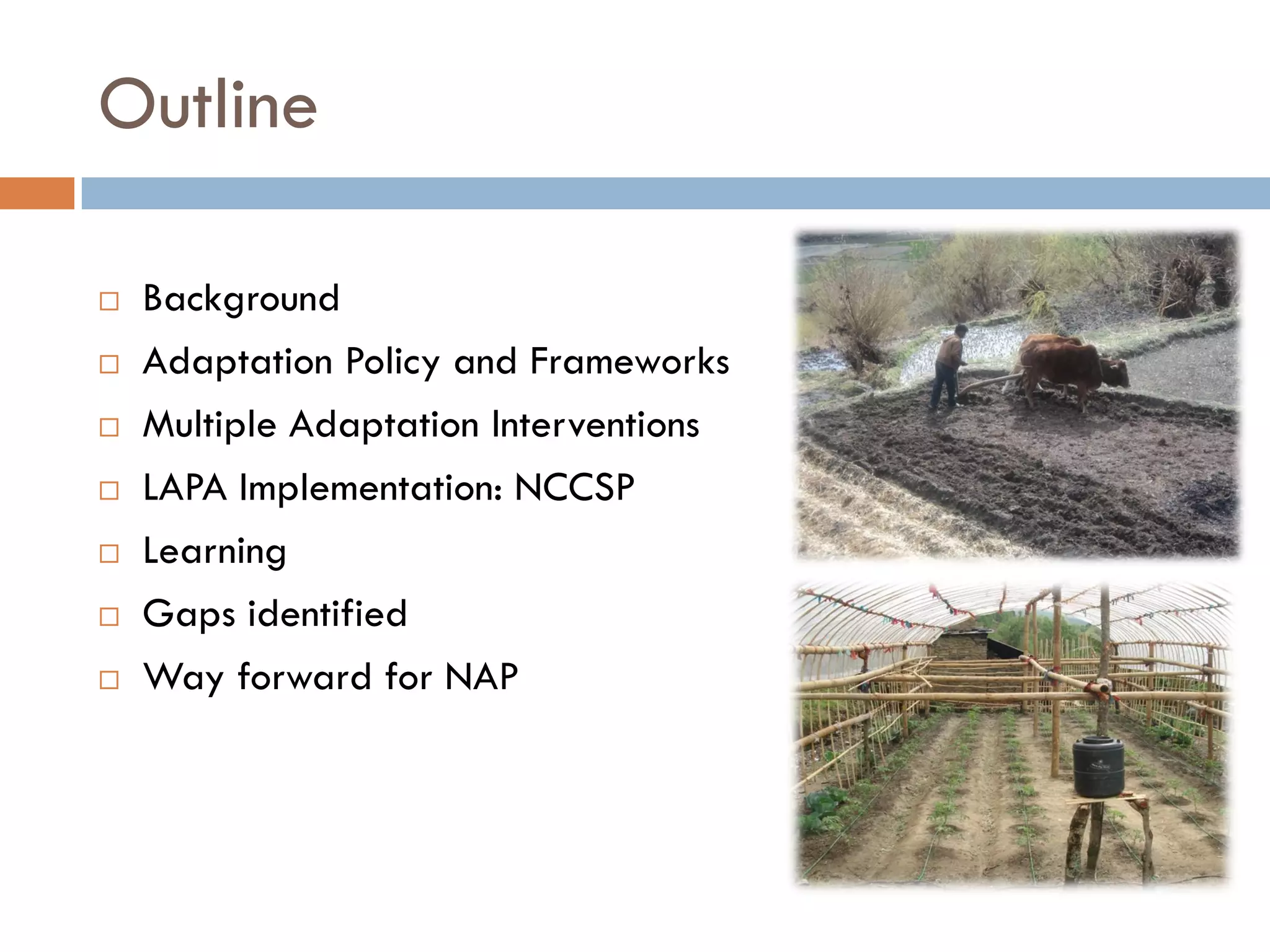
LEARNING FROM LOCAL ADAPTATION
ACTIONS IN NEPAL : A WAY FORWARD
FOR NAP PROCESS
Ananda Raj Pokharel and Binita Bhattarai
Section Officer(s)
Ministry of Science, Technology and Environment, Nepal
Outline
 Background
 Adaptation Policy and Frameworks
 Multiple Adaptation Interventions
 LAPA Implementation: NCCSP
 Learning
 Gaps identified
 Way forward for NAP
Climate change and Nepal
 Nepal one of the most climate change
vulnerable countries
 Enabling policies and plans on climate
change and adaptation
 National Adaptation Programme of
Action (NAPA), Three Year Plan, and
Climate Change Policy and National
Framework on LAPA
 LAPA - localizing implementation of
adaptation actions
 Some stand-alone projects on adaptation
Country Policy
Mainstreaming climate agenda into national
development
Primary objectives:
Poverty reduction
Livelihood improvement and diversification
Building resilience
National Framework on LAPA
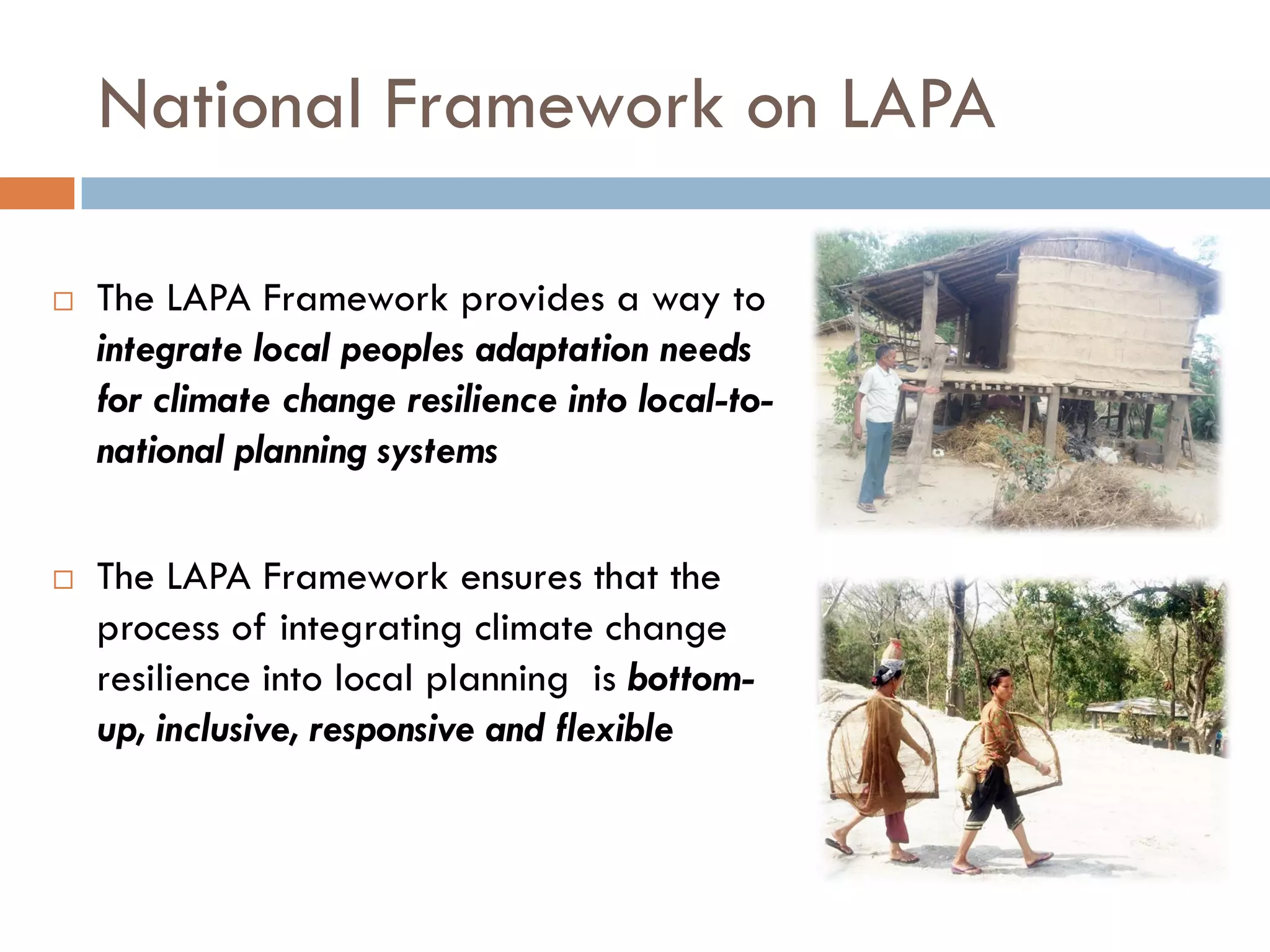
 The LAPA Framework provides a way to
integrate local peoples adaptation needs
for climate change resilience into local-to-
national planning systems
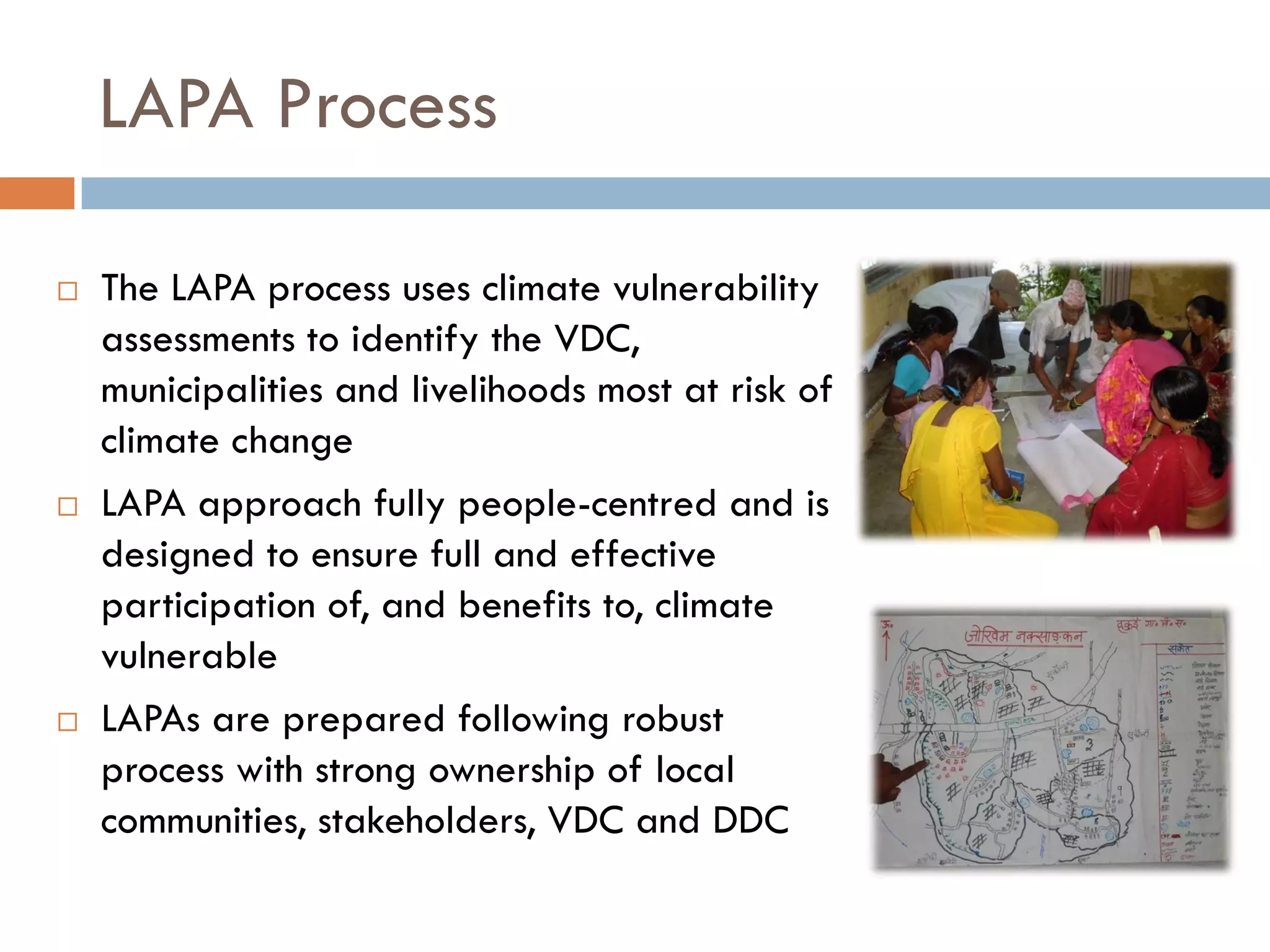
 The LAPA Framework ensures that the
process of integrating climate change
resilience into local planning is bottom-
up, inclusive, responsive and flexible
LAPA Process
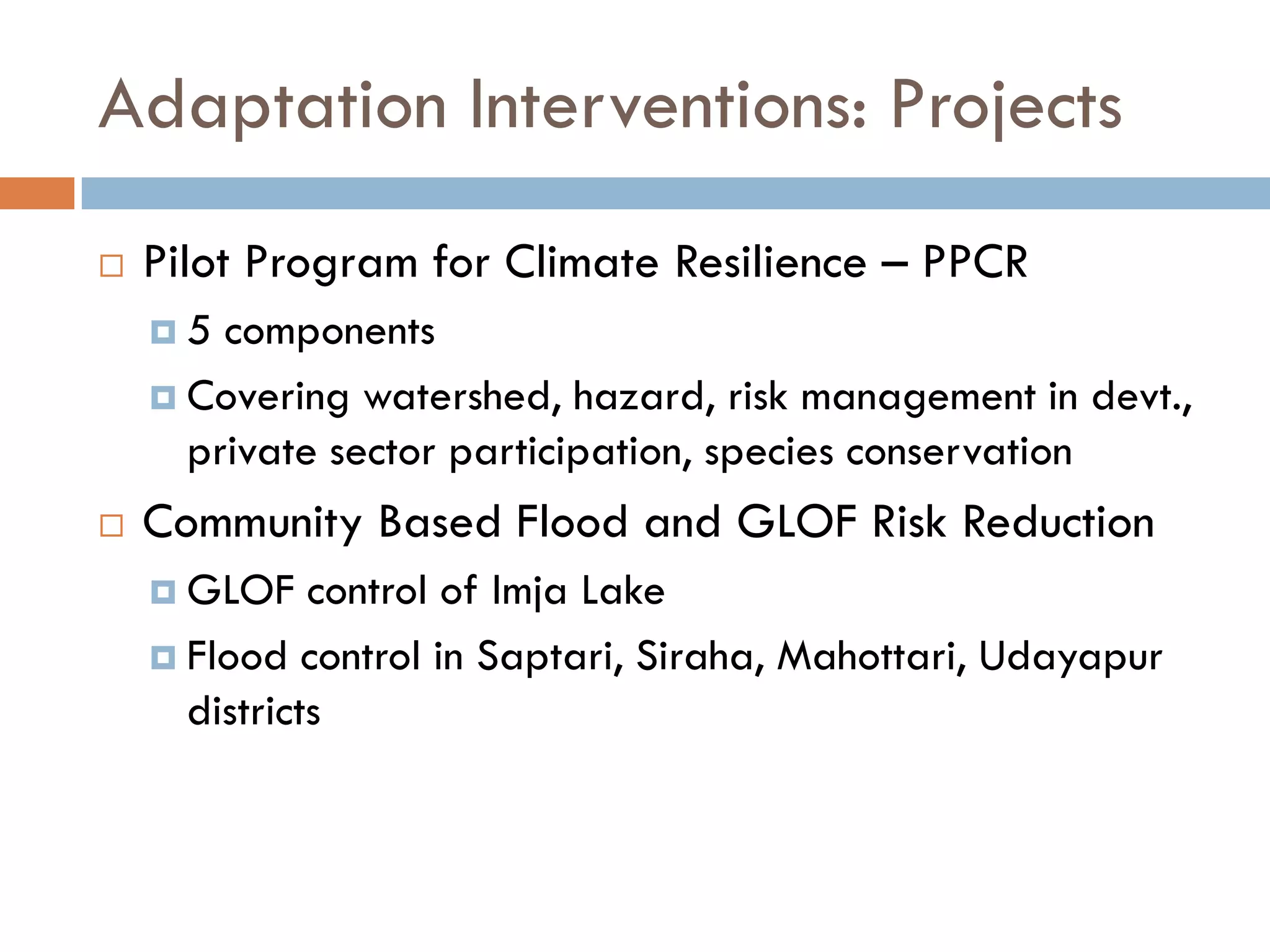
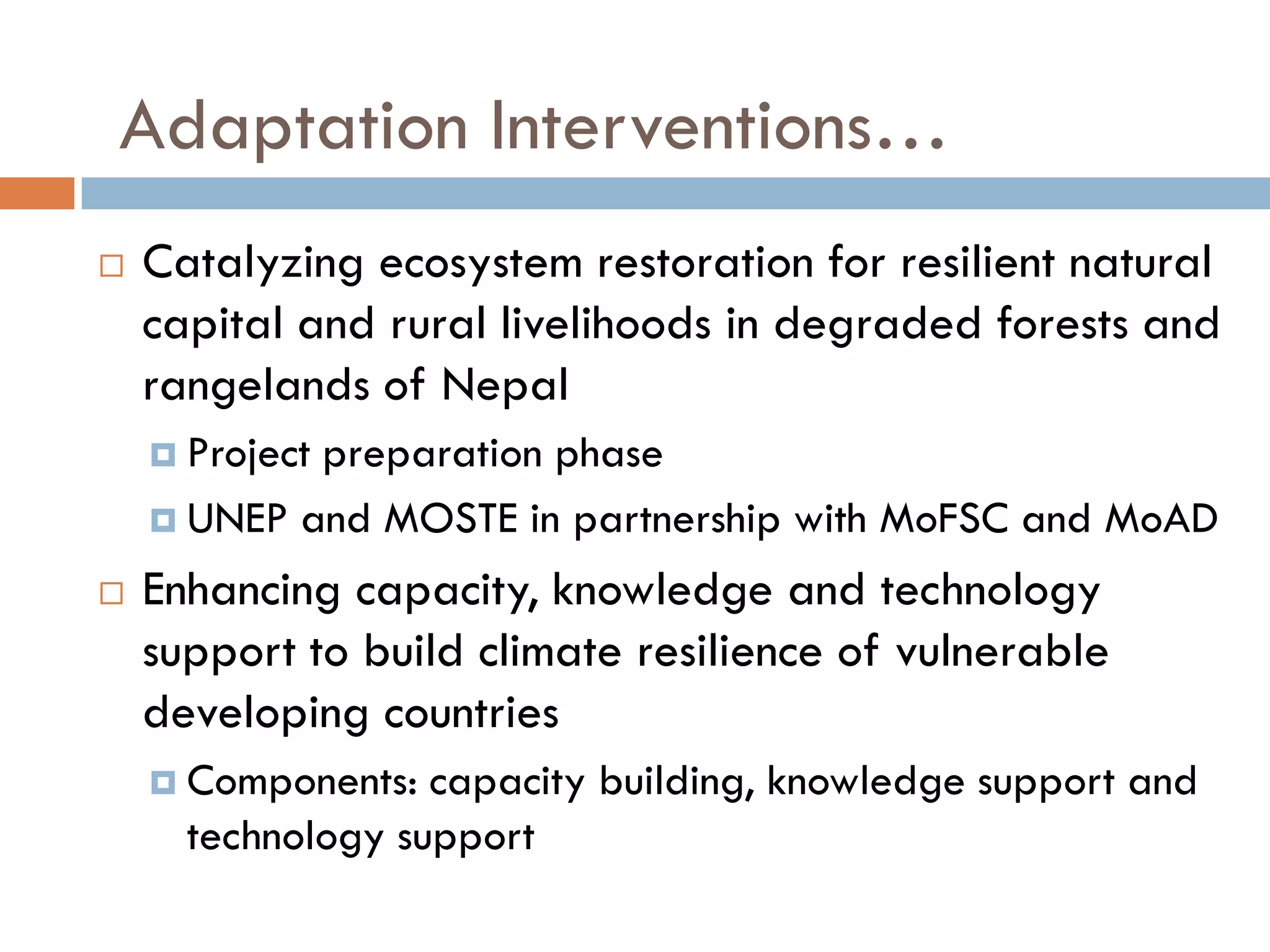
 The LAPA process uses climate vulnerability
assessments to identify the VDC,
municipalities and livelihoods most at risk of
climate change
 LAPA approach fully people-centred and is
designed to ensure full and effective
participation of, and benefits to, climate
vulnerable
 LAPAs are prepared following robust
process with strong ownership of local
communities, stakeholders, VDC and DDC
Adaptation Interventions: Projects
 Pilot Program for Climate Resilience – PPCR
 5 components
 Covering watershed, hazard, risk management in devt.,
private sector participation, species conservation
 Community Based Flood and GLOF Risk Reduction
 GLOF control of Imja Lake
 Flood control in Saptari, Siraha, Mahottari, Udayapur
districts
 Catalyzing ecosystem restoration for resilient natural
capital and rural livelihoods in degraded forests and
rangelands of Nepal
 Project preparation phase
 UNEP and MOSTE in partnership with MoFSC and MoAD
 Enhancing capacity, knowledge and technology
support to build climate resilience of vulnerable
developing countries
 Components: capacity building, knowledge support and
technology support
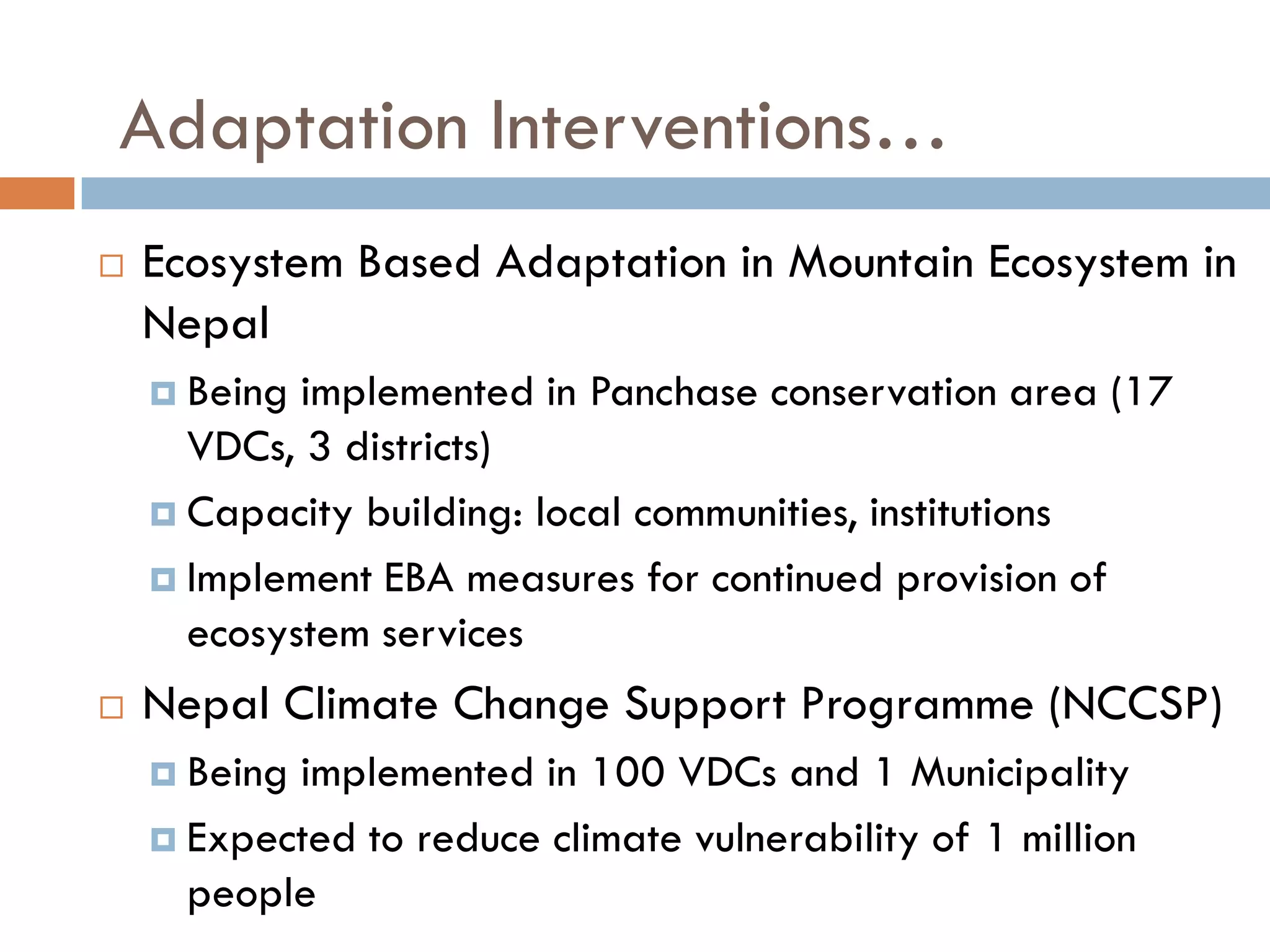
Adaptation Interventions…
 Ecosystem Based Adaptation in Mountain Ecosystem in
Nepal
 Being implemented in Panchase conservation area (17
VDCs, 3 districts)
 Capacity building: local communities, institutions
 Implement EBA measures for continued provision of
ecosystem services
 Nepal Climate Change Support Programme (NCCSP)
 Being implemented in 100 VDCs and 1 Municipality
 Expected to reduce climate vulnerability of 1 million
people
Adaptation Interventions…
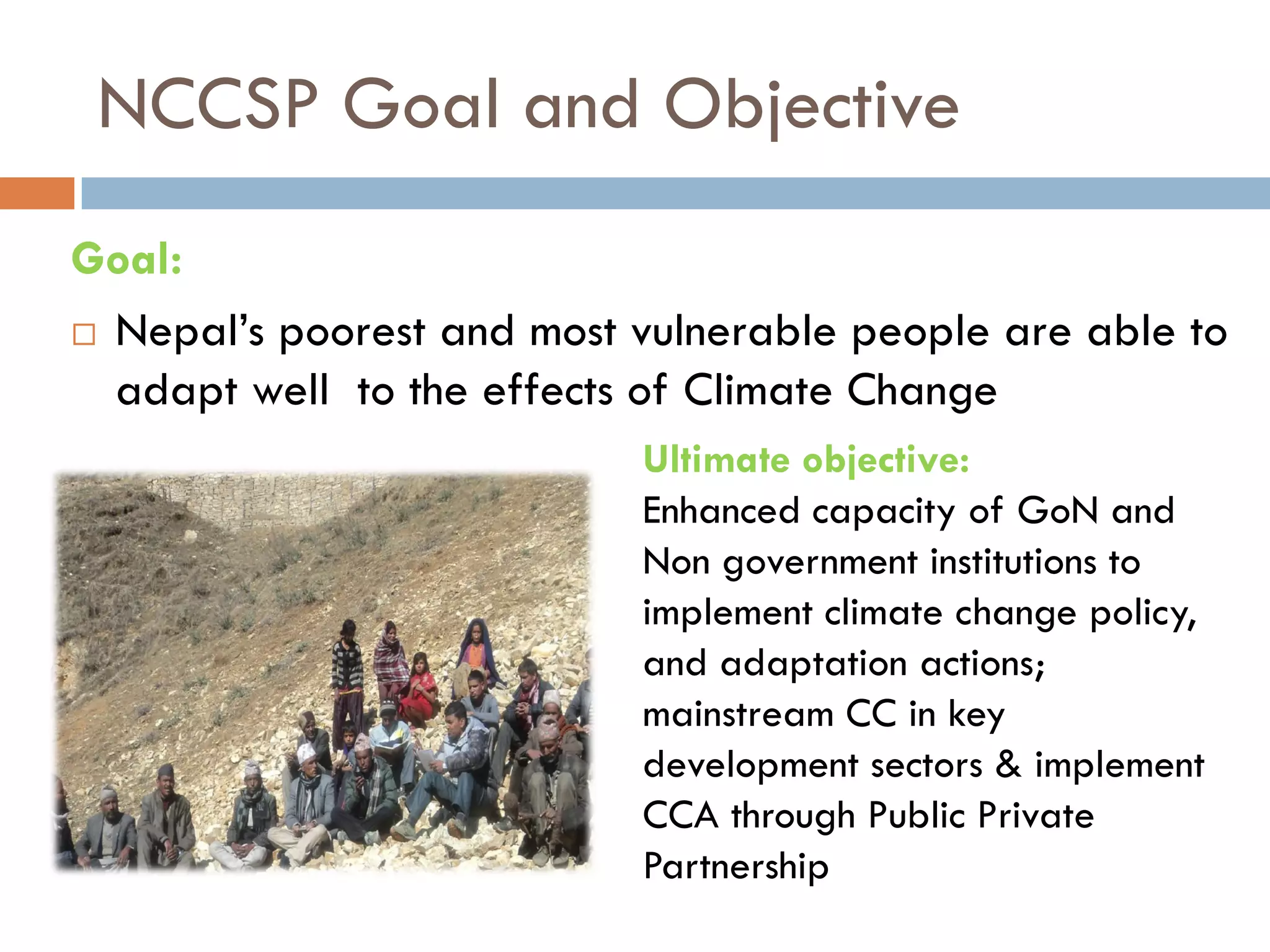
NCCSP Goal and Objective
Goal:
 Nepal’s poorest and most vulnerable people are able to
adapt well to the effects of Climate Change
Ultimate objective:
Enhanced capacity of GoN and
Non government institutions to
implement climate change policy,
and adaptation actions;
mainstream CC in key
development sectors & implement
CCA through Public Private
Partnership
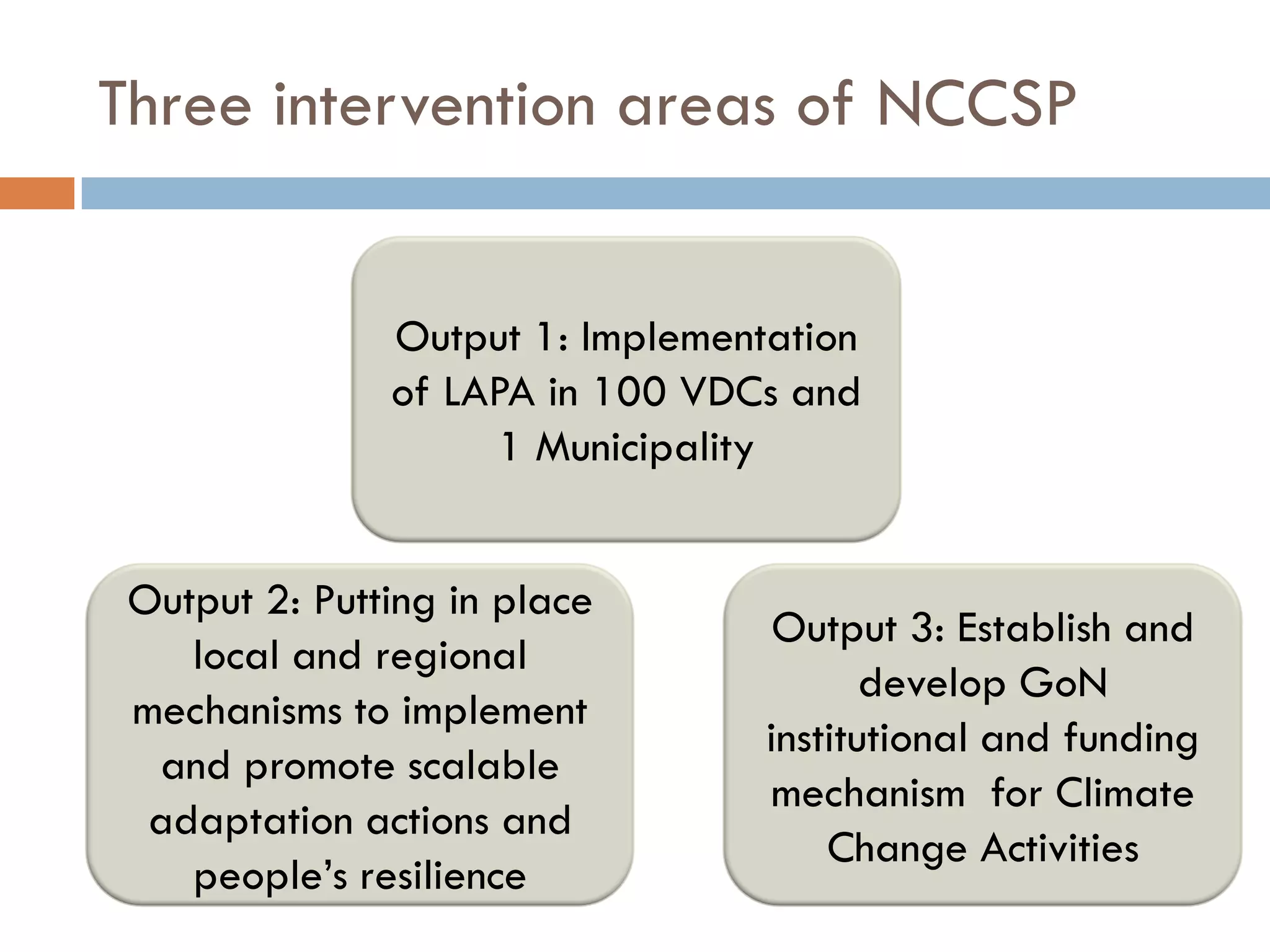
Three intervention areas of NCCSP
Output 2: Putting in place
local and regional
mechanisms to implement
and promote scalable
adaptation actions and
people’s resilience
Output 1: Implementation
of LAPA in 100 VDCs and
1 Municipality
Output 3: Establish and
develop GoN
institutional and funding
mechanism for Climate
Change Activities
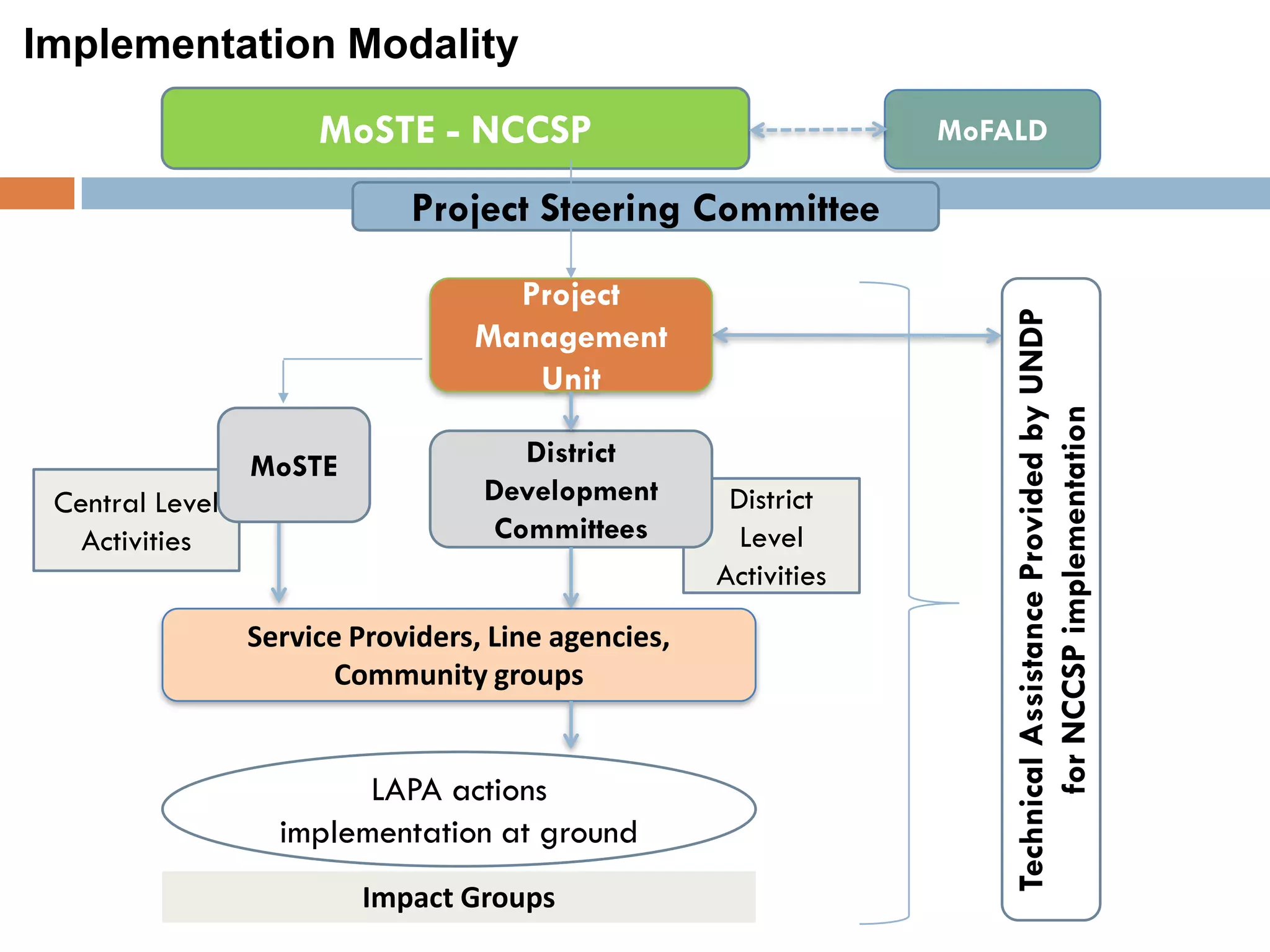
District
Level
Activities
District
Development
Committees
LAPA actions
implementation at ground
Impact Groups
MoSTE - NCCSP
Service Providers, Line agencies,
Community groups
Implementation Modality
MoFALD
Project
Management
Unit
TechnicalAssistanceProvidedbyUNDP
forNCCSPimplementation
Central Level
Activities
Project Steering Committee
MoSTE
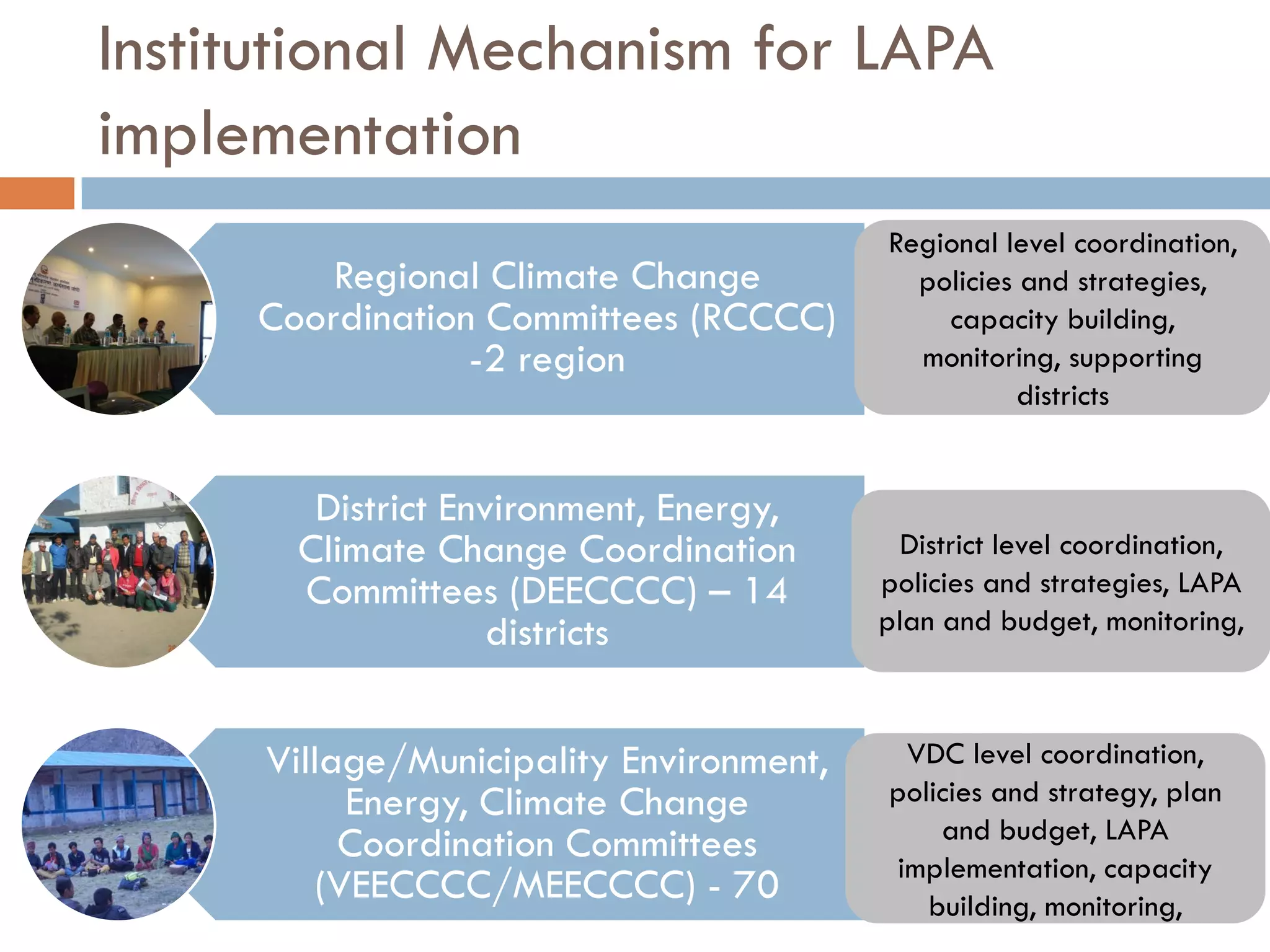
Institutional Mechanism for LAPA
implementation
Regional Climate Change
Coordination Committees (RCCCC)
-2 region
District Environment, Energy,
Climate Change Coordination
Committees (DEECCCC) – 14
districts
Village/Municipality Environment,
Energy, Climate Change
Coordination Committees
(VEECCCC/MEECCCC) - 70
Regional level coordination,
policies and strategies,
capacity building,
monitoring, supporting
districts
District level coordination,
policies and strategies, LAPA
plan and budget, monitoring,
VDC level coordination,
policies and strategy, plan
and budget, LAPA
implementation, capacity
building, monitoring,
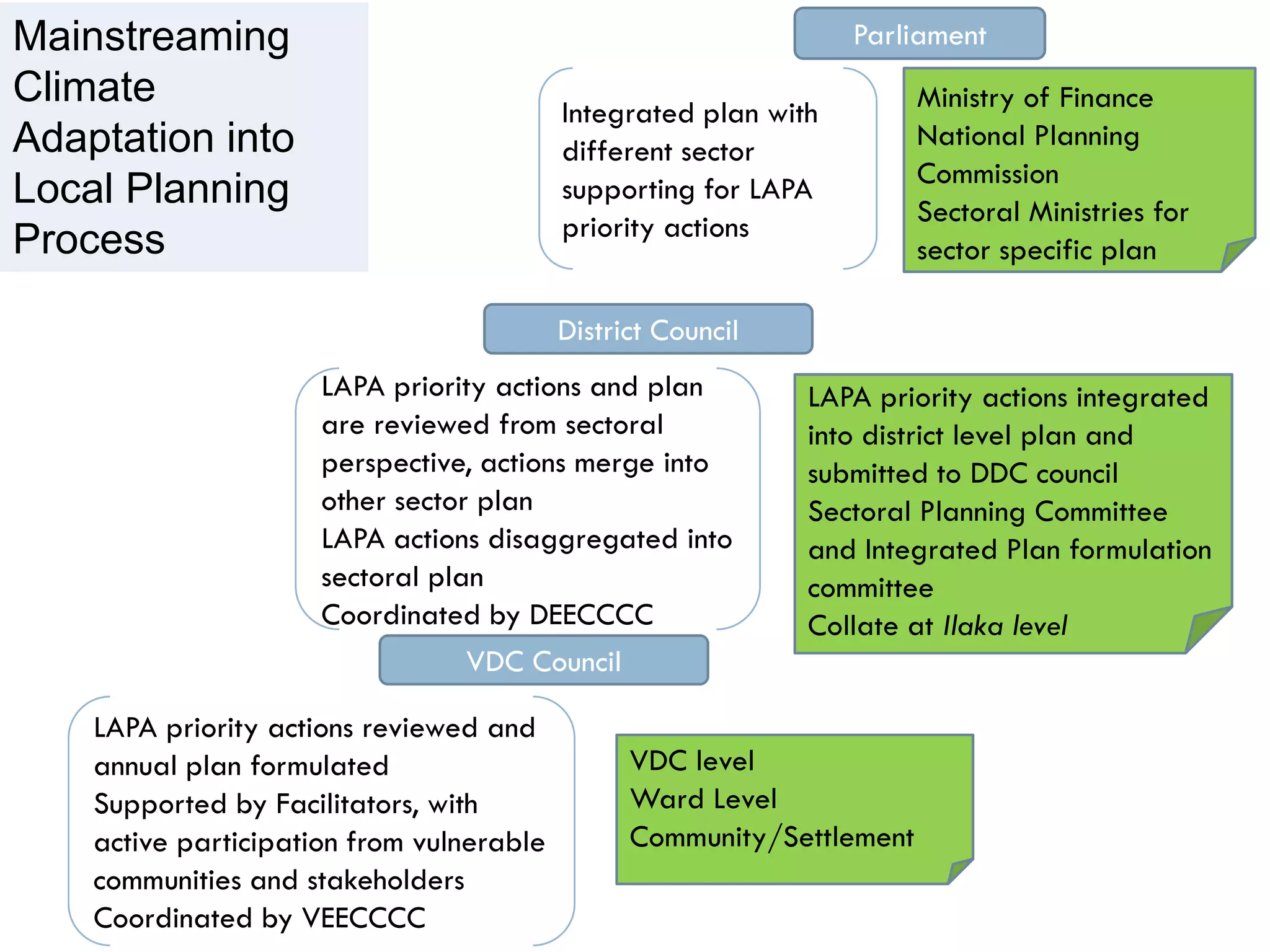
VDC Council
District Council
ParliamentMainstreaming
Climate
Adaptation into
Local Planning
Process
LAPA priority actions reviewed and
annual plan formulated
Supported by Facilitators, with
active participation from vulnerable
communities and stakeholders
Coordinated by VEECCCC
VDC level
Ward Level
Community/Settlement
LAPA priority actions and plan
are reviewed from sectoral
perspective, actions merge into
other sector plan
LAPA actions disaggregated into
sectoral plan
Coordinated by DEECCCC
LAPA priority actions integrated
into district level plan and
submitted to DDC council
Sectoral Planning Committee
and Integrated Plan formulation
committee
Collate at Ilaka level
Ministry of Finance
National Planning
Commission
Sectoral Ministries for
sector specific plan
Integrated plan with
different sector
supporting for LAPA
priority actions
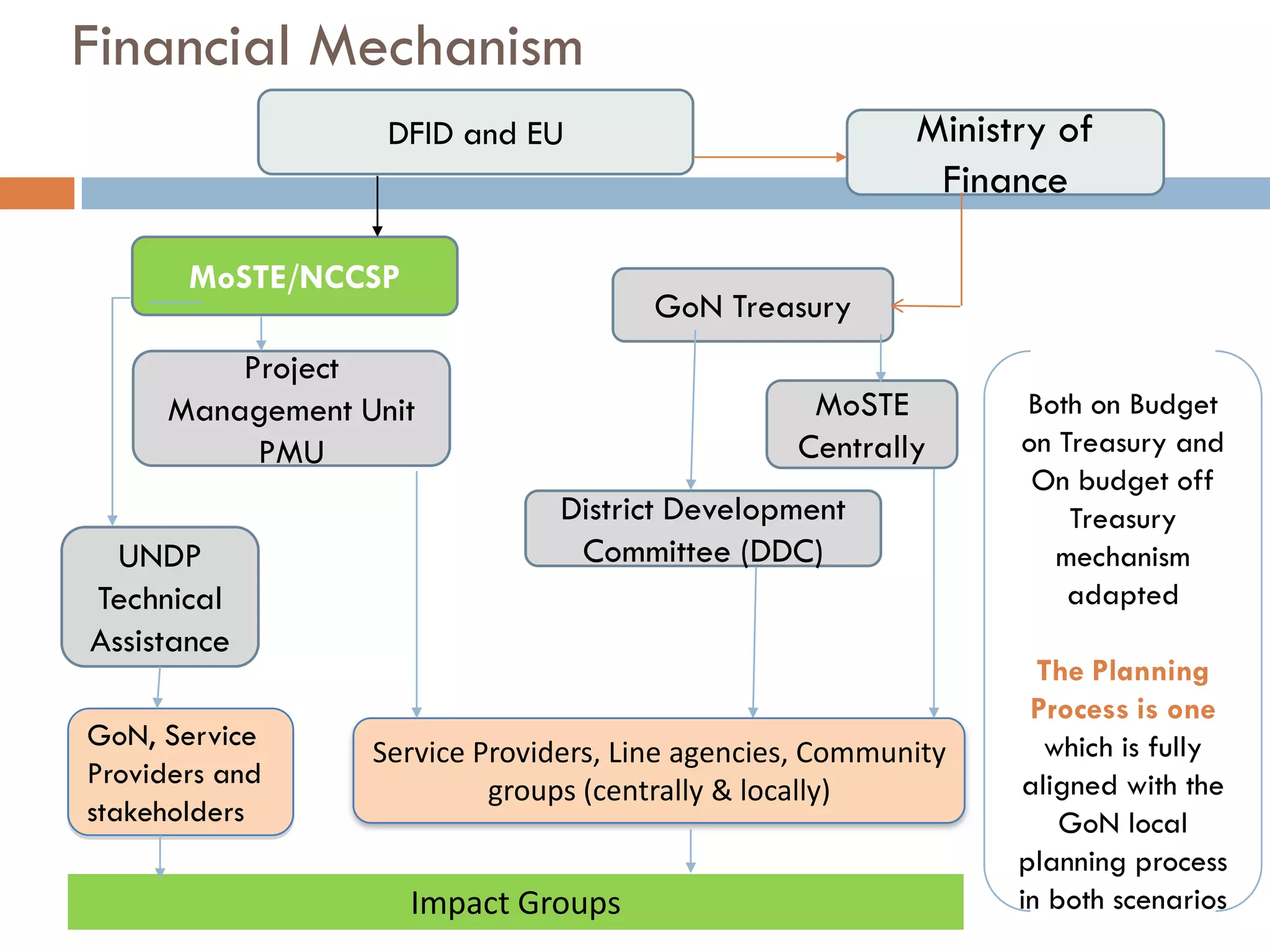
Financial Mechanism
Impact Groups
GoN Treasury
Ministry of
Finance
District Development
Committee (DDC)
MoSTE/NCCSP
DFID and EU
MoSTE
Centrally
Project
Management Unit
PMU
Service Providers, Line agencies, Community
groups (centrally & locally)
UNDP
Technical
Assistance
GoN, Service
Providers and
stakeholders
Both on Budget
on Treasury and
On budget off
Treasury
mechanism
adapted
The Planning
Process is one
which is fully
aligned with the
GoN local
planning process
in both scenarios
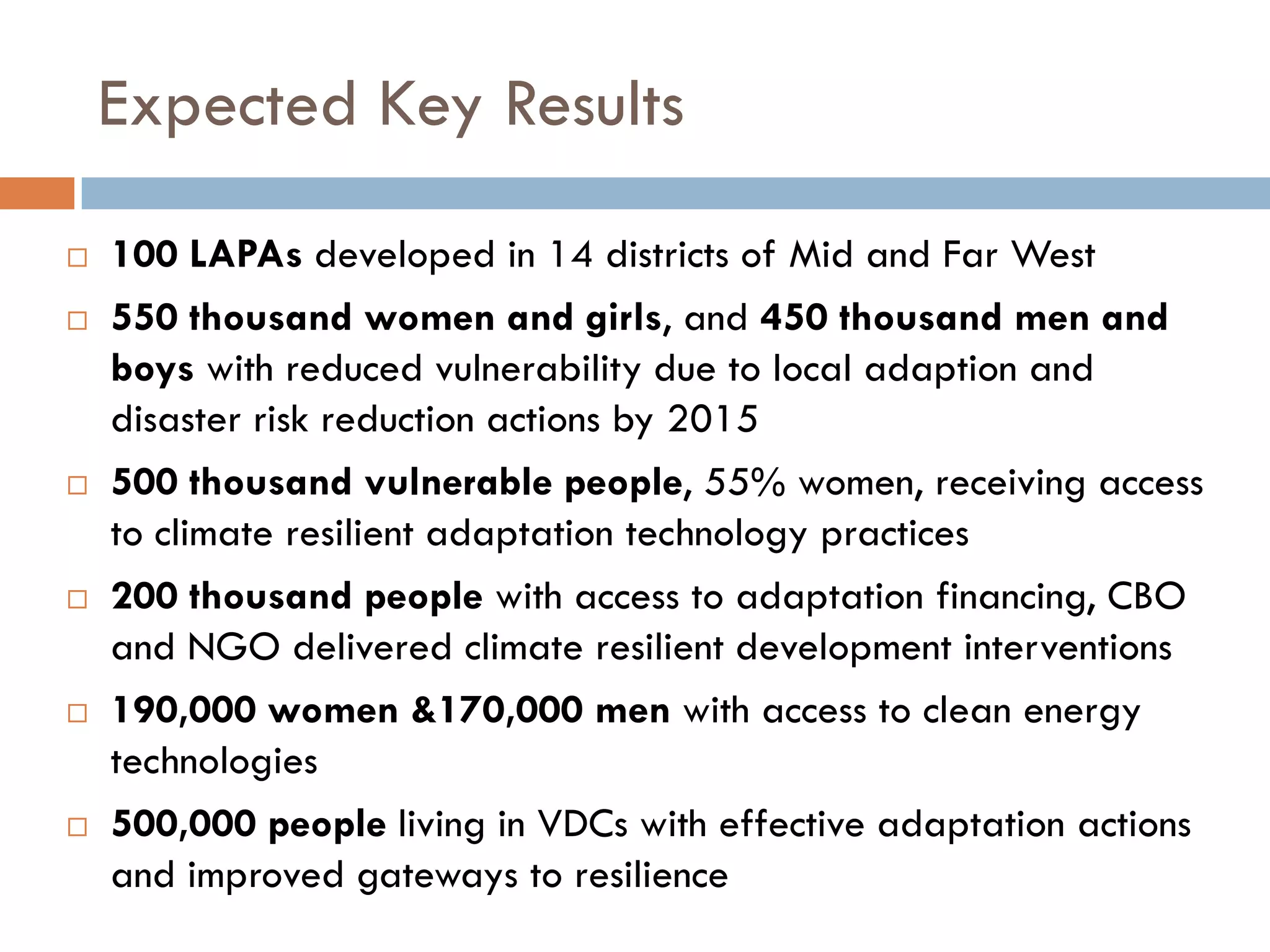
Expected Key Results
 100 LAPAs developed in 14 districts of Mid and Far West
 550 thousand women and girls, and 450 thousand men and
boys with reduced vulnerability due to local adaption and
disaster risk reduction actions by 2015
 500 thousand vulnerable people, 55% women, receiving access
to climate resilient adaptation technology practices
 200 thousand people with access to adaptation financing, CBO
and NGO delivered climate resilient development interventions
 190,000 women &170,000 men with access to clean energy
technologies
 500,000 people living in VDCs with effective adaptation actions
and improved gateways to resilience
Key milestones of NCCSP (2012-2014)
 Seventy LAPAs prepared, additional LAPAs in 30 VDCs is
being prepared from July 2014
 Institutional framework and coordination mechanism
established
 Capacity Development Plan prepared
 Monitoring and Evaluation framework prepared
 Low Carbon Economic Development Strategy started and
ongoing
 Political agreement on Low Carbon Development Strategy
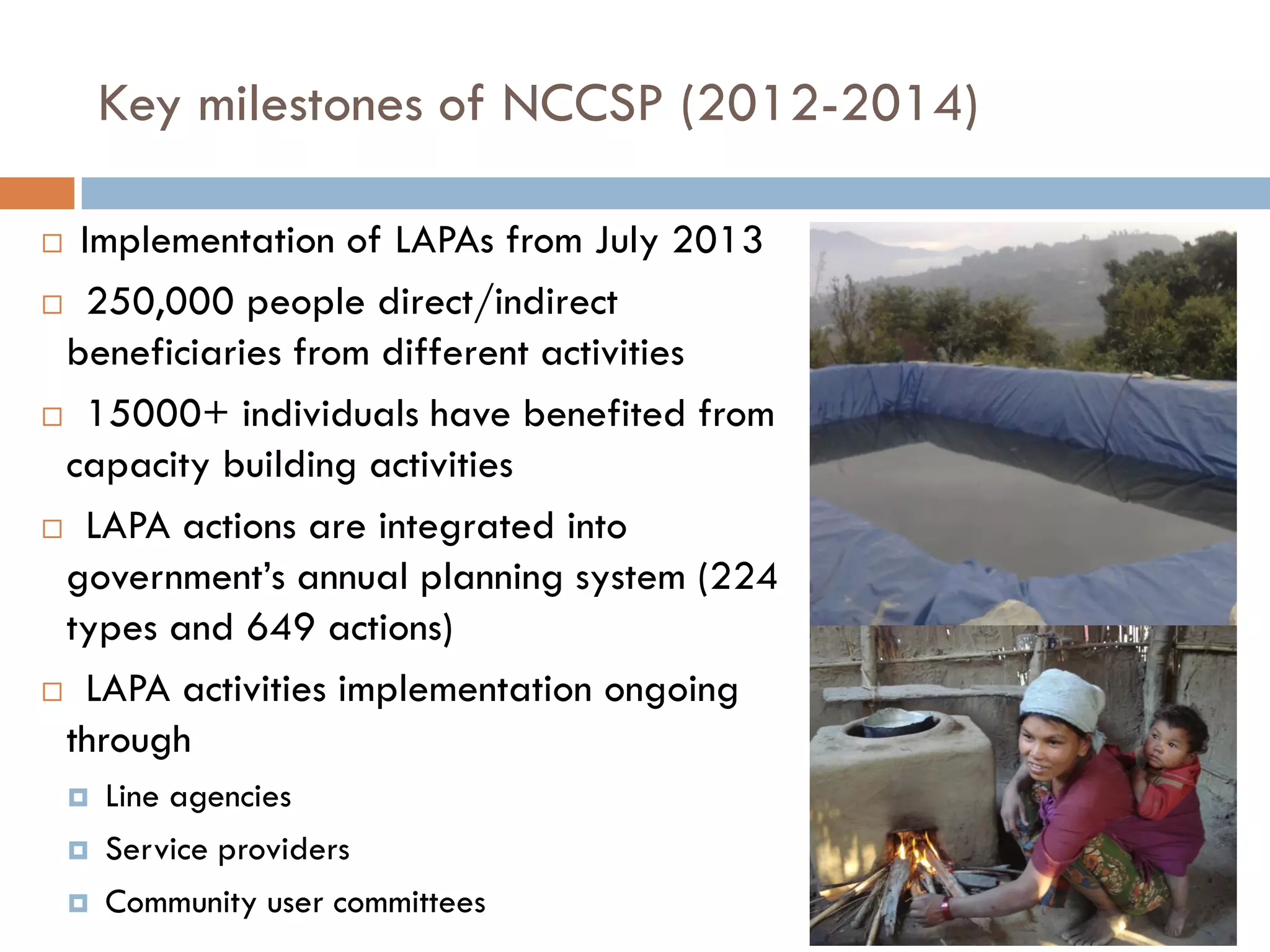
Key milestones of NCCSP (2012-2014)
 Implementation of LAPAs from July 2013
 250,000 people direct/indirect
beneficiaries from different activities
 15000+ individuals have benefited from
capacity building activities
 LAPA actions are integrated into
government’s annual planning system (224
types and 649 actions)
 LAPA activities implementation ongoing
through
 Line agencies
 Service providers
 Community user committees
Learning
 Ownership of the government at National to Local level is
critical for mainstreaming and implementation of LAPA
 Building on existing systems and mechanism enables the
operationalization of LAPA smooth and sustainable
 Engagement of multi-sector and multi-stakeholders is essential
throughout LAPA process to ensure range of thematic coverage
 Efforts has to be put into strengthening the system (governance,
structures and mechanisms, capacity of central and local
government) to directly benefit the climate vulnerable
communities and to ensure prompt service delivery of LAPA
priority actions
Learning continued….
 Flexible management approach is necessary to be responsive
to the local context to deal with any hurdles in LAPA delivery
while implementation
 Good examples of mainstreaming and leveraging finances at
local level to enable the local communities to successfully
implement big project where funding gap exist
 LAPAs are therefore becoming a plan that gives other agencies
a basis to support vulnerable communities to adapt to change.
Gaps identified
 Common national goal/targets to ensure unified
results among multiple adaptation interventions is
necessary;
 A number of interventions/projects are being
implemented which has increased operational cost
of the system;
 Some projects are being run off-budget and off-
treasury;
 Projects tend to invest the most in policy and
central-level activities;
Gaps identified…
 Quality data and information is lagging for fact
based adaptation planning;
 Scientifically proven theoretical frame and indicator
for measuring community and system resilience is
highly desirable;
 Many adaptation interventions have used ‘no regret
options’ as the basis for deciding on adaptive
interventions;
 Identification and assessment of the adaptive
capacity of the interventions (activities on ground) is
necessary;
Gaps identified…
 Creation of functioning learning network among
government and non government stakeholders,
including private sector, is necessary;
 Investment in local technological innovation is
necessary to ensure sustainability of system
resilience
Way forward for NAP
 Key Result Areas:
 Creation of National Adaptation Plan document
 Creation of Climate Change Fund
 Implementation of Sector Wide Approach (SWAp) framework in the
climate change planning and implementation process
 Mobilization of climate finance through climate change budget code
 Harmonize adaptation interventions with national system and policies
 Build capacity of MoSTE and government organizations (central and
local)
 Strengthen sector coordination and bring synergy
 Reduce vulnerability of local population to climate induced hazards
and strengthen livelihood options, significantly
 Build local innovation systems and promote local technological
innovations.
Way forward for NAP…
 Action Plan for Implementing NAP process:
 Institutional Arrangements and Mandate for NAP
 NAP Stocktaking
 Envisioning NAP
 Capacity Building for NAP
 Drafting National Adaptation Plan
 Implementation Strategies
 Launching NAP Implementation
 Implementing NAP
 Reporting, Monitoring and Review
THANK YOU
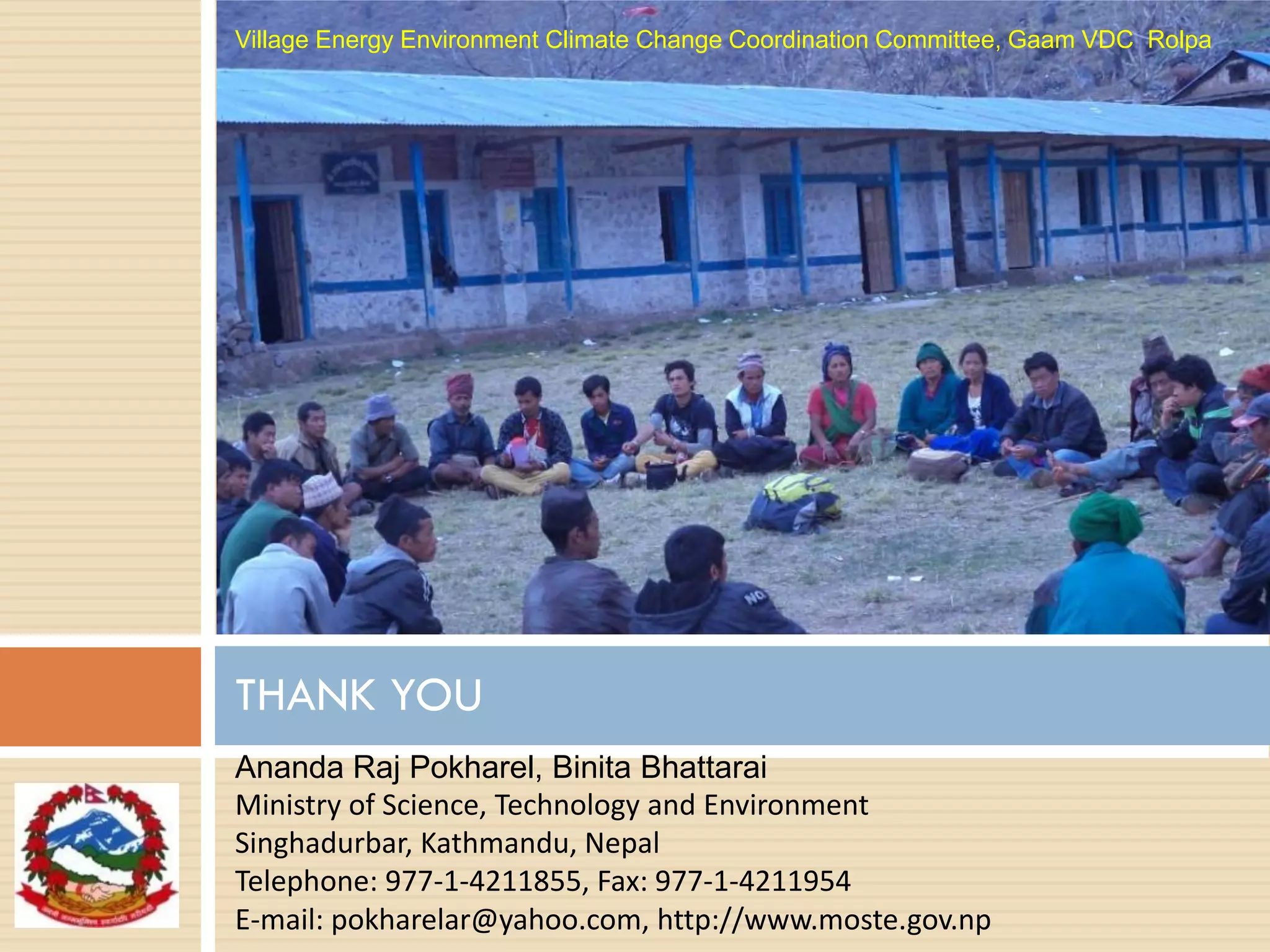
Village Energy Environment Climate Change Coordination Committee, Gaam VDC Rolpa
Ananda Raj Pokharel, Binita Bhattarai
Ministry of Science, Technology and Environment
Singhadurbar, Kathmandu, Nepal
Telephone: 977-1-4211855, Fax: 977-1-4211954
E-mail: pokharelar@yahoo.com, http://www.moste.gov.np

Ananda Raj Pokharel and Binita Bhattarai: Learning from local adaptation actions in Nepal

  • 1.
    LEARNING FROM LOCALADAPTATION ACTIONS IN NEPAL : A WAY FORWARD FOR NAP PROCESS Ananda Raj Pokharel and Binita Bhattarai Section Officer(s) Ministry of Science, Technology and Environment, Nepal
  • 2.
    Outline  Background  AdaptationPolicy and Frameworks  Multiple Adaptation Interventions  LAPA Implementation: NCCSP  Learning  Gaps identified  Way forward for NAP
  • 3.
    Climate change andNepal  Nepal one of the most climate change vulnerable countries  Enabling policies and plans on climate change and adaptation  National Adaptation Programme of Action (NAPA), Three Year Plan, and Climate Change Policy and National Framework on LAPA  LAPA - localizing implementation of adaptation actions  Some stand-alone projects on adaptation
  • 4.
    Country Policy Mainstreaming climateagenda into national development Primary objectives: Poverty reduction Livelihood improvement and diversification Building resilience
  • 5.
    National Framework onLAPA  The LAPA Framework provides a way to integrate local peoples adaptation needs for climate change resilience into local-to- national planning systems  The LAPA Framework ensures that the process of integrating climate change resilience into local planning is bottom- up, inclusive, responsive and flexible
  • 6.
    LAPA Process  TheLAPA process uses climate vulnerability assessments to identify the VDC, municipalities and livelihoods most at risk of climate change  LAPA approach fully people-centred and is designed to ensure full and effective participation of, and benefits to, climate vulnerable  LAPAs are prepared following robust process with strong ownership of local communities, stakeholders, VDC and DDC
  • 7.
    Adaptation Interventions: Projects Pilot Program for Climate Resilience – PPCR  5 components  Covering watershed, hazard, risk management in devt., private sector participation, species conservation  Community Based Flood and GLOF Risk Reduction  GLOF control of Imja Lake  Flood control in Saptari, Siraha, Mahottari, Udayapur districts
  • 8.
     Catalyzing ecosystemrestoration for resilient natural capital and rural livelihoods in degraded forests and rangelands of Nepal  Project preparation phase  UNEP and MOSTE in partnership with MoFSC and MoAD  Enhancing capacity, knowledge and technology support to build climate resilience of vulnerable developing countries  Components: capacity building, knowledge support and technology support Adaptation Interventions…
  • 9.
     Ecosystem BasedAdaptation in Mountain Ecosystem in Nepal  Being implemented in Panchase conservation area (17 VDCs, 3 districts)  Capacity building: local communities, institutions  Implement EBA measures for continued provision of ecosystem services  Nepal Climate Change Support Programme (NCCSP)  Being implemented in 100 VDCs and 1 Municipality  Expected to reduce climate vulnerability of 1 million people Adaptation Interventions…
  • 10.
    NCCSP Goal andObjective Goal:  Nepal’s poorest and most vulnerable people are able to adapt well to the effects of Climate Change Ultimate objective: Enhanced capacity of GoN and Non government institutions to implement climate change policy, and adaptation actions; mainstream CC in key development sectors & implement CCA through Public Private Partnership
  • 11.
    Three intervention areasof NCCSP Output 2: Putting in place local and regional mechanisms to implement and promote scalable adaptation actions and people’s resilience Output 1: Implementation of LAPA in 100 VDCs and 1 Municipality Output 3: Establish and develop GoN institutional and funding mechanism for Climate Change Activities
  • 12.
    District Level Activities District Development Committees LAPA actions implementation atground Impact Groups MoSTE - NCCSP Service Providers, Line agencies, Community groups Implementation Modality MoFALD Project Management Unit TechnicalAssistanceProvidedbyUNDP forNCCSPimplementation Central Level Activities Project Steering Committee MoSTE
  • 13.
    Institutional Mechanism forLAPA implementation Regional Climate Change Coordination Committees (RCCCC) -2 region District Environment, Energy, Climate Change Coordination Committees (DEECCCC) – 14 districts Village/Municipality Environment, Energy, Climate Change Coordination Committees (VEECCCC/MEECCCC) - 70 Regional level coordination, policies and strategies, capacity building, monitoring, supporting districts District level coordination, policies and strategies, LAPA plan and budget, monitoring, VDC level coordination, policies and strategy, plan and budget, LAPA implementation, capacity building, monitoring,
  • 14.
    VDC Council District Council ParliamentMainstreaming Climate Adaptationinto Local Planning Process LAPA priority actions reviewed and annual plan formulated Supported by Facilitators, with active participation from vulnerable communities and stakeholders Coordinated by VEECCCC VDC level Ward Level Community/Settlement LAPA priority actions and plan are reviewed from sectoral perspective, actions merge into other sector plan LAPA actions disaggregated into sectoral plan Coordinated by DEECCCC LAPA priority actions integrated into district level plan and submitted to DDC council Sectoral Planning Committee and Integrated Plan formulation committee Collate at Ilaka level Ministry of Finance National Planning Commission Sectoral Ministries for sector specific plan Integrated plan with different sector supporting for LAPA priority actions
  • 15.
    Financial Mechanism Impact Groups GoNTreasury Ministry of Finance District Development Committee (DDC) MoSTE/NCCSP DFID and EU MoSTE Centrally Project Management Unit PMU Service Providers, Line agencies, Community groups (centrally & locally) UNDP Technical Assistance GoN, Service Providers and stakeholders Both on Budget on Treasury and On budget off Treasury mechanism adapted The Planning Process is one which is fully aligned with the GoN local planning process in both scenarios
  • 16.
    Expected Key Results 100 LAPAs developed in 14 districts of Mid and Far West  550 thousand women and girls, and 450 thousand men and boys with reduced vulnerability due to local adaption and disaster risk reduction actions by 2015  500 thousand vulnerable people, 55% women, receiving access to climate resilient adaptation technology practices  200 thousand people with access to adaptation financing, CBO and NGO delivered climate resilient development interventions  190,000 women &170,000 men with access to clean energy technologies  500,000 people living in VDCs with effective adaptation actions and improved gateways to resilience
  • 17.
    Key milestones ofNCCSP (2012-2014)  Seventy LAPAs prepared, additional LAPAs in 30 VDCs is being prepared from July 2014  Institutional framework and coordination mechanism established  Capacity Development Plan prepared  Monitoring and Evaluation framework prepared  Low Carbon Economic Development Strategy started and ongoing  Political agreement on Low Carbon Development Strategy
  • 18.
    Key milestones ofNCCSP (2012-2014)  Implementation of LAPAs from July 2013  250,000 people direct/indirect beneficiaries from different activities  15000+ individuals have benefited from capacity building activities  LAPA actions are integrated into government’s annual planning system (224 types and 649 actions)  LAPA activities implementation ongoing through  Line agencies  Service providers  Community user committees
  • 19.
    Learning  Ownership ofthe government at National to Local level is critical for mainstreaming and implementation of LAPA  Building on existing systems and mechanism enables the operationalization of LAPA smooth and sustainable  Engagement of multi-sector and multi-stakeholders is essential throughout LAPA process to ensure range of thematic coverage  Efforts has to be put into strengthening the system (governance, structures and mechanisms, capacity of central and local government) to directly benefit the climate vulnerable communities and to ensure prompt service delivery of LAPA priority actions
  • 20.
    Learning continued….  Flexiblemanagement approach is necessary to be responsive to the local context to deal with any hurdles in LAPA delivery while implementation  Good examples of mainstreaming and leveraging finances at local level to enable the local communities to successfully implement big project where funding gap exist  LAPAs are therefore becoming a plan that gives other agencies a basis to support vulnerable communities to adapt to change.
  • 21.
    Gaps identified  Commonnational goal/targets to ensure unified results among multiple adaptation interventions is necessary;  A number of interventions/projects are being implemented which has increased operational cost of the system;  Some projects are being run off-budget and off- treasury;  Projects tend to invest the most in policy and central-level activities;
  • 22.
    Gaps identified…  Qualitydata and information is lagging for fact based adaptation planning;  Scientifically proven theoretical frame and indicator for measuring community and system resilience is highly desirable;  Many adaptation interventions have used ‘no regret options’ as the basis for deciding on adaptive interventions;  Identification and assessment of the adaptive capacity of the interventions (activities on ground) is necessary;
  • 23.
    Gaps identified…  Creationof functioning learning network among government and non government stakeholders, including private sector, is necessary;  Investment in local technological innovation is necessary to ensure sustainability of system resilience
  • 24.
    Way forward forNAP  Key Result Areas:  Creation of National Adaptation Plan document  Creation of Climate Change Fund  Implementation of Sector Wide Approach (SWAp) framework in the climate change planning and implementation process  Mobilization of climate finance through climate change budget code  Harmonize adaptation interventions with national system and policies  Build capacity of MoSTE and government organizations (central and local)  Strengthen sector coordination and bring synergy  Reduce vulnerability of local population to climate induced hazards and strengthen livelihood options, significantly  Build local innovation systems and promote local technological innovations.
  • 25.
    Way forward forNAP…  Action Plan for Implementing NAP process:  Institutional Arrangements and Mandate for NAP  NAP Stocktaking  Envisioning NAP  Capacity Building for NAP  Drafting National Adaptation Plan  Implementation Strategies  Launching NAP Implementation  Implementing NAP  Reporting, Monitoring and Review
  • 26.
    THANK YOU Village EnergyEnvironment Climate Change Coordination Committee, Gaam VDC Rolpa Ananda Raj Pokharel, Binita Bhattarai Ministry of Science, Technology and Environment Singhadurbar, Kathmandu, Nepal Telephone: 977-1-4211855, Fax: 977-1-4211954 E-mail: pokharelar@yahoo.com, http://www.moste.gov.np