Adaptation is not
        fundamentally
         different from
development activities
    aiming at reducing
vulnerability of people
    to current stresses
                (CIFOR 2009)
Adaptation reduces the impacts of climate stresses
on human and natural systems and consists of a
multitude of behavioural, structural and
technological adjustments.

Adaptation measures can vary in:

   Timing (anticipatory vs. reactive; ex ante vs. ex post)

   Scope (short-term vs. long-term; localised vs. regional)

   Purposefulness (autonomous vs. planned; passive vs. active)

   Adapting agent (private vs. public; societies vs. natural systems)
The need to adapt to changing environmental and
climatic conditions is not a new one.

Societies throughout history have had to adapt to
variations or changes in their climate through a
variety of strategies and by using knowledge
accumulated through experience of past climatic
events.


          Is past experience with adaptation
          sufficient for dealing with the impacts
          of climate change?
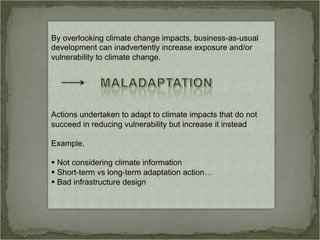
Overlaps do exist between “business-as-usual”
development strategies and adaptation.

Decisions taken as part of development
activities can have considerable bearing on
the vulnerability of societies to the potential
impacts of climate change.

Better developed societies possess more
adaptive capacity than less developed
societies and therefore have lower
vulnerability to climate change.
While there are overlaps between adaptation and
   development, activities with an explicit focus on adaptation
   and climate change will also be required…

   Example:

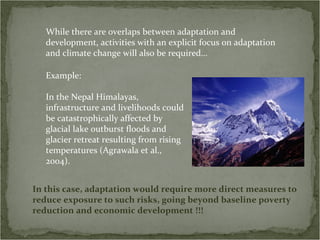
   In the Nepal Himalayas,
   infrastructure and livelihoods could
   be catastrophically affected by
   glacial lake outburst floods and
   glacier retreat resulting from rising
   temperatures (Agrawala et al.,
   2004).


In this case, adaptation would require more direct measures to
reduce exposure to such risks, going beyond baseline poverty
reduction and economic development !!!
Business-as-usual development does
 not include activities that specifically
  aim to address climate change and
reduce its impacts or take advantage of
    any new opportunities. For such
  action, explicit adaptation activities
         need to be developed.
(OECD 2009)
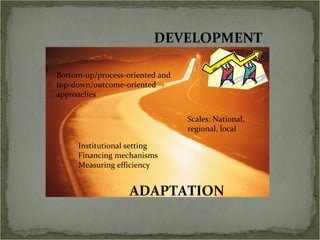
DEVELOPMENT

Bottom-up/process-oriented and
top-down/outcome-oriented
approaches


                                 Scales: National,
                                 regional, local

     Institutional setting
     Financing mechanisms
     Measuring efficiency


                   ADAPTATION
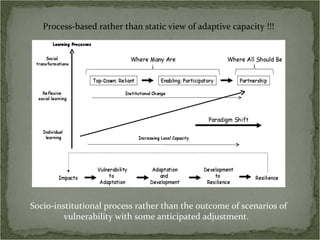
Process-based rather than static view of adaptive capacity !!!


Socio-institutional process rather than the outcome of scenarios of
         vulnerability with some anticipated adjustment.