Experiences from the Tohoku
Disaster in Japan and
Stakeholder Perceptions on
Loss and Damage Associated
with Climate Change and
Adaptation
SVRK Prabhakar
Task Manager (Adaptation)
IGES, Japan
Presented at the 8th SDMO Forum, 11-12 August 2014,
Beijing, China
Outline
The Tohoku ‘triple’ disaster of Japan
Background
Current state of recovery
Lessons learned
Loss and damage associated with
climate change and adaptation
Background
Stakeholder perceptions
Conclusions
2
Experiences from the Tohoku
Disaster
Contributors to this part of the presentation:
Prof. H. Suzuki, Hiroshima University; Dr. S. Hayashi; Prof. Y. Kajitani,
Kyoto University; and Mr. Y. Chiba, IGES
The Tohoku Triple Disaster Event
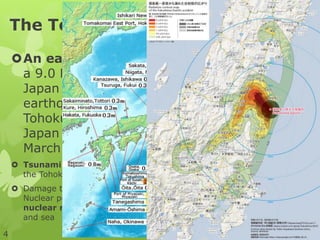
An earthquake with
a 9.0 Magnitude (7 on
Japan seismic scale)
earthquake hitting the
Tohoku region of
Japan at 2:46 p.m. on
March 11, 2011
 Tsunami along the Pacific coast in
the Tohoku and Kanto regions
 Damage to Fukushima Dai Ichi
Nuclear power plant releasing
nuclear radiation onto the land
and sea
USGS, 2014
4
The Damage
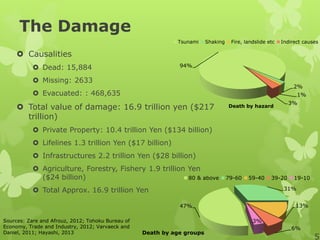
 Causalities
 Dead: 15,884
 Missing: 2633
 Evacuated: : 468,635
 Total value of damage: 16.9 trillion yen ($217
trillion)
 Private Property: 10.4 trillion Yen ($134 billion)
 Lifelines 1.3 trillion Yen ($17 billion)
 Infrastructures 2.2 trillion Yen ($28 billion)
 Agriculture, Forestry, Fishery 1.9 trillion Yen
($24 billion)
 Total Approx. 16.9 trillion Yen
Sources: Zare and Afrouz, 2012; Tohoku Bureau of
Economy, Trade and Industry, 2012; Varvaeck and
Daniel, 2011; Hayashi, 2013
94%
2%
1%
3%
Tsunami Shaking Fire, landslide etc Indirect causes
47%
31%
13%
6%
3%
80 & above 79-60 59-40 39-20 19-10
Death by hazard
Death by age groups
5
The Radiation Damage
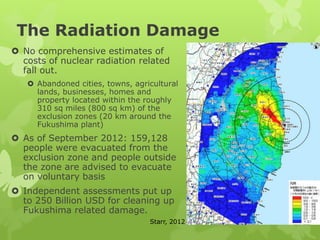
 No comprehensive estimates of
costs of nuclear radiation related
fall out.
 Abandoned cities, towns, agricultural
lands, businesses, homes and
property located within the roughly
310 sq miles (800 sq km) of the
exclusion zones (20 km around the
Fukushima plant)
 As of September 2012: 159,128
people were evacuated from the
exclusion zone and people outside
the zone are advised to evacuate
on voluntary basis
 Independent assessments put up
to 250 Billion USD for cleaning up
Fukushima related damage.
Starr, 2012
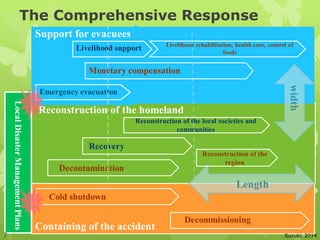
The Comprehensive Response
Suzuki, 20147
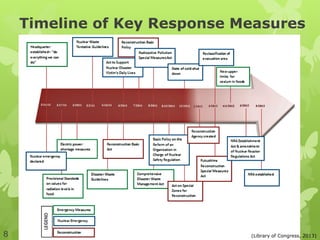
Timeline of Key Response Measures
(Library of Congress, 2013)8
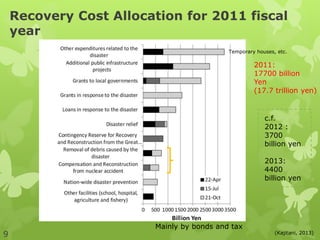
Recovery Cost Allocation for 2011 fiscal
year
9
c.f.
2012 :
3700
billion yen
2013:
4400
billion yen
Temporary houses, etc.
2011:
17700 billion
Yen
(17.7 trillion yen)
Mainly by bonds and tax
(Kajitani, 2013)
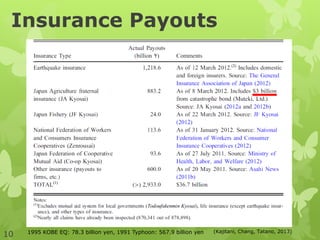
Insurance Payouts
1995 KOBE EQ: 78.3 billion yen, 1991 Typhoon: 567.9 billion yen (Kajitani, Chang, Tatano, 2013)
10
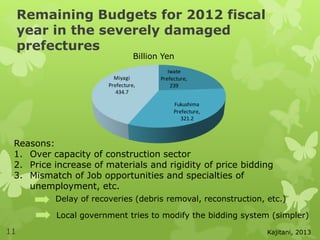
Remaining Budgets for 2012 fiscal
year in the severely damaged
prefectures
11
Iwate
Prefecture,
239
Fukushima
Prefecture,
321.2
Miyagi
Prefecture,
434.7
Billion Yen
Reasons:
1. Over capacity of construction sector
2. Price increase of materials and rigidity of price bidding
3. Mismatch of Job opportunities and specialties of
unemployment, etc.
Delay of recoveries (debris removal, reconstruction, etc.)
Local government tries to modify the bidding system (simpler)
Kajitani, 2013
12
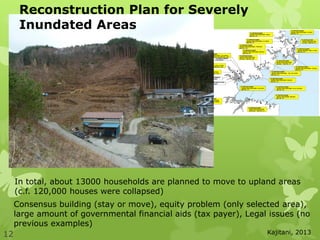
In total, about 13000 households are planned to move to upland areas
(c.f. 120,000 houses were collapsed)
Consensus building (stay or move), equity problem (only selected area),
large amount of governmental financial aids (tax payer), Legal issues (no
previous examples)
Reconstruction Plan for Severely
Inundated Areas
Kajitani, 2013
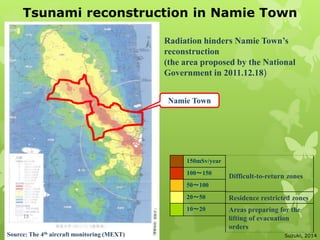
150mSv/year
100~150
50~100
20~50
10~20
Difficult-to-return zones
Residence restricted zones
Areas preparing for the
lifting of evacuation
orders
Radiation hinders Namie Town’s
reconstruction
(the area proposed by the National
Government in 2011.12.18)
Source: The 4th aircraft monitoring (MEXT)
13
Namie Town
Tsunami reconstruction in Namie Town
Suzuki, 2014
Despite the significant efforts…
Hardships in evacuees’ lives and in the recovery
process
1. Lack of proper communication led to solitary decisions
of the affected local governments
2. Damages on the areas which suffering from declining
population and aging
• How to reflect the preconditions on rehabilitation/
recovery?
• Can communities be revitalized?
• More and more evacuees seek to “start new lives”
in the other areas.
3. Devastation of the key industries of the region, i.e.
agriculture, forestry and fisheries
• How to rebuild and/or reconnect them with societies
/ economies in the wider areas.
(Suzuki, 2014)14
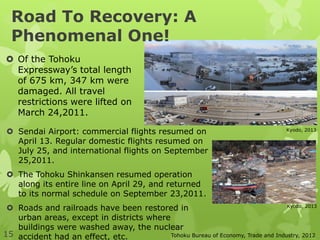
 Sendai Airport: commercial flights resumed on
April 13. Regular domestic flights resumed on
July 25, and international flights on September
25,2011.
 The Tohoku Shinkansen resumed operation
along its entire line on April 29, and returned
to its normal schedule on September 23,2011.
 Roads and railroads have been restored in
urban areas, except in districts where
buildings were washed away, the nuclear
accident had an effect, etc.
 Of the Tohoku
Expressway’s total length
of 675 km, 347 km were
damaged. All travel
restrictions were lifted on
March 24,2011.
Tohoku Bureau of Economy, Trade and Industry, 2012
Kyodo, 2013
Kyodo, 2013
15
Road To Recovery: A
Phenomenal One!
Innovations in Reconstruction
Financing: Crowd-sourcing
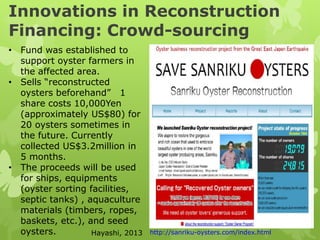
• Fund was established to
support oyster farmers in
the affected area.
• Sells “reconstructed
oysters beforehand” 1
share costs 10,000Yen
(approximately US$80) for
20 oysters sometimes in
the future. Currently
collected US$3.2million in
5 months.
• The proceeds will be used
for ships, equipments
(oyster sorting facilities,
septic tanks) , aquaculture
materials (timbers, ropes,
baskets, etc.), and seed
oysters. http://sanriku-oysters.com/index.htmlHayashi, 2013
Crowd-Sourcing of Rehabilitation and
Reconstruction: Small Businesses
http://oen.securite.jp/
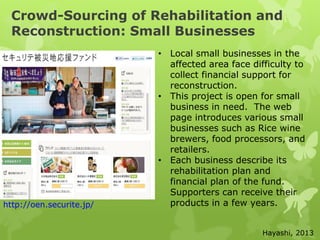
• Local small businesses in the
affected area face difficulty to
collect financial support for
reconstruction.
• This project is open for small
business in need. The web
page introduces various small
businesses such as Rice wine
brewers, food processors, and
retailers.
• Each business describe its
rehabilitation plan and
financial plan of the fund.
Supporters can receive their
products in a few years.
Hayashi, 2013
Internet based Supply Chain
for Small Manufacturers
http://www.b-mall.ne.jp/hukkoushien.aspx
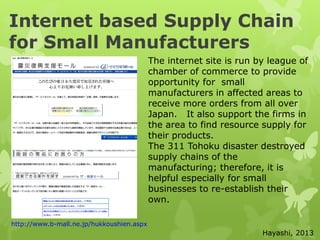
The internet site is run by league of
chamber of commerce to provide
opportunity for small
manufacturers in affected areas to
receive more orders from all over
Japan. It also support the firms in
the area to find resource supply for
their products.
The 311 Tohoku disaster destroyed
supply chains of the
manufacturing; therefore, it is
helpful especially for small
businesses to re-establish their
own.
Hayashi, 2013
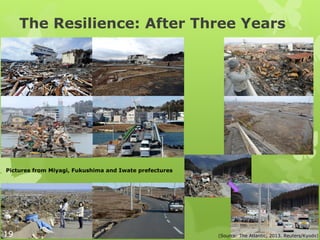
The Resilience: After Three Years
Pictures from Miyagi, Fukushima and Iwate prefectures
(Source: The Atlantic, 2013. Reuters/Kyodo)19
Significant Lessons from the
triple disaster
 Lesson I: Community based is the best way to manage
disasters.
 Lesson II: Information sharing among different stakeholders
including communities with integrated and transparent
emergency planning is vital.
 Lesson III: Long-term partnerships, twinning, and
coupling/pairing between local governments, NGOs, schools,
expertise, and business sectors are a useful tool to respond in
the case of disaster; nonetheless, how to coordinate them
varies.
 Lesson IV: The triple disaster has tested financial and
reconstruction preparedness and capacity to deal with such
catastrophes even in developed country context.
Hayashi, 2013; Kajitani, 201320
Stakeholder
Perceptions on Loss
and Damage
Associated with
Climate Change
Impacts and
Adaptation
Report: Prabhakar, S.V.R.K. and M. Nakata. 2014. Loss And Damage Associated With Climate Change
Impacts And Adaptation: Stakeholder Perceptions For Shaping The Future Agenda Of Asia Pacific
Adaptation Network. IGES Research Report 2013-03. Hayama, Japan: Institute for Global
Environmental Strategies. Available at http://pub.iges.or.jp/modules/envirolib/view.php?docid=4949
21
Loss and Damage due to
Climate Change
 Current level of GHG mitigation and adaptation
measures are insufficient to fully neutralize the
climate change related negative impacts
 There will be residual impacts despite all the efforts
 Partly, the loss and damage could be due to limited
adaptation, failure of adaptation (maladaptation) and
no-adaptation
 There will be areas where limits to adaptation will be
reached
 Understanding the possible level of these losses and
damages, their implications and required interventions is
necessary
22
Stakeholder Perceptions
 A stakeholder perception survey covering the subscribers of the Asia
Pacific Adaptation Network (APAN) activities was carried out
 To identify the pertinent issues and perceptions among the stakeholders
engaged in climate change adaptation
 To help design the agenda of knowledge networks engaged in climate
change adaptation and disaster risk reduction
 Design:
 Multiple choice questionnaire with some open ended questions
 Administered online
 n=102
 Representation: Non-governmental developmental organizations (38%),
government departments (15%), independent think tanks (14%),
universities (11%) and governmental think tanks (9%).
 Age group: 30-50 (56%), 50-60 (21%) and 18-30 (17%).
 38% of the respondents worked in climate change adaptation, 30% in
environmental management and 12% in disaster risk reduction.
23
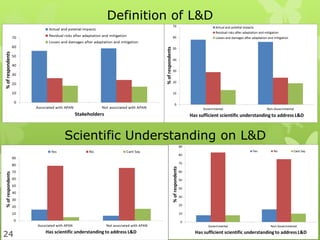
Definition of L&D
Scientific Understanding on L&D
24
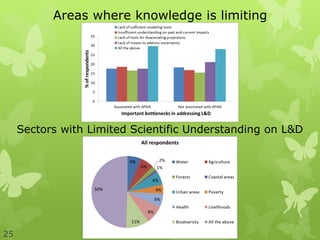
Areas where knowledge is limiting
Sectors with Limited Scientific Understanding on L&D
25
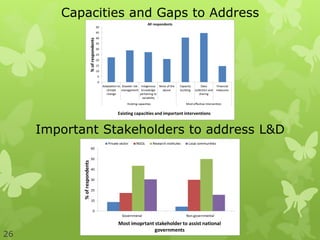
Capacities and Gaps to Address
Important Stakeholders to address L&D
26
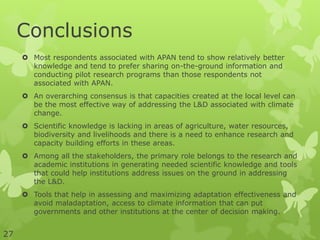
Conclusions
 Most respondents associated with APAN tend to show relatively better
knowledge and tend to prefer sharing on-the-ground information and
conducting pilot research programs than those respondents not
associated with APAN.
 An overarching consensus is that capacities created at the local level can
be the most effective way of addressing the L&D associated with climate
change.
 Scientific knowledge is lacking in areas of agriculture, water resources,
biodiversity and livelihoods and there is a need to enhance research and
capacity building efforts in these areas.
 Among all the stakeholders, the primary role belongs to the research and
academic institutions in generating needed scientific knowledge and tools
that could help institutions address issues on the ground in addressing
the L&D.
 Tools that help in assessing and maximizing adaptation effectiveness and
avoid maladaptation, access to climate information that can put
governments and other institutions at the center of decision making.
27
Thank You!
prabhakar@iges.or.jp;
sivapuram.prabhakar@gmail.com

Experiences From The Tohoku Disaster In Japan And Stakeholder Perceptions On Loss And Damage Associated With Climate Change And Adaptation

  • 1.
    Experiences from theTohoku Disaster in Japan and Stakeholder Perceptions on Loss and Damage Associated with Climate Change and Adaptation SVRK Prabhakar Task Manager (Adaptation) IGES, Japan Presented at the 8th SDMO Forum, 11-12 August 2014, Beijing, China
  • 2.
    Outline The Tohoku ‘triple’disaster of Japan Background Current state of recovery Lessons learned Loss and damage associated with climate change and adaptation Background Stakeholder perceptions Conclusions 2
  • 3.
    Experiences from theTohoku Disaster Contributors to this part of the presentation: Prof. H. Suzuki, Hiroshima University; Dr. S. Hayashi; Prof. Y. Kajitani, Kyoto University; and Mr. Y. Chiba, IGES
  • 4.
    The Tohoku TripleDisaster Event An earthquake with a 9.0 Magnitude (7 on Japan seismic scale) earthquake hitting the Tohoku region of Japan at 2:46 p.m. on March 11, 2011  Tsunami along the Pacific coast in the Tohoku and Kanto regions  Damage to Fukushima Dai Ichi Nuclear power plant releasing nuclear radiation onto the land and sea USGS, 2014 4
  • 5.
    The Damage  Causalities Dead: 15,884  Missing: 2633  Evacuated: : 468,635  Total value of damage: 16.9 trillion yen ($217 trillion)  Private Property: 10.4 trillion Yen ($134 billion)  Lifelines 1.3 trillion Yen ($17 billion)  Infrastructures 2.2 trillion Yen ($28 billion)  Agriculture, Forestry, Fishery 1.9 trillion Yen ($24 billion)  Total Approx. 16.9 trillion Yen Sources: Zare and Afrouz, 2012; Tohoku Bureau of Economy, Trade and Industry, 2012; Varvaeck and Daniel, 2011; Hayashi, 2013 94% 2% 1% 3% Tsunami Shaking Fire, landslide etc Indirect causes 47% 31% 13% 6% 3% 80 & above 79-60 59-40 39-20 19-10 Death by hazard Death by age groups 5
  • 6.
    The Radiation Damage No comprehensive estimates of costs of nuclear radiation related fall out.  Abandoned cities, towns, agricultural lands, businesses, homes and property located within the roughly 310 sq miles (800 sq km) of the exclusion zones (20 km around the Fukushima plant)  As of September 2012: 159,128 people were evacuated from the exclusion zone and people outside the zone are advised to evacuate on voluntary basis  Independent assessments put up to 250 Billion USD for cleaning up Fukushima related damage. Starr, 2012
  • 7.
  • 8.
    Timeline of KeyResponse Measures (Library of Congress, 2013)8
  • 9.
    Recovery Cost Allocationfor 2011 fiscal year 9 c.f. 2012 : 3700 billion yen 2013: 4400 billion yen Temporary houses, etc. 2011: 17700 billion Yen (17.7 trillion yen) Mainly by bonds and tax (Kajitani, 2013)
  • 10.
    Insurance Payouts 1995 KOBEEQ: 78.3 billion yen, 1991 Typhoon: 567.9 billion yen (Kajitani, Chang, Tatano, 2013) 10
  • 11.
    Remaining Budgets for2012 fiscal year in the severely damaged prefectures 11 Iwate Prefecture, 239 Fukushima Prefecture, 321.2 Miyagi Prefecture, 434.7 Billion Yen Reasons: 1. Over capacity of construction sector 2. Price increase of materials and rigidity of price bidding 3. Mismatch of Job opportunities and specialties of unemployment, etc. Delay of recoveries (debris removal, reconstruction, etc.) Local government tries to modify the bidding system (simpler) Kajitani, 2013
  • 12.
    12 In total, about13000 households are planned to move to upland areas (c.f. 120,000 houses were collapsed) Consensus building (stay or move), equity problem (only selected area), large amount of governmental financial aids (tax payer), Legal issues (no previous examples) Reconstruction Plan for Severely Inundated Areas Kajitani, 2013
  • 13.
    150mSv/year 100~150 50~100 20~50 10~20 Difficult-to-return zones Residence restrictedzones Areas preparing for the lifting of evacuation orders Radiation hinders Namie Town’s reconstruction (the area proposed by the National Government in 2011.12.18) Source: The 4th aircraft monitoring (MEXT) 13 Namie Town Tsunami reconstruction in Namie Town Suzuki, 2014
  • 14.
    Despite the significantefforts… Hardships in evacuees’ lives and in the recovery process 1. Lack of proper communication led to solitary decisions of the affected local governments 2. Damages on the areas which suffering from declining population and aging • How to reflect the preconditions on rehabilitation/ recovery? • Can communities be revitalized? • More and more evacuees seek to “start new lives” in the other areas. 3. Devastation of the key industries of the region, i.e. agriculture, forestry and fisheries • How to rebuild and/or reconnect them with societies / economies in the wider areas. (Suzuki, 2014)14
  • 15.
     Sendai Airport:commercial flights resumed on April 13. Regular domestic flights resumed on July 25, and international flights on September 25,2011.  The Tohoku Shinkansen resumed operation along its entire line on April 29, and returned to its normal schedule on September 23,2011.  Roads and railroads have been restored in urban areas, except in districts where buildings were washed away, the nuclear accident had an effect, etc.  Of the Tohoku Expressway’s total length of 675 km, 347 km were damaged. All travel restrictions were lifted on March 24,2011. Tohoku Bureau of Economy, Trade and Industry, 2012 Kyodo, 2013 Kyodo, 2013 15 Road To Recovery: A Phenomenal One!
  • 16.
    Innovations in Reconstruction Financing:Crowd-sourcing • Fund was established to support oyster farmers in the affected area. • Sells “reconstructed oysters beforehand” 1 share costs 10,000Yen (approximately US$80) for 20 oysters sometimes in the future. Currently collected US$3.2million in 5 months. • The proceeds will be used for ships, equipments (oyster sorting facilities, septic tanks) , aquaculture materials (timbers, ropes, baskets, etc.), and seed oysters. http://sanriku-oysters.com/index.htmlHayashi, 2013
  • 17.
    Crowd-Sourcing of Rehabilitationand Reconstruction: Small Businesses http://oen.securite.jp/ • Local small businesses in the affected area face difficulty to collect financial support for reconstruction. • This project is open for small business in need. The web page introduces various small businesses such as Rice wine brewers, food processors, and retailers. • Each business describe its rehabilitation plan and financial plan of the fund. Supporters can receive their products in a few years. Hayashi, 2013
  • 18.
    Internet based SupplyChain for Small Manufacturers http://www.b-mall.ne.jp/hukkoushien.aspx The internet site is run by league of chamber of commerce to provide opportunity for small manufacturers in affected areas to receive more orders from all over Japan. It also support the firms in the area to find resource supply for their products. The 311 Tohoku disaster destroyed supply chains of the manufacturing; therefore, it is helpful especially for small businesses to re-establish their own. Hayashi, 2013
  • 19.
    The Resilience: AfterThree Years Pictures from Miyagi, Fukushima and Iwate prefectures (Source: The Atlantic, 2013. Reuters/Kyodo)19
  • 20.
    Significant Lessons fromthe triple disaster  Lesson I: Community based is the best way to manage disasters.  Lesson II: Information sharing among different stakeholders including communities with integrated and transparent emergency planning is vital.  Lesson III: Long-term partnerships, twinning, and coupling/pairing between local governments, NGOs, schools, expertise, and business sectors are a useful tool to respond in the case of disaster; nonetheless, how to coordinate them varies.  Lesson IV: The triple disaster has tested financial and reconstruction preparedness and capacity to deal with such catastrophes even in developed country context. Hayashi, 2013; Kajitani, 201320
  • 21.
    Stakeholder Perceptions on Loss andDamage Associated with Climate Change Impacts and Adaptation Report: Prabhakar, S.V.R.K. and M. Nakata. 2014. Loss And Damage Associated With Climate Change Impacts And Adaptation: Stakeholder Perceptions For Shaping The Future Agenda Of Asia Pacific Adaptation Network. IGES Research Report 2013-03. Hayama, Japan: Institute for Global Environmental Strategies. Available at http://pub.iges.or.jp/modules/envirolib/view.php?docid=4949 21
  • 22.
    Loss and Damagedue to Climate Change  Current level of GHG mitigation and adaptation measures are insufficient to fully neutralize the climate change related negative impacts  There will be residual impacts despite all the efforts  Partly, the loss and damage could be due to limited adaptation, failure of adaptation (maladaptation) and no-adaptation  There will be areas where limits to adaptation will be reached  Understanding the possible level of these losses and damages, their implications and required interventions is necessary 22
  • 23.
    Stakeholder Perceptions  Astakeholder perception survey covering the subscribers of the Asia Pacific Adaptation Network (APAN) activities was carried out  To identify the pertinent issues and perceptions among the stakeholders engaged in climate change adaptation  To help design the agenda of knowledge networks engaged in climate change adaptation and disaster risk reduction  Design:  Multiple choice questionnaire with some open ended questions  Administered online  n=102  Representation: Non-governmental developmental organizations (38%), government departments (15%), independent think tanks (14%), universities (11%) and governmental think tanks (9%).  Age group: 30-50 (56%), 50-60 (21%) and 18-30 (17%).  38% of the respondents worked in climate change adaptation, 30% in environmental management and 12% in disaster risk reduction. 23
  • 24.
    Definition of L&D ScientificUnderstanding on L&D 24
  • 25.
    Areas where knowledgeis limiting Sectors with Limited Scientific Understanding on L&D 25
  • 26.
    Capacities and Gapsto Address Important Stakeholders to address L&D 26
  • 27.
    Conclusions  Most respondentsassociated with APAN tend to show relatively better knowledge and tend to prefer sharing on-the-ground information and conducting pilot research programs than those respondents not associated with APAN.  An overarching consensus is that capacities created at the local level can be the most effective way of addressing the L&D associated with climate change.  Scientific knowledge is lacking in areas of agriculture, water resources, biodiversity and livelihoods and there is a need to enhance research and capacity building efforts in these areas.  Among all the stakeholders, the primary role belongs to the research and academic institutions in generating needed scientific knowledge and tools that could help institutions address issues on the ground in addressing the L&D.  Tools that help in assessing and maximizing adaptation effectiveness and avoid maladaptation, access to climate information that can put governments and other institutions at the center of decision making. 27
  • 28.