I N F R A S T R U C T U R E
A N D W AT E R
A F O C U S O N C I T I E S
A N D S E T T L E M E N T S
G I N A Z I E RVO G E L
A S S O C I A T E P R O F E S S O R , D E P T O F
E N V I R O N M E N T A L A N D G E O G R A P H I C A L S C I E N C E
U N I V E R S I T Y O F C A P E T O W N
L E A D A U T H O R : C H A P T E R 6 C I T I E S ,
S E T T L E M E N T S A N D K E Y I N F R A S T R U C T U R E
SIXTH ASSESSMENT REPORT
Impacts are magnified in cities where
more than half the world’s population
lives.
[Peter Nguyen / Unsplash]
IMPORTANCE OF
CITIES
• Cities are sites of risk but also
opportunity
• Cities are growing fast so need to act fast
to avoid lock-in
• People, infrastructure and assets highly
connected which concentrates risk
• When extreme climate events and
increasing urbanization intersect, the
impacts can be very widespread
[Chuttersnap, Jordan Brierley / Unsplash; SDOT Photos CC BY-NC 2.0]
CITIES AND WATER
By 2050 urban areas could be home to two-thirds of
the world’s population.
1/3 of all major cities may exhaust their current water
resources by 2050 (Florke et al. 2018)
Risks of urban water scarcity and security
compounded by:
- service availability
- quality of infrastructure to supply water for
increased urban demand from in-migration to
cities
Water scarcity felt more acutely among low-income
compared to high-income populations
Image source: Ziervogel
URBAN
VULNERABILITY
SPM.B.2.5 Future human vulnerability will
continue to concentrate where the capacities of
local, municipal and national governments,
communities and the private sector are least able
to provide infrastructures and basic services
(high confidence). Under the global trend of
urbanization, human vulnerability will also
concentrate in informal settlements and rapidly
growing smaller settlements (high confidence).
COMPOUND AND CASCADING EVENTS
Compound event losses arise from the interaction of single climate hazards with at least
one other hazard driver
– flooding with poor water quality (e.g. from contaminated run-off and flood water)
Cascading impacts are observed when damages in one place or system reduce resilience
and generate impacts elsewhere
– flood waters damage energy infrastructure causing blackouts and knock on financial
and human impacts
Losses become systemic when affecting entire systems and can even jump from one
system to another
– drought impacting on rural food production contributing to urban food insecurity
IPCC AR6 Chaper 6: Executive summary
INFRASTRUCTURE
FRAMING (CH 6)
• Refers to ‘critical nodes and arteries’
– urban energy, food, water, sewerage, health,
transport and communication systems (Steele
and Legacy, 2017; Maxwell et al., 2018; Bassolas
et al., 2019)
• Material basis of cities and settlements
– the mechanisms for enabling flows of people,
goods, data, waste, energy and capital, between
urban regions and rural areas (Blay-Palmer et
al., 2018; Dijst et al., 2018)
TYPES OF INFRASTRUCTURE
• Grey/physical infrastructure
– engineered assets that provide one or multiple services required by society
– energy, transport, communications (including digital), built form, water and sanitation and
solid waste management
• Nature-based infrastructure
– solutions to risk applying natural assets
– clean air, flood protection, urban agriculture, temperature, green corridors, watercourses
and riverways
• Social infrastructure
– social, cultural, and financial activities and institutions
– housing, health, education, livelihoods and social safety nets, security, cultural
heritage/institutions, disaster risk management and urban planning
INFRASTRUCTURE FOCUS
• Adaptation options have tended to focus on grey and physical
infrastructure in the past
• Increasing focus on other types of adaptation which are important for
cities including
– Nature-based infrastructure
• Green roofs, retention ponds, watershed restoration and urban
farming
– Social policy and planning
• Land use planning, DRM, health sector and climate education
• These actions have co-benefits such as increasing social capital,
reducing poverty and helping to prepare for multiple hazards.
PHYSICAL INFRASTRUCTURE AND
WATER-RELATED IMPACTS
Low flows from drought
• sedimentation, increase pollutant concentration and block sewer
infrastructure networks (Campos and Darch, 2015).
Flooding
• greater risk for urban sanitation in low and middle income
settings where onsite systems more common
• wash out pits and tanks, mobilising faecal sludges à direct and
indirect exposure via food and contaminated objects and
surfaces; pollute streams and waterbodies (Howard et al., 2016;
Braks and de Roda Husman, 13 2013; Bornemann et al., 2019)
• damage infrastructure; toilets, pits, tanks and treatment systems
are all vulnerable (Sherpa et al., 2014; UNICEF and WHO 2019).
Physical infrastructure
and water-related adaptation
Infrastructure to protect key assets such as water and
wastewater treatment plants or pumping stations
- high cost
- benefits all connected households and reduces
pollution from flood events
Protecting water sources from pollution
• more important in a warmer climate that increases the
frequency of algal blooms.
Sanitation services with a lower reliance on fixed
infrastructure, or container based sanitation
• appropriate in many urban areas that are badly affected
by flooding
Nature-based solutions
Enhance flood protection
• Grass and riparian buffers and forested
watersheds can reduce volume and impact
of riverine flooding
• Coastal ecosystems can stabilise shorelines
and reduce coastal flooding
Stormwater regulation
• Engineered devices such as bioswales and
rain gardens
Water quality
• Restore natural infiltration capacity and
increase water security
Health facilities
(social infrastructure)
• Improved building design and
spatial urban planning (where
facilities are located)
• increase resilience for higher
temperature and flood risk
• Improvements to health
surveillance
• increase resilience,
particularly for populations
in informal settlements
URBAN ICT AND WATER-RELATED IMPACTS
(SOCIAL AND PHYSICAL INFRASTRUCTURE)
Information and Communication Technology vulnerable
to increased frequency of coastal, fluvial or pluvial
flooding
• damage to key ICT assets such as cables, masts, pylons,
data centres, telephone exchanges, base stations or
switching centres (Fu, Horrocks and Winne, 2016).
• leads to loss of voice communications, inability to
process financial transactions
Insufficient information about the location and nature of
many ICT assets limits detailed quantitative assessment of
climate change risks.
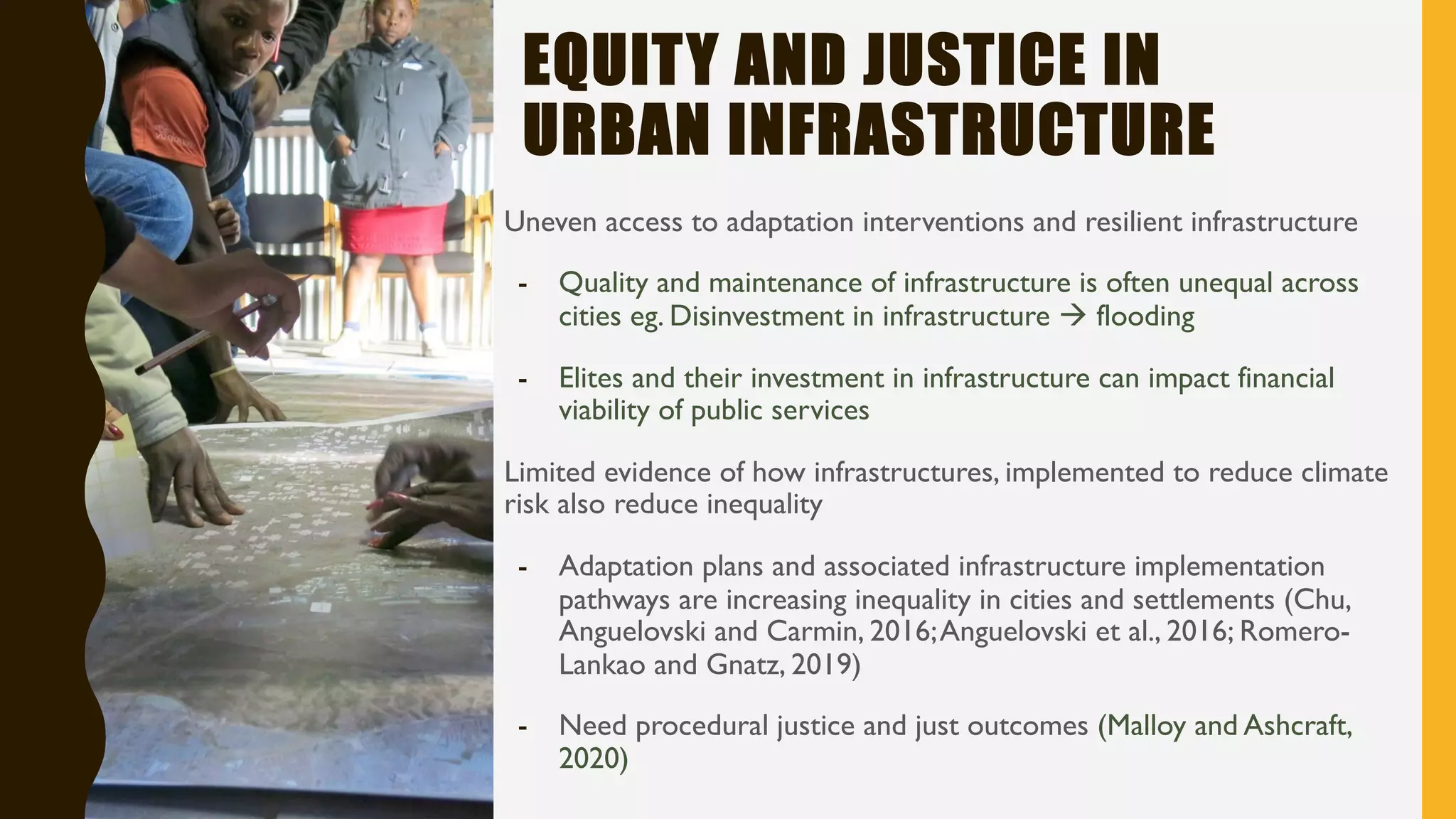
EQUITY AND JUSTICE IN
URBAN INFRASTRUCTURE
Uneven access to adaptation interventions and resilient infrastructure
- Quality and maintenance of infrastructure is often unequal across
cities eg. Disinvestment in infrastructure à flooding
- Elites and their investment in infrastructure can impact financial
viability of public services
Limited evidence of how infrastructures, implemented to reduce climate
risk also reduce inequality
- Adaptation plans and associated infrastructure implementation
pathways are increasing inequality in cities and settlements (Chu,
Anguelovski and Carmin, 2016;Anguelovski et al., 2016; Romero-
Lankao and Gnatz, 2019)
- Need procedural justice and just outcomes (Malloy and Ashcraft,
2020)
SCALING UP ADAPTATION RESPONSES
• Increasing number of urban adaptation
responses
• Feasibility and effectiveness
constrained by:
- Institutional
- Financial
- Technological access and capacity
• Requires coordinated contextual
responses
- Across physical, natural and social
infrastructure
Source: SPM.C.2.7
CONCLUSION
• Need breadth of focus
– Bring in new fields and collaborate across
disciplines
– Draw on local and indigenous knowledge
– Ensure opportunities for co-production
• Informal settlement and low-income areas need more
attention
• Infrastructure part of complex urban system
– Creative approaches needed
– Finance and support across scales
THANKYOU gina@csag.ut.ac.za

Infrastructure and Water: A Focus on Cities and Settlements

  • 1.
    I N FR A S T R U C T U R E A N D W AT E R A F O C U S O N C I T I E S A N D S E T T L E M E N T S G I N A Z I E RVO G E L A S S O C I A T E P R O F E S S O R , D E P T O F E N V I R O N M E N T A L A N D G E O G R A P H I C A L S C I E N C E U N I V E R S I T Y O F C A P E T O W N L E A D A U T H O R : C H A P T E R 6 C I T I E S , S E T T L E M E N T S A N D K E Y I N F R A S T R U C T U R E
  • 2.
    SIXTH ASSESSMENT REPORT Impactsare magnified in cities where more than half the world’s population lives. [Peter Nguyen / Unsplash]
  • 3.
    IMPORTANCE OF CITIES • Citiesare sites of risk but also opportunity • Cities are growing fast so need to act fast to avoid lock-in • People, infrastructure and assets highly connected which concentrates risk • When extreme climate events and increasing urbanization intersect, the impacts can be very widespread [Chuttersnap, Jordan Brierley / Unsplash; SDOT Photos CC BY-NC 2.0]
  • 4.
    CITIES AND WATER By2050 urban areas could be home to two-thirds of the world’s population. 1/3 of all major cities may exhaust their current water resources by 2050 (Florke et al. 2018) Risks of urban water scarcity and security compounded by: - service availability - quality of infrastructure to supply water for increased urban demand from in-migration to cities Water scarcity felt more acutely among low-income compared to high-income populations Image source: Ziervogel
  • 5.
    URBAN VULNERABILITY SPM.B.2.5 Future humanvulnerability will continue to concentrate where the capacities of local, municipal and national governments, communities and the private sector are least able to provide infrastructures and basic services (high confidence). Under the global trend of urbanization, human vulnerability will also concentrate in informal settlements and rapidly growing smaller settlements (high confidence).
  • 6.
    COMPOUND AND CASCADINGEVENTS Compound event losses arise from the interaction of single climate hazards with at least one other hazard driver – flooding with poor water quality (e.g. from contaminated run-off and flood water) Cascading impacts are observed when damages in one place or system reduce resilience and generate impacts elsewhere – flood waters damage energy infrastructure causing blackouts and knock on financial and human impacts Losses become systemic when affecting entire systems and can even jump from one system to another – drought impacting on rural food production contributing to urban food insecurity IPCC AR6 Chaper 6: Executive summary
  • 7.
    INFRASTRUCTURE FRAMING (CH 6) •Refers to ‘critical nodes and arteries’ – urban energy, food, water, sewerage, health, transport and communication systems (Steele and Legacy, 2017; Maxwell et al., 2018; Bassolas et al., 2019) • Material basis of cities and settlements – the mechanisms for enabling flows of people, goods, data, waste, energy and capital, between urban regions and rural areas (Blay-Palmer et al., 2018; Dijst et al., 2018)
  • 8.
    TYPES OF INFRASTRUCTURE •Grey/physical infrastructure – engineered assets that provide one or multiple services required by society – energy, transport, communications (including digital), built form, water and sanitation and solid waste management • Nature-based infrastructure – solutions to risk applying natural assets – clean air, flood protection, urban agriculture, temperature, green corridors, watercourses and riverways • Social infrastructure – social, cultural, and financial activities and institutions – housing, health, education, livelihoods and social safety nets, security, cultural heritage/institutions, disaster risk management and urban planning
  • 9.
    INFRASTRUCTURE FOCUS • Adaptationoptions have tended to focus on grey and physical infrastructure in the past • Increasing focus on other types of adaptation which are important for cities including – Nature-based infrastructure • Green roofs, retention ponds, watershed restoration and urban farming – Social policy and planning • Land use planning, DRM, health sector and climate education • These actions have co-benefits such as increasing social capital, reducing poverty and helping to prepare for multiple hazards.
  • 10.
    PHYSICAL INFRASTRUCTURE AND WATER-RELATEDIMPACTS Low flows from drought • sedimentation, increase pollutant concentration and block sewer infrastructure networks (Campos and Darch, 2015). Flooding • greater risk for urban sanitation in low and middle income settings where onsite systems more common • wash out pits and tanks, mobilising faecal sludges à direct and indirect exposure via food and contaminated objects and surfaces; pollute streams and waterbodies (Howard et al., 2016; Braks and de Roda Husman, 13 2013; Bornemann et al., 2019) • damage infrastructure; toilets, pits, tanks and treatment systems are all vulnerable (Sherpa et al., 2014; UNICEF and WHO 2019).
  • 11.
    Physical infrastructure and water-relatedadaptation Infrastructure to protect key assets such as water and wastewater treatment plants or pumping stations - high cost - benefits all connected households and reduces pollution from flood events Protecting water sources from pollution • more important in a warmer climate that increases the frequency of algal blooms. Sanitation services with a lower reliance on fixed infrastructure, or container based sanitation • appropriate in many urban areas that are badly affected by flooding
  • 12.
    Nature-based solutions Enhance floodprotection • Grass and riparian buffers and forested watersheds can reduce volume and impact of riverine flooding • Coastal ecosystems can stabilise shorelines and reduce coastal flooding Stormwater regulation • Engineered devices such as bioswales and rain gardens Water quality • Restore natural infiltration capacity and increase water security
  • 13.
    Health facilities (social infrastructure) •Improved building design and spatial urban planning (where facilities are located) • increase resilience for higher temperature and flood risk • Improvements to health surveillance • increase resilience, particularly for populations in informal settlements
  • 14.
    URBAN ICT ANDWATER-RELATED IMPACTS (SOCIAL AND PHYSICAL INFRASTRUCTURE) Information and Communication Technology vulnerable to increased frequency of coastal, fluvial or pluvial flooding • damage to key ICT assets such as cables, masts, pylons, data centres, telephone exchanges, base stations or switching centres (Fu, Horrocks and Winne, 2016). • leads to loss of voice communications, inability to process financial transactions Insufficient information about the location and nature of many ICT assets limits detailed quantitative assessment of climate change risks.
  • 15.
    EQUITY AND JUSTICEIN URBAN INFRASTRUCTURE Uneven access to adaptation interventions and resilient infrastructure - Quality and maintenance of infrastructure is often unequal across cities eg. Disinvestment in infrastructure à flooding - Elites and their investment in infrastructure can impact financial viability of public services Limited evidence of how infrastructures, implemented to reduce climate risk also reduce inequality - Adaptation plans and associated infrastructure implementation pathways are increasing inequality in cities and settlements (Chu, Anguelovski and Carmin, 2016;Anguelovski et al., 2016; Romero- Lankao and Gnatz, 2019) - Need procedural justice and just outcomes (Malloy and Ashcraft, 2020)
  • 17.
    SCALING UP ADAPTATIONRESPONSES • Increasing number of urban adaptation responses • Feasibility and effectiveness constrained by: - Institutional - Financial - Technological access and capacity • Requires coordinated contextual responses - Across physical, natural and social infrastructure Source: SPM.C.2.7
  • 18.
    CONCLUSION • Need breadthof focus – Bring in new fields and collaborate across disciplines – Draw on local and indigenous knowledge – Ensure opportunities for co-production • Informal settlement and low-income areas need more attention • Infrastructure part of complex urban system – Creative approaches needed – Finance and support across scales THANKYOU gina@csag.ut.ac.za