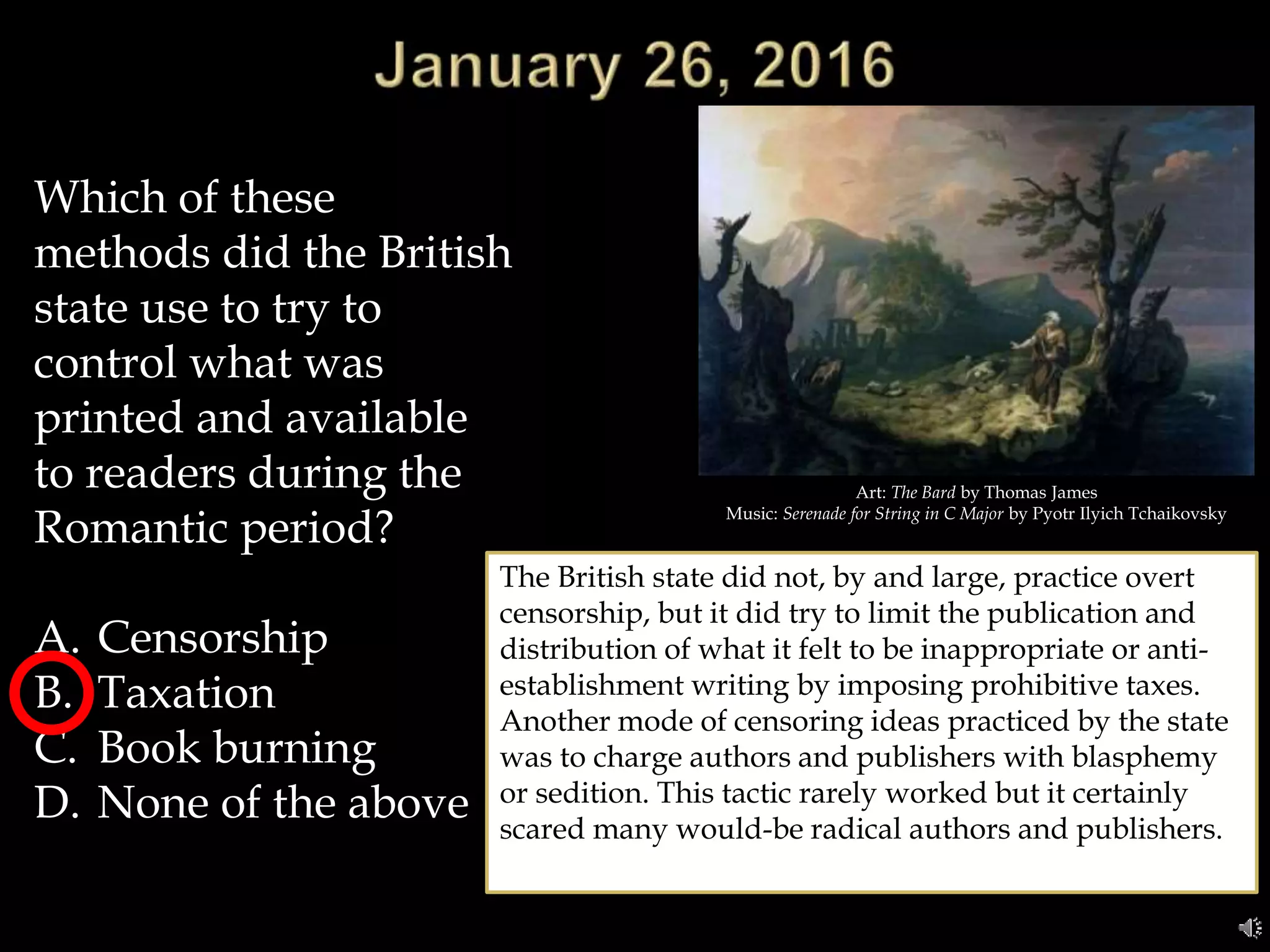
Art: The Bard by Thomas James
Music: Serenade for String in C Major by Pyotr Ilyich Tchaikovsky
Which of these
methods did the British
state use to try to
control what was
printed and available
to readers during the
Romantic period?
A. Censorship
B. Taxation
C. Book burning
D. None of the above
The British state did not, by and large, practice overt
censorship, but it did try to limit the publication and
distribution of what it felt to be inappropriate or anti-
establishment writing by imposing prohibitive taxes.
Another mode of censoring ideas practiced by the state
was to charge authors and publishers with blasphemy
or sedition. This tactic rarely worked but it certainly
scared many would-be radical authors and publishers.
 Write a weekly response
 Understand the reading art project
 Summarize the introduction
 Articulate the difference between poets and
Romantic poets
 Consider outsiders
Week 1 Response Assignment deadline
extended—Both Week 1 and Week 2
will be due on January 31st
Try to highlight the main points of the section.
What does a person need to remember in order to
fully understand the topic? See if you can
summarize the section in one or two sentences.
1. Revolution and Reaction
2. The New Poetries: Theory and Practice (Concepts of
the Poet and the Poem)
3. The New Poetries: Theory and Practice (Spontaneity
and the Impulses of Feeling)
4. The New Poetries: Theory and Practice (Glorification
of the Ordinary)
5. The New Poetries: Theory and Practice (The
Supernatural, the Romance, and Psychological
Extremes)
6. The New Poetries: Theory and Practice (Individualism
and Alienation)
7. Writing in the Marketplace and the Law Courts
Write your answer on a piece of paper.
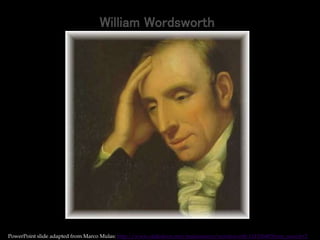
William Wordsworth
PowerPoint slide adapted from Marco Mulas: http://www.slideshare.net/mulasmarco/wordsworth-11192648?from_search=2
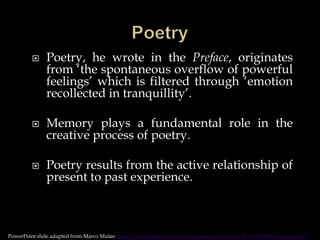
 Poetry, he wrote in the Preface, originates
from ‘the spontaneous overflow of powerful
feelings’ which is filtered through ‘emotion
recollected in tranquillity’.
 Memory plays a fundamental role in the
creative process of poetry.
 Poetry results from the active relationship of
present to past experience.
PowerPoint slide adapted from Marco Mulas: http://www.slideshare.net/mulasmarco/wordsworth-11192648?from_search=2
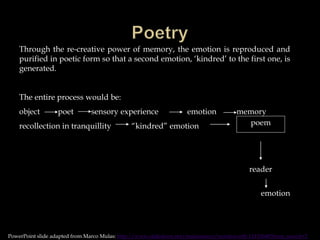
Through the re-creative power of memory, the emotion is reproduced and
purified in poetic form so that a second emotion, ‘kindred’ to the first one, is
generated.
The entire process would be:
object poet sensory experience emotion memory
recollection in tranquillity “kindred” emotion
reader
emotion
poem
PowerPoint slide adapted from Marco Mulas: http://www.slideshare.net/mulasmarco/wordsworth-11192648?from_search=2
Notes below your answer
in four groups.
Wordsworth
Blake
Shelley
Keats
 *Was Wordsworth’s “Preface to the Lyrical Ballads” condescending
to the lower-class he claimed to be writing for?
 *Wordsworth describes a poet as being knowledgeable of life,
giving a poet more understanding than a non-poet; does everyone
agree with this?
 *Why didn’t Wordsworth want his friends’ opinions or help?
 What does Wordsworth mean by “scenes taken from common
life”? Where do we see that in the readings so far?
 What does Wordsworth say is the appropriate language of poetry?
Do you agree or disagree?
 Coleridge later criticized Wordsworth’s claims for the language of
poetry in that he disagrees that the language of rustics is the best
language and that there is no difference between the language of
poetry and prose. How do you feel about this debate?
Main Menu
 How do the “Introduction” poems represent the practice of
poetry? How are they different?
 What does the lamb symbolize in “The Lamb”? How consistent is
this symbolic meaning when the image appears in other poems?
 How does your interpretation of “The Lamb” change after you
read “The Tyger”?
 *What made Blake single out a lamb and a tiger to question where
they come from?
 What do the Songs of Innocence, taken collectively, suggest about
Blake’s use of the pastoral? Consider pastoral themes, such as the
loss of innocence, the healing power of nature, the triumph of life
over death.
 *Do you think Blake’s poems shone a light on his criticisms
toward the culture of selling children for work?
 *Who do you think the child was?
Main Menu
 What does it mean when Shelley calls Bacon and
Plato poets? How does Shelley’s essay contribute
to the disagreement between Wordsworth and
Coleridge over the suitability of the language of
prose in poetry?
 In what sense is poetry a moral exercise for its
readers?
 What is the source of Shelley’s hope and idealism
in the essay and in the poems? Does his hope have
a practical basis?
 *Is the whole point of the poem to express how he
wants the world to appreciate his poetry as much
as he appreciates the bird’s music?
Main Menu
 How would you explain the poet’s relationship to the nightingale
in the ode? How does it change from the beginning to the end?
 What is it that the poet seeks to escape when he fades “far away”
in the third stanza? What is the implication that Beauty will not
keep her lustrous eyes,/Or new Love pine at them beyond
tomorrow”? Compare this to the poet’s enthusiastic sympathy for
lovers on the Grecian urn.
 In his letters, Keats writes that “poetry should surprise by fine
excess and not by Singularity…Its touches of Beauty should never
be half way thereby making the reader breathless instead of
content.” In another place he writes, “We hate poetry that has a
palpable design upon us…Poetry should be great and
unobtrusive, a thing which enters into one’s soul, and does not
startle it or amaze it with itself but with its subject.” To what
extent does Keats achieve these goals in his odes? How?
 *How do Shelley and Keats use birds to illustrate their
philosophies on life?
Main Menu
Introduction
 Fascination with the mysterious isolated
figure
 Mental state of the figure exiled from
society, haunted by guilt over past
transgressions, and defined by those
crimes
 Women poets engaging in the topic as
exiled/isolated figures
 Gothic/satire
 Write a weekly response
 Understand the reading art project
 Summarize the introduction
 Articulate the difference between poets and
Romantic poets
 Consider outsiders
Readings for the week:
 Byron Don Juan (pp. 673-674, canto 1-7) (feel free, of course, to
continue reading if you like!) and Manfred (p. 638) (read the
introduction and skim the dramatic poem)
 Coleridge Rime of the Ancient Mariner (pp. 443-459)
 Shelley “Introduction to The Last Man” (pp. 983-986)
Due Thursday, January 28, at 11:55 p.m.:
 Post to the weekly discussion
Due Saturday, January 30, at 11:55 p.m.:
 Take quizzes (3)
Due Sunday, January 31, at 11:55 p.m. to Turnitin:
 Weekly Response Assignment
Due Tuesday, February 2, in class:
 Reading log for each reading (4 total!)

January 26, 2016 (104)

  • 1.
    Art: The Bardby Thomas James Music: Serenade for String in C Major by Pyotr Ilyich Tchaikovsky Which of these methods did the British state use to try to control what was printed and available to readers during the Romantic period? A. Censorship B. Taxation C. Book burning D. None of the above The British state did not, by and large, practice overt censorship, but it did try to limit the publication and distribution of what it felt to be inappropriate or anti- establishment writing by imposing prohibitive taxes. Another mode of censoring ideas practiced by the state was to charge authors and publishers with blasphemy or sedition. This tactic rarely worked but it certainly scared many would-be radical authors and publishers.
  • 3.
     Write aweekly response  Understand the reading art project  Summarize the introduction  Articulate the difference between poets and Romantic poets  Consider outsiders
  • 4.
    Week 1 ResponseAssignment deadline extended—Both Week 1 and Week 2 will be due on January 31st
  • 6.
    Try to highlightthe main points of the section. What does a person need to remember in order to fully understand the topic? See if you can summarize the section in one or two sentences.
  • 7.
    1. Revolution andReaction 2. The New Poetries: Theory and Practice (Concepts of the Poet and the Poem) 3. The New Poetries: Theory and Practice (Spontaneity and the Impulses of Feeling) 4. The New Poetries: Theory and Practice (Glorification of the Ordinary) 5. The New Poetries: Theory and Practice (The Supernatural, the Romance, and Psychological Extremes) 6. The New Poetries: Theory and Practice (Individualism and Alienation) 7. Writing in the Marketplace and the Law Courts
  • 9.
    Write your answeron a piece of paper.
  • 10.
    William Wordsworth PowerPoint slideadapted from Marco Mulas: http://www.slideshare.net/mulasmarco/wordsworth-11192648?from_search=2
  • 11.
     Poetry, hewrote in the Preface, originates from ‘the spontaneous overflow of powerful feelings’ which is filtered through ‘emotion recollected in tranquillity’.  Memory plays a fundamental role in the creative process of poetry.  Poetry results from the active relationship of present to past experience. PowerPoint slide adapted from Marco Mulas: http://www.slideshare.net/mulasmarco/wordsworth-11192648?from_search=2
  • 12.
    Through the re-creativepower of memory, the emotion is reproduced and purified in poetic form so that a second emotion, ‘kindred’ to the first one, is generated. The entire process would be: object poet sensory experience emotion memory recollection in tranquillity “kindred” emotion reader emotion poem PowerPoint slide adapted from Marco Mulas: http://www.slideshare.net/mulasmarco/wordsworth-11192648?from_search=2
  • 13.
    Notes below youranswer in four groups.
  • 15.
  • 16.
     *Was Wordsworth’s“Preface to the Lyrical Ballads” condescending to the lower-class he claimed to be writing for?  *Wordsworth describes a poet as being knowledgeable of life, giving a poet more understanding than a non-poet; does everyone agree with this?  *Why didn’t Wordsworth want his friends’ opinions or help?  What does Wordsworth mean by “scenes taken from common life”? Where do we see that in the readings so far?  What does Wordsworth say is the appropriate language of poetry? Do you agree or disagree?  Coleridge later criticized Wordsworth’s claims for the language of poetry in that he disagrees that the language of rustics is the best language and that there is no difference between the language of poetry and prose. How do you feel about this debate? Main Menu
  • 17.
     How dothe “Introduction” poems represent the practice of poetry? How are they different?  What does the lamb symbolize in “The Lamb”? How consistent is this symbolic meaning when the image appears in other poems?  How does your interpretation of “The Lamb” change after you read “The Tyger”?  *What made Blake single out a lamb and a tiger to question where they come from?  What do the Songs of Innocence, taken collectively, suggest about Blake’s use of the pastoral? Consider pastoral themes, such as the loss of innocence, the healing power of nature, the triumph of life over death.  *Do you think Blake’s poems shone a light on his criticisms toward the culture of selling children for work?  *Who do you think the child was? Main Menu
  • 18.
     What doesit mean when Shelley calls Bacon and Plato poets? How does Shelley’s essay contribute to the disagreement between Wordsworth and Coleridge over the suitability of the language of prose in poetry?  In what sense is poetry a moral exercise for its readers?  What is the source of Shelley’s hope and idealism in the essay and in the poems? Does his hope have a practical basis?  *Is the whole point of the poem to express how he wants the world to appreciate his poetry as much as he appreciates the bird’s music? Main Menu
  • 19.
     How wouldyou explain the poet’s relationship to the nightingale in the ode? How does it change from the beginning to the end?  What is it that the poet seeks to escape when he fades “far away” in the third stanza? What is the implication that Beauty will not keep her lustrous eyes,/Or new Love pine at them beyond tomorrow”? Compare this to the poet’s enthusiastic sympathy for lovers on the Grecian urn.  In his letters, Keats writes that “poetry should surprise by fine excess and not by Singularity…Its touches of Beauty should never be half way thereby making the reader breathless instead of content.” In another place he writes, “We hate poetry that has a palpable design upon us…Poetry should be great and unobtrusive, a thing which enters into one’s soul, and does not startle it or amaze it with itself but with its subject.” To what extent does Keats achieve these goals in his odes? How?  *How do Shelley and Keats use birds to illustrate their philosophies on life? Main Menu
  • 20.
  • 21.
     Fascination withthe mysterious isolated figure  Mental state of the figure exiled from society, haunted by guilt over past transgressions, and defined by those crimes  Women poets engaging in the topic as exiled/isolated figures  Gothic/satire
  • 22.
     Write aweekly response  Understand the reading art project  Summarize the introduction  Articulate the difference between poets and Romantic poets  Consider outsiders
  • 23.
    Readings for theweek:  Byron Don Juan (pp. 673-674, canto 1-7) (feel free, of course, to continue reading if you like!) and Manfred (p. 638) (read the introduction and skim the dramatic poem)  Coleridge Rime of the Ancient Mariner (pp. 443-459)  Shelley “Introduction to The Last Man” (pp. 983-986) Due Thursday, January 28, at 11:55 p.m.:  Post to the weekly discussion Due Saturday, January 30, at 11:55 p.m.:  Take quizzes (3) Due Sunday, January 31, at 11:55 p.m. to Turnitin:  Weekly Response Assignment Due Tuesday, February 2, in class:  Reading log for each reading (4 total!)

Editor's Notes

  • #2 The Bard by Thomas James