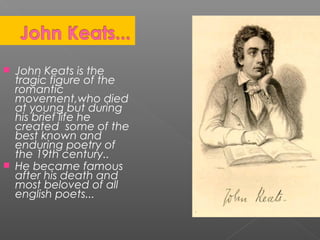
 John Keats is the
tragic figure of the
romantic
movement,who died
at young but during
his brief life he
created some of the
best known and
enduring poetry of
the 19th century..
 He became famous
after his death and
most beloved of all
english poets...
 Keats was very famous for his appreciation
of beauty in all his poems.....
 In 1819,Keats composed six Odes,which
are among his most famous and well-
regarded poems...
 As a whole, the Odes represent Keats
attempt to create a new type of short
lyrical poem,which influenced later
generations..
• The word "ODE" derived from a Greek
word 'aeidein',which means to chant or
sing.
• An ode is a form of lyric, or a form of poetry, such
as Sonnet or Elegy..
• A form of poetry that's written usually addressed
to someone or something. It represents the poet's
musings on that person or thing.
• It is a literary technique that is Lyrical in
nature,with short size..
• It's subject matter is solemn and
serious..
 It was Originated in ancient Greece by
Greek poet 'Pindar'..
 Later on the form was practiced with
certain modification by the Roman
poet 'Horace'..
 Edmund Goose defines the Ode as a
''strain of enthusiastic and exalted lyric
verse, directed to a fixed purpose and
dealing progressively with one dignified
theme"...
 A single, unified strain of exalted lyrical
verse.
 Tends to focus on one purpose and
theme.
 Its tone and manner is typically
elaborate, dignified, and imaginative.
 There are three types of Odes in
English:. 1) The Pindaric or
Regular ode; 2) The
Horatian or Homostrophic; and
3) The Irregular....
 The Pindaric is characterized by a three
strophe pattern of strophe, antistrophe,
and epode. Each new three strophe
pattern repeats the meter and rhyme
scheme of the first set.
 The Horatian has only one stanza type.
 The Irregular has no consistent stanza
pattern.
 Keats' odes tend to be ten-line stanzas in
iambic pentameter with a rhyme scheme
of ABABCDECDE.. On the basis of this, one
could argue that Keats is broadly Horatian.
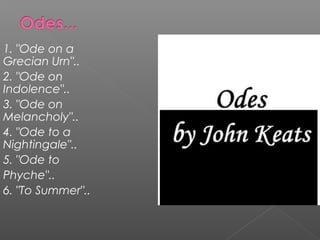
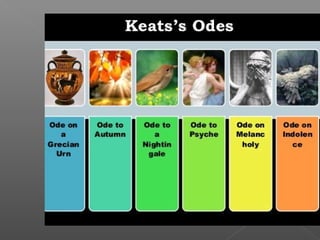
1. "Ode on a
Grecian Urn"..
2. "Ode on
Indolence"..
3. "Ode on
Melancholy"..
4. "Ode to a
Nightingale"..
5. "Ode to
Phyche"..
6. "To Summer"..
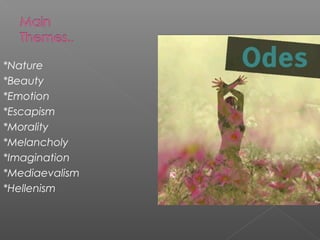
*Nature
*Beauty
*Emotion
*Escapism
*Morality
*Melancholy
*Imagination
*Mediaevalism
*Hellenism
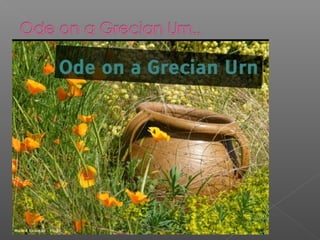
 What is an Urn?
-An Urn is a kind of vase that usually has a narrowed
neck above a footed pedestal..it's generally made by
marble or brass,often different kinds of scenes and
situations were carved on the outer surface of Urn.
 This poem proposes something far more  obviously 
enduring in a quite ordinary sense: a work of art. 
 Keats imagined the identity of those 
people portrayed on
the Urn and considers their feelings which are 
frozen in time. 
 As a work of beauty, the Urn represents the never-
ending life..
 The poem ends,at least superficially, in a strongly expres
sed certainty:
 “Beauty is truth, truth beauty, - that is all
Ye know on earth, and all ye need to know.”
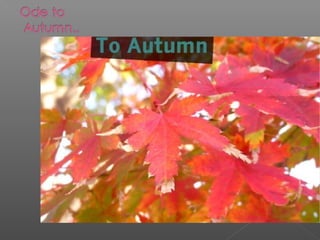
 The Ode is an address to the season of
Autumn.
 It's a season of mist and in this season
fruits are ripened on the collaboration
with the sun..
 It's all about a power of season, a
suggestion of the gradual passing away
of time,and a sense of sadness comes in
the soft dying days..
 Keats depicts the autumn season and
claims that it's unique music.
 Keats described, Autumn as a part of
the year,as old age is of life...
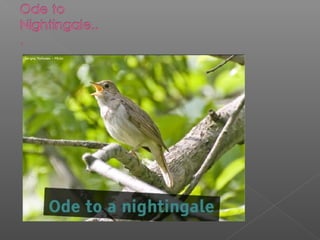
 In “Ode to a Nightingale” Keats describes ho
w he feels pain, ache, numbness, death,
sickness as
opposedosed to the bird which he describes 
as immortal.
 He describes how he listens to
the song of the bird which he considers as a 
symbol of the eternal melody of  happiness.
 Therefore he responds to the beauty of the bi
rd’s song both with “happiness” and
 “pain”. ..
 The Nightingale is “immortal” because it is 
“not born for death".
 This should lead to the affirmation of Keats..
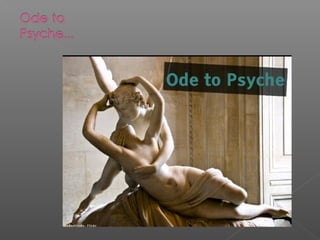
 Ode to Psyche is a tribute of the Greek
goddess Psyche,with whom Cupid fell
in love.
 In classical methodology Psyche was
a beautiful maiden,of whom the
goddess Venus was extremely jealous..
 Venus sent her son to humiliate that
girl,but Cupid fall in love with Psyche
and took her away to a secret valley
where he visited her each night..
 The myth symbolise the purification of
human intellect into soul and the
elevation of love to divinity...
• In conclusion we can say that, Keats all Odes are very
'Unique in literature'..
• Keats wished, to die into nature –to ‘cease upon the midnight
with no pains, but this was not his ordinary mood’. ..
• Keats sought, in spite of such moments of pain, to live in
nature and to be incorporate with one beautiful thing after
another.
• He had a way of fluttering butterfly fashion from one object to
another, touching for the moment the charm of each thing-
the work of fancy ‘who is never at home’.
• Keats all odes, is very difficult to understanding, and his all
odes are very famous in the romantic age.
Paper No. 5

Paper No. 5

  • 2.
     John Keatsis the tragic figure of the romantic movement,who died at young but during his brief life he created some of the best known and enduring poetry of the 19th century..  He became famous after his death and most beloved of all english poets...
  • 3.
     Keats wasvery famous for his appreciation of beauty in all his poems.....  In 1819,Keats composed six Odes,which are among his most famous and well- regarded poems...  As a whole, the Odes represent Keats attempt to create a new type of short lyrical poem,which influenced later generations..
  • 4.
    • The word"ODE" derived from a Greek word 'aeidein',which means to chant or sing. • An ode is a form of lyric, or a form of poetry, such as Sonnet or Elegy.. • A form of poetry that's written usually addressed to someone or something. It represents the poet's musings on that person or thing. • It is a literary technique that is Lyrical in nature,with short size.. • It's subject matter is solemn and serious..
  • 5.
     It wasOriginated in ancient Greece by Greek poet 'Pindar'..  Later on the form was practiced with certain modification by the Roman poet 'Horace'..  Edmund Goose defines the Ode as a ''strain of enthusiastic and exalted lyric verse, directed to a fixed purpose and dealing progressively with one dignified theme"...
  • 6.
     A single,unified strain of exalted lyrical verse.  Tends to focus on one purpose and theme.  Its tone and manner is typically elaborate, dignified, and imaginative.  There are three types of Odes in English:. 1) The Pindaric or Regular ode; 2) The Horatian or Homostrophic; and 3) The Irregular....
  • 7.
     The Pindaricis characterized by a three strophe pattern of strophe, antistrophe, and epode. Each new three strophe pattern repeats the meter and rhyme scheme of the first set.  The Horatian has only one stanza type.  The Irregular has no consistent stanza pattern.  Keats' odes tend to be ten-line stanzas in iambic pentameter with a rhyme scheme of ABABCDECDE.. On the basis of this, one could argue that Keats is broadly Horatian.
  • 8.
    1. "Ode ona Grecian Urn".. 2. "Ode on Indolence".. 3. "Ode on Melancholy".. 4. "Ode to a Nightingale".. 5. "Ode to Phyche".. 6. "To Summer"..
  • 9.
  • 12.
     What isan Urn? -An Urn is a kind of vase that usually has a narrowed neck above a footed pedestal..it's generally made by marble or brass,often different kinds of scenes and situations were carved on the outer surface of Urn.  This poem proposes something far more  obviously  enduring in a quite ordinary sense: a work of art.   Keats imagined the identity of those  people portrayed on the Urn and considers their feelings which are  frozen in time.   As a work of beauty, the Urn represents the never- ending life..  The poem ends,at least superficially, in a strongly expres sed certainty:  “Beauty is truth, truth beauty, - that is all Ye know on earth, and all ye need to know.”
  • 14.
     The Odeis an address to the season of Autumn.  It's a season of mist and in this season fruits are ripened on the collaboration with the sun..  It's all about a power of season, a suggestion of the gradual passing away of time,and a sense of sadness comes in the soft dying days..  Keats depicts the autumn season and claims that it's unique music.  Keats described, Autumn as a part of the year,as old age is of life...
  • 16.
     In “Ode to a Nightingale” Keats describes ho w he feels pain, ache, numbness, death, sickness as opposedosed to the bird which he describes  as immortal. He describes how he listens to the song of the bird which he considers as a  symbol of the eternal melody of  happiness.  Therefore he responds to the beauty of the bi rd’s song both with “happiness” and  “pain”. ..  The Nightingale is “immortal” because it is  “not born for death".  This should lead to the affirmation of Keats..
  • 18.
     Ode toPsyche is a tribute of the Greek goddess Psyche,with whom Cupid fell in love.  In classical methodology Psyche was a beautiful maiden,of whom the goddess Venus was extremely jealous..  Venus sent her son to humiliate that girl,but Cupid fall in love with Psyche and took her away to a secret valley where he visited her each night..  The myth symbolise the purification of human intellect into soul and the elevation of love to divinity...
  • 19.
    • In conclusionwe can say that, Keats all Odes are very 'Unique in literature'.. • Keats wished, to die into nature –to ‘cease upon the midnight with no pains, but this was not his ordinary mood’. .. • Keats sought, in spite of such moments of pain, to live in nature and to be incorporate with one beautiful thing after another. • He had a way of fluttering butterfly fashion from one object to another, touching for the moment the charm of each thing- the work of fancy ‘who is never at home’. • Keats all odes, is very difficult to understanding, and his all odes are very famous in the romantic age.