IOSR Journal of Mechanical and Civil Engineering (IOSR-JMCE)
e-ISSN: 2278-1684,p-ISSN: 2320-334X, Volume 13, Issue 3 Ver. IV (May- Jun. 2016), PP 53-60
www.iosrjournals.org
DOI: 10.9790/1684-1303045360 www.iosrjournals.org 53 | Page
Identifying the Significant Risk Management Factors for
Construction of Public Projects in Jordan
Ghanim A. Bekr1
, Ashraf Samarah2
1
(Civil Engineering Dept./Zarqa University, Jordan)
2
(Energy Research Center / Zarqa University, Jordan)
Abstract: The aim of the current study is to identify and assess the most significant risk factors affecting the
construction of public projects in Jordan and their probability of occurrence, impact and total effect. A
questionnaire survey was carried out and a total of 53 risk factors were identified and categorized into four
groups. These are technical related (19 factors), management related (12 factors), financial and market
related (13 factors) and political, social and environmental related (9 factors). Total number of participants
contributed to the survey was 108 distributed as 36 clients, 32 consultants and 40 contractors involve in the
implementation of public works projects. The results are presented on the basis of probability of occurrence,
impact and total effect. Number of factors that showed significant effect on the performance of the projects is:
eight factors are related to technical group; six factors are related to management group; five factors are
related to financial and market group and four factors are due to political, social and environmental factors.
Total of 20 out of 53risk factors showed that they are of significant effect. Top ten factors of significant effect
on risk in public sector's projects in Jordan are: (1) Changes of design by different parties, (2) Management
problems related to the contractors, (3) Design and contract documents errors, (4) Conflict in contract
documents, (5) Lack of planning and budgeting of project, (6) Financial problems suffered by contractors ,
(7) Inappropriate communications between client and other parties, (8) Loss due to bureaucracy and late
approval, (9) Material wastage on site (10) Rework due to labor mistakes.
Keywords: Risk factors, management, construction project, public works, Jordan
I. Introduction
Risk management is one of the nine knowledge areas covered by the project management Institute
[1]. The advantage of implementing risk management process will be identifying and analyzing risks and
improvement of construction projectactivities and optimum usage of resources. Construction projects are
always unique implemented and risks occurred due many different reasons [2].
The construction projects are complex and dynamic. This is due to multiple feedback processes, so
many participants are involved with different experience and interests [3].
Risk management assists the participants involved in the construction process (Client, Consultant,
Contractors and other parties) to meet their obligations and reduce the negative impact on the performance of
the project management represented by time, cost and quality.
The construction projects in Jordan, in general, and public projects in specific, experience different
kinds of risks through the different phases of the project. Most of these projects do not carry any risk
prediction during the tendering phase. The risk in construction should be realized as incident that affects the
project goals and in specific cost, time and quality. Some of the risks related to construction activities can be
predicted reasonably while the others cannot [4].
As far as project management is concerned, the most important effects of risks are:
• The possibility of not finishing the project within the cost estimate.
• The possibility of not completing the project within the expected time.
• Not achieving the required quality and operational requirements.
1.1. Definition and context of risk management
The term "risk management" in construction projects relates to recognizing, analyzing and
responding to the risk of the project.
The risk management comprises the maximizing of the output of favorable activities and reducing the effect
of adverse activities [5].
British standard institute defines risk as "the uncertainty implicit in plans and potential of something
occurred that can influence the likelihood of achieving, business or project aim [6]. In a project status, it is a
chance of an activity or action occurs that will have an effect upon aims. It includes the probability of loss or
winning, or diversion from the expected or planned outcomes, as a result of the uncertainty linked with
Identifying the significant risk management factors for construction of public projects in Jordan
DOI: 10.9790/1684-1303045360 www.iosrjournals.org 54 | Page
following a certain course of action. Accordingly risk has two elements. These are the chance or likelihood of
an action occurring and the results or influence of it does.
Risk management is an integral part of successful management, and essential to achieving successful
business and project outcomes and successful procurement of goods and services. Risk management presents
a clear way of appreciating and handling future uncertainty.
1.2. Classification of risk
There are different ways for sorting risk for different objectives. [1] classifies risks in construction
projects, in general, in to external risks and internal risks. Other authors, like [7] categorize risk in greater
detailed items. These are political risk, financial risk, market risk, intellectual property risk, social risk, safety
risk, etc. [8] suggested that the type risk, rely upon whether the risk is national or international. The internal
risks are related to all projects regardless of whether they are national or international projects.
II. Objective of the Study
The objectives of this study can be summarized as in the following:
 Recognizing and categorizing the risk for public construction projects in Jordan.
 Using probability, impact and total effect to rank the factors causing risk in Jordanian public construction
projects.
III. Literature Review
The risk in project management is well known as one of the most crucial process and potency areas in the
field of project management. Some of the research works in the field of risk management are shown below.
Reference [9] classified the factors causing risks into 8 groups. In their survey about risk
management, [10] concentrated on Build-Operate-Transfer (BOT) projects in china and discussed, in specific,
the criticality of the political and force majeure risks. Reference [11] developed a model in a formal way to
take into consideration and quantifying uncertainty in the plan of construction project.
In Russia, the risk management of global and joint venture construction with foreign cooperation was studied
by [7]. Similar study by [12] considered the risk factors associated with financial aspects related to
international construction from incorporated point of view.
In Hong Kong, reference [13] studied the importance of risk factors to the building contractors. In
Queensland, [14] carried out a survey involved senior construction management. This survey was related to
the utilization of risk management techniques.
Reference [15] in their study which was based on questionnaire survey identified that contractors
suffer more from contractual- related and legal- rated risks rather than the other types of risks.
In United Kingdom, as developed country, [16] carried out a survey to examine the priorities in the
allocation of risk. The analysis of data collected from the questionnaire revealed that some risks should be
possess in the public sector or participated with private sector.
Methodology Followed In This Study
The study followed the steps described below to achieve the objectives:
1. Literature review concerning the risk management in construction projects. The review concentrated on
identifying the risk factors that affect the performance of construction projects.
2. Relying on the literature review, a questionnaire set was created. The questionnaire consists of two parts.
The first has the general questions about the engineers who responded to the survey such as the
establishment type, years of experience, value of projects they are responsible for, etc. The second part of
the questionnaire contained questions about the evaluation of construction risk. In this study, (53) risk
factors are considered, distributed into (4) categories. These are technical related factors (19 factors),
management related factors (12 factors), financial and market factors (13 factors) and political, social and
environment factors (9 factors). Likert scale of 1 to 5 was utilized in this questionnaire. The respondents
were asked to estimate the total risk effect of each risk factor. The approach considered is to have two
features for each risk: the expected probability level of the risk occurrence represented by Probability
Index (P.I) and the degree of impact or the level of loss if the risk occurs represented by Impact Index
(I.I).By applying this approach, the respondents were asked to respond to the two attributes for each risk
factor. For considering (P.I), the respondents were required to estimate the probability level of risk
occurrence by selecting one from among five levels, namely: Very small, Small, Normal, large, and Very
Large. For considering (I.I) the respondents were asked to estimate the degree of impact if the risk
concerned occurs by selecting one from among five grades, namely: Very low, Low, medium, High, and
Very high.
Identifying the significant risk management factors for construction of public projects in Jordan
DOI: 10.9790/1684-1303045360 www.iosrjournals.org 55 | Page
3. Carrying out many construction projects sites visits in different cities in Jordan (Amman, Zarqa, Irbid and
Aqaba).
4. Distributing the questionnaire and personal interviews with key staff representing the public clients.
5. Analysis of the data. This item will be discussed, thoroughly in the next section.
6. Writing up conclusions and recommendations to identify risks and suggesting remedial measures.
I. Data Analysis
Descriptive and frequency statistical analysis techniques were used to analyze the data collected in
the survey. However, an advanced and accurate method is necessary to analyze the data in a systematic, fast
and reliable way. For this purpose, the computer software Statistical Package for Social Science (SPSS 16)
and MS Excel were selected.
The data collected from the survey were analyzed using the probability and impact index method [17] as
explained below.
According to [17], a formula as shown in equation (1) was used to rank risk factors based on frequency of
occurrence as identified by the participants, which is called the probability Index (P.I).
Where (a) is the constant expressing weighting given to each response (ranges from 1 for very small
up to 5 for very high occurrence), n is the probability of the responses, and N is the total number of responses.
Similarly, a formula as shown in equation (2) used to rank risk factors based on Impact index as indicated by
the participants, which is called Impact Index (I.I).
Where (a) is the constant expressing weighting given to each response (range from 1 for very low to
5 for very high effect), n is the frequency of the response, and N is the total number of responses.
Total Effect Index: The Total Effect index of each risk factor is calculated as a function of both probability
and impact indices, as follows:
IV. Results and Discussions
6.1. Characteristics of the respondents
The respondents participated in the survey are engineers representing clients (36), consultants (32)
and contractors (40). The majority of the engineers responded to the survey have experience more than 15
years. The study covered mainly the public sector projects. The respondents representing the clients are from
different ministries and municipalities. The contracting companies included in the survey are only from the
highest three classes (first, second and third). The respondents experience cover different types of projects
(Housing, public buildings, hospitals, water supply, water treatment plants, roads, etc.). The majority of the
respondents are civil engineers in addition to architectural, mechanical, electrical engineers, etc. with different
qualifications (BSc. and postgraduate).
6.2. The significance of risk factors
Fifty three risk factors have been considered in this research. Rating estimation of the factors was
carried out depending on the level of significance. This was estimated depending on Probability Index, Impact
Index and then Total Effect Index for each factor. The 53 factors are distributed on four groups. These are:
Technical (19) factors, management (12) factors, financial and market (13) factors and political, social and
environmental (9) factors. The significant factors considered for each group are those with Total Effect Index
above the average of the group.
6.3. Technical risk factors
The questionnaire included 19 technical-related factors. The average importance index for this group
is 48.69. Fig. (1) shows the Importance index for each factor and the significant ones.
Identifying the significant risk management factors for construction of public projects in Jordan
DOI: 10.9790/1684-1303045360 www.iosrjournals.org 56 | Page
Figure (1) – The technical related risk factors
6.4. Management risk factors
The questionnaire included 12 management-related factors. The average importance index for this
group is 49.05. Fig. (2) shows the Total Effect index for each factor and the significant ones.
Figure (2) – The management related risk factors
6.5. Financial and market factors
The questionnaire included 13 financial and market-related factors. The average importance index
for this group is 44.27. Fig. (3) shows the Total Effect for each factor and the significant ones.
Identifying the significant risk management factors for construction of public projects in Jordan
DOI: 10.9790/1684-1303045360 www.iosrjournals.org 57 | Page
Figure (3) – The financial and market related risk factors
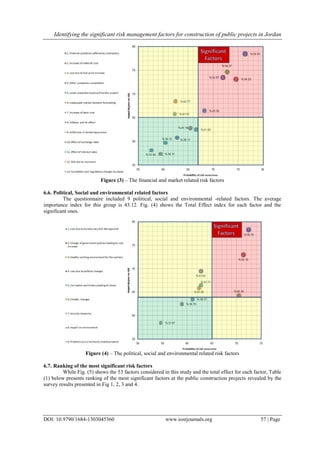
6.6. Political, Social and environmental related factors
The questionnaire included 9 political, social and environmental -related factors. The average
importance index for this group is 43.12. Fig. (4) shows the Total Effect index for each factor and the
significant ones.
Figure (4) – The political, social and environmental related risk factors
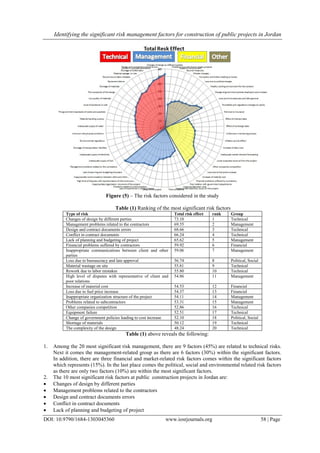
6.7. Ranking of the most significant risk factors
While Fig. (5) shows the 53 factors considered in this study and the total effect for each factor, Table
(1) below presents ranking of the most significant factors at the public construction projects revealed by the
survey results presented in Fig 1, 2, 3 and 4.
Identifying the significant risk management factors for construction of public projects in Jordan
DOI: 10.9790/1684-1303045360 www.iosrjournals.org 58 | Page
Figure (5) – The risk factors considered in the study
Table (1) Ranking of the most significant risk factors
Type of risk Total risk effect rank Group
Changes of design by different parties 73.10 1 Technical
Management problems related to the contractors 69.55 2 Management
Design and contract documents errors 68.66 3 Technical
Conflict in contract documents 66.24 4 Technical
Lack of planning and budgeting of project 65.62 5 Management
Financial problems suffered by contractors 59.92 6 Financial
Inappropriate communications between client and other
parties
59.06 7 Management
Loss due to bureaucracy and late approval 56.74 8 Political, Social
Material wastage on site 55.81 9 Technical
Rework due to labor mistakes 55.80 10 Technical
High level of disputes with representative of client and
poor relations
54.86 11 Management
Increase of material cost 54.53 12 Financial
Loss due to fuel price increase 54.37 13 Financial
Inappropriate organization structure of the project 54.11 14 Management
Problems related to subcontractors 53.31 15 Management
Other companies competition 52.86 16 Technical
Equipment failure 52.51 17 Technical
Change of government policies leading to cost increase 52.10 18 Political, Social
Shortage of materials 50.12 19 Technical
The complexity of the design 48.24 20 Technical
Table (1) above reveals the following:
1. Among the 20 most significant risk management, there are 9 factors (45%) are related to technical risks.
Next it comes the management-related group as there are 6 factors (30%) within the significant factors.
In addition, there are three financial and market-related risk factors comes within the significant factors
which represents (15%). In the last place comes the political, social and environmental related risk factors
as there are only two factors (10%) are within the most significant factors.
2. The 10 most significant risk factors at public construction projects in Jordan are:
 Changes of design by different parties
 Management problems related to the contractors
 Design and contract documents errors
 Conflict in contract documents
 Lack of planning and budgeting of project
Identifying the significant risk management factors for construction of public projects in Jordan
DOI: 10.9790/1684-1303045360 www.iosrjournals.org 59 | Page
 Financial problems suffered by contractors
 Inappropriate communications between client and other parties
 Loss due to bureaucracy and late approval
 Material wastage on site
 Rework due to labor mistakes
6.8. Reliability of factor analysis
To examine the reliability of the factors, Cronbach's alpha (Cα) test was carried out on each group of
factors to view if they were integrated. The values of Crobach's alpha should have a range between 0 and 1.
The lower values represent lower internal consistency and larger values represent greater internal consistency.
The criteria introduced by [18] for the interpretation of this coefficient was considered to evaluate the
results of the analysis. Cα> 0.8, 'Excellent'; 0.8> Cα> 0.7 'Good'; 0.7> Cα>0.5 'Satisfactory' and Cα <0.5 '
Poor'. Table (2) shows that the results of Cronbach alpha for all the groups.
Table (2) Reliability analysis
factors Cronbach alpha Result
Technical 0.765 Good
Management 0.548 Satisfactory
Financial and legal 0.479 poor
Political, social and environmental 0.638 Satisfactory
All factors 0.648 Satisfactory
V. Conclusions
The aim of the study was to recognize and categorize the risk for public construction projects in
Jordan. The probability, impact and total effect were used to rank the factors causing risk in Jordanian public
construction projects.
To recognize the major risk factors related to public works in Jordan. A comprehensive literature
review was carried out to identify the risk factors specified in the literature. The literature review and the pilot
study revealed 53risk factors distributed over four categories.
The questionnaire sets were distributed to the three main parties involve in the construction process.
Number of participants responded to the survey were 36 clients, 40 contractors and 32 consultants.
Number of factors that showed significant effect on the performance of the projects is 20 distributed to: nine
factors are related to technical group; six factors are related to management group; three factors are related to
financial and market group and two factors are due to political, social and environmental factors.
Total of 20 out of 53 risk factors showed that they are of significant effect. Ranking of these factors was made
according to the "Total Effect Indices" for the four groups.
Top ten factors causing delays for public sector projects in Jordan are: (1) Changes of design by
different parties, (2) Management problems related to the contractors, (3) Design and contract documents
errors, (4) Conflict in contract documents, (5) Lack of planning and budgeting of project, (6) Financial
problems suffered by contractors , (7) Inappropriate communications between client and other parties, (8)
Loss due to bureaucracy and late approval, (9) Material wastage on site (10) Rework due to labor mistakes.
VI. Recommendations
 Parties should compute with high accuracy and consider risks by adding a risk premium to quotation and
time estimation.
 Parties should provide all the efforts to prevent financial failure by practicing a tough cash flow
management and minimizing the dependence on bank loans.
 Parties should learn how to share and shift risks by hiring specialized staff or specialized subcontractors.
It is suggested that the contractor enforced to employ specialized Project Management Company
especially for the large scale projects to participate in both the design and construction stages.
 The contract clauses should be modified and improved to meet the impact of the political situation in the
country.
References
[1] Project Management Institute, Guide to the project management body of knowledge (PMBOK® Guide),5th ed. (Newtown
Square: Project Management Institute, 2008).
[2] L.S. Pheng and Q.T. Chuan, Environmental factors and work performance of project managers in the construction industry.
International Journal Project Management, 24(1), 2006, 4–37.
[3] P.K. Dey and S.O. Ogunlana, Selection and application of risk management tools and techniques for build-operate-transfer
projects. Industrial Management & Data Systems, 104(4), 2004, 334–346.
Identifying the significant risk management factors for construction of public projects in Jordan
DOI: 10.9790/1684-1303045360 www.iosrjournals.org 60 | Page
[4] J.F. Al-Bahar and K.C. Crandall, Systematic risk management approach for construction project. Journal of Construction
Engineering and Management, 116 (3), (1990), 533-546.
[5] J.F. Shan, Project risk management in Malaysia, 6th
Project management Conference, Sydney, Australia, 2012
[6] British Standards Institution (BSI), Guide To Project Management, B.S. 6079, 1996
[7] A. Aleshin, Risk management of international projects in Russia, International Journal of Project Management, 19, 2001, 207-
222.
[8] F. Ahmad and M. Wood, Causes of project failure in developing countries, School of Construction management and
Engineering, University of Reading.(2010).
[9] L. Bing, R. L. K. Tiong, W. F. Wong, and D. Chow, Risk management of international construction joint ventures, Journal of
Construction Engineering and Management ASCE, 25(4), 1999, 277–284.
[10] Q. Shou, Robert, L. K. Tiong, S. K. Ting and D. Ashley, Evaluation and management of political risks in China's BOT projects,
Journal of Construction Engineering and Management, 126(3), 2000, 242-250.
[11] B. Mulholland and J. Christian, Risk assessment in construction schedules,Journal of Construction Engineering and
Management, 125(1), 1999, 8-15
[12] M. Ahmed andJ. Dikbas, Applying a risk management process (RPM) to manage construction projects in Turkey, Istanbul
Technical University, Turkey, 2013
[13] M. Wang andH. Chou, Risk allocation and risk management of highway projects in Taiwan, Journal of Management in
Engineering, 19, 2003, 145-152.
[14] N.S. Lyons, and M. Skitmore, Project risk management in the Queensland engineering construction industry: a survey.
International Journal of Project Management 22(1), 2004, 51-61.
[15] N. Kartamand S. Kartam, Risk and its management in the Kuwaiti construction industry: a contractors' perspective, International
Journal of Project Management 19 (2),2001, 325-335.
[16] Li Bing, A. Akintoye, P.J. Edwards and C. Hardcastle, The allocation of risk in PPP/PFI construction projects in the UK,
International Journal of Project Management 23(3), 2005, 25–35.
[17] S. Assaf and Al-Hejji, Causes of delay in large construction projects. International Journal of Project Management, 21 (4),2006,
349-357.
[18] J. Nunally, Psychometric theory, 2nd Edition (, New York: McGraw-Hill, 1978)

J1303045360

  • 1.
    IOSR Journal ofMechanical and Civil Engineering (IOSR-JMCE) e-ISSN: 2278-1684,p-ISSN: 2320-334X, Volume 13, Issue 3 Ver. IV (May- Jun. 2016), PP 53-60 www.iosrjournals.org DOI: 10.9790/1684-1303045360 www.iosrjournals.org 53 | Page Identifying the Significant Risk Management Factors for Construction of Public Projects in Jordan Ghanim A. Bekr1 , Ashraf Samarah2 1 (Civil Engineering Dept./Zarqa University, Jordan) 2 (Energy Research Center / Zarqa University, Jordan) Abstract: The aim of the current study is to identify and assess the most significant risk factors affecting the construction of public projects in Jordan and their probability of occurrence, impact and total effect. A questionnaire survey was carried out and a total of 53 risk factors were identified and categorized into four groups. These are technical related (19 factors), management related (12 factors), financial and market related (13 factors) and political, social and environmental related (9 factors). Total number of participants contributed to the survey was 108 distributed as 36 clients, 32 consultants and 40 contractors involve in the implementation of public works projects. The results are presented on the basis of probability of occurrence, impact and total effect. Number of factors that showed significant effect on the performance of the projects is: eight factors are related to technical group; six factors are related to management group; five factors are related to financial and market group and four factors are due to political, social and environmental factors. Total of 20 out of 53risk factors showed that they are of significant effect. Top ten factors of significant effect on risk in public sector's projects in Jordan are: (1) Changes of design by different parties, (2) Management problems related to the contractors, (3) Design and contract documents errors, (4) Conflict in contract documents, (5) Lack of planning and budgeting of project, (6) Financial problems suffered by contractors , (7) Inappropriate communications between client and other parties, (8) Loss due to bureaucracy and late approval, (9) Material wastage on site (10) Rework due to labor mistakes. Keywords: Risk factors, management, construction project, public works, Jordan I. Introduction Risk management is one of the nine knowledge areas covered by the project management Institute [1]. The advantage of implementing risk management process will be identifying and analyzing risks and improvement of construction projectactivities and optimum usage of resources. Construction projects are always unique implemented and risks occurred due many different reasons [2]. The construction projects are complex and dynamic. This is due to multiple feedback processes, so many participants are involved with different experience and interests [3]. Risk management assists the participants involved in the construction process (Client, Consultant, Contractors and other parties) to meet their obligations and reduce the negative impact on the performance of the project management represented by time, cost and quality. The construction projects in Jordan, in general, and public projects in specific, experience different kinds of risks through the different phases of the project. Most of these projects do not carry any risk prediction during the tendering phase. The risk in construction should be realized as incident that affects the project goals and in specific cost, time and quality. Some of the risks related to construction activities can be predicted reasonably while the others cannot [4]. As far as project management is concerned, the most important effects of risks are: • The possibility of not finishing the project within the cost estimate. • The possibility of not completing the project within the expected time. • Not achieving the required quality and operational requirements. 1.1. Definition and context of risk management The term "risk management" in construction projects relates to recognizing, analyzing and responding to the risk of the project. The risk management comprises the maximizing of the output of favorable activities and reducing the effect of adverse activities [5]. British standard institute defines risk as "the uncertainty implicit in plans and potential of something occurred that can influence the likelihood of achieving, business or project aim [6]. In a project status, it is a chance of an activity or action occurs that will have an effect upon aims. It includes the probability of loss or winning, or diversion from the expected or planned outcomes, as a result of the uncertainty linked with
  • 2.
    Identifying the significantrisk management factors for construction of public projects in Jordan DOI: 10.9790/1684-1303045360 www.iosrjournals.org 54 | Page following a certain course of action. Accordingly risk has two elements. These are the chance or likelihood of an action occurring and the results or influence of it does. Risk management is an integral part of successful management, and essential to achieving successful business and project outcomes and successful procurement of goods and services. Risk management presents a clear way of appreciating and handling future uncertainty. 1.2. Classification of risk There are different ways for sorting risk for different objectives. [1] classifies risks in construction projects, in general, in to external risks and internal risks. Other authors, like [7] categorize risk in greater detailed items. These are political risk, financial risk, market risk, intellectual property risk, social risk, safety risk, etc. [8] suggested that the type risk, rely upon whether the risk is national or international. The internal risks are related to all projects regardless of whether they are national or international projects. II. Objective of the Study The objectives of this study can be summarized as in the following:  Recognizing and categorizing the risk for public construction projects in Jordan.  Using probability, impact and total effect to rank the factors causing risk in Jordanian public construction projects. III. Literature Review The risk in project management is well known as one of the most crucial process and potency areas in the field of project management. Some of the research works in the field of risk management are shown below. Reference [9] classified the factors causing risks into 8 groups. In their survey about risk management, [10] concentrated on Build-Operate-Transfer (BOT) projects in china and discussed, in specific, the criticality of the political and force majeure risks. Reference [11] developed a model in a formal way to take into consideration and quantifying uncertainty in the plan of construction project. In Russia, the risk management of global and joint venture construction with foreign cooperation was studied by [7]. Similar study by [12] considered the risk factors associated with financial aspects related to international construction from incorporated point of view. In Hong Kong, reference [13] studied the importance of risk factors to the building contractors. In Queensland, [14] carried out a survey involved senior construction management. This survey was related to the utilization of risk management techniques. Reference [15] in their study which was based on questionnaire survey identified that contractors suffer more from contractual- related and legal- rated risks rather than the other types of risks. In United Kingdom, as developed country, [16] carried out a survey to examine the priorities in the allocation of risk. The analysis of data collected from the questionnaire revealed that some risks should be possess in the public sector or participated with private sector. Methodology Followed In This Study The study followed the steps described below to achieve the objectives: 1. Literature review concerning the risk management in construction projects. The review concentrated on identifying the risk factors that affect the performance of construction projects. 2. Relying on the literature review, a questionnaire set was created. The questionnaire consists of two parts. The first has the general questions about the engineers who responded to the survey such as the establishment type, years of experience, value of projects they are responsible for, etc. The second part of the questionnaire contained questions about the evaluation of construction risk. In this study, (53) risk factors are considered, distributed into (4) categories. These are technical related factors (19 factors), management related factors (12 factors), financial and market factors (13 factors) and political, social and environment factors (9 factors). Likert scale of 1 to 5 was utilized in this questionnaire. The respondents were asked to estimate the total risk effect of each risk factor. The approach considered is to have two features for each risk: the expected probability level of the risk occurrence represented by Probability Index (P.I) and the degree of impact or the level of loss if the risk occurs represented by Impact Index (I.I).By applying this approach, the respondents were asked to respond to the two attributes for each risk factor. For considering (P.I), the respondents were required to estimate the probability level of risk occurrence by selecting one from among five levels, namely: Very small, Small, Normal, large, and Very Large. For considering (I.I) the respondents were asked to estimate the degree of impact if the risk concerned occurs by selecting one from among five grades, namely: Very low, Low, medium, High, and Very high.
  • 3.
    Identifying the significantrisk management factors for construction of public projects in Jordan DOI: 10.9790/1684-1303045360 www.iosrjournals.org 55 | Page 3. Carrying out many construction projects sites visits in different cities in Jordan (Amman, Zarqa, Irbid and Aqaba). 4. Distributing the questionnaire and personal interviews with key staff representing the public clients. 5. Analysis of the data. This item will be discussed, thoroughly in the next section. 6. Writing up conclusions and recommendations to identify risks and suggesting remedial measures. I. Data Analysis Descriptive and frequency statistical analysis techniques were used to analyze the data collected in the survey. However, an advanced and accurate method is necessary to analyze the data in a systematic, fast and reliable way. For this purpose, the computer software Statistical Package for Social Science (SPSS 16) and MS Excel were selected. The data collected from the survey were analyzed using the probability and impact index method [17] as explained below. According to [17], a formula as shown in equation (1) was used to rank risk factors based on frequency of occurrence as identified by the participants, which is called the probability Index (P.I). Where (a) is the constant expressing weighting given to each response (ranges from 1 for very small up to 5 for very high occurrence), n is the probability of the responses, and N is the total number of responses. Similarly, a formula as shown in equation (2) used to rank risk factors based on Impact index as indicated by the participants, which is called Impact Index (I.I). Where (a) is the constant expressing weighting given to each response (range from 1 for very low to 5 for very high effect), n is the frequency of the response, and N is the total number of responses. Total Effect Index: The Total Effect index of each risk factor is calculated as a function of both probability and impact indices, as follows: IV. Results and Discussions 6.1. Characteristics of the respondents The respondents participated in the survey are engineers representing clients (36), consultants (32) and contractors (40). The majority of the engineers responded to the survey have experience more than 15 years. The study covered mainly the public sector projects. The respondents representing the clients are from different ministries and municipalities. The contracting companies included in the survey are only from the highest three classes (first, second and third). The respondents experience cover different types of projects (Housing, public buildings, hospitals, water supply, water treatment plants, roads, etc.). The majority of the respondents are civil engineers in addition to architectural, mechanical, electrical engineers, etc. with different qualifications (BSc. and postgraduate). 6.2. The significance of risk factors Fifty three risk factors have been considered in this research. Rating estimation of the factors was carried out depending on the level of significance. This was estimated depending on Probability Index, Impact Index and then Total Effect Index for each factor. The 53 factors are distributed on four groups. These are: Technical (19) factors, management (12) factors, financial and market (13) factors and political, social and environmental (9) factors. The significant factors considered for each group are those with Total Effect Index above the average of the group. 6.3. Technical risk factors The questionnaire included 19 technical-related factors. The average importance index for this group is 48.69. Fig. (1) shows the Importance index for each factor and the significant ones.
  • 4.
    Identifying the significantrisk management factors for construction of public projects in Jordan DOI: 10.9790/1684-1303045360 www.iosrjournals.org 56 | Page Figure (1) – The technical related risk factors 6.4. Management risk factors The questionnaire included 12 management-related factors. The average importance index for this group is 49.05. Fig. (2) shows the Total Effect index for each factor and the significant ones. Figure (2) – The management related risk factors 6.5. Financial and market factors The questionnaire included 13 financial and market-related factors. The average importance index for this group is 44.27. Fig. (3) shows the Total Effect for each factor and the significant ones.
  • 5.
    Identifying the significantrisk management factors for construction of public projects in Jordan DOI: 10.9790/1684-1303045360 www.iosrjournals.org 57 | Page Figure (3) – The financial and market related risk factors 6.6. Political, Social and environmental related factors The questionnaire included 9 political, social and environmental -related factors. The average importance index for this group is 43.12. Fig. (4) shows the Total Effect index for each factor and the significant ones. Figure (4) – The political, social and environmental related risk factors 6.7. Ranking of the most significant risk factors While Fig. (5) shows the 53 factors considered in this study and the total effect for each factor, Table (1) below presents ranking of the most significant factors at the public construction projects revealed by the survey results presented in Fig 1, 2, 3 and 4.
  • 6.
    Identifying the significantrisk management factors for construction of public projects in Jordan DOI: 10.9790/1684-1303045360 www.iosrjournals.org 58 | Page Figure (5) – The risk factors considered in the study Table (1) Ranking of the most significant risk factors Type of risk Total risk effect rank Group Changes of design by different parties 73.10 1 Technical Management problems related to the contractors 69.55 2 Management Design and contract documents errors 68.66 3 Technical Conflict in contract documents 66.24 4 Technical Lack of planning and budgeting of project 65.62 5 Management Financial problems suffered by contractors 59.92 6 Financial Inappropriate communications between client and other parties 59.06 7 Management Loss due to bureaucracy and late approval 56.74 8 Political, Social Material wastage on site 55.81 9 Technical Rework due to labor mistakes 55.80 10 Technical High level of disputes with representative of client and poor relations 54.86 11 Management Increase of material cost 54.53 12 Financial Loss due to fuel price increase 54.37 13 Financial Inappropriate organization structure of the project 54.11 14 Management Problems related to subcontractors 53.31 15 Management Other companies competition 52.86 16 Technical Equipment failure 52.51 17 Technical Change of government policies leading to cost increase 52.10 18 Political, Social Shortage of materials 50.12 19 Technical The complexity of the design 48.24 20 Technical Table (1) above reveals the following: 1. Among the 20 most significant risk management, there are 9 factors (45%) are related to technical risks. Next it comes the management-related group as there are 6 factors (30%) within the significant factors. In addition, there are three financial and market-related risk factors comes within the significant factors which represents (15%). In the last place comes the political, social and environmental related risk factors as there are only two factors (10%) are within the most significant factors. 2. The 10 most significant risk factors at public construction projects in Jordan are:  Changes of design by different parties  Management problems related to the contractors  Design and contract documents errors  Conflict in contract documents  Lack of planning and budgeting of project
  • 7.
    Identifying the significantrisk management factors for construction of public projects in Jordan DOI: 10.9790/1684-1303045360 www.iosrjournals.org 59 | Page  Financial problems suffered by contractors  Inappropriate communications between client and other parties  Loss due to bureaucracy and late approval  Material wastage on site  Rework due to labor mistakes 6.8. Reliability of factor analysis To examine the reliability of the factors, Cronbach's alpha (Cα) test was carried out on each group of factors to view if they were integrated. The values of Crobach's alpha should have a range between 0 and 1. The lower values represent lower internal consistency and larger values represent greater internal consistency. The criteria introduced by [18] for the interpretation of this coefficient was considered to evaluate the results of the analysis. Cα> 0.8, 'Excellent'; 0.8> Cα> 0.7 'Good'; 0.7> Cα>0.5 'Satisfactory' and Cα <0.5 ' Poor'. Table (2) shows that the results of Cronbach alpha for all the groups. Table (2) Reliability analysis factors Cronbach alpha Result Technical 0.765 Good Management 0.548 Satisfactory Financial and legal 0.479 poor Political, social and environmental 0.638 Satisfactory All factors 0.648 Satisfactory V. Conclusions The aim of the study was to recognize and categorize the risk for public construction projects in Jordan. The probability, impact and total effect were used to rank the factors causing risk in Jordanian public construction projects. To recognize the major risk factors related to public works in Jordan. A comprehensive literature review was carried out to identify the risk factors specified in the literature. The literature review and the pilot study revealed 53risk factors distributed over four categories. The questionnaire sets were distributed to the three main parties involve in the construction process. Number of participants responded to the survey were 36 clients, 40 contractors and 32 consultants. Number of factors that showed significant effect on the performance of the projects is 20 distributed to: nine factors are related to technical group; six factors are related to management group; three factors are related to financial and market group and two factors are due to political, social and environmental factors. Total of 20 out of 53 risk factors showed that they are of significant effect. Ranking of these factors was made according to the "Total Effect Indices" for the four groups. Top ten factors causing delays for public sector projects in Jordan are: (1) Changes of design by different parties, (2) Management problems related to the contractors, (3) Design and contract documents errors, (4) Conflict in contract documents, (5) Lack of planning and budgeting of project, (6) Financial problems suffered by contractors , (7) Inappropriate communications between client and other parties, (8) Loss due to bureaucracy and late approval, (9) Material wastage on site (10) Rework due to labor mistakes. VI. Recommendations  Parties should compute with high accuracy and consider risks by adding a risk premium to quotation and time estimation.  Parties should provide all the efforts to prevent financial failure by practicing a tough cash flow management and minimizing the dependence on bank loans.  Parties should learn how to share and shift risks by hiring specialized staff or specialized subcontractors. It is suggested that the contractor enforced to employ specialized Project Management Company especially for the large scale projects to participate in both the design and construction stages.  The contract clauses should be modified and improved to meet the impact of the political situation in the country. References [1] Project Management Institute, Guide to the project management body of knowledge (PMBOK® Guide),5th ed. (Newtown Square: Project Management Institute, 2008). [2] L.S. Pheng and Q.T. Chuan, Environmental factors and work performance of project managers in the construction industry. International Journal Project Management, 24(1), 2006, 4–37. [3] P.K. Dey and S.O. Ogunlana, Selection and application of risk management tools and techniques for build-operate-transfer projects. Industrial Management & Data Systems, 104(4), 2004, 334–346.
  • 8.
    Identifying the significantrisk management factors for construction of public projects in Jordan DOI: 10.9790/1684-1303045360 www.iosrjournals.org 60 | Page [4] J.F. Al-Bahar and K.C. Crandall, Systematic risk management approach for construction project. Journal of Construction Engineering and Management, 116 (3), (1990), 533-546. [5] J.F. Shan, Project risk management in Malaysia, 6th Project management Conference, Sydney, Australia, 2012 [6] British Standards Institution (BSI), Guide To Project Management, B.S. 6079, 1996 [7] A. Aleshin, Risk management of international projects in Russia, International Journal of Project Management, 19, 2001, 207- 222. [8] F. Ahmad and M. Wood, Causes of project failure in developing countries, School of Construction management and Engineering, University of Reading.(2010). [9] L. Bing, R. L. K. Tiong, W. F. Wong, and D. Chow, Risk management of international construction joint ventures, Journal of Construction Engineering and Management ASCE, 25(4), 1999, 277–284. [10] Q. Shou, Robert, L. K. Tiong, S. K. Ting and D. Ashley, Evaluation and management of political risks in China's BOT projects, Journal of Construction Engineering and Management, 126(3), 2000, 242-250. [11] B. Mulholland and J. Christian, Risk assessment in construction schedules,Journal of Construction Engineering and Management, 125(1), 1999, 8-15 [12] M. Ahmed andJ. Dikbas, Applying a risk management process (RPM) to manage construction projects in Turkey, Istanbul Technical University, Turkey, 2013 [13] M. Wang andH. Chou, Risk allocation and risk management of highway projects in Taiwan, Journal of Management in Engineering, 19, 2003, 145-152. [14] N.S. Lyons, and M. Skitmore, Project risk management in the Queensland engineering construction industry: a survey. International Journal of Project Management 22(1), 2004, 51-61. [15] N. Kartamand S. Kartam, Risk and its management in the Kuwaiti construction industry: a contractors' perspective, International Journal of Project Management 19 (2),2001, 325-335. [16] Li Bing, A. Akintoye, P.J. Edwards and C. Hardcastle, The allocation of risk in PPP/PFI construction projects in the UK, International Journal of Project Management 23(3), 2005, 25–35. [17] S. Assaf and Al-Hejji, Causes of delay in large construction projects. International Journal of Project Management, 21 (4),2006, 349-357. [18] J. Nunally, Psychometric theory, 2nd Edition (, New York: McGraw-Hill, 1978)