Risk Management and
Ratio Analysis of BOP
Bank of Punjab
Executive Summary:
The bank of Punjab (BOP) established in 1989 and got the status of scheduled bank in 1994. The
bank of Punjab offer number of products in their customer. There are 293 braches of BOP in the
whole country. Functionally the bank of Punjab is divided in the division and the each division is
headed bye the general managers.
The government of the Punjab holds the majority of the shares in BOP. It is doing business in
commercial banking and the retail banking. Corporate banking treasury and investment and trade
finance. The shares of BOP are traded in all three stock Exchanges of the Pakistan.
As for as the different ratios of the Bank Of the Punjab, they all give the healthy sign regarding
financial position of the Bank as well as the operation results of the different financial years. All
ratios are fully in accordance with the banking industry’s standard and norm which is a yard stick
to measure the performance of any bank. These ratio depict and indicate that the financial
strength of the on a higher side and further prospect of the Bank is brighter.
At the end the conclusion and the recommendations are the part of the report.
History:
The Bank of Punjab started functioning with the inauguration of its first branch of 7-Egerton
Road, Lahore on November 15, 1989. The founder of the bank Mr. Nawaz Sharif performed the
inauguration.
The Bank of Punjab is working as a scheduled bank with its 273 branches in all major cities of
the country. The bank provides all types of banking services such as Deposit in Local currency,
Client Deposits in Foreign currency, Remittances and Advances to businesses, trade, industry
and agriculture. The Bank of Punjab ahs entered into a new era of science to the nation under the
experienced and professional hands of its management.
The Bank of Punjab has played a vital role in the national economy through mobilization of
untapped local resources, promoting savings and providing funds for investments.
The Bank of Punjab has played a vital role in the economy through mobilization of untapped
local resources, promoting savings and providing funds for investment.
The Bank of Punjab has the privilege to discharge its responsibilities towards national prosperity
and progress. Within the couple of years of its scheduling, the bank has not only carved out for
itself prominent niche in the mainstream banking of the country but in certain areas it has the
distinction of taking the lead. In short span of time the Bank has been able to evolve a distinct
corporate culture through of its owned-based policies, which are realistic and are on highly
professional footings.
Vision Statement:
“To be a customer focused bank with service Excellence”
Mission Statement:
“To exceed the expectation of our stakeholders by
Leveraging our relationship with the government of
Punjab and delivering a complete range of professional
Solutions with a focus on program driven products
And services in the agriculture and middle markets
Through a motivated team"
Risk Management Process:
Managing risks on projects is a process that includes risk assessment and a mitigation strategy
for those risks. Risk assessment includes both the identification of potential risk and the
evaluation of the potential impact of the risk. A risk mitigation plan is designed to eliminate or
minimize the impact of the risk events—occurrences that have a negative impact on the project.
Identifying risk is both a creative and a disciplined process. The creative process includes
brainstorming sessions where the team is asked to create a list of everything that could go wrong.
All ideas are welcome at this stage with the evaluation of the ideas coming later.
R ISK ID EN TIFICATION :
A more disciplined process involves using checklists of potential risks and evaluating the
likelihood that those events might happen on the project. Some companies and industries develop
risk checklists based on experience from past projects. These checklists can be helpful to the
project manager and project team in identifying both specific risks on the checklist and
expanding the thinking of the team. The past experience of the project team, project experience
within the company, and experts in the industry can be valuable resources for identifying
potential risk on a project.
Identifying the sources of risk by category is another method for exploring potential risk on a
project. Some examples of categories for potential risks include the following:
 Technical
 Cost
 Schedule
 Client
 Contractual
 Weather
 Financial
 Political
 Environmental
 People
The people category can be subdivided into risks associated with the people. Examples of people
risks include the risk of not finding the skills needed to execute the project or the sudden
unavailability of key people on the project. David Hillson[1] uses the same framework as the
work breakdown structure (WBS) for developing a risk breakdown structure (RBS). A risk
breakdown structure organizes the risks that have been identified into categories using a table
with increasing levels of detail to the right.
The result is a clearer understanding of where risks are most concentrated. Hillson’s approach
helps the project team identify known risks, but can be restrictive and less creative in identifying
unknown risks and risks not easily found inside the work breakdown structure
R ISK EVALUATION :
After the potential risks have been identified, the project team then evaluates the risk based on
the probability that the risk event will occur and the potential loss associated with the event. Not
all risks are equal. Some risk events are more likely to happen than others, and the cost of a risk
event can vary greatly. Evaluating the risk for probability of occurrence and the severity or the
potential loss to the project is the next step in the risk management process.
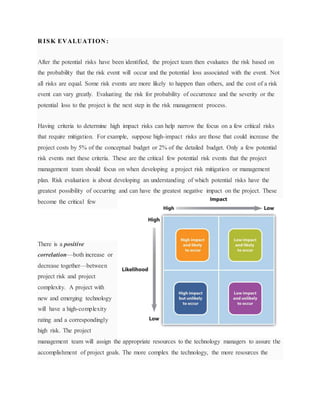
Having criteria to determine high impact risks can help narrow the focus on a few critical risks
that require mitigation. For example, suppose high-impact risks are those that could increase the
project costs by 5% of the conceptual budget or 2% of the detailed budget. Only a few potential
risk events met these criteria. These are the critical few potential risk events that the project
management team should focus on when developing a project risk mitigation or management
plan. Risk evaluation is about developing an understanding of which potential risks have the
greatest possibility of occurring and can have the greatest negative impact on the project. These
become the critical few
There is a positive
correlation—both increase or
decrease together—between
project risk and project
complexity. A project with
new and emerging technology
will have a high-complexity
rating and a correspondingly
high risk. The project
management team will assign the appropriate resources to the technology managers to assure the
accomplishment of project goals. The more complex the technology, the more resources the
technology manager typically needs to meet project goals, and each of those resources could face
unexpected problems.
Risk evaluation often occurs in a workshop setting. Building on the identification of the risks,
each risk event is analyzed to determine the likelihood of occurring and the potential cost if it did
occur. The likelihood and impact are both rated as high, medium, or low. A risk mitigation plan
addresses the items that have high ratings on both factors—likelihood and impact.
A project team analyzed the risk of some important equipment not arriving to the project on
time. The team identified three pieces of equipment that were critical to the project and would
significantly increase the costs of the project if they were late in arriving. One of the vendors,
who was selected to deliver an important piece of equipment, had a history of being late on other
projects. The vendor was good and often took on more work than it could deliver on time. This
risk event (the identified equipment arriving late) was rated as high likelihood with a high
impact. The other two pieces of equipment were potentially a high impact on the project but with
a low probability of occurring.
Not all project managers conduct a formal risk assessment on the project. One reason, as found
by David Parker and Alison Mobey[2] in their phenomenological study of project managers, was
a low understanding of the tools and benefits of a structured analysis of project risks. The lack of
formal risk management tools was also seen as a barrier to implementing a risk management
program. Additionally, the project manager’s personality and management style play into risk
preparation levels. Some project managers are more proactive and will develop elaborate risk
management programs for their projects. Other managers are reactive and are more confident in
their ability to handle unexpected events when they occur. Yet others are risk averse, and prefer
to be optimistic and not consider risks or avoid taking risks whenever possible.
On projects with a low complexity profile, the project manager may informally track items that
may be considered risk items. On more complex projects, the project management team may
develop a list of items perceived to be higher risk and track them during project reviews. On
projects with greater complexity, the process for evaluating risk is more formal with a risk
assessment meeting or series of meetings during the life of the project to assess risks at different
phases of the project. On highly complex projects, an outside expert may be included in the risk
assessment process, and the risk assessment plan may take a more prominent place in the project
execution plan.
On complex projects, statistical models are sometimes used to evaluate risk because there are too
many different possible combinations of risks to calculate them one at a time. One example of
the statistical model used on projects is the Monte Carlo simulation, which simulates a possible
range of outcomes by trying many different combinations of risks based on their likelihood. The
output from a Monte Carlo simulation provides the project team with the probability of an event
occurring within a range and for combinations of events. For example, the typical output from a
Monte Carlo simulation may reflect that there is a 10% chance that one of the three important
pieces of equipment will be late and that the weather will also be unusually bad after the
equipment arrives.
R ISK M ITIGATION :
After the risk has been identified and evaluated, the project team develops a risk mitigation plan,
which is a plan to reduce the impact of an unexpected event. The project team mitigates risks in
the following ways:
 Risk avoidance
 Risk sharing
 Risk reduction
 Risk transfer
Each of these mitigation techniques can be an effective tool in reducing individual risks and the
risk profile of the project. The risk mitigation plan captures the risk mitigation approach for each
identified risk event and the actions the project management team will take to reduce or
eliminate the risk.
Risk avoidance usually involves developing an alternative strategy that has a higher probability
of success but usually at a higher cost associated with accomplishing a project task. A common
risk avoidance technique is to use proven and existing technologies rather than adopt new
techniques, even though the new techniques may show promise of better performance or lower
costs. A project team may choose a vendor with a proven track record over a new vendor that is
providing significant price incentives to avoid the risk of working with a new vendor. The
project team that requires drug testing for team members is practicing risk avoidance by avoiding
damage done by someone under the influence of drugs.
Risk sharing involves partnering with others to share responsibility for the risk activities. Many
organizations that work on international projects will reduce political, legal, labor, and others
risk types associated with international projects by developing a joint venture with a company
located in that country. Partnering with another company to share the risk associated with a
portion of the project is advantageous when the other company has expertise and experience the
project team does not have. If the risk event does occur, then the partnering company absorbs
some or all of the negative impact of the event. The company will also derive some of the profit
or benefit gained by a successful project.
Risk reduction is an investment of funds to reduce the risk on a project. On international
projects, companies will often purchase the guarantee of a currency rate to reduce the risk
associated with fluctuations in the currency exchange rate. A project manager may hire an expert
to review the technical plans or the cost estimate on a project to increase the confidence in that
plan and reduce the project risk. Assigning highly skilled project personnel to manage the high-
risk activities is another risk reduction method. Experts managing a high-risk activity can often
predict problems and find solutions that prevent the activities from having a negative impact on
the project. Some companies reduce risk by forbidding key executives or technology experts to
ride on the same airplane.
Risk transfer is a risk reduction method that shifts the risk from the project to another party. The
purchase of insurance on certain items is a risk transfer method. The risk is transferred from the
project to the insurance company. A construction project in the Caribbean may purchase
hurricane insurance that would cover the cost of a hurricane damaging the construction site. The
purchase of insurance is usually in areas outside the control of the project team. Weather,
political unrest, and labor strikes are examples of events that can significantly impact the project
and that are outside the control of the project team.
CO N TIN GEN CY PLAN :
The project risk plan balances the investment of the mitigation against the benefit for the project.
The project team often develops an alternative method for accomplishing a project goal when a
risk event has been identified that may frustrate the accomplishment of that goal. These plans are
called contingency plans. The risk of a truck drivers’ strike may be mitigated with a contingency
plan that uses a train to transport the needed equipment for the project. If a critical piece of
equipment is late, the impact on the schedule can be mitigated by making changes to the
schedule to accommodate a late equipment delivery.
Contingency funds are funds set aside by the project team to address unforeseen events that
cause the project costs to increase. Projects with a high-risk profile will typically have a large
contingency budget. Although the amount of contingency allocated in the project budget is a
function of the risks identified in the risk analysis process, contingency is typically managed as
one line item in the project budget.
Some project managers allocate the contingency budget to the items in the budget that have high
risk rather than developing one line item in the budget for contingencies. This approach allows
the project team to track the use of contingency against the risk plan. This approach also
allocates the responsibility to manage the risk budget to the managers responsible for those line
items. The availability of contingency funds in the line item budget may also increase the use of
contingency funds to solve problems rather than finding alternative, less costly solutions. Most
project managers, especially on more complex projects, will manage contingency funds at the
project level, with approval of the project manager required before contingency funds can be
used.
The 5C's
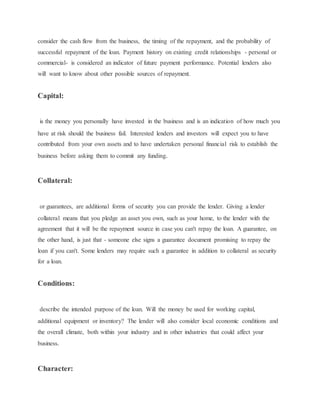
Capacity:
to repay is the most critical of the five factors, it is the primary source of repayment - cash. The
prospective lender will want to know exactly how you intend to repay the loan. The lender will
consider the cash flow from the business, the timing of the repayment, and the probability of
successful repayment of the loan. Payment history on existing credit relationships - personal or
commercial- is considered an indicator of future payment performance. Potential lenders also
will want to know about other possible sources of repayment.
Capital:
is the money you personally have invested in the business and is an indication of how much you
have at risk should the business fail. Interested lenders and investors will expect you to have
contributed from your own assets and to have undertaken personal financial risk to establish the
business before asking them to commit any funding.
Collateral:
or guarantees, are additional forms of security you can provide the lender. Giving a lender
collateral means that you pledge an asset you own, such as your home, to the lender with the
agreement that it will be the repayment source in case you can't repay the loan. A guarantee, on
the other hand, is just that - someone else signs a guarantee document promising to repay the
loan if you can't. Some lenders may require such a guarantee in addition to collateral as security
for a loan.
Conditions:
describe the intended purpose of the loan. Will the money be used for working capital,
additional equipment or inventory? The lender will also consider local economic conditions and
the overall climate, both within your industry and in other industries that could affect your
business.
Character:
is the general impression you make on the prospective lender or investor. The lender will form a
subjective opinion as to whether or not you are sufficiently trustworthy to repay the loan or
generate a return on funds invested in your company. Your educational background and
experience in business and in your industry will be considered. The quality of your references
and the background and experience levels of your employees will also be
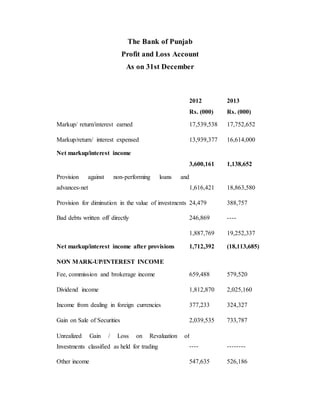
The Bank of Punjab
Profit and Loss Account
As on 31st December
2012
Rs. (000)
2013
Rs. (000)
Markup/ return/interest earned 17,539,538 17,752,652
Markup/return/ interest expensed 13,939,377 16,614,000
Net markup/interest income
3,600,161 1,138,652
Provision against non-performing loans and
advances-net 1,616,421 18,863,580
Provision for diminution in the value of investments 24,479 388,757
Bad debts written off directly 246,869 ----
1,887,769 19,252,337
Net markup/interest income after provisions 1,712,392 (18,113,685)
NON MARK-UP/INTEREST INCOME
Fee, commission and brokerage income 659,488 579,520
Dividend income 1,812,870 2,025,160
Income from dealing in foreign currencies 377,233 324,327
Gain on Sale of Securities 2,039,535 733,787
Unrealized Gain / Loss on Revaluation of
Investments classified as held for trading ---- --------
Other income 547,635 526,186
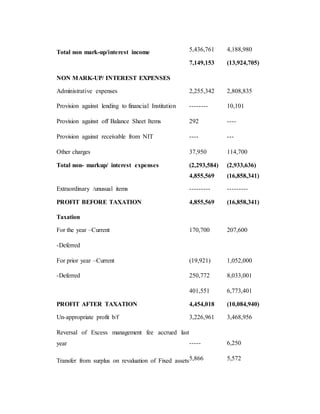
Total non mark-up/interest income 5,436,761 4,188,980
7,149,153 (13,924,705)
NON MARK-UP/ INTEREST EXPENSES
Administrative expenses 2,255,342 2,808,835
Provision against lending to financial Institution -------- 10,101
Provision against off Balance Sheet Items 292 ----
Provision against receivable from NIT ---- ---
Other charges 37,950 114,700
Total non- markup/ interest expenses (2,293,584) (2,933,636)
4,855,569 (16,858,341)
Extraordinary /unusual items --------- ---------
PROFIT BEFORE TAXATION 4,855,569 (16,858,341)
Taxation
For the year –Current 170,700 207,600
-Deferred
For prior year –Current (19,921) 1,052,000
-Deferred 250,772 8,033,001
401,551 6,773,401
PROFIT AFTER TAXATION 4,454,018 (10,084,940)
Un-appropriate profit b/f 3,226,961 3,468,956
Reversal of Excess management fee accrued last
year ----- 6,250
Transfer from surplus on revaluation of Fixed assets5,866 5,572
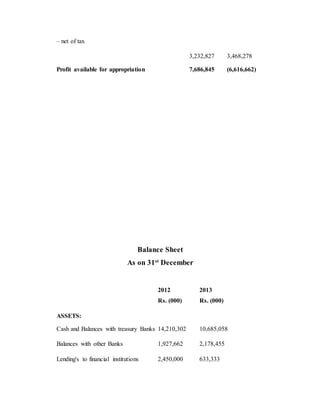
– net of tax
3,232,827 3,468,278
Profit available for appropriation 7,686,845 (6,616,662)
Balance Sheet
As on 31st
December
2012
Rs. (000)
2013
Rs. (000)
ASSETS:
Cash and Balances with treasury Banks 14,210,302 10,685,058
Balances with other Banks 1,927,662 2,178,455
Lending's to financial institutions 2,450,000 633,333
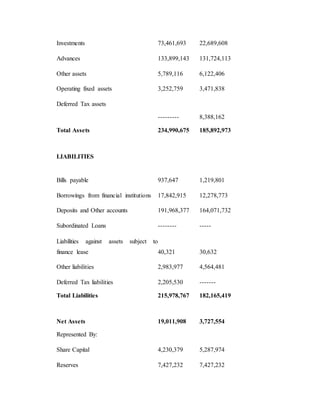
Investments 73,461,693 22,689,608
Advances 133,899,143 131,724,113
Other assets 5,789,116 6,122,406
Operating fixed assets 3,252,759 3,471,838
Deferred Tax assets
--------- 8,388,162
Total Assets 234,990,675 185,892,973
LIABILITIES
Bills payable 937,647 1,219,801
Borrowings from financial institutions 17,842,915 12,278,773
Deposits and Other accounts 191,968,377 164,071,732
Subordinated Loans -------- -----
Liabilities against assets subject to
finance lease 40,321 30,632
Other liabilities 2,983,977 4,564,481
Deferred Tax liabilities 2,205,530 -------
Total Liabilities 215,978,767 182,165,419
Net Assets 19,011,908 3,727,554
Represented By:
Share Capital 4,230,379 5,287,974
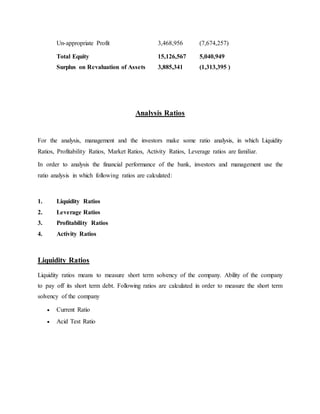
Reserves 7,427,232 7,427,232
Un-appropriate Profit 3,468,956 (7,674,257)
Total Equity 15,126,567 5,040,949
Surplus on Revaluation of Assets 3,885,341 (1,313,395 )
Analysis Ratios
For the analysis, management and the investors make some ratio analysis, in which Liquidity
Ratios, Profitability Ratios, Market Ratios, Activity Ratios, Leverage ratios are familiar.
In order to analysis the financial performance of the bank, investors and management use the
ratio analysis in which following ratios are calculated:
1. Liquidity Ratios
2. Leverage Ratios
3. Profitability Ratios
4. Activity Ratios
Liquidity Ratios
Liquidity ratios means to measure short term solvency of the company. Ability of the company
to pay off its short term debt. Following ratios are calculated in order to measure the short term
solvency of the company
 Current Ratio
 Acid Test Ratio
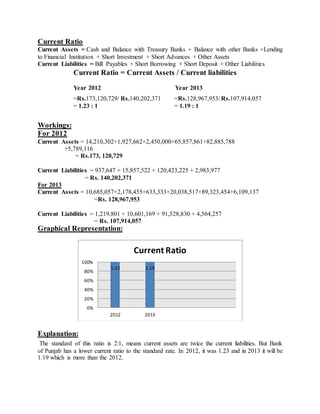
Current Ratio
Current Assets = Cash and Balance with Treasury Banks + Balance with other Banks +Lending
to Financial Institution + Short Investment + Short Advances + Other Assets
Current Liabilities = Bill Payables + Short Borrowing + Short Deposit + Other Liabilities
Current Ratio = Current Assets / Current liabilities
Year 2012 Year 2013
=Rs.173,120,729/ Rs.140,202,371
= 1.23 : 1
=Rs.128,967,953/ Rs.107,914,057
= 1.19 : 1
Workings:
For 2012
Current Assets = 14,210,302+1,927,662+2,450,000+65,857,861+82,885,788
+5,789,116
= Rs.173, 120,729
Current Liabilities = 937,647 + 15,857,522 + 120,423,225 + 2,983,977
= Rs. 140,202,371
For 2013
Current Assets = 10,685,057+2,178,455+633,333+20,038,517+89,323,454+6,109,137
=Rs. 128,967,953
Current Liabilities = 1,219,801 + 10,601,169 + 91,528,830 + 4,564,257
= Rs. 107,914,057
Graphical Representation:
Explanation:
The standard of this ratio is 2:1, means current assets are twice the current liabilities. But Bank
of Punjab has a lower current ratio to the standard rate. In 2012, it was 1.23 and in 2013 it will be
1.19 which is more than the 2012.
1.23 1.19
0%
20%
40%
60%
80%
100%
2012 2013
Current Ratio
Acid Test Ratio
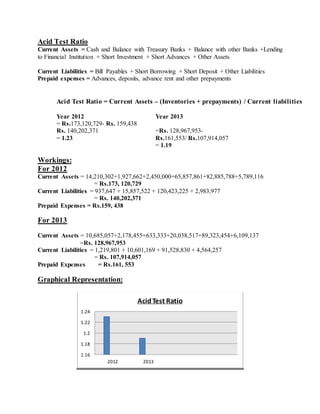
Current Assets = Cash and Balance with Treasury Banks + Balance with other Banks +Lending
to Financial Institution + Short Investment + Short Advances + Other Assets
Current Liabilities = Bill Payables + Short Borrowing + Short Deposit + Other Liabilities
Prepaid expenses = Advances, deposits, advance rent and other prepayments
Acid Test Ratio = Current Assets – (Inventories + prepayments) / Current liabilities
Year 2012 Year 2013
= Rs.173,120,729- Rs. 159,438 /
Rs. 140,202,371
= 1.23
=Rs. 128,967,953-
Rs.161,553/ Rs.107,914,057
= 1.19
Workings:
For 2012
Current Assets = 14,210,302+1,927,662+2,450,000+65,857,861+82,885,788+5,789,116
= Rs.173, 120,729
Current Liabilities = 937,647 + 15,857,522 + 120,423,225 + 2,983,977
= Rs. 140,202,371
Prepaid Expenses = Rs.159, 438
For 2013
Current Assets = 10,685,057+2,178,455+633,333+20,038,517+89,323,454+6,109,137
=Rs. 128,967,953
Current Liabilities = 1,219,801 + 10,601,169 + 91,528,830 + 4,564,257
= Rs. 107,914,057
Prepaid Expenses = Rs.161, 553
Graphical Representation:
1.16
1.18
1.2
1.22
1.24
2012 2013
AcidTest Ratio
Explanation:
As the Acid test ratio from year 2012 to 2013 is: Rs. 1.23 and Rs 1.19 respectively. In all two
years acid test ratio is slight more than is standard ratio. It must be 1:1 in order to proof the short
term solvency of the bank to pay off is short term bank.
Leverage Ratios
These ratios show the capital structure of the firm. Through these ratios we find that how the
firm finance their activities. It is more important for the lender to assess that the firm can repay
the loan amount or not. Increasing debt increases the likelihood of bankruptcy of the firm.
Following ratios falls under this category,
 Time Interest Earned
 Debt Ratio
 Debt to Equity Ratio
 Debt to Tangible Net Worth
 Total Capitalization Ratio
Time Interest Earned Ratio:
Time Interest Earned = Profit before tax + Interest Expense (EBIT) / Interest Expense
Year 2012 Year 2013
=Rs.4,855,569/Rs.13,939,377
= 0.35
=(Rs.16,832,906)/Rs.16,614,000
= -1.01
Working
Given in the Profit and Loss Account
For 2012
Profit before tax+ Interest Expense = Rs. 4,855,569
Interest Expense = Rs. 13,939,377
For 2013
Profit before tax+ Interest Expense = Rs. -16,832,906
Interest Expense = Rs. 16,614,000
Graphical Representation:
Explanation:
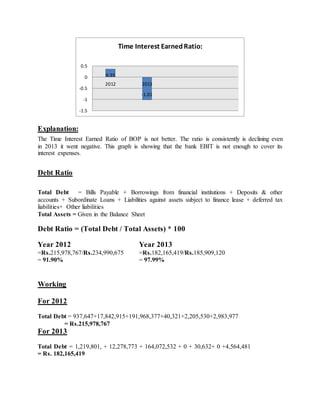
The Time Interest Earned Ratio of BOP is not better. The ratio is consistently is declining even
in 2013 it went negative. This graph is showing that the bank EBIT is not enough to cover its
interest expenses.
Debt Ratio
Total Debt = Bills Payable + Borrowings from financial institutions + Deposits & other
accounts + Subordinate Loans + Liabilities against assets subject to finance lease + deferred tax
liabilities+ Other liabilities
Total Assets = Given in the Balance Sheet
Working
For 2012
Total Debt = 937,647+17,842,915+191,968,377+40,321+2,205,530+2,983,977
= Rs.215,978,767
For 2013
Total Debt = 1,219,801, + 12,278,773 + 164,072,532 + 0 + 30,632+ 0 +4,564,481
= Rs. 182,165,419
0.35
-1.01
-1.5
-1
-0.5
0
0.5
2012 2013
Time Interest Earned Ratio:
Debt Ratio = (Total Debt / Total Assets) * 100
Year 2012 Year 2013
=Rs.215,978,767/Rs.234,990,675
= 91.90%
=Rs.182,165,419/Rs.185,909,120
= 97.99%
Graphical Representation:
Explanation:
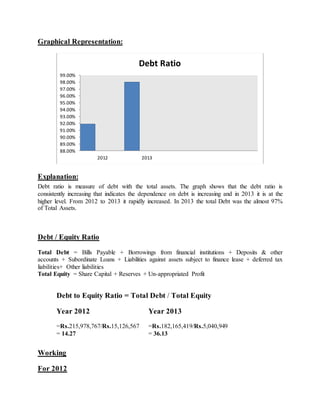
Debt ratio is measure of debt with the total assets. The graph shows that the debt ratio is
consistently increasing that indicates the dependence on debt is increasing and in 2013 it is at the
higher level. From 2012 to 2013 it rapidly increased. In 2013 the total Debt was the almost 97%
of Total Assets.
Debt / Equity Ratio
Total Debt = Bills Payable + Borrowings from financial institutions + Deposits & other
accounts + Subordinate Loans + Liabilities against assets subject to finance lease + deferred tax
liabilities+ Other liabilities
Total Equity = Share Capital + Reserves + Un-appropriated Profit
Debt to Equity Ratio = Total Debt / Total Equity
Year 2012 Year 2013
=Rs.215,978,767/Rs.15,126,567
= 14.27
=Rs.182,165,419/Rs.5,040,949
= 36.13
Working
For 2012
88.00%
89.00%
90.00%
91.00%
92.00%
93.00%
94.00%
95.00%
96.00%
97.00%
98.00%
99.00%
2012 2013
Debt Ratio
Total Debt = 937,647 + 17,842,915 + 191,968,377 + 0 +40,321+2,205,530+2,983,977
= Rs.215,978,767
Total Equity = 4,230,379 + 7,427,232 + 3,468,956
= Rs.15,126,567
For 2013
Total Debt = 1,219,801, + 12,278,773 + 164,072,532 + 0 + 30,632+ 0 +4,564,481
= Rs.182,165,419
Total Equity = 5,287,974 + 7,427,232 + (– 7,658,686 (Loss))
= Rs.5,040,949
Graphical Representation:
Explanation:
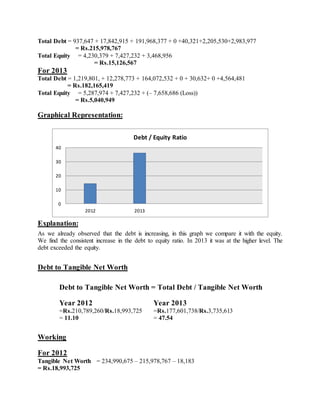
As we already observed that the debt is increasing, in this graph we compare it with the equity.
We find the consistent increase in the debt to equity ratio. In 2013 it was at the higher level. The
debt exceeded the equity.
Debt to Tangible Net Worth
Debt to Tangible Net Worth = Total Debt / Tangible Net Worth
Year 2012 Year 2013
=Rs.210,789,260/Rs.18,993,725
= 11.10
=Rs.177,601,738/Rs.3,735,613
= 47.54
Working
For 2012
Tangible Net Worth = 234,990,675 – 215,978,767 – 18,183
= Rs.18,993,725
0
10
20
30
40
2012 2013
Debt / Equity Ratio
For 2013
Tangible Net Worth = 185,909,120 – 182,165,995 – 7,512
= Rs.3,735,613
Graphical Representation:
Explanation:
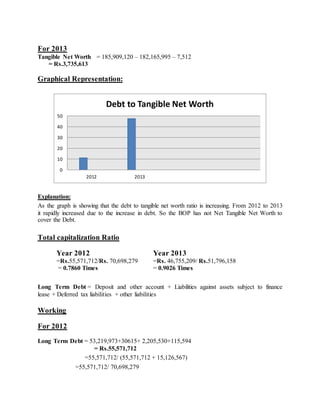
As the graph is showing that the debt to tangible net worth ratio is increasing. From 2012 to 2013
it rapidly increased due to the increase in debt. So the BOP has not Net Tangible Net Worth to
cover the Debt.
Total capitalization Ratio
Year 2012 Year 2013
=Rs.55,571,712/Rs. 70,698,279
= 0.7860 Times
=Rs. 46,755,209/ Rs.51,796,158
= 0.9026 Times
Long Term Debt = Deposit and other account + Liabilities against assets subject to finance
lease + Deferred tax liabilities + other liabilities
Working
For 2012
Long Term Debt = 53,219,973+30615+ 2,205,530+115,594
= Rs.55,571,712
=55,571,712/ (55,571,712 + 15,126,567)
=55,571,712/ 70,698,279
0
10
20
30
40
50
2012 2013
Debt to Tangible Net Worth
For 2013
Long Term Debt =46,555,790+19859+0+ 179,560
= Rs.46,755,209
= 46,755,209/ (46,755,209+ 5,040,949)
= 46,755,209/51,796,15
Graphical Representation:
Explanation:
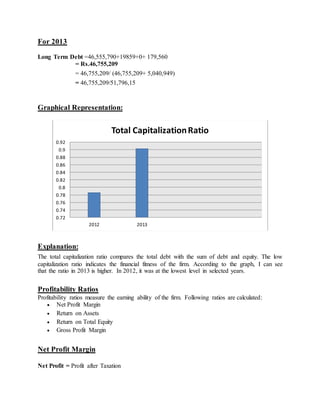
The total capitalization ratio compares the total debt with the sum of debt and equity. The low
capitalization ratio indicates the financial fitness of the firm. According to the graph, I can see
that the ratio in 2013 is higher. In 2012, it was at the lowest level in selected years.
Profitability Ratios
Profitability ratios measure the earning ability of the firm. Following ratios are calculated:
 Net Profit Margin
 Return on Assets
 Return on Total Equity
 Gross Profit Margin
Net Profit Margin
Net Profit = Profit after Taxation
0.72
0.74
0.76
0.78
0.8
0.82
0.84
0.86
0.88
0.9
0.92
2012 2013
Total CapitalizationRatio
Total Revenue = Markup/ return/interest earned
Net Profit Margin = Net Profit / Total Revenue
Year 2012 Year 2013
= Rs.4,454,018 / Rs. 17,539,538
= 25.39%
= (Rs.10,084,940) / Rs.17,752,652
= -56.81%
Working
For 2012
Net Profit = Rs.4,454,018
Total Revenue = Rs.17,539,538
For 2013
Net Profit = Rs.-10,084,940
Total Revenue = Rs.17,752,652
Graphical Representation:
Explanation:
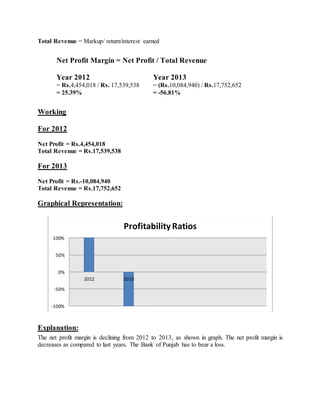
The net profit margin is declining from 2012 to 2013, as shown in graph. The net profit margin is
decreases as compared to last years. The Bank of Punjab has to bear a loss.
-100%
-50%
0%
50%
100%
2012 2013
Profitability Ratios
Return on Assets
Net Profit = Profit after Taxation
Total Assets = Given in the Balance Sheet
ROA = Net Income / Total Assets
Year 2012 Year 2013
= Rs.4,454,018 / Rs.234,990,675
= 1.895%
= (Rs.10,084,940)/ Rs.185,892,973
= -5.425%
Working
For 2012
Net Profit = 4,454,018
Total Assets = 234,990,675
For 2013
Net Profit = 10,084,940
Total Assets = 185,892,973
Graphical Representation:
Explanation:
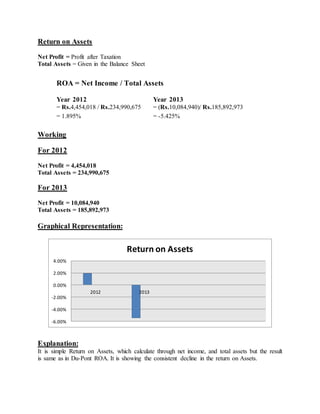
It is simple Return on Assets, which calculate through net income, and total assets but the result
is same as in Du-Pont ROA. It is showing the consistent decline in the return on Assets.
-6.00%
-4.00%
-2.00%
0.00%
2.00%
4.00%
2012 2013
Return on Assets
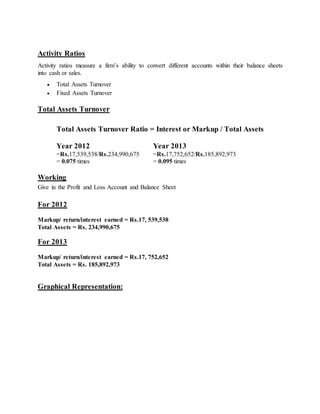
Activity Ratios
Activity ratios measure a firm’s ability to convert different accounts within their balance sheets
into cash or sales.
 Total Assets Turnover
 Fixed Assets Turnover
Total Assets Turnover
Total Assets Turnover Ratio = Interest or Markup / Total Assets
Year 2012 Year 2013
=Rs.17,539,538/Rs.234,990,675
= 0.075 times
=Rs.17,752,652/Rs.185,892,973
= 0.095 times
Working
Give in the Profit and Loss Account and Balance Sheet
For 2012
Markup/ return/interest earned = Rs.17, 539,538
Total Assets = Rs. 234,990,675
For 2013
Markup/ return/interest earned = Rs.17, 752,652
Total Assets = Rs. 185,892,973
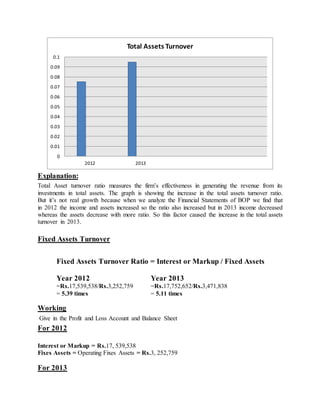
Graphical Representation:
Explanation:
Total Asset turnover ratio measures the firm’s effectiveness in generating the revenue from its
investments in total assets. The graph is showing the increase in the total assets turnover ratio.
But it’s not real growth because when we analyze the Financial Statements of BOP we find that
in 2012 the income and assets increased so the ratio also increased but in 2013 income decreased
whereas the assets decrease with more ratio. So this factor caused the increase in the total assets
turnover in 2013.
Fixed Assets Turnover
Fixed Assets Turnover Ratio = Interest or Markup / Fixed Assets
Year 2012 Year 2013
=Rs.17,539,538/Rs.3,252,759
= 5.39 times
=Rs.17,752,652/Rs.3,471,838
= 5.11 times
Working
Give in the Profit and Loss Account and Balance Sheet
For 2012
Interest or Markup = Rs.17, 539,538
Fixes Assets = Operating Fixes Assets = Rs.3, 252,759
For 2013
0
0.01
0.02
0.03
0.04
0.05
0.06
0.07
0.08
0.09
0.1
2012 2013
Total Assets Turnover
Interest or Markup = Rs. Rs.17, 752,652
Fixes Assets = Operating Fixes Assets = Rs.3, 471,838
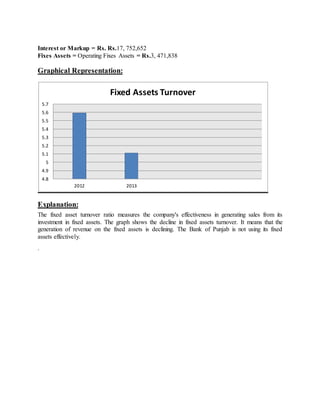
Graphical Representation:
Explanation:
The fixed asset turnover ratio measures the company's effectiveness in generating sales from its
investment in fixed assets. The graph shows the decline in fixed assets turnover. It means that the
generation of revenue on the fixed assets is declining. The Bank of Punjab is not using its fixed
assets effectively.
.
4.8
4.9
5
5.1
5.2
5.3
5.4
5.5
5.6
5.7
2012 2013
Fixed Assets Turnover

Financial Analysis of BOP

  • 1.
    Risk Management and RatioAnalysis of BOP Bank of Punjab
  • 2.
    Executive Summary: The bankof Punjab (BOP) established in 1989 and got the status of scheduled bank in 1994. The bank of Punjab offer number of products in their customer. There are 293 braches of BOP in the whole country. Functionally the bank of Punjab is divided in the division and the each division is headed bye the general managers. The government of the Punjab holds the majority of the shares in BOP. It is doing business in commercial banking and the retail banking. Corporate banking treasury and investment and trade finance. The shares of BOP are traded in all three stock Exchanges of the Pakistan. As for as the different ratios of the Bank Of the Punjab, they all give the healthy sign regarding financial position of the Bank as well as the operation results of the different financial years. All ratios are fully in accordance with the banking industry’s standard and norm which is a yard stick to measure the performance of any bank. These ratio depict and indicate that the financial strength of the on a higher side and further prospect of the Bank is brighter. At the end the conclusion and the recommendations are the part of the report. History: The Bank of Punjab started functioning with the inauguration of its first branch of 7-Egerton Road, Lahore on November 15, 1989. The founder of the bank Mr. Nawaz Sharif performed the inauguration. The Bank of Punjab is working as a scheduled bank with its 273 branches in all major cities of the country. The bank provides all types of banking services such as Deposit in Local currency, Client Deposits in Foreign currency, Remittances and Advances to businesses, trade, industry
  • 3.
    and agriculture. TheBank of Punjab ahs entered into a new era of science to the nation under the experienced and professional hands of its management. The Bank of Punjab has played a vital role in the national economy through mobilization of untapped local resources, promoting savings and providing funds for investments. The Bank of Punjab has played a vital role in the economy through mobilization of untapped local resources, promoting savings and providing funds for investment. The Bank of Punjab has the privilege to discharge its responsibilities towards national prosperity and progress. Within the couple of years of its scheduling, the bank has not only carved out for itself prominent niche in the mainstream banking of the country but in certain areas it has the distinction of taking the lead. In short span of time the Bank has been able to evolve a distinct corporate culture through of its owned-based policies, which are realistic and are on highly professional footings. Vision Statement: “To be a customer focused bank with service Excellence” Mission Statement: “To exceed the expectation of our stakeholders by Leveraging our relationship with the government of Punjab and delivering a complete range of professional Solutions with a focus on program driven products And services in the agriculture and middle markets Through a motivated team"
  • 4.
    Risk Management Process: Managingrisks on projects is a process that includes risk assessment and a mitigation strategy for those risks. Risk assessment includes both the identification of potential risk and the evaluation of the potential impact of the risk. A risk mitigation plan is designed to eliminate or minimize the impact of the risk events—occurrences that have a negative impact on the project. Identifying risk is both a creative and a disciplined process. The creative process includes brainstorming sessions where the team is asked to create a list of everything that could go wrong. All ideas are welcome at this stage with the evaluation of the ideas coming later. R ISK ID EN TIFICATION : A more disciplined process involves using checklists of potential risks and evaluating the likelihood that those events might happen on the project. Some companies and industries develop risk checklists based on experience from past projects. These checklists can be helpful to the project manager and project team in identifying both specific risks on the checklist and expanding the thinking of the team. The past experience of the project team, project experience within the company, and experts in the industry can be valuable resources for identifying potential risk on a project. Identifying the sources of risk by category is another method for exploring potential risk on a project. Some examples of categories for potential risks include the following:  Technical  Cost  Schedule  Client  Contractual  Weather  Financial
  • 5.
     Political  Environmental People The people category can be subdivided into risks associated with the people. Examples of people risks include the risk of not finding the skills needed to execute the project or the sudden unavailability of key people on the project. David Hillson[1] uses the same framework as the work breakdown structure (WBS) for developing a risk breakdown structure (RBS). A risk breakdown structure organizes the risks that have been identified into categories using a table with increasing levels of detail to the right. The result is a clearer understanding of where risks are most concentrated. Hillson’s approach helps the project team identify known risks, but can be restrictive and less creative in identifying unknown risks and risks not easily found inside the work breakdown structure
  • 6.
    R ISK EVALUATION: After the potential risks have been identified, the project team then evaluates the risk based on the probability that the risk event will occur and the potential loss associated with the event. Not all risks are equal. Some risk events are more likely to happen than others, and the cost of a risk event can vary greatly. Evaluating the risk for probability of occurrence and the severity or the potential loss to the project is the next step in the risk management process. Having criteria to determine high impact risks can help narrow the focus on a few critical risks that require mitigation. For example, suppose high-impact risks are those that could increase the project costs by 5% of the conceptual budget or 2% of the detailed budget. Only a few potential risk events met these criteria. These are the critical few potential risk events that the project management team should focus on when developing a project risk mitigation or management plan. Risk evaluation is about developing an understanding of which potential risks have the greatest possibility of occurring and can have the greatest negative impact on the project. These become the critical few There is a positive correlation—both increase or decrease together—between project risk and project complexity. A project with new and emerging technology will have a high-complexity rating and a correspondingly high risk. The project management team will assign the appropriate resources to the technology managers to assure the accomplishment of project goals. The more complex the technology, the more resources the
  • 7.
    technology manager typicallyneeds to meet project goals, and each of those resources could face unexpected problems. Risk evaluation often occurs in a workshop setting. Building on the identification of the risks, each risk event is analyzed to determine the likelihood of occurring and the potential cost if it did occur. The likelihood and impact are both rated as high, medium, or low. A risk mitigation plan addresses the items that have high ratings on both factors—likelihood and impact. A project team analyzed the risk of some important equipment not arriving to the project on time. The team identified three pieces of equipment that were critical to the project and would significantly increase the costs of the project if they were late in arriving. One of the vendors, who was selected to deliver an important piece of equipment, had a history of being late on other projects. The vendor was good and often took on more work than it could deliver on time. This risk event (the identified equipment arriving late) was rated as high likelihood with a high impact. The other two pieces of equipment were potentially a high impact on the project but with a low probability of occurring. Not all project managers conduct a formal risk assessment on the project. One reason, as found by David Parker and Alison Mobey[2] in their phenomenological study of project managers, was a low understanding of the tools and benefits of a structured analysis of project risks. The lack of formal risk management tools was also seen as a barrier to implementing a risk management program. Additionally, the project manager’s personality and management style play into risk preparation levels. Some project managers are more proactive and will develop elaborate risk management programs for their projects. Other managers are reactive and are more confident in their ability to handle unexpected events when they occur. Yet others are risk averse, and prefer to be optimistic and not consider risks or avoid taking risks whenever possible. On projects with a low complexity profile, the project manager may informally track items that may be considered risk items. On more complex projects, the project management team may develop a list of items perceived to be higher risk and track them during project reviews. On projects with greater complexity, the process for evaluating risk is more formal with a risk assessment meeting or series of meetings during the life of the project to assess risks at different phases of the project. On highly complex projects, an outside expert may be included in the risk
  • 8.
    assessment process, andthe risk assessment plan may take a more prominent place in the project execution plan. On complex projects, statistical models are sometimes used to evaluate risk because there are too many different possible combinations of risks to calculate them one at a time. One example of the statistical model used on projects is the Monte Carlo simulation, which simulates a possible range of outcomes by trying many different combinations of risks based on their likelihood. The output from a Monte Carlo simulation provides the project team with the probability of an event occurring within a range and for combinations of events. For example, the typical output from a Monte Carlo simulation may reflect that there is a 10% chance that one of the three important pieces of equipment will be late and that the weather will also be unusually bad after the equipment arrives. R ISK M ITIGATION : After the risk has been identified and evaluated, the project team develops a risk mitigation plan, which is a plan to reduce the impact of an unexpected event. The project team mitigates risks in the following ways:  Risk avoidance  Risk sharing  Risk reduction  Risk transfer Each of these mitigation techniques can be an effective tool in reducing individual risks and the risk profile of the project. The risk mitigation plan captures the risk mitigation approach for each identified risk event and the actions the project management team will take to reduce or eliminate the risk. Risk avoidance usually involves developing an alternative strategy that has a higher probability of success but usually at a higher cost associated with accomplishing a project task. A common risk avoidance technique is to use proven and existing technologies rather than adopt new techniques, even though the new techniques may show promise of better performance or lower
  • 9.
    costs. A projectteam may choose a vendor with a proven track record over a new vendor that is providing significant price incentives to avoid the risk of working with a new vendor. The project team that requires drug testing for team members is practicing risk avoidance by avoiding damage done by someone under the influence of drugs. Risk sharing involves partnering with others to share responsibility for the risk activities. Many organizations that work on international projects will reduce political, legal, labor, and others risk types associated with international projects by developing a joint venture with a company located in that country. Partnering with another company to share the risk associated with a portion of the project is advantageous when the other company has expertise and experience the project team does not have. If the risk event does occur, then the partnering company absorbs some or all of the negative impact of the event. The company will also derive some of the profit or benefit gained by a successful project. Risk reduction is an investment of funds to reduce the risk on a project. On international projects, companies will often purchase the guarantee of a currency rate to reduce the risk associated with fluctuations in the currency exchange rate. A project manager may hire an expert to review the technical plans or the cost estimate on a project to increase the confidence in that plan and reduce the project risk. Assigning highly skilled project personnel to manage the high- risk activities is another risk reduction method. Experts managing a high-risk activity can often predict problems and find solutions that prevent the activities from having a negative impact on the project. Some companies reduce risk by forbidding key executives or technology experts to ride on the same airplane. Risk transfer is a risk reduction method that shifts the risk from the project to another party. The purchase of insurance on certain items is a risk transfer method. The risk is transferred from the project to the insurance company. A construction project in the Caribbean may purchase hurricane insurance that would cover the cost of a hurricane damaging the construction site. The purchase of insurance is usually in areas outside the control of the project team. Weather, political unrest, and labor strikes are examples of events that can significantly impact the project and that are outside the control of the project team. CO N TIN GEN CY PLAN :
  • 10.
    The project riskplan balances the investment of the mitigation against the benefit for the project. The project team often develops an alternative method for accomplishing a project goal when a risk event has been identified that may frustrate the accomplishment of that goal. These plans are called contingency plans. The risk of a truck drivers’ strike may be mitigated with a contingency plan that uses a train to transport the needed equipment for the project. If a critical piece of equipment is late, the impact on the schedule can be mitigated by making changes to the schedule to accommodate a late equipment delivery. Contingency funds are funds set aside by the project team to address unforeseen events that cause the project costs to increase. Projects with a high-risk profile will typically have a large contingency budget. Although the amount of contingency allocated in the project budget is a function of the risks identified in the risk analysis process, contingency is typically managed as one line item in the project budget. Some project managers allocate the contingency budget to the items in the budget that have high risk rather than developing one line item in the budget for contingencies. This approach allows the project team to track the use of contingency against the risk plan. This approach also allocates the responsibility to manage the risk budget to the managers responsible for those line items. The availability of contingency funds in the line item budget may also increase the use of contingency funds to solve problems rather than finding alternative, less costly solutions. Most project managers, especially on more complex projects, will manage contingency funds at the project level, with approval of the project manager required before contingency funds can be used. The 5C's Capacity: to repay is the most critical of the five factors, it is the primary source of repayment - cash. The prospective lender will want to know exactly how you intend to repay the loan. The lender will
  • 11.
    consider the cashflow from the business, the timing of the repayment, and the probability of successful repayment of the loan. Payment history on existing credit relationships - personal or commercial- is considered an indicator of future payment performance. Potential lenders also will want to know about other possible sources of repayment. Capital: is the money you personally have invested in the business and is an indication of how much you have at risk should the business fail. Interested lenders and investors will expect you to have contributed from your own assets and to have undertaken personal financial risk to establish the business before asking them to commit any funding. Collateral: or guarantees, are additional forms of security you can provide the lender. Giving a lender collateral means that you pledge an asset you own, such as your home, to the lender with the agreement that it will be the repayment source in case you can't repay the loan. A guarantee, on the other hand, is just that - someone else signs a guarantee document promising to repay the loan if you can't. Some lenders may require such a guarantee in addition to collateral as security for a loan. Conditions: describe the intended purpose of the loan. Will the money be used for working capital, additional equipment or inventory? The lender will also consider local economic conditions and the overall climate, both within your industry and in other industries that could affect your business. Character:
  • 12.
    is the generalimpression you make on the prospective lender or investor. The lender will form a subjective opinion as to whether or not you are sufficiently trustworthy to repay the loan or generate a return on funds invested in your company. Your educational background and experience in business and in your industry will be considered. The quality of your references and the background and experience levels of your employees will also be
  • 13.
    The Bank ofPunjab Profit and Loss Account As on 31st December 2012 Rs. (000) 2013 Rs. (000) Markup/ return/interest earned 17,539,538 17,752,652 Markup/return/ interest expensed 13,939,377 16,614,000 Net markup/interest income 3,600,161 1,138,652 Provision against non-performing loans and advances-net 1,616,421 18,863,580 Provision for diminution in the value of investments 24,479 388,757 Bad debts written off directly 246,869 ---- 1,887,769 19,252,337 Net markup/interest income after provisions 1,712,392 (18,113,685) NON MARK-UP/INTEREST INCOME Fee, commission and brokerage income 659,488 579,520 Dividend income 1,812,870 2,025,160 Income from dealing in foreign currencies 377,233 324,327 Gain on Sale of Securities 2,039,535 733,787 Unrealized Gain / Loss on Revaluation of Investments classified as held for trading ---- -------- Other income 547,635 526,186
  • 14.
    Total non mark-up/interestincome 5,436,761 4,188,980 7,149,153 (13,924,705) NON MARK-UP/ INTEREST EXPENSES Administrative expenses 2,255,342 2,808,835 Provision against lending to financial Institution -------- 10,101 Provision against off Balance Sheet Items 292 ---- Provision against receivable from NIT ---- --- Other charges 37,950 114,700 Total non- markup/ interest expenses (2,293,584) (2,933,636) 4,855,569 (16,858,341) Extraordinary /unusual items --------- --------- PROFIT BEFORE TAXATION 4,855,569 (16,858,341) Taxation For the year –Current 170,700 207,600 -Deferred For prior year –Current (19,921) 1,052,000 -Deferred 250,772 8,033,001 401,551 6,773,401 PROFIT AFTER TAXATION 4,454,018 (10,084,940) Un-appropriate profit b/f 3,226,961 3,468,956 Reversal of Excess management fee accrued last year ----- 6,250 Transfer from surplus on revaluation of Fixed assets5,866 5,572
  • 15.
    – net oftax 3,232,827 3,468,278 Profit available for appropriation 7,686,845 (6,616,662) Balance Sheet As on 31st December 2012 Rs. (000) 2013 Rs. (000) ASSETS: Cash and Balances with treasury Banks 14,210,302 10,685,058 Balances with other Banks 1,927,662 2,178,455 Lending's to financial institutions 2,450,000 633,333
  • 16.
    Investments 73,461,693 22,689,608 Advances133,899,143 131,724,113 Other assets 5,789,116 6,122,406 Operating fixed assets 3,252,759 3,471,838 Deferred Tax assets --------- 8,388,162 Total Assets 234,990,675 185,892,973 LIABILITIES Bills payable 937,647 1,219,801 Borrowings from financial institutions 17,842,915 12,278,773 Deposits and Other accounts 191,968,377 164,071,732 Subordinated Loans -------- ----- Liabilities against assets subject to finance lease 40,321 30,632 Other liabilities 2,983,977 4,564,481 Deferred Tax liabilities 2,205,530 ------- Total Liabilities 215,978,767 182,165,419 Net Assets 19,011,908 3,727,554 Represented By: Share Capital 4,230,379 5,287,974 Reserves 7,427,232 7,427,232
  • 17.
    Un-appropriate Profit 3,468,956(7,674,257) Total Equity 15,126,567 5,040,949 Surplus on Revaluation of Assets 3,885,341 (1,313,395 ) Analysis Ratios For the analysis, management and the investors make some ratio analysis, in which Liquidity Ratios, Profitability Ratios, Market Ratios, Activity Ratios, Leverage ratios are familiar. In order to analysis the financial performance of the bank, investors and management use the ratio analysis in which following ratios are calculated: 1. Liquidity Ratios 2. Leverage Ratios 3. Profitability Ratios 4. Activity Ratios Liquidity Ratios Liquidity ratios means to measure short term solvency of the company. Ability of the company to pay off its short term debt. Following ratios are calculated in order to measure the short term solvency of the company  Current Ratio  Acid Test Ratio
  • 18.
    Current Ratio Current Assets= Cash and Balance with Treasury Banks + Balance with other Banks +Lending to Financial Institution + Short Investment + Short Advances + Other Assets Current Liabilities = Bill Payables + Short Borrowing + Short Deposit + Other Liabilities Current Ratio = Current Assets / Current liabilities Year 2012 Year 2013 =Rs.173,120,729/ Rs.140,202,371 = 1.23 : 1 =Rs.128,967,953/ Rs.107,914,057 = 1.19 : 1 Workings: For 2012 Current Assets = 14,210,302+1,927,662+2,450,000+65,857,861+82,885,788 +5,789,116 = Rs.173, 120,729 Current Liabilities = 937,647 + 15,857,522 + 120,423,225 + 2,983,977 = Rs. 140,202,371 For 2013 Current Assets = 10,685,057+2,178,455+633,333+20,038,517+89,323,454+6,109,137 =Rs. 128,967,953 Current Liabilities = 1,219,801 + 10,601,169 + 91,528,830 + 4,564,257 = Rs. 107,914,057 Graphical Representation: Explanation: The standard of this ratio is 2:1, means current assets are twice the current liabilities. But Bank of Punjab has a lower current ratio to the standard rate. In 2012, it was 1.23 and in 2013 it will be 1.19 which is more than the 2012. 1.23 1.19 0% 20% 40% 60% 80% 100% 2012 2013 Current Ratio
  • 19.
    Acid Test Ratio CurrentAssets = Cash and Balance with Treasury Banks + Balance with other Banks +Lending to Financial Institution + Short Investment + Short Advances + Other Assets Current Liabilities = Bill Payables + Short Borrowing + Short Deposit + Other Liabilities Prepaid expenses = Advances, deposits, advance rent and other prepayments Acid Test Ratio = Current Assets – (Inventories + prepayments) / Current liabilities Year 2012 Year 2013 = Rs.173,120,729- Rs. 159,438 / Rs. 140,202,371 = 1.23 =Rs. 128,967,953- Rs.161,553/ Rs.107,914,057 = 1.19 Workings: For 2012 Current Assets = 14,210,302+1,927,662+2,450,000+65,857,861+82,885,788+5,789,116 = Rs.173, 120,729 Current Liabilities = 937,647 + 15,857,522 + 120,423,225 + 2,983,977 = Rs. 140,202,371 Prepaid Expenses = Rs.159, 438 For 2013 Current Assets = 10,685,057+2,178,455+633,333+20,038,517+89,323,454+6,109,137 =Rs. 128,967,953 Current Liabilities = 1,219,801 + 10,601,169 + 91,528,830 + 4,564,257 = Rs. 107,914,057 Prepaid Expenses = Rs.161, 553 Graphical Representation: 1.16 1.18 1.2 1.22 1.24 2012 2013 AcidTest Ratio
  • 20.
    Explanation: As the Acidtest ratio from year 2012 to 2013 is: Rs. 1.23 and Rs 1.19 respectively. In all two years acid test ratio is slight more than is standard ratio. It must be 1:1 in order to proof the short term solvency of the bank to pay off is short term bank. Leverage Ratios These ratios show the capital structure of the firm. Through these ratios we find that how the firm finance their activities. It is more important for the lender to assess that the firm can repay the loan amount or not. Increasing debt increases the likelihood of bankruptcy of the firm. Following ratios falls under this category,  Time Interest Earned  Debt Ratio  Debt to Equity Ratio  Debt to Tangible Net Worth  Total Capitalization Ratio Time Interest Earned Ratio: Time Interest Earned = Profit before tax + Interest Expense (EBIT) / Interest Expense Year 2012 Year 2013 =Rs.4,855,569/Rs.13,939,377 = 0.35 =(Rs.16,832,906)/Rs.16,614,000 = -1.01 Working Given in the Profit and Loss Account For 2012 Profit before tax+ Interest Expense = Rs. 4,855,569 Interest Expense = Rs. 13,939,377 For 2013 Profit before tax+ Interest Expense = Rs. -16,832,906 Interest Expense = Rs. 16,614,000 Graphical Representation:
  • 21.
    Explanation: The Time InterestEarned Ratio of BOP is not better. The ratio is consistently is declining even in 2013 it went negative. This graph is showing that the bank EBIT is not enough to cover its interest expenses. Debt Ratio Total Debt = Bills Payable + Borrowings from financial institutions + Deposits & other accounts + Subordinate Loans + Liabilities against assets subject to finance lease + deferred tax liabilities+ Other liabilities Total Assets = Given in the Balance Sheet Working For 2012 Total Debt = 937,647+17,842,915+191,968,377+40,321+2,205,530+2,983,977 = Rs.215,978,767 For 2013 Total Debt = 1,219,801, + 12,278,773 + 164,072,532 + 0 + 30,632+ 0 +4,564,481 = Rs. 182,165,419 0.35 -1.01 -1.5 -1 -0.5 0 0.5 2012 2013 Time Interest Earned Ratio: Debt Ratio = (Total Debt / Total Assets) * 100 Year 2012 Year 2013 =Rs.215,978,767/Rs.234,990,675 = 91.90% =Rs.182,165,419/Rs.185,909,120 = 97.99%
  • 22.
    Graphical Representation: Explanation: Debt ratiois measure of debt with the total assets. The graph shows that the debt ratio is consistently increasing that indicates the dependence on debt is increasing and in 2013 it is at the higher level. From 2012 to 2013 it rapidly increased. In 2013 the total Debt was the almost 97% of Total Assets. Debt / Equity Ratio Total Debt = Bills Payable + Borrowings from financial institutions + Deposits & other accounts + Subordinate Loans + Liabilities against assets subject to finance lease + deferred tax liabilities+ Other liabilities Total Equity = Share Capital + Reserves + Un-appropriated Profit Debt to Equity Ratio = Total Debt / Total Equity Year 2012 Year 2013 =Rs.215,978,767/Rs.15,126,567 = 14.27 =Rs.182,165,419/Rs.5,040,949 = 36.13 Working For 2012 88.00% 89.00% 90.00% 91.00% 92.00% 93.00% 94.00% 95.00% 96.00% 97.00% 98.00% 99.00% 2012 2013 Debt Ratio
  • 23.
    Total Debt =937,647 + 17,842,915 + 191,968,377 + 0 +40,321+2,205,530+2,983,977 = Rs.215,978,767 Total Equity = 4,230,379 + 7,427,232 + 3,468,956 = Rs.15,126,567 For 2013 Total Debt = 1,219,801, + 12,278,773 + 164,072,532 + 0 + 30,632+ 0 +4,564,481 = Rs.182,165,419 Total Equity = 5,287,974 + 7,427,232 + (– 7,658,686 (Loss)) = Rs.5,040,949 Graphical Representation: Explanation: As we already observed that the debt is increasing, in this graph we compare it with the equity. We find the consistent increase in the debt to equity ratio. In 2013 it was at the higher level. The debt exceeded the equity. Debt to Tangible Net Worth Debt to Tangible Net Worth = Total Debt / Tangible Net Worth Year 2012 Year 2013 =Rs.210,789,260/Rs.18,993,725 = 11.10 =Rs.177,601,738/Rs.3,735,613 = 47.54 Working For 2012 Tangible Net Worth = 234,990,675 – 215,978,767 – 18,183 = Rs.18,993,725 0 10 20 30 40 2012 2013 Debt / Equity Ratio
  • 24.
    For 2013 Tangible NetWorth = 185,909,120 – 182,165,995 – 7,512 = Rs.3,735,613 Graphical Representation: Explanation: As the graph is showing that the debt to tangible net worth ratio is increasing. From 2012 to 2013 it rapidly increased due to the increase in debt. So the BOP has not Net Tangible Net Worth to cover the Debt. Total capitalization Ratio Year 2012 Year 2013 =Rs.55,571,712/Rs. 70,698,279 = 0.7860 Times =Rs. 46,755,209/ Rs.51,796,158 = 0.9026 Times Long Term Debt = Deposit and other account + Liabilities against assets subject to finance lease + Deferred tax liabilities + other liabilities Working For 2012 Long Term Debt = 53,219,973+30615+ 2,205,530+115,594 = Rs.55,571,712 =55,571,712/ (55,571,712 + 15,126,567) =55,571,712/ 70,698,279 0 10 20 30 40 50 2012 2013 Debt to Tangible Net Worth
  • 25.
    For 2013 Long TermDebt =46,555,790+19859+0+ 179,560 = Rs.46,755,209 = 46,755,209/ (46,755,209+ 5,040,949) = 46,755,209/51,796,15 Graphical Representation: Explanation: The total capitalization ratio compares the total debt with the sum of debt and equity. The low capitalization ratio indicates the financial fitness of the firm. According to the graph, I can see that the ratio in 2013 is higher. In 2012, it was at the lowest level in selected years. Profitability Ratios Profitability ratios measure the earning ability of the firm. Following ratios are calculated:  Net Profit Margin  Return on Assets  Return on Total Equity  Gross Profit Margin Net Profit Margin Net Profit = Profit after Taxation 0.72 0.74 0.76 0.78 0.8 0.82 0.84 0.86 0.88 0.9 0.92 2012 2013 Total CapitalizationRatio
  • 26.
    Total Revenue =Markup/ return/interest earned Net Profit Margin = Net Profit / Total Revenue Year 2012 Year 2013 = Rs.4,454,018 / Rs. 17,539,538 = 25.39% = (Rs.10,084,940) / Rs.17,752,652 = -56.81% Working For 2012 Net Profit = Rs.4,454,018 Total Revenue = Rs.17,539,538 For 2013 Net Profit = Rs.-10,084,940 Total Revenue = Rs.17,752,652 Graphical Representation: Explanation: The net profit margin is declining from 2012 to 2013, as shown in graph. The net profit margin is decreases as compared to last years. The Bank of Punjab has to bear a loss. -100% -50% 0% 50% 100% 2012 2013 Profitability Ratios
  • 27.
    Return on Assets NetProfit = Profit after Taxation Total Assets = Given in the Balance Sheet ROA = Net Income / Total Assets Year 2012 Year 2013 = Rs.4,454,018 / Rs.234,990,675 = 1.895% = (Rs.10,084,940)/ Rs.185,892,973 = -5.425% Working For 2012 Net Profit = 4,454,018 Total Assets = 234,990,675 For 2013 Net Profit = 10,084,940 Total Assets = 185,892,973 Graphical Representation: Explanation: It is simple Return on Assets, which calculate through net income, and total assets but the result is same as in Du-Pont ROA. It is showing the consistent decline in the return on Assets. -6.00% -4.00% -2.00% 0.00% 2.00% 4.00% 2012 2013 Return on Assets
  • 28.
    Activity Ratios Activity ratiosmeasure a firm’s ability to convert different accounts within their balance sheets into cash or sales.  Total Assets Turnover  Fixed Assets Turnover Total Assets Turnover Total Assets Turnover Ratio = Interest or Markup / Total Assets Year 2012 Year 2013 =Rs.17,539,538/Rs.234,990,675 = 0.075 times =Rs.17,752,652/Rs.185,892,973 = 0.095 times Working Give in the Profit and Loss Account and Balance Sheet For 2012 Markup/ return/interest earned = Rs.17, 539,538 Total Assets = Rs. 234,990,675 For 2013 Markup/ return/interest earned = Rs.17, 752,652 Total Assets = Rs. 185,892,973 Graphical Representation:
  • 29.
    Explanation: Total Asset turnoverratio measures the firm’s effectiveness in generating the revenue from its investments in total assets. The graph is showing the increase in the total assets turnover ratio. But it’s not real growth because when we analyze the Financial Statements of BOP we find that in 2012 the income and assets increased so the ratio also increased but in 2013 income decreased whereas the assets decrease with more ratio. So this factor caused the increase in the total assets turnover in 2013. Fixed Assets Turnover Fixed Assets Turnover Ratio = Interest or Markup / Fixed Assets Year 2012 Year 2013 =Rs.17,539,538/Rs.3,252,759 = 5.39 times =Rs.17,752,652/Rs.3,471,838 = 5.11 times Working Give in the Profit and Loss Account and Balance Sheet For 2012 Interest or Markup = Rs.17, 539,538 Fixes Assets = Operating Fixes Assets = Rs.3, 252,759 For 2013 0 0.01 0.02 0.03 0.04 0.05 0.06 0.07 0.08 0.09 0.1 2012 2013 Total Assets Turnover
  • 30.
    Interest or Markup= Rs. Rs.17, 752,652 Fixes Assets = Operating Fixes Assets = Rs.3, 471,838 Graphical Representation: Explanation: The fixed asset turnover ratio measures the company's effectiveness in generating sales from its investment in fixed assets. The graph shows the decline in fixed assets turnover. It means that the generation of revenue on the fixed assets is declining. The Bank of Punjab is not using its fixed assets effectively. . 4.8 4.9 5 5.1 5.2 5.3 5.4 5.5 5.6 5.7 2012 2013 Fixed Assets Turnover