In-Vitro Fertilization (IVF)
Andleeb Arif
M.Sc. Biotechnology (Sem-III)
CONTENTS
01 Introduction
History
02
03 Purpose
Principles
04
Procedure
05
Advantages
06
01 Introduction
In-Vitro Fertilization (IVF)
Process by which egg is fertilized outside the body in-vitro
Fertilization of the oocytes in the laboratory conditions.
This is in contrast with the natural fertilization, which occurs in the uterus
Reasonably successful as it results in 70-80% of fertilized eggs
Through IVF technology, a large number of off springs can be produced
from a single individual
02 History
2 History
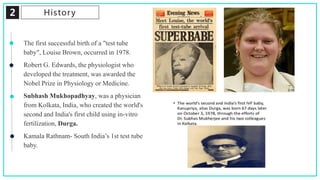
The first successful birth of a "test tube
baby", Louise Brown, occurred in 1978.
Robert G. Edwards, the physiologist who
developed the treatment, was awarded the
Nobel Prize in Physiology or Medicine.
Subhash Mukhopadhyay, was a physician
from Kolkata, India, who created the world's
second and India's first child using in-vitro
fertilization, Durga.
Kamala Rathnam- South India’s 1st test tube
baby.
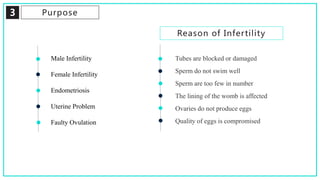
03 Purpose
3 Purpose
Male Infertility
Female Infertility
Endometriosis
Uterine Problem
Faulty Ovulation
Reason of Infertility
Tubes are blocked or damaged
Sperm do not swim well
Sperm are too few in number
The lining of the womb is affected
Ovaries do not produce eggs
Quality of eggs is compromised
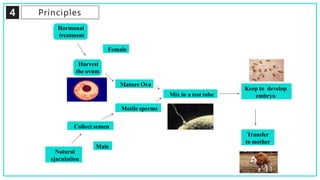
04 Principles
4 Principles
Hormonal
treatment
Female
Harvest
the ovum
Mix in a test tube
Natural
ejaculation
Collect semen
Mature Ova
Motile sperms
Keep to develop
embryo
Transfer
to mother
Male
05 Procedure
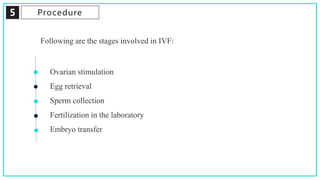
5 Procedure
Ovarian stimulation
Egg retrieval
Sperm collection
Fertilization in the laboratory
Embryo transfer
Following are the stages involved in IVF:
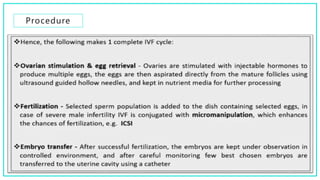
Procedure
06 Advantages
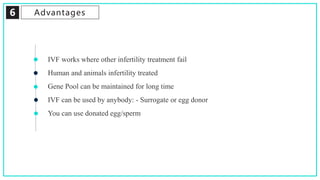
6 Advantages
IVF works where other infertility treatment fail
Human and animals infertility treated
Gene Pool can be maintained for long time
IVF can be used by anybody: - Surrogate or egg donor
You can use donated egg/sperm
THANK YOU
FOR
LISTENING

Ivf