
Lec-9: ITIL
Mr. Islahuddin Jalal
MS (Cyber Security) – UKM Malaysia
Research Title – 3C-CSIRT Model for Afghanistan
BAKHTAR UNIVERSITY ‫باخترپوهنتون‬ ‫د‬
Outlines to be discussed ……………Today
• Problem management
• Process of problem management
• Technical problems
• Formal approach to Problem Management
Problem Management
Problem Management
• Problem
• A problem is the unknown underlying cause of one or more incidents.
• A problem is NOT just a particularly serious incident
• E.g
• Mail server not responding to incoming or outgoing messages, and the root cause is
identified as power has been lost because the server was accidentally unplugged due to
other servers being un-plugged and relocated to another part of the building.
• Note
• ITIL recommends a clear demarcation between incident control and problem management.
• If help desk cannot resolve an incident, it is progressed to problem management
Problem Management
• Error
• An error is the known underlying cause of one or more incidents.
• Known Error
• A known error is the known cause of an incident for which a workaround also
exists
Problem Management
• A problem is a cause of one or more incidents.
• The cause is not usually known at the time a problem record is created, and the problem
management process is responsible for further investigation.
• The key objectives of Problem Management are:
• To prevent problems and resulting incidents from happening,
• To eliminate recurring incidents and
• To minimize the impact of incidents that cannot be prevented.
• Problem Management includes diagnosing causes of incidents,
• Determining the resolution
• Ensuring that the resolution is implemented.
• Problem Management also maintains information about problems and the appropriate
workarounds and resolutions.
Continued….
• Problems are categorized in a similar way to incidents,
• but the goal is:
• To understand causes
• Document issues
• Request changes to permanently resolve the problems.
• Issues are documented in a Known Error Database, which improves the efficiency and
effectiveness of Incident Management.
• Although Incident and Problem Management are separate processes, they are closely
related and will typically use the same tools, and may use similar categorization, impact
and priority coding systems.
• This will ensure effective communication when dealing with related incidents and
problems.
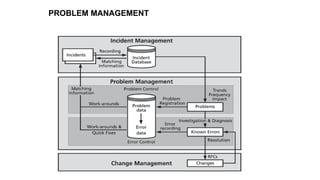
PROBLEM MANAGEMENT
Problem Management Process
• Proactive problem management
• Reactive problem management
Proactive Problem Management
• Charged with proactively seeking out improvements to services and
infrastructure before incidents occur.
Reactive Problem management
• Charged with responding to problems as they arise in the
environment, usually driven by the Incident Management process.
Problem management-----Technical Problems
• Technical problems can exist without impacting the user. However, if they are not
spotted and dealt with before an incident occurs they can have a big impact on the
availability of IT Services.
• Problems experienced by users are as follow:
• The printer won’t form feed paper through the printer. The user has to advance the paper by
using the form feed button.
• Each time a new user logs onto a computer, they have to reinstall the printer driver.
• Windows applications crash intermittently without an error message. The computer will
restart and work properly afterwards.
Continued…
• Disk space usage is erratic. Sometimes a considerable amount of disk space is available, but at
other times little is available. There is no obvious reason and no impact to the users.
• A network card is creating lots of unnecessary traffic on the network, which could eventually
reduce the bandwidth available, leading to a slow response from network requests.
Problem Management----Roles
• Problem Manager
• Supported by technical groups
• Technical Management
• IT Operations
• Applications Management
• Third-party suppliers
Forma Approach to Problem Management
• The benefits of taking a formal approach to problem management include the following:
• Improved quality of the IT service
• Incident volume reduction
• Permanent solution
• Improved organizational learning
• A better first time fix rate at the service desk
Thank You
For Your Patience

ITIL # Lecture 9

  • 1.
    Lec-9: ITIL Mr. IslahuddinJalal MS (Cyber Security) – UKM Malaysia Research Title – 3C-CSIRT Model for Afghanistan BAKHTAR UNIVERSITY ‫باخترپوهنتون‬ ‫د‬
  • 2.
    Outlines to bediscussed ……………Today • Problem management • Process of problem management • Technical problems • Formal approach to Problem Management
  • 3.
  • 4.
    Problem Management • Problem •A problem is the unknown underlying cause of one or more incidents. • A problem is NOT just a particularly serious incident • E.g • Mail server not responding to incoming or outgoing messages, and the root cause is identified as power has been lost because the server was accidentally unplugged due to other servers being un-plugged and relocated to another part of the building. • Note • ITIL recommends a clear demarcation between incident control and problem management. • If help desk cannot resolve an incident, it is progressed to problem management
  • 5.
    Problem Management • Error •An error is the known underlying cause of one or more incidents. • Known Error • A known error is the known cause of an incident for which a workaround also exists
  • 6.
    Problem Management • Aproblem is a cause of one or more incidents. • The cause is not usually known at the time a problem record is created, and the problem management process is responsible for further investigation. • The key objectives of Problem Management are: • To prevent problems and resulting incidents from happening, • To eliminate recurring incidents and • To minimize the impact of incidents that cannot be prevented. • Problem Management includes diagnosing causes of incidents, • Determining the resolution • Ensuring that the resolution is implemented. • Problem Management also maintains information about problems and the appropriate workarounds and resolutions.
  • 7.
    Continued…. • Problems arecategorized in a similar way to incidents, • but the goal is: • To understand causes • Document issues • Request changes to permanently resolve the problems. • Issues are documented in a Known Error Database, which improves the efficiency and effectiveness of Incident Management. • Although Incident and Problem Management are separate processes, they are closely related and will typically use the same tools, and may use similar categorization, impact and priority coding systems. • This will ensure effective communication when dealing with related incidents and problems.
  • 8.
  • 9.
    Problem Management Process •Proactive problem management • Reactive problem management
  • 10.
    Proactive Problem Management •Charged with proactively seeking out improvements to services and infrastructure before incidents occur.
  • 11.
    Reactive Problem management •Charged with responding to problems as they arise in the environment, usually driven by the Incident Management process.
  • 12.
    Problem management-----Technical Problems •Technical problems can exist without impacting the user. However, if they are not spotted and dealt with before an incident occurs they can have a big impact on the availability of IT Services. • Problems experienced by users are as follow: • The printer won’t form feed paper through the printer. The user has to advance the paper by using the form feed button. • Each time a new user logs onto a computer, they have to reinstall the printer driver. • Windows applications crash intermittently without an error message. The computer will restart and work properly afterwards.
  • 13.
    Continued… • Disk spaceusage is erratic. Sometimes a considerable amount of disk space is available, but at other times little is available. There is no obvious reason and no impact to the users. • A network card is creating lots of unnecessary traffic on the network, which could eventually reduce the bandwidth available, leading to a slow response from network requests.
  • 14.
    Problem Management----Roles • ProblemManager • Supported by technical groups • Technical Management • IT Operations • Applications Management • Third-party suppliers
  • 15.
    Forma Approach toProblem Management • The benefits of taking a formal approach to problem management include the following: • Improved quality of the IT service • Incident volume reduction • Permanent solution • Improved organizational learning • A better first time fix rate at the service desk
  • 16.