
Lec-6: ITIL
Mr. Islahuddin Jalal
MS (Cyber Security) – UKM Malaysia
Research Title – 3C-CSIRT Model for Afghanistan
BAKHTAR UNIVERSITY ‫باخترپوهنتون‬ ‫د‬
Outlines to be discussed……. Today
• Release and Deployment Management
• Purpose of RDM
• Objective of RDM
• Scope of RDM
• Release Policy
• Types of Release
Release and Deployment Management
• The Release and Deployment Management (RDM) process aims at
building, testing and delivering the capability to provide the services
to the customer specified by service design
• A release is a set of new or changed Cis that are tested and implemented
• Release management plans, schedules, and controls the movement of new or
changed services, in the form of a release package
• Deployment management is responsible for the movement of new or
changed hardware, software, documentation, or other configuration items
into the live production environment
RDM
• The goal of release and deployment management is to deploy
releases into operation and establish effective use of the service in
order to deliver value to the customer.
• Release and deployment management also ensures handover to
service operations takes place and that suitable training and
documentation exists to ensure ongoing support of the new service.
• An effective RDM enables the service provider to add value to the
business by delivering changes, faster, at optimum cost and
minimized risk
Purpose of RDM
• Plan, schedule and control the build, test an deployment of releases
• Deliver new functionalities needed by the business while ensuring
that the integrity of existing services is protected.
Objective of RDM
• Define and agree RDM plans with customers and stakeholders
• Create and test release packages
• Track, install, test, verify, uninstall or back out all releases
• Record as well as manage risks, deviations and issues related to a new
or changed service
Scope of RDM
• Define processes, systems and functions to package, build, test an
deploy a release into production
• Establish the service specified in the service design package
Release Policy
• The release policy is the primary strategy for releases and is derived
from the service design phase of the service lifecycle. The policy
includes the following:
• Release description
• The roles and responsibilities at each stage of the process
• The expected frequency for each kind of release
• The approach taken to accept and group changes into a release
• Use of automation for release and deployment
Continued..
• How the configuration baseline for the release is captured and
verified against the contents of the actual release
• Entry and exit criteria and authority for accepting the release at each
stage for service transition
• Criteria and authorization to exit early life support and handover to
service operations
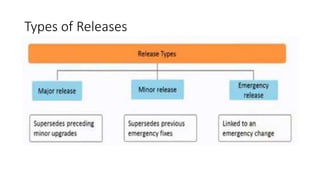
Types of Releases
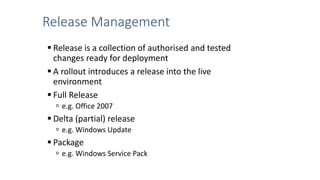
Release Management
 Release is a collection of authorised and tested
changes ready for deployment
 A rollout introduces a release into the live
environment
 Full Release
 e.g. Office 2007
 Delta (partial) release
 e.g. Windows Update
 Package
 e.g. Windows Service Pack
Thank You
For Your Patience

ITIL # Lecture 6

  • 1.
    Lec-6: ITIL Mr. IslahuddinJalal MS (Cyber Security) – UKM Malaysia Research Title – 3C-CSIRT Model for Afghanistan BAKHTAR UNIVERSITY ‫باخترپوهنتون‬ ‫د‬
  • 2.
    Outlines to bediscussed……. Today • Release and Deployment Management • Purpose of RDM • Objective of RDM • Scope of RDM • Release Policy • Types of Release
  • 3.
    Release and DeploymentManagement • The Release and Deployment Management (RDM) process aims at building, testing and delivering the capability to provide the services to the customer specified by service design • A release is a set of new or changed Cis that are tested and implemented • Release management plans, schedules, and controls the movement of new or changed services, in the form of a release package • Deployment management is responsible for the movement of new or changed hardware, software, documentation, or other configuration items into the live production environment
  • 4.
    RDM • The goalof release and deployment management is to deploy releases into operation and establish effective use of the service in order to deliver value to the customer. • Release and deployment management also ensures handover to service operations takes place and that suitable training and documentation exists to ensure ongoing support of the new service. • An effective RDM enables the service provider to add value to the business by delivering changes, faster, at optimum cost and minimized risk
  • 5.
    Purpose of RDM •Plan, schedule and control the build, test an deployment of releases • Deliver new functionalities needed by the business while ensuring that the integrity of existing services is protected.
  • 6.
    Objective of RDM •Define and agree RDM plans with customers and stakeholders • Create and test release packages • Track, install, test, verify, uninstall or back out all releases • Record as well as manage risks, deviations and issues related to a new or changed service
  • 7.
    Scope of RDM •Define processes, systems and functions to package, build, test an deploy a release into production • Establish the service specified in the service design package
  • 8.
    Release Policy • Therelease policy is the primary strategy for releases and is derived from the service design phase of the service lifecycle. The policy includes the following: • Release description • The roles and responsibilities at each stage of the process • The expected frequency for each kind of release • The approach taken to accept and group changes into a release • Use of automation for release and deployment
  • 9.
    Continued.. • How theconfiguration baseline for the release is captured and verified against the contents of the actual release • Entry and exit criteria and authority for accepting the release at each stage for service transition • Criteria and authorization to exit early life support and handover to service operations
  • 10.
  • 11.
    Release Management  Releaseis a collection of authorised and tested changes ready for deployment  A rollout introduces a release into the live environment  Full Release  e.g. Office 2007  Delta (partial) release  e.g. Windows Update  Package  e.g. Windows Service Pack
  • 12.

Editor's Notes

  • #4 Service Design: How are we going to provide it? // build // // test // // deploy //
  • #12 rollout= unveiling of new thing