Lec-3: ITIL
Mr. Islahuddin Jalal
MS (Cyber Security) – UKM Malaysia
Research Title – 3C-CSIRT Model for Afghanistan
BAKHTAR UNIVERSITY ‫باخترپوهنتون‬ ‫د‬
Outlines to be discussed…..
• ITSCM-DRM
• Information Security Management
• Change Management
• Service Transitions
ITSCM – DRM
• IT Service Continuity Management
• Ensures resumption of services within agreed
timescale
• Business Impact Analysis informs decisions about
resources
• E.g. Stock Exchange can’t afford 5 minutes downtime but 2
hours downtime probably wont badly affect a
departmental accounts office or a college bursary
Standby for liftoff...
• Cold
• Accommodation and environment ready but no IT
equipment
• Warm
• As cold plus backup IT equipment to receive data
• Hot
• Full duplexing, redundancy and failover
Information Security Management
• Confidentiality
• Making sure only those authorised can see data
• Integrity
• Making sure the data is accurate and not corrupted
• Availability
• Making sure data is supplied when it is requested
Change Management
• A change is a modification, addition, or removal of anything that
could impact IT services.
• This includes
• Addition
• Modification
• Removal of approved, supported or base lined H.W
• Network
• software
• application
• environment
• system
• desktop build or associated documentation
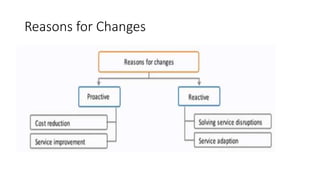
Reasons for Changes
Purpose of Change Management
• Control the lifecycle of all changes
• Help in making beneficial changes with minimum disruption to IT
services
Objectives of CM
• Respond to business and IT requests to ensure alignment of services
with business needs
• Ensure that changes are introduced in a controlled manner, thus
optimizing business risk
• Implement changes timely and successfully to meet business needs
• Use the standard processes and record every change
Scope of CM
• Any changes to all architecture , tools, metrics, processes and
documentation
• Addition, removal or modification of a service or a configuration item
or an associated documentation
• Changes to any of the five aspects of service design
• Build
• Deployment
• Testing
• User acceptance
• Bed-in (optimize)
Change Model
• A change model refers to pre-defined set of steps, policies and
procedures for assessing, authorizing and executing a specific type of
change. Change models should include the following:
• The steps to handle the change
• The chronological order of the steps
• Defined roles and responsibilities
• Thresholds and timescales for completion of the actions
• Escalation procedures
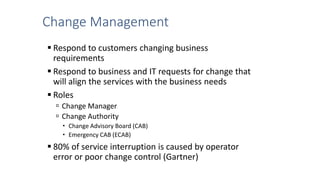
Change Management
 Respond to customers changing business
requirements
 Respond to business and IT requests for change that
will align the services with the business needs
 Roles
 Change Manager
 Change Authority
 Change Advisory Board (CAB)
 Emergency CAB (ECAB)
 80% of service interruption is caused by operator
error or poor change control (Gartner)
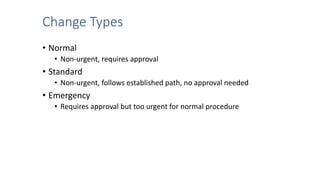
Change Types
• Normal
• Non-urgent, requires approval
• Standard
• Non-urgent, follows established path, no approval needed
• Emergency
• Requires approval but too urgent for normal procedure
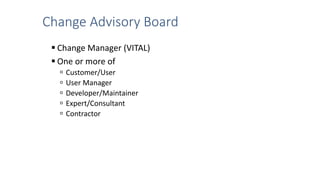
Change Advisory Board
 Change Manager (VITAL)
 One or more of
 Customer/User
 User Manager
 Developer/Maintainer
 Expert/Consultant
 Contractor
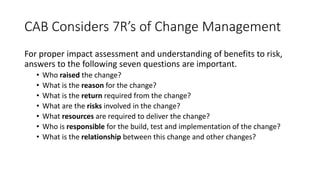
CAB Considers 7R’s of Change Management
For proper impact assessment and understanding of benefits to risk,
answers to the following seven questions are important.
• Who raised the change?
• What is the reason for the change?
• What is the return required from the change?
• What are the risks involved in the change?
• What resources are required to deliver the change?
• Who is responsible for the build, test and implementation of the change?
• What is the relationship between this change and other changes?
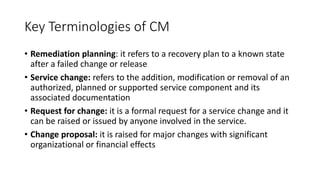
Key Terminologies of CM
• Remediation planning: it refers to a recovery plan to a known state
after a failed change or release
• Service change: refers to the addition, modification or removal of an
authorized, planned or supported service component and its
associated documentation
• Request for change: it is a formal request for a service change and it
can be raised or issued by anyone involved in the service.
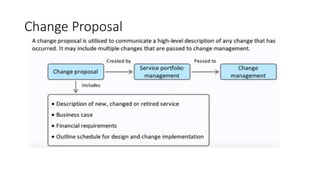
• Change proposal: it is raised for major changes with significant
organizational or financial effects
Change Proposal
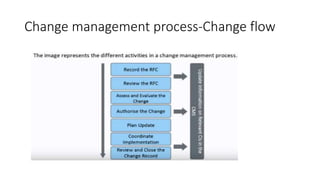
Change management process-Change flow
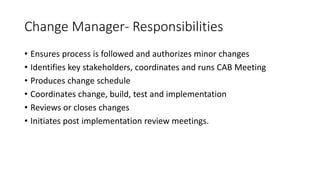
Change Manager- Responsibilities
• Ensures process is followed and authorizes minor changes
• Identifies key stakeholders, coordinates and runs CAB Meeting
• Produces change schedule
• Coordinates change, build, test and implementation
• Reviews or closes changes
• Initiates post implementation review meetings.
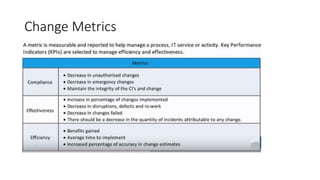
Change Metrics
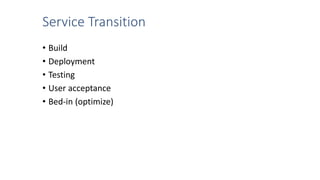
Service Transition
• Build
• Deployment
• Testing
• User acceptance
• Bed-in (optimize)
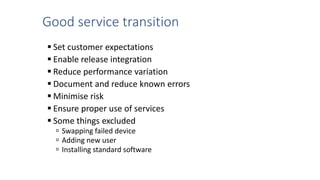
Good service transition
 Set customer expectations
 Enable release integration
 Reduce performance variation
 Document and reduce known errors
 Minimise risk
 Ensure proper use of services
 Some things excluded
 Swapping failed device
 Adding new user
 Installing standard software
Thank You
For Your Patience

ITIL # Lecture 3

  • 1.
    Lec-3: ITIL Mr. IslahuddinJalal MS (Cyber Security) – UKM Malaysia Research Title – 3C-CSIRT Model for Afghanistan BAKHTAR UNIVERSITY ‫باخترپوهنتون‬ ‫د‬
  • 2.
    Outlines to bediscussed….. • ITSCM-DRM • Information Security Management • Change Management • Service Transitions
  • 3.
    ITSCM – DRM •IT Service Continuity Management • Ensures resumption of services within agreed timescale • Business Impact Analysis informs decisions about resources • E.g. Stock Exchange can’t afford 5 minutes downtime but 2 hours downtime probably wont badly affect a departmental accounts office or a college bursary
  • 4.
    Standby for liftoff... •Cold • Accommodation and environment ready but no IT equipment • Warm • As cold plus backup IT equipment to receive data • Hot • Full duplexing, redundancy and failover
  • 5.
    Information Security Management •Confidentiality • Making sure only those authorised can see data • Integrity • Making sure the data is accurate and not corrupted • Availability • Making sure data is supplied when it is requested
  • 6.
    Change Management • Achange is a modification, addition, or removal of anything that could impact IT services. • This includes • Addition • Modification • Removal of approved, supported or base lined H.W • Network • software • application • environment • system • desktop build or associated documentation
  • 7.
  • 8.
    Purpose of ChangeManagement • Control the lifecycle of all changes • Help in making beneficial changes with minimum disruption to IT services
  • 9.
    Objectives of CM •Respond to business and IT requests to ensure alignment of services with business needs • Ensure that changes are introduced in a controlled manner, thus optimizing business risk • Implement changes timely and successfully to meet business needs • Use the standard processes and record every change
  • 10.
    Scope of CM •Any changes to all architecture , tools, metrics, processes and documentation • Addition, removal or modification of a service or a configuration item or an associated documentation • Changes to any of the five aspects of service design • Build • Deployment • Testing • User acceptance • Bed-in (optimize)
  • 11.
    Change Model • Achange model refers to pre-defined set of steps, policies and procedures for assessing, authorizing and executing a specific type of change. Change models should include the following: • The steps to handle the change • The chronological order of the steps • Defined roles and responsibilities • Thresholds and timescales for completion of the actions • Escalation procedures
  • 12.
    Change Management  Respondto customers changing business requirements  Respond to business and IT requests for change that will align the services with the business needs  Roles  Change Manager  Change Authority  Change Advisory Board (CAB)  Emergency CAB (ECAB)  80% of service interruption is caused by operator error or poor change control (Gartner)
  • 13.
    Change Types • Normal •Non-urgent, requires approval • Standard • Non-urgent, follows established path, no approval needed • Emergency • Requires approval but too urgent for normal procedure
  • 14.
    Change Advisory Board Change Manager (VITAL)  One or more of  Customer/User  User Manager  Developer/Maintainer  Expert/Consultant  Contractor
  • 15.
    CAB Considers 7R’sof Change Management For proper impact assessment and understanding of benefits to risk, answers to the following seven questions are important. • Who raised the change? • What is the reason for the change? • What is the return required from the change? • What are the risks involved in the change? • What resources are required to deliver the change? • Who is responsible for the build, test and implementation of the change? • What is the relationship between this change and other changes?
  • 16.
    Key Terminologies ofCM • Remediation planning: it refers to a recovery plan to a known state after a failed change or release • Service change: refers to the addition, modification or removal of an authorized, planned or supported service component and its associated documentation • Request for change: it is a formal request for a service change and it can be raised or issued by anyone involved in the service. • Change proposal: it is raised for major changes with significant organizational or financial effects
  • 17.
  • 18.
  • 19.
    Change Manager- Responsibilities •Ensures process is followed and authorizes minor changes • Identifies key stakeholders, coordinates and runs CAB Meeting • Produces change schedule • Coordinates change, build, test and implementation • Reviews or closes changes • Initiates post implementation review meetings.
  • 20.
  • 21.
    Service Transition • Build •Deployment • Testing • User acceptance • Bed-in (optimize)
  • 22.
    Good service transition Set customer expectations  Enable release integration  Reduce performance variation  Document and reduce known errors  Minimise risk  Ensure proper use of services  Some things excluded  Swapping failed device  Adding new user  Installing standard software
  • 23.

Editor's Notes

  • #19 Cis: Configuration Items
  • #22  Service transition is one of the component of ITIL service life cycle component