
Lec-4: ITIL
Mr. Islahuddin Jalal
MS (Cyber Security) – UKM Malaysia
Research Title – 3C-CSIRT Model for Afghanistan
BAKHTAR UNIVERSITY ‫باخترپوهنتون‬ ‫د‬
Outlines to be discussed…..
• Useful grounding for SACM
• Service Asset and configuration Management (SACM)
• Purpose of SACM
• Objective of SACM
• Scope of SACM
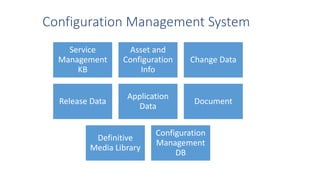
• Configuration Management System (CMS)
• Configuration baseline and Database
Useful Grounding for SACM
• Asset Management: A generic activity or process responsible for
tracking and reporting the value and ownership of assets throughout
their lifecycle.
• Configuration Item (CI): any component or other service asset that
needs to be managed in order to deliver an IT service
• Configuration Management: the process responsible for maintaining
information about configuration items required to deliver an IT
service.
Service Asset and Configuration Management
• Is this type of information only one click away?
• How many PCs are there in your company?
• How many Office licenses do you own?
• How many PCs are due to be replaced?
• What version of the SOE are the PCs running?
• What updates are installed on them?
• What server do they connect to?
• When are they due for maintenance?
• What SLAs and contracts apply to them?
Service Asset and Configuration Management
• Efficient and effective management of the infrastructure is only
possible within the constraints of available, accurate and up-to-date
information (Marco Cattane)
• The process responsible for ensuring that the assets required to
deliver services are properly controlled, and that accurate and reliable
information about those assets is available when and where it is
needed.
• This information includes details of how the assets have been configured and
the relationships between assets.
Purpose of SACM
• Ensure the assets required to deliver services are properly controlled
• Store accurate and reliable information about the assets
• Ensure that the information is available anytime
Objective of SACM
• Support the business
• Support ITSM (processes)
• Minimize the number of quality and compliance issues
• Optimize
• Service assets
• IT configuration
• Capabilities
• Resources
• Define and control the components of infrastructure and services
• Maintain exact configuration records
Scope of SACM
• Ensure all assets used during the service lifecycle are within the scope
of asset management
• Manage the complete lifecycle of every configuration item
Service Asset and Configuration
• Managing these assets properly is the key
• Provides Logical Model of Infrastructure and Accurate
Configuration information
• Controls assets
• Minimised costs
• Enables proper change and release management
• Speeds incident and problem resolution
Practice what you Preach
• Getting to understand the objectives for service Asset and
Configuration Management
• See if you can find answers to the following:
• Where is information on IT related assets stored?
• Who owns and maintains this information?
• Is the information up-to-date, accurate and relevant?
• Is it easy to report on this information?
• Who actually uses the information?
• How much redundancy/duplication is there
Configuration Management System (CMS)
• CMS is a set of tools and databases that are used to manage IT service
provider configuration data
• Also increase information about incidents, problems, known errors,
changes and releases and may contain data about employees,
suppliers location, business units, customers and users
• CMS is maintained by service assets and configuration management
and is used by all IT service management processes
• Two major components of CMS are
• CMDB (it stores configuration details of the IT infrastructure)
• KEDB (create by problem management and used by incident and problem
mgmt.
Configuration Management System
Service
Management
KB
Asset and
Configuration
Info
Change Data
Release Data
Application
Data
Document
Definitive
Media Library
Configuration
Management
DB
Configuration Baseline and Database
• A configuration baseline is the configuration of a service, product or
infrastructure that is formally reviewed and agreed on. A
configuration baseline:
• Captures the structure, contents and details of a configuration
• Represents a set of configuration items that are related to each other
• a configuration Management Database (CMDB) is a database to store
records of Cis
• The CMDB provides a logical model of the IT infrastructure
• Similar to the CMDB, there are two libraries as part of the Configuration
Management system
Definitive Media Library
• The definitive media library (DML) is a secure store where the
definitive, authorized and approved versions of all media Cis are
stored and monitored
• DML is the only source for build and distribution
• The master copies of items pass quality assurance checks
• DML includes master copies of all software assets such as scripts, codes,
licenses and so on.
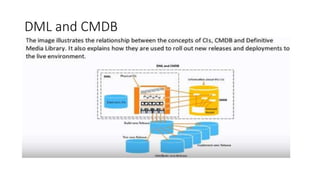
DML and CMDB
Thank You
For Your Patience

ITIL # Lecture 4

  • 1.
    Lec-4: ITIL Mr. IslahuddinJalal MS (Cyber Security) – UKM Malaysia Research Title – 3C-CSIRT Model for Afghanistan BAKHTAR UNIVERSITY ‫باخترپوهنتون‬ ‫د‬
  • 2.
    Outlines to bediscussed….. • Useful grounding for SACM • Service Asset and configuration Management (SACM) • Purpose of SACM • Objective of SACM • Scope of SACM • Configuration Management System (CMS) • Configuration baseline and Database
  • 3.
    Useful Grounding forSACM • Asset Management: A generic activity or process responsible for tracking and reporting the value and ownership of assets throughout their lifecycle. • Configuration Item (CI): any component or other service asset that needs to be managed in order to deliver an IT service • Configuration Management: the process responsible for maintaining information about configuration items required to deliver an IT service.
  • 4.
    Service Asset andConfiguration Management • Is this type of information only one click away? • How many PCs are there in your company? • How many Office licenses do you own? • How many PCs are due to be replaced? • What version of the SOE are the PCs running? • What updates are installed on them? • What server do they connect to? • When are they due for maintenance? • What SLAs and contracts apply to them?
  • 5.
    Service Asset andConfiguration Management • Efficient and effective management of the infrastructure is only possible within the constraints of available, accurate and up-to-date information (Marco Cattane) • The process responsible for ensuring that the assets required to deliver services are properly controlled, and that accurate and reliable information about those assets is available when and where it is needed. • This information includes details of how the assets have been configured and the relationships between assets.
  • 6.
    Purpose of SACM •Ensure the assets required to deliver services are properly controlled • Store accurate and reliable information about the assets • Ensure that the information is available anytime
  • 7.
    Objective of SACM •Support the business • Support ITSM (processes) • Minimize the number of quality and compliance issues • Optimize • Service assets • IT configuration • Capabilities • Resources • Define and control the components of infrastructure and services • Maintain exact configuration records
  • 8.
    Scope of SACM •Ensure all assets used during the service lifecycle are within the scope of asset management • Manage the complete lifecycle of every configuration item
  • 9.
    Service Asset andConfiguration • Managing these assets properly is the key • Provides Logical Model of Infrastructure and Accurate Configuration information • Controls assets • Minimised costs • Enables proper change and release management • Speeds incident and problem resolution
  • 10.
    Practice what youPreach • Getting to understand the objectives for service Asset and Configuration Management • See if you can find answers to the following: • Where is information on IT related assets stored? • Who owns and maintains this information? • Is the information up-to-date, accurate and relevant? • Is it easy to report on this information? • Who actually uses the information? • How much redundancy/duplication is there
  • 11.
    Configuration Management System(CMS) • CMS is a set of tools and databases that are used to manage IT service provider configuration data • Also increase information about incidents, problems, known errors, changes and releases and may contain data about employees, suppliers location, business units, customers and users • CMS is maintained by service assets and configuration management and is used by all IT service management processes • Two major components of CMS are • CMDB (it stores configuration details of the IT infrastructure) • KEDB (create by problem management and used by incident and problem mgmt.
  • 12.
    Configuration Management System Service Management KB Assetand Configuration Info Change Data Release Data Application Data Document Definitive Media Library Configuration Management DB
  • 13.
    Configuration Baseline andDatabase • A configuration baseline is the configuration of a service, product or infrastructure that is formally reviewed and agreed on. A configuration baseline: • Captures the structure, contents and details of a configuration • Represents a set of configuration items that are related to each other • a configuration Management Database (CMDB) is a database to store records of Cis • The CMDB provides a logical model of the IT infrastructure • Similar to the CMDB, there are two libraries as part of the Configuration Management system
  • 14.
    Definitive Media Library •The definitive media library (DML) is a secure store where the definitive, authorized and approved versions of all media Cis are stored and monitored • DML is the only source for build and distribution • The master copies of items pass quality assurance checks • DML includes master copies of all software assets such as scripts, codes, licenses and so on.
  • 15.
  • 16.

Editor's Notes

  • #5 SOE: standard operating Environment
  • #8 This helps organization in comply with corporate governance requirements, controlling their asset base, optimizing their costs, managing change and release effectively and resolving incidents or problem faster
  • #9 The process offers a complete overview of all assets and shows who is the responsible for control and mantanance of these assets
  • #12 CMDB: Configuration management Database KEDB: Known Error Database
  • #14 Baseline: This serve as the basis for further activities Configuration baseline is the snapshot of configuration of the Cis on that particular time interval. This can be used for comparison in the future. CMDB provides logical Model: As it captures CI and the relationship that exist between them These libraries are used for releasing and controlling the components throughout the service lifecycle
  • #16 The big rectangle box represent CMS, the DML and CMDB are the part of the CMS. During a new release, the authorize Cis are taken or checked out from the DML and used in the development environment to create a new release. The new release is tested in the test environment before being rolled out for the deployment in the production environment. All the documentation about this release is kept in release records and related to associated Cis in the CMDB