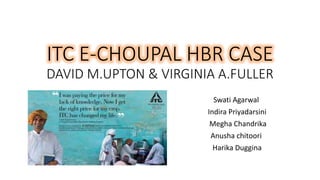
ITC E-CHOUPAL HBR CASE
DAVID M.UPTON & VIRGINIA A.FULLER
Swati Agarwal
Indira Priyadarsini
Megha Chandrika
Anusha chitoori
Harika Duggina
• Long-term economic growth can not be feasible in INDIA without
including Agriculture sector in it since most of the work force are
acquainted to this.
• The idea of Creative use of information technology has made ITC to
launch e-Choupal to reduce the distance between farmers and
company and make them advantageous
• Farmer’s are losing 60-70% of the potential value of crop throughout
the process flow
• Farming methods followed were same as their ancestors like 50 years
back, they are risk averted with new experimentation
• Involvement of CA’S in auction of the produce in mandi’s clogged the
supply chain and make reduction in profit margins for both farmers
and buyers like ITC
• Weight of the crop has been manipulated because of inaccuracy of
crude beam scales resulting in loss of transaction
• Price offered will not be known beforehand here and farmers are not
provided with any warehouse
www.soyachoupal.com
Information's
Provided:
1)Best practices page
2)Crop Information
3)Market Information
4)Q+A forum
5) News page
1) Old static cultivation process.
2) Selling through mundi.
3) Fraud in weighing the
production.
4) Loss suffered by farmers.
5) Non transparent system
1) Continuous development in
the process.
2) Selling through echoupal.
3) Weighing through digital
machines.
4) Highly effective.
5) Completely transparent
system.
 Lack of effective communication with farmers
 Price and quality distortions
 Distance from farmer &Daily price inflation
 Intra day price changes
 Constantly decreasing profit.(profit margins are low)
 Virtual vertical integration
 A social imperative
No contract like bound farmers to sell to ITC once they used the
Website.
The farmers could use all of the echoupal’s facilities ,soak in all the
information and still choose to take his crop to the mandi.
ITC did not ask for commitment; the farmer was free to do as he
wished.
Perfect usage of sanchaayak and samyojak
Providing ITC Hubs where farmers can buy and sell products
• Shifting farmers from traditional method to echoupal.
• They appointed the sanchaayak and transformed CA’S to samyojak
• Farmers don’t have the IT knowledge and the ITC trained them
• ITC provided weather forecasting for 600 villages with the help of
IMD.
• According to the agricultural produce marketing act government
ordered to sell their products with in the mandi's. But ITC made
government agree to their new system.
• Mobile Phones vs. Computers
• Information exchange between the farmer & the echoupal
• eChoupal used as distribution of other products / services
• Reach into poorer and more remote parts of India
• Dissemination of agricultural best practices
• Getting into other fields like coffee, seafood and other commodities
 Commitment beyond the market
 Optimum use of technology.
 Moving with the market changes.
 Effective use of man force
 Penetration of Choupal to other commodities
ITC Echoupal HBR case

ITC Echoupal HBR case

  • 1.
    ITC E-CHOUPAL HBRCASE DAVID M.UPTON & VIRGINIA A.FULLER Swati Agarwal Indira Priyadarsini Megha Chandrika Anusha chitoori Harika Duggina
  • 2.
    • Long-term economicgrowth can not be feasible in INDIA without including Agriculture sector in it since most of the work force are acquainted to this. • The idea of Creative use of information technology has made ITC to launch e-Choupal to reduce the distance between farmers and company and make them advantageous
  • 3.
    • Farmer’s arelosing 60-70% of the potential value of crop throughout the process flow • Farming methods followed were same as their ancestors like 50 years back, they are risk averted with new experimentation • Involvement of CA’S in auction of the produce in mandi’s clogged the supply chain and make reduction in profit margins for both farmers and buyers like ITC • Weight of the crop has been manipulated because of inaccuracy of crude beam scales resulting in loss of transaction • Price offered will not be known beforehand here and farmers are not provided with any warehouse
  • 5.
    www.soyachoupal.com Information's Provided: 1)Best practices page 2)CropInformation 3)Market Information 4)Q+A forum 5) News page
  • 6.
    1) Old staticcultivation process. 2) Selling through mundi. 3) Fraud in weighing the production. 4) Loss suffered by farmers. 5) Non transparent system 1) Continuous development in the process. 2) Selling through echoupal. 3) Weighing through digital machines. 4) Highly effective. 5) Completely transparent system.
  • 7.
     Lack ofeffective communication with farmers  Price and quality distortions  Distance from farmer &Daily price inflation  Intra day price changes  Constantly decreasing profit.(profit margins are low)  Virtual vertical integration  A social imperative
  • 10.
    No contract likebound farmers to sell to ITC once they used the Website. The farmers could use all of the echoupal’s facilities ,soak in all the information and still choose to take his crop to the mandi. ITC did not ask for commitment; the farmer was free to do as he wished. Perfect usage of sanchaayak and samyojak Providing ITC Hubs where farmers can buy and sell products
  • 11.
    • Shifting farmersfrom traditional method to echoupal. • They appointed the sanchaayak and transformed CA’S to samyojak • Farmers don’t have the IT knowledge and the ITC trained them • ITC provided weather forecasting for 600 villages with the help of IMD. • According to the agricultural produce marketing act government ordered to sell their products with in the mandi's. But ITC made government agree to their new system.
  • 12.
    • Mobile Phonesvs. Computers • Information exchange between the farmer & the echoupal • eChoupal used as distribution of other products / services • Reach into poorer and more remote parts of India • Dissemination of agricultural best practices • Getting into other fields like coffee, seafood and other commodities
  • 13.
     Commitment beyondthe market  Optimum use of technology.  Moving with the market changes.  Effective use of man force  Penetration of Choupal to other commodities