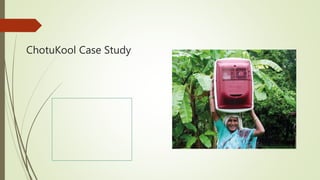
ChotuKool Case Study
Evaluate the ChotuKool opportunity
• 80-percent of the Indian households lacked access to refrigeration
due to unaffordable conventional refrigerators.
• If Godrej could achieve 50-percent penetration of this market, it
could generate sales of approximately $6.8 billion.
• India’s economy was growing. So India was becoming a target for
multinational appliance manufacturers. So in order to cut short the
competition and capture the new market, Godrej went with new
product.
• Improved technology and additional features would increase both
sales and margins.
What factors lead the company to embark on
this unconventional innovation path?
Factors:
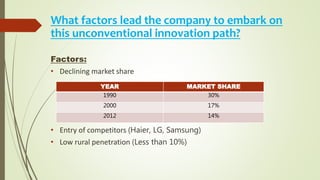
• Declining market share
• Entry of competitors (Haier, LG, Samsung)
• Low rural penetration (Less than 10%)
YEAR MARKET SHARE
1990 30%
2000 17%
2012 14%
What are the most important things that the
chotuKool Team learned from the 2009 soft launch?
• Cooling specifications did not meet the customers’ needs.
• They learnt that the rural customers also cared about branding as much as
urban customers.
• They also learned their market strategy of word of mouth did not work.
• They got to know that the potential customers turned out to be mom- and
–pop shops.
• They were astonished that majority of retailers need refrigeration and if
they are able to sell 50% of these to retailers they could generate $500
million in sales.
Did they learn the right things?
• Yes, they have learned the right things.
• They learnt that people actually felt inferior about the product
rather than being proud.
• They learned that a single marketing strategy doesn’t work.
• They also understood that the aspirations of people are growing at
much faster rate than the economic condition and income of
households.
• That also implied that they need to do more product innovation
and better design in order to appeal the customers.
In considering the launch strategy should Gopalan
push for rural integration or urban roll out
options? Why?
• Urban roll out or Urban integration is better option as it has more
advantages:
• They do not need any new sales-distribution channel.
• They don’t need any special training for sales personnel.
• The Indian middle class is one of the fastest growing urban
population as per the estimates.
• It can serve the purpose of a refrigerator and as well as furniture in
small urban homes.
What concerns do you have?
• Here we are suggesting the urban rollout, so it might completely
change the agenda or contradict the launch of chotuKool, but if we
are able to get into the minds of middle class it will send a message
to the less affluent that it is way more aspirational and cool
product.
• It might affect the sales of already existing conventional
refrigerators which are three times more costly than chotuKool.
Thank you

ChotuKool Case Study Solution.pptx

  • 1.
  • 2.
    Evaluate the ChotuKoolopportunity • 80-percent of the Indian households lacked access to refrigeration due to unaffordable conventional refrigerators. • If Godrej could achieve 50-percent penetration of this market, it could generate sales of approximately $6.8 billion. • India’s economy was growing. So India was becoming a target for multinational appliance manufacturers. So in order to cut short the competition and capture the new market, Godrej went with new product. • Improved technology and additional features would increase both sales and margins.
  • 3.
    What factors leadthe company to embark on this unconventional innovation path? Factors: • Declining market share • Entry of competitors (Haier, LG, Samsung) • Low rural penetration (Less than 10%) YEAR MARKET SHARE 1990 30% 2000 17% 2012 14%
  • 4.
    What are themost important things that the chotuKool Team learned from the 2009 soft launch? • Cooling specifications did not meet the customers’ needs. • They learnt that the rural customers also cared about branding as much as urban customers. • They also learned their market strategy of word of mouth did not work. • They got to know that the potential customers turned out to be mom- and –pop shops. • They were astonished that majority of retailers need refrigeration and if they are able to sell 50% of these to retailers they could generate $500 million in sales.
  • 5.
    Did they learnthe right things? • Yes, they have learned the right things. • They learnt that people actually felt inferior about the product rather than being proud. • They learned that a single marketing strategy doesn’t work. • They also understood that the aspirations of people are growing at much faster rate than the economic condition and income of households. • That also implied that they need to do more product innovation and better design in order to appeal the customers.
  • 6.
    In considering thelaunch strategy should Gopalan push for rural integration or urban roll out options? Why? • Urban roll out or Urban integration is better option as it has more advantages: • They do not need any new sales-distribution channel. • They don’t need any special training for sales personnel. • The Indian middle class is one of the fastest growing urban population as per the estimates. • It can serve the purpose of a refrigerator and as well as furniture in small urban homes.
  • 7.
    What concerns doyou have? • Here we are suggesting the urban rollout, so it might completely change the agenda or contradict the launch of chotuKool, but if we are able to get into the minds of middle class it will send a message to the less affluent that it is way more aspirational and cool product. • It might affect the sales of already existing conventional refrigerators which are three times more costly than chotuKool.
  • 8.