Friday February
25th
Buc
Beginning:
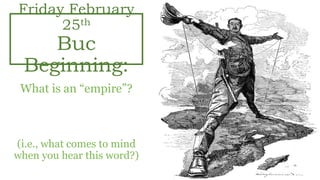
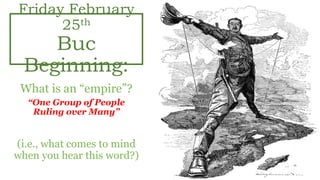
What is an “empire”?
“One Group of People
Ruling over Many”
(i.e., what comes to mind
when you hear this word?)
Friday February
25th
Buc
Beginning:
What is an “empire”?
“One Group of People
Ruling over Many”
(i.e., what comes to mind
when you hear this word?)
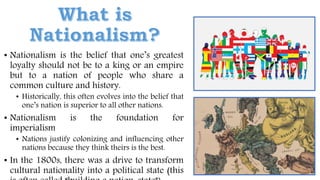
• Nationalism is the belief that one’s greatest
loyalty should not be to a king or an empire
but to a nation of people who share a
common culture and history.
• Historically, this often evolves into the belief that
one’s nation is superior to all other nations.
• Nationalism is the foundation for
imperialism
• Nations justify colonizing and influencing other
nations because they think theirs is the best.
• In the 1800s, there was a drive to transform
cultural nationality into a political state (this
Case Study #1:
Italy
The Unification of Italy
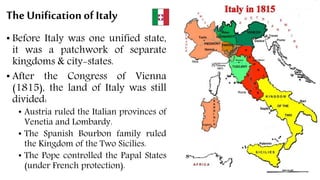
• Before Italy was one unified state,
it was a patchwork of separate
kingdoms & city-states.
• After the Congress of Vienna
(1815), the land of Italy was still
divided:
• Austria ruled the Italian provinces of
Venetia and Lombardy.
• The Spanish Bourbon family ruled
the Kingdom of the Two Sicilies.
• The Pope controlled the Papal States
(under French protection).
The Unification of Italy
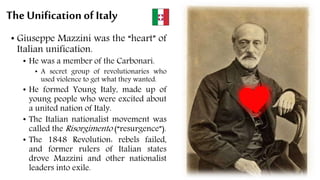
• Giuseppe Mazzini was the “heart” of
Italian unification.
• He was a member of the Carbonari.
• A secret group of revolutionaries who
used violence to get what they wanted.
• He formed Young Italy, made up of
young people who were excited about
a united nation of Italy.
• The Italian nationalist movement was
called the Risorgimento (“resurgence”).
• The 1848 Revolution: rebels failed,
and former rulers of Italian states
drove Mazzini and other nationalist
leaders into exile.
The Unification of Italy
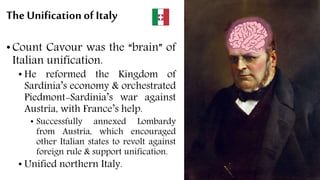
•Count Cavour was the “brain” of
Italian unification.
• He reformed the Kingdom of
Sardinia’s economy & orchestrated
Piedmont-Sardinia’s war against
Austria, with France’s help.
• Successfully annexed Lombardy
from Austria, which encouraged
other Italian states to revolt against
foreign rule & support unification.
• Unified northern Italy.
The Unification of Italy
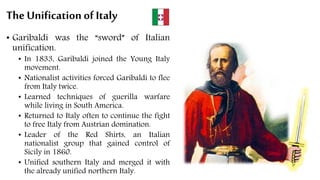
• Garibaldi was the “sword” of Italian
unification.
• In 1833, Garibaldi joined the Young Italy
movement.
• Nationalist activities forced Garibaldi to flee
from Italy twice.
• Learned techniques of guerilla warfare
while living in South America.
• Returned to Italy often to continue the fight
to free Italy from Austrian domination.
• Leader of the Red Shirts, an Italian
nationalist group that gained control of
Sicily in 1860.
• Unified southern Italy and merged it with
the already unified northern Italy.
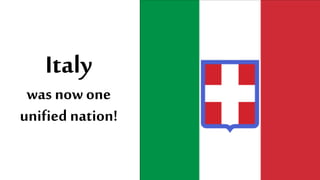
Italy
was now one
unified nation!
Case Study #2:
Germany
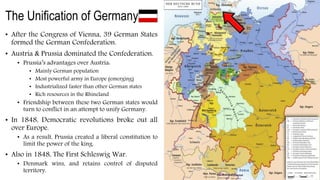
The Unification of Germany
• After the Congress of Vienna, 39 German States
formed the German Confederation.
• Austria & Prussia dominated the Confederation.
• Prussia’s advantages over Austria:
• Mainly German population
• Most powerful army in Europe (emerging)
• Industrialized faster than other German states
• Rich resources in the Rhineland
• Friendship between these two German states would
turn to conflict in an attempt to unify Germany.
• In 1848, Democratic revolutions broke out all
over Europe.
• As a result, Prussia created a liberal constitution to
limit the power of the king.
• Also in 1848, The First Schleswig War.
• Denmark wins, and retains control of disputed
territory.
The Unification of Germany
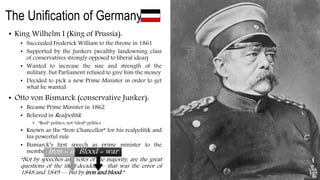
• King Wilhelm I (King of Prussia):
• Succeeded Frederick William to the throne in 1861
• Supported by the Junkers (wealthy landowning class
of conservatives strongly opposed to liberal ideas)
• Wanted to increase the size and strength of the
military, but Parliament refused to give him the money
• Decided to pick a new Prime Minister in order to get
what he wanted
• Otto von Bismarck (conservative Junker):
• Became Prime Minister in 1862
• Believed in Realpolitik
• “Real” politics, not “ideal” politics
• Known as the “Iron Chancellor” for his realpolitik and
his powerful rule
• Bismarck’s first speech as prime minister to the
members of the Parliament:
“Not by speeches and votes of the majority, are the great
questions of the time decided — that was the error of
1848 and 1849 — but by iron and blood.”
Iron = industry
Blood = war
The Unification of Germany
- Steps to German Unification -
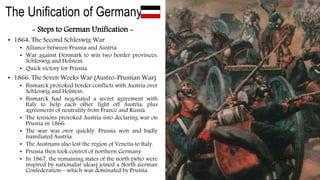
• 1864: The Second Schleswig War
• Alliance between Prussia and Austria.
• War against Denmark to win two border provinces:
Schleswig and Holstein.
• Quick victory for Prussia.
• 1866: The Seven Weeks War (Austro-Prussian War)
• Bismarck provoked border conflicts with Austria over
Schleswig and Holstein.
• Bismarck had negotiated a secret agreement with
Italy to help each other fight off Austria, plus
agreements of neutrality from France and Russia.
• The tensions provoked Austria into declaring war on
Prussia in 1866.
• The war was over quickly. Prussia won and badly
humiliated Austria.
• The Austrians also lost the region of Venetia to Italy.
• Prussia then took control of northern Germany.
• In 1867, the remaining states of the north (who were
inspired by nationalist ideas) joined a North German
Confederation—which was dominated by Prussia.
The Unification of Germany
- Steps to German Unification -
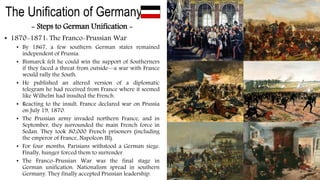
• 1870-1871: The Franco-Prussian War
• By 1867, a few southern German states remained
independent of Prussia.
• Bismarck felt he could win the support of Southerners
if they faced a threat from outside—a war with France
would rally the South.
• He published an altered version of a diplomatic
telegram he had received from France where it seemed
like Wilhelm had insulted the French.
• Reacting to the insult, France declared war on Prussia
on July 19, 1870.
• The Prussian army invaded northern France, and in
September, they surrounded the main French force in
Sedan. They took 80,000 French prisoners (including
the emperor of France, Napoleon III).
• For four months, Parisians withstood a German siege.
Finally, hunger forced them to surrender.
• The Franco-Prussian War was the final stage in
German unification. Nationalism spread in southern
Germany. They finally accepted Prussian leadership.
The Unification of Germany
- Steps to German Unification –
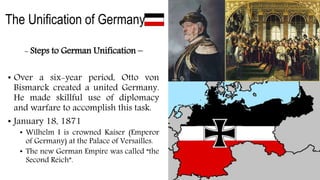
• Over a six-year period, Otto von
Bismarck created a united Germany.
He made skillful use of diplomacy
and warfare to accomplish this task.
• January 18, 1871
• Wilhelm I is crowned Kaiser (Emperor
of Germany) at the Palace of Versailles.
• The new German Empire was called “the
Second Reich”.
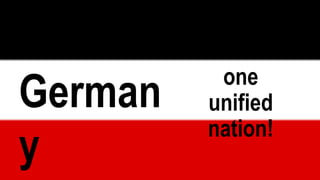
was now
one
unified
nation!
German
y
The nation tries to expand its ,
, and influence over other
nations…
…and begins!
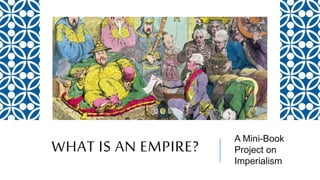
WHAT IS AN EMPIRE? A Mini-Book
Project on
Imperialism
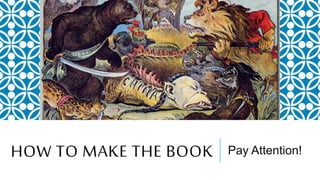
HOW TO MAKE THE BOOK Pay Attention!
THE COVER
E.M.P.I.R.E.
A Mini-Book about Imperialism
By
[Your Name]
The Definition of an Empire:
“One Group of People
Ruling over Many”
Make it colorful!
Add pictures!
(look up some related to
imperialism for inspiration)
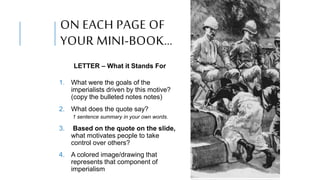
ON EACH PAGE OF
YOUR MINI-BOOK…
LETTER – What it Stands For
1. What were the goals of the
imperialists driven by this motive?
(copy the bulleted notes notes)
2. What does the quote say?
1 sentence summary in your own words.
3. Based on the quote on the slide,
what motivates people to take
control over others?
4. A colored image/drawing that
represents that component of
imperialism

Unification ppt

  • 1.
    Friday February 25th Buc Beginning: What isan “empire”? “One Group of People Ruling over Many” (i.e., what comes to mind when you hear this word?)
  • 2.
    Friday February 25th Buc Beginning: What isan “empire”? “One Group of People Ruling over Many” (i.e., what comes to mind when you hear this word?)
  • 4.
    • Nationalism isthe belief that one’s greatest loyalty should not be to a king or an empire but to a nation of people who share a common culture and history. • Historically, this often evolves into the belief that one’s nation is superior to all other nations. • Nationalism is the foundation for imperialism • Nations justify colonizing and influencing other nations because they think theirs is the best. • In the 1800s, there was a drive to transform cultural nationality into a political state (this
  • 5.
  • 6.
    The Unification ofItaly • Before Italy was one unified state, it was a patchwork of separate kingdoms & city-states. • After the Congress of Vienna (1815), the land of Italy was still divided: • Austria ruled the Italian provinces of Venetia and Lombardy. • The Spanish Bourbon family ruled the Kingdom of the Two Sicilies. • The Pope controlled the Papal States (under French protection).
  • 7.
    The Unification ofItaly • Giuseppe Mazzini was the “heart” of Italian unification. • He was a member of the Carbonari. • A secret group of revolutionaries who used violence to get what they wanted. • He formed Young Italy, made up of young people who were excited about a united nation of Italy. • The Italian nationalist movement was called the Risorgimento (“resurgence”). • The 1848 Revolution: rebels failed, and former rulers of Italian states drove Mazzini and other nationalist leaders into exile.
  • 8.
    The Unification ofItaly •Count Cavour was the “brain” of Italian unification. • He reformed the Kingdom of Sardinia’s economy & orchestrated Piedmont-Sardinia’s war against Austria, with France’s help. • Successfully annexed Lombardy from Austria, which encouraged other Italian states to revolt against foreign rule & support unification. • Unified northern Italy.
  • 9.
    The Unification ofItaly • Garibaldi was the “sword” of Italian unification. • In 1833, Garibaldi joined the Young Italy movement. • Nationalist activities forced Garibaldi to flee from Italy twice. • Learned techniques of guerilla warfare while living in South America. • Returned to Italy often to continue the fight to free Italy from Austrian domination. • Leader of the Red Shirts, an Italian nationalist group that gained control of Sicily in 1860. • Unified southern Italy and merged it with the already unified northern Italy.
  • 10.
  • 11.
  • 12.
    The Unification ofGermany • After the Congress of Vienna, 39 German States formed the German Confederation. • Austria & Prussia dominated the Confederation. • Prussia’s advantages over Austria: • Mainly German population • Most powerful army in Europe (emerging) • Industrialized faster than other German states • Rich resources in the Rhineland • Friendship between these two German states would turn to conflict in an attempt to unify Germany. • In 1848, Democratic revolutions broke out all over Europe. • As a result, Prussia created a liberal constitution to limit the power of the king. • Also in 1848, The First Schleswig War. • Denmark wins, and retains control of disputed territory.
  • 13.
    The Unification ofGermany • King Wilhelm I (King of Prussia): • Succeeded Frederick William to the throne in 1861 • Supported by the Junkers (wealthy landowning class of conservatives strongly opposed to liberal ideas) • Wanted to increase the size and strength of the military, but Parliament refused to give him the money • Decided to pick a new Prime Minister in order to get what he wanted • Otto von Bismarck (conservative Junker): • Became Prime Minister in 1862 • Believed in Realpolitik • “Real” politics, not “ideal” politics • Known as the “Iron Chancellor” for his realpolitik and his powerful rule • Bismarck’s first speech as prime minister to the members of the Parliament: “Not by speeches and votes of the majority, are the great questions of the time decided — that was the error of 1848 and 1849 — but by iron and blood.” Iron = industry Blood = war
  • 14.
    The Unification ofGermany - Steps to German Unification - • 1864: The Second Schleswig War • Alliance between Prussia and Austria. • War against Denmark to win two border provinces: Schleswig and Holstein. • Quick victory for Prussia. • 1866: The Seven Weeks War (Austro-Prussian War) • Bismarck provoked border conflicts with Austria over Schleswig and Holstein. • Bismarck had negotiated a secret agreement with Italy to help each other fight off Austria, plus agreements of neutrality from France and Russia. • The tensions provoked Austria into declaring war on Prussia in 1866. • The war was over quickly. Prussia won and badly humiliated Austria. • The Austrians also lost the region of Venetia to Italy. • Prussia then took control of northern Germany. • In 1867, the remaining states of the north (who were inspired by nationalist ideas) joined a North German Confederation—which was dominated by Prussia.
  • 15.
    The Unification ofGermany - Steps to German Unification - • 1870-1871: The Franco-Prussian War • By 1867, a few southern German states remained independent of Prussia. • Bismarck felt he could win the support of Southerners if they faced a threat from outside—a war with France would rally the South. • He published an altered version of a diplomatic telegram he had received from France where it seemed like Wilhelm had insulted the French. • Reacting to the insult, France declared war on Prussia on July 19, 1870. • The Prussian army invaded northern France, and in September, they surrounded the main French force in Sedan. They took 80,000 French prisoners (including the emperor of France, Napoleon III). • For four months, Parisians withstood a German siege. Finally, hunger forced them to surrender. • The Franco-Prussian War was the final stage in German unification. Nationalism spread in southern Germany. They finally accepted Prussian leadership.
  • 16.
    The Unification ofGermany - Steps to German Unification – • Over a six-year period, Otto von Bismarck created a united Germany. He made skillful use of diplomacy and warfare to accomplish this task. • January 18, 1871 • Wilhelm I is crowned Kaiser (Emperor of Germany) at the Palace of Versailles. • The new German Empire was called “the Second Reich”.
  • 17.
  • 19.
    The nation triesto expand its , , and influence over other nations… …and begins!
  • 20.
    WHAT IS ANEMPIRE? A Mini-Book Project on Imperialism
  • 21.
    HOW TO MAKETHE BOOK Pay Attention!
  • 22.
    THE COVER E.M.P.I.R.E. A Mini-Bookabout Imperialism By [Your Name] The Definition of an Empire: “One Group of People Ruling over Many” Make it colorful! Add pictures! (look up some related to imperialism for inspiration)
  • 23.
    ON EACH PAGEOF YOUR MINI-BOOK… LETTER – What it Stands For 1. What were the goals of the imperialists driven by this motive? (copy the bulleted notes notes) 2. What does the quote say? 1 sentence summary in your own words. 3. Based on the quote on the slide, what motivates people to take control over others? 4. A colored image/drawing that represents that component of imperialism