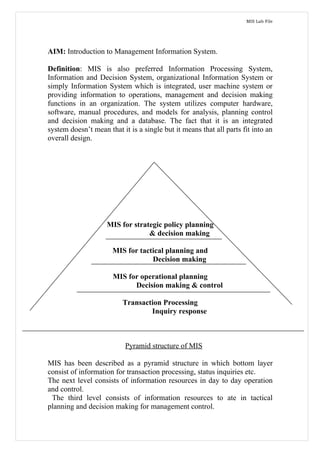
EXPERIMENT NO -1

                     (MIS and Its Functional Subsystems)

Management information systems provide decision-makers information and feedback on
daily operations. Additionally, management information systems can be used
strategically, often incorporating Web technology.

Marketing MIS: Marketing Management Information System (MIS) supports
managerial activities in product development, distribution, pricing decisions, promotional
effectiveness and sales forecasting.


Inputs to Marketing MIS

   •   Strategic plan and corporate policies
   •   The TPS (Transaction Processing Systems)
   •   External sources :
   •   The competition
   •   The market

Marketing MIS Subsystems and Outputs

   •   Marketing research
   •   Web based market research
   •   Product development
   •   Promotion and advertising
   •   Product pricing


                                                                                        1
Human Resources MIS: Human Resource Management Information System (MIS) is
concerned with all of the activities related to employees and potential employees of the
organization.

Inputs to the Human Resource MIS

   •   Strategic plan or corporate policies
   •   The TPS:
           o Payroll data
           o Order processing data
           o Personnel data
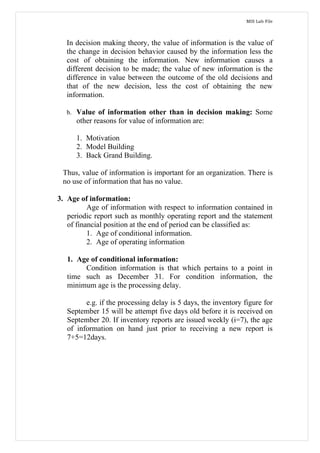
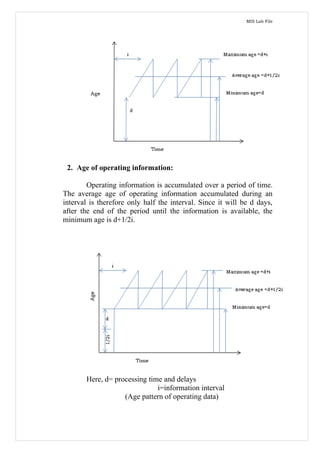
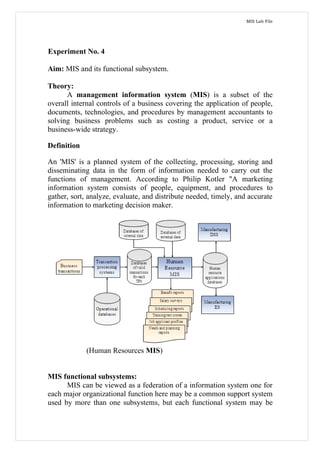
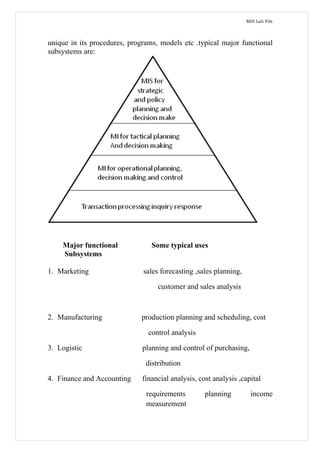
   •   External sources


Human Resource MIS Subsystems and Outputs

   •   Human resource planning
   •   Personnel selection and recruiting
   •   Training and skills inventory
   •   Scheduling and job placement
   •   Wage and salary administration


                                                                                      2
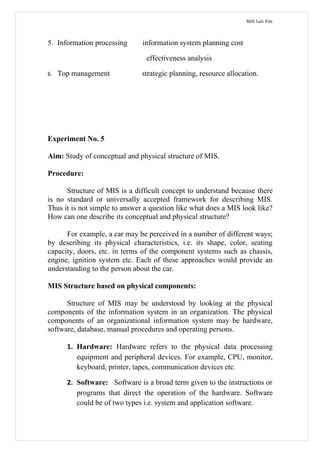
EXPERIMENT NO -2

           Study of physical and conceptual structure of MIS

Our company is a twenty years old company, manufacturing cement in its nine
different Cement Plants all over the country. The technology used in cement
manufacturing is more or less the same; but the plants vary in terms of the tonnage
per day (TPD) production of cement.

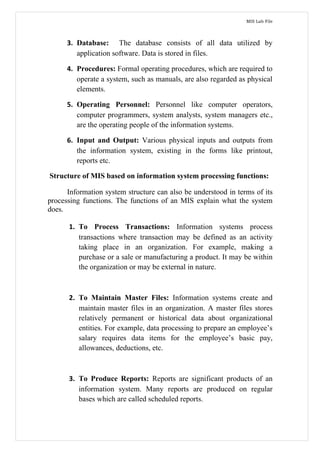
Conceptual Structure of MIS:
                                The cement manufacturing is fairly a stable affair and
the organization for this is functional and hierarchical. The Finance, Sales, and
Personnel are the centralized functions in location x, while the Production and
Material are functions, which are decentralized. The plant manager is a Chief
Executive at the Cement Plant, reporting to the Managing Director of the company.
The plant manager is also responsible for the commercial, accounting and personnel
and such other functions, which are required to operate the plant. In fact, each plant
is termed as the Strategic Business Unit (SBU) responsible for resources and results.

Physical Structure of MIS:
                              Our Company has a Management Services Department
(MSD), which continuously studies the operation of business in the light of ever
hanging requirements of the Management of the cement business. The nature of the
business is such that a fuller utilization of the plant capacity coupled with a strict
cost and expense control, are the keys to profitable business. The operations at the
plant level are procurement, transportation and material handling of cement raw
material, distribution of cement as per advices received from location X, hiring of
temporary labor to clear the peak loads of distribution, And upkeep and
maintenance of plant to reduce breakdown and down times.


                                                                                    3
CONCEPTUAL STRUCTURE OF MIS OF OUR COMPANY


                           Managing       Director


                                   GM                                       GM
 GM             GM              Management              GM               Projects and
Finance        Personnel         Services               Sales            Construction


            Manager        Plant Manager Production               Manager
          Administration                                          Law and
                           And Distribution
                                                                 Secretarial


              Officer            Officer              Officer             Officer
             Personnel         Distribution                             Commercial
                                                      Purchase


                                                                               4
EXPERIMENT NO -3
              (STUDY OF DSS ITS USERS AND CHARACTERISTICS)

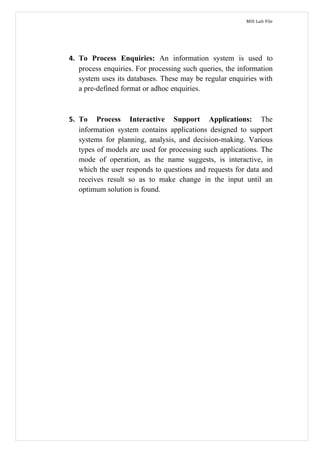
DEFINITION: - It is set of well indicated user friendly computer based tools that
combined data with various decision making models to solve semi structured and
unstructured problems.

ITS USERS:-The ultimate user of DSS is decision maker in the cement company.
However he or she may not actually run the system. There are four distinct usage
patterns
   1. Subscription mode: - receives reports that are generated automatically on
       the regular basis.
   2. Terminal mode: - decision maker is the direct user of the system by making
       online access.
   3. Clerk mode: - In this decision maker uses the system directly but offline.
   4.    Intermediary mode: - the decision maker uses the system with
       intermediaries who perform the analysis and gives the report of the result.

CHARACTERISTICS:-

   1. It facilitates semi structured and unstructured decision making by bringing
   together data.
   2. It provides decision support for several independent decisions.
   3. It supports a wide variety of decision making processes and styles.
   4. It tells the decision maker to make decision under dynamic business
   conditions.
   5. It helps the decision maker to address ad hoc queries.

   Basically in this company DSS helps in problem situations.


   Problem 1:-In last six months recently a problem occurred in crushing hoopers.
   Due to heavy load for crushing in hoopers, the hammers were damaged due to
   hard stone crushing.

   Solution: - As the problem faced then the plant did stop working for 2- 3 days.
   Experts make the solution for this and mechanics checks the hoppers and
   replace the crushing hammers because the hammers heads were totally
   damaged.

   Problem 2:- Another problem occurred in the exhaust pipes to smoke out,
   because the silt had totally blocked the exhaust pipes.


                                                                                5
Solution: - At this problem the exhaust pipes stops to exhaust the smoke which
are produced in the kiln. So the pipes were replaced with in a day by the
mechanics.


Problem 3:- Belt conveyors broke.

Solution: - Now the totally movement of belt stops due to which the whole
transportation of material stops. Belt conveyors were replaced with in 3 days. At
this time the functioning of manufacturing stops.


                                                                               6
EXPERIMENT NO -4
                 (STUDY OF INFORMATION SYSTEM AND ITS TYPES)

INFORMATION SYSTEM: - Means an interconnected set of information resources under the same
direct management control that shares common functionality. A system normally includes hardware,
software, information, data, applications, communications, and people.

DEFINITIONS:
 1. A system, whether automated or manual, that comprises people, machines, and/or methods
organized to collect, process, transmit, and disseminate data that represent user information.
2. The entire infrastructure, organization, personnel, and components for the collection, processing,
storage, transmission, display, dissemination, and disposition of information.

TYPES OF INFORMATION SYSTEM:-

The main kinds of information systems in business are described briefly below:

Information       Description
System
Executive       An Executive Support System ("ESS") is designed to help senior management
Support Systems make strategic decisions. It gathers analyses and summarizes the key internal and
                external information used in the business.

                  A good way to think about an ESS is to imagine the senior management team at
                  the main branch having a software program that shows the current status of all
                  the operating Branches. ESS typically involves lots of data analysis and modeling
                  tools such as "what-if" analysis to help strategic decision-making.

Management        A management information system ("MIS") is mainly concerned with internal
Information       sources of information. MIS usually take data from the transaction processing
Systems           systems and summarize it into a series of management reports.

                  MIS reports tend to be used by middle management and operational supervisors.
Decision-Support Decision-support systems ("DSS") are specifically designed to help management
Systems          make decisions in situations where there is uncertainty about the possible
                 outcomes of those decisions. DSS comprise tools and techniques to help gather
                 relevant information and analyze the options and alternatives. DSS often involves
                 use of complex spreadsheet and databases to create "what-if" models.


                                                                                                   7
Knowledge     Knowledge Management Systems ("KMS") exist to help businesses create and
Management    share information. These are typically used in a business where employees create
Systems       new knowledge and expertise - which can then be shared by other people in the
              organization to create further commercial opportunities. Good examples include
              firms of lawyers, accountants and management consultants.

              KMS are built around systems which allow efficient categorization and
              distribution of knowledge. For example, the knowledge itself might be contained
              in word processing documents, spreadsheets, PowerPoint presentations, Internet
              pages or the local plant files. To share the knowledge, a KMS would use group
              collaboration systems such as an intranet, which are shared by all plants via a
              communication medium.

Transaction   As the name implies, Transaction Processing Systems ("TPS") are designed to
Processing    process routine transactions efficiently and accurately. A business will have
Systems       several (sometimes many) TPS; for example:

              -     Billing     systems     to      send    invoices      to    customers
              - Systems to calculate the weekly and monthly payroll and tax payments
              - Production and purchasing systems to calculate raw material requirements
              - Stock control systems to process all movements into, within and out of the
              business


Office        Office Automation Systems are systems that try to improve the productivity of
Automation    employees who need to process data and information. Perhaps the best example is
Systems       a system that allow employees to work from home or whilst on the move.


                                                                                            8
EXPERIMENT NO -5
                       (Study of ERP and its Limitation)

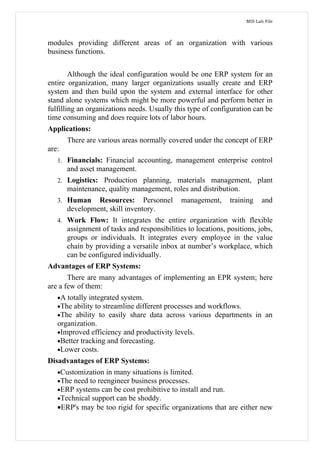
ERP is one of the most widely implemented business software systems in a wide variety
of industries and organizations. ERP is the acronym of Enterprise Resource Planning.
ERP is just not only software. ERP definition refers to both; ERP software and business
strategies that implement ERP system.
      ERP implementation utilizes various ERP software applications to improve the
performance of organizations for
1) resource planning,
2) management control and
3) operational control.
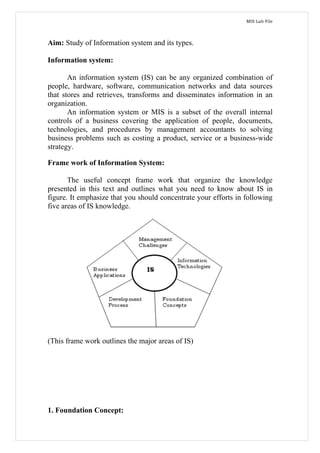
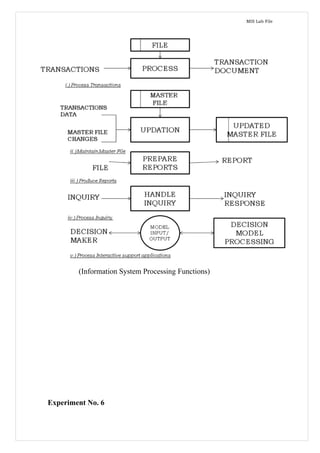
Simple Block diagram of ERP.


Limitations of ERP include:


                                                                                     9
1. Customization of the ERP software is limited. Some customization may involve
   changing of the ERP software structure which is usually not allowed.

2. Re-engineering of business processes to fit the "industry standard" prescribed by
   the ERP system may lead to a loss of competitive advantage.

3. ERP systems can be very expensive to install.

4. ERP vendors can charge sums of money for annual license renewal that is
   unrelated to the size of the company using the ERP or its profitability.

5. Systems can be difficult to use.

6. The system can suffer from the "weakest link" problem—an inefficiency in one
   department or at one of the partners may affect other participants.

7. The blurring of company boundaries can cause problems in accountability, lines
   of responsibility, and employee morale.

8. Resistance in sharing sensitive internal information between departments can
   reduce the effectiveness of the software.

9. There are frequent compatibility problems with the various legacy systems of the
   partners.

10. The system may be over-engineered relative to the actual needs of the customer.


                                                                                   10
11
IT-314 MIS (Practicals)

IT-314 MIS (Practicals)

  • 1.
    EXPERIMENT NO -1 (MIS and Its Functional Subsystems) Management information systems provide decision-makers information and feedback on daily operations. Additionally, management information systems can be used strategically, often incorporating Web technology. Marketing MIS: Marketing Management Information System (MIS) supports managerial activities in product development, distribution, pricing decisions, promotional effectiveness and sales forecasting. Inputs to Marketing MIS • Strategic plan and corporate policies • The TPS (Transaction Processing Systems) • External sources : • The competition • The market Marketing MIS Subsystems and Outputs • Marketing research • Web based market research • Product development • Promotion and advertising • Product pricing 1
  • 2.
    Human Resources MIS:Human Resource Management Information System (MIS) is concerned with all of the activities related to employees and potential employees of the organization. Inputs to the Human Resource MIS • Strategic plan or corporate policies • The TPS: o Payroll data o Order processing data o Personnel data • External sources Human Resource MIS Subsystems and Outputs • Human resource planning • Personnel selection and recruiting • Training and skills inventory • Scheduling and job placement • Wage and salary administration 2
  • 3.
    EXPERIMENT NO -2 Study of physical and conceptual structure of MIS Our company is a twenty years old company, manufacturing cement in its nine different Cement Plants all over the country. The technology used in cement manufacturing is more or less the same; but the plants vary in terms of the tonnage per day (TPD) production of cement. Conceptual Structure of MIS: The cement manufacturing is fairly a stable affair and the organization for this is functional and hierarchical. The Finance, Sales, and Personnel are the centralized functions in location x, while the Production and Material are functions, which are decentralized. The plant manager is a Chief Executive at the Cement Plant, reporting to the Managing Director of the company. The plant manager is also responsible for the commercial, accounting and personnel and such other functions, which are required to operate the plant. In fact, each plant is termed as the Strategic Business Unit (SBU) responsible for resources and results. Physical Structure of MIS: Our Company has a Management Services Department (MSD), which continuously studies the operation of business in the light of ever hanging requirements of the Management of the cement business. The nature of the business is such that a fuller utilization of the plant capacity coupled with a strict cost and expense control, are the keys to profitable business. The operations at the plant level are procurement, transportation and material handling of cement raw material, distribution of cement as per advices received from location X, hiring of temporary labor to clear the peak loads of distribution, And upkeep and maintenance of plant to reduce breakdown and down times. 3
  • 4.
    CONCEPTUAL STRUCTURE OFMIS OF OUR COMPANY Managing Director GM GM GM GM Management GM Projects and Finance Personnel Services Sales Construction Manager Plant Manager Production Manager Administration Law and And Distribution Secretarial Officer Officer Officer Officer Personnel Distribution Commercial Purchase 4
  • 5.
    EXPERIMENT NO -3 (STUDY OF DSS ITS USERS AND CHARACTERISTICS) DEFINITION: - It is set of well indicated user friendly computer based tools that combined data with various decision making models to solve semi structured and unstructured problems. ITS USERS:-The ultimate user of DSS is decision maker in the cement company. However he or she may not actually run the system. There are four distinct usage patterns 1. Subscription mode: - receives reports that are generated automatically on the regular basis. 2. Terminal mode: - decision maker is the direct user of the system by making online access. 3. Clerk mode: - In this decision maker uses the system directly but offline. 4. Intermediary mode: - the decision maker uses the system with intermediaries who perform the analysis and gives the report of the result. CHARACTERISTICS:- 1. It facilitates semi structured and unstructured decision making by bringing together data. 2. It provides decision support for several independent decisions. 3. It supports a wide variety of decision making processes and styles. 4. It tells the decision maker to make decision under dynamic business conditions. 5. It helps the decision maker to address ad hoc queries. Basically in this company DSS helps in problem situations. Problem 1:-In last six months recently a problem occurred in crushing hoopers. Due to heavy load for crushing in hoopers, the hammers were damaged due to hard stone crushing. Solution: - As the problem faced then the plant did stop working for 2- 3 days. Experts make the solution for this and mechanics checks the hoppers and replace the crushing hammers because the hammers heads were totally damaged. Problem 2:- Another problem occurred in the exhaust pipes to smoke out, because the silt had totally blocked the exhaust pipes. 5
  • 6.
    Solution: - Atthis problem the exhaust pipes stops to exhaust the smoke which are produced in the kiln. So the pipes were replaced with in a day by the mechanics. Problem 3:- Belt conveyors broke. Solution: - Now the totally movement of belt stops due to which the whole transportation of material stops. Belt conveyors were replaced with in 3 days. At this time the functioning of manufacturing stops. 6
  • 7.
    EXPERIMENT NO -4 (STUDY OF INFORMATION SYSTEM AND ITS TYPES) INFORMATION SYSTEM: - Means an interconnected set of information resources under the same direct management control that shares common functionality. A system normally includes hardware, software, information, data, applications, communications, and people. DEFINITIONS: 1. A system, whether automated or manual, that comprises people, machines, and/or methods organized to collect, process, transmit, and disseminate data that represent user information. 2. The entire infrastructure, organization, personnel, and components for the collection, processing, storage, transmission, display, dissemination, and disposition of information. TYPES OF INFORMATION SYSTEM:- The main kinds of information systems in business are described briefly below: Information Description System Executive An Executive Support System ("ESS") is designed to help senior management Support Systems make strategic decisions. It gathers analyses and summarizes the key internal and external information used in the business. A good way to think about an ESS is to imagine the senior management team at the main branch having a software program that shows the current status of all the operating Branches. ESS typically involves lots of data analysis and modeling tools such as "what-if" analysis to help strategic decision-making. Management A management information system ("MIS") is mainly concerned with internal Information sources of information. MIS usually take data from the transaction processing Systems systems and summarize it into a series of management reports. MIS reports tend to be used by middle management and operational supervisors. Decision-Support Decision-support systems ("DSS") are specifically designed to help management Systems make decisions in situations where there is uncertainty about the possible outcomes of those decisions. DSS comprise tools and techniques to help gather relevant information and analyze the options and alternatives. DSS often involves use of complex spreadsheet and databases to create "what-if" models. 7
  • 8.
    Knowledge Knowledge Management Systems ("KMS") exist to help businesses create and Management share information. These are typically used in a business where employees create Systems new knowledge and expertise - which can then be shared by other people in the organization to create further commercial opportunities. Good examples include firms of lawyers, accountants and management consultants. KMS are built around systems which allow efficient categorization and distribution of knowledge. For example, the knowledge itself might be contained in word processing documents, spreadsheets, PowerPoint presentations, Internet pages or the local plant files. To share the knowledge, a KMS would use group collaboration systems such as an intranet, which are shared by all plants via a communication medium. Transaction As the name implies, Transaction Processing Systems ("TPS") are designed to Processing process routine transactions efficiently and accurately. A business will have Systems several (sometimes many) TPS; for example: - Billing systems to send invoices to customers - Systems to calculate the weekly and monthly payroll and tax payments - Production and purchasing systems to calculate raw material requirements - Stock control systems to process all movements into, within and out of the business Office Office Automation Systems are systems that try to improve the productivity of Automation employees who need to process data and information. Perhaps the best example is Systems a system that allow employees to work from home or whilst on the move. 8
  • 9.
    EXPERIMENT NO -5 (Study of ERP and its Limitation) ERP is one of the most widely implemented business software systems in a wide variety of industries and organizations. ERP is the acronym of Enterprise Resource Planning. ERP is just not only software. ERP definition refers to both; ERP software and business strategies that implement ERP system. ERP implementation utilizes various ERP software applications to improve the performance of organizations for 1) resource planning, 2) management control and 3) operational control. Simple Block diagram of ERP. Limitations of ERP include: 9
  • 10.
    1. Customization ofthe ERP software is limited. Some customization may involve changing of the ERP software structure which is usually not allowed. 2. Re-engineering of business processes to fit the "industry standard" prescribed by the ERP system may lead to a loss of competitive advantage. 3. ERP systems can be very expensive to install. 4. ERP vendors can charge sums of money for annual license renewal that is unrelated to the size of the company using the ERP or its profitability. 5. Systems can be difficult to use. 6. The system can suffer from the "weakest link" problem—an inefficiency in one department or at one of the partners may affect other participants. 7. The blurring of company boundaries can cause problems in accountability, lines of responsibility, and employee morale. 8. Resistance in sharing sensitive internal information between departments can reduce the effectiveness of the software. 9. There are frequent compatibility problems with the various legacy systems of the partners. 10. The system may be over-engineered relative to the actual needs of the customer. 10
  • 11.