IT Infrastructure   for the   Agile Enterprise: Grid, SOA, and Virtualization   Michael Hugos CIO at Large Center for Systems Innovation www.MichaelHugos.com   © 2007 Michael Hugos www.MichaelHugos.com
Overview of Briefing PART 1 – Business Realities PART 2 – IT Infrastructure for Agility PART 3 – Business Case Study © 2007 Michael Hugos www.MichaelHugos.com
PART 1 Business Realities © 2007 Michael Hugos www.MichaelHugos.com
Global Economy – New Reality Formerly separate national and regional markets now electronically connected into single global market Global market does what free markets do so well; it’s called “efficient price discovery”  In many businesses gross margins average 10-15%; under constant pressure; heading lower Global economy is like  global stock market! Profit in hyper competitive real-time world  comes from  many small adjustments & some big wins  as companies respond to constantly changing environments © 2007 Michael Hugos www.MichaelHugos.com
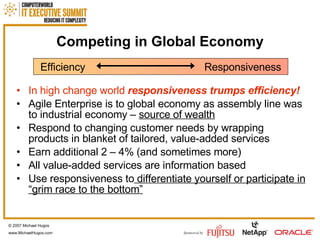
Competing in Global Economy In high change world   responsiveness trumps efficiency! Agile Enterprise is to global economy as assembly line was to industrial economy –  source of wealth Respond to changing customer needs by wrapping  products in blanket of tailored, value-added services  Earn additional 2 – 4% (and sometimes more) All value-added services are information based Use responsiveness to  differentiate yourself or participate in “grim race to the bottom” © 2007 Michael Hugos www.MichaelHugos.com Efficiency Responsiveness
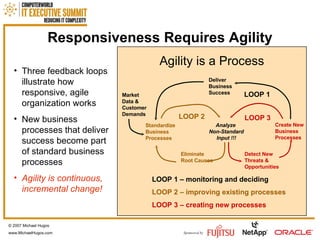
Responsiveness Requires Agility Three feedback loops illustrate how responsive, agile organization works New business processes that deliver success become part of standard business processes Agility is   continuous, incremental change! © 2007 Michael Hugos www.MichaelHugos.com Agility is a Process Create New Business Processes  Market Data & Customer Demands Deliver Business Success Analyze  Non-Standard Input !!! Standardize  Business Processes Detect New Threats & Opportunities Eliminate Root Causes LOOP 2 LOOP 3 LOOP 1 LOOP 1 – monitoring and deciding LOOP 2 – improving existing processes LOOP 3 – creating new processes
PART 2 IT Infrastructure for Agility © 2007 Michael Hugos www.MichaelHugos.com
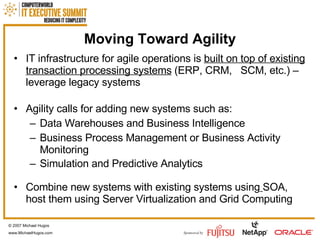
Moving Toward Agility IT infrastructure for agile operations is  built on top of existing transaction processing systems  (ERP, CRM,  SCM, etc.) – leverage legacy systems Agility calls for adding new systems such as: Data Warehouses and Business Intelligence Business Process Management or Business Activity Monitoring Simulation and Predictive Analytics Combine new systems with existing systems using   SOA, host them using Server Virtualization and Grid Computing © 2007 Michael Hugos www.MichaelHugos.com
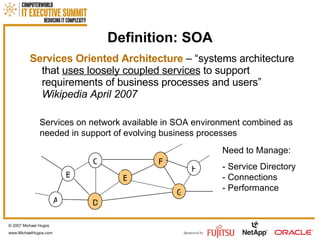
Definition: SOA Services Oriented Architecture  – “systems architecture that  uses loosely coupled services  to support requirements of business processes and users”  Wikipedia April 2007 Need to Manage: - Service Directory - Connections - Performance Services on network available in SOA environment combined as needed in support of evolving business processes © 2007 Michael Hugos www.MichaelHugos.com B C E G D F H A
Definition: Virtualization Server Virtualization  – “partitioning one [or many] physical server computer[s] into multiple servers that each has the appearance and capabilities of running on its own dedicated machine.”  Wikipedia April 2007 Optimize use of server resources Centralize server administration Common practice on mainframes now available for other architectures © 2007 Michael Hugos www.MichaelHugos.com
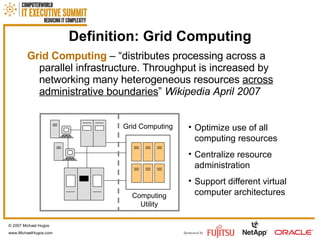
Definition: Grid Computing Grid Computing  – “distributes processing across a parallel infrastructure. Throughput is increased by networking many heterogeneous resources  across administrative boundaries ”  Wikipedia April 2007 Optimize use of all computing resources Centralize resource administration Support different virtual computer architectures © 2007 Michael Hugos www.MichaelHugos.com Computing Utility Grid Computing
Disruption of IT Paradigm - Again Remember how technologies like Client/Server, Internet and World Wide Web once created havoc with conventional IT paradigm? It’s happening again…  ready or not! SOA, Virtualization, Grid Computing offer new opportunities for IT infrastructure that is fast, flexible, and cost effective Those that master the use of these technologies will once again  set the pace for everyone else © 2007 Michael Hugos www.MichaelHugos.com
PART 3 Business Case Study © 2007 Michael Hugos www.MichaelHugos.com
Is IT a Profession or a Utility? Does IT matter; is it a competitive advantage? Efficient 24/7 operation of existing systems is no longer a competitive advantage  –   it’s a given! Companies need to  outsource operation of existing systems and provisioning of new infrastructure Large vendors of hardware and software become computing utility vendors offering greater efficiency Company IT groups focus on development of new systems and continuous adjustment of infrastructure Agile IT enables companies to  earn additional 2-4% © 2007 Michael Hugos www.MichaelHugos.com
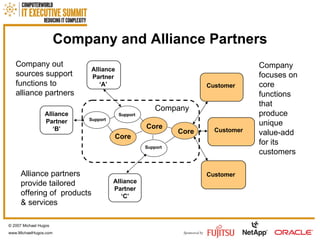
Company and Alliance Partners © 2007 Michael Hugos www.MichaelHugos.com Company focuses on core functions that produce unique value-add for its customers Company out sources support functions to alliance partners Alliance Partner ‘B’ Alliance Partner ‘A’ Alliance Partner ‘C’ Support  Support Core Customer Customer Customer Alliance partners provide tailored offering of  products & services Core Core Support Company
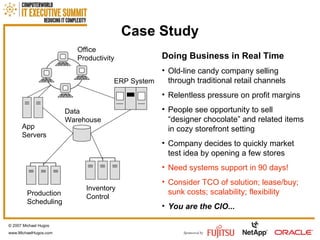
Case Study Doing Business in Real Time Old-line candy company selling through traditional retail channels Relentless pressure on profit margins People see opportunity to sell “designer chocolate” and related items in cozy storefront setting Company decides to quickly market test idea by opening a few stores Need systems support in 90 days! Consider TCO of solution; lease/buy; sunk costs; scalability; flexibility You are the CIO... © 2007 Michael Hugos www.MichaelHugos.com Office Productivity App Servers ERP System Data Warehouse Production Scheduling Inventory Control
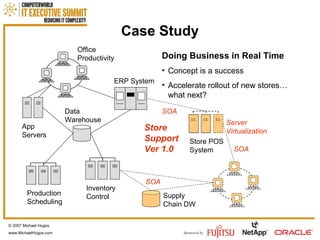
Case Study Office Productivity App Servers Store Support Ver 1.0 Doing Business in Real Time Concept is a success Accelerate rollout of new stores… what next? Supply Chain DW SOA SOA Server Virtualization SOA © 2007 Michael Hugos www.MichaelHugos.com ERP System Data Warehouse Production Scheduling Inventory Control Store POS System
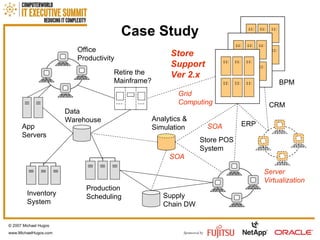
Case Study © 2007 Michael Hugos www.MichaelHugos.com Office Productivity App Servers Data Warehouse Supply Chain DW Inventory System Production Scheduling Analytics & Simulation ERP Store POS System CRM Store Support Ver 2.x SOA SOA Grid Computing  Server Virtualization Retire the Mainframe? BPM
Lessons Learned Web portals provide unified user interface by replacing different system screens with common GUI front-end SOA - build new systems using legacy system components and new server/grid components Split systems processing between server/grid platforms and legacy hardware - host new system features and databases on server/grid platforms Centralize and consolidate servers through virtualization Retire legacy systems as it becomes cost effective to replace them with server/grid based systems Continuous incremental change  (no big bang projects!) © 2007 Michael Hugos www.MichaelHugos.com
Learn More… Presentation excerpted from : -  Building the Real-Time Enterprise , author, 2005 -  CIO Best Practices , co-author, 2007 Read my IT Insights column at Computerworld.com Read my blog “Doing Business in Real Time” at CIO.com © 2007 Michael Hugos www.MichaelHugos.com

IT Infrastructure for the Agile Enterprise: Grid, SOA, and Virtualization

  • 1.
    IT Infrastructure for the Agile Enterprise: Grid, SOA, and Virtualization Michael Hugos CIO at Large Center for Systems Innovation www.MichaelHugos.com © 2007 Michael Hugos www.MichaelHugos.com
  • 2.
    Overview of BriefingPART 1 – Business Realities PART 2 – IT Infrastructure for Agility PART 3 – Business Case Study © 2007 Michael Hugos www.MichaelHugos.com
  • 3.
    PART 1 BusinessRealities © 2007 Michael Hugos www.MichaelHugos.com
  • 4.
    Global Economy –New Reality Formerly separate national and regional markets now electronically connected into single global market Global market does what free markets do so well; it’s called “efficient price discovery” In many businesses gross margins average 10-15%; under constant pressure; heading lower Global economy is like global stock market! Profit in hyper competitive real-time world comes from many small adjustments & some big wins as companies respond to constantly changing environments © 2007 Michael Hugos www.MichaelHugos.com
  • 5.
    Competing in GlobalEconomy In high change world responsiveness trumps efficiency! Agile Enterprise is to global economy as assembly line was to industrial economy – source of wealth Respond to changing customer needs by wrapping products in blanket of tailored, value-added services Earn additional 2 – 4% (and sometimes more) All value-added services are information based Use responsiveness to differentiate yourself or participate in “grim race to the bottom” © 2007 Michael Hugos www.MichaelHugos.com Efficiency Responsiveness
  • 6.
    Responsiveness Requires AgilityThree feedback loops illustrate how responsive, agile organization works New business processes that deliver success become part of standard business processes Agility is continuous, incremental change! © 2007 Michael Hugos www.MichaelHugos.com Agility is a Process Create New Business Processes Market Data & Customer Demands Deliver Business Success Analyze Non-Standard Input !!! Standardize Business Processes Detect New Threats & Opportunities Eliminate Root Causes LOOP 2 LOOP 3 LOOP 1 LOOP 1 – monitoring and deciding LOOP 2 – improving existing processes LOOP 3 – creating new processes
  • 7.
    PART 2 ITInfrastructure for Agility © 2007 Michael Hugos www.MichaelHugos.com
  • 8.
    Moving Toward AgilityIT infrastructure for agile operations is built on top of existing transaction processing systems (ERP, CRM, SCM, etc.) – leverage legacy systems Agility calls for adding new systems such as: Data Warehouses and Business Intelligence Business Process Management or Business Activity Monitoring Simulation and Predictive Analytics Combine new systems with existing systems using SOA, host them using Server Virtualization and Grid Computing © 2007 Michael Hugos www.MichaelHugos.com
  • 9.
    Definition: SOA ServicesOriented Architecture – “systems architecture that uses loosely coupled services to support requirements of business processes and users” Wikipedia April 2007 Need to Manage: - Service Directory - Connections - Performance Services on network available in SOA environment combined as needed in support of evolving business processes © 2007 Michael Hugos www.MichaelHugos.com B C E G D F H A
  • 10.
    Definition: Virtualization ServerVirtualization – “partitioning one [or many] physical server computer[s] into multiple servers that each has the appearance and capabilities of running on its own dedicated machine.” Wikipedia April 2007 Optimize use of server resources Centralize server administration Common practice on mainframes now available for other architectures © 2007 Michael Hugos www.MichaelHugos.com
  • 11.
    Definition: Grid ComputingGrid Computing – “distributes processing across a parallel infrastructure. Throughput is increased by networking many heterogeneous resources across administrative boundaries ” Wikipedia April 2007 Optimize use of all computing resources Centralize resource administration Support different virtual computer architectures © 2007 Michael Hugos www.MichaelHugos.com Computing Utility Grid Computing
  • 12.
    Disruption of ITParadigm - Again Remember how technologies like Client/Server, Internet and World Wide Web once created havoc with conventional IT paradigm? It’s happening again… ready or not! SOA, Virtualization, Grid Computing offer new opportunities for IT infrastructure that is fast, flexible, and cost effective Those that master the use of these technologies will once again set the pace for everyone else © 2007 Michael Hugos www.MichaelHugos.com
  • 13.
    PART 3 BusinessCase Study © 2007 Michael Hugos www.MichaelHugos.com
  • 14.
    Is IT aProfession or a Utility? Does IT matter; is it a competitive advantage? Efficient 24/7 operation of existing systems is no longer a competitive advantage – it’s a given! Companies need to outsource operation of existing systems and provisioning of new infrastructure Large vendors of hardware and software become computing utility vendors offering greater efficiency Company IT groups focus on development of new systems and continuous adjustment of infrastructure Agile IT enables companies to earn additional 2-4% © 2007 Michael Hugos www.MichaelHugos.com
  • 15.
    Company and AlliancePartners © 2007 Michael Hugos www.MichaelHugos.com Company focuses on core functions that produce unique value-add for its customers Company out sources support functions to alliance partners Alliance Partner ‘B’ Alliance Partner ‘A’ Alliance Partner ‘C’ Support Support Core Customer Customer Customer Alliance partners provide tailored offering of products & services Core Core Support Company
  • 16.
    Case Study DoingBusiness in Real Time Old-line candy company selling through traditional retail channels Relentless pressure on profit margins People see opportunity to sell “designer chocolate” and related items in cozy storefront setting Company decides to quickly market test idea by opening a few stores Need systems support in 90 days! Consider TCO of solution; lease/buy; sunk costs; scalability; flexibility You are the CIO... © 2007 Michael Hugos www.MichaelHugos.com Office Productivity App Servers ERP System Data Warehouse Production Scheduling Inventory Control
  • 17.
    Case Study OfficeProductivity App Servers Store Support Ver 1.0 Doing Business in Real Time Concept is a success Accelerate rollout of new stores… what next? Supply Chain DW SOA SOA Server Virtualization SOA © 2007 Michael Hugos www.MichaelHugos.com ERP System Data Warehouse Production Scheduling Inventory Control Store POS System
  • 18.
    Case Study ©2007 Michael Hugos www.MichaelHugos.com Office Productivity App Servers Data Warehouse Supply Chain DW Inventory System Production Scheduling Analytics & Simulation ERP Store POS System CRM Store Support Ver 2.x SOA SOA Grid Computing Server Virtualization Retire the Mainframe? BPM
  • 19.
    Lessons Learned Webportals provide unified user interface by replacing different system screens with common GUI front-end SOA - build new systems using legacy system components and new server/grid components Split systems processing between server/grid platforms and legacy hardware - host new system features and databases on server/grid platforms Centralize and consolidate servers through virtualization Retire legacy systems as it becomes cost effective to replace them with server/grid based systems Continuous incremental change (no big bang projects!) © 2007 Michael Hugos www.MichaelHugos.com
  • 20.
    Learn More… Presentationexcerpted from : - Building the Real-Time Enterprise , author, 2005 - CIO Best Practices , co-author, 2007 Read my IT Insights column at Computerworld.com Read my blog “Doing Business in Real Time” at CIO.com © 2007 Michael Hugos www.MichaelHugos.com