Digital Transformation requires
Integration Modernization
What is Digital
Transformation?
Transforming your business’
technical architecture,
processes, and technology
choices to allow you to make
most out of the data that you
have available to you.
IBM Cloud / DOC ID / Month XX, 2017 / © 2017 IBM Corporation
Why do you need it?
Transforming enables smart
applications, AI and analytics
tools, and multiple parts of
your organisation to have
access to data, which an help
drive greater customer
experiences, which ultimately
provides for a much greater
competitive advantage
3
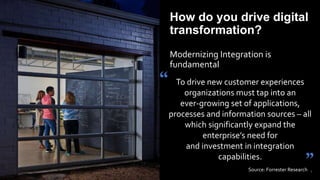
To drive new customer experiences
organizations must tap into an
ever-growing set of applications,
processes and information sources – all
which significantly expand the
enterprise’s need for
and investment in integration
capabilities.
How do you drive digital
transformation?
Modernizing Integration is
fundamental
Source: Forrester Research
4
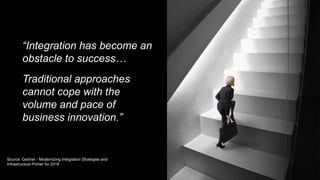
“Integration has become an
obstacle to success…
Traditional approaches
cannot cope with the
volume and pace of
business innovation.”
Source: Gartner - Modernizing Integration Strategies and
Infrastructure Primer for 2018
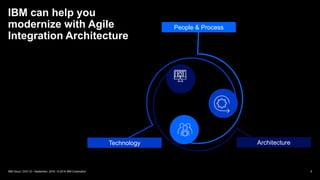
IBM can help you
modernize with Agile
Integration Architecture
5IBM Cloud / DOC ID / September, 2018 / © 2018 IBM Corporation
People & Process
ArchitectureTechnology
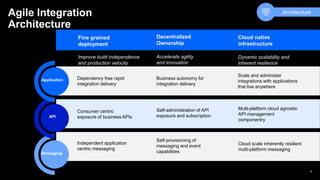
Agile Integration
Architecture
6
Fine grained
deployment
Decentralized
Ownership
Cloud native
infrastructure
Improve build independence
and production velocity
Accelerate agility
and innovation
Dynamic scalability and
inherent resilience
Dependency free rapid
integration delivery
Business autonomy for
integration delivery
Scale and administer
integrations with applications
that live anywhere
Consumer centric
exposure of business APIs
Self-administration of API
exposure and subscription
Multi-platform cloud agnostic
API management
componentry
Independent application
centric messaging
Self-provisioning of
messaging and event
capabilities
Cloud scale inherently resilient
multi-platform messaging
Application
API
Messaging
Architecture
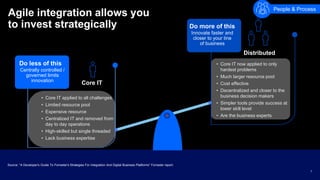
Agile integration allows you
to invest strategically
7
Source: “A Developer's Guide To Forrester's Strategies For Integration And Digital Business Platforms” Forrester report.
• Core IT applied to all challenges
• Limited resource pool
• Expensive resource
• Centralized IT and removed from
day to day operations
• High-skilled but single threaded
• Lack business expertise
Core IT
• Core IT now applied to only
hardest problems
• Much larger resource pool
• Cost effective
• Decentralized and closer to the
business decision makers
• Simpler tools provide success at
lower skill level
• Are the business experts
Distributed
Do more of this
Innovate faster and
closer to your line
of business
Do less of this
Centrally controlled /
governed limits
innovation
People & Process
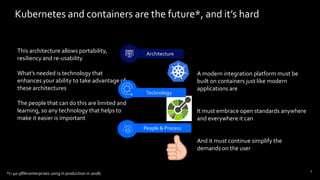
Kubernetes and containers are the future*, and it’s hard
8
This architecture allows portability,
resiliency and re-usability
What’s needed is technology that
enhances your ability to take advantage of
these architectures
The people that can do this are limited and
learning, so any technology that helps to
make it easier is important
A modern integration platform must be
built on containers just like modern
applications are
It must embrace open standards anywhere
and everywhere it can
And it must continue simplify the
demands on the user
Architecture
Technology
People & Process
*(~40-58%+enterprises using in production in 2018)
9Think 2019 © 2019 IBM Corporation
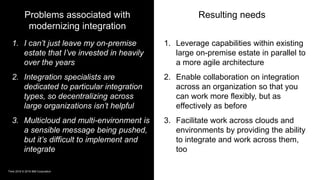
1. I can’t just leave my on-premise
estate that I’ve invested in heavily
over the years
2. Integration specialists are
dedicated to particular integration
types, so decentralizing across
large organizations isn’t helpful
3. Multicloud and multi-environment is
a sensible message being pushed,
but it’s difficult to implement and
integrate
Problems associated with
modernizing integration
Resulting needs
1. Leverage capabilities within existing
large on-premise estate in parallel to
a more agile architecture
2. Enable collaboration on integration
across an organization so that you
can work more flexibly, but as
effectively as before
3. Facilitate work across clouds and
environments by providing the ability
to integrate and work across them,
too
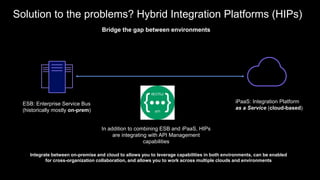
Solution to the problems? Hybrid Integration Platforms (HIPs)
ESB: Enterprise Service Bus
(historically mostly on-prem)
iPaaS: Integration Platform
as a Service (cloud-based)
In addition to combining ESB and iPaaS, HIPs
are integrating with API Management
capabilities
Bridge the gap between environments
Integrate between on-premise and cloud to allows you to leverage capabilities in both environments, can be enabled
for cross-organization collaboration, and allows you to work across multiple clouds and environments
11
11
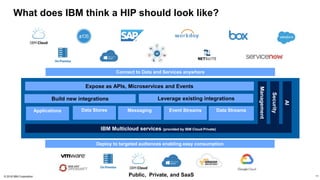
Public, Private, and SaaS
Management
Deploy to targeted audiences enabling easy consumption
Build new integrations Leverage existing integrations
Applications Data StreamsEvent StreamsData Stores
Security
Expose as APIs, Microservices and Events
AI
Messaging
What does IBM think a HIP should look like?
IBM Multicloud services (provided by IBM Cloud Private)
Connect to Data and Services anywhere
© 2018 IBM Corporation
Introducing the IBM Cloud Pak for
Integration
12
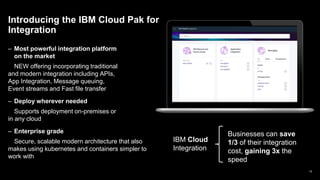
– Most powerful integration platform
on the market
NEW offering incorporating traditional
and modern integration including APIs,
App Integration, Message queuing,
Event streams and Fast file transfer
– Deploy wherever needed
Supports deployment on-premises or
in any cloud
– Enterprise grade
Secure, scalable modern architecture that also
makes using kubernetes and containers simpler to
work with
Businesses can save
1/3 of their integration
cost, gaining 3x the
speed
IBM Cloud
Integration
13
Get started with IBM to
modernize integration
Workshop
More Info
Agile Integration Architecture
http://www.ibm.com/cloud/agile-integration-architecture
IBM Cloud Integration Modernization
Workshops – book today!
http://www.ibm.com/cloud/integration
eBook

Digital transformation requires integration modernization

  • 1.
  • 2.
    What is Digital Transformation? Transformingyour business’ technical architecture, processes, and technology choices to allow you to make most out of the data that you have available to you. IBM Cloud / DOC ID / Month XX, 2017 / © 2017 IBM Corporation Why do you need it? Transforming enables smart applications, AI and analytics tools, and multiple parts of your organisation to have access to data, which an help drive greater customer experiences, which ultimately provides for a much greater competitive advantage
  • 3.
    3 To drive newcustomer experiences organizations must tap into an ever-growing set of applications, processes and information sources – all which significantly expand the enterprise’s need for and investment in integration capabilities. How do you drive digital transformation? Modernizing Integration is fundamental Source: Forrester Research
  • 4.
    4 “Integration has becomean obstacle to success… Traditional approaches cannot cope with the volume and pace of business innovation.” Source: Gartner - Modernizing Integration Strategies and Infrastructure Primer for 2018
  • 5.
    IBM can helpyou modernize with Agile Integration Architecture 5IBM Cloud / DOC ID / September, 2018 / © 2018 IBM Corporation People & Process ArchitectureTechnology
  • 6.
    Agile Integration Architecture 6 Fine grained deployment Decentralized Ownership Cloudnative infrastructure Improve build independence and production velocity Accelerate agility and innovation Dynamic scalability and inherent resilience Dependency free rapid integration delivery Business autonomy for integration delivery Scale and administer integrations with applications that live anywhere Consumer centric exposure of business APIs Self-administration of API exposure and subscription Multi-platform cloud agnostic API management componentry Independent application centric messaging Self-provisioning of messaging and event capabilities Cloud scale inherently resilient multi-platform messaging Application API Messaging Architecture
  • 7.
    Agile integration allowsyou to invest strategically 7 Source: “A Developer's Guide To Forrester's Strategies For Integration And Digital Business Platforms” Forrester report. • Core IT applied to all challenges • Limited resource pool • Expensive resource • Centralized IT and removed from day to day operations • High-skilled but single threaded • Lack business expertise Core IT • Core IT now applied to only hardest problems • Much larger resource pool • Cost effective • Decentralized and closer to the business decision makers • Simpler tools provide success at lower skill level • Are the business experts Distributed Do more of this Innovate faster and closer to your line of business Do less of this Centrally controlled / governed limits innovation People & Process
  • 8.
    Kubernetes and containersare the future*, and it’s hard 8 This architecture allows portability, resiliency and re-usability What’s needed is technology that enhances your ability to take advantage of these architectures The people that can do this are limited and learning, so any technology that helps to make it easier is important A modern integration platform must be built on containers just like modern applications are It must embrace open standards anywhere and everywhere it can And it must continue simplify the demands on the user Architecture Technology People & Process *(~40-58%+enterprises using in production in 2018)
  • 9.
    9Think 2019 ©2019 IBM Corporation 1. I can’t just leave my on-premise estate that I’ve invested in heavily over the years 2. Integration specialists are dedicated to particular integration types, so decentralizing across large organizations isn’t helpful 3. Multicloud and multi-environment is a sensible message being pushed, but it’s difficult to implement and integrate Problems associated with modernizing integration Resulting needs 1. Leverage capabilities within existing large on-premise estate in parallel to a more agile architecture 2. Enable collaboration on integration across an organization so that you can work more flexibly, but as effectively as before 3. Facilitate work across clouds and environments by providing the ability to integrate and work across them, too
  • 10.
    Solution to theproblems? Hybrid Integration Platforms (HIPs) ESB: Enterprise Service Bus (historically mostly on-prem) iPaaS: Integration Platform as a Service (cloud-based) In addition to combining ESB and iPaaS, HIPs are integrating with API Management capabilities Bridge the gap between environments Integrate between on-premise and cloud to allows you to leverage capabilities in both environments, can be enabled for cross-organization collaboration, and allows you to work across multiple clouds and environments
  • 11.
    11 11 Public, Private, andSaaS Management Deploy to targeted audiences enabling easy consumption Build new integrations Leverage existing integrations Applications Data StreamsEvent StreamsData Stores Security Expose as APIs, Microservices and Events AI Messaging What does IBM think a HIP should look like? IBM Multicloud services (provided by IBM Cloud Private) Connect to Data and Services anywhere © 2018 IBM Corporation
  • 12.
    Introducing the IBMCloud Pak for Integration 12 – Most powerful integration platform on the market NEW offering incorporating traditional and modern integration including APIs, App Integration, Message queuing, Event streams and Fast file transfer – Deploy wherever needed Supports deployment on-premises or in any cloud – Enterprise grade Secure, scalable modern architecture that also makes using kubernetes and containers simpler to work with Businesses can save 1/3 of their integration cost, gaining 3x the speed IBM Cloud Integration
  • 13.
    13 Get started withIBM to modernize integration Workshop More Info Agile Integration Architecture http://www.ibm.com/cloud/agile-integration-architecture IBM Cloud Integration Modernization Workshops – book today! http://www.ibm.com/cloud/integration eBook

Editor's Notes

  • #9 58% of respondents are using Kubernetes in production, while 42% are evaluating it for future use. In comparison, 40% of enterprise companies (5000+) are running Kubernetes in production. In production, 40% of respondents are running 2-5 clusters, 1 cluster (22%), 6-10 clusters (14%), and more than 50 clusters (13% up from 9%). As for which environment Kubernetes is being run in, 51% are using AWS (down from 57%), on premise servers (37% down from 51%), Google Cloud Platform (32% down from 39%), Microsoft Azure (20% down from 23%), OpenStack (16% down from 22%), and VMware (15% up from 1%). The graph below illustrates where respondents are running Kubernetes vs. where they’re deploying containers. Top challenges? Cultural Changes with Development Team (41%) Complexity (40% up from 35%) Lack of Training (40%) Security (38% down from 43%) Monitoring (34% down from 38%) Storage (30% down from 41%) Networking (30% down from 38%) https://www.cncf.io/blog/2018/08/29/cncf-survey-use-of-cloud-native-technologies-in-production-has-grown-over-200-percent/ 58% using or plan to use K8s in 2018 Per diamanti (which offers networking and storage simplification for K8s)  https://thenewstack.io/diamanti-one-stop-shop-docker-kubernetes/ 69% use K8s to  orchestrate containers per new stack- more if counting managed K8s services  https://thenewstack.io/data-says-kubernetes-deployment-patterns/ K8s and managed K8s services by far biggest from Portworx- also Persistent storage the biggest challenge to adoption in 2017 at 26%  (note portworx provides block storage)  https://portworx.com/2017-container-adoption-survey/
  • #11 “The hybrid integration platform is a mix of 2 major technologies, namely, ESB/SOA-based on-premises integration platform and cloud-based Integration Platform as a Service (iPaaS). ” ”they have been evolving to include API management” “Hybrid Integration Platform” solves integration issues with Things and Cloud Services that old ESB/ETL solutions cannot handle effectively Many vendors are going in the direction of providing HIP, including MuleSoft, but no one is there yet. Some issues are on-premise strength but relatively new cloud deployment support, organization having existing integration technologies HIP is NOT something you buy, but something you build iPaaS solution are cloud-centric, have built-in SaaS/Cloud connectors and are very easy to use compared to classic ESBs - 50% growth with 2B market, ESB on the other hand is single digit growth and 3.2B market 100+ vendors in HIP space, so there will be consolidation likely
  • #12 Add it pros and LOB devs, fit for