INFORMATION
TECHNOLOGY ACT -
2000
Introduction
Information Technology.
Application in IT.
E-commerce.
IT in Banking Sector
Many facilities provided.
Conversion of currencies to ‘Plastic Money’.
IT is increasingly moving from a back office function to a
prime assistant.
Traditional banking loosing its existence.
E-banking and its benefits.
Information TechnologyAct,
2000
The Information Technology Act 2000 (also known as ITA-
2000, or the IT Act) is an Act of the Indian Parliament(No
21 of 2000) notified on October 17, 2000.
 Essence of the ACT
 Purpose
 Objective
 Advantages
 Shortcomings
Key Terms
Digital Signature
E Governance
Encryption
Decryption
Computer Source Code
Cyber Terrorism
Electronic Documents
Important Sections of IT
Act,2000
1) Section 65-
 Tampering with any computer source code used for a
computer, computer programme, computer system or
computer network.
 Punishment- Imprisonment up to three years, or with fine
which may extend up to two lakh rupees.
2) Section 66-
 Hacking with computer system.
 Punishment- Imprisonment up to three years, or with fine
which may extend up to five lakh rupees, or with both.
3) Section 67-
 Publishing transmitting information which is obscene in
electronic form shall be punished.
 Punishment-
o Imprisonment of either three years and with fine which may
extend to five lakh rupees.
o Imprisonment of either five years and also with fine which
may extend to ten lakh rupees.
4) Penalty for Breach of Confidentiality and Privacy
(Section 72)-
 Any person who has secured access to any electronic
record, book, register, correspondence, information,
document or other material without the consent of the
person concerned.
 Punishment-Imprisonment for two years, or with fine
which may extend to one lakh rupees, or with both.
5) Punishment for publishing Digital Signature Certificate
false in certain particulars (Section 73)-
 Punishment- Imprisonment for two years, or with fine
which may extend to one lakh rupees, or with both.
Amendments Information
Technology Act, 2008
The IT Amendment Bill 2008 has been passed by the Lok
Sabha and the Rajya Sabha in the last week of December,
2008.
 Different Sections-
Section 66B
Section 66C
Section 66E
Section 67A
Section 67B
Section 72A
Case Study
• The Hyderabad case study.
• Section 66D- Punishments for cheating by personation by
using computer resource (Inserted Vide ITA2008).
• Punishment-Imprisonment of three years and shall also be
liable to fine which may extend to one lakh rupees.
Cyber Crime
Unlawful acts wherein the computer is either a tool or a target orboth
Whatis Cyber Crime
Criminals can operate anonymously over the
computer networks.
Hackers invade privacy.
Hackers destroy “property” in the form of
computer files or records.
Hackers injure other computer users by
destroying information systems.
Computer pirates steal intellectual property.
Financial Crimes
It includes cheating, credit card frauds, money laundering.
Cyber Pornography
It includes pornographic websites; pornographic magazines
produced using computers (to publish and print the
material) and the Internet (to download and transmit
pornographic pictures, photos, writings etc).
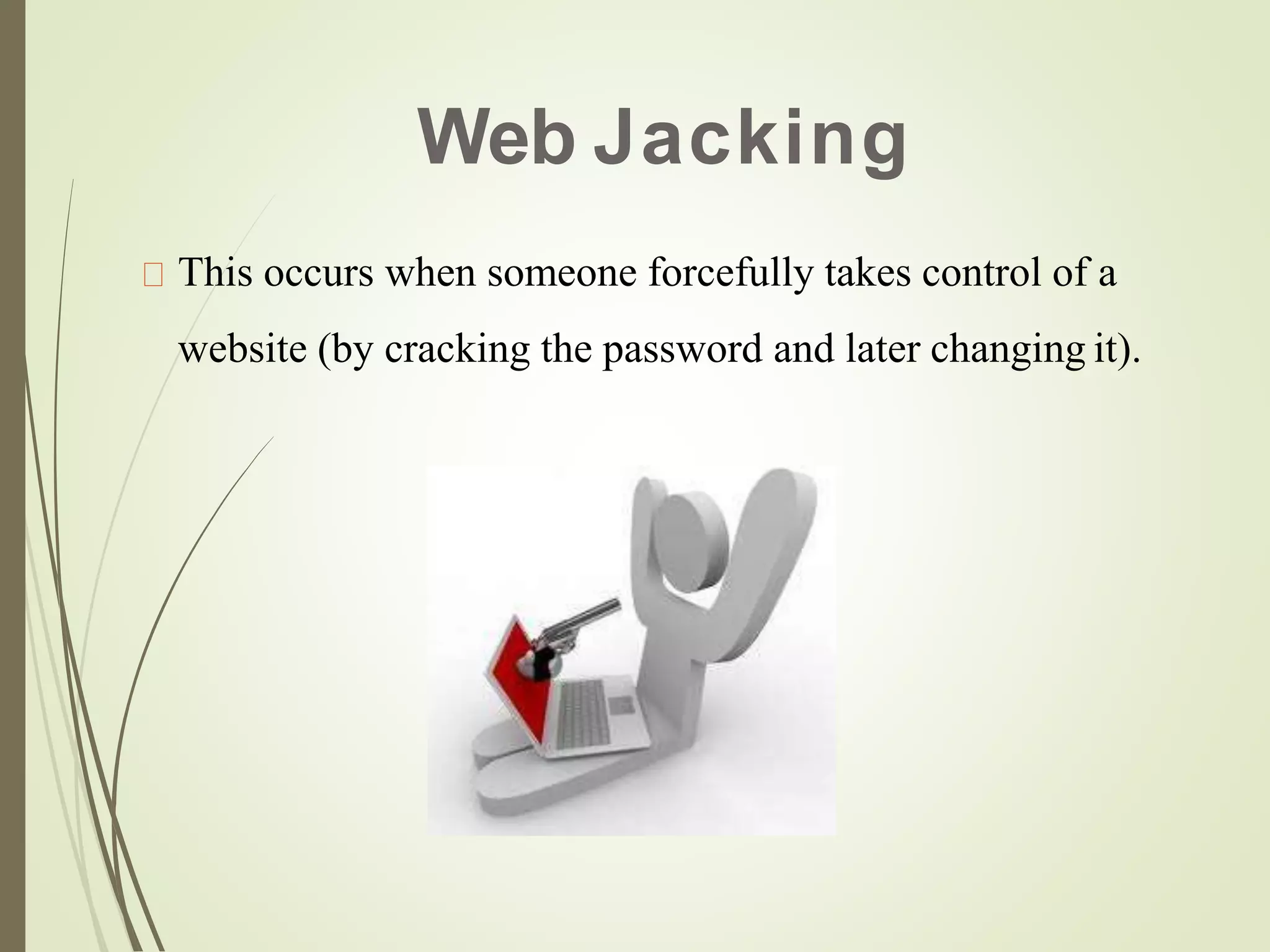
Web Jacking
This occurs when someone forcefully takes control of a
website (by cracking the password and later changing it).
Sale of illegal articles
Phishing
Online gambling
Email spoofing
Intellectual Property
crimes-
These include software piracy, copyright infringement,
trademarks violations, theft of computer source code etc.
Cyber Criminals
Kids (age group (9-16 years)
Organized hacktivitsts
Disgruntled employees
Professional hackers
Case Study
Case study related to bank.
Case study related to cyber crime.
NASSCOMFORUMS
Gaming Forum
BPO
Engineering Services
Remote Infrastructure Management
Conclusion
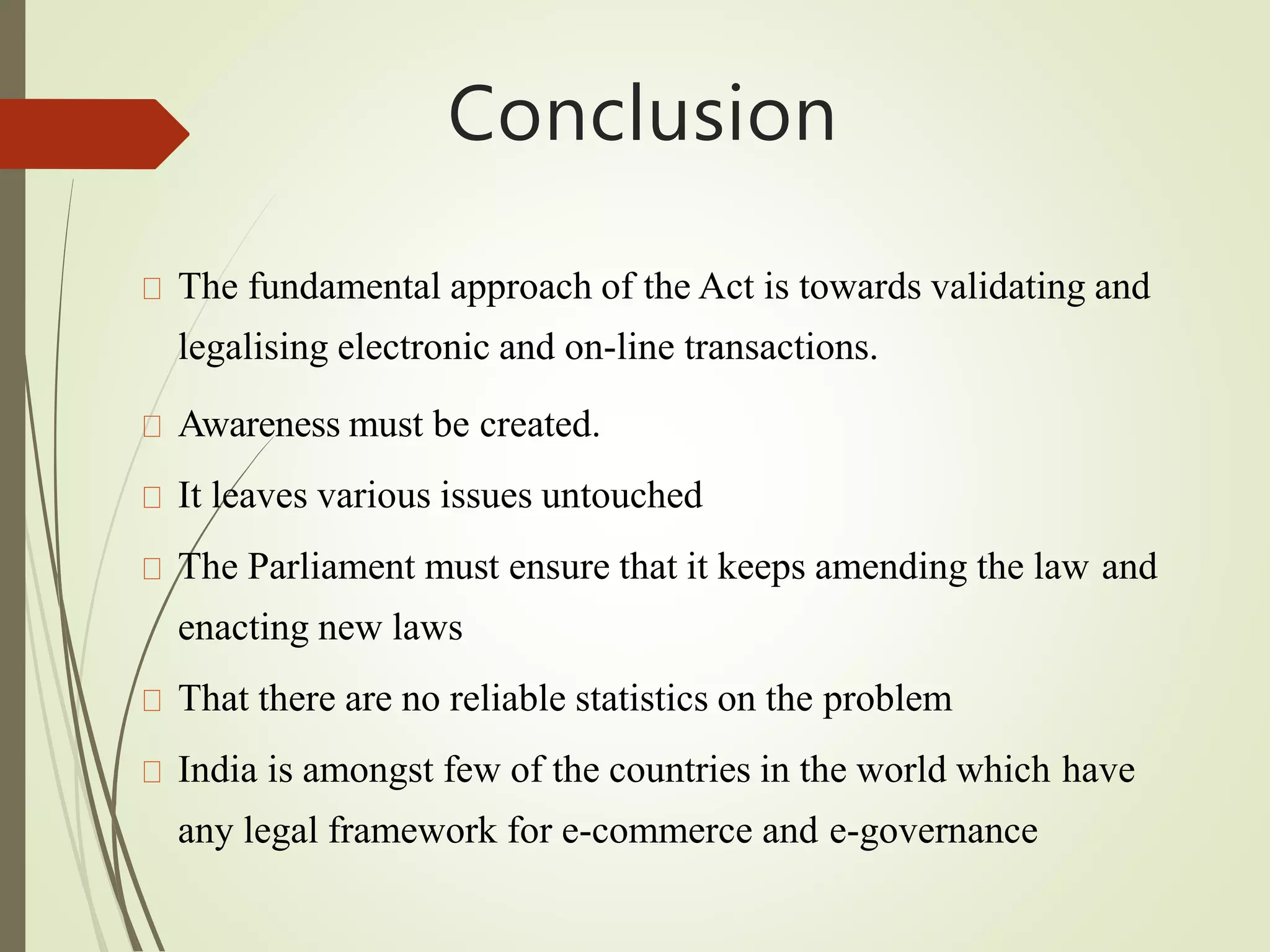
The fundamental approach of the Act is towards validating and
legalising electronic and on-line transactions.
Awareness must be created.
It leaves various issues untouched
The Parliament must ensure that it keeps amending the law and
enacting new laws
That there are no reliable statistics on the problem
India is amongst few of the countries in the world which have
any legal framework for e-commerce and e-governance
Suggestions
1) Recruitment
2) Red Coding System
3) Training and Development
4) Domain
5) Vague Definations
Thank You!!

Indian it act 2000

  • 1.
  • 2.
  • 3.
    IT in BankingSector Many facilities provided. Conversion of currencies to ‘Plastic Money’. IT is increasingly moving from a back office function to a prime assistant. Traditional banking loosing its existence. E-banking and its benefits.
  • 4.
    Information TechnologyAct, 2000 The InformationTechnology Act 2000 (also known as ITA- 2000, or the IT Act) is an Act of the Indian Parliament(No 21 of 2000) notified on October 17, 2000.  Essence of the ACT  Purpose  Objective  Advantages  Shortcomings
  • 5.
    Key Terms Digital Signature EGovernance Encryption Decryption Computer Source Code Cyber Terrorism Electronic Documents
  • 6.
    Important Sections ofIT Act,2000 1) Section 65-  Tampering with any computer source code used for a computer, computer programme, computer system or computer network.  Punishment- Imprisonment up to three years, or with fine which may extend up to two lakh rupees.
  • 7.
    2) Section 66- Hacking with computer system.  Punishment- Imprisonment up to three years, or with fine which may extend up to five lakh rupees, or with both.
  • 8.
    3) Section 67- Publishing transmitting information which is obscene in electronic form shall be punished.  Punishment- o Imprisonment of either three years and with fine which may extend to five lakh rupees. o Imprisonment of either five years and also with fine which may extend to ten lakh rupees.
  • 9.
    4) Penalty forBreach of Confidentiality and Privacy (Section 72)-  Any person who has secured access to any electronic record, book, register, correspondence, information, document or other material without the consent of the person concerned.  Punishment-Imprisonment for two years, or with fine which may extend to one lakh rupees, or with both.
  • 10.
    5) Punishment forpublishing Digital Signature Certificate false in certain particulars (Section 73)-  Punishment- Imprisonment for two years, or with fine which may extend to one lakh rupees, or with both.
  • 11.
    Amendments Information Technology Act,2008 The IT Amendment Bill 2008 has been passed by the Lok Sabha and the Rajya Sabha in the last week of December, 2008.  Different Sections- Section 66B Section 66C Section 66E Section 67A Section 67B Section 72A
  • 12.
    Case Study • TheHyderabad case study. • Section 66D- Punishments for cheating by personation by using computer resource (Inserted Vide ITA2008). • Punishment-Imprisonment of three years and shall also be liable to fine which may extend to one lakh rupees.
  • 13.
    Cyber Crime Unlawful actswherein the computer is either a tool or a target orboth
  • 14.
    Whatis Cyber Crime Criminalscan operate anonymously over the computer networks. Hackers invade privacy. Hackers destroy “property” in the form of computer files or records. Hackers injure other computer users by destroying information systems. Computer pirates steal intellectual property.
  • 15.
    Financial Crimes It includescheating, credit card frauds, money laundering.
  • 16.
    Cyber Pornography It includespornographic websites; pornographic magazines produced using computers (to publish and print the material) and the Internet (to download and transmit pornographic pictures, photos, writings etc).
  • 17.
    Web Jacking This occurswhen someone forcefully takes control of a website (by cracking the password and later changing it).
  • 18.
    Sale of illegalarticles Phishing Online gambling Email spoofing
  • 19.
    Intellectual Property crimes- These includesoftware piracy, copyright infringement, trademarks violations, theft of computer source code etc.
  • 20.
    Cyber Criminals Kids (agegroup (9-16 years) Organized hacktivitsts Disgruntled employees Professional hackers
  • 21.
    Case Study Case studyrelated to bank. Case study related to cyber crime.
  • 23.
  • 24.
    Conclusion The fundamental approachof the Act is towards validating and legalising electronic and on-line transactions. Awareness must be created. It leaves various issues untouched The Parliament must ensure that it keeps amending the law and enacting new laws That there are no reliable statistics on the problem India is amongst few of the countries in the world which have any legal framework for e-commerce and e-governance
  • 25.
    Suggestions 1) Recruitment 2) RedCoding System 3) Training and Development 4) Domain 5) Vague Definations
  • 26.