ISSUES IN BASIC EDUCATION
IN DEVELOPING COUNTRIES
Devindra Oktaviano
Hetri Pima Anggara
Jefri Januardi
Muhammad Nur Islami
Bella Risasta
Aida Rahma Suci
Efrania
International Relations – Riau University, 2013
Political Development Issues
 Parents face a trade-off between:
Household Consumption now
vs
Children’s expected future income
o Practical and Financial difficulties become major factor
(95%) why the parents consider the opportunity cost.
o Case study:
 many children in Malawi began working on the estate farms at very
early ages and were not enrolled in at all.
 In Nigeria, establishment of neighbourhood schools appeared to
have been an effective answer to the problem of rural parents who
wanted to be compensated for the loss of their children’s labour on
the farm as the child is available after school hours.
Equity and Gender Issues
• Parential Characteristic and Sosio-economic status of the
household influencing male and female differentials in
literacy and school enrolment.
• Schools need to be adapted to the specific needs of
deprived local communities. (Ahmed & Carron, 1989)
• Discrimination in basic education sometimes explicit,
(school designed along region, ethnic, or rasial lines), and
sometimes implicit (through language instruction).
(Lockheed & Verspoor, 1992)
CULTURAL AND RELIGIOUS ATTITUDES
 Culturally determined ways defining men
and women and their roles in a given
society shape gender-specific
opportunities and constraints.
 Case study:
many under-developed tribes in Indonesia
prohibit school for their children because
break over the customs.
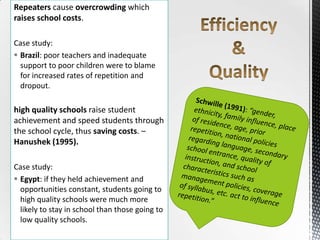
Repeaters cause overcrowding which
raises school costs.
Case study:
 Brazil: poor teachers and inadequate
support to poor children were to blame
for increased rates of repetition and
dropout.
high quality schools raise student
achievement and speed students through
the school cycle, thus saving costs. –
Hanushek (1995).
Case study:
 Egypt: if they held achievement and
opportunities constant, students going to
high quality schools were much more
likely to stay in school than those going to
low quality schools.
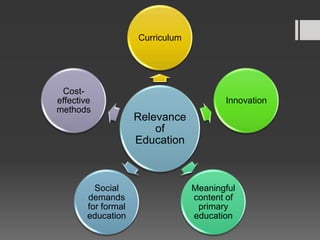
Relevance
of
Education
Curriculum
Innovation
Meaningful
content of
primary
education
Social
demands
for formal
education
Cost-
effective
methods
Financial Issues
 Inadequate priority to basic education in
state’s or public expenditure.
 Low income-states more considerable to
spending more in education sector.
Bibliography…
 Chimombo, Joseph (2005), Issues in Basic
Education in Developing Countries: An
Exploration of Policy Options for Improved
Delivery. Journal of International Cooperation
in Education: Hiroshima University.

Issues in basic education in developing countries (Pemasalahan Pendidikan Dasar di Negara Berkembang)

  • 1.
    ISSUES IN BASICEDUCATION IN DEVELOPING COUNTRIES Devindra Oktaviano Hetri Pima Anggara Jefri Januardi Muhammad Nur Islami Bella Risasta Aida Rahma Suci Efrania International Relations – Riau University, 2013 Political Development Issues
  • 2.
     Parents facea trade-off between: Household Consumption now vs Children’s expected future income o Practical and Financial difficulties become major factor (95%) why the parents consider the opportunity cost. o Case study:  many children in Malawi began working on the estate farms at very early ages and were not enrolled in at all.  In Nigeria, establishment of neighbourhood schools appeared to have been an effective answer to the problem of rural parents who wanted to be compensated for the loss of their children’s labour on the farm as the child is available after school hours.
  • 3.
    Equity and GenderIssues • Parential Characteristic and Sosio-economic status of the household influencing male and female differentials in literacy and school enrolment. • Schools need to be adapted to the specific needs of deprived local communities. (Ahmed & Carron, 1989) • Discrimination in basic education sometimes explicit, (school designed along region, ethnic, or rasial lines), and sometimes implicit (through language instruction). (Lockheed & Verspoor, 1992)
  • 4.
    CULTURAL AND RELIGIOUSATTITUDES  Culturally determined ways defining men and women and their roles in a given society shape gender-specific opportunities and constraints.  Case study: many under-developed tribes in Indonesia prohibit school for their children because break over the customs.
  • 5.
    Repeaters cause overcrowdingwhich raises school costs. Case study:  Brazil: poor teachers and inadequate support to poor children were to blame for increased rates of repetition and dropout. high quality schools raise student achievement and speed students through the school cycle, thus saving costs. – Hanushek (1995). Case study:  Egypt: if they held achievement and opportunities constant, students going to high quality schools were much more likely to stay in school than those going to low quality schools.
  • 6.
  • 7.
    Financial Issues  Inadequatepriority to basic education in state’s or public expenditure.  Low income-states more considerable to spending more in education sector.
  • 8.
    Bibliography…  Chimombo, Joseph(2005), Issues in Basic Education in Developing Countries: An Exploration of Policy Options for Improved Delivery. Journal of International Cooperation in Education: Hiroshima University.