NGS
The Trust Of Education
Reg.: CIN No.U7499RJ2019NPL063853
NGO Section 8 License Number: 113966
Niti Aayog : RJ/2019/0225846
BRN NGO: 8005250014000057
Mission Education is a National level Programs of NGS Education Foundation,
which is committed to providing basic education and healthcare to underprivileged
children.
NGS Foundation believes that whether you are addressing healthcare, poverty,
population control, unemployment or human rights, there's no better place to start
than in the corridors of education.
“ “
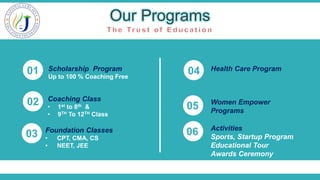
Our Programs
Scholarship Program
Up to 100 % Coaching Free
Coaching Class
• 1st to 8th &
• 9TH To 12TH Class
Foundation Classes
• CPT, CMA, CS
• NEET, JEE
Health Care Program
Women Empower
Programs
01
02
03
04
05
06 Activities
Sports, Startup Program
Educational Tour
Awards Ceremony
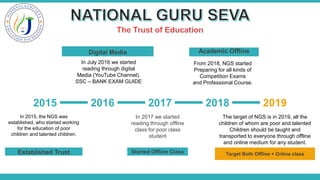
2015 2016 2017 2018 2019
In 2015, the NGS was
established, who started working
for the education of poor
children and talented children.
Established Trust
In July 2016 we started
reading through digital
Media (YouTube Channel).
SSC – BANK EXAM GUIDE
Digital Media
In 2017 we started
reading through offline
class for poor class
student
Started Offline Class
The target of NGS is in 2019, all the
children of whom are poor and talented
Children should be taught and
transported to everyone through offline
and online medium for any student.
Target Both Offline + Online class
From 2018, NGS started
Preparing for all kinds of
Competition Exams
and Professional Course.
Academic Offline
Our
Mission
Mission Education is a national level program of NGS Education
Foundation, which is committed to providing education and healthcare to
underprivileged children.
NGS Foundation believes that whether you are addressing healthcare,
poverty, population control, unemployment or human rights, there's no
better place to start than in the corridors of education.
Children inflicted and affected with HIV/AIDS, street and runaway
children, children with rare disabilities, disaster struck children and slum
children .
We value every Human Being and we feel that every Human Being has
right to live in peace with good health, dignity, self reliance and
availability of opportunities to Learn & Grow.
India is a country with more than one billion people, and just one-third of them can read.
Rapidly growing size of population, shortages of teachers, books, and basic facilities, and
insufficient public funds to cover education costs are some of the nation’s toughest challenge
s. This is where Children in India are facing the basic challenges. According to a study, more
than 30% of educational funds are allocated towards higher education, leaving the primary
education in India in sway.
India is fourth among the top 10 nations with the highest numbers of out-of children in
primary level. Furthermore, the rate of school drop-outs amongst students is very high. One
of the main reasons behind this is poverty. When earning a livelihood and taking care of the
members of the family becomes a primary matter of concern in one’s life, education stands
a little or, very often, no chance of pursuance. For the underprivileged people in India,
education is perceived as a high-priced luxury, and this negative outlook continues on with e
very new generation.
A disproportionate number of total out-of-school children in India are girls. What denies
equal opportunities of children are serious social issues that have arose out of caste, class
and gender differences. The practice of child labor in India and resistance to sending girls
to school in several parts of the country remain as genuine concerns. If the current trend
continues, millions of underprivileged children will probably never set foot in a classroom.
India’s growth relies on a well-educated and skilled workforce. Improving education is a
critical area of investment. A shabby foundation in primary education can overturn the lives,
careers and productivity of millions of its citizens. Already, a considerable proportion of the
adult workforce in India is acutely under-equipped to be eligible for skilled and semi-skilled
jobs. In order to build India as a consumer market of global standards, it is very important
that every child reaps the benefits of quality education
As much as 500 million of India’s total population live below the poverty level.
These families live in living standards that are among the poorest in the world.
Thousands of mothers, newborn babies and children in India die every year
from preventable diseases. 27% of deaths of children below age 5 are because
of prematurity, 14% due to respiratory infections and 11% due to diarrhea. 66%
of the rural population in India lacks access to preventive medicines.
Healthcare is, by far, out of a poor man’s reach. About 75% of healthcare
resources are concentrated in urban areas, where only 27% of the total populati
on resides. 31% of the rural population in India has to travel over 30 km to get
even the most urgent medical treatment.
About 40% of the population in the metropolitan and large cities live in urban
slums, where primary healthcare is provided by health posts. Most of the health
posts are located outside the slum areas, making accessibility difficult.
Healthcare is every child’s right but problems like lack of quality infrastructure,
shortage of experienced medical functionaries and non-access to basic
medicines and medical facilities avert its reach to over 60% of the child
population in India.
The need of the hour is to work collectively towards promoting health in areas,
where the poor children manage to survive.
Statistics on Status of Child Education in India
The literacy ratio of India is 65.38% with male literacy at 75.85% and
female literacy at
54.16%Of the 193 million Children in the age group 6 to 14 years, 8.1 million
children are out of school as of Sept 2004 as per Government statistics.
Net primary enrolment ratio in 2001/02 : 83 7%
Children reaching grade 5 in 2000/01 : 59 8 %
Ministry of Finance / Press Information Bureau Data
Number of Primary Schools in India : 0.664 million (2001-02)
Number Upper Primary Schools in India : 0.219 million
Population in the age group of 6-14 years : 193 Million
Secondary and Senior Secondary Schools : 0.133 million;
Enrollment : 30.5 million
Findings from the Survey – ‘Social infrastructure like education is as important
as physical infrastructure, not only for sustaining high growth but also
for enhancing welfare. The root of poverty often lies in illiteracy.’
Statistics
on Status
of Child
Education
in India
Facts on Education
Less than half of India's children between the age 6 and 14 go to school.
A little over one-third of all children who enroll in grade one reach grade eight.
At least 35 million children aged 6 - 14 years do not attend school.
53% of girls in the age group of 5 to 9 years are illiterate.
In India, only 53% of habitation has a primary school.
In India, only 20% of habitation has a secondary school.
On an average an upper primary school is 3 km away in 22% of areas under habitations.
In nearly 60% of schools, there are less than two teachers to teach Classes I to V.
On an average, there are less than three teachers per primary school. They have to manage
classes from I to V every day.
High cost of private education and need to work to support their families and little interest in
studies are the reasons given by 3 in every four drop-outs as the reason they leave.
Dropout rates increase alarmingly in class III to V, its 50% for boys, 58% for girls.
1 in 40, primary school in India is conducted in open spaces or tents.
In Andhra Pradesh (South India), 52 upper primary schools were operating without a building
in 2002, while in 1993, there were none.
In Maharashtra (West India), there were 10 schools operating without a building in 1993, this
has climbed to 33 in 2002.
More than 50 per cent of girls fail to enroll in school; those that do are likely to drop out by th
e age of 12.
50% of Indian children aged 6-18 do not go to school
Problem
in
Education
System
India
Problems Faced in the Progress of Education in India –
The economic growth of the country not only depends on
natural resources, technology and capital but mainly on the
quantity and quality of manpower.
By quality of manpower, we mean the efficiency and
productivity of work force.
The efficiency of the manpower depends on many
important factors like health and nutrition, education and
training, housing facilities, safe drinking water and sanitation.
Education is the most important component out of various
components of social infrastructure.
The well educated and properly trained manpower can
accelerate the pace of economic development.
Problem
in
Education
System
India
Problems Faced in the Progress of Education in India –
The following are the main problems faced in the
progress of education:
1. Lack of funds: The lack of sufficient funds is the main problem in the
development of education. Outlay for education in Five Year Plans has been
decreasing. Due to insufficient funds most educational institutions lack
infrastructure, science equipment and libraries etc.
Due to this reason, desired results cannot be achieved.
2. Expensive higher education:
University, professional and technical education has become costly in India.
Fee structure of technical and professional institutes like IIM’s is quite high IIM’s
charge Rs. 2 lakh per semester for MBA classes. It is beyond the reach of
common man. Privatization of higher education has led to the growth of
profit hungry entrepreneurs. Now a day’s higher education is much costly affair.
Problem
in
Education
System
India
Problems Faced in the Progress of Education in India –
The following are the main problems faced in the
progress of education:
3. Neglect of Indian languages:
The medium of instruction particularly in science subjects is English.
So rural students who are not well versed in English, cannot study science
properly in English. They suffer a lot; Indian languages are still under developed.
Standard publications are not available in Indian language.
4. Problem of Brain drain:
When intelligent, talented and deserving candidates do not get suitable jobs in
the country, they prefer to go abroad for seeking jobs. So our country is deprived
of good talent. This phenomenon is called ‘Brain drain’.
5. Mass illiteracy:
Despite constitutional directives and economic planning we are not able to
achieve cent percent literacy. -Even now 35 percent people remain illiterate.
In India, the number of illiterates is almost one-third of the total illiterates in the
world. Advanced countries are 100% literate; the position in India is quite dismal.
Problem
in
Education
System
India
Problems Faced in the Progress of Education in India –
The following are the main problems faced in the
progress of education:
6. Wastage of resources:
Our education system is based on General Education. The dropout rate is very
high in primary and secondary level. Most of the students in 6-14 age groups
leave the school before completing their education. It leads to wastage of
5nancial and human resources.
7. General education oriented:
Our educational system is of General Education in nature. Development of
technical and vocational education is quite unsatisfactory. So our education is
unproductive. Hence number of educated unemployed persons is increasing
day by day. This has become a great concern for Govt.
8. Problems of primary education:
Our primary education is ridden with too many problems. Large number of
primary schools has no buildings what to talk of basic facilities like drinking
water, urinals and electricity, furniture and study materials etc. Large numbers
of primary schools are single teacher schools and many schools are even
without teachers. So the drop rate is very high and a cause of concern.
Concluding, we can say that there is quantitative expansion of education but in
qualitative development we are still lagging behind.
Problem
in
Education
System
India
Problems Faced in the Progress of Education in India –
The following are the main problems faced in the
progress of education:
9. Education Given is Irrelevant to Job-Market
This is perhaps the most apparent failure of our education system that after
completing graduation in any discipline students are not able to get jobs.
It is simply because skills that are required in a job market are simply not
present in a fresh graduate. All that a student is taught in his entire school and
college life is almost redundant for job markets. Skill that is required by them is
not taught in schools and colleges. Hence our education system is needed to be
revamped and must be designed according to our economic policies.
10.Missing Innovation & Creation because Only Aping West
If we talk about the privileged children in India then even they are not able to
innovate and create new things. Although they have everything that a child
need but still they lack something in them. What they are doing is only aping
western culture and not being able to do something new. On the one hand
children are not able to go to schools and on other hand, if they are going then
are not able to innovate or solve the problems that the country is facing.
Hence, this is yet another fundamental problem with our education system.
Problem
in
Education
System
India
Problems Faced in the Progress of Education in India –
The following are the main problems faced in the
progress of education:
Conclusion
Finally, I would say education is very important but we spend only few percent
of our GDP on education, so our government should make education its first
priority and try to address issues those are mentioned in this blog.
If government is able to take note of these 10 problems then we can definitely
overhaul our education system.
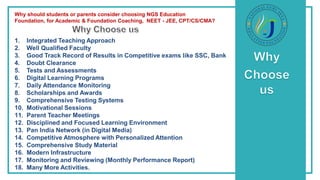
Why should students or parents consider choosing NGS Education
Foundation, for Academic & Foundation Coaching, NEET - JEE, CPT/CS/CMA?
1. Integrated Teaching Approach
2. Well Qualified Faculty
3. Good Track Record of Results in Competitive exams like SSC, Bank
4. Doubt Clearance
5. Tests and Assessments
6. Digital Learning Programs
7. Daily Attendance Monitoring
8. Scholarships and Awards
9. Comprehensive Testing Systems
10. Motivational Sessions
11. Parent Teacher Meetings
12. Disciplined and Focused Learning Environment
13. Pan India Network (in Digital Media)
14. Competitive Atmosphere with Personalized Attention
15. Comprehensive Study Material
16. Modern Infrastructure
17. Monitoring and Reviewing (Monthly Performance Report)
18. Many More Activities.
Apply
Now
Presents: NGSST-19
(NATIONAL GURU SEVA SCHOLARSHIP TEST)
Scholarship For Every Student
• SCHOOL
• COLLEGE
• NON-COLLEGE
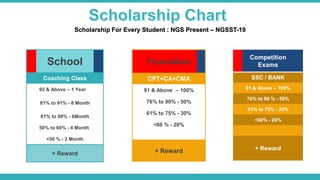
Scholarship For Every Student : NGS Present – NGSST-19
School
Coaching Class
92 & Above – 1 Year
81% to 91% - 8 Month
61% to 80% - 6Month
50% to 60% - 4 Month
<50 % - 2 Month
+ Reward
Competition
Exams
SSC / BANK
91 & Above – 100%
76% to 90 % - 50%
61% to 75% - 30%
<60% - 20%
+ Reward
Foundation
CPT+CA+CMA
91 & Above – 100%
76% to 90% - 50%
61% to 75% - 30%
<60 % - 20%
+ Reward
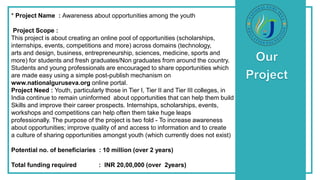
* Project Name : Awareness about opportunities among the youth
Project Scope :
This project is about creating an online pool of opportunities (scholarships,
internships, events, competitions and more) across domains (technology,
arts and design, business, entrepreneurship, sciences, medicine, sports and
more) for students and fresh graduates/Non graduates from around the country.
Students and young professionals are encouraged to share opportunities which
are made easy using a simple post-publish mechanism on
www.nationalguruseva.org online portal.
Project Need : Youth, particularly those in Tier I, Tier II and Tier III colleges, in
India continue to remain uninformed about opportunities that can help them build
Skills and improve their career prospects. Internships, scholarships, events,
workshops and competitions can help often them take huge leaps
professionally. The purpose of the project is two fold - To increase awareness
about opportunities; improve quality of and access to information and to create
a culture of sharing opportunities amongst youth (which currently does not exist)
Potential no. of beneficiaries : 10 million (over 2 years)
Total funding required : INR 20,00,000 (over 2years)
Our
Project
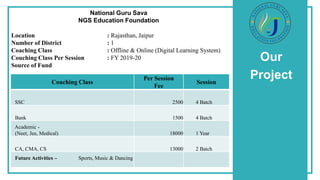
National Guru Sava
NGS Education Foundation
Location : Rajasthan, Jaipur
Number of District : 1
Coaching Class : Offline & Online (Digital Learning System)
Couching Class Per Session : FY 2019-20
Source of Fund
Couching Class
Per Session
Fee
Session
SSC 2500 4 Batch
Bank 1500 4 Batch
Academic -
(Neet, Jee, Medical) 18000 1 Year
CA, CMA, CS 13000 2 Batch
Future Activities – Sports, Music & Dancing
Target
Project
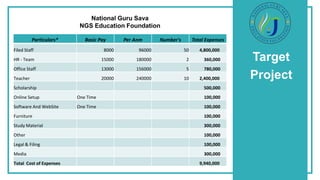
National Guru Sava
NGS Education Foundation
Particulars* Basic Pay Per Anm Number's Total Expenses
Filed Staff 8000 96000 50 4,800,000
HR - Team 15000 180000 2 360,000
Office Staff 13000 156000 5 780,000
Teacher 20000 240000 10 2,400,000
Scholarship 500,000
Online Setup One Time 100,000
Software And WebSite One Time 100,000
Furniture 100,000
Study Material 300,000
Other 100,000
Legal & Filing 100,000
Media 300,000
Total Cost of Expenses 9,940,000
Our
Team
Member’s
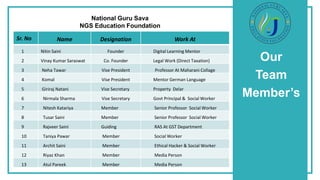
National Guru Sava
NGS Education Foundation
Sr. No Name Designation Work At
1 Nitin Saini Founder Digital Learning Mentor
2 Vinay Kumar Saraswat Co. Founder Legal Work (Direct Taxation)
3 Neha Tawar Vise President Professor At Maharani Collage
4 Komal Vise President Mentor German Language
5 Giriraj Natani Vise Secretary Property Delar
6 Nirmala Sharma Vise Secretary Govt Principal & Social Worker
7 Nitesh Katariya Member Senior Professor Social Worker
8 Tusar Saini Member Senior Professor Social Worker
9 Rajveer Saini Guiding RAS At GST Department
10 Taniya Pawar Member Social Worker
11 Archit Saini Member Ethical Hacker & Social Worker
12 Riyaz Khan Member Media Person
13 Atul Pareek Member Media Person
Infographic Designed
Easy to change colors, photos and Text.

NGSEDU2-PPT for Donerschemeconverted.pdf

  • 1.
    NGS The Trust OfEducation Reg.: CIN No.U7499RJ2019NPL063853 NGO Section 8 License Number: 113966 Niti Aayog : RJ/2019/0225846 BRN NGO: 8005250014000057
  • 2.
    Mission Education isa National level Programs of NGS Education Foundation, which is committed to providing basic education and healthcare to underprivileged children. NGS Foundation believes that whether you are addressing healthcare, poverty, population control, unemployment or human rights, there's no better place to start than in the corridors of education. “ “
  • 3.
    Our Programs Scholarship Program Upto 100 % Coaching Free Coaching Class • 1st to 8th & • 9TH To 12TH Class Foundation Classes • CPT, CMA, CS • NEET, JEE Health Care Program Women Empower Programs 01 02 03 04 05 06 Activities Sports, Startup Program Educational Tour Awards Ceremony
  • 4.
    2015 2016 20172018 2019 In 2015, the NGS was established, who started working for the education of poor children and talented children. Established Trust In July 2016 we started reading through digital Media (YouTube Channel). SSC – BANK EXAM GUIDE Digital Media In 2017 we started reading through offline class for poor class student Started Offline Class The target of NGS is in 2019, all the children of whom are poor and talented Children should be taught and transported to everyone through offline and online medium for any student. Target Both Offline + Online class From 2018, NGS started Preparing for all kinds of Competition Exams and Professional Course. Academic Offline
  • 5.
    Our Mission Mission Education isa national level program of NGS Education Foundation, which is committed to providing education and healthcare to underprivileged children. NGS Foundation believes that whether you are addressing healthcare, poverty, population control, unemployment or human rights, there's no better place to start than in the corridors of education. Children inflicted and affected with HIV/AIDS, street and runaway children, children with rare disabilities, disaster struck children and slum children . We value every Human Being and we feel that every Human Being has right to live in peace with good health, dignity, self reliance and availability of opportunities to Learn & Grow.
  • 6.
    India is acountry with more than one billion people, and just one-third of them can read. Rapidly growing size of population, shortages of teachers, books, and basic facilities, and insufficient public funds to cover education costs are some of the nation’s toughest challenge s. This is where Children in India are facing the basic challenges. According to a study, more than 30% of educational funds are allocated towards higher education, leaving the primary education in India in sway. India is fourth among the top 10 nations with the highest numbers of out-of children in primary level. Furthermore, the rate of school drop-outs amongst students is very high. One of the main reasons behind this is poverty. When earning a livelihood and taking care of the members of the family becomes a primary matter of concern in one’s life, education stands a little or, very often, no chance of pursuance. For the underprivileged people in India, education is perceived as a high-priced luxury, and this negative outlook continues on with e very new generation. A disproportionate number of total out-of-school children in India are girls. What denies equal opportunities of children are serious social issues that have arose out of caste, class and gender differences. The practice of child labor in India and resistance to sending girls to school in several parts of the country remain as genuine concerns. If the current trend continues, millions of underprivileged children will probably never set foot in a classroom. India’s growth relies on a well-educated and skilled workforce. Improving education is a critical area of investment. A shabby foundation in primary education can overturn the lives, careers and productivity of millions of its citizens. Already, a considerable proportion of the adult workforce in India is acutely under-equipped to be eligible for skilled and semi-skilled jobs. In order to build India as a consumer market of global standards, it is very important that every child reaps the benefits of quality education
  • 7.
    As much as500 million of India’s total population live below the poverty level. These families live in living standards that are among the poorest in the world. Thousands of mothers, newborn babies and children in India die every year from preventable diseases. 27% of deaths of children below age 5 are because of prematurity, 14% due to respiratory infections and 11% due to diarrhea. 66% of the rural population in India lacks access to preventive medicines. Healthcare is, by far, out of a poor man’s reach. About 75% of healthcare resources are concentrated in urban areas, where only 27% of the total populati on resides. 31% of the rural population in India has to travel over 30 km to get even the most urgent medical treatment. About 40% of the population in the metropolitan and large cities live in urban slums, where primary healthcare is provided by health posts. Most of the health posts are located outside the slum areas, making accessibility difficult. Healthcare is every child’s right but problems like lack of quality infrastructure, shortage of experienced medical functionaries and non-access to basic medicines and medical facilities avert its reach to over 60% of the child population in India. The need of the hour is to work collectively towards promoting health in areas, where the poor children manage to survive.
  • 8.
    Statistics on Statusof Child Education in India The literacy ratio of India is 65.38% with male literacy at 75.85% and female literacy at 54.16%Of the 193 million Children in the age group 6 to 14 years, 8.1 million children are out of school as of Sept 2004 as per Government statistics. Net primary enrolment ratio in 2001/02 : 83 7% Children reaching grade 5 in 2000/01 : 59 8 % Ministry of Finance / Press Information Bureau Data Number of Primary Schools in India : 0.664 million (2001-02) Number Upper Primary Schools in India : 0.219 million Population in the age group of 6-14 years : 193 Million Secondary and Senior Secondary Schools : 0.133 million; Enrollment : 30.5 million Findings from the Survey – ‘Social infrastructure like education is as important as physical infrastructure, not only for sustaining high growth but also for enhancing welfare. The root of poverty often lies in illiteracy.’
  • 9.
    Statistics on Status of Child Education inIndia Facts on Education Less than half of India's children between the age 6 and 14 go to school. A little over one-third of all children who enroll in grade one reach grade eight. At least 35 million children aged 6 - 14 years do not attend school. 53% of girls in the age group of 5 to 9 years are illiterate. In India, only 53% of habitation has a primary school. In India, only 20% of habitation has a secondary school. On an average an upper primary school is 3 km away in 22% of areas under habitations. In nearly 60% of schools, there are less than two teachers to teach Classes I to V. On an average, there are less than three teachers per primary school. They have to manage classes from I to V every day. High cost of private education and need to work to support their families and little interest in studies are the reasons given by 3 in every four drop-outs as the reason they leave. Dropout rates increase alarmingly in class III to V, its 50% for boys, 58% for girls. 1 in 40, primary school in India is conducted in open spaces or tents. In Andhra Pradesh (South India), 52 upper primary schools were operating without a building in 2002, while in 1993, there were none. In Maharashtra (West India), there were 10 schools operating without a building in 1993, this has climbed to 33 in 2002. More than 50 per cent of girls fail to enroll in school; those that do are likely to drop out by th e age of 12. 50% of Indian children aged 6-18 do not go to school
  • 10.
    Problem in Education System India Problems Faced inthe Progress of Education in India – The economic growth of the country not only depends on natural resources, technology and capital but mainly on the quantity and quality of manpower. By quality of manpower, we mean the efficiency and productivity of work force. The efficiency of the manpower depends on many important factors like health and nutrition, education and training, housing facilities, safe drinking water and sanitation. Education is the most important component out of various components of social infrastructure. The well educated and properly trained manpower can accelerate the pace of economic development.
  • 11.
    Problem in Education System India Problems Faced inthe Progress of Education in India – The following are the main problems faced in the progress of education: 1. Lack of funds: The lack of sufficient funds is the main problem in the development of education. Outlay for education in Five Year Plans has been decreasing. Due to insufficient funds most educational institutions lack infrastructure, science equipment and libraries etc. Due to this reason, desired results cannot be achieved. 2. Expensive higher education: University, professional and technical education has become costly in India. Fee structure of technical and professional institutes like IIM’s is quite high IIM’s charge Rs. 2 lakh per semester for MBA classes. It is beyond the reach of common man. Privatization of higher education has led to the growth of profit hungry entrepreneurs. Now a day’s higher education is much costly affair.
  • 12.
    Problem in Education System India Problems Faced inthe Progress of Education in India – The following are the main problems faced in the progress of education: 3. Neglect of Indian languages: The medium of instruction particularly in science subjects is English. So rural students who are not well versed in English, cannot study science properly in English. They suffer a lot; Indian languages are still under developed. Standard publications are not available in Indian language. 4. Problem of Brain drain: When intelligent, talented and deserving candidates do not get suitable jobs in the country, they prefer to go abroad for seeking jobs. So our country is deprived of good talent. This phenomenon is called ‘Brain drain’. 5. Mass illiteracy: Despite constitutional directives and economic planning we are not able to achieve cent percent literacy. -Even now 35 percent people remain illiterate. In India, the number of illiterates is almost one-third of the total illiterates in the world. Advanced countries are 100% literate; the position in India is quite dismal.
  • 13.
    Problem in Education System India Problems Faced inthe Progress of Education in India – The following are the main problems faced in the progress of education: 6. Wastage of resources: Our education system is based on General Education. The dropout rate is very high in primary and secondary level. Most of the students in 6-14 age groups leave the school before completing their education. It leads to wastage of 5nancial and human resources. 7. General education oriented: Our educational system is of General Education in nature. Development of technical and vocational education is quite unsatisfactory. So our education is unproductive. Hence number of educated unemployed persons is increasing day by day. This has become a great concern for Govt. 8. Problems of primary education: Our primary education is ridden with too many problems. Large number of primary schools has no buildings what to talk of basic facilities like drinking water, urinals and electricity, furniture and study materials etc. Large numbers of primary schools are single teacher schools and many schools are even without teachers. So the drop rate is very high and a cause of concern. Concluding, we can say that there is quantitative expansion of education but in qualitative development we are still lagging behind.
  • 14.
    Problem in Education System India Problems Faced inthe Progress of Education in India – The following are the main problems faced in the progress of education: 9. Education Given is Irrelevant to Job-Market This is perhaps the most apparent failure of our education system that after completing graduation in any discipline students are not able to get jobs. It is simply because skills that are required in a job market are simply not present in a fresh graduate. All that a student is taught in his entire school and college life is almost redundant for job markets. Skill that is required by them is not taught in schools and colleges. Hence our education system is needed to be revamped and must be designed according to our economic policies. 10.Missing Innovation & Creation because Only Aping West If we talk about the privileged children in India then even they are not able to innovate and create new things. Although they have everything that a child need but still they lack something in them. What they are doing is only aping western culture and not being able to do something new. On the one hand children are not able to go to schools and on other hand, if they are going then are not able to innovate or solve the problems that the country is facing. Hence, this is yet another fundamental problem with our education system.
  • 15.
    Problem in Education System India Problems Faced inthe Progress of Education in India – The following are the main problems faced in the progress of education: Conclusion Finally, I would say education is very important but we spend only few percent of our GDP on education, so our government should make education its first priority and try to address issues those are mentioned in this blog. If government is able to take note of these 10 problems then we can definitely overhaul our education system.
  • 16.
    Why should studentsor parents consider choosing NGS Education Foundation, for Academic & Foundation Coaching, NEET - JEE, CPT/CS/CMA? 1. Integrated Teaching Approach 2. Well Qualified Faculty 3. Good Track Record of Results in Competitive exams like SSC, Bank 4. Doubt Clearance 5. Tests and Assessments 6. Digital Learning Programs 7. Daily Attendance Monitoring 8. Scholarships and Awards 9. Comprehensive Testing Systems 10. Motivational Sessions 11. Parent Teacher Meetings 12. Disciplined and Focused Learning Environment 13. Pan India Network (in Digital Media) 14. Competitive Atmosphere with Personalized Attention 15. Comprehensive Study Material 16. Modern Infrastructure 17. Monitoring and Reviewing (Monthly Performance Report) 18. Many More Activities.
  • 17.
    Apply Now Presents: NGSST-19 (NATIONAL GURUSEVA SCHOLARSHIP TEST) Scholarship For Every Student • SCHOOL • COLLEGE • NON-COLLEGE
  • 18.
    Scholarship For EveryStudent : NGS Present – NGSST-19 School Coaching Class 92 & Above – 1 Year 81% to 91% - 8 Month 61% to 80% - 6Month 50% to 60% - 4 Month <50 % - 2 Month + Reward Competition Exams SSC / BANK 91 & Above – 100% 76% to 90 % - 50% 61% to 75% - 30% <60% - 20% + Reward Foundation CPT+CA+CMA 91 & Above – 100% 76% to 90% - 50% 61% to 75% - 30% <60 % - 20% + Reward
  • 19.
    * Project Name: Awareness about opportunities among the youth Project Scope : This project is about creating an online pool of opportunities (scholarships, internships, events, competitions and more) across domains (technology, arts and design, business, entrepreneurship, sciences, medicine, sports and more) for students and fresh graduates/Non graduates from around the country. Students and young professionals are encouraged to share opportunities which are made easy using a simple post-publish mechanism on www.nationalguruseva.org online portal. Project Need : Youth, particularly those in Tier I, Tier II and Tier III colleges, in India continue to remain uninformed about opportunities that can help them build Skills and improve their career prospects. Internships, scholarships, events, workshops and competitions can help often them take huge leaps professionally. The purpose of the project is two fold - To increase awareness about opportunities; improve quality of and access to information and to create a culture of sharing opportunities amongst youth (which currently does not exist) Potential no. of beneficiaries : 10 million (over 2 years) Total funding required : INR 20,00,000 (over 2years)
  • 20.
    Our Project National Guru Sava NGSEducation Foundation Location : Rajasthan, Jaipur Number of District : 1 Coaching Class : Offline & Online (Digital Learning System) Couching Class Per Session : FY 2019-20 Source of Fund Couching Class Per Session Fee Session SSC 2500 4 Batch Bank 1500 4 Batch Academic - (Neet, Jee, Medical) 18000 1 Year CA, CMA, CS 13000 2 Batch Future Activities – Sports, Music & Dancing
  • 21.
    Target Project National Guru Sava NGSEducation Foundation Particulars* Basic Pay Per Anm Number's Total Expenses Filed Staff 8000 96000 50 4,800,000 HR - Team 15000 180000 2 360,000 Office Staff 13000 156000 5 780,000 Teacher 20000 240000 10 2,400,000 Scholarship 500,000 Online Setup One Time 100,000 Software And WebSite One Time 100,000 Furniture 100,000 Study Material 300,000 Other 100,000 Legal & Filing 100,000 Media 300,000 Total Cost of Expenses 9,940,000
  • 22.
    Our Team Member’s National Guru Sava NGSEducation Foundation Sr. No Name Designation Work At 1 Nitin Saini Founder Digital Learning Mentor 2 Vinay Kumar Saraswat Co. Founder Legal Work (Direct Taxation) 3 Neha Tawar Vise President Professor At Maharani Collage 4 Komal Vise President Mentor German Language 5 Giriraj Natani Vise Secretary Property Delar 6 Nirmala Sharma Vise Secretary Govt Principal & Social Worker 7 Nitesh Katariya Member Senior Professor Social Worker 8 Tusar Saini Member Senior Professor Social Worker 9 Rajveer Saini Guiding RAS At GST Department 10 Taniya Pawar Member Social Worker 11 Archit Saini Member Ethical Hacker & Social Worker 12 Riyaz Khan Member Media Person 13 Atul Pareek Member Media Person
  • 23.
    Infographic Designed Easy tochange colors, photos and Text.