LEARNING EPISODE 5:
Towards Teacher
Quality:
Developing a
Glocal Teacher of
the 21st Century
THE GLOBAL AND GLOCAL TEACHER
PROFESSIONAL: Is there a difference?
 According to Roland Robertson (1992), Glocal may
mean a global outlook adapted to the local condition
or a local outlook adapted to the global condition.
 Glocalization in Oxford Dictionary of New Words,
defines the word glocal and the process noun word
glocalization as a blending of global perspective and
local condition.
THE GLOBAL AND GLOCAL TEACHER
PROFESSIONAL: Is there a difference?
 As future teachers, you have to blend both
global and local perspective. As the saying
goes: “think globally, but act locally” or “think
global but act local”
Global and Glocal Teacher Education
Global Education
 UNESCO defines global education as a goal to become
aware of educational conditions or lack of it, in
developing countries worldwide and aim to educate all
people to a certain world standards.
 Is a curriculum that is international in scope which
prepares today’s youth around the world to function
in one world environment under teachers who are
intellectually, professionally and humanistically
prepared.
 To become a global teacher, you should
be equipped with a wider range of
knowledge of the various educational
system outside the country; master
skills and competencies which can
address global demands; and possess
attitudes and values that are acceptable
to multicultural communities.
UNESCO’s Education 2030 Incheon Declaration
during the World Education Forum established
a vision “Towards inclusive and equitable quality
educational lifelong learning for all.”
Sustainable Development Goal (SDG) 4 for
Education is one of the 17 goals of the United
Nation’s SDGs. These outcomes targets
bringing together all member nations to expand
beyond their geographical territories for global
education.
By 2030, the seven outcome targets of SDG 4
must have been achieved, these are:
1. . Universal primary and secondary education.
2. Early childhood development and universal
pre-primary education.
3. Equal access to technical/vocational and
higher education.
4. Relevant skills for decent work.
5. Gender equality and inclusion.
6. Universal youth literacy.
7. Education for sustainable development and
global citizenship
JAMES BECKER (1988)
Define global education “An effort to help
individuals to see the world as a single and
global system and see themselves as a
participants of that system. It is a school
curriculum that has a worldwide standard
of teaching and learning.
21st Century Learning Goals
 21st century content: emerging content
areas such as global awareness,
financial, economic, business, and
entrepreneurial literacy; civic service
literacy; health and awareness.
 Learning and thinking and problem
solving skills, communication, creativity
and innovation, collaboration, contextual
learning, information and media literacy.
 ICT literacy: using technology in the
context of learning so students know how
to learn.
 Life skills: leadership, ethics,
accountability personal responsibility, self
direction, others.
 21st century assessment: Authentic
assessments that measure the area of
learning
FILIPINO GLOBAL TEACHER
 Understands how this world is
interconnected;
 Recognizes that the world has rich variety
of ways of life;
 Has a vision of the future and sees what
the future would be for himself/herself
and the students;
 Must understand, respect and be tolerant
of the diversity of the cultures;
 Must believe and take action for
education that will sustain the future;
 Must be able to facilitate digitally
mediated learning;
 Must have depth of knowledge;
 Must posses good communication skills
 Must possess the competencies of a
professional teacher as embodied in
National Competency-Based Standards
for Teachers (NCBTS)
GLOCAL TEACHERS
In addition to the above qualities must
possess the following distinct characteristics
and core values of Filipino teachers.
a)Cultural and historical rootedness
b) Ability to contextualize teaching-learning
c) Excellence
d) Responsiveness
e) Accountability and integrity
f) Ecological sensitivity
g) Nationalism/Filipinism
h) Faith in the Divine Providence
“ Live as if you were
to die tomorrow.
Learn as if you were
to live forever ” 😉
-MAHATMA GANDHI
“A CLOSER
LOOK AT
THE
TEACHERS
AND THE
TEACHING
PROFESSION
IN THE
ASEAN AND
BEYOND”
PRIMARY LEVEL
 Pre-primary (Play-school, Pre-K, Kindergarten)
and the Primary Level which is composed of
Grade 1 aged 6 yrs old; Grade 2 aged 7 yrs old;
Grade 3 aged 8yrs old; Grade 4 aged 9 yrs; Grade
5 aged 10 yrs old; and Grade 6 aged 11 years old.
 It refers to elementary level Primary grades-
Kindergarten to Grade 4 Intermediate grades –
Grade 5 and Grade 6
The Levels of Schooling as a
Teaching Milieu
SECONDARY LEVEL
Composed of Junior High School and Senior
High School. Graduate from senior high school
can proceed to college or find a job appropriate
to the qualification
Slight Variations in some countries
 Lower Secondary level is three years with
Grade 7, 8, and 9.
 Upper Secondary level is composed of Grades
10, 11 and 12.
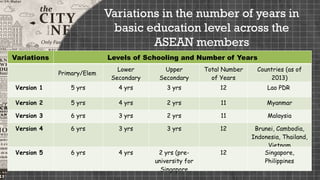
Variations in the number of years in
basic education level across the
ASEAN members
Variations Levels of Schooling and Number of Years
Primary/Elem
Lower
Secondary
Upper
Secondary
Total Number
of Years
Countries (as of
2013)
Version 1 5 yrs 4 yrs 3 yrs 12 Lao PDR
Version 2 5 yrs 4 yrs 2 yrs 11 Myanmar
Version 3 6 yrs 3 yrs 2 yrs 11 Malaysia
Version 4 6 yrs 3 yrs 3 yrs 12 Brunei, Cambodia,
Indonesia, Thailand,
Vietnam
Version 5 6 yrs 4 yrs 2 yrs (pre-
university for
Singapore
12 Singapore,
Philippines
All primary education levels are compulsory,
while in some countries the secondary level is
voluntary except the Philippines. In Singapore,
the last two year levels are pre-university level.
The basic education levels of
Elementary/Primary and the Secondary level
will provide the future jobs of teacher
education pre-service graduates.
TERTIARY LEVEL
a) College level which beyond the basic education in all the countries in
the ASEAN
b) Ladder of educational system where the student earns a bachelor’s
degree in teacher education, which is a requirement to take a licensure
examination to become professional teacher
c) In the Philippines, TESDA provides diploma and training certificates
for lifelong learning
d) The agency also assists in the implementation of the senior high
school technical-vocational tracks
e) The pre-service teacher gets appropriate qualification degree in
the tertiary level in order to teach in either the elementary or
secondary level of the education system in either the public or private
school in a particular country
f) Most countries have specific recruitment policies and guidelines
The Teacher Professionals
Across the ASEAN
1. Academic Preparation of Teacher Professionals in
Basic Education
• Admission to pre-service teacher education varies from
the graduates of Grade 9 or Grade 12 Places of Lao PDR,
Indonesia, Myanmar and Cambodia
 pre-school, pre-primary of kindergarten future teachers
can have 9 years of basic education (Grade 9) and get
advanced training for 3 years to become teachers (9 yrs
basic education + 3 years teacher preparation) or 10 years
basic education plus 3 years of teacher preparation.
• FOR TEACHERS OF LOWER SECONDARY LEVEL
 future teachers should have 12 years of basic
education and 2 years of teacher preparation to
earn a Diploma in Teaching
• FOR UPPER SECONDARY LEVEL
 requirement is 12 years of basic education plus 4 to
5 years of teacher preparation to earn a Bachelor’s
degree
• NON-EDUCATION DEGREE GRADUATES, THEY
CAN TAKE THE POST GRADUATE DIPLOMA IN
EDUCATION/TEACHING
 an equivalent to 12 years of basic education plus 4
to 5 years of Baccalaureate Degree plus one year
of Graduate Diploma
 All teacher education provides a teaching practicum,
student teaching or field experiences course.
 This will provide them the opportunity to apply the
theories and concepts in the content and pedagogy
courses in real class situation.
 ASEAN countries have comparable academic teacher
education preparations, however there are those who
have gone beyond their borders, while others are still
strengthening their programs.
 Differences are according to the context and needs and
the education system of the particular member country,
their history culture and aspirations. Here are some
commonalities in the teacher preparation.
Components of Teacher Preparation
 Qualified, professionally trained, motivated
and well supported teachers are the key to
quality education.
General Knowledge and Understanding
 Embedded in the general education or liberal arts
education subjects in college as preparatory to the
core content subjects in the professional education.
 Cluster of subjects in liberal education provides the
development of the person-hood of the future
teacher. (What to Know about Oneself and World)
Pedagogy
 Provides variety of teaching delivery approaches
beyond the traditional methods of teaching.
 More innovative methods including student-centered
approaches, cooperative learning, project-based
learning and many more based on international
values to enhance, peace education, sustainable
development, respect for diversity, inclusive
education, and global citizenship.
 Pedagogical theories and principles are also
included (How to Teach)
Teaching Practicum/Experiential
Learning
 Knowledge, theories, principles and pedagogies
learned are validated in real life situation as teachers.
 All ASEAN countries, teaching practicum and
experiential learning are required as a component of
training or for certification to teach (Immersion to real
world of teaching/ Practicum/Teaching Internship)
Specialized knowledge/ Major courses
 For those who will teach the content or discipline in
the upper elementary or secondary levels, major
content courses are learned.
 For the early years (pre-school to Grade 3, a more
comprehensive knowledge of child growth and
development is given emphasis (What to teach in
specific discipline or subject area)
 Common degree titles include Bachelor of Education
(BEd); Bachelor of Elementary Education (BEEd);
Bachelor of Secondary Education (BSEd); and Diploma
in Education either Pre-baccalaureate/Post Graduate
(PGDip)
 Common standards and competencies were developed as
a guide for all teachers
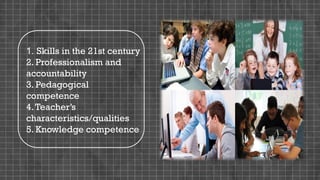
1. Skills in the 21st century
2. Professionalism and
accountability
3. Pedagogical
competence
4.Teacher’s
characteristics/qualities
5. Knowledge competence
The Teaching Profession
Practices in the ASEAN
1.Teacher’s Major Responsibilities
 3 major responsibilities of professional
teachers across the different countries:
 Actual teaching
 Management of learning
 Administrative work
Carried out in the teaching hours required
which is 6-8 hours per day, 40 to 45 hours per
week, 4 weeks per month and 10 months a year.
Actual Teaching
a) Refers to time of engagement of the
teacher with the learners
b) Happens within the official teaching hours
c) Actual teaching hours vary from country and
from school to school
d) Actual teaching refers to contact time or
time on task
Management of Learning
a) Refers to activities that support the actual
teaching
b) Can be beyond actual teaching time like
remediation or enhancement, homework, or
co-curricular activities
Administrative work
c) Refers to the teachers’ job that includes
writing test items, checking and recording of
the test paper results, attending to parents,
making reports and other related activities
With all the responsibilities that the teacher is
required to do, the salary of the teacher varies across
the different countries.
ASEAN teacher’s salary ranges from as low as USD
120.50 to as high as USD 2,589.00 per month or even
higher as in case of Singapore which around $45,
755.00 per year according to the Global Teacher Status
Index Report
 Salary is based on qualification, teaching experiences
and level or grade assigned
 Teaching in the public schools will also have a
different salary scale
 In some countries, there are fringe benefits
provided like hardship pay, maternity pay and other
bonuses
 In the primary level, teachers handle more
than one specialized subject
 Team teaching is practiced either vertically
or horizontally
 Vertical team teaching - Elementary Science
will be taught by one science teacher Grade 1
to Grade 6
 Horizontal team teaching - science will be
taught by one teacher in one level with
different sections or groups
 In secondary level, the teacher teaches the
specific subject area or major area in the
same level or in different grade level
Teacher Licensing and Recruitment
 Most teachers are licensed as
professional or are certified to teach
by the country’s appropriate agencies.
 Those who are not certified or licensed
become para-professionals or assistant
teacher.
 Philippines - Professional Regulation
Commission (PRC)
Singapore - National Institute for Education
(NIE)
Thailand - Teacher Education Council
(Khurusapha)
Indonesia - Akta IV teacher license is given
by the teacher colleges for the authority to
teach
Other countries – no licensing is provided,
certification is issued instead this is done by
the Ministry of Education or the teacher
education colleges or universities
Teacher recruitment process and
qualifications are guided by the Ministry of
Education for the public schools and the
individual private schools under the
guidance and polices of each country
ministry.
The Teacher and the
Teaching Profession Beyond
the ASEAN
1. CHINA
 200 million students attending public schools
taught by over 9 million teachers in the
elementary, junior, and senior high schools
 Largest teaching force in the world
 Education system is highly centralized
 Subject matter and instructional contents are
uniform for all
 First six years of school make up the primary grades
which are devoted to development of cognitive skills
 Six year of high school
 Class size ranges 40 to 60 students and cover all
topics in order to pass national examinations
 To attend university must pass one of the two versions
of the National University Entrance Examination
 The quality and reputation of the school will depend on
the number of students passing the examination
 Six years of primary education, three years of junior
middle school, three years of senior middle school, six
years of university
 Varieties of technical and vocational schools
The political and ideological orientation of teacher
education is “cultivate cultured persons as teachers with
lofty ideals, high morality, strong discipline, a sense of
mission as educators, engineers of the human soul and
the gardeners of nation’s flowers” (Leung and Hui, 2000)
There are two main categories of teachers based on the
source and structure of their salary or pay
1) Gongban (state-paid) teachers who earn salary
comparable with other state employees in state-owned
enterprises
2) Minban (community-paid) teachers who are paid by
local community depending on the community income.
They are categorized into grades according to their
years of service and their standard performance
Five Grade System:
a. Super-grade teacher – highest level which
occupy the upper level of 5% of the teaching force
b. Senior-grade teacher occupy 6% of the teaching
force in 1990 where most of the primary level
teachers belong
c. Third-grade teachers
d. Second-grade teachers include the majority of
the secondary teachers
e. First-grade teachers- some of the newly hired
primary teachers
A. China’s Teacher Licensing
1) Examinations are standardized for the secondary
teachers by the central government
2) Elementary teachers are the responsibility of
each province
3) Primary teachers should have at least graduated
from secondary normal schools or secondary school
4) Junior secondary teachers should at least have a
teaching diploma from junior teacher colleges
5) Senior secondary teachers shall graduate from a
normal university or teacher colleges and holder of
degrees from tertiary institutions.
B. Chinese Teachers Enjoy Unquestionable
Authority
1) General assumption in the Chinese society “the
teacher tells the single and absolute truth, and the job
of the students is to absorb the knowledge conveyed
by the teacher without questions.”
2) English and Mathematics provide opportunities to
practice, the structure of the lesson, their peace, and
the nature of questioning is determined by the teacher.
3) It is common experience of students to complete a
45 minute class period without having talked once, or
called individually or was able to raise question.
4) Because of the cultural uniqueness in delivering the
lesson by the teacher, China Ranked 1 in the Global
Teacher Status Index.
5) Teaching profession is regarded equal to the doctor.
C. Students are guided by the following
tenets:
1) Important knowledge comes from teachers and
textbooks.
2) Learning involves listening, thinking and silent
practice.
3) Knowledge espoused by the teacher and the
textbook is not to be changed.
2. JAPAN
 Highly centralized and administered by the
Mombusho or Ministry of Education
 School system from kindergarten through
university serves about 24 million students, with
about ten percent (10%) going to the university
 About one-third go to the private schools and
the rest are enrolled in the public school system
 Japanese educational system is sometimes seen
as a model on how to operation school
 System gives us a mental picture of obedient,
quiet school children sitting on their desk, listening
to the teacher and working hard to pass the
various entrance examination.
 Education is free and compulsory for children from
6 to 15 years
 Classes are large and teaching methods are usually
lectures
 Students spend 243 days a year in school
 School calendar is year-round with some breaks
between sessions
 Standard curriculum includes Japanese language,
social studies, math and science along with art, music,
home economics, physical education, with the greatest
emphasis on learning the Japanese language
A. Japanese Educational System:
1) Kindergarten
2) Elementary school (six years)
3) Lower Secondary school (three years)
4) Upper secondary school (three years)
5) University (usually around four years)
 Elementary school (Grade 1 to Grade6) – teachers are
females
 Lower school (Grade 7 to 9) – 2/3 composed men -
class size average is 38 and periods are 55 minutes long
 Upper secondary school offer academic, technical,
and vocational program
 First year courses include Japanese language, English,
Science and Math
 Vocational course includes information processing,
navigation, fish farming, ceramics and business English
 Upper secondary schools are ranked based on their
success in placing graduating students into prestigious
universities
B.The Teaching Profession in Japan
1) Major responsibilities are trusted upon the
teachers for moral education and character
development and for instilling values, attitudes, and
living habits in students at all levels.
2) Teachers are expected to infuse cultural values
throughout school activities including student’s lives,
both in school or even at home and community.
3) Has been an attractive profession in terms of
status.
4) Appeal of the teaching career has heightened
because of increase in remuneration.
C.Teacher Certification in Japan
1) First Class Certificate - to teach in the
preschool, elementary or secondary teachers with
basic qualification of having earned a Bachelor’s
Degree. To teach in the upper secondary level, the
basic qualification is a Master’s degree.
2) Second Class certificate - Has a basic
qualification of 2 years of study (62 credit unit) in a
university or other postsecondary institution. While
to teach in the secondary level, without a Master’s
degree, the Second Class Certificate will be issued.
To the length of study and degree qualifications,
prospective teachers must earn a prescribed number
of credits in education studies and in the subjects
to be taught.
D. Becoming Employed as a Teacher
1) Public school teachers are prefectural employees
2) Prefectures play a role in the selection and hiring
of teachers
3) The teacher applicant must secure a license to
teach from the prefectural board of education
4) Applicant is required to take prefectural
appointment examination
5) Two stages of prefectural appointment
examination consist of;
(1) written test in general education, and
specialized fields and skills test for P.E., Music and
Art and
(2) interview. Applicant for lower secondary-
required to take the test in physical fitness.
6) Age is very important consideration for
teacher applicants
7) More than ½ of the prefectures require
applicants to be under the age of 30
8) they assured for lifetime employment
9) Promotion is on the basis of seniority
10) Dismissal are extremely rare and normally
occur only for unethical conduct.
5. UNITED STATES OF AMERICA
 American Educational System has greatly
influenced the Philippine Educational System
specifically the making of the Filipino teacher.
 The first American teachers called the
Thomasites
 Opening of the normal schools in different
provinces of the country provided a very strong
foundation for teacher education
A. Basic Education, The Avenue for Teaching
Jobs in USA
1) Pre-primary education – type of school providing
this education are kindergarten, nursery schools,
preschool programmes, child/day care center. Age level
is 4 to 6 years old and the duration is 2 years.
2) Primary education – elementary school, there are
varied levels of schooling in primary education.
3) Middle school education – Grade 4-6, 5-7, or 6-8
4) Secondary education – high school – Grades 7-12 or
8-12
5) Junior high school – Grades 7-8, 7-9, or 8
6) Senior high school – Grade 9-12, or 10-12 Duration
of compulsory education is from entry of 6 years old to
exit 18 years old.
B. Becoming a Professional Teacher in
the USA
1) Have to attend a college or a university for
four years, major or minor in education and earn
a teaching certificate
2) It is possible to earn a teaching degree after
graduation by taking additional courses post-
baccalaureate or by entering a Master of Arts in
Teaching program
C. Earning Teaching Certificates
1) United States of America has decentralized
educational system and each State Education Agency
(SEA) has its own guidelines and requirements for
earning and maintaining a teaching certificate.
2) Teaching certificate earned in one state may or
may not be recognized in another.
3) There is an increasing practice requiring that
prospective teachers demonstrate some minimal level
of competency by passing a competency test before
they allowed to enter the profession.
4) National Teacher Examination (NTE) or on Praxis I
Pre-professional Skills Test) or Praxis II written
test.
5) Praxis tests -measure the academic skills and
subject-specific content knowledge needed for
teaching.
6) Teachers also renew their certification by
continuing to take “renewal credits”.
7) Permanent certification is granted if the
teacher performs adequately according to the
standards established by the state.
D. Recruitment of Teachers
1) Superintendent approves the applicant and then
forwards a recommendation to hire to the local
school board
2) Once signed, a teacher has a legally binding
contract to work, unless guilty of a crime, fails to
show teaching competency, or demonstrates
egregious professional conduct
3) Expected to complete teaching during the term
of his/her contract, with exception for pregnancy,
medical leaves and unforeseen emergencies
E. Salaries of Teachers
1) Salary range for teachers is determine by education
and experience as by locale
2) Teachers who have earned “masters plus 30
doctorate units” earn more than those with master’s
degrees, while teachers with master’s degree receive a
higher salary than the bachelor’s degree holder
3) Merit pay has been adopted by some school districts,
those who teach in sub-urban school districts or large
towns typically earn more than teachers in either urban
or rural districts
4) Some teachers work at another job during the school
year or summer 5) Average income of teachers $ 44,
917.00 (Global Teacher Status)
F.What Makes a Good American
Teacher?
1) “Good” teacher slightly differs among level
2) Working in elementary schools seemed more
child-focused in their discussions and believed
that a good teacher is a kind person, one who is
“understanding” and “sensitive to the needs of
children”
3) Secondary school teachers generally consider
themselves subject-matter specialist
4) Good teachers have to know how to teach their
subjects
5) Some feel that having a sense of humor and an
ability to handle a class increased the likelihood
that students would learn, but the teacher’s
primary responsibility is to teach
6) Middle school teachers pointed out that many
school are changing from junior high to a middle
school model because young adolescent still need
the support of the family like concerns
7) As a team should be able to give more personal
attention to middle school learners
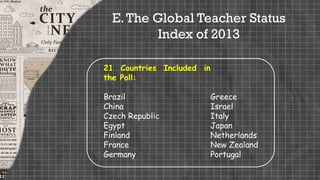
E.The Global Teacher Status
Index of 2013
21 Countries Included in
the Poll:
Brazil
China
Czech Republic
Egypt
Finland
France
Germany
Greece
Israel
Italy
Japan
Netherlands
New Zealand
Portugal
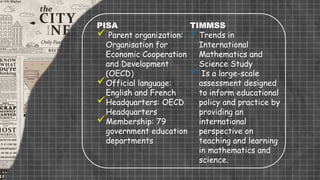
PISA
 Parent organization:
Organisation for
Economic Cooperation
and Development
(OECD)
Official language:
English and French
Headquarters: OECD
Headquarters
Membership: 79
government education
departments
TIMMSS
Trends in
International
Mathematics and
Science Study
 Is a large-scale
assessment designed
to inform educational
policy and practice by
providing an
international
perspective on
teaching and learning
in mathematics and
science.
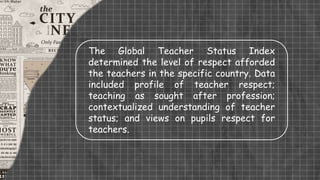
The Global Teacher Status Index
determined the level of respect afforded
the teachers in the specific country. Data
included profile of teacher respect;
teaching as sought after profession;
contextualized understanding of teacher
status; and views on pupils respect for
teachers.
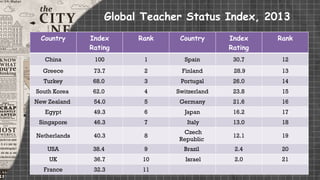
Country Index
Rating
Rank Country Index
Rating
Rank
China 100 1 Spain 30.7 12
Greece 73.7 2 Finland 28.9 13
Turkey 68.0 3 Portugal 26.0 14
South Korea 62.0 4 Switzerland 23.8 15
New Zealand 54.0 5 Germany 21.6 16
Egypt 49.3 6 Japan 16.2 17
Singapore 46.3 7 Italy 13.0 18
Netherlands 40.3 8
Czech
Republic
12.1 19
USA 38.4 9 Brazil 2.4 20
UK 36.7 10 Israel 2.0 21
France 32.3 11
Global Teacher Status Index, 2013
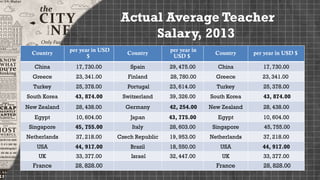
Actual Average Teacher
Salary, 2013
Country
per year in USD
$
Country
per year in
USD $
Country per year in USD $
China 17, 730.00 Spain 29, 475.00 China 17, 730.00
Greece 23, 341.00 Finland 28, 780.00 Greece 23, 341.00
Turkey 25, 378.00 Portugal 23, 614.00 Turkey 25, 378.00
South Korea 43, 874.00 Switzerland 39, 326.00 South Korea 43, 874.00
New Zealand 28, 438.00 Germany 42, 254.00 New Zealand 28, 438.00
Egypt 10, 604.00 Japan 43, 775.00 Egypt 10, 604.00
Singapore 45, 755.00 Italy 28, 603.00 Singapore 45, 755.00
Netherlands 37, 218.00 Czech Republic 19, 953.00 Netherlands 37, 218.00
USA 44, 917.00 Brazil 18, 550.00 USA 44, 917.00
UK 33, 377.00 Israel 32, 447.00 UK 33, 377.00
France 28, 828.00 France 28, 828.00
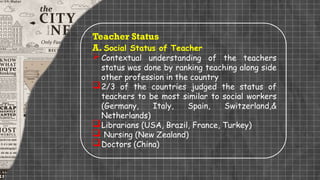
Teacher Status
A. Social Status of Teacher
Contextual understanding of the teachers
status was done by ranking teaching along side
other profession in the country
2/3 of the countries judged the status of
teachers to be most similar to social workers
(Germany, Italy, Spain, Switzerland,&
Netherlands)
Librarians (USA, Brazil, France, Turkey)
 Nursing (New Zealand)
Doctors (China)
B. How the teaching profession are
respected?
 There is a higher regard of teachers in the
primary/elementary school teachers than in the
secondary school teachers, and head teachers against
14 other occupations included.
C.Teaching: Sought-After Profession
 When parents were asked if they could encourage
their children to become teachers.
 50% of parents in China provide positive
encouragement for child to become teacher together
with South Korea, Turkey, and Egypt.
 Least likely to encourage their children to become
teacher –Israel, Portugal, Brazil, and Japan.
D. Pupil Respect for Teacher
 Parents were asked to respond whether they
believed that teachers are respected by their pupils
 In China, 75% of the respondents believe that
students respect their teachers, compared to only
27% average per country
 Turkey, Egypt and Singapore have a high level of
belief that pupils respect teachers with an average
of 46%
 Across Europe, there are higher levels of
pessimism about students’ respect for teacher than
in Asia and the Middle East
 Most of the European countries, pupils disrespect
teachers
E. Perception of Teacher Reward
 Most countries judged a fair rate of pay as similar to
teacher’s actual pay
 In Japan, France, and USA, the actual pay was judged
higher than the fair rate of salary
 Majority of the countries think teachers ought to be
rewarded with higher pay than what they are presently
getting
 Performance-Related Pay. Most countries believed that
teachers salary should be based on the achieved
student learning outcomes. The performance-related
pay (PRP) should be used according to performance
 In all the 21 countries, more than 59% of people think
teachers ought to be paid according to the
performance of their pupils
 Average across countries was 75%
F.Teacher Agency and Control Trusting
Teachers to Deliver Education:
 No country gave a rating below 5, suggesting
that all countries placed satisfactory to positive
trust in their teachers.
 Finland and Brazil at the top, displaying strong
trust in their teachers.
 Israel, Japan, South Korea & Egypt are at the
bottom, showing limited trust for their teachers.
THE CHANGING GLOBAL
LANDSCAPE FOR THE 21ST
CENTURY TEACHERS
The Changing Global Landscape for the 21st
Century Teachers
 Zhou, 2006 as mentioned in SEAMEO, INNOTECH 2011,
identified some key categories of the different changes and
developments in the 21st century teaching and learning.
A. The new learning environment;
B. The new learning contents;
C. The new processes of learning and how these will be
facilitated;
D. The new type of learners; and
E. The new type of teachers
A. The New Learning Environment
 It is a place where interactions of the learners
among one another, with the teacher and the
surroundings happen. It is characterized by
the following: learner-centered, new spaces
and borderless, enhanced opportunity for
creativity and innovations and use of ICT.
B. The New Learning Contents
 With the new learning environment and the
explosion of knowledge, content or subject
matter of learning has been modified,
integrated/Interdisciplinary, demand-driven,
emphasis on learning tools on how to retrieve
knowledge, and balance of scientific,
technological, cultural, global, local concepts.
C. The New Processes of Learning
and How these will be Facilitated
 Face-to-face
 Distance Learning
 Blended modalities
 Experiential and lifelong
D. The New Types of Learners
 Confident person who thinks independently and
critically and who communicates effectively;
 Self-directed and who questions, reflects and
takes responsibility for his/her own learning;
 Concerned citizen, informed about the world
and local affairs, has a strong sense of civic
responsibilities and participates actively in
improving the lives of others; and
 Member of the new generation: pop-culture,
different ways of thinking, responding.
Life and Career Skills
 Flexibility and Adaptability - learners adapt to
various roles, responsibilities and schedules.
Despite the complex condition, they are able to do
the different tasks at on time.
 Initiative and Self-directed - Goals are set and
managed by themselves. There is a commitment to
learning as a lifelong process.
 Social and Cross-cultural skills - This life and
career skills require learners to respect cultural
differences and work effectively with others, to be
open-minded to different ideas in order to innovate
and improve quality of work.
 Productivity and Accountability -
Individuals who possess these skills are able to
produce results. They respect teamwork and
cooperation.
 Leadership and Responsibility - Good
leaders use interpersonal problem-solving skills
with integrity ethical behaviour to influence
and guide others.
E. The New Type of Teachers
• As teachers are currently preparing students for jobs and
technologies that don’t even exist yet, the challenge then is to
produce the new type of teachers.
 Clear standards and accountability that their learners should
know and be able to do at the end of their schooling;
 Use broad pedagogies including inquiry-based learning,
cooperative learning, other pedagogies;
 Skillful in the use of assessment to guide teaching and learning;
 Great understanding of local and global cultures;
 Skillful in action research to diagnose and solve classroom
problems based on evidence;
 Practice the core values of inspiring teachers; and
 Develop life and career skills for the 21st century and beyond.
UNESCO’s Four Pillars of
Learning
When Jaques Delor wrote a report for the
UNESCO entitled: Learning: A Treasure from
Within.
It was because he believes that “within each
child lies a treasure,” (Delors, 1996).
The four pillars are seamlessly linked to each
other.
UNESCO’s Four Pillars of Learning From
Delor’s Report:
1. LEARNING TO KNOW
 This implies thirst for knowledge and
acquisition of such knowledge. More so,
it is learning how to learn throughout
one’s life.
How is Literacy Defined?
 UNESCO defined literacy as the ability to
identify, understand, interpret, create,
communicate and compute using printed and
written materials associated with varying
contexts.
The 21st Century Literacies
1) The Arts and Creativity - Creativity and innovation
are 21st century skills, thus in solving problems and
creating art works are part of this literacy.
2) Ecoliteracy - Acquisition of knowledge about climate
change, pollution, loss of natural habitats and
biodiversity. Solutions on how these environmental
problems could addressed must be practiced.
3) Cyberliteracy/Digital Literacy (Information and
ICT Knowledge) - Being in the rapid changes in the use
of technology for teaching and learning, teachers and
learners need to develop and enhance the use of digital
gadgets whether on-line or off-line.
4) Financial Literacy - Basic knowledge about the
basics of economics and financial management.
5) Media Literacy - Teachers and Learners must
learn how to dicern about any information which
are transmitted via various forms and media.
6) Social/Emotional Literacy - Knowledge about
social dimensions and social skills that are
appropriate in the context of society.
7) Globalization and Multi-cultural Literacy -
Respect multi-cultural diversity, aware of the
global trends, acknowledge differences and
similarities, respect each other’s dignity.
2. LEARNING TO DO
 How can the knowledge and the methods be
incorporated and enhanced towards the
development of skills? To apply knowledge, one
must have the 21st century skills.
Qualifications now is equated to skills and not
to knowledge alone.
 Can the knowledge gained be translated to
application? Learning by doing is a pragmatist’s
view of life. Knowledge acquired is nothing
unless applied in daily life.
3. LEARNING TO BE
 It implies developing the potentials of
each individual. Continuing education
must improve self-knowledge and self-
esteem.
4. Learning to Live Together
 This refers to the relationships
among people. It is bringing in
together a community to work
harmoniously, to live in peace and
prosperity and show respect and
concern for others.
Are all pillars are
interrelated with each other
as a basic principles?
One pillar will not function if
it stand alone. There is a
need to connect in order to
address the 21st century
demands for teaching and
learning.
Any
Question?
Thank You!

LEARNING EP5 PPT FINAL - GROUP 2 ENGLISH.pptx

  • 1.
    LEARNING EPISODE 5: TowardsTeacher Quality: Developing a Glocal Teacher of the 21st Century
  • 2.
    THE GLOBAL ANDGLOCAL TEACHER PROFESSIONAL: Is there a difference?  According to Roland Robertson (1992), Glocal may mean a global outlook adapted to the local condition or a local outlook adapted to the global condition.  Glocalization in Oxford Dictionary of New Words, defines the word glocal and the process noun word glocalization as a blending of global perspective and local condition.
  • 3.
    THE GLOBAL ANDGLOCAL TEACHER PROFESSIONAL: Is there a difference?  As future teachers, you have to blend both global and local perspective. As the saying goes: “think globally, but act locally” or “think global but act local”
  • 4.
    Global and GlocalTeacher Education Global Education  UNESCO defines global education as a goal to become aware of educational conditions or lack of it, in developing countries worldwide and aim to educate all people to a certain world standards.  Is a curriculum that is international in scope which prepares today’s youth around the world to function in one world environment under teachers who are intellectually, professionally and humanistically prepared.
  • 5.
     To becomea global teacher, you should be equipped with a wider range of knowledge of the various educational system outside the country; master skills and competencies which can address global demands; and possess attitudes and values that are acceptable to multicultural communities.
  • 6.
    UNESCO’s Education 2030Incheon Declaration during the World Education Forum established a vision “Towards inclusive and equitable quality educational lifelong learning for all.” Sustainable Development Goal (SDG) 4 for Education is one of the 17 goals of the United Nation’s SDGs. These outcomes targets bringing together all member nations to expand beyond their geographical territories for global education.
  • 7.
    By 2030, theseven outcome targets of SDG 4 must have been achieved, these are: 1. . Universal primary and secondary education. 2. Early childhood development and universal pre-primary education. 3. Equal access to technical/vocational and higher education. 4. Relevant skills for decent work. 5. Gender equality and inclusion. 6. Universal youth literacy. 7. Education for sustainable development and global citizenship
  • 8.
    JAMES BECKER (1988) Defineglobal education “An effort to help individuals to see the world as a single and global system and see themselves as a participants of that system. It is a school curriculum that has a worldwide standard of teaching and learning.
  • 9.
    21st Century LearningGoals  21st century content: emerging content areas such as global awareness, financial, economic, business, and entrepreneurial literacy; civic service literacy; health and awareness.  Learning and thinking and problem solving skills, communication, creativity and innovation, collaboration, contextual learning, information and media literacy.
  • 10.
     ICT literacy:using technology in the context of learning so students know how to learn.  Life skills: leadership, ethics, accountability personal responsibility, self direction, others.  21st century assessment: Authentic assessments that measure the area of learning
  • 11.
    FILIPINO GLOBAL TEACHER Understands how this world is interconnected;  Recognizes that the world has rich variety of ways of life;  Has a vision of the future and sees what the future would be for himself/herself and the students;  Must understand, respect and be tolerant of the diversity of the cultures;
  • 12.
     Must believeand take action for education that will sustain the future;  Must be able to facilitate digitally mediated learning;  Must have depth of knowledge;  Must posses good communication skills  Must possess the competencies of a professional teacher as embodied in National Competency-Based Standards for Teachers (NCBTS)
  • 13.
    GLOCAL TEACHERS In additionto the above qualities must possess the following distinct characteristics and core values of Filipino teachers. a)Cultural and historical rootedness b) Ability to contextualize teaching-learning c) Excellence d) Responsiveness e) Accountability and integrity f) Ecological sensitivity g) Nationalism/Filipinism h) Faith in the Divine Providence
  • 14.
    “ Live asif you were to die tomorrow. Learn as if you were to live forever ” 😉 -MAHATMA GANDHI
  • 15.
    “A CLOSER LOOK AT THE TEACHERS ANDTHE TEACHING PROFESSION IN THE ASEAN AND BEYOND”
  • 16.
    PRIMARY LEVEL  Pre-primary(Play-school, Pre-K, Kindergarten) and the Primary Level which is composed of Grade 1 aged 6 yrs old; Grade 2 aged 7 yrs old; Grade 3 aged 8yrs old; Grade 4 aged 9 yrs; Grade 5 aged 10 yrs old; and Grade 6 aged 11 years old.  It refers to elementary level Primary grades- Kindergarten to Grade 4 Intermediate grades – Grade 5 and Grade 6 The Levels of Schooling as a Teaching Milieu
  • 17.
    SECONDARY LEVEL Composed ofJunior High School and Senior High School. Graduate from senior high school can proceed to college or find a job appropriate to the qualification Slight Variations in some countries  Lower Secondary level is three years with Grade 7, 8, and 9.  Upper Secondary level is composed of Grades 10, 11 and 12.
  • 18.
    Variations in thenumber of years in basic education level across the ASEAN members Variations Levels of Schooling and Number of Years Primary/Elem Lower Secondary Upper Secondary Total Number of Years Countries (as of 2013) Version 1 5 yrs 4 yrs 3 yrs 12 Lao PDR Version 2 5 yrs 4 yrs 2 yrs 11 Myanmar Version 3 6 yrs 3 yrs 2 yrs 11 Malaysia Version 4 6 yrs 3 yrs 3 yrs 12 Brunei, Cambodia, Indonesia, Thailand, Vietnam Version 5 6 yrs 4 yrs 2 yrs (pre- university for Singapore 12 Singapore, Philippines
  • 19.
    All primary educationlevels are compulsory, while in some countries the secondary level is voluntary except the Philippines. In Singapore, the last two year levels are pre-university level. The basic education levels of Elementary/Primary and the Secondary level will provide the future jobs of teacher education pre-service graduates.
  • 20.
    TERTIARY LEVEL a) Collegelevel which beyond the basic education in all the countries in the ASEAN b) Ladder of educational system where the student earns a bachelor’s degree in teacher education, which is a requirement to take a licensure examination to become professional teacher c) In the Philippines, TESDA provides diploma and training certificates for lifelong learning d) The agency also assists in the implementation of the senior high school technical-vocational tracks e) The pre-service teacher gets appropriate qualification degree in the tertiary level in order to teach in either the elementary or secondary level of the education system in either the public or private school in a particular country f) Most countries have specific recruitment policies and guidelines
  • 21.
    The Teacher Professionals Acrossthe ASEAN 1. Academic Preparation of Teacher Professionals in Basic Education • Admission to pre-service teacher education varies from the graduates of Grade 9 or Grade 12 Places of Lao PDR, Indonesia, Myanmar and Cambodia  pre-school, pre-primary of kindergarten future teachers can have 9 years of basic education (Grade 9) and get advanced training for 3 years to become teachers (9 yrs basic education + 3 years teacher preparation) or 10 years basic education plus 3 years of teacher preparation.
  • 22.
    • FOR TEACHERSOF LOWER SECONDARY LEVEL  future teachers should have 12 years of basic education and 2 years of teacher preparation to earn a Diploma in Teaching • FOR UPPER SECONDARY LEVEL  requirement is 12 years of basic education plus 4 to 5 years of teacher preparation to earn a Bachelor’s degree • NON-EDUCATION DEGREE GRADUATES, THEY CAN TAKE THE POST GRADUATE DIPLOMA IN EDUCATION/TEACHING  an equivalent to 12 years of basic education plus 4 to 5 years of Baccalaureate Degree plus one year of Graduate Diploma
  • 23.
     All teachereducation provides a teaching practicum, student teaching or field experiences course.  This will provide them the opportunity to apply the theories and concepts in the content and pedagogy courses in real class situation.  ASEAN countries have comparable academic teacher education preparations, however there are those who have gone beyond their borders, while others are still strengthening their programs.  Differences are according to the context and needs and the education system of the particular member country, their history culture and aspirations. Here are some commonalities in the teacher preparation.
  • 24.
    Components of TeacherPreparation  Qualified, professionally trained, motivated and well supported teachers are the key to quality education.
  • 25.
    General Knowledge andUnderstanding  Embedded in the general education or liberal arts education subjects in college as preparatory to the core content subjects in the professional education.  Cluster of subjects in liberal education provides the development of the person-hood of the future teacher. (What to Know about Oneself and World)
  • 26.
    Pedagogy  Provides varietyof teaching delivery approaches beyond the traditional methods of teaching.  More innovative methods including student-centered approaches, cooperative learning, project-based learning and many more based on international values to enhance, peace education, sustainable development, respect for diversity, inclusive education, and global citizenship.  Pedagogical theories and principles are also included (How to Teach)
  • 27.
    Teaching Practicum/Experiential Learning  Knowledge,theories, principles and pedagogies learned are validated in real life situation as teachers.  All ASEAN countries, teaching practicum and experiential learning are required as a component of training or for certification to teach (Immersion to real world of teaching/ Practicum/Teaching Internship)
  • 28.
    Specialized knowledge/ Majorcourses  For those who will teach the content or discipline in the upper elementary or secondary levels, major content courses are learned.  For the early years (pre-school to Grade 3, a more comprehensive knowledge of child growth and development is given emphasis (What to teach in specific discipline or subject area)  Common degree titles include Bachelor of Education (BEd); Bachelor of Elementary Education (BEEd); Bachelor of Secondary Education (BSEd); and Diploma in Education either Pre-baccalaureate/Post Graduate (PGDip)  Common standards and competencies were developed as a guide for all teachers
  • 29.
    1. Skills inthe 21st century 2. Professionalism and accountability 3. Pedagogical competence 4.Teacher’s characteristics/qualities 5. Knowledge competence
  • 30.
    The Teaching Profession Practicesin the ASEAN 1.Teacher’s Major Responsibilities  3 major responsibilities of professional teachers across the different countries:  Actual teaching  Management of learning  Administrative work
  • 31.
    Carried out inthe teaching hours required which is 6-8 hours per day, 40 to 45 hours per week, 4 weeks per month and 10 months a year. Actual Teaching a) Refers to time of engagement of the teacher with the learners b) Happens within the official teaching hours c) Actual teaching hours vary from country and from school to school d) Actual teaching refers to contact time or time on task
  • 32.
    Management of Learning a)Refers to activities that support the actual teaching b) Can be beyond actual teaching time like remediation or enhancement, homework, or co-curricular activities Administrative work c) Refers to the teachers’ job that includes writing test items, checking and recording of the test paper results, attending to parents, making reports and other related activities
  • 33.
    With all theresponsibilities that the teacher is required to do, the salary of the teacher varies across the different countries. ASEAN teacher’s salary ranges from as low as USD 120.50 to as high as USD 2,589.00 per month or even higher as in case of Singapore which around $45, 755.00 per year according to the Global Teacher Status Index Report  Salary is based on qualification, teaching experiences and level or grade assigned  Teaching in the public schools will also have a different salary scale  In some countries, there are fringe benefits provided like hardship pay, maternity pay and other bonuses
  • 34.
     In theprimary level, teachers handle more than one specialized subject  Team teaching is practiced either vertically or horizontally  Vertical team teaching - Elementary Science will be taught by one science teacher Grade 1 to Grade 6  Horizontal team teaching - science will be taught by one teacher in one level with different sections or groups  In secondary level, the teacher teaches the specific subject area or major area in the same level or in different grade level
  • 35.
    Teacher Licensing andRecruitment  Most teachers are licensed as professional or are certified to teach by the country’s appropriate agencies.  Those who are not certified or licensed become para-professionals or assistant teacher.
  • 36.
     Philippines -Professional Regulation Commission (PRC) Singapore - National Institute for Education (NIE) Thailand - Teacher Education Council (Khurusapha) Indonesia - Akta IV teacher license is given by the teacher colleges for the authority to teach Other countries – no licensing is provided, certification is issued instead this is done by the Ministry of Education or the teacher education colleges or universities
  • 37.
    Teacher recruitment processand qualifications are guided by the Ministry of Education for the public schools and the individual private schools under the guidance and polices of each country ministry.
  • 38.
    The Teacher andthe Teaching Profession Beyond the ASEAN 1. CHINA  200 million students attending public schools taught by over 9 million teachers in the elementary, junior, and senior high schools  Largest teaching force in the world  Education system is highly centralized  Subject matter and instructional contents are uniform for all
  • 39.
     First sixyears of school make up the primary grades which are devoted to development of cognitive skills  Six year of high school  Class size ranges 40 to 60 students and cover all topics in order to pass national examinations  To attend university must pass one of the two versions of the National University Entrance Examination  The quality and reputation of the school will depend on the number of students passing the examination  Six years of primary education, three years of junior middle school, three years of senior middle school, six years of university  Varieties of technical and vocational schools
  • 40.
    The political andideological orientation of teacher education is “cultivate cultured persons as teachers with lofty ideals, high morality, strong discipline, a sense of mission as educators, engineers of the human soul and the gardeners of nation’s flowers” (Leung and Hui, 2000) There are two main categories of teachers based on the source and structure of their salary or pay 1) Gongban (state-paid) teachers who earn salary comparable with other state employees in state-owned enterprises 2) Minban (community-paid) teachers who are paid by local community depending on the community income. They are categorized into grades according to their years of service and their standard performance
  • 41.
    Five Grade System: a.Super-grade teacher – highest level which occupy the upper level of 5% of the teaching force b. Senior-grade teacher occupy 6% of the teaching force in 1990 where most of the primary level teachers belong c. Third-grade teachers d. Second-grade teachers include the majority of the secondary teachers e. First-grade teachers- some of the newly hired primary teachers
  • 42.
    A. China’s TeacherLicensing 1) Examinations are standardized for the secondary teachers by the central government 2) Elementary teachers are the responsibility of each province 3) Primary teachers should have at least graduated from secondary normal schools or secondary school 4) Junior secondary teachers should at least have a teaching diploma from junior teacher colleges 5) Senior secondary teachers shall graduate from a normal university or teacher colleges and holder of degrees from tertiary institutions.
  • 43.
    B. Chinese TeachersEnjoy Unquestionable Authority 1) General assumption in the Chinese society “the teacher tells the single and absolute truth, and the job of the students is to absorb the knowledge conveyed by the teacher without questions.” 2) English and Mathematics provide opportunities to practice, the structure of the lesson, their peace, and the nature of questioning is determined by the teacher. 3) It is common experience of students to complete a 45 minute class period without having talked once, or called individually or was able to raise question. 4) Because of the cultural uniqueness in delivering the lesson by the teacher, China Ranked 1 in the Global Teacher Status Index. 5) Teaching profession is regarded equal to the doctor.
  • 44.
    C. Students areguided by the following tenets: 1) Important knowledge comes from teachers and textbooks. 2) Learning involves listening, thinking and silent practice. 3) Knowledge espoused by the teacher and the textbook is not to be changed.
  • 45.
    2. JAPAN  Highlycentralized and administered by the Mombusho or Ministry of Education  School system from kindergarten through university serves about 24 million students, with about ten percent (10%) going to the university  About one-third go to the private schools and the rest are enrolled in the public school system  Japanese educational system is sometimes seen as a model on how to operation school  System gives us a mental picture of obedient, quiet school children sitting on their desk, listening to the teacher and working hard to pass the various entrance examination.
  • 46.
     Education isfree and compulsory for children from 6 to 15 years  Classes are large and teaching methods are usually lectures  Students spend 243 days a year in school  School calendar is year-round with some breaks between sessions  Standard curriculum includes Japanese language, social studies, math and science along with art, music, home economics, physical education, with the greatest emphasis on learning the Japanese language
  • 47.
    A. Japanese EducationalSystem: 1) Kindergarten 2) Elementary school (six years) 3) Lower Secondary school (three years) 4) Upper secondary school (three years) 5) University (usually around four years)
  • 48.
     Elementary school(Grade 1 to Grade6) – teachers are females  Lower school (Grade 7 to 9) – 2/3 composed men - class size average is 38 and periods are 55 minutes long  Upper secondary school offer academic, technical, and vocational program  First year courses include Japanese language, English, Science and Math  Vocational course includes information processing, navigation, fish farming, ceramics and business English  Upper secondary schools are ranked based on their success in placing graduating students into prestigious universities
  • 49.
    B.The Teaching Professionin Japan 1) Major responsibilities are trusted upon the teachers for moral education and character development and for instilling values, attitudes, and living habits in students at all levels. 2) Teachers are expected to infuse cultural values throughout school activities including student’s lives, both in school or even at home and community. 3) Has been an attractive profession in terms of status. 4) Appeal of the teaching career has heightened because of increase in remuneration.
  • 50.
    C.Teacher Certification inJapan 1) First Class Certificate - to teach in the preschool, elementary or secondary teachers with basic qualification of having earned a Bachelor’s Degree. To teach in the upper secondary level, the basic qualification is a Master’s degree. 2) Second Class certificate - Has a basic qualification of 2 years of study (62 credit unit) in a university or other postsecondary institution. While to teach in the secondary level, without a Master’s degree, the Second Class Certificate will be issued. To the length of study and degree qualifications, prospective teachers must earn a prescribed number of credits in education studies and in the subjects to be taught.
  • 51.
    D. Becoming Employedas a Teacher 1) Public school teachers are prefectural employees 2) Prefectures play a role in the selection and hiring of teachers 3) The teacher applicant must secure a license to teach from the prefectural board of education 4) Applicant is required to take prefectural appointment examination 5) Two stages of prefectural appointment examination consist of; (1) written test in general education, and specialized fields and skills test for P.E., Music and Art and (2) interview. Applicant for lower secondary- required to take the test in physical fitness.
  • 52.
    6) Age isvery important consideration for teacher applicants 7) More than ½ of the prefectures require applicants to be under the age of 30 8) they assured for lifetime employment 9) Promotion is on the basis of seniority 10) Dismissal are extremely rare and normally occur only for unethical conduct.
  • 53.
    5. UNITED STATESOF AMERICA  American Educational System has greatly influenced the Philippine Educational System specifically the making of the Filipino teacher.  The first American teachers called the Thomasites  Opening of the normal schools in different provinces of the country provided a very strong foundation for teacher education
  • 54.
    A. Basic Education,The Avenue for Teaching Jobs in USA 1) Pre-primary education – type of school providing this education are kindergarten, nursery schools, preschool programmes, child/day care center. Age level is 4 to 6 years old and the duration is 2 years. 2) Primary education – elementary school, there are varied levels of schooling in primary education. 3) Middle school education – Grade 4-6, 5-7, or 6-8 4) Secondary education – high school – Grades 7-12 or 8-12 5) Junior high school – Grades 7-8, 7-9, or 8 6) Senior high school – Grade 9-12, or 10-12 Duration of compulsory education is from entry of 6 years old to exit 18 years old.
  • 55.
    B. Becoming aProfessional Teacher in the USA 1) Have to attend a college or a university for four years, major or minor in education and earn a teaching certificate 2) It is possible to earn a teaching degree after graduation by taking additional courses post- baccalaureate or by entering a Master of Arts in Teaching program
  • 56.
    C. Earning TeachingCertificates 1) United States of America has decentralized educational system and each State Education Agency (SEA) has its own guidelines and requirements for earning and maintaining a teaching certificate. 2) Teaching certificate earned in one state may or may not be recognized in another. 3) There is an increasing practice requiring that prospective teachers demonstrate some minimal level of competency by passing a competency test before they allowed to enter the profession. 4) National Teacher Examination (NTE) or on Praxis I Pre-professional Skills Test) or Praxis II written test.
  • 57.
    5) Praxis tests-measure the academic skills and subject-specific content knowledge needed for teaching. 6) Teachers also renew their certification by continuing to take “renewal credits”. 7) Permanent certification is granted if the teacher performs adequately according to the standards established by the state.
  • 58.
    D. Recruitment ofTeachers 1) Superintendent approves the applicant and then forwards a recommendation to hire to the local school board 2) Once signed, a teacher has a legally binding contract to work, unless guilty of a crime, fails to show teaching competency, or demonstrates egregious professional conduct 3) Expected to complete teaching during the term of his/her contract, with exception for pregnancy, medical leaves and unforeseen emergencies
  • 59.
    E. Salaries ofTeachers 1) Salary range for teachers is determine by education and experience as by locale 2) Teachers who have earned “masters plus 30 doctorate units” earn more than those with master’s degrees, while teachers with master’s degree receive a higher salary than the bachelor’s degree holder 3) Merit pay has been adopted by some school districts, those who teach in sub-urban school districts or large towns typically earn more than teachers in either urban or rural districts 4) Some teachers work at another job during the school year or summer 5) Average income of teachers $ 44, 917.00 (Global Teacher Status)
  • 60.
    F.What Makes aGood American Teacher? 1) “Good” teacher slightly differs among level 2) Working in elementary schools seemed more child-focused in their discussions and believed that a good teacher is a kind person, one who is “understanding” and “sensitive to the needs of children” 3) Secondary school teachers generally consider themselves subject-matter specialist 4) Good teachers have to know how to teach their subjects
  • 61.
    5) Some feelthat having a sense of humor and an ability to handle a class increased the likelihood that students would learn, but the teacher’s primary responsibility is to teach 6) Middle school teachers pointed out that many school are changing from junior high to a middle school model because young adolescent still need the support of the family like concerns 7) As a team should be able to give more personal attention to middle school learners
  • 62.
    E.The Global TeacherStatus Index of 2013 21 Countries Included in the Poll: Brazil China Czech Republic Egypt Finland France Germany Greece Israel Italy Japan Netherlands New Zealand Portugal
  • 63.
    PISA  Parent organization: Organisationfor Economic Cooperation and Development (OECD) Official language: English and French Headquarters: OECD Headquarters Membership: 79 government education departments TIMMSS Trends in International Mathematics and Science Study  Is a large-scale assessment designed to inform educational policy and practice by providing an international perspective on teaching and learning in mathematics and science.
  • 64.
    The Global TeacherStatus Index determined the level of respect afforded the teachers in the specific country. Data included profile of teacher respect; teaching as sought after profession; contextualized understanding of teacher status; and views on pupils respect for teachers.
  • 65.
    Country Index Rating Rank CountryIndex Rating Rank China 100 1 Spain 30.7 12 Greece 73.7 2 Finland 28.9 13 Turkey 68.0 3 Portugal 26.0 14 South Korea 62.0 4 Switzerland 23.8 15 New Zealand 54.0 5 Germany 21.6 16 Egypt 49.3 6 Japan 16.2 17 Singapore 46.3 7 Italy 13.0 18 Netherlands 40.3 8 Czech Republic 12.1 19 USA 38.4 9 Brazil 2.4 20 UK 36.7 10 Israel 2.0 21 France 32.3 11 Global Teacher Status Index, 2013
  • 66.
    Actual Average Teacher Salary,2013 Country per year in USD $ Country per year in USD $ Country per year in USD $ China 17, 730.00 Spain 29, 475.00 China 17, 730.00 Greece 23, 341.00 Finland 28, 780.00 Greece 23, 341.00 Turkey 25, 378.00 Portugal 23, 614.00 Turkey 25, 378.00 South Korea 43, 874.00 Switzerland 39, 326.00 South Korea 43, 874.00 New Zealand 28, 438.00 Germany 42, 254.00 New Zealand 28, 438.00 Egypt 10, 604.00 Japan 43, 775.00 Egypt 10, 604.00 Singapore 45, 755.00 Italy 28, 603.00 Singapore 45, 755.00 Netherlands 37, 218.00 Czech Republic 19, 953.00 Netherlands 37, 218.00 USA 44, 917.00 Brazil 18, 550.00 USA 44, 917.00 UK 33, 377.00 Israel 32, 447.00 UK 33, 377.00 France 28, 828.00 France 28, 828.00
  • 67.
    Teacher Status A. SocialStatus of Teacher Contextual understanding of the teachers status was done by ranking teaching along side other profession in the country 2/3 of the countries judged the status of teachers to be most similar to social workers (Germany, Italy, Spain, Switzerland,& Netherlands) Librarians (USA, Brazil, France, Turkey)  Nursing (New Zealand) Doctors (China)
  • 68.
    B. How theteaching profession are respected?  There is a higher regard of teachers in the primary/elementary school teachers than in the secondary school teachers, and head teachers against 14 other occupations included. C.Teaching: Sought-After Profession  When parents were asked if they could encourage their children to become teachers.  50% of parents in China provide positive encouragement for child to become teacher together with South Korea, Turkey, and Egypt.  Least likely to encourage their children to become teacher –Israel, Portugal, Brazil, and Japan.
  • 69.
    D. Pupil Respectfor Teacher  Parents were asked to respond whether they believed that teachers are respected by their pupils  In China, 75% of the respondents believe that students respect their teachers, compared to only 27% average per country  Turkey, Egypt and Singapore have a high level of belief that pupils respect teachers with an average of 46%  Across Europe, there are higher levels of pessimism about students’ respect for teacher than in Asia and the Middle East  Most of the European countries, pupils disrespect teachers
  • 70.
    E. Perception ofTeacher Reward  Most countries judged a fair rate of pay as similar to teacher’s actual pay  In Japan, France, and USA, the actual pay was judged higher than the fair rate of salary  Majority of the countries think teachers ought to be rewarded with higher pay than what they are presently getting  Performance-Related Pay. Most countries believed that teachers salary should be based on the achieved student learning outcomes. The performance-related pay (PRP) should be used according to performance  In all the 21 countries, more than 59% of people think teachers ought to be paid according to the performance of their pupils  Average across countries was 75%
  • 71.
    F.Teacher Agency andControl Trusting Teachers to Deliver Education:  No country gave a rating below 5, suggesting that all countries placed satisfactory to positive trust in their teachers.  Finland and Brazil at the top, displaying strong trust in their teachers.  Israel, Japan, South Korea & Egypt are at the bottom, showing limited trust for their teachers.
  • 72.
    THE CHANGING GLOBAL LANDSCAPEFOR THE 21ST CENTURY TEACHERS The Changing Global Landscape for the 21st Century Teachers  Zhou, 2006 as mentioned in SEAMEO, INNOTECH 2011, identified some key categories of the different changes and developments in the 21st century teaching and learning. A. The new learning environment; B. The new learning contents; C. The new processes of learning and how these will be facilitated; D. The new type of learners; and E. The new type of teachers
  • 73.
    A. The NewLearning Environment  It is a place where interactions of the learners among one another, with the teacher and the surroundings happen. It is characterized by the following: learner-centered, new spaces and borderless, enhanced opportunity for creativity and innovations and use of ICT.
  • 74.
    B. The NewLearning Contents  With the new learning environment and the explosion of knowledge, content or subject matter of learning has been modified, integrated/Interdisciplinary, demand-driven, emphasis on learning tools on how to retrieve knowledge, and balance of scientific, technological, cultural, global, local concepts.
  • 75.
    C. The NewProcesses of Learning and How these will be Facilitated  Face-to-face  Distance Learning  Blended modalities  Experiential and lifelong
  • 76.
    D. The NewTypes of Learners  Confident person who thinks independently and critically and who communicates effectively;  Self-directed and who questions, reflects and takes responsibility for his/her own learning;  Concerned citizen, informed about the world and local affairs, has a strong sense of civic responsibilities and participates actively in improving the lives of others; and  Member of the new generation: pop-culture, different ways of thinking, responding.
  • 77.
    Life and CareerSkills  Flexibility and Adaptability - learners adapt to various roles, responsibilities and schedules. Despite the complex condition, they are able to do the different tasks at on time.  Initiative and Self-directed - Goals are set and managed by themselves. There is a commitment to learning as a lifelong process.  Social and Cross-cultural skills - This life and career skills require learners to respect cultural differences and work effectively with others, to be open-minded to different ideas in order to innovate and improve quality of work.
  • 78.
     Productivity andAccountability - Individuals who possess these skills are able to produce results. They respect teamwork and cooperation.  Leadership and Responsibility - Good leaders use interpersonal problem-solving skills with integrity ethical behaviour to influence and guide others.
  • 79.
    E. The NewType of Teachers • As teachers are currently preparing students for jobs and technologies that don’t even exist yet, the challenge then is to produce the new type of teachers.  Clear standards and accountability that their learners should know and be able to do at the end of their schooling;  Use broad pedagogies including inquiry-based learning, cooperative learning, other pedagogies;  Skillful in the use of assessment to guide teaching and learning;  Great understanding of local and global cultures;  Skillful in action research to diagnose and solve classroom problems based on evidence;  Practice the core values of inspiring teachers; and  Develop life and career skills for the 21st century and beyond.
  • 80.
    UNESCO’s Four Pillarsof Learning When Jaques Delor wrote a report for the UNESCO entitled: Learning: A Treasure from Within. It was because he believes that “within each child lies a treasure,” (Delors, 1996). The four pillars are seamlessly linked to each other.
  • 81.
    UNESCO’s Four Pillarsof Learning From Delor’s Report: 1. LEARNING TO KNOW  This implies thirst for knowledge and acquisition of such knowledge. More so, it is learning how to learn throughout one’s life.
  • 82.
    How is LiteracyDefined?  UNESCO defined literacy as the ability to identify, understand, interpret, create, communicate and compute using printed and written materials associated with varying contexts.
  • 83.
    The 21st CenturyLiteracies 1) The Arts and Creativity - Creativity and innovation are 21st century skills, thus in solving problems and creating art works are part of this literacy. 2) Ecoliteracy - Acquisition of knowledge about climate change, pollution, loss of natural habitats and biodiversity. Solutions on how these environmental problems could addressed must be practiced. 3) Cyberliteracy/Digital Literacy (Information and ICT Knowledge) - Being in the rapid changes in the use of technology for teaching and learning, teachers and learners need to develop and enhance the use of digital gadgets whether on-line or off-line.
  • 84.
    4) Financial Literacy- Basic knowledge about the basics of economics and financial management. 5) Media Literacy - Teachers and Learners must learn how to dicern about any information which are transmitted via various forms and media. 6) Social/Emotional Literacy - Knowledge about social dimensions and social skills that are appropriate in the context of society. 7) Globalization and Multi-cultural Literacy - Respect multi-cultural diversity, aware of the global trends, acknowledge differences and similarities, respect each other’s dignity.
  • 85.
    2. LEARNING TODO  How can the knowledge and the methods be incorporated and enhanced towards the development of skills? To apply knowledge, one must have the 21st century skills. Qualifications now is equated to skills and not to knowledge alone.  Can the knowledge gained be translated to application? Learning by doing is a pragmatist’s view of life. Knowledge acquired is nothing unless applied in daily life.
  • 86.
    3. LEARNING TOBE  It implies developing the potentials of each individual. Continuing education must improve self-knowledge and self- esteem.
  • 87.
    4. Learning toLive Together  This refers to the relationships among people. It is bringing in together a community to work harmoniously, to live in peace and prosperity and show respect and concern for others.
  • 88.
    Are all pillarsare interrelated with each other as a basic principles? One pillar will not function if it stand alone. There is a need to connect in order to address the 21st century demands for teaching and learning.
  • 89.
  • 90.