Isothermal Titration Calorimetry (ITC)
Pharmaceutical Analysis
T. Y B. Pharm
By
Prof. Khemchand R. Surana
(M. S. Pharm)
Divine College of Pharmacy, Satana,
Nashik
1KRS-Divine
Isothermal Titration
Calorimetry (ITC)
• Isothermal Titration Calorimetry (ITC) is a technique
used in quantitative studies of a wide variety of
biomolecular interactions.
•A direct measurement of heat generated or absorbed
when molecules interact.
•It works by directly measuring the heat that is either
released or absorbed during a biomolecular binding
event.
•ITC is the only technique that can simultaneously
determine all binding parameters in a single experiment.
•Requiring no modification of binding partners, either with
fluorescent tags or through immobilization, ITC measures2KRS-Divine
Cont…..
•Measuring heat transfer during binding enables
accurate determination of binding constants (KD),
reaction stoichiometry (n), enthalpy (∆H) and entropy
(ΔS).
•This provides a complete thermodynamic profile of the
molecular interaction.
•ITC goes beyond binding affinities and can elucidate
the mechanisms underlying molecular interactions.
•This deeper understanding of structure-function
relationships enables more confident decision making in
hit selection and lead optimization.
3KRS-Divine
4KRS-Divine
Measurement Principle
•Isothermal Titration Calorimetry is used to measure
reactions between biomolecules.
•The methodology allows determination of the binding
affinity, stoichiometry, and entropy and enthalpy of the
binding reaction in solution, without the need to use
labels.
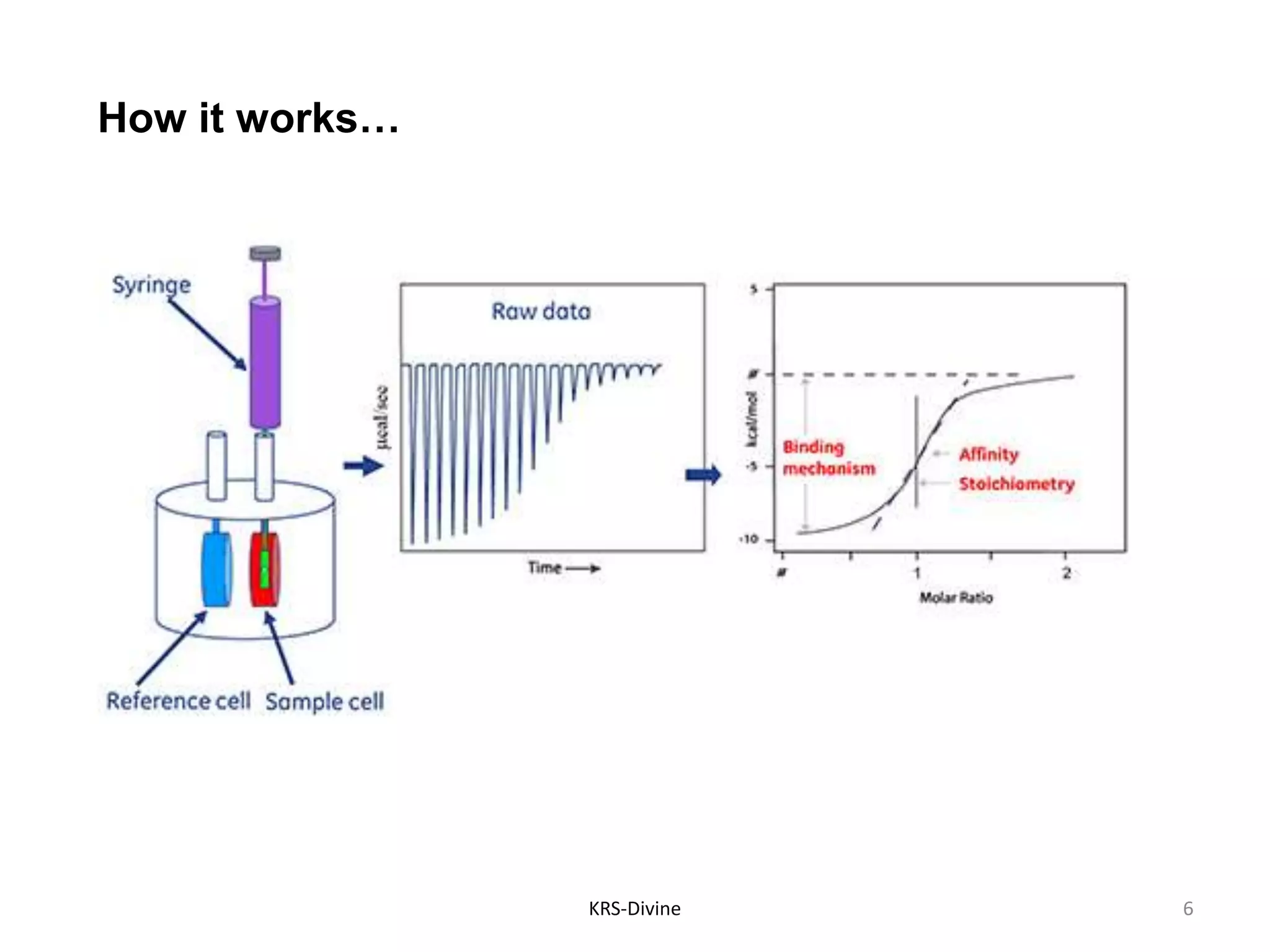
•When binding occurs, heat is either absorbed or
released and this is measured by the sensitive
calorimeter during gradual titration of the ligand into
the sample cell containing the biomolecule of interest.
5KRS-Divine
How it works…
6KRS-Divine
Working …
7KRS-Divine
8KRS-Divine
9KRS-Divine
Instrumentation
The thermal core:
•In the microcalorimeter there are two cells, one of which
contains water and acts as a reference cell, the other
contains the sample.
•The microcalorimeter needs to keep these two cells at
exactly the same temperature.
•The heat sensing devices detect temperature difference
between the cells when binding occurs and give feedback
to the heaters, which compensate for this difference and
return the cells to equal temperature.
10KRS-Divine
Instrumentation
Making a measurement:
•The reference cell and the sample cell are set to the
desired experimental temperature.
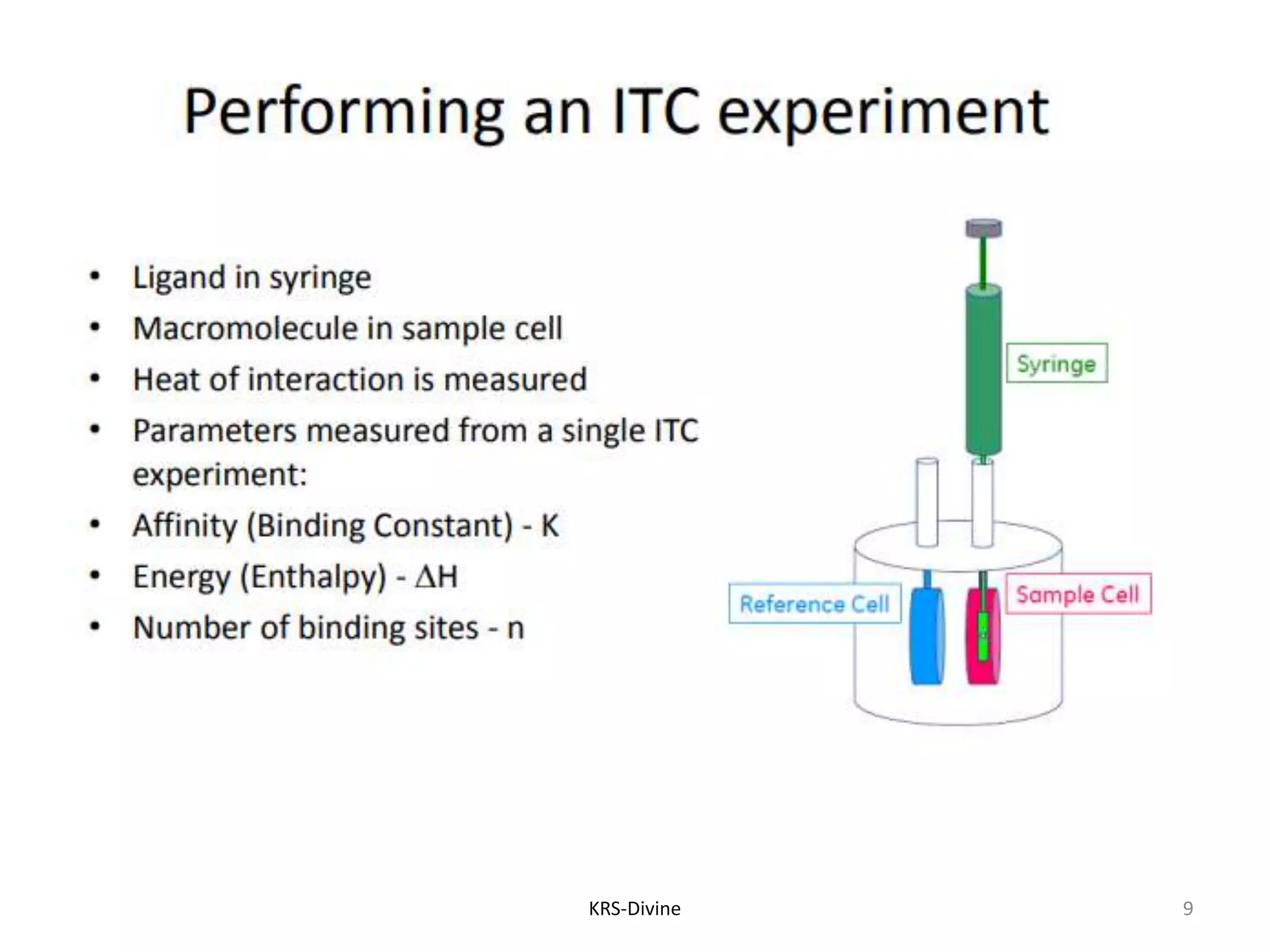
•The ligand is loaded into a syringe which sits in a very
accurate injection device.
•The injection device is inserted into the sample cell
containing the protein of interest.
•A series of small aliquots of ligand are injected into the
protein solution.
• If there is a binding of the ligand to the protein, heat
changes of a few millionths of a degree Celsius are
detected and measured.
•As the first injection is made, the microcalorimeter
measures all heat released until the binding reaction has
reached equilibrium. 11KRS-Divine
12KRS-Divine
13KRS-Divine
14KRS-Divine
15KRS-Divine
16KRS-Divine
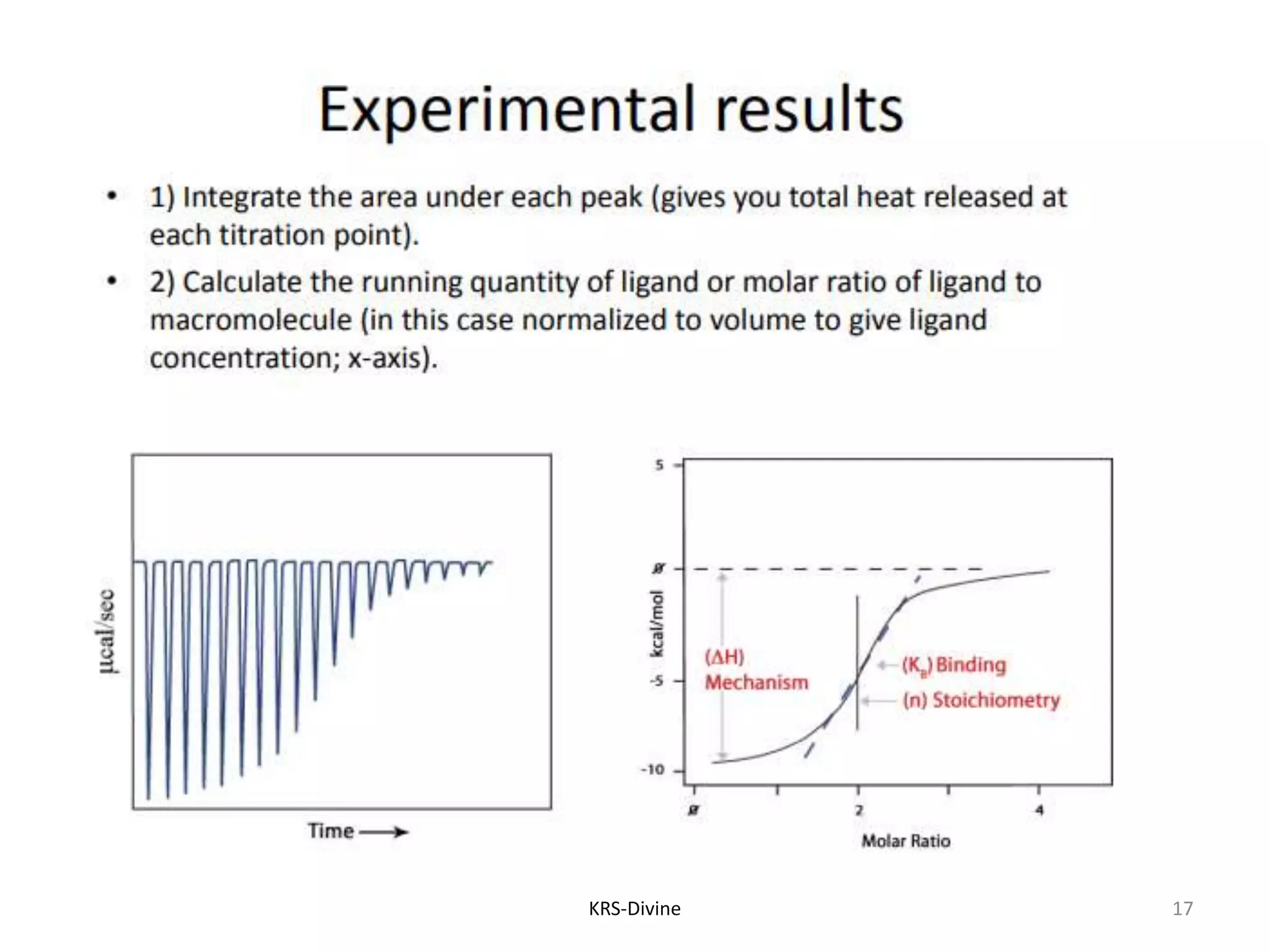
17KRS-Divine
Advantages of ITC
In comparison with other biophysical techniques, the key
advantages are:
•Complete basic thermodynamic characterization
(stoichiometry, association constant, and binding enthalpy)
in a single experiment.
•Heat is a universal signal, and, hence, no need for reporter
labels (e.g. chromophores, fluorophores).
•Direct determination of the binding enthalpy.
•Non-destructive technique.
•Interaction in solution
•Possibility of performing experiment with optically dense
solutions or unusual systems (e.g. dispersions, intact
organelles or cells)
•Considerably fast. 18KRS-Divine
Disadvantages of ITC
There are however, certain disadvantages:
•Signal is proportional to the binding enthalpy, and the
non-covalent complexes may exhibit rather small
binding enthalpies
•Heat is a universal signal and each process
contributes to the global measured heat, thus
complicating the evaluation of the contribution because
of binding
•Large amount of sample is needed, though this has
come down considerably
•It is a slow technique with a low throughput (0.25 - 2
h/assay), not suitable for HTS
•Kinetically slow processes may be overlooked
•A limited range for consistently measured binding
affinities.
•Before now, no kinetic information for binding
interactions could be accessed 19KRS-Divine
Applications
ITC is widely used in drug discovery and
development for:
•Quantify binding affinity
•Candidate selection and optimization
•Measurement of thermodynamics and active
concentration
•Characterization of mechanism of action
•Confirmation of intended binding targets in small
molecule drug discovery
•Determination of binding specificity and
stoichiometry
•Validation of IC50 and EC50 values during hit-to- 20KRS-Divine
Online video link
https://www.malvernpanalytical.com/en/pr
oducts/technology/microcalorimetry/isothe
rmal-titration-calorimetry
21KRS-Divine
22

Isothermal titration calorimetry (ITC)

  • 1.
    Isothermal Titration Calorimetry(ITC) Pharmaceutical Analysis T. Y B. Pharm By Prof. Khemchand R. Surana (M. S. Pharm) Divine College of Pharmacy, Satana, Nashik 1KRS-Divine
  • 2.
    Isothermal Titration Calorimetry (ITC) •Isothermal Titration Calorimetry (ITC) is a technique used in quantitative studies of a wide variety of biomolecular interactions. •A direct measurement of heat generated or absorbed when molecules interact. •It works by directly measuring the heat that is either released or absorbed during a biomolecular binding event. •ITC is the only technique that can simultaneously determine all binding parameters in a single experiment. •Requiring no modification of binding partners, either with fluorescent tags or through immobilization, ITC measures2KRS-Divine
  • 3.
    Cont….. •Measuring heat transferduring binding enables accurate determination of binding constants (KD), reaction stoichiometry (n), enthalpy (∆H) and entropy (ΔS). •This provides a complete thermodynamic profile of the molecular interaction. •ITC goes beyond binding affinities and can elucidate the mechanisms underlying molecular interactions. •This deeper understanding of structure-function relationships enables more confident decision making in hit selection and lead optimization. 3KRS-Divine
  • 4.
  • 5.
    Measurement Principle •Isothermal TitrationCalorimetry is used to measure reactions between biomolecules. •The methodology allows determination of the binding affinity, stoichiometry, and entropy and enthalpy of the binding reaction in solution, without the need to use labels. •When binding occurs, heat is either absorbed or released and this is measured by the sensitive calorimeter during gradual titration of the ligand into the sample cell containing the biomolecule of interest. 5KRS-Divine
  • 6.
  • 7.
  • 8.
  • 9.
  • 10.
    Instrumentation The thermal core: •Inthe microcalorimeter there are two cells, one of which contains water and acts as a reference cell, the other contains the sample. •The microcalorimeter needs to keep these two cells at exactly the same temperature. •The heat sensing devices detect temperature difference between the cells when binding occurs and give feedback to the heaters, which compensate for this difference and return the cells to equal temperature. 10KRS-Divine
  • 11.
    Instrumentation Making a measurement: •Thereference cell and the sample cell are set to the desired experimental temperature. •The ligand is loaded into a syringe which sits in a very accurate injection device. •The injection device is inserted into the sample cell containing the protein of interest. •A series of small aliquots of ligand are injected into the protein solution. • If there is a binding of the ligand to the protein, heat changes of a few millionths of a degree Celsius are detected and measured. •As the first injection is made, the microcalorimeter measures all heat released until the binding reaction has reached equilibrium. 11KRS-Divine
  • 12.
  • 13.
  • 14.
  • 15.
  • 16.
  • 17.
  • 18.
    Advantages of ITC Incomparison with other biophysical techniques, the key advantages are: •Complete basic thermodynamic characterization (stoichiometry, association constant, and binding enthalpy) in a single experiment. •Heat is a universal signal, and, hence, no need for reporter labels (e.g. chromophores, fluorophores). •Direct determination of the binding enthalpy. •Non-destructive technique. •Interaction in solution •Possibility of performing experiment with optically dense solutions or unusual systems (e.g. dispersions, intact organelles or cells) •Considerably fast. 18KRS-Divine
  • 19.
    Disadvantages of ITC Thereare however, certain disadvantages: •Signal is proportional to the binding enthalpy, and the non-covalent complexes may exhibit rather small binding enthalpies •Heat is a universal signal and each process contributes to the global measured heat, thus complicating the evaluation of the contribution because of binding •Large amount of sample is needed, though this has come down considerably •It is a slow technique with a low throughput (0.25 - 2 h/assay), not suitable for HTS •Kinetically slow processes may be overlooked •A limited range for consistently measured binding affinities. •Before now, no kinetic information for binding interactions could be accessed 19KRS-Divine
  • 20.
    Applications ITC is widelyused in drug discovery and development for: •Quantify binding affinity •Candidate selection and optimization •Measurement of thermodynamics and active concentration •Characterization of mechanism of action •Confirmation of intended binding targets in small molecule drug discovery •Determination of binding specificity and stoichiometry •Validation of IC50 and EC50 values during hit-to- 20KRS-Divine
  • 21.
  • 22.