www.lensculture.com 21rdh.blogspot.com
What makes a person a photography? Not just someone snapping pictures? What genres of photography have you come across and what is your favourite genre of photography? What in your life are you passionate about? (possible subject matter for your coursework) Photography Questionnaire
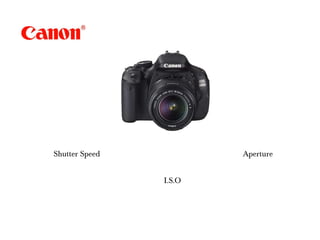
I.S.O Aperture Shutter Speed
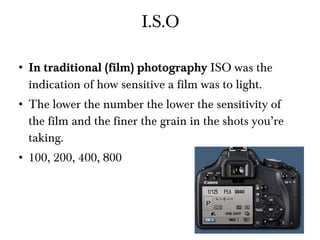
I.S.O In traditional (film) photography  ISO was the indication of how sensitive a film was to light. The lower the number the lower the sensitivity of the film and the finer the grain in the shots you’re taking. 100, 200, 400, 800
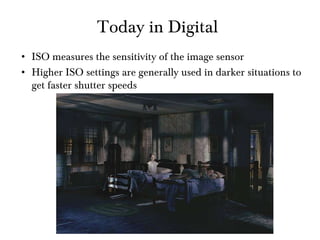
Today in Digital ISO measures the sensitivity of the image sensor Higher ISO settings are generally used in darker situations to get faster shutter speeds
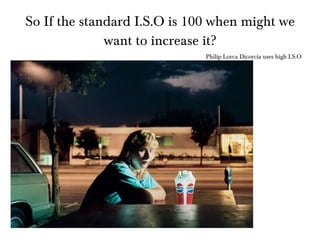
So If the standard I.S.O is 100 when might we want to increase it? Philip Lorca Dicorcia uses high I.S.O
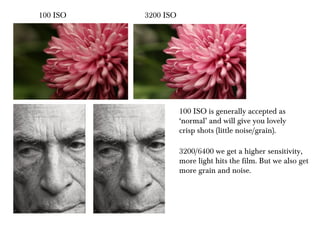
100 ISO 3200 ISO 100 ISO is generally accepted as ‘normal’ and will give you lovely crisp shots (little noise/grain).  3200/6400 we get a higher sensitivity, more light hits the film. But we also get more grain and noise.
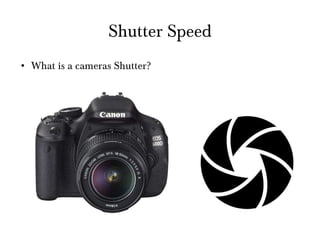
Shutter Speed What is a cameras Shutter?
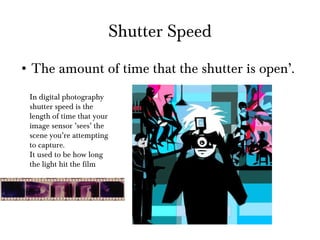
Shutter Speed The amount of time that the shutter is open’. In digital photography shutter speed is the length of time that your image sensor ’sees’ the scene you’re attempting to capture. It used to be how long the light hit the film
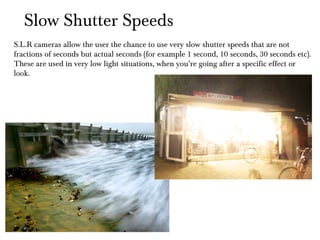
Slow Shutter Speeds S.L.R cameras allow the user the chance to use very slow shutter speeds that are not  fractions of seconds but actual seconds (for example 1 second, 10 seconds, 30 seconds etc). These are used in very low light situations, when you’re going after a specific effect or look.
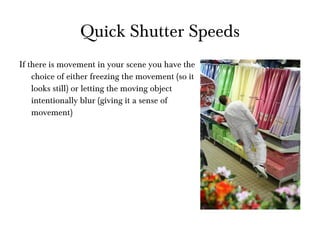
Quick Shutter Speeds If there is movement in your scene you have the choice of either freezing the movement (so it looks still) or letting the moving object intentionally blur (giving it a sense of movement)
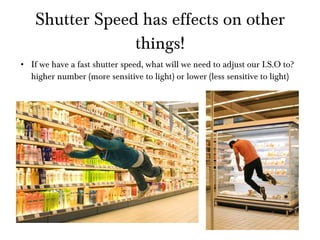
Shutter Speed has effects on other things! If we have a fast shutter speed, what will we need to adjust our I.S.O to? higher number (more sensitive to light) or lower (less sensitive to light)
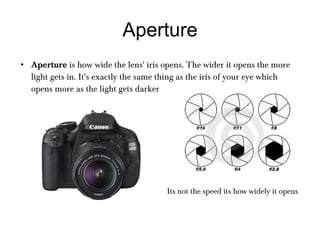
Aperture Aperture  is how wide the lens' iris opens. The wider it opens the more light gets in. It's exactly the same thing as the iris of your eye which opens more as the light gets darker Its not the speed its how widely it opens
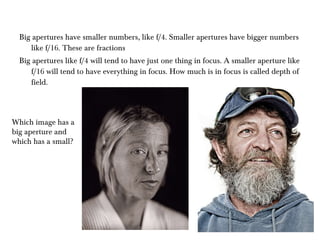
Big apertures have smaller numbers, like f/4. Smaller apertures have bigger numbers like f/16. These are fractions  Big apertures like f/4 will tend to have just one thing in focus. A smaller aperture like f/16 will tend to have everything in focus. How much is in focus is called depth of field.  Which image has a big aperture and which has a small?

Iso aperture shutter speed tech

  • 1.
  • 2.
    What makes aperson a photography? Not just someone snapping pictures? What genres of photography have you come across and what is your favourite genre of photography? What in your life are you passionate about? (possible subject matter for your coursework) Photography Questionnaire
  • 3.
  • 4.
    I.S.O In traditional(film) photography ISO was the indication of how sensitive a film was to light. The lower the number the lower the sensitivity of the film and the finer the grain in the shots you’re taking. 100, 200, 400, 800
  • 5.
    Today in DigitalISO measures the sensitivity of the image sensor Higher ISO settings are generally used in darker situations to get faster shutter speeds
  • 6.
    So If thestandard I.S.O is 100 when might we want to increase it? Philip Lorca Dicorcia uses high I.S.O
  • 7.
    100 ISO 3200ISO 100 ISO is generally accepted as ‘normal’ and will give you lovely crisp shots (little noise/grain). 3200/6400 we get a higher sensitivity, more light hits the film. But we also get more grain and noise.
  • 8.
    Shutter Speed Whatis a cameras Shutter?
  • 9.
    Shutter Speed Theamount of time that the shutter is open’. In digital photography shutter speed is the length of time that your image sensor ’sees’ the scene you’re attempting to capture. It used to be how long the light hit the film
  • 10.
    Slow Shutter SpeedsS.L.R cameras allow the user the chance to use very slow shutter speeds that are not fractions of seconds but actual seconds (for example 1 second, 10 seconds, 30 seconds etc). These are used in very low light situations, when you’re going after a specific effect or look.
  • 11.
    Quick Shutter SpeedsIf there is movement in your scene you have the choice of either freezing the movement (so it looks still) or letting the moving object intentionally blur (giving it a sense of movement)
  • 12.
    Shutter Speed haseffects on other things! If we have a fast shutter speed, what will we need to adjust our I.S.O to? higher number (more sensitive to light) or lower (less sensitive to light)
  • 13.
    Aperture Aperture is how wide the lens' iris opens. The wider it opens the more light gets in. It's exactly the same thing as the iris of your eye which opens more as the light gets darker Its not the speed its how widely it opens
  • 14.
    Big apertures havesmaller numbers, like f/4. Smaller apertures have bigger numbers like f/16. These are fractions Big apertures like f/4 will tend to have just one thing in focus. A smaller aperture like f/16 will tend to have everything in focus. How much is in focus is called depth of field. Which image has a big aperture and which has a small?