ISO 9001:2015 DIS
Section 9, Performance
01/04/15 © 2014 Cavendish Scott, Inc.
www.CavendishScott.com
1
Overall purpose of this presentation
• Provide a comparison between the similar requirements of ISO
9001:2008 clauses
• Provide an assessment of the intent
• Provide possible solutions for transition
01/04/15 © 2014 Cavendish Scott, Inc.
www.CavendishScott.com
2
Overall purpose of ISO 9001 Section 9
The purpose of ISO 9001:2015 Section 9, Performance, is for
organizations to assess conformance and effectiveness:
– Conformance to the requirements of the standard and to the
process requirements they have defined,
– Their effectiveness of processes in achieving their planned
results,
– The overall quality performance and effectiveness of their quality
management system (QMS).
01/04/15 © 2014 Cavendish Scott, Inc.
www.CavendishScott.com
3
Overall purpose of ISO 9001 Section 9
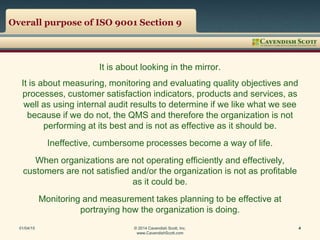
It is about looking in the mirror.
It is about measuring, monitoring and evaluating quality objectives and
processes, customer satisfaction indicators, products and services, as
well as using internal audit results to determine if we like what we see
because if we do not, the QMS and therefore the organization is not
performing at its best and is not as effective as it should be.
Ineffective, cumbersome processes become a way of life.
When organizations are not operating efficiently and effectively,
customers are not satisfied and/or the organization is not as profitable
as it could be.
Monitoring and measurement takes planning to be effective at
portraying how the organization is doing.
01/04/15 © 2014 Cavendish Scott, Inc.
www.CavendishScott.com
4
Overall purpose of ISO 9001 Section 9
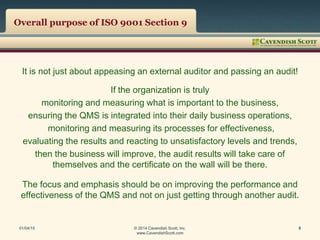
It is not just about appeasing an external auditor and passing an audit!
If the organization is truly
monitoring and measuring what is important to the business,
ensuring the QMS is integrated into their daily business operations,
monitoring and measuring its processes for effectiveness,
evaluating the results and reacting to unsatisfactory levels and trends,
then the business will improve, the audit results will take care of
themselves and the certificate on the wall will be there.
The focus and emphasis should be on improving the performance and
effectiveness of the QMS and not on just getting through another audit.
01/04/15 © 2014 Cavendish Scott, Inc.
www.CavendishScott.com
5
2015 v. 2008 Comparison
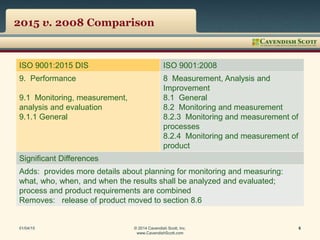
ISO 9001:2015 DIS ISO 9001:2008
9. Performance
9.1 Monitoring, measurement,
analysis and evaluation
9.1.1 General
8 Measurement, Analysis and
Improvement
8.1 General
8.2 Monitoring and measurement
8.2.3 Monitoring and measurement of
processes
8.2.4 Monitoring and measurement of
product
Significant Differences
Adds: provides more details about planning for monitoring and measuring:
what, who, when, and when the results shall be analyzed and evaluated;
process and product requirements are combined
Removes: release of product moved to section 8.6
01/04/15 © 2014 Cavendish Scott, Inc.
www.CavendishScott.com
6
2008 v. 2015 Comparison
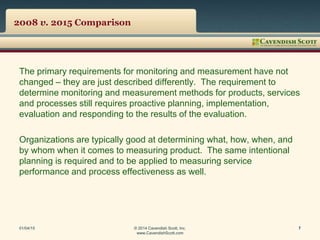
The primary requirements for monitoring and measurement have not
changed – they are just described differently. The requirement to
determine monitoring and measurement methods for products, services
and processes still requires proactive planning, implementation,
evaluation and responding to the results of the evaluation.
Organizations are typically good at determining what, how, when, and
by whom when it comes to measuring product. The same intentional
planning is required and to be applied to measuring service
performance and process effectiveness as well.
01/04/15 © 2014 Cavendish Scott, Inc.
www.CavendishScott.com
7
What do you need to do?
• Ensure you have objective evidence of planning for process
monitoring and measurement, including details of what, when, how,
and when the results will be evaluated. If the
• Limiting this planning and evaluation to the annual management
review will not provide the benefit to the organization as intended so
consider a more frequent review
• Ensure there is evidence of what actions are taken when
performance in both product and process measurements are below
satisfactory levels
01/04/15 © 2014 Cavendish Scott, Inc.
www.CavendishScott.com
8
2015 v. 2008 Comparison
ISO 9001:2015 DIS ISO 9001:2008
9.1.2 Customer satisfaction 8.2.1 Customer satisfaction
Significant Differences
Adds: “to the degree” to which customer requirements have been met;
obtaining information relating to customer views and opinions of the
organization and its products and services; market share analysis in the Note
Removes: lost business analysis in the Note
01/04/15 © 2014 Cavendish Scott, Inc.
www.CavendishScott.com
9
2008 v. 2015 Comparison
Determining the customers’ perception of the organization’s
performance has basically not changed. However, it is now referred to
as the “degree to which customer requirements have been met.”
The primary change is adding the requirement to plan how the
organization will obtain information relating to customer views and
opinions of the organization itself and its products and services and not
just to how it met customer requirements.
As before, a proactive approach to soliciting information is expected
rather than just waiting for positive and negative feedback to appear.
01/04/15 © 2014 Cavendish Scott, Inc.
www.CavendishScott.com
10
What do you need to do?
• Ensure there is a plan for obtaining customer feedback –
proactively as well as reactively.
• Ensure the plan includes gathering information on the organization
as well as the products and services provided.
• Ensure the plan is implemented
• Ensure the results are evaluated and appropriate follow-through
activities ensue.
01/04/15 © 2014 Cavendish Scott, Inc.
www.CavendishScott.com
11
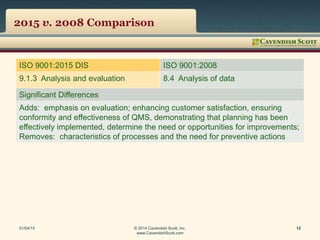
2015 v. 2008 Comparison
ISO 9001:2015 DIS ISO 9001:2008
9.1.3 Analysis and evaluation 8.4 Analysis of data
Significant Differences
Adds: emphasis on evaluation; enhancing customer satisfaction, ensuring
conformity and effectiveness of QMS, demonstrating that planning has been
effectively implemented, determine the need or opportunities for improvements;
Removes: characteristics of processes and the need for preventive actions
01/04/15 © 2014 Cavendish Scott, Inc.
www.CavendishScott.com
12
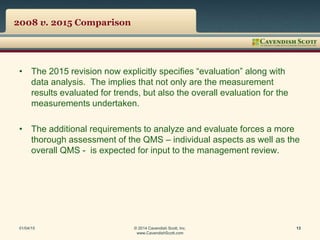
2008 v. 2015 Comparison
• The 2015 revision now explicitly specifies “evaluation” along with
data analysis. The implies that not only are the measurement
results evaluated for trends, but also the overall evaluation for the
measurements undertaken.
• The additional requirements to analyze and evaluate forces a more
thorough assessment of the QMS – individual aspects as well as the
overall QMS - is expected for input to the management review.
01/04/15 © 2014 Cavendish Scott, Inc.
www.CavendishScott.com
13
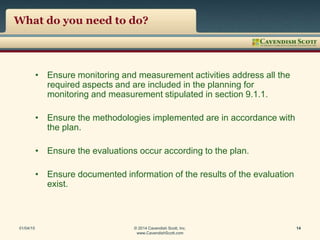
What do you need to do?
• Ensure monitoring and measurement activities address all the
required aspects and are included in the planning for
monitoring and measurement stipulated in section 9.1.1.
• Ensure the methodologies implemented are in accordance with
the plan.
• Ensure the evaluations occur according to the plan.
• Ensure documented information of the results of the evaluation
exist.
01/04/15 © 2014 Cavendish Scott, Inc.
www.CavendishScott.com
14
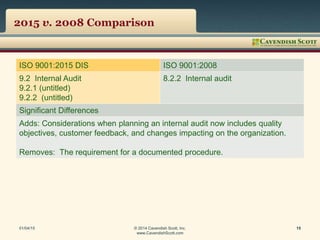
2015 v. 2008 Comparison
ISO 9001:2015 DIS ISO 9001:2008
9.2 Internal Audit
9.2.1 (untitled)
9.2.2 (untitled)
8.2.2 Internal audit
Significant Differences
Adds: Considerations when planning an internal audit now includes quality
objectives, customer feedback, and changes impacting on the organization.
Removes: The requirement for a documented procedure.
01/04/15 © 2014 Cavendish Scott, Inc.
www.CavendishScott.com
15
9.2 Internal Audits
The overall intent of internal audits has not changed – the intent is still
to determine whether or not the quality management system conforms
to the requirements of the standard as well as the organization’s own
requirements. This falls into the “check” aspect of the Plan-Do-Check-
Act approach.
Section 9.2.1 states: The organization shall conduct internal audits at
planned results to provide information on whether the quality
management system…b) is effectively implemented and maintained.
• This implies that the internal audits must determine the processes
audited within the QMS are effective: planned activities are realized
and planned results are achieved.
01/04/15 © 2014 Cavendish Scott, Inc.
www.CavendishScott.com
16
2015 v. 2008 Comparison
• There are no process changes for Internal Audits or changes to how
they are planned and performed.
• “The management responsible for the area being audited” is now
identified as “relevant management” implying that results may be of
importance to areas of the organization other than just the area
being audited.
01/04/15 © 2014 Cavendish Scott, Inc.
www.CavendishScott.com
17
2015 v. 2008 Comparison
The emphasis on auditing quality objectives, customer feedback, and
changes impacting on the organization provides a significant difference
to the expected audit results. And of course, a third-party auditor will
expect to see evidence of audit results for these areas.
– Quality objectives: increased consideration implies a focus on
planning for quality objectives, assessing appropriateness of the
objectives, the method for collecting the data and its analysis
and evaluation, actual performance levels indicating process
effectiveness (or not), and follow-up activities to the evaluation of
the results.
01/04/15 © 2014 Cavendish Scott, Inc.
www.CavendishScott.com
18
2015 v. 2008 Comparison
– Customer feedback: specifically auditing customer feedback ties
into the determination of customer satisfaction. The internal
audit should be able to confirm that customer satisfaction, as
demonstrated by satisfaction survey results and/or other
indicators, is truly indicative of or takes into consideration
feedback received, product returns, etc.
– Change management: this will require a thorough assessment
of top management’s commitment to integrate the QMS into
strategic planning and how the QMS is included when changes
are planned and implemented.
01/04/15 © 2014 Cavendish Scott, Inc.
www.CavendishScott.com
19
What do you need to do?
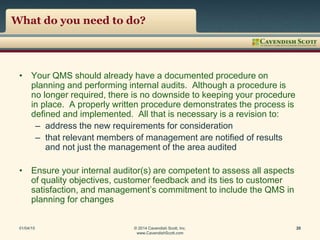
• Your QMS should already have a documented procedure on
planning and performing internal audits. Although a procedure is
no longer required, there is no downside to keeping your procedure
in place. A properly written procedure demonstrates the process is
defined and implemented. All that is necessary is a revision to:
– address the new requirements for consideration
– that relevant members of management are notified of results
and not just the management of the area audited
• Ensure your internal auditor(s) are competent to assess all aspects
of quality objectives, customer feedback and its ties to customer
satisfaction, and management’s commitment to include the QMS in
planning for changes
01/04/15 © 2014 Cavendish Scott, Inc.
www.CavendishScott.com
20
What do you need to do?
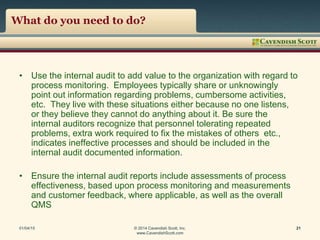
• Use the internal audit to add value to the organization with regard to
process monitoring. Employees typically share or unknowingly
point out information regarding problems, cumbersome activities,
etc. They live with these situations either because no one listens,
or they believe they cannot do anything about it. Be sure the
internal auditors recognize that personnel tolerating repeated
problems, extra work required to fix the mistakes of others etc.,
indicates ineffective processes and should be included in the
internal audit documented information.
• Ensure the internal audit reports include assessments of process
effectiveness, based upon process monitoring and measurements
and customer feedback, where applicable, as well as the overall
QMS
01/04/15 © 2014 Cavendish Scott, Inc.
www.CavendishScott.com
21
2015 v. 2008 Comparison
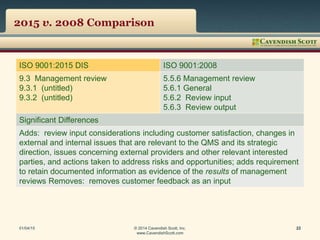
ISO 9001:2015 DIS ISO 9001:2008
9.3 Management review
9.3.1 (untitled)
9.3.2 (untitled)
5.5.6 Management review
5.6.1 General
5.6.2 Review input
5.6.3 Review output
Significant Differences
Adds: review input considerations including customer satisfaction, changes in
external and internal issues that are relevant to the QMS and its strategic
direction, issues concerning external providers and other relevant interested
parties, and actions taken to address risks and opportunities; adds requirement
to retain documented information as evidence of the results of management
reviews Removes: removes customer feedback as an input
01/04/15 © 2014 Cavendish Scott, Inc.
www.CavendishScott.com
22
9.3 Management review
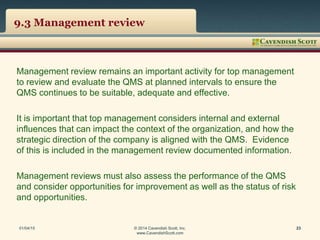
Management review remains an important activity for top management
to review and evaluate the QMS at planned intervals to ensure the
QMS continues to be suitable, adequate and effective.
It is important that top management considers internal and external
influences that can impact the context of the organization, and how the
strategic direction of the company is aligned with the QMS. Evidence
of this is included in the management review documented information.
Management reviews must also assess the performance of the QMS
and consider opportunities for improvement as well as the status of risk
and opportunities.
01/04/15 © 2014 Cavendish Scott, Inc.
www.CavendishScott.com
23
2015 v. 2008 Comparison
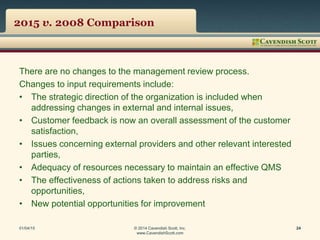
There are no changes to the management review process.
Changes to input requirements include:
• The strategic direction of the organization is included when
addressing changes in external and internal issues,
• Customer feedback is now an overall assessment of the customer
satisfaction,
• Issues concerning external providers and other relevant interested
parties,
• Adequacy of resources necessary to maintain an effective QMS
• The effectiveness of actions taken to address risks and
opportunities,
• New potential opportunities for improvement
01/04/15 © 2014 Cavendish Scott, Inc.
www.CavendishScott.com
24
2015 v. 2008 Comparison
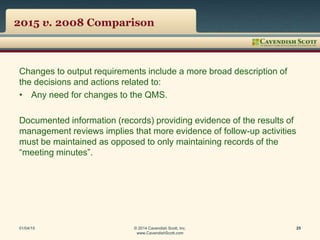
Changes to output requirements include a more broad description of
the decisions and actions related to:
• Any need for changes to the QMS.
Documented information (records) providing evidence of the results of
management reviews implies that more evidence of follow-up activities
must be maintained as opposed to only maintaining records of the
“meeting minutes”.
01/04/15 © 2014 Cavendish Scott, Inc.
www.CavendishScott.com
25
What you need to do
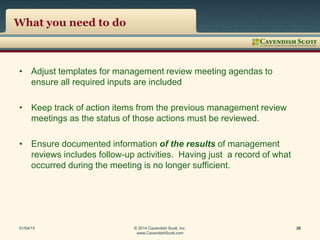
• Adjust templates for management review meeting agendas to
ensure all required inputs are included
• Keep track of action items from the previous management review
meetings as the status of those actions must be reviewed.
• Ensure documented information of the results of management
reviews includes follow-up activities. Having just a record of what
occurred during the meeting is no longer sufficient.
01/04/15 © 2014 Cavendish Scott, Inc.
www.CavendishScott.com
26
We are here to help!
For more information please contact us!
• Colin Gray
– colin@cavendishscott.com 303 668 2500
• Emily Myers
– emily@cavendishscott.com 720 226 5968
• Dave Moskal
– dave@cavendishscott.com 303 386 6788
• Diana Lough
– diana@cavendishscott.com 720 212 7300
Or visit our Website for current status:
www.cavendishscott.com
01/04/15 © 2014 Cavendish Scott, Inc.
www.CavendishScott.com
27

ISO 9001 2015 DIS 9.0 performance 1-04-15

  • 1.
    ISO 9001:2015 DIS Section9, Performance 01/04/15 © 2014 Cavendish Scott, Inc. www.CavendishScott.com 1
  • 2.
    Overall purpose ofthis presentation • Provide a comparison between the similar requirements of ISO 9001:2008 clauses • Provide an assessment of the intent • Provide possible solutions for transition 01/04/15 © 2014 Cavendish Scott, Inc. www.CavendishScott.com 2
  • 3.
    Overall purpose ofISO 9001 Section 9 The purpose of ISO 9001:2015 Section 9, Performance, is for organizations to assess conformance and effectiveness: – Conformance to the requirements of the standard and to the process requirements they have defined, – Their effectiveness of processes in achieving their planned results, – The overall quality performance and effectiveness of their quality management system (QMS). 01/04/15 © 2014 Cavendish Scott, Inc. www.CavendishScott.com 3
  • 4.
    Overall purpose ofISO 9001 Section 9 It is about looking in the mirror. It is about measuring, monitoring and evaluating quality objectives and processes, customer satisfaction indicators, products and services, as well as using internal audit results to determine if we like what we see because if we do not, the QMS and therefore the organization is not performing at its best and is not as effective as it should be. Ineffective, cumbersome processes become a way of life. When organizations are not operating efficiently and effectively, customers are not satisfied and/or the organization is not as profitable as it could be. Monitoring and measurement takes planning to be effective at portraying how the organization is doing. 01/04/15 © 2014 Cavendish Scott, Inc. www.CavendishScott.com 4
  • 5.
    Overall purpose ofISO 9001 Section 9 It is not just about appeasing an external auditor and passing an audit! If the organization is truly monitoring and measuring what is important to the business, ensuring the QMS is integrated into their daily business operations, monitoring and measuring its processes for effectiveness, evaluating the results and reacting to unsatisfactory levels and trends, then the business will improve, the audit results will take care of themselves and the certificate on the wall will be there. The focus and emphasis should be on improving the performance and effectiveness of the QMS and not on just getting through another audit. 01/04/15 © 2014 Cavendish Scott, Inc. www.CavendishScott.com 5
  • 6.
    2015 v. 2008Comparison ISO 9001:2015 DIS ISO 9001:2008 9. Performance 9.1 Monitoring, measurement, analysis and evaluation 9.1.1 General 8 Measurement, Analysis and Improvement 8.1 General 8.2 Monitoring and measurement 8.2.3 Monitoring and measurement of processes 8.2.4 Monitoring and measurement of product Significant Differences Adds: provides more details about planning for monitoring and measuring: what, who, when, and when the results shall be analyzed and evaluated; process and product requirements are combined Removes: release of product moved to section 8.6 01/04/15 © 2014 Cavendish Scott, Inc. www.CavendishScott.com 6
  • 7.
    2008 v. 2015Comparison The primary requirements for monitoring and measurement have not changed – they are just described differently. The requirement to determine monitoring and measurement methods for products, services and processes still requires proactive planning, implementation, evaluation and responding to the results of the evaluation. Organizations are typically good at determining what, how, when, and by whom when it comes to measuring product. The same intentional planning is required and to be applied to measuring service performance and process effectiveness as well. 01/04/15 © 2014 Cavendish Scott, Inc. www.CavendishScott.com 7
  • 8.
    What do youneed to do? • Ensure you have objective evidence of planning for process monitoring and measurement, including details of what, when, how, and when the results will be evaluated. If the • Limiting this planning and evaluation to the annual management review will not provide the benefit to the organization as intended so consider a more frequent review • Ensure there is evidence of what actions are taken when performance in both product and process measurements are below satisfactory levels 01/04/15 © 2014 Cavendish Scott, Inc. www.CavendishScott.com 8
  • 9.
    2015 v. 2008Comparison ISO 9001:2015 DIS ISO 9001:2008 9.1.2 Customer satisfaction 8.2.1 Customer satisfaction Significant Differences Adds: “to the degree” to which customer requirements have been met; obtaining information relating to customer views and opinions of the organization and its products and services; market share analysis in the Note Removes: lost business analysis in the Note 01/04/15 © 2014 Cavendish Scott, Inc. www.CavendishScott.com 9
  • 10.
    2008 v. 2015Comparison Determining the customers’ perception of the organization’s performance has basically not changed. However, it is now referred to as the “degree to which customer requirements have been met.” The primary change is adding the requirement to plan how the organization will obtain information relating to customer views and opinions of the organization itself and its products and services and not just to how it met customer requirements. As before, a proactive approach to soliciting information is expected rather than just waiting for positive and negative feedback to appear. 01/04/15 © 2014 Cavendish Scott, Inc. www.CavendishScott.com 10
  • 11.
    What do youneed to do? • Ensure there is a plan for obtaining customer feedback – proactively as well as reactively. • Ensure the plan includes gathering information on the organization as well as the products and services provided. • Ensure the plan is implemented • Ensure the results are evaluated and appropriate follow-through activities ensue. 01/04/15 © 2014 Cavendish Scott, Inc. www.CavendishScott.com 11
  • 12.
    2015 v. 2008Comparison ISO 9001:2015 DIS ISO 9001:2008 9.1.3 Analysis and evaluation 8.4 Analysis of data Significant Differences Adds: emphasis on evaluation; enhancing customer satisfaction, ensuring conformity and effectiveness of QMS, demonstrating that planning has been effectively implemented, determine the need or opportunities for improvements; Removes: characteristics of processes and the need for preventive actions 01/04/15 © 2014 Cavendish Scott, Inc. www.CavendishScott.com 12
  • 13.
    2008 v. 2015Comparison • The 2015 revision now explicitly specifies “evaluation” along with data analysis. The implies that not only are the measurement results evaluated for trends, but also the overall evaluation for the measurements undertaken. • The additional requirements to analyze and evaluate forces a more thorough assessment of the QMS – individual aspects as well as the overall QMS - is expected for input to the management review. 01/04/15 © 2014 Cavendish Scott, Inc. www.CavendishScott.com 13
  • 14.
    What do youneed to do? • Ensure monitoring and measurement activities address all the required aspects and are included in the planning for monitoring and measurement stipulated in section 9.1.1. • Ensure the methodologies implemented are in accordance with the plan. • Ensure the evaluations occur according to the plan. • Ensure documented information of the results of the evaluation exist. 01/04/15 © 2014 Cavendish Scott, Inc. www.CavendishScott.com 14
  • 15.
    2015 v. 2008Comparison ISO 9001:2015 DIS ISO 9001:2008 9.2 Internal Audit 9.2.1 (untitled) 9.2.2 (untitled) 8.2.2 Internal audit Significant Differences Adds: Considerations when planning an internal audit now includes quality objectives, customer feedback, and changes impacting on the organization. Removes: The requirement for a documented procedure. 01/04/15 © 2014 Cavendish Scott, Inc. www.CavendishScott.com 15
  • 16.
    9.2 Internal Audits Theoverall intent of internal audits has not changed – the intent is still to determine whether or not the quality management system conforms to the requirements of the standard as well as the organization’s own requirements. This falls into the “check” aspect of the Plan-Do-Check- Act approach. Section 9.2.1 states: The organization shall conduct internal audits at planned results to provide information on whether the quality management system…b) is effectively implemented and maintained. • This implies that the internal audits must determine the processes audited within the QMS are effective: planned activities are realized and planned results are achieved. 01/04/15 © 2014 Cavendish Scott, Inc. www.CavendishScott.com 16
  • 17.
    2015 v. 2008Comparison • There are no process changes for Internal Audits or changes to how they are planned and performed. • “The management responsible for the area being audited” is now identified as “relevant management” implying that results may be of importance to areas of the organization other than just the area being audited. 01/04/15 © 2014 Cavendish Scott, Inc. www.CavendishScott.com 17
  • 18.
    2015 v. 2008Comparison The emphasis on auditing quality objectives, customer feedback, and changes impacting on the organization provides a significant difference to the expected audit results. And of course, a third-party auditor will expect to see evidence of audit results for these areas. – Quality objectives: increased consideration implies a focus on planning for quality objectives, assessing appropriateness of the objectives, the method for collecting the data and its analysis and evaluation, actual performance levels indicating process effectiveness (or not), and follow-up activities to the evaluation of the results. 01/04/15 © 2014 Cavendish Scott, Inc. www.CavendishScott.com 18
  • 19.
    2015 v. 2008Comparison – Customer feedback: specifically auditing customer feedback ties into the determination of customer satisfaction. The internal audit should be able to confirm that customer satisfaction, as demonstrated by satisfaction survey results and/or other indicators, is truly indicative of or takes into consideration feedback received, product returns, etc. – Change management: this will require a thorough assessment of top management’s commitment to integrate the QMS into strategic planning and how the QMS is included when changes are planned and implemented. 01/04/15 © 2014 Cavendish Scott, Inc. www.CavendishScott.com 19
  • 20.
    What do youneed to do? • Your QMS should already have a documented procedure on planning and performing internal audits. Although a procedure is no longer required, there is no downside to keeping your procedure in place. A properly written procedure demonstrates the process is defined and implemented. All that is necessary is a revision to: – address the new requirements for consideration – that relevant members of management are notified of results and not just the management of the area audited • Ensure your internal auditor(s) are competent to assess all aspects of quality objectives, customer feedback and its ties to customer satisfaction, and management’s commitment to include the QMS in planning for changes 01/04/15 © 2014 Cavendish Scott, Inc. www.CavendishScott.com 20
  • 21.
    What do youneed to do? • Use the internal audit to add value to the organization with regard to process monitoring. Employees typically share or unknowingly point out information regarding problems, cumbersome activities, etc. They live with these situations either because no one listens, or they believe they cannot do anything about it. Be sure the internal auditors recognize that personnel tolerating repeated problems, extra work required to fix the mistakes of others etc., indicates ineffective processes and should be included in the internal audit documented information. • Ensure the internal audit reports include assessments of process effectiveness, based upon process monitoring and measurements and customer feedback, where applicable, as well as the overall QMS 01/04/15 © 2014 Cavendish Scott, Inc. www.CavendishScott.com 21
  • 22.
    2015 v. 2008Comparison ISO 9001:2015 DIS ISO 9001:2008 9.3 Management review 9.3.1 (untitled) 9.3.2 (untitled) 5.5.6 Management review 5.6.1 General 5.6.2 Review input 5.6.3 Review output Significant Differences Adds: review input considerations including customer satisfaction, changes in external and internal issues that are relevant to the QMS and its strategic direction, issues concerning external providers and other relevant interested parties, and actions taken to address risks and opportunities; adds requirement to retain documented information as evidence of the results of management reviews Removes: removes customer feedback as an input 01/04/15 © 2014 Cavendish Scott, Inc. www.CavendishScott.com 22
  • 23.
    9.3 Management review Managementreview remains an important activity for top management to review and evaluate the QMS at planned intervals to ensure the QMS continues to be suitable, adequate and effective. It is important that top management considers internal and external influences that can impact the context of the organization, and how the strategic direction of the company is aligned with the QMS. Evidence of this is included in the management review documented information. Management reviews must also assess the performance of the QMS and consider opportunities for improvement as well as the status of risk and opportunities. 01/04/15 © 2014 Cavendish Scott, Inc. www.CavendishScott.com 23
  • 24.
    2015 v. 2008Comparison There are no changes to the management review process. Changes to input requirements include: • The strategic direction of the organization is included when addressing changes in external and internal issues, • Customer feedback is now an overall assessment of the customer satisfaction, • Issues concerning external providers and other relevant interested parties, • Adequacy of resources necessary to maintain an effective QMS • The effectiveness of actions taken to address risks and opportunities, • New potential opportunities for improvement 01/04/15 © 2014 Cavendish Scott, Inc. www.CavendishScott.com 24
  • 25.
    2015 v. 2008Comparison Changes to output requirements include a more broad description of the decisions and actions related to: • Any need for changes to the QMS. Documented information (records) providing evidence of the results of management reviews implies that more evidence of follow-up activities must be maintained as opposed to only maintaining records of the “meeting minutes”. 01/04/15 © 2014 Cavendish Scott, Inc. www.CavendishScott.com 25
  • 26.
    What you needto do • Adjust templates for management review meeting agendas to ensure all required inputs are included • Keep track of action items from the previous management review meetings as the status of those actions must be reviewed. • Ensure documented information of the results of management reviews includes follow-up activities. Having just a record of what occurred during the meeting is no longer sufficient. 01/04/15 © 2014 Cavendish Scott, Inc. www.CavendishScott.com 26
  • 27.
    We are hereto help! For more information please contact us! • Colin Gray – colin@cavendishscott.com 303 668 2500 • Emily Myers – emily@cavendishscott.com 720 226 5968 • Dave Moskal – dave@cavendishscott.com 303 386 6788 • Diana Lough – diana@cavendishscott.com 720 212 7300 Or visit our Website for current status: www.cavendishscott.com 01/04/15 © 2014 Cavendish Scott, Inc. www.CavendishScott.com 27