ISO 9001:2008

Benefits for growing
   organizations
Standards
    Unit Measurement.
1.    Measuring Tapes :Ex-Meter, Kilo Meter Etc
2.    Weighing Balance: Ex - Grams, Kg Etc
Standards
 Indian              International
  Standards            Standards
 : ISI                 : ISO
Indian               International
  Standards          Organization for
  Institutes           Standardization
Quality
   Future of the product.
   Conformance to the requirement.
   Expectation of the customer.
   Inheritant characteristics of the
    product.
Organizations already have established
            management systems
   These systems do have some or the other operating
    problem
    • Inability to ensure consistency in quality
            of inputs
            in processes
            of deliverables
    •   Ongoing confusions in employee functionalities
    •   Repeating mistakes
    •   Absence of customer satisfaction assurance
    •   Employee unrest
    •   Increasing ‘Cost of Poor Quality’ (cost incurred due to absence
        of quality)
   Long term continuity can not be guaranteed with
    traditional systems
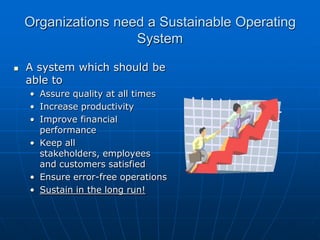
Organizations need a Sustainable Operating
                     System

   A system which should be
    able to
    • Assure quality at all times
    • Increase productivity
    • Improve financial
      performance
    • Keep all
      stakeholders, employees
      and customers satisfied
    • Ensure error-free operations
    • Sustain in the long run!
ISO 9001:2000 offers a sustainable
             management operating system
   ISO 9001:2000 is an internationally
    recognized Quality Management System
    • With the process approach, it covers all aspects of
      every organization – right from procurement to
      end service delivery
    • It aligns businesses for long term sustainability
    • Generic in nature, it can fit into any environment
          Commercial organizations – Manufacturers, service
           providers
          Non Profit organizations – Trusts, Governments, NGOs
    • Best of all, it is a voluntary standard
          NO legal enforcement
          One need to adopt it on will
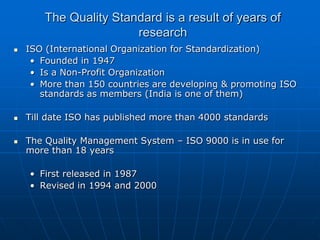
The Quality Standard is a result of years of
                        research
   ISO (International Organization for Standardization)
     • Founded in 1947
     • Is a Non-Profit Organization
     • More than 150 countries are developing & promoting ISO
       standards as members (India is one of them)

   Till date ISO has published more than 4000 standards

   The Quality Management System – ISO 9000 is in use for
    more than 18 years

    • First released in 1987
    • Revised in 1994 and 2000
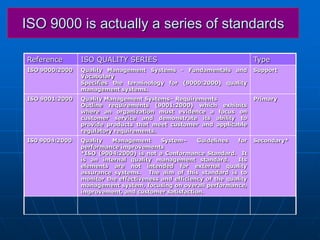
ISO 9000 is actually a series of standards

Reference       ISO QUALITY SERIES                                        Type
ISO 9000:2000   Quality Management Systems - Fundamentals and             Support
                Vocabulary
                Specifies the terminology for (9000:2000) quality
                management systems.
ISO 9001:2000   Quality Management Systems– Requirements                  Primary
                Outline requirements (9001:2000) which exhibits
                where an organization must evidence a focus on
                customer service and demonstrate its ability to
                provide products that meet customer and applicable
                regulatory requirements.
IS0 9004:2000   Quality   Management      System–     Guidelines    for   Secondary*
                performance improvements
                *ISO (9004:2000) is not a Conformance Standard. It
                is an internal quality management standard.         Its
                elements are not intended for external quality
                assurance systems. The aim of this standard is to
                monitor the effectiveness and efficiency of the quality
                management system, focusing on overall performance,
                improvement, and customer satisfaction.
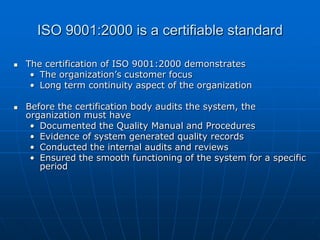
ISO 9001:2000 is a certifiable standard

   The certification of ISO 9001:2000 demonstrates
     • The organization’s customer focus
     • Long term continuity aspect of the organization

   Before the certification body audits the system, the
    organization must have
     • Documented the Quality Manual and Procedures
     • Evidence of system generated quality records
     • Conducted the internal audits and reviews
     • Ensured the smooth functioning of the system for a specific
       period
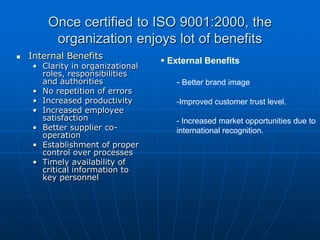
Once certified to ISO 9001:2000, the
         organization enjoys lot of benefits
   Internal Benefits
                                   External Benefits
    • Clarity in organizational
      roles, responsibilities
      and authorities                - Better brand image
    • No repetition of errors
    • Increased productivity         -Improved customer trust level.
    • Increased employee
      satisfaction                   - Increased market opportunities due to
    • Better supplier co-            international recognition.
      operation
    • Establishment of proper
      control over processes
    • Timely availability of
      critical information to
      key personnel
Quality Management Systems –
                  Requirements

   1.   Scope

   1.1 General

   This International standard specifies requirements for a
    quality management system where an organization.

   a)Needs to demonstrate its ability to consistently provide
    product that meets customer and applicable regulatory
    requirements.

   b) aims to enhance customer satisfaction through the
    effective application of the system, including processes for
    continual improvement of the system and the assurance of
    conformity to customer and applicable regulatory
    requirements.
1.2 Application

   All requirements of this International Standard are generic
    and are intended to be applicable to all
    organizations, regardless of type, size and product
    provided.

   Where any requirement(s) of this International Standard
    cannot be applied due to the nature of an organisation and
    its product, this can be considered for exclusion.

   Where exclusions are made, claims of conformity to this
    International Standard are not acceptable unless these
    exclusions are limited to requirements within clause 7, and
    such exclusions do not affect the organisation’s ability, or
    responsibility, to provide product that meets customer and
    applicable regularly requirements.
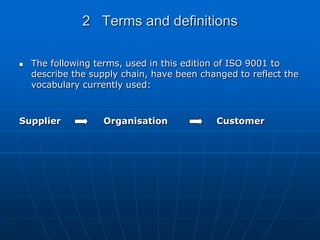
2 Terms and definitions

   The following terms, used in this edition of ISO 9001 to
    describe the supply chain, have been changed to reflect the
    vocabulary currently used:


Supplier           Organisation             Customer
4      Quality Management System


   The organisation shall establish, document, implement and maintain a
    quality management system and continually improve its effectiveness in
    accordance with the requirements of this International Standard.

   The organisation shall

    a)   identify the processes needed for the quality management system
         and their application throughout
         the organisation (see 1.2).
    b)   determine the sequence and interaction of these processes.
    c)   determine criteria and methods needed to ensure that both the
         operation and control of these
         processes are effective,
    d)   ensure the availability of resources and in formation necessary to
         support the operation and       monitoring of these processes,
    e)   monitor, measure and analyse these processes, and
    f)    Implement actions necessary to achieve planned results and
         continual improvement of these processes.

    These processes shall be managed by the organisation in accordance with
    the requirements of this International Standard.
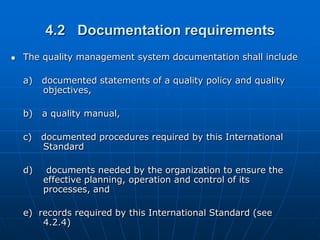
4.2 Documentation requirements
   The quality management system documentation shall include

    a)   documented statements of a quality policy and quality
         objectives,

    b)   a quality manual,

    c)   documented procedures required by this International
         Standard

    d)    documents needed by the organization to ensure the
         effective planning, operation and control of its
         processes, and

    e) records required by this International Standard (see
        4.2.4)
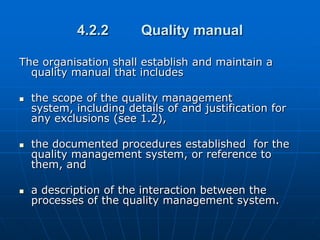
4.2.2        Quality manual

The organisation shall establish and maintain a
  quality manual that includes

   the scope of the quality management
    system, including details of and justification for
    any exclusions (see 1.2),

   the documented procedures established for the
    quality management system, or reference to
    them, and

   a description of the interaction between the
    processes of the quality management system.
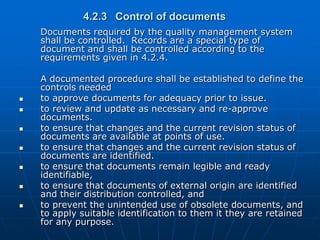
4.2.3 Control of documents
    Documents required by the quality management system
    shall be controlled. Records are a special type of
    document and shall be controlled according to the
    requirements given in 4.2.4.

    A documented procedure shall be established to define the
    controls needed
   to approve documents for adequacy prior to issue.
   to review and update as necessary and re-approve
    documents.
   to ensure that changes and the current revision status of
    documents are available at points of use.
   to ensure that changes and the current revision status of
    documents are identified.
   to ensure that documents remain legible and ready
    identifiable,
   to ensure that documents of external origin are identified
    and their distribution controlled, and
   to prevent the unintended use of obsolete documents, and
    to apply suitable identification to them it they are retained
    for any purpose.
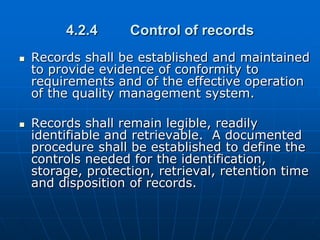
4.2.4      Control of records
   Records shall be established and maintained
    to provide evidence of conformity to
    requirements and of the effective operation
    of the quality management system.

   Records shall remain legible, readily
    identifiable and retrievable. A documented
    procedure shall be established to define the
    controls needed for the identification,
    storage, protection, retrieval, retention time
    and disposition of records.
5     Management responsibility
    5.1         Management commitment

    Top management shall provide evidence of its commitment to
    the development and implementation of the quality
    management system and continually improving its
    effectiveness by

   communicating to the organization the importance of meeting
    customer as well as statutory and regulatory requirements,

   establishing the quality policy,

   ensuring that quality objectives are established,

   conducting management reviews, and

   ensuring the availability of resources.
5.2        Customer focus

Top management shall ensure that the customer
requirements are determined and met with the
aim of enhancing customer satisfaction ( see
7.2.3 and 8.2.1)
5.3 Quality Policy

   Top management shall ensure that the Quality
    Policy
   is appropriate to the purpose of the organisation,
   includes a commitment to comply with
    requirements and continually improve the
    effectiveness of the quality management system,
   provides a framework for establishing and
    reviewing quality objectives,
   is communicated and understood within the
    organization, and
   is reviewed for continuing suitability.
5.4 Planning

5.4.1 Quality objectives

   Top management shall ensure that quality
    objectives, including those needed to meet
    requirements, for product are established at
    relevant functions and levels within the
    organisation.

    The quality objectives shall be measurable and
    consistent with the quality policy.
5.4.2 Quality management system planning


   Top management shall ensure that

   the planning of the quality management system
    is carried out in order to meet the requirements
    given in 4.1, as well as the quality objectives,
    and

   the integrity of the quality management system
    is maintained when changes to the quality
    management system are planned and
    implemented.
5.5   Responsibility, authority and
                 communication

   5.5.1     Responsibility and authority

   Top management shall ensure that responsibilities
    and authorities are defined and communicated
    within the organization.

ISO 9001:2008 (shared using http://VisualBee.com).

  • 1.
    ISO 9001:2008 Benefits forgrowing organizations
  • 2.
    Standards  Unit Measurement. 1. Measuring Tapes :Ex-Meter, Kilo Meter Etc 2. Weighing Balance: Ex - Grams, Kg Etc
  • 3.
    Standards  Indian  International Standards Standards : ISI : ISO Indian International Standards Organization for Institutes Standardization
  • 4.
    Quality  Future of the product.  Conformance to the requirement.  Expectation of the customer.  Inheritant characteristics of the product.
  • 5.
    Organizations already haveestablished management systems  These systems do have some or the other operating problem • Inability to ensure consistency in quality  of inputs  in processes  of deliverables • Ongoing confusions in employee functionalities • Repeating mistakes • Absence of customer satisfaction assurance • Employee unrest • Increasing ‘Cost of Poor Quality’ (cost incurred due to absence of quality)  Long term continuity can not be guaranteed with traditional systems
  • 6.
    Organizations need aSustainable Operating System  A system which should be able to • Assure quality at all times • Increase productivity • Improve financial performance • Keep all stakeholders, employees and customers satisfied • Ensure error-free operations • Sustain in the long run!
  • 7.
    ISO 9001:2000 offersa sustainable management operating system  ISO 9001:2000 is an internationally recognized Quality Management System • With the process approach, it covers all aspects of every organization – right from procurement to end service delivery • It aligns businesses for long term sustainability • Generic in nature, it can fit into any environment  Commercial organizations – Manufacturers, service providers  Non Profit organizations – Trusts, Governments, NGOs • Best of all, it is a voluntary standard  NO legal enforcement  One need to adopt it on will
  • 8.
    The Quality Standardis a result of years of research  ISO (International Organization for Standardization) • Founded in 1947 • Is a Non-Profit Organization • More than 150 countries are developing & promoting ISO standards as members (India is one of them)  Till date ISO has published more than 4000 standards  The Quality Management System – ISO 9000 is in use for more than 18 years • First released in 1987 • Revised in 1994 and 2000
  • 9.
    ISO 9000 isactually a series of standards Reference ISO QUALITY SERIES Type ISO 9000:2000 Quality Management Systems - Fundamentals and Support Vocabulary Specifies the terminology for (9000:2000) quality management systems. ISO 9001:2000 Quality Management Systems– Requirements Primary Outline requirements (9001:2000) which exhibits where an organization must evidence a focus on customer service and demonstrate its ability to provide products that meet customer and applicable regulatory requirements. IS0 9004:2000 Quality Management System– Guidelines for Secondary* performance improvements *ISO (9004:2000) is not a Conformance Standard. It is an internal quality management standard. Its elements are not intended for external quality assurance systems. The aim of this standard is to monitor the effectiveness and efficiency of the quality management system, focusing on overall performance, improvement, and customer satisfaction.
  • 10.
    ISO 9001:2000 isa certifiable standard  The certification of ISO 9001:2000 demonstrates • The organization’s customer focus • Long term continuity aspect of the organization  Before the certification body audits the system, the organization must have • Documented the Quality Manual and Procedures • Evidence of system generated quality records • Conducted the internal audits and reviews • Ensured the smooth functioning of the system for a specific period
  • 11.
    Once certified toISO 9001:2000, the organization enjoys lot of benefits  Internal Benefits  External Benefits • Clarity in organizational roles, responsibilities and authorities - Better brand image • No repetition of errors • Increased productivity -Improved customer trust level. • Increased employee satisfaction - Increased market opportunities due to • Better supplier co- international recognition. operation • Establishment of proper control over processes • Timely availability of critical information to key personnel
  • 12.
    Quality Management Systems– Requirements  1. Scope  1.1 General  This International standard specifies requirements for a quality management system where an organization.  a)Needs to demonstrate its ability to consistently provide product that meets customer and applicable regulatory requirements.  b) aims to enhance customer satisfaction through the effective application of the system, including processes for continual improvement of the system and the assurance of conformity to customer and applicable regulatory requirements.
  • 13.
    1.2 Application  All requirements of this International Standard are generic and are intended to be applicable to all organizations, regardless of type, size and product provided.  Where any requirement(s) of this International Standard cannot be applied due to the nature of an organisation and its product, this can be considered for exclusion.  Where exclusions are made, claims of conformity to this International Standard are not acceptable unless these exclusions are limited to requirements within clause 7, and such exclusions do not affect the organisation’s ability, or responsibility, to provide product that meets customer and applicable regularly requirements.
  • 14.
    2 Terms anddefinitions  The following terms, used in this edition of ISO 9001 to describe the supply chain, have been changed to reflect the vocabulary currently used: Supplier Organisation Customer
  • 15.
    4 Quality Management System  The organisation shall establish, document, implement and maintain a quality management system and continually improve its effectiveness in accordance with the requirements of this International Standard.  The organisation shall a) identify the processes needed for the quality management system and their application throughout the organisation (see 1.2). b) determine the sequence and interaction of these processes. c) determine criteria and methods needed to ensure that both the operation and control of these processes are effective, d) ensure the availability of resources and in formation necessary to support the operation and monitoring of these processes, e) monitor, measure and analyse these processes, and f) Implement actions necessary to achieve planned results and continual improvement of these processes. These processes shall be managed by the organisation in accordance with the requirements of this International Standard.
  • 16.
    4.2 Documentation requirements  The quality management system documentation shall include a) documented statements of a quality policy and quality objectives, b) a quality manual, c) documented procedures required by this International Standard d) documents needed by the organization to ensure the effective planning, operation and control of its processes, and e) records required by this International Standard (see 4.2.4)
  • 17.
    4.2.2 Quality manual The organisation shall establish and maintain a quality manual that includes  the scope of the quality management system, including details of and justification for any exclusions (see 1.2),  the documented procedures established for the quality management system, or reference to them, and  a description of the interaction between the processes of the quality management system.
  • 18.
    4.2.3 Control ofdocuments Documents required by the quality management system shall be controlled. Records are a special type of document and shall be controlled according to the requirements given in 4.2.4. A documented procedure shall be established to define the controls needed  to approve documents for adequacy prior to issue.  to review and update as necessary and re-approve documents.  to ensure that changes and the current revision status of documents are available at points of use.  to ensure that changes and the current revision status of documents are identified.  to ensure that documents remain legible and ready identifiable,  to ensure that documents of external origin are identified and their distribution controlled, and  to prevent the unintended use of obsolete documents, and to apply suitable identification to them it they are retained for any purpose.
  • 19.
    4.2.4 Control of records  Records shall be established and maintained to provide evidence of conformity to requirements and of the effective operation of the quality management system.  Records shall remain legible, readily identifiable and retrievable. A documented procedure shall be established to define the controls needed for the identification, storage, protection, retrieval, retention time and disposition of records.
  • 20.
    5 Management responsibility 5.1 Management commitment Top management shall provide evidence of its commitment to the development and implementation of the quality management system and continually improving its effectiveness by  communicating to the organization the importance of meeting customer as well as statutory and regulatory requirements,  establishing the quality policy,  ensuring that quality objectives are established,  conducting management reviews, and  ensuring the availability of resources.
  • 21.
    5.2 Customer focus Top management shall ensure that the customer requirements are determined and met with the aim of enhancing customer satisfaction ( see 7.2.3 and 8.2.1)
  • 22.
    5.3 Quality Policy  Top management shall ensure that the Quality Policy  is appropriate to the purpose of the organisation,  includes a commitment to comply with requirements and continually improve the effectiveness of the quality management system,  provides a framework for establishing and reviewing quality objectives,  is communicated and understood within the organization, and  is reviewed for continuing suitability.
  • 23.
    5.4 Planning 5.4.1 Qualityobjectives  Top management shall ensure that quality objectives, including those needed to meet requirements, for product are established at relevant functions and levels within the organisation.  The quality objectives shall be measurable and consistent with the quality policy.
  • 24.
    5.4.2 Quality managementsystem planning  Top management shall ensure that  the planning of the quality management system is carried out in order to meet the requirements given in 4.1, as well as the quality objectives, and  the integrity of the quality management system is maintained when changes to the quality management system are planned and implemented.
  • 25.
    5.5 Responsibility, authority and communication  5.5.1 Responsibility and authority  Top management shall ensure that responsibilities and authorities are defined and communicated within the organization.