
Gladiators
of Jinnah
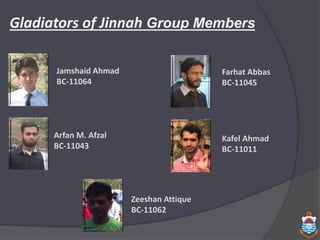
Gladiators of Jinnah Group Members
Jamshaid Ahmad
BC-11064
Farhat Abbas
BC-11045
Arfan M. Afzal
BC-11043
Kafel Ahmad
BC-11011
Zeeshan Attique
BC-11062
Subject: Islamic Finance
Presented To: Ms. Qandeel Anjum
Presented By: Gladiators of Jinnah Group
University of The Punjab
(Gujranwala Campus)
Arfan Mohammad Afzal
BC-11043
1) Islamic investment funds
2) Why we need the Islamic investment?
3) Literature review
4) Australian and Indonesia stock exchange
5) Shariah Screening Criteria
6) Dividend Purification
7) Ask from Shariah
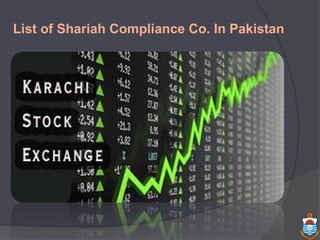
8) List of Shariah Compliance Co. in Pakistan
9) How the Conventional Business convert into Shariah Business
10) Procedure for investment in Secondary Market
Islamic investment funds mean “a joint pool
wherein the investors contribute their surplus
money for the purpose of its investment to
earn Halal profits in strict conformity with the
precepts of Islamic Shari’ah.”
Shariah-compliant Investments means
According to Abdullah ibn Masud, Radi-Allahu unhu, The
Prophet Muhammad (P.B.U.H.) said:
‘Seeking halal earning is a duty after the duty.’
In other words working to earn a halal living is itself a religious
obligation second in importance after the primary religious
obligations like prayers, fasting and hajj.
Why we need of Islamic
investment?
 It is unlawful include businesses dealing with
alcohol and pork products, gambling casinos,
movie theatres, hotels, conventional financial
services, restaurants earning mainly from
selling alcohol and airlines earning their profit
from duty free sale of alcohol and tobacco.
Question?
 Isn't safe to say that Stocks are Haram because
you are taking a RISK just like in gambling The
element of risk taking is always there. If stocks
are halal, then could you please quote from the
holy Quran, or the hadith.
Answer:
 Investment in stock is an extremely different process
from gambling, although it carries risk with it.
 In fact we developed the first integrated guidelines to
investing in the stock market (equities)/mutual funds.
 The following is a summary of the guidelines:
The following is a summary of the
guidelines:
 The spirit of investing according to Islamic
Jurisprudence is to participate in EQUITY
investing and not in debt type investing.
 Equity investing means owning equity in the
company (companies) one invests in.
 Debt investing means lending money to the
company using a RIBA instrument like a loan
promissory note or a bond.
Over Review of Islamic Investment
Islamic investment is based on Shariah principles, that is, it
prohibit activities with elements of usury (riba), gambling
(maisir), and ambiguity (gharar) and also prohibit activities like
producing products or delivering services which are against
Islamic teaching such as producing/selling alcohol, casino etc.
The Islamic financial industry is growing at a rate 50% faster
than that of conventional Industry and is expected to be worth
USD 2.1 trillion by the end of 2014
Australian Stock Exchange
 We have collated data from the Australian Stock Exchange
(ASX) for the period 2001-2013 to investigate whether
investors in Shariah products earn a higher rate of return
compared to the conventional stocks.
 Investments in financial instruments with fixed income,
such as, preferred stocks, bonds and some derivatives
(e.g. options) are unacceptable as they promise a fixed
rate of return and grant no voting rights.
 Islamic investors are not permitted to purchase stocks of
companies whose main business activities are involves in
prohibited things.
Department of Finance (University of Waikato)
Australian Stock Exchange
Shariah and Conventional Stocks Performance of
Public Companies Listed
This significant shift from conventional into Shariah financial system is
generated by three main reasons.
 First, a strong demand for Shariah-compliant financial products from
a large number of Muslim communities worldwide.
 Second, a strong demand from oil rich nations particularly the Middle
East countries which prefer to invest in Shariah-compliant products.
 The last reason is the competitiveness and the ethical focus of the
Shariah-compliant products not only attracting Muslim investors but
also non-Muslim investors.
Indonesia Stock Exchange
 Islamic finance has become systemically important
globally. With Islamic finance in more than 55 countries,
the global market for Islamic financial services, as
measured by the total volume of Shariah compliant
assets, is estimated to have increased from only $80
billion at the beginning of the last decade to $1.1 trillion
at end-2011.
Conti…
Does Shariah Complaint Stocks Perform
Better than the Conventional Stocks?
 The first Islamic Index was established in the Dow Jones Market in
December 1995 to enable Islamic fund managers to list businesses in
the capital markets.
 Since its establishment, investment in Islamic stocks has experienced
remarkable growth. At the end of 2002, there were 105 Islamic equity
funds worth approximately US$5 billion with 48 %t located in the
Middle East, 30 % in Europe and North America, and 22 % in Asia
(Falaika, 2002).
 Consequently, various capital markets and financial institutions
around the world now have established their own Islamic Indexes.
 Stocks Listed on the Australian Stock Exchange
Al Meezan Index by Board of Meezan Bank and
Mufti Muhammad Taqi Usmani
 Al Meezan Investment Management, a subsidiary of Meezan
Bank in collaboration with Karachi Stock Exchange has
introduced in Pakistan the first co-branded Islamic index of
listed companies - KSE Meezan Index.
 KMI INDEX BOOKLET The objective of KSE-Meezan Index
(KMI) is to serve as a instrument for measuring the
performance of Shariah compliant equity investments. Besides
tracking performance of Shariah compliant equities, its
construction will increase investor trust and enhance their
participation.
 KSE-Meezan Index is also calculated using the “Free-Float
Market Capitalization” for 30 companies that qualified the
Shariah screening criteria.
Case Study
Farhat Abbas
BC-11045
For Shariah compliance of stocks to be “Shariah compliant”, it
must meet ALL the six key tests given below.
Screening Criteria # 1. Business of the Investee Company
 Core business of the company must be halal and in line with
the dictates of Shariah. Hence, investment in securities of any
company dealing in conventional banking, conventional
insurance, alcoholic drinks, tobacco, pork production, arms
manufacturing, pornography or related activities is not
allowable.
 Case: Atlas Honda
Shariah Screening Criteria
(for equity securities)
Conti…
Screening Criteria # 2: Interest Bearing Debt to Total
Assets, <37%
 Debt to Asset ratio should be less than 37%. Debt, in
this case, is classified as any interest bearing debts.
Zero coupon bonds and preference shares are, both,
by definition, part of debt.
CASE Atlas Honda:
Total Debts: 512500000 ,Total Asset: 8522276000
Debt To Asset Ratio: 512500000/8522276000
=6.01%<37%
Conti…
Screening Criteria # 3: Non-Compliant Investments to
Total Assets,<33%
The ratio of Non Compliant Investments to Total Assets
should be less than 33%. Investment in any non-compliant
security shall be included for the calculation of this ratio.
CASE Atlas Honda: Total Long term Depositd:9632000
Total Asset:14365190000
=9632000/14365190000
=.067%<33%
Conti…
Screening Criteria # 4: Non-complaint Income to Total
revenue,<5%
The ratio of non compliant income to total revenue should be
less than 5%. Total revenue includes Gross revenue plus any
other income earned by the company. This amount should be
purified by shareholder by giving this amount as charity
process called PURIFICATION
CASE Atlas Honda: Total Non compliant Income:1819000
Total Rev:44899364000
=1819000 /44899364000
= .00405% < 5%
Conti…
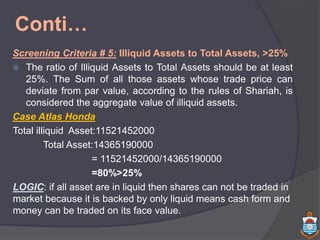
Screening Criteria # 5: Illiquid Assets to Total Assets, >25%
 The ratio of Illiquid Assets to Total Assets should be at least
25%. The Sum of all those assets whose trade price can
deviate from par value, according to the rules of Shariah, is
considered the aggregate value of illiquid assets.
Case Atlas Honda
Total illiquid Asset:11521452000
Total Asset:14365190000
= 11521452000/14365190000
=80%>25%
LOGIC: if all asset are in liquid then shares can not be traded in
market because it is backed by only liquid means cash form and
money can be traded on its face value.
Conti…
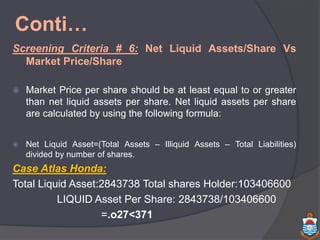
Screening Criteria # 6: Net Liquid Assets/Share Vs
Market Price/Share
 Market Price per share should be at least equal to or greater
than net liquid assets per share. Net liquid assets per share
are calculated by using the following formula:
 Net Liquid Asset=(Total Assets – Illiquid Assets – Total Liabilities)
divided by number of shares.
Case Atlas Honda:
Total Liquid Asset:2843738 Total shares Holder:103406600
LIQUID Asset Per Share: 2843738/103406600
=.o27<371
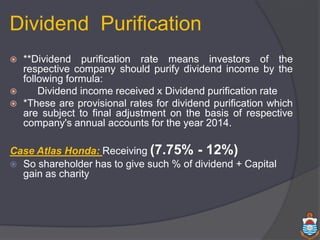
 **Dividend purification rate means investors of the
respective company should purify dividend income by the
following formula:
 Dividend income received x Dividend purification rate
 *These are provisional rates for dividend purification which
are subject to final adjustment on the basis of respective
company's annual accounts for the year 2014.
Case Atlas Honda: Receiving (7.75% - 12%)
 So shareholder has to give such % of dividend + Capital
gain as charity
Dividend Purification
Zeeshan Attique
BC-11062
Q= I am a professional accountant and apart from doing my
practice I also trade in the Stock market. I avoid badla trading,
future, Investment in companies in Banking. Leasing and
Insurance sector. What about the day trading, is it Halal or
Haram? and why so?
Answer:
View of Ulema about Day-trading is its non- permissibility.
Because in Day trading a buyer buys a scrip at say 10:30 am @ Rs.95
and sells it at 11:15 am @ Rs.96. The reason behind its non-
permissibility is that the buyer sells a commodity before he takes its
delivery that is done on Day 3 after Day of trading. Well knowingly
selling before taking possession is not allowed in Shariah.
Conti…
Q. Are the Shares of " BankIslami " Offered to
people through IPO HALAL?
Answer: Yes, BankIslami pus its efforts to do only
Shariah compliant business. I am here to see daily
operations of the Bank to make it Shariah
compliant.
Q. I would like to get your opinion about purchasing shares of
BankIslami?
On what price they could be purchased (above or under their face value) ?
Answer :
BankIslami's share could be purchased and sold at any price since the company
has financial assets along with its fixed assets
Question:
Would the Dividend from these shares be Halal?
Anawer :
Yes the Dividend is Halal
Question:
Would the Capital gains by sale of these shares be Halal?
Answer :
Capital gain is also Halal because the share itself is Halal.
Conti…
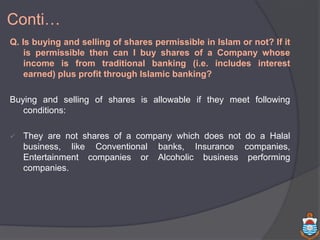
Q. Is buying and selling of shares permissible in Islam or not? If it
is permissible then can I buy shares of a Company whose
income is from traditional banking (i.e. includes interest
earned) plus profit through Islamic banking?
Buying and selling of shares is allowable if they meet following
conditions:
 They are not shares of a company which does not do a Halal
business, like Conventional banks, Insurance companies,
Entertainment companies or Alcoholic business performing
companies.
Conti…
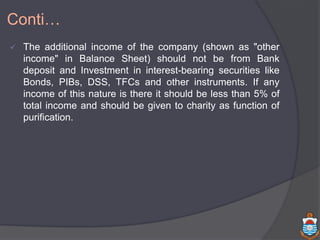
 The additional income of the company (shown as "other
income" in Balance Sheet) should not be from Bank
deposit and Investment in interest-bearing securities like
Bonds, PIBs, DSS, TFCs and other instruments. If any
income of this nature is there it should be less than 5% of
total income and should be given to charity as function of
purification.
Conti…
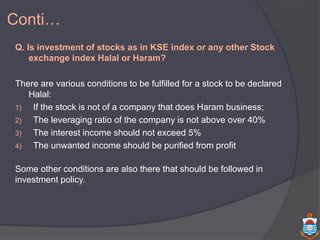
Q. Is investment of stocks as in KSE index or any other Stock
exchange index Halal or Haram?
There are various conditions to be fulfilled for a stock to be declared
Halal:
1) If the stock is not of a company that does Haram business;
2) The leveraging ratio of the company is not above over 40%
3) The interest income should not exceed 5%
4) The unwanted income should be purified from profit
Some other conditions are also there that should be followed in
investment policy.
Conti…
List of Shariah Compliance Co. In Pakistan
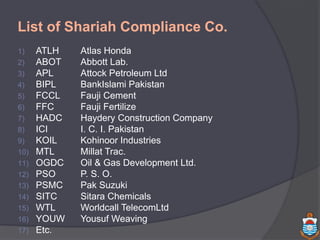
List of Shariah Compliance Co.
1) ATLH Atlas Honda
2) ABOT Abbott Lab.
3) APL Attock Petroleum Ltd
4) BIPL BankIslami Pakistan
5) FCCL Fauji Cement
6) FFC Fauji Fertilize
7) HADC Haydery Construction Company
8) ICI I. C. I. Pakistan
9) KOIL Kohinoor Industries
10) MTL Millat Trac.
11) OGDC Oil & Gas Development Ltd.
12) PSO P. S. O.
13) PSMC Pak Suzuki
14) SITC Sitara Chemicals
15) WTL Worldcall TelecomLtd
16) YOUW Yousuf Weaving
17) Etc.
Kafeel Ahmad
BC-11011
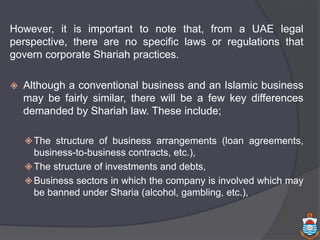
However, it is important to note that, from a UAE legal
perspective, there are no specific laws or regulations that
govern corporate Shariah practices.
 Although a conventional business and an Islamic business
may be fairly similar, there will be a few key differences
demanded by Shariah law. These include;
The structure of business arrangements (loan agreements,
business-to-business contracts, etc.),
The structure of investments and debts,
Business sectors in which the company is involved which may
be banned under Sharia (alcohol, gambling, etc.),
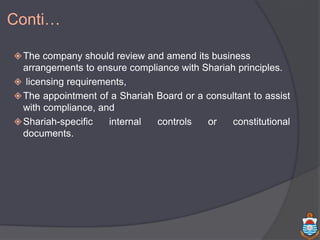
The company should review and amend its business
arrangements to ensure compliance with Shariah principles.
 licensing requirements,
The appointment of a Shariah Board or a consultant to assist
with compliance, and
Shariah-specific internal controls or constitutional
documents.
Conti…
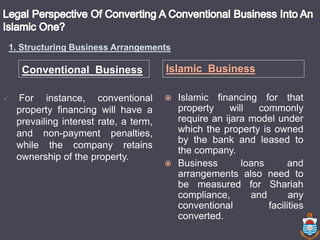
1. Structuring Business Arrangements
Islamic Business
 For instance, conventional
property financing will have a
prevailing interest rate, a term,
and non-payment penalties,
while the company retains
ownership of the property.
 Islamic financing for that
property will commonly
require an ijara model under
which the property is owned
by the bank and leased to
the company.
 Business loans and
arrangements also need to
be measured for Shariah
compliance, and any
conventional facilities
converted.
Conventional Business
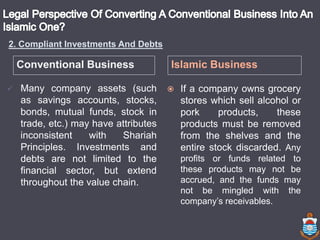
Conventional Business Islamic Business
 Many company assets (such
as savings accounts, stocks,
bonds, mutual funds, stock in
trade, etc.) may have attributes
inconsistent with Shariah
Principles. Investments and
debts are not limited to the
financial sector, but extend
throughout the value chain.
 If a company owns grocery
stores which sell alcohol or
pork products, these
products must be removed
from the shelves and the
entire stock discarded. Any
profits or funds related to
these products may not be
accrued, and the funds may
not be mingled with the
company’s receivables.
2. Compliant Investments And Debts
Conventional Business Islamic Business
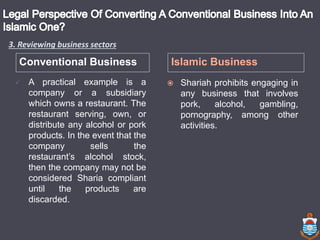
 A practical example is a
company or a subsidiary
which owns a restaurant. The
restaurant serving, own, or
distribute any alcohol or pork
products. In the event that the
company sells the
restaurant’s alcohol stock,
then the company may not be
considered Sharia compliant
until the products are
discarded.
 Shariah prohibits engaging in
any business that involves
pork, alcohol, gambling,
pornography, among other
activities.
3. Reviewing business sectors
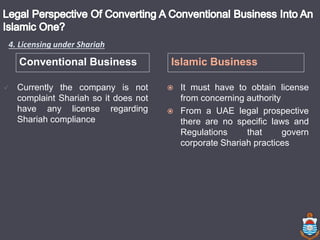
 Currently the company is not
complaint Shariah so it does not
have any license regarding
Shariah compliance
 It must have to obtain license
from concerning authority
 From a UAE legal prospective
there are no specific laws and
Regulations that govern
corporate Shariah practices
Conventional Business Islamic Business
4. Licensing under Shariah
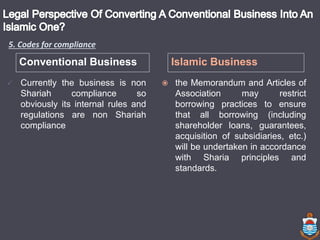
 Currently the business is non
Shariah compliance so
obviously its internal rules and
regulations are non Shariah
compliance
 the Memorandum and Articles of
Association may restrict
borrowing practices to ensure
that all borrowing (including
shareholder loans, guarantees,
acquisition of subsidiaries, etc.)
will be undertaken in accordance
with Sharia principles and
standards.
Conventional Business Islamic Business
5. Codes for compliance
Jamshaid Ahmad
BC-11064
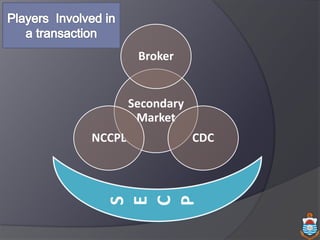
Secondary
Market
Broker
CDCNCCPL
S
E
C
P
Islamic investment Fund

Islamic investment Fund

  • 1.
  • 2.
    Gladiators of JinnahGroup Members Jamshaid Ahmad BC-11064 Farhat Abbas BC-11045 Arfan M. Afzal BC-11043 Kafel Ahmad BC-11011 Zeeshan Attique BC-11062
  • 3.
    Subject: Islamic Finance PresentedTo: Ms. Qandeel Anjum Presented By: Gladiators of Jinnah Group University of The Punjab (Gujranwala Campus)
  • 4.
  • 5.
    1) Islamic investmentfunds 2) Why we need the Islamic investment? 3) Literature review 4) Australian and Indonesia stock exchange 5) Shariah Screening Criteria 6) Dividend Purification 7) Ask from Shariah 8) List of Shariah Compliance Co. in Pakistan 9) How the Conventional Business convert into Shariah Business 10) Procedure for investment in Secondary Market
  • 6.
    Islamic investment fundsmean “a joint pool wherein the investors contribute their surplus money for the purpose of its investment to earn Halal profits in strict conformity with the precepts of Islamic Shari’ah.”
  • 7.
    Shariah-compliant Investments means Accordingto Abdullah ibn Masud, Radi-Allahu unhu, The Prophet Muhammad (P.B.U.H.) said: ‘Seeking halal earning is a duty after the duty.’ In other words working to earn a halal living is itself a religious obligation second in importance after the primary religious obligations like prayers, fasting and hajj.
  • 8.
    Why we needof Islamic investment?  It is unlawful include businesses dealing with alcohol and pork products, gambling casinos, movie theatres, hotels, conventional financial services, restaurants earning mainly from selling alcohol and airlines earning their profit from duty free sale of alcohol and tobacco.
  • 9.
    Question?  Isn't safeto say that Stocks are Haram because you are taking a RISK just like in gambling The element of risk taking is always there. If stocks are halal, then could you please quote from the holy Quran, or the hadith.
  • 10.
    Answer:  Investment instock is an extremely different process from gambling, although it carries risk with it.  In fact we developed the first integrated guidelines to investing in the stock market (equities)/mutual funds.  The following is a summary of the guidelines:
  • 11.
    The following isa summary of the guidelines:  The spirit of investing according to Islamic Jurisprudence is to participate in EQUITY investing and not in debt type investing.  Equity investing means owning equity in the company (companies) one invests in.  Debt investing means lending money to the company using a RIBA instrument like a loan promissory note or a bond.
  • 12.
    Over Review ofIslamic Investment Islamic investment is based on Shariah principles, that is, it prohibit activities with elements of usury (riba), gambling (maisir), and ambiguity (gharar) and also prohibit activities like producing products or delivering services which are against Islamic teaching such as producing/selling alcohol, casino etc. The Islamic financial industry is growing at a rate 50% faster than that of conventional Industry and is expected to be worth USD 2.1 trillion by the end of 2014 Australian Stock Exchange
  • 13.
     We havecollated data from the Australian Stock Exchange (ASX) for the period 2001-2013 to investigate whether investors in Shariah products earn a higher rate of return compared to the conventional stocks.  Investments in financial instruments with fixed income, such as, preferred stocks, bonds and some derivatives (e.g. options) are unacceptable as they promise a fixed rate of return and grant no voting rights.  Islamic investors are not permitted to purchase stocks of companies whose main business activities are involves in prohibited things. Department of Finance (University of Waikato) Australian Stock Exchange
  • 14.
    Shariah and ConventionalStocks Performance of Public Companies Listed This significant shift from conventional into Shariah financial system is generated by three main reasons.  First, a strong demand for Shariah-compliant financial products from a large number of Muslim communities worldwide.  Second, a strong demand from oil rich nations particularly the Middle East countries which prefer to invest in Shariah-compliant products.  The last reason is the competitiveness and the ethical focus of the Shariah-compliant products not only attracting Muslim investors but also non-Muslim investors. Indonesia Stock Exchange
  • 15.
     Islamic financehas become systemically important globally. With Islamic finance in more than 55 countries, the global market for Islamic financial services, as measured by the total volume of Shariah compliant assets, is estimated to have increased from only $80 billion at the beginning of the last decade to $1.1 trillion at end-2011. Conti…
  • 16.
    Does Shariah ComplaintStocks Perform Better than the Conventional Stocks?  The first Islamic Index was established in the Dow Jones Market in December 1995 to enable Islamic fund managers to list businesses in the capital markets.  Since its establishment, investment in Islamic stocks has experienced remarkable growth. At the end of 2002, there were 105 Islamic equity funds worth approximately US$5 billion with 48 %t located in the Middle East, 30 % in Europe and North America, and 22 % in Asia (Falaika, 2002).  Consequently, various capital markets and financial institutions around the world now have established their own Islamic Indexes.  Stocks Listed on the Australian Stock Exchange
  • 17.
    Al Meezan Indexby Board of Meezan Bank and Mufti Muhammad Taqi Usmani  Al Meezan Investment Management, a subsidiary of Meezan Bank in collaboration with Karachi Stock Exchange has introduced in Pakistan the first co-branded Islamic index of listed companies - KSE Meezan Index.  KMI INDEX BOOKLET The objective of KSE-Meezan Index (KMI) is to serve as a instrument for measuring the performance of Shariah compliant equity investments. Besides tracking performance of Shariah compliant equities, its construction will increase investor trust and enhance their participation.  KSE-Meezan Index is also calculated using the “Free-Float Market Capitalization” for 30 companies that qualified the Shariah screening criteria.
  • 18.
  • 19.
  • 21.
    For Shariah complianceof stocks to be “Shariah compliant”, it must meet ALL the six key tests given below. Screening Criteria # 1. Business of the Investee Company  Core business of the company must be halal and in line with the dictates of Shariah. Hence, investment in securities of any company dealing in conventional banking, conventional insurance, alcoholic drinks, tobacco, pork production, arms manufacturing, pornography or related activities is not allowable.  Case: Atlas Honda Shariah Screening Criteria (for equity securities)
  • 22.
    Conti… Screening Criteria #2: Interest Bearing Debt to Total Assets, <37%  Debt to Asset ratio should be less than 37%. Debt, in this case, is classified as any interest bearing debts. Zero coupon bonds and preference shares are, both, by definition, part of debt. CASE Atlas Honda: Total Debts: 512500000 ,Total Asset: 8522276000 Debt To Asset Ratio: 512500000/8522276000 =6.01%<37%
  • 23.
    Conti… Screening Criteria #3: Non-Compliant Investments to Total Assets,<33% The ratio of Non Compliant Investments to Total Assets should be less than 33%. Investment in any non-compliant security shall be included for the calculation of this ratio. CASE Atlas Honda: Total Long term Depositd:9632000 Total Asset:14365190000 =9632000/14365190000 =.067%<33%
  • 24.
    Conti… Screening Criteria #4: Non-complaint Income to Total revenue,<5% The ratio of non compliant income to total revenue should be less than 5%. Total revenue includes Gross revenue plus any other income earned by the company. This amount should be purified by shareholder by giving this amount as charity process called PURIFICATION CASE Atlas Honda: Total Non compliant Income:1819000 Total Rev:44899364000 =1819000 /44899364000 = .00405% < 5%
  • 25.
    Conti… Screening Criteria #5: Illiquid Assets to Total Assets, >25%  The ratio of Illiquid Assets to Total Assets should be at least 25%. The Sum of all those assets whose trade price can deviate from par value, according to the rules of Shariah, is considered the aggregate value of illiquid assets. Case Atlas Honda Total illiquid Asset:11521452000 Total Asset:14365190000 = 11521452000/14365190000 =80%>25% LOGIC: if all asset are in liquid then shares can not be traded in market because it is backed by only liquid means cash form and money can be traded on its face value.
  • 26.
    Conti… Screening Criteria #6: Net Liquid Assets/Share Vs Market Price/Share  Market Price per share should be at least equal to or greater than net liquid assets per share. Net liquid assets per share are calculated by using the following formula:  Net Liquid Asset=(Total Assets – Illiquid Assets – Total Liabilities) divided by number of shares. Case Atlas Honda: Total Liquid Asset:2843738 Total shares Holder:103406600 LIQUID Asset Per Share: 2843738/103406600 =.o27<371
  • 27.
     **Dividend purificationrate means investors of the respective company should purify dividend income by the following formula:  Dividend income received x Dividend purification rate  *These are provisional rates for dividend purification which are subject to final adjustment on the basis of respective company's annual accounts for the year 2014. Case Atlas Honda: Receiving (7.75% - 12%)  So shareholder has to give such % of dividend + Capital gain as charity Dividend Purification
  • 28.
  • 30.
    Q= I ama professional accountant and apart from doing my practice I also trade in the Stock market. I avoid badla trading, future, Investment in companies in Banking. Leasing and Insurance sector. What about the day trading, is it Halal or Haram? and why so? Answer: View of Ulema about Day-trading is its non- permissibility. Because in Day trading a buyer buys a scrip at say 10:30 am @ Rs.95 and sells it at 11:15 am @ Rs.96. The reason behind its non- permissibility is that the buyer sells a commodity before he takes its delivery that is done on Day 3 after Day of trading. Well knowingly selling before taking possession is not allowed in Shariah.
  • 31.
    Conti… Q. Are theShares of " BankIslami " Offered to people through IPO HALAL? Answer: Yes, BankIslami pus its efforts to do only Shariah compliant business. I am here to see daily operations of the Bank to make it Shariah compliant.
  • 32.
    Q. I wouldlike to get your opinion about purchasing shares of BankIslami? On what price they could be purchased (above or under their face value) ? Answer : BankIslami's share could be purchased and sold at any price since the company has financial assets along with its fixed assets Question: Would the Dividend from these shares be Halal? Anawer : Yes the Dividend is Halal Question: Would the Capital gains by sale of these shares be Halal? Answer : Capital gain is also Halal because the share itself is Halal. Conti…
  • 33.
    Q. Is buyingand selling of shares permissible in Islam or not? If it is permissible then can I buy shares of a Company whose income is from traditional banking (i.e. includes interest earned) plus profit through Islamic banking? Buying and selling of shares is allowable if they meet following conditions:  They are not shares of a company which does not do a Halal business, like Conventional banks, Insurance companies, Entertainment companies or Alcoholic business performing companies. Conti…
  • 34.
     The additionalincome of the company (shown as "other income" in Balance Sheet) should not be from Bank deposit and Investment in interest-bearing securities like Bonds, PIBs, DSS, TFCs and other instruments. If any income of this nature is there it should be less than 5% of total income and should be given to charity as function of purification. Conti…
  • 35.
    Q. Is investmentof stocks as in KSE index or any other Stock exchange index Halal or Haram? There are various conditions to be fulfilled for a stock to be declared Halal: 1) If the stock is not of a company that does Haram business; 2) The leveraging ratio of the company is not above over 40% 3) The interest income should not exceed 5% 4) The unwanted income should be purified from profit Some other conditions are also there that should be followed in investment policy. Conti…
  • 37.
    List of ShariahCompliance Co. In Pakistan
  • 38.
    List of ShariahCompliance Co. 1) ATLH Atlas Honda 2) ABOT Abbott Lab. 3) APL Attock Petroleum Ltd 4) BIPL BankIslami Pakistan 5) FCCL Fauji Cement 6) FFC Fauji Fertilize 7) HADC Haydery Construction Company 8) ICI I. C. I. Pakistan 9) KOIL Kohinoor Industries 10) MTL Millat Trac. 11) OGDC Oil & Gas Development Ltd. 12) PSO P. S. O. 13) PSMC Pak Suzuki 14) SITC Sitara Chemicals 15) WTL Worldcall TelecomLtd 16) YOUW Yousuf Weaving 17) Etc.
  • 39.
  • 41.
    However, it isimportant to note that, from a UAE legal perspective, there are no specific laws or regulations that govern corporate Shariah practices.  Although a conventional business and an Islamic business may be fairly similar, there will be a few key differences demanded by Shariah law. These include; The structure of business arrangements (loan agreements, business-to-business contracts, etc.), The structure of investments and debts, Business sectors in which the company is involved which may be banned under Sharia (alcohol, gambling, etc.),
  • 42.
    The company shouldreview and amend its business arrangements to ensure compliance with Shariah principles.  licensing requirements, The appointment of a Shariah Board or a consultant to assist with compliance, and Shariah-specific internal controls or constitutional documents. Conti…
  • 43.
    1. Structuring BusinessArrangements Islamic Business  For instance, conventional property financing will have a prevailing interest rate, a term, and non-payment penalties, while the company retains ownership of the property.  Islamic financing for that property will commonly require an ijara model under which the property is owned by the bank and leased to the company.  Business loans and arrangements also need to be measured for Shariah compliance, and any conventional facilities converted. Conventional Business
  • 44.
    Conventional Business IslamicBusiness  Many company assets (such as savings accounts, stocks, bonds, mutual funds, stock in trade, etc.) may have attributes inconsistent with Shariah Principles. Investments and debts are not limited to the financial sector, but extend throughout the value chain.  If a company owns grocery stores which sell alcohol or pork products, these products must be removed from the shelves and the entire stock discarded. Any profits or funds related to these products may not be accrued, and the funds may not be mingled with the company’s receivables. 2. Compliant Investments And Debts
  • 45.
    Conventional Business IslamicBusiness  A practical example is a company or a subsidiary which owns a restaurant. The restaurant serving, own, or distribute any alcohol or pork products. In the event that the company sells the restaurant’s alcohol stock, then the company may not be considered Sharia compliant until the products are discarded.  Shariah prohibits engaging in any business that involves pork, alcohol, gambling, pornography, among other activities. 3. Reviewing business sectors
  • 46.
     Currently thecompany is not complaint Shariah so it does not have any license regarding Shariah compliance  It must have to obtain license from concerning authority  From a UAE legal prospective there are no specific laws and Regulations that govern corporate Shariah practices Conventional Business Islamic Business 4. Licensing under Shariah
  • 47.
     Currently thebusiness is non Shariah compliance so obviously its internal rules and regulations are non Shariah compliance  the Memorandum and Articles of Association may restrict borrowing practices to ensure that all borrowing (including shareholder loans, guarantees, acquisition of subsidiaries, etc.) will be undertaken in accordance with Sharia principles and standards. Conventional Business Islamic Business 5. Codes for compliance
  • 48.
  • 50.

Editor's Notes

  • #11 Isn't safe to say that Stocks are Haram because you are taking a RISK just like in gambling The element of risk taking is always there. If stocks are halal, then could you please quote from the holy Quran, or the hadith. Actually, not only stocks, but most types of trade, commerce, and methods of production involve risk, and this is not the criteria that makes them Halal or Haram.
  • #13 A rapid growth of Islamic finance in the past decades has motivated many investors to focus on Islamic stocks rather than conventional stocks.
  • #17 For example, the Kuala Lumpur Stock Exchange Shari’ah Index (KLSESI) introduced by Bursa Malaysia (the Malaysian Stock Exchange) is considered to be an important mechanism of promoting the accomplishment of the Islamic capital markets plan. According to Walkshäusl and Lobe (2012), Shariah-complaint assets are in access of $939 billion worldwide and over 600 Islamic funds are available, thus investors are shifting their assets from actively managed mutual funds to passive index-based investments.
  • #18 Many different types of investors hold the shares of a company! The Govt. may hold some of the shares. Some of the shares may be held by the “founders” or “directors” of the company. Some of the shares may be held by the FDI’s etc. etc! Now, only the “open market” shares that are free for trading by anyone, are called the “free-float” shares. When we are calculating the Sensex, we are interested in these “free-float” shares! A particular company, may have certain shares in the open market and certain shares that are not available for trading in the open market. According the BSE, any shares that DO NOT fall under the following criteria, can be considered to be open market shares: Holdings by founders/directors/ acquirers which has control element Holdings by persons/ bodies with "controlling interest" Government holding as promoter/acquirer Holdings through the FDI Route Strategic stakes by private corporate bodies/ individuals Equity held by associate/group companies (cross-holdings) Equity held by employee welfare trusts Locked-in shares and shares which would not be sold in the open market in normal course. A company has to submit a complete report about “who has how many of the company’s shares” to the BSE. On the basis of this, the BSE will decide the “free-float factor” of the company. The “free-float factor” is a very valuable number! If you multiply the "free-float factor" with the “market cap” of that company, you will get the “free-float market cap” which is the value of the shares of the company in the open market!  A simple way to understand the “free-float market cap” would be, the total cost of buying all the shares in the open market! So, having understood what the “free float market cap” is, now what? How do you find out the value of the Sensex at a particular point? Well, it’s pretty simple…. First: Find out the “free-float market cap” of all the 30 companies that make up the Sensex! Second: Add all the “free-float market cap’s” of all the 30 companies! Third: Make all this relative to the Sensex base. The value you get is the Sensex value! The “third” step probably confused you. To understand it, you will need to understand “ratios and proportions” from 5th standard mathematics. Think of it this way: Suppose, for a “free-float market cap” of Rs.100,000 Cr... the Sensex value is 4000… Then, for a “free-float market cap” of Rs.150,000 Cr... the Sensex value will be.. So, the Sensex value will be 6000 if the “free-float market cap” comes to Rs.150,000 Cr! Please Note: Every time one of the 30 companies has a “stock split” or a "bonus" etc. appropriate changes are made in the “market cap” calculations. Now, there is only one question left to be answered, which 30 companies, why those 30 companies, why no other companies? The 30 companies that make up the Sensex are selected and reviewed from time to time by an “index committee”. This “index committee” is made up of academicians, mutual fund managers, finance journalists, independent governing board members and other participants in the financial markets.
  • #22 Shariah compliance of stocks is done under the guidance of qualified and reputed Shariah experts. For stocks to be “Shariah compliant”, it must meet ALL the six key tests given below. 1. Business of the Investee Company Core business of the company must be halal and in line with the dictates of Shariah. Hence, investment in securities of any company dealing in conventional banking, conventional insurance, alcoholic drinks, tobacco, pork production, arms manufacturing, pornography or related activities is not allowable. 2. Debt to Total Assets Debt to Asset ratio should be less than 37%. Debt, in this case, is classified as any interest bearing debts. Zero coupon bonds and preference shares are, both, by definition, part of debt.
  • #23 The Interest Bearing Debt to Assets ratio should be less than 37%. To understand the rationale behind this condition, it should be kept in mind that such companies are mostly based on interest. Here again, the aforementioned principle applies i.e. if the shareholder is not personally agreeable to such borrowings, but has been overruled by the majority, these borrowing transactions cannot be attributed to him/her. Debt, in this case, is classified as any interest bearing debt including Bonds, Commercial Paper, Conventional Bank Loans, Finance Lease, Hire Purchase, issuing preference shares etc.
  • #24 Non-Shar’iah Compliant Investments include investments in conventional mutual funds, conventional money market instruments, Commercial Paper, interest bearing bank deposits, Bonds, PIBs, FIB, TBills, CoIs, CoDs, TFCs, DSCs, NSS, derivatives etc. Non-Compliant investments also include investments in companies which are declared Shar’iah non-Compliant due to non-compliance to any of the mentioned criteria for Shar’iah Compliance.
  • #25 The ratio of Non Compliant Income to Total Revenue should be less than 5%. Total Revenue includes Gross Revenue plus any other income earned by the company. Non Compliant Income includes income from gambling, income from interest based transactions, income from Gharar based transactions i.e. derivatives, insurance claim reimbursement from a conventional insurance company, any penalty charged on late payment in credit sale, income from casinos, addictive drugs, alcohol, dividend income from above mentioned businesses or companies which have been declared Shar’iah Non-Compliant due to non-compliance to any of the mentioned criteria for Shar’iah Compliance etc.
  • #26 Illiquid Assets include inventory of raw materials, work-in process, all fixed assets such as property, plant & equipment, stores and spares, stock in trade etc.
  • #28 1 These companies are evaluated on accounts of June, 2013. 2 These companies are evaluated on accounts of March, 2013. For Detailed KMI eligibility and selection criteria, please contact Islamic Financial Advisory Team of MBL on IFA@meezanbank.com or please see section 1.2 & 1.3 of the KMI - 30 Index Booklet of Karachi Stock Exchange.
  • #36 Leverage
  • #44 Structuring business arrangements First, the company should review and amend its business arrangements to ensure compliance with Sharia principles. Its liabilities must also comply with Sharia standards, which prohibit earning or paying interest.  All the facility arrangements the company has undertaken with any financial institution must be Sharia compliant. For instance, conventional property financing will have a prevailing interest rate, a term, and non-payment penalties, while the company retains ownership of the property.  Islamic financing for that property will commonly require an ijara model under which the property is owned by the bank and leased to the company. Business loans and arrangements also need to be assessed for Sharia compliance, and any conventional facilities converted. This review will not only include outstanding facility arrangements, third-party guarantees, and corporate credit cards, but business-to-business arrangements that impose penalties, fines or interest.  Compliant investments and debts A company needs to ensure that its investments are in accordance with Sharia standards, which may be a fundamental change to its risk management. Many company assets (such as savings accounts, stocks, bonds, mutual funds, stock in trade, etc.) may have attributes inconsistent with Sharia principles.  Investments and debts are not limited to the financial sector, but extend throughout the value chain. If a company owns grocery stores which sell alcohol or pork products, these products must be removed from the shelves and the entire stock discarded.  Any profits or funds related to these products may not be accrued, and the funds may not be mingled with the company’s receivables. Reviewing business sectors Taking a holistic approach, a company must ensure Sharia compliance within the various business sectors in which it operates or participates.  Sharia prohibits engaging in any business that involves pork, alcohol, gambling, pornography, among other activities.  A practical example is a company or a subsidiary which owns a restaurant..  The restaurant may not serve, own, or distribute any alcohol or pork products. In the event that the company sells the restaurant’s alcohol stock, then the company may not be considered Sharia compliant until the products are discarded. Any resulting funds may not be utilized as working capital or create a benefit to the company.  This becomes more intricate and complex as companies engage in multiple activities and projects that have underlying profit centers (for example, airlines sell alcoholic beverages). This may also be a concern for entities with shareholdings in other companies that may engage in prohibited activities.  Even if the shareholding is minimal, the business must be Sharia compliant. This extends to a company’s marketing practices. As an example, raffles and other marketing plans may be considered gambling under Sharia law. Licensing under Sharia The company must be compliant with all licensing and regulatory requirements within the jurisdictions in which it operates.  In the United Arab Emirates/UAE/Emirates, the UAE Commercial Companies Law, Federal Law No. 8 of 1984 (Companies Law), does not specifically regulate Sharia compliance. Rather, the same Companies Law applies to both conventional and Sharia-compliant corporations. This is contrary to the regulation of financial institutions licensed by the UAE Central Bank which has specific requirements for Islamic institutions. The company needs to incorporate any additional or varied regulatory requirements within the new Sharia-compliant model and provide the necessary training for employees to ensure proper and adequate compliance. However, beyond Islamic financial institutions, the option to adopt Sharia compliance will often be an individual choice. A Sharia Board or consultant A company should consider the appointment of a Sharia board or a Sharia consultant to aid in the transition and review of the company and its activities. Although not compulsory, it is in the company’s interests since a Sharia board will identify even minor elements of its internal operations or asset management that require modification.  Currently there are no global or regional standards governing Sharia-compliant companies. - See more at: file:///I:/LEGAL%20PERSPECTIVE%20OF%20CONVERTING%20A%20CONVENTIONAL%20BUSINESS%20INTO%20AN%20ISLAMIC%20ONE%20-%20Al%20Tamimi%20&%20Company.html#sthash.sIPLWh8J.dpuf
  • #46 Reviewing business sectors Taking a holistic approach, a company must ensure Sharia compliance within the various business sectors in which it operates or participates.  Sharia prohibits engaging in any business that involves pork, alcohol, gambling, pornography, among other activities.  A practical example is a company or a subsidiary which owns a restaurant..  The restaurant may not serve, own, or distribute any alcohol or pork products. In the event that the company sells the restaurant’s alcohol stock, then the company may not be considered Sharia compliant until the products are discarded. Any resulting funds may not be utilized as working capital or create a benefit to the company.  This becomes more intricate and complex as companies engage in multiple activities and projects that have underlying profit centers (for example, airlines sell alcoholic beverages). This may also be a concern for entities with shareholdings in other companies that may engage in prohibited activities.  Even if the shareholding is minimal, the business must be Sharia compliant. This extends to a company’s marketing practices. As an example, raffles and other marketing plans may be considered gambling under Sharia law
  • #47 Licensing under Sharia The company must be compliant with all licensing and regulatory requirements within the jurisdictions in which it operates.  In the United Arab Emirates/UAE/Emirates, the UAE Commercial Companies Law, Federal Law No. 8 of 1984 (Companies Law), does not specifically regulate Sharia compliance. Rather, the same Companies Law applies to both conventional and Sharia-compliant corporations. This is contrary to the regulation of financial institutions licensed by the UAE Central Bank which has specific requirements for Islamic institutions. The company needs to incorporate any additional or varied regulatory requirements within the new Sharia-compliant model and provide the necessary training for employees to ensure proper and adequate compliance. However, beyond Islamic financial institutions, the option to adopt Sharia compliance will often be an individual choice