Presented By
Md. Fariduddin Ahmed
Former Managing Director & CEO
Islami Bank Bangladesh Limited
Export Import Bank of Bangladesh Ltd.
Sponsor CEO Jaiz Bank Ltd, Nigeria
Former Advisor
Export Import Bank of Bangladesh Ltd.
Former Head of Islamic Banking
AB Bank Limited
Secretary General
Bangladesh Islamic Banker’s Association
Member: Shariah Supervisory Committee
of several Islamic Banks
 Sukuk means Certificates.
 Islamic securities are popularly known as Sukuk (Plural of
Sakk).
 Sukuk are papers representing financial obligations
arising from trade and other commercial activities.
 It is also similar to trust certificate which represent a
share in an asset of a business venture.
Prepared by Forkan Uddin Mahmood
3
Sukuk
Meaning of Sukuk:
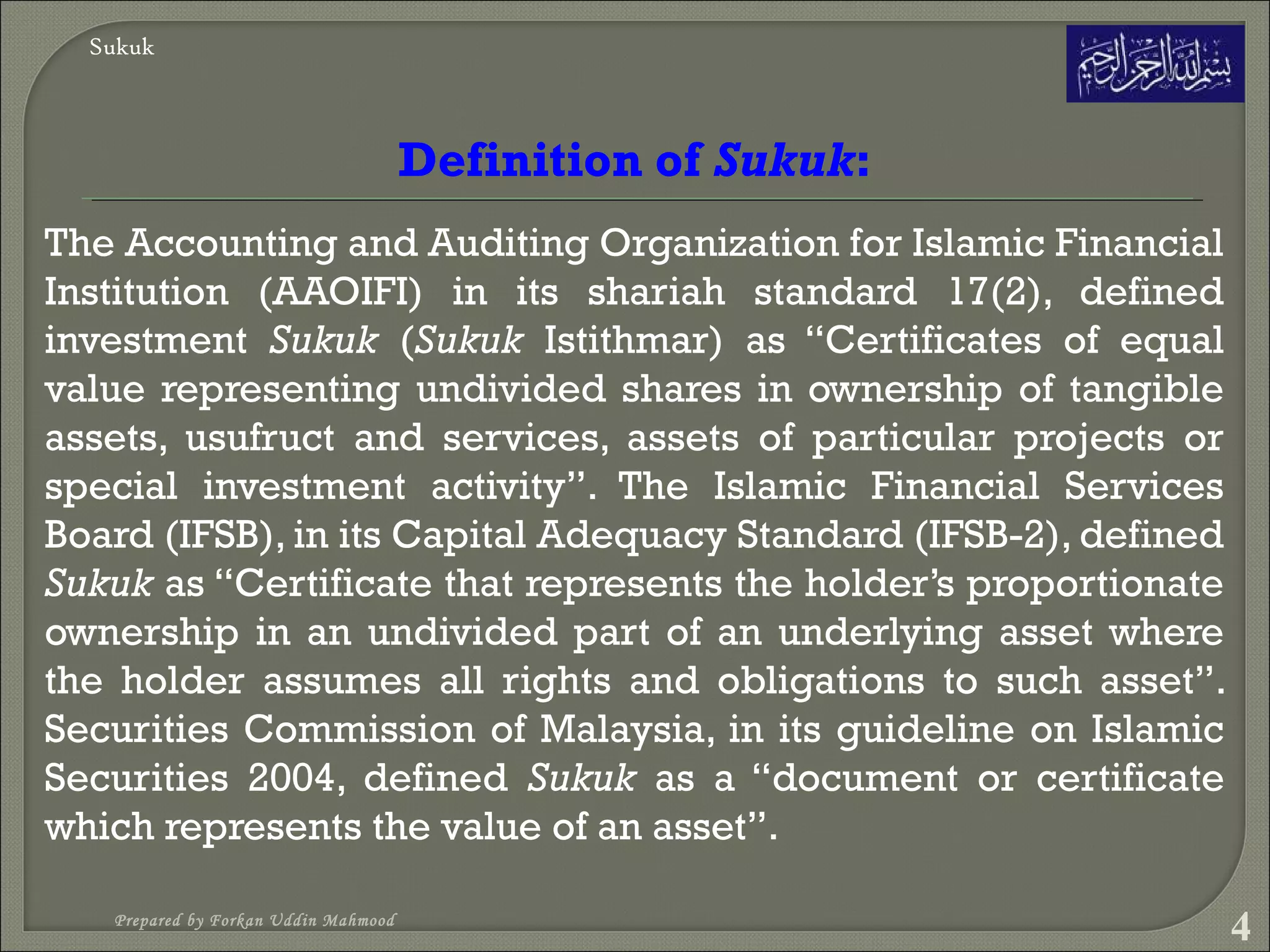
The Accounting and Auditing Organization for Islamic Financial
Institution (AAOIFI) in its shariah standard 17(2), defined
investment Sukuk (Sukuk Istithmar) as “Certificates of equal
value representing undivided shares in ownership of tangible
assets, usufruct and services, assets of particular projects or
special investment activity”. The Islamic Financial Services
Board (IFSB), in its Capital Adequacy Standard (IFSB-2), defined
Sukuk as “Certificate that represents the holder’s proportionate
ownership in an undivided part of an underlying asset where
the holder assumes all rights and obligations to such asset”.
Securities Commission of Malaysia, in its guideline on Islamic
Securities 2004, defined Sukuk as a “document or certificate
which represents the value of an asset”.
Prepared by Forkan Uddin Mahmood
4
Sukuk
Definition of Sukuk:
 The definition of the Securities Commission Malaysia is
the broadest and encompasses the other two definitions.
 AAOIFI & IFSB do not recognize financial assets (i.e.
receivables) as assets that would qualify to form the
underlying assets of a tradable Sukuk, while the Security
Commission Malaysia does allow such assets.
Prepared by Forkan Uddin Mahmood
5
Sukuk
Differences among the above three definitions:
 It is not permissible to trade in Murabaha Certificates
after delivery of the Murabaha commodity to the buyer.
However, trading of Murabaha Certificates is permissible
after purchasing the Murabaha commodity and before
selling it to the buyer (Standard 17 of AAOIFI).
 Salam Sukuk is not tradable (IFSB Standard 2, Paragraph 196).
 Securities Commission Malaysia allows a Shariah
Compliant debt to be sold at a discount in a securitization
exercise. However, this is not permissible according to
global shari’ah standard due to differences in opinion
regarding sale of debt (bay’al dayan).
Prepared by Forkan Uddin Mahmood
6
Sukuk
Difference of opinion regarding tradability of Sukuk:
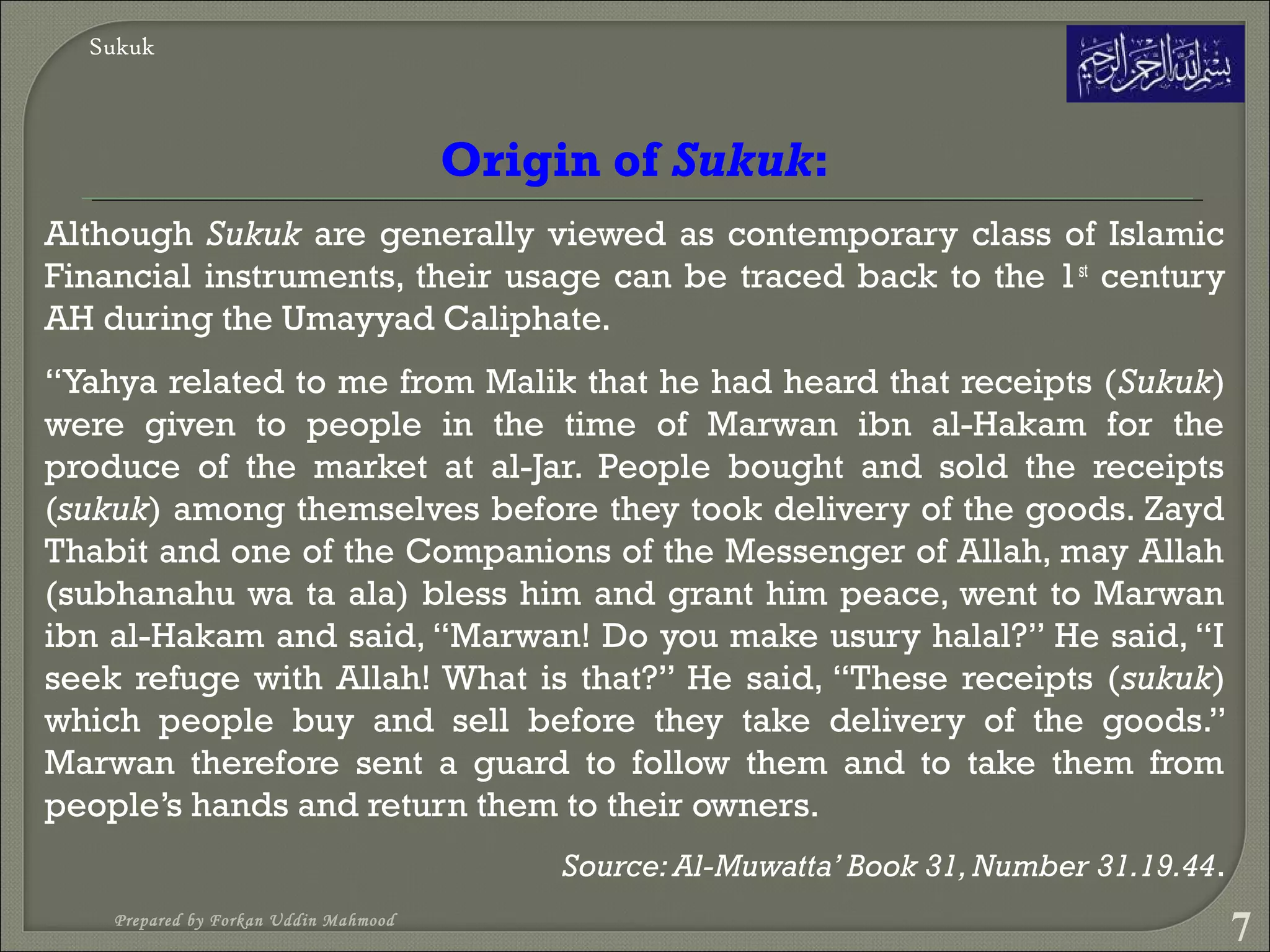
Although Sukuk are generally viewed as contemporary class of Islamic
Financial instruments, their usage can be traced back to the 1st
century
AH during the Umayyad Caliphate.
“Yahya related to me from Malik that he had heard that receipts (Sukuk)
were given to people in the time of Marwan ibn al-Hakam for the
produce of the market at al-Jar. People bought and sold the receipts
(sukuk) among themselves before they took delivery of the goods. Zayd
Thabit and one of the Companions of the Messenger of Allah, may Allah
(subhanahu wa ta ala) bless him and grant him peace, went to Marwan
ibn al-Hakam and said, “Marwan! Do you make usury halal?” He said, “I
seek refuge with Allah! What is that?” He said, “These receipts (sukuk)
which people buy and sell before they take delivery of the goods.”
Marwan therefore sent a guard to follow them and to take them from
people’s hands and return them to their owners.
Source: Al-Muwatta’ Book 31, Number 31.19.44.
Prepared by Forkan Uddin Mahmood
7
Sukuk
Origin of Sukuk:
Prepared by Forkan Uddin Mahmood
8
Sukuk
Sukuk Structures:
Sukuk Based on Shari’ah Contracts
Sales-based Lease-based Partnership-based Agency-based
BBA
Murabahah
Salam
Istisna
Ijarah
Ijarah
Muntahiyah
Bittamlik
Ijarah
Mawsufah fi
Dhimmah
Mudarabah
Musharakah
Wakalah bi
Istithmar
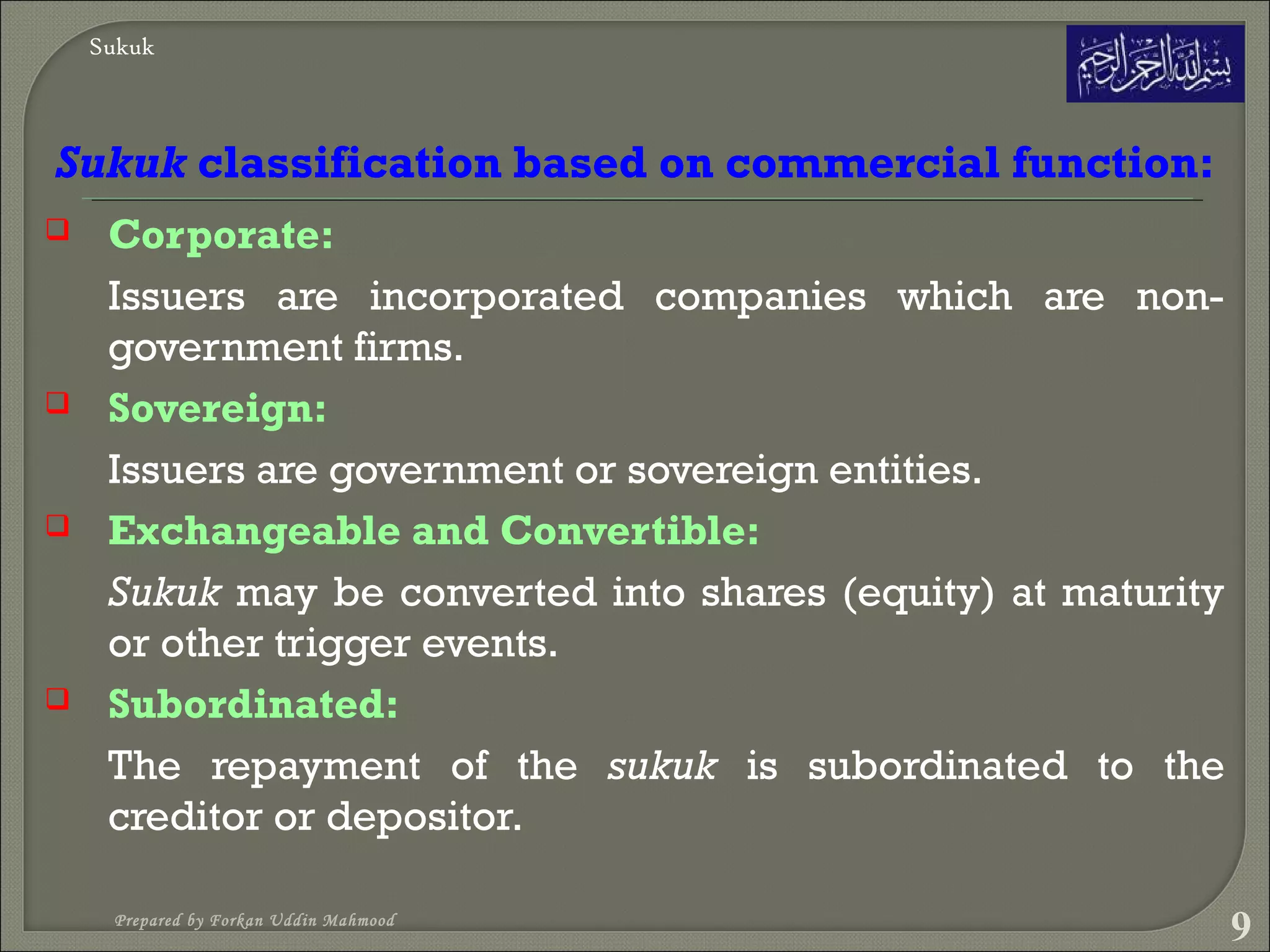
 Corporate:
Issuers are incorporated companies which are non-
government firms.
 Sovereign:
Issuers are government or sovereign entities.
 Exchangeable and Convertible:
Sukuk may be converted into shares (equity) at maturity
or other trigger events.
 Subordinated:
The repayment of the sukuk is subordinated to the
creditor or depositor.
Prepared by Forkan Uddin Mahmood
9
Sukuk
Sukuk classification based on commercial function:
 Stapled:
Two instruments are attached together and cannot be
traded separately.
 Asset-Backed:
Are securities backed by an income generating asset
with stable cash flow.This involves true sale securitization
where the recourse is to the asset and not the originator.
 Project financing:
Proceeds of sukuk is used to finance a project. Repayment
to investors comes from cash flow generated from the
project.
Prepared by Forkan Uddin Mahmood
10
Sukuk
Sukuk classification based on commercial function (Contd…)
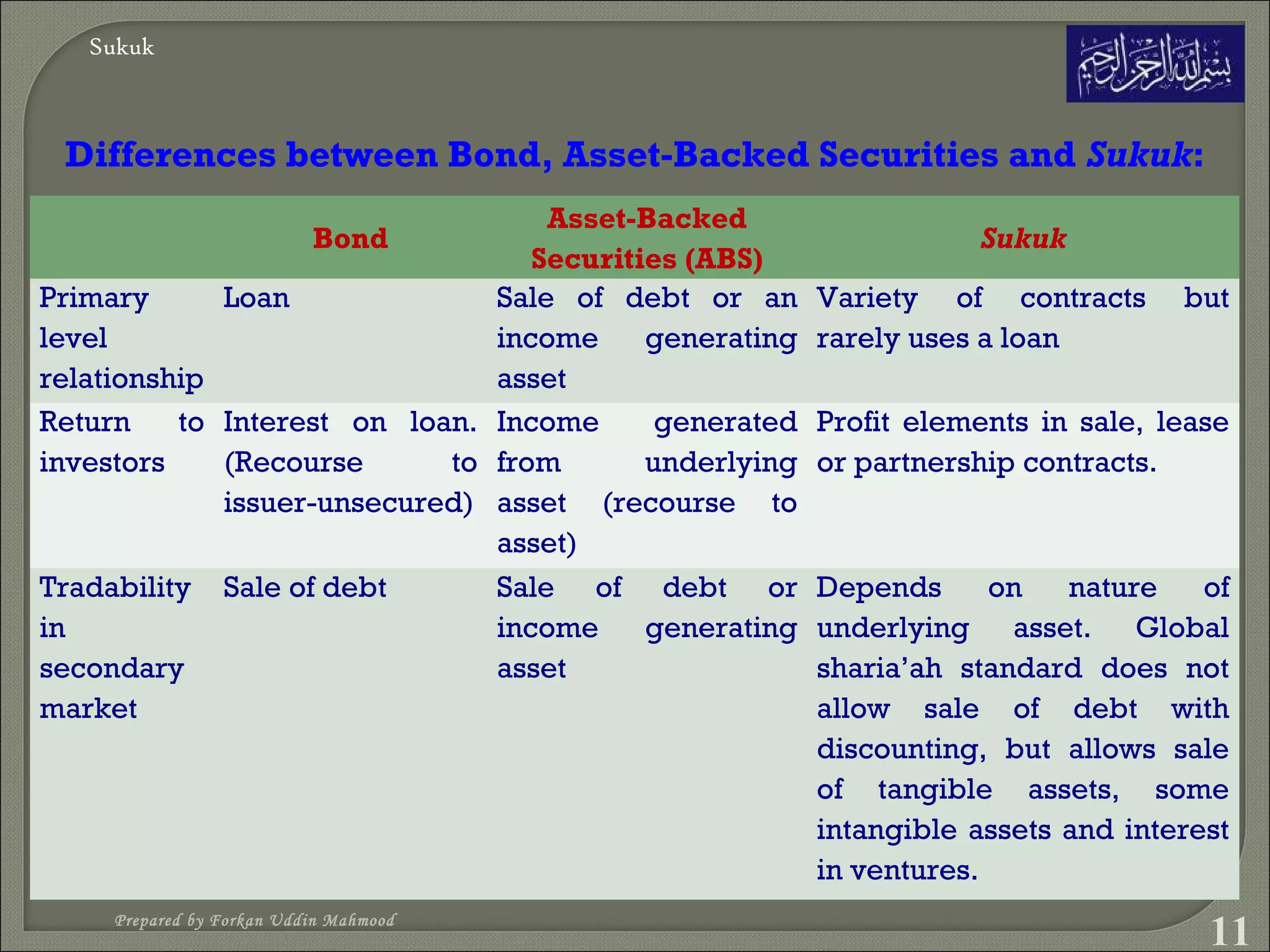
Bond
Asset-Backed
Securities (ABS)
Sukuk
Primary
level
relationship
Loan Sale of debt or an
income generating
asset
Variety of contracts but
rarely uses a loan
Return to
investors
Interest on loan.
(Recourse to
issuer-unsecured)
Income generated
from underlying
asset (recourse to
asset)
Profit elements in sale, lease
or partnership contracts.
Tradability
in
secondary
market
Sale of debt Sale of debt or
income generating
asset
Depends on nature of
underlying asset. Global
sharia’ah standard does not
allow sale of debt with
discounting, but allows sale
of tangible assets, some
intangible assets and interest
in ventures.
Prepared by Forkan Uddin Mahmood
11
Sukuk
Differences between Bond, Asset-Backed Securities and Sukuk:
 Sukuk-debt or equity?
It can either be debt or equity. It depends on local legal
framework and tax structure.
 Sukuk trading:
Currently, there is limited secondary trading of sukuk. Trading
requires structuring of the sukuk as per guidelines of the
securities authority of the concerned countries.
 Sukuk Pricing:
 LIBOR +
 It’s a reference/benchmark.
 Depends on demand and supply.
 Sukuk Default:
Default may occur. It depends on the efficiency and honesty of
the issuers/originators
Prepared by Forkan Uddin Mahmood
12
Sukuk
Issues, Opportunities & Challenges in Sukuk Market:
 The central idea underlying Islamic equity is the notion of
sharing risks and rewards. The Islamic nominate
contracts of mudarabah and musharakah are important
instruments in operationalising Islamic equity.
 Jurists have generally approved of the concept of modern
day corporations and the secondary market trading of
shares.
 In the area of valuation of equity, there is still much
reliance on conventional finance theories. Hence, there is
a research gap to be filled- Islamic inputs on equity
valuation.
Prepared by Forkan Uddin Mahmood
13
Sukuk
Islamic Equity Market:
 The use of instruments and practices such as preference
shares, stock index futures and short-selling has been
allowed by some shari’ah jurisdictions, despite the
presence of dissenting opinions and objections by some
others.
 Unit trusts or mutual funds, real estate investment trusts
(REITs) and exchange traded funds (ETFs) are important
instruments in Islamic equity and have great potential to
further develop the Islamic capital market.
Prepared by Forkan Uddin Mahmood
14
Sukuk
Islamic Equity Market (Contd…)
 The Shari’ah stock-screening process comprises two
main components- sector screening and financial
screening- and also raises the issue of dividend
purification. There are still a number of issues-being
debated, thus making shari’ah stock-screening a
dynamic process, subject to further refinement and
improvement.
 Equity market indices serve important roles, and their
functionalities in Islamic equity markets are no different.
 Speculative trading in equity markets can have
undesirable consequences, and it is envisioned that an
Islamic equity market should minimize its prevalence.
Prepared by Forkan Uddin Mahmood
15
Sukuk
Islamic Equity Market (Contd…)
16
Allah Hafez

Sukuk

  • 1.
    Presented By Md. FariduddinAhmed Former Managing Director & CEO Islami Bank Bangladesh Limited Export Import Bank of Bangladesh Ltd. Sponsor CEO Jaiz Bank Ltd, Nigeria Former Advisor Export Import Bank of Bangladesh Ltd. Former Head of Islamic Banking AB Bank Limited Secretary General Bangladesh Islamic Banker’s Association Member: Shariah Supervisory Committee of several Islamic Banks
  • 3.
     Sukuk meansCertificates.  Islamic securities are popularly known as Sukuk (Plural of Sakk).  Sukuk are papers representing financial obligations arising from trade and other commercial activities.  It is also similar to trust certificate which represent a share in an asset of a business venture. Prepared by Forkan Uddin Mahmood 3 Sukuk Meaning of Sukuk:
  • 4.
    The Accounting andAuditing Organization for Islamic Financial Institution (AAOIFI) in its shariah standard 17(2), defined investment Sukuk (Sukuk Istithmar) as “Certificates of equal value representing undivided shares in ownership of tangible assets, usufruct and services, assets of particular projects or special investment activity”. The Islamic Financial Services Board (IFSB), in its Capital Adequacy Standard (IFSB-2), defined Sukuk as “Certificate that represents the holder’s proportionate ownership in an undivided part of an underlying asset where the holder assumes all rights and obligations to such asset”. Securities Commission of Malaysia, in its guideline on Islamic Securities 2004, defined Sukuk as a “document or certificate which represents the value of an asset”. Prepared by Forkan Uddin Mahmood 4 Sukuk Definition of Sukuk:
  • 5.
     The definitionof the Securities Commission Malaysia is the broadest and encompasses the other two definitions.  AAOIFI & IFSB do not recognize financial assets (i.e. receivables) as assets that would qualify to form the underlying assets of a tradable Sukuk, while the Security Commission Malaysia does allow such assets. Prepared by Forkan Uddin Mahmood 5 Sukuk Differences among the above three definitions:
  • 6.
     It isnot permissible to trade in Murabaha Certificates after delivery of the Murabaha commodity to the buyer. However, trading of Murabaha Certificates is permissible after purchasing the Murabaha commodity and before selling it to the buyer (Standard 17 of AAOIFI).  Salam Sukuk is not tradable (IFSB Standard 2, Paragraph 196).  Securities Commission Malaysia allows a Shariah Compliant debt to be sold at a discount in a securitization exercise. However, this is not permissible according to global shari’ah standard due to differences in opinion regarding sale of debt (bay’al dayan). Prepared by Forkan Uddin Mahmood 6 Sukuk Difference of opinion regarding tradability of Sukuk:
  • 7.
    Although Sukuk aregenerally viewed as contemporary class of Islamic Financial instruments, their usage can be traced back to the 1st century AH during the Umayyad Caliphate. “Yahya related to me from Malik that he had heard that receipts (Sukuk) were given to people in the time of Marwan ibn al-Hakam for the produce of the market at al-Jar. People bought and sold the receipts (sukuk) among themselves before they took delivery of the goods. Zayd Thabit and one of the Companions of the Messenger of Allah, may Allah (subhanahu wa ta ala) bless him and grant him peace, went to Marwan ibn al-Hakam and said, “Marwan! Do you make usury halal?” He said, “I seek refuge with Allah! What is that?” He said, “These receipts (sukuk) which people buy and sell before they take delivery of the goods.” Marwan therefore sent a guard to follow them and to take them from people’s hands and return them to their owners. Source: Al-Muwatta’ Book 31, Number 31.19.44. Prepared by Forkan Uddin Mahmood 7 Sukuk Origin of Sukuk:
  • 8.
    Prepared by ForkanUddin Mahmood 8 Sukuk Sukuk Structures: Sukuk Based on Shari’ah Contracts Sales-based Lease-based Partnership-based Agency-based BBA Murabahah Salam Istisna Ijarah Ijarah Muntahiyah Bittamlik Ijarah Mawsufah fi Dhimmah Mudarabah Musharakah Wakalah bi Istithmar
  • 9.
     Corporate: Issuers areincorporated companies which are non- government firms.  Sovereign: Issuers are government or sovereign entities.  Exchangeable and Convertible: Sukuk may be converted into shares (equity) at maturity or other trigger events.  Subordinated: The repayment of the sukuk is subordinated to the creditor or depositor. Prepared by Forkan Uddin Mahmood 9 Sukuk Sukuk classification based on commercial function:
  • 10.
     Stapled: Two instrumentsare attached together and cannot be traded separately.  Asset-Backed: Are securities backed by an income generating asset with stable cash flow.This involves true sale securitization where the recourse is to the asset and not the originator.  Project financing: Proceeds of sukuk is used to finance a project. Repayment to investors comes from cash flow generated from the project. Prepared by Forkan Uddin Mahmood 10 Sukuk Sukuk classification based on commercial function (Contd…)
  • 11.
    Bond Asset-Backed Securities (ABS) Sukuk Primary level relationship Loan Saleof debt or an income generating asset Variety of contracts but rarely uses a loan Return to investors Interest on loan. (Recourse to issuer-unsecured) Income generated from underlying asset (recourse to asset) Profit elements in sale, lease or partnership contracts. Tradability in secondary market Sale of debt Sale of debt or income generating asset Depends on nature of underlying asset. Global sharia’ah standard does not allow sale of debt with discounting, but allows sale of tangible assets, some intangible assets and interest in ventures. Prepared by Forkan Uddin Mahmood 11 Sukuk Differences between Bond, Asset-Backed Securities and Sukuk:
  • 12.
     Sukuk-debt orequity? It can either be debt or equity. It depends on local legal framework and tax structure.  Sukuk trading: Currently, there is limited secondary trading of sukuk. Trading requires structuring of the sukuk as per guidelines of the securities authority of the concerned countries.  Sukuk Pricing:  LIBOR +  It’s a reference/benchmark.  Depends on demand and supply.  Sukuk Default: Default may occur. It depends on the efficiency and honesty of the issuers/originators Prepared by Forkan Uddin Mahmood 12 Sukuk Issues, Opportunities & Challenges in Sukuk Market:
  • 13.
     The centralidea underlying Islamic equity is the notion of sharing risks and rewards. The Islamic nominate contracts of mudarabah and musharakah are important instruments in operationalising Islamic equity.  Jurists have generally approved of the concept of modern day corporations and the secondary market trading of shares.  In the area of valuation of equity, there is still much reliance on conventional finance theories. Hence, there is a research gap to be filled- Islamic inputs on equity valuation. Prepared by Forkan Uddin Mahmood 13 Sukuk Islamic Equity Market:
  • 14.
     The useof instruments and practices such as preference shares, stock index futures and short-selling has been allowed by some shari’ah jurisdictions, despite the presence of dissenting opinions and objections by some others.  Unit trusts or mutual funds, real estate investment trusts (REITs) and exchange traded funds (ETFs) are important instruments in Islamic equity and have great potential to further develop the Islamic capital market. Prepared by Forkan Uddin Mahmood 14 Sukuk Islamic Equity Market (Contd…)
  • 15.
     The Shari’ahstock-screening process comprises two main components- sector screening and financial screening- and also raises the issue of dividend purification. There are still a number of issues-being debated, thus making shari’ah stock-screening a dynamic process, subject to further refinement and improvement.  Equity market indices serve important roles, and their functionalities in Islamic equity markets are no different.  Speculative trading in equity markets can have undesirable consequences, and it is envisioned that an Islamic equity market should minimize its prevalence. Prepared by Forkan Uddin Mahmood 15 Sukuk Islamic Equity Market (Contd…)
  • 16.