Shariah Screening
Empowering investors in disciplining markets

A proposed
modified criteria
Tariqullah Khan
Important!
This is an academic
handout and not a
business proposal.
First, some Q&A on
Shariah Screening
--Second, the modified
criteria
A

1

Q

These questions have become very relevant in
modern times where technology has facilitated
globalization and investors’ concerns with Shariahcompliance has also grown – estimated size US$ 2
trillions. Shariah Screening is a computer aided
response of the market to address to similar
questions to facilitate wealth management in
compliance with the Shariah.
Does the Shariah allow buying and selling company
shares? Can I invest in Google, Facebook or Twitter
Shares? Can I invest in a hotel, that may occasionally
be selling alcohol? Can I buy and sell shares of a
company which owes a lot to others?
A

Q

Investment decisions have important implications for
human and economic development, environmental
balance, use of resources and for the future generations.
Hence these shall not merely be determined by expected
financial returns but shall also be based on the nonfinancial benefits and overall impact on society & its
future.
Thus investment decisions shall be simultaneously
guided by the compliance with certain ethical and moral
norms in addition to the expectations for a rate of
return.

So what is the exact
concern addressed?
A

Q

In recent years there has been a growing interest in ethical &
socially responsible investments. In 1994 the Fiqh Academy of the
OIC ruled that it is not permissible to buy and sell shares of
companies which don’t 100% confirm to the Shariah even if the
business itself may be permissible like a hotel that sells alcohol.
Indeed, this is very restrictive as almost all companies somehow
violate certain Shariah conditions. This meant that Shariah
compliant investment in stock markets is not possible. This imposes
restrictions under which capital markets cannot be flourished.
As a response of the market, the pioneering Dow Jones Islamic
Market Index (DJIMI), developed by Mr. Rushdi Siddiqi of the Dow
Jones & his team was launched in 1999 in Bahrain and
subsequently replicated in a number of different ways.
A research paper "Trading In Equities - A Shariah Perspective" by
Nizam Yaquby was submitted to the Fourth Harvard University
Forum on Islamic Finance in 2000.

What is the background of
Shariah Screening?
A

Q

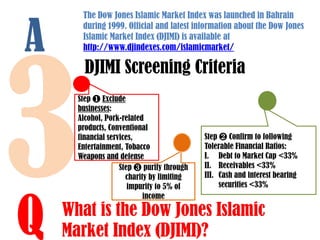
The Dow Jones Islamic Market Index was launched in Bahrain
during 1999. Official and latest information about the Dow Jones
Islamic Market Index (DJIMI) is available at
http://www.djindexes.com/islamicmarket/

DJIMI Screening Criteria
Step ❶ Exclude
businesses:
Alcohol, Pork-related
products, Conventional
financial services,
Entertainment, Tobacco
Weapons and defense
Step ❸ purify through
charity by limiting
impurity to 5% of
income

Step ❷ Confirm to following
Tolerable Financial Ratios:
I. Debt to Market Cap <33%
II. Receivables <33%
III. Cash and interest bearing
securities <33%

What is the Dow Jones Islamic
Market Index (DJIMI)?
A

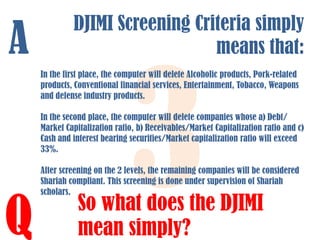
DJIMI Screening Criteria simply
means that:
In the first place, the computer will delete Alcoholic products, Pork-related
products, Conventional financial services, Entertainment, Tobacco, Weapons
and defense industry products.
In the second place, the computer will delete companies whose a) Debt/
Market Capitalization ratio, b) Receivables/Market Capitalization ratio and c)
Cash and interest bearing securities/Market capitalization ratio will exceed
33%.

Q

After screening on the 2 levels, the remaining companies will be considered
Shariah compliant. This screening is done under supervision of Shariah
scholars.

So what does the DJIMI
mean simply?
A

Q

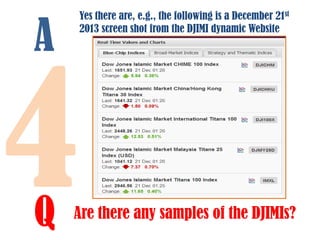
Yes there are, e.g., the following is a December 21st
2013 screen shot from the DJIMI dynamic Website

Are there any samples of the DJIMIs?
A

Q

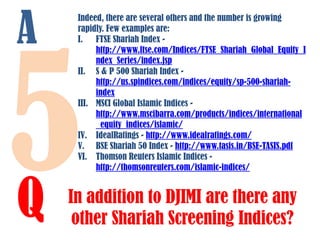
Indeed, there are several others and the number is growing
rapidly. Few examples are:
I. FTSE Shariah Index http://www.ftse.com/Indices/FTSE_Shariah_Global_Equity_I
ndex_Series/index.jsp
II. S & P 500 Shariah Index http://us.spindices.com/indices/equity/sp-500-shariahindex
III. MSCI Global Islamic Indices http://www.mscibarra.com/products/indices/international
_equity_indices/islamic/
IV. IdealRatings - http://www.idealratings.com/
V. BSE Shariah 50 Index - http://www.tasis.in/BSE-TASIS.pdf
VI. Thomson Reuters Islamic Indices http://thomsonreuters.com/islamic-indices/

In addition to DJIMI are there any
other Shariah Screening Indices?
A

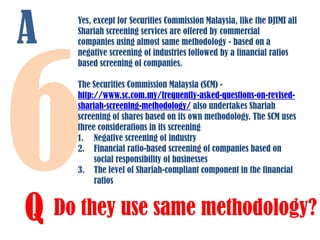
Yes, except for Securities Commission Malaysia, like the DJIMI all
Shariah screening services are offered by commercial
companies using almost same methodology - based on a
negative screening of industries followed by a financial ratios
based screening of companies.

The Securities Commission Malaysia (SCM) http://www.sc.com.my/frequently-asked-questions-on-revisedshariah-screening-methodology/ also undertakes Shariah
screening of shares based on its own methodology. The SCM uses
three considerations in its screening
1. Negative screening of industry
2. Financial ratio-based screening of companies based on
social responsibility of businesses
3. The level of Shariah-compliant component in the financial
ratios

Q Do they use same methodology?
A

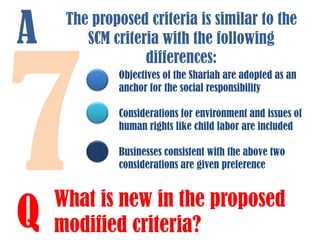
The proposed criteria is similar to the
SCM criteria with the following
differences:
Objectives of the Shariah are adopted as an
anchor for the social responsibility
Considerations for environment and issues of
human rights like child labor are included
Businesses consistent with the above two
considerations are given preference

Q

What is new in the proposed
modified criteria?
modified
criteria in
7 steps
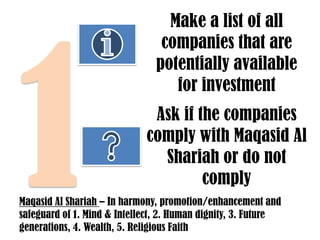
Make a list of all
companies that are
potentially available
for investment
Ask if the companies
comply with Maqasid Al
Shariah or do not
comply
Maqasid Al Shariah – In harmony, promotion/enhancement and
safeguard of 1. Mind & Intellect, 2. Human dignity, 3. Future
generations, 4. Wealth, 5. Religious Faith
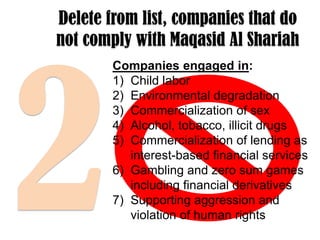
Delete from list, companies that do
not comply with Maqasid Al Shariah
Companies engaged in:
1) Child labor
2) Environmental degradation
3) Commercialization of sex
4) Alcohol, tobacco, illicit drugs
5) Commercialization of lending as
interest-based financial services
6) Gambling and zero sum games
including financial derivatives
7) Supporting aggression and
violation of human rights
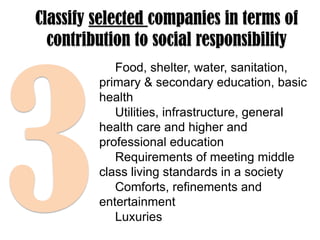
Classify selected companies in terms of
contribution to social responsibility
Food, shelter, water, sanitation,
primary & secondary education, basic
health
Utilities, infrastructure, general
health care and higher and
professional education
Requirements of meeting middle
class living standards in a society
Comforts, refinements and
entertainment
Luxuries
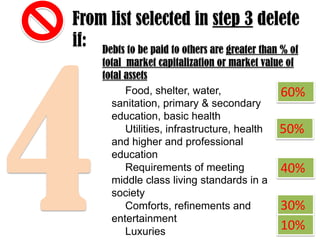
From list selected in step 3 delete
if: Debts to be paid to others are greater than % of
total market capitalization or market value of
total assets
Food, shelter, water,
60%
sanitation, primary & secondary
education, basic health
Utilities, infrastructure, health
50%
and higher and professional
education
Requirements of meeting
40%
middle class living standards in a
society
Comforts, refinements and
30%
entertainment
10%
Luxuries
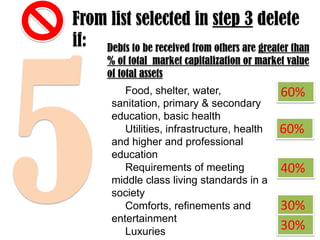
From list selected in step 3 delete
if: Debts to be received from others are greater than
% of total market capitalization or market value
of total assets
Food, shelter, water,
sanitation, primary & secondary
education, basic health
Utilities, infrastructure, health
and higher and professional
education
Requirements of meeting
middle class living standards in a
society
Comforts, refinements and
entertainment
Luxuries

60%
60%
40%
30%
30%
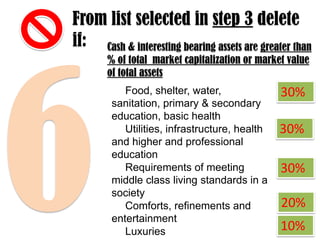
From list selected in step 3 delete
if: Cash & interesting bearing assets are greater than
% of total market capitalization or market value
of total assets
Food, shelter, water,
sanitation, primary & secondary
education, basic health
Utilities, infrastructure, health
and higher and professional
education
Requirements of meeting
middle class living standards in a
society
Comforts, refinements and
entertainment
Luxuries

30%
30%
30%
20%
10%
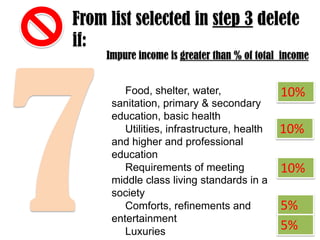
From list selected in step 3 delete
if:
Impure income is greater than % of total income
Food, shelter, water,
sanitation, primary & secondary
education, basic health
Utilities, infrastructure, health
and higher and professional
education
Requirements of meeting
middle class living standards in a
society
Comforts, refinements and
entertainment
Luxuries

10%
10%
10%
5%
5%
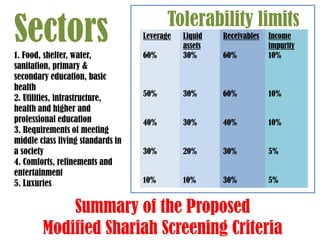
Sectors
1. Food, shelter, water,
sanitation, primary &
secondary education, basic
health
2. Utilities, infrastructure,
health and higher and
professional education
3. Requirements of meeting
middle class living standards in
a society
4. Comforts, refinements and
entertainment
5. Luxuries

Tolerability limits
Receivables

60%

Liquid
assets
30%

60%

Income
impurity
10%

50%

30%

60%

10%

40%

30%

40%

10%

30%

20%

30%

5%

10%

10%

30%

5%

Leverage

Summary of the Proposed
Modified Shariah Screening Criteria

Shariah and ethical screening in Islamic finance in the light of environment, human rights and child labor

  • 1.
    Shariah Screening Empowering investorsin disciplining markets A proposed modified criteria Tariqullah Khan
  • 2.
    Important! This is anacademic handout and not a business proposal.
  • 3.
    First, some Q&Aon Shariah Screening --Second, the modified criteria
  • 4.
    A 1 Q These questions havebecome very relevant in modern times where technology has facilitated globalization and investors’ concerns with Shariahcompliance has also grown – estimated size US$ 2 trillions. Shariah Screening is a computer aided response of the market to address to similar questions to facilitate wealth management in compliance with the Shariah. Does the Shariah allow buying and selling company shares? Can I invest in Google, Facebook or Twitter Shares? Can I invest in a hotel, that may occasionally be selling alcohol? Can I buy and sell shares of a company which owes a lot to others?
  • 5.
    A Q Investment decisions haveimportant implications for human and economic development, environmental balance, use of resources and for the future generations. Hence these shall not merely be determined by expected financial returns but shall also be based on the nonfinancial benefits and overall impact on society & its future. Thus investment decisions shall be simultaneously guided by the compliance with certain ethical and moral norms in addition to the expectations for a rate of return. So what is the exact concern addressed?
  • 6.
    A Q In recent yearsthere has been a growing interest in ethical & socially responsible investments. In 1994 the Fiqh Academy of the OIC ruled that it is not permissible to buy and sell shares of companies which don’t 100% confirm to the Shariah even if the business itself may be permissible like a hotel that sells alcohol. Indeed, this is very restrictive as almost all companies somehow violate certain Shariah conditions. This meant that Shariah compliant investment in stock markets is not possible. This imposes restrictions under which capital markets cannot be flourished. As a response of the market, the pioneering Dow Jones Islamic Market Index (DJIMI), developed by Mr. Rushdi Siddiqi of the Dow Jones & his team was launched in 1999 in Bahrain and subsequently replicated in a number of different ways. A research paper "Trading In Equities - A Shariah Perspective" by Nizam Yaquby was submitted to the Fourth Harvard University Forum on Islamic Finance in 2000. What is the background of Shariah Screening?
  • 7.
    A Q The Dow JonesIslamic Market Index was launched in Bahrain during 1999. Official and latest information about the Dow Jones Islamic Market Index (DJIMI) is available at http://www.djindexes.com/islamicmarket/ DJIMI Screening Criteria Step ❶ Exclude businesses: Alcohol, Pork-related products, Conventional financial services, Entertainment, Tobacco Weapons and defense Step ❸ purify through charity by limiting impurity to 5% of income Step ❷ Confirm to following Tolerable Financial Ratios: I. Debt to Market Cap <33% II. Receivables <33% III. Cash and interest bearing securities <33% What is the Dow Jones Islamic Market Index (DJIMI)?
  • 8.
    A DJIMI Screening Criteriasimply means that: In the first place, the computer will delete Alcoholic products, Pork-related products, Conventional financial services, Entertainment, Tobacco, Weapons and defense industry products. In the second place, the computer will delete companies whose a) Debt/ Market Capitalization ratio, b) Receivables/Market Capitalization ratio and c) Cash and interest bearing securities/Market capitalization ratio will exceed 33%. Q After screening on the 2 levels, the remaining companies will be considered Shariah compliant. This screening is done under supervision of Shariah scholars. So what does the DJIMI mean simply?
  • 9.
    A Q Yes there are,e.g., the following is a December 21st 2013 screen shot from the DJIMI dynamic Website Are there any samples of the DJIMIs?
  • 10.
    A Q Indeed, there areseveral others and the number is growing rapidly. Few examples are: I. FTSE Shariah Index http://www.ftse.com/Indices/FTSE_Shariah_Global_Equity_I ndex_Series/index.jsp II. S & P 500 Shariah Index http://us.spindices.com/indices/equity/sp-500-shariahindex III. MSCI Global Islamic Indices http://www.mscibarra.com/products/indices/international _equity_indices/islamic/ IV. IdealRatings - http://www.idealratings.com/ V. BSE Shariah 50 Index - http://www.tasis.in/BSE-TASIS.pdf VI. Thomson Reuters Islamic Indices http://thomsonreuters.com/islamic-indices/ In addition to DJIMI are there any other Shariah Screening Indices?
  • 11.
    A Yes, except forSecurities Commission Malaysia, like the DJIMI all Shariah screening services are offered by commercial companies using almost same methodology - based on a negative screening of industries followed by a financial ratios based screening of companies. The Securities Commission Malaysia (SCM) http://www.sc.com.my/frequently-asked-questions-on-revisedshariah-screening-methodology/ also undertakes Shariah screening of shares based on its own methodology. The SCM uses three considerations in its screening 1. Negative screening of industry 2. Financial ratio-based screening of companies based on social responsibility of businesses 3. The level of Shariah-compliant component in the financial ratios Q Do they use same methodology?
  • 12.
    A The proposed criteriais similar to the SCM criteria with the following differences: Objectives of the Shariah are adopted as an anchor for the social responsibility Considerations for environment and issues of human rights like child labor are included Businesses consistent with the above two considerations are given preference Q What is new in the proposed modified criteria?
  • 13.
  • 14.
    Make a listof all companies that are potentially available for investment Ask if the companies comply with Maqasid Al Shariah or do not comply Maqasid Al Shariah – In harmony, promotion/enhancement and safeguard of 1. Mind & Intellect, 2. Human dignity, 3. Future generations, 4. Wealth, 5. Religious Faith
  • 15.
    Delete from list,companies that do not comply with Maqasid Al Shariah Companies engaged in: 1) Child labor 2) Environmental degradation 3) Commercialization of sex 4) Alcohol, tobacco, illicit drugs 5) Commercialization of lending as interest-based financial services 6) Gambling and zero sum games including financial derivatives 7) Supporting aggression and violation of human rights
  • 16.
    Classify selected companiesin terms of contribution to social responsibility Food, shelter, water, sanitation, primary & secondary education, basic health Utilities, infrastructure, general health care and higher and professional education Requirements of meeting middle class living standards in a society Comforts, refinements and entertainment Luxuries
  • 17.
    From list selectedin step 3 delete if: Debts to be paid to others are greater than % of total market capitalization or market value of total assets Food, shelter, water, 60% sanitation, primary & secondary education, basic health Utilities, infrastructure, health 50% and higher and professional education Requirements of meeting 40% middle class living standards in a society Comforts, refinements and 30% entertainment 10% Luxuries
  • 18.
    From list selectedin step 3 delete if: Debts to be received from others are greater than % of total market capitalization or market value of total assets Food, shelter, water, sanitation, primary & secondary education, basic health Utilities, infrastructure, health and higher and professional education Requirements of meeting middle class living standards in a society Comforts, refinements and entertainment Luxuries 60% 60% 40% 30% 30%
  • 19.
    From list selectedin step 3 delete if: Cash & interesting bearing assets are greater than % of total market capitalization or market value of total assets Food, shelter, water, sanitation, primary & secondary education, basic health Utilities, infrastructure, health and higher and professional education Requirements of meeting middle class living standards in a society Comforts, refinements and entertainment Luxuries 30% 30% 30% 20% 10%
  • 20.
    From list selectedin step 3 delete if: Impure income is greater than % of total income Food, shelter, water, sanitation, primary & secondary education, basic health Utilities, infrastructure, health and higher and professional education Requirements of meeting middle class living standards in a society Comforts, refinements and entertainment Luxuries 10% 10% 10% 5% 5%
  • 21.
    Sectors 1. Food, shelter,water, sanitation, primary & secondary education, basic health 2. Utilities, infrastructure, health and higher and professional education 3. Requirements of meeting middle class living standards in a society 4. Comforts, refinements and entertainment 5. Luxuries Tolerability limits Receivables 60% Liquid assets 30% 60% Income impurity 10% 50% 30% 60% 10% 40% 30% 40% 10% 30% 20% 30% 5% 10% 10% 30% 5% Leverage Summary of the Proposed Modified Shariah Screening Criteria