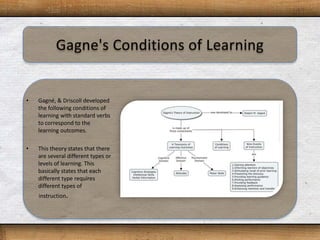
•   Gagné, & Driscoll developed
    the following conditions of
    learning with standard verbs
    to correspond to the
    learning outcomes.

•   This theory states that there
    are several different types or
    levels of learning. This
    basically states that each
    different type requires
    different types of
    instruction.
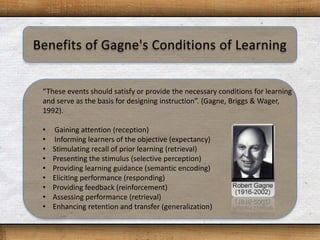
“These events should satisfy or provide the necessary conditions for learning
and serve as the basis for designing instruction”. (Gagne, Briggs & Wager,
1992).

•   Gaining attention (reception)
•   Informing learners of the objective (expectancy)
•   Stimulating recall of prior learning (retrieval)
•   Presenting the stimulus (selective perception)
•   Providing learning guidance (semantic encoding)
•   Eliciting performance (responding)
•   Providing feedback (reinforcement)
•   Assessing performance (retrieval)
•   Enhancing retention and transfer (generalization)
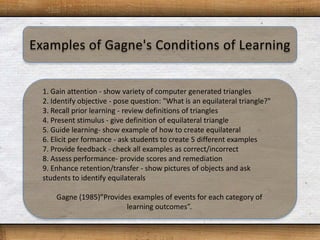
1. Gain attention - show variety of computer generated triangles
2. Identify objective - pose question: "What is an equilateral triangle?"
3. Recall prior learning - review definitions of triangles
4. Present stimulus - give definition of equilateral triangle
5. Guide learning- show example of how to create equilateral
6. Elicit per formance - ask students to create 5 different examples
7. Provide feedback - check all examples as correct/incorrect
8. Assess performance- provide scores and remediation
9. Enhance retention/transfer - show pictures of objects and ask
students to identify equilaterals

    Gagne (1985)”Provides examples of events for each category of
                        learning outcomes”.
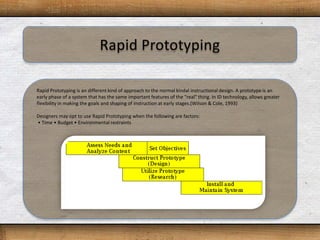
Rapid Prototyping is an different kind of approach to the normal kindal instructional design. A prototype is an
early phase of a system that has the same important features of the "real" thing. In ID technology, allows greater
flexibility in making the goals and shaping of instruction at early stages.(Wilson & Cole, 1993)

Designers may opt to use Rapid Prototyping when the following are factors:
• Time • Budget • Environmental restraints
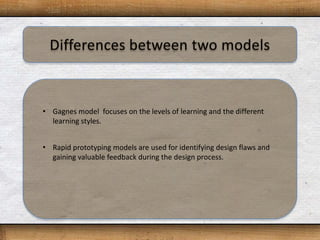
• Gagnes model focuses on the levels of learning and the different
  learning styles.


• Rapid prototyping models are used for identifying design flaws and
  gaining valuable feedback during the design process.
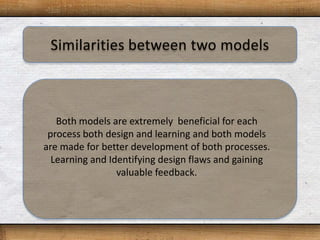
Both models are extremely beneficial for each
 process both design and learning and both models
are made for better development of both processes.
  Learning and Identifying design flaws and gaining
                 valuable feedback.
•


•

ISD Powerpoint

  • 3.
    Gagné, & Driscoll developed the following conditions of learning with standard verbs to correspond to the learning outcomes. • This theory states that there are several different types or levels of learning. This basically states that each different type requires different types of instruction.
  • 4.
    “These events shouldsatisfy or provide the necessary conditions for learning and serve as the basis for designing instruction”. (Gagne, Briggs & Wager, 1992). • Gaining attention (reception) • Informing learners of the objective (expectancy) • Stimulating recall of prior learning (retrieval) • Presenting the stimulus (selective perception) • Providing learning guidance (semantic encoding) • Eliciting performance (responding) • Providing feedback (reinforcement) • Assessing performance (retrieval) • Enhancing retention and transfer (generalization)
  • 5.
    1. Gain attention- show variety of computer generated triangles 2. Identify objective - pose question: "What is an equilateral triangle?" 3. Recall prior learning - review definitions of triangles 4. Present stimulus - give definition of equilateral triangle 5. Guide learning- show example of how to create equilateral 6. Elicit per formance - ask students to create 5 different examples 7. Provide feedback - check all examples as correct/incorrect 8. Assess performance- provide scores and remediation 9. Enhance retention/transfer - show pictures of objects and ask students to identify equilaterals Gagne (1985)”Provides examples of events for each category of learning outcomes”.
  • 6.
    Rapid Prototyping isan different kind of approach to the normal kindal instructional design. A prototype is an early phase of a system that has the same important features of the "real" thing. In ID technology, allows greater flexibility in making the goals and shaping of instruction at early stages.(Wilson & Cole, 1993) Designers may opt to use Rapid Prototyping when the following are factors: • Time • Budget • Environmental restraints
  • 10.
    • Gagnes modelfocuses on the levels of learning and the different learning styles. • Rapid prototyping models are used for identifying design flaws and gaining valuable feedback during the design process.
  • 11.
    Both models areextremely beneficial for each process both design and learning and both models are made for better development of both processes. Learning and Identifying design flaws and gaining valuable feedback.
  • 12.