The Dick and Carey Model
An Instructional Systems Design
Model
Who Are Dick & Carey?
 Walter Dick: Studied
with Robert Gagne.
Emeritus Professor at
Florida State University.
 Lou Carey: Studied
with Walter Dick and
Robert Gagne. University
of South Florida Professor
and Interim Dean.
Dick & Carey Model
 “Performance-oriented model, stressing the identification of skills
students need to learn and the collection of data from students to
revise instruction”
 Based on the reductionist perspective, which emphasizes
breaking instruction down into smaller components.
 Focuses on the skills, knowledge, attitudes that need to be
learned and provides the right learning conditions for the
outcomes.
 “Based on the idea that there is a predictable and reliable link
between a stimulus (instructional materials) and the response that
it produces in a learner (learning of materials).”
Dick & Carey, Past and Present
 First Edition, 1978: Very traditional ISD approach,
with emphasis on behavioral theory and some
cognitivist theories.
 Second Edition, 1996: Still traditional, reflects an
attempt to incorporate changes in the field, such
as shifts toward constructivism, growth in
computers, etc.
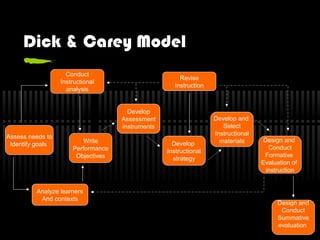
Dick & Carey Model
Assess needs to
Identify goals
Conduct
Instructional
analysis
Write
Performance
Objectives
Design and
Conduct
Formative
Evaluation of
instruction
Design and
Conduct
Summative
evaluation
Develop
Assessment
instruments
Develop and
Select
Instructional
materialsDevelop
Instructional
strategy
Analyze learners
And contexts
Revise
Instruction
Shell Island Simulation
 Contexts for Dick & Carey Model seem to endless.
 Shell Island is a good example of how modify the traditional
ISD approach with constructivist goals.
 Part of a reform project by Carolina Coastal Science
project with a goal to create an online environment for
primary and secondary students to engage in authentic
scientific inquiry.
Shell Island Dilemma
 Students investigate the fate of the Shell Island Resort
through the resources available on NCS website.
 After considering the scientific, social, political issues, they
engage in a debate over its future.
QuickTime™ and a
Cinepak decompressor
are needed to see this picture.
Shell Island D&C Model 1
 Determining Instructional
Goals
Determined out of a lack
of good environmental
science curricular and
inquiry-based simulations in
North Carolina secondary
schools.
Instructional goal is for
learners to be able to identify
the scientific, social, political,
and moral issues that
“different stakeholders must
deal with in a current
environmental science issue.”
 Analyzing the Instructional
Goal
Students identify
environmental and
economic concerns of
stakeholders.
Students take a position
for or against building a hard
structure to protect the Shell
Island Resort.
Shell Island D&C Model 2
 Analyze Learners and
Context
Use technology skills
and critical thinking skills
to explore online
resources and construct a
logical argument for
unresolved issue.
Use decision-making
skills to act on personal
and social interests.
 Write Performance
Objectives
Students will list the 3
strongest arguments for
and against building a
hard structure to protect
Resort.
Students will identify
individuals for and
against.
Students will prepare
statement for next course
of action.
Shell Island D&C Model 3
 Developing Assessment
Instruments
Students complete a
“Position Statement
Handout” designed to assess
stated objectives for an in
class debate.
Students complete a
“Student Record Sheet
Assessment” at the
conclusion of debate.
 Developing Instructional
Strategy
Terminal Objectives:
Design role-playing
activity
Select unresolved issue
Collect background info
Develop real-life scenario
Identify roles of real
people (stakeholders)
Develop student roles
Select Debate format
with time limits
Shell Island D&C Model 4
 Developing and Selecting
Instruction
Materials are developed in
the context of “The Shell
Island Dilemma” web site,
with many resources for
students
Educator’s Guide is
provided, recommending
teaching strategies and
assesments
 Designing and
Conducting Formative
Evaluation
Included a small group of
primary and secondary
school educators enrolled in
a ET graduate course.
They made
recommendations to modify
program
Shell Island D&C Model 5
 Revising Instruction
Upon recommendations
by group:
Specific descriptions of
stakeholders were
developed.
“Student Record Sheet
Assessment”’ was
developed.
Debate simulation was
tested on 10th grade
environmental science class.
“Position Statement
Handout” was created.
 Conducting Summative
Evalution
Conducted by marine
education specialist, a
coastal geologist, a university
professor with C&I expertise,
and two secondary school
environmental science
teachers.
No further
recommendations were
made.
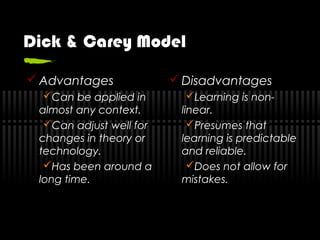
Dick & Carey Model
 Advantages
Can be applied in
almost any context.
Can adjust well for
changes in theory or
technology.
Has been around a
long time.
 Disadvantages
Learning is non-
linear.
Presumes that
learning is predictable
and reliable.
Does not allow for
mistakes.
References
 Carey, L. & Dick, W. (1996). The Systematic Design of Instruction.
Longman; New York, NY.
 Bodzin, A.M. & Park, J.C. (1999). An Online Inquiry Instructional System for
Environmental Issues. Meridian: 2(2).
http://www.ncsu.edu/meridian/jul199/coastal/bodzinparkbio.html.
Retrieved 09/25/07.
 Dempsey, J.V. & Reiser, R.A. (2007). Trends and Issues in Instructional
Design and Technology. Pearson; Upper Saddle River, NJ.
 McGriff, S.J. (2001). ISD Knowledge Base/ Instructional Systems Design
Models/ Dick & Carey.
http://www.personal.psu.edu/faculty/s/j/sjm256/portfolio/kbase/IDD/dick&carey.h
. Retrieved 09/25/07.
 Reiber, L.
http://lreiber.myweb.uga.edu/edit6170/ppt/unit-goal_analysis.ppt.
Retrieved 09/25/07.

Emily dick and carey model

  • 1.
    The Dick andCarey Model An Instructional Systems Design Model
  • 2.
    Who Are Dick& Carey?  Walter Dick: Studied with Robert Gagne. Emeritus Professor at Florida State University.  Lou Carey: Studied with Walter Dick and Robert Gagne. University of South Florida Professor and Interim Dean.
  • 3.
    Dick & CareyModel  “Performance-oriented model, stressing the identification of skills students need to learn and the collection of data from students to revise instruction”  Based on the reductionist perspective, which emphasizes breaking instruction down into smaller components.  Focuses on the skills, knowledge, attitudes that need to be learned and provides the right learning conditions for the outcomes.  “Based on the idea that there is a predictable and reliable link between a stimulus (instructional materials) and the response that it produces in a learner (learning of materials).”
  • 4.
    Dick & Carey,Past and Present  First Edition, 1978: Very traditional ISD approach, with emphasis on behavioral theory and some cognitivist theories.  Second Edition, 1996: Still traditional, reflects an attempt to incorporate changes in the field, such as shifts toward constructivism, growth in computers, etc.
  • 5.
    Dick & CareyModel Assess needs to Identify goals Conduct Instructional analysis Write Performance Objectives Design and Conduct Formative Evaluation of instruction Design and Conduct Summative evaluation Develop Assessment instruments Develop and Select Instructional materialsDevelop Instructional strategy Analyze learners And contexts Revise Instruction
  • 6.
    Shell Island Simulation Contexts for Dick & Carey Model seem to endless.  Shell Island is a good example of how modify the traditional ISD approach with constructivist goals.  Part of a reform project by Carolina Coastal Science project with a goal to create an online environment for primary and secondary students to engage in authentic scientific inquiry.
  • 7.
    Shell Island Dilemma Students investigate the fate of the Shell Island Resort through the resources available on NCS website.  After considering the scientific, social, political issues, they engage in a debate over its future. QuickTime™ and a Cinepak decompressor are needed to see this picture.
  • 8.
    Shell Island D&CModel 1  Determining Instructional Goals Determined out of a lack of good environmental science curricular and inquiry-based simulations in North Carolina secondary schools. Instructional goal is for learners to be able to identify the scientific, social, political, and moral issues that “different stakeholders must deal with in a current environmental science issue.”  Analyzing the Instructional Goal Students identify environmental and economic concerns of stakeholders. Students take a position for or against building a hard structure to protect the Shell Island Resort.
  • 9.
    Shell Island D&CModel 2  Analyze Learners and Context Use technology skills and critical thinking skills to explore online resources and construct a logical argument for unresolved issue. Use decision-making skills to act on personal and social interests.  Write Performance Objectives Students will list the 3 strongest arguments for and against building a hard structure to protect Resort. Students will identify individuals for and against. Students will prepare statement for next course of action.
  • 10.
    Shell Island D&CModel 3  Developing Assessment Instruments Students complete a “Position Statement Handout” designed to assess stated objectives for an in class debate. Students complete a “Student Record Sheet Assessment” at the conclusion of debate.  Developing Instructional Strategy Terminal Objectives: Design role-playing activity Select unresolved issue Collect background info Develop real-life scenario Identify roles of real people (stakeholders) Develop student roles Select Debate format with time limits
  • 11.
    Shell Island D&CModel 4  Developing and Selecting Instruction Materials are developed in the context of “The Shell Island Dilemma” web site, with many resources for students Educator’s Guide is provided, recommending teaching strategies and assesments  Designing and Conducting Formative Evaluation Included a small group of primary and secondary school educators enrolled in a ET graduate course. They made recommendations to modify program
  • 12.
    Shell Island D&CModel 5  Revising Instruction Upon recommendations by group: Specific descriptions of stakeholders were developed. “Student Record Sheet Assessment”’ was developed. Debate simulation was tested on 10th grade environmental science class. “Position Statement Handout” was created.  Conducting Summative Evalution Conducted by marine education specialist, a coastal geologist, a university professor with C&I expertise, and two secondary school environmental science teachers. No further recommendations were made.
  • 13.
    Dick & CareyModel  Advantages Can be applied in almost any context. Can adjust well for changes in theory or technology. Has been around a long time.  Disadvantages Learning is non- linear. Presumes that learning is predictable and reliable. Does not allow for mistakes.
  • 14.
    References  Carey, L.& Dick, W. (1996). The Systematic Design of Instruction. Longman; New York, NY.  Bodzin, A.M. & Park, J.C. (1999). An Online Inquiry Instructional System for Environmental Issues. Meridian: 2(2). http://www.ncsu.edu/meridian/jul199/coastal/bodzinparkbio.html. Retrieved 09/25/07.  Dempsey, J.V. & Reiser, R.A. (2007). Trends and Issues in Instructional Design and Technology. Pearson; Upper Saddle River, NJ.  McGriff, S.J. (2001). ISD Knowledge Base/ Instructional Systems Design Models/ Dick & Carey. http://www.personal.psu.edu/faculty/s/j/sjm256/portfolio/kbase/IDD/dick&carey.h . Retrieved 09/25/07.  Reiber, L. http://lreiber.myweb.uga.edu/edit6170/ppt/unit-goal_analysis.ppt. Retrieved 09/25/07.