Metrics and Outreach

 ISciCo – Module 4
     ISCICO Course, 14-18 Jan 2013,
          Universitat de Girona
           Miquel Duran, UdG
             @miquelduran
         miquel.duran@udg.edu
         http://miquelduran.net

   License: Creative Commons CC-BY-SA
Scholarly reputation
• Articles published
• Impact factor of journals where papers
  published
• Actual impact (cites received)
• Pondering between knowledge fields
  (SciMago ranking)
• H Index and other indexes / highly-cited
  papers, hot papers
Reputation and Metrics in web 2.0
•   Twitter followers, mentions, etc.
•   Facebook likes
•   Visits to blog / Page views
•   Comments In blog
•   Comments and following in flickr, youtube, etc.
•   Interaction in academic social networks
•   Provide a value. Rather opaque but people may
    believe them. Related especially to
    twitter+fbk+gplus
    – Klout klout.com
    – Kred kred.com
    – Peerindex peerindex.com
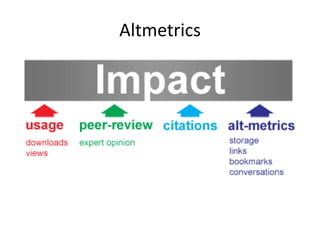
Altmetrics
• Our contribution to other communicaton and
  dissemination efforts should be ackowledged.
  This is becoming more and more important,
  relevant and recognised by funding agencies
  and evaluation bodies.
• Altmetrics.info: The Altmetrics manifesto
  – http://altmetrics.org/manifesto/
• Use of API to provide actual, comprehensible
  impact (opportunities for startups)
Altmetrics manifesto
• Altmetrics expand our view of what impact looks
  like, but also of what’s making the impact. This
  matters because expressions of scholarship are
  becoming more diverse. Articles are increasingly
  joined by:
   – The sharing of “raw science” like datasets, code, and
     experimental designs
   – Semantic publishing or “nanopublication,” where the
     citeable unit is an argument or passage rather than entire
     article.
   – Widespread self-publishing via blogging, microblogging,
     and comments or annotations on existing work.
• http://altmetrics.org
Altmetrics
A final recommendation on social
              networking
• Take a look at @lseimpact
• London School of Economics’ blog
• Twitter guide:
  – A guide to using Twitter in university research,
    teaching, and impact activities
  – http://blogs.lse.ac.uk/impactofsocialsciences/2011/09/29/twitter-guide/
And now researchers’ frontier:
                Outreach
• The guardian: Going viral: Using social media
  to publicise academic research
• http://www.guardian.co.uk/higher-education-
  network/blog/2011/apr/11/communications-marketing-management-
  admin-and-services
Outreach: compulsory?
• Outreach is more and more relevant
• It’s a duty of (senior) researchers
• It’s interesting (and perhaps fun) for junior researchers
  and PhD students
• Pushed by governments… but no much money
• Loved by people out there
• Universities, learned societies, associations, museums,
  … a network of disseminators
• Social communication of research, science,knowledge
• Leads to a well-informed society
• Provides publications beyond scholarly papers - +cv
How we (scientists) can communicate
• By origin
  – Personal
  – Groupal
  – Corporate
• By destination
  –   Indexed Journals / Scholar Publications
  –   Science journals for scientists (eg Scientific American)
  –   Science General for the Public (eg Quo, La Recherche)
  –   Communicacion of Science Culture
  –   Citizens Outreach
  –   Children's, Youth Outreach
How we (scientists) can communicate
• Personal
  – Shows
  – Theater
  – Performances
• By message
  – Own personal: PhD / researcher blog
  – News curation on a particular field of science
  – News curation on policy, funding, etc.
  – Contributing to shared blog
  – Contributing to research group
Reports

– FECyT report on social perception of Science
– BBVA Foundation: report on attitudes vs Science
– COSCE
– And many others!
Outreach possibilities
•   What?
    – Our work
    – Someone else's work
    – Sound knowledge
    – Citizen Science
    – Public awareness
•   On the spot
    – Demonstrative
    – Pedagogic/teaching Spectacular
•   Internet
    – Blogging/website
    – Science Blogs @ Newspapers Contests
    – Etc
Relevant article
• More than a blog: Should science bloggers stick
  to popularizing science and fighting
  creationism, or does blogging have a wider role
  to play in the scientific discoursehan a blog:?
• http://www.nature.com/embor/journal/v12/n11/full/
  embor2011201a.html?WT.ec_id=EMBOR-201111
The Guardian
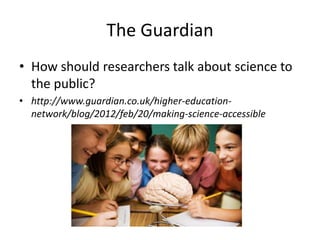
• How should researchers talk about science to
  the public?
• http://www.guardian.co.uk/higher-education-
  network/blog/2012/feb/20/making-science-accessible
Outreach in an actual group
• PPT "Is digital communication an actual, clever
  way to disseminate science?”
• PPT "Imagine! - some trends in recreational
  science and the pursue of science careers"
And finally…
• Take a look at my blog Edunomia, category
  “comciencia”
  – http://edunomia.net
• And also my mesoblog, tal iscico
  – http://edunoming.wordpress.com

• Entries may be in Catalan, but many
  references are to English information on
  Outreach

Iscico Module 4 - Metrics and Outreach

  • 1.
    Metrics and Outreach ISciCo – Module 4 ISCICO Course, 14-18 Jan 2013, Universitat de Girona Miquel Duran, UdG @miquelduran miquel.duran@udg.edu http://miquelduran.net License: Creative Commons CC-BY-SA
  • 2.
    Scholarly reputation • Articlespublished • Impact factor of journals where papers published • Actual impact (cites received) • Pondering between knowledge fields (SciMago ranking) • H Index and other indexes / highly-cited papers, hot papers
  • 3.
    Reputation and Metricsin web 2.0 • Twitter followers, mentions, etc. • Facebook likes • Visits to blog / Page views • Comments In blog • Comments and following in flickr, youtube, etc. • Interaction in academic social networks • Provide a value. Rather opaque but people may believe them. Related especially to twitter+fbk+gplus – Klout klout.com – Kred kred.com – Peerindex peerindex.com
  • 4.
    Altmetrics • Our contributionto other communicaton and dissemination efforts should be ackowledged. This is becoming more and more important, relevant and recognised by funding agencies and evaluation bodies. • Altmetrics.info: The Altmetrics manifesto – http://altmetrics.org/manifesto/ • Use of API to provide actual, comprehensible impact (opportunities for startups)
  • 5.
    Altmetrics manifesto • Altmetricsexpand our view of what impact looks like, but also of what’s making the impact. This matters because expressions of scholarship are becoming more diverse. Articles are increasingly joined by: – The sharing of “raw science” like datasets, code, and experimental designs – Semantic publishing or “nanopublication,” where the citeable unit is an argument or passage rather than entire article. – Widespread self-publishing via blogging, microblogging, and comments or annotations on existing work. • http://altmetrics.org
  • 6.
  • 7.
    A final recommendationon social networking • Take a look at @lseimpact • London School of Economics’ blog • Twitter guide: – A guide to using Twitter in university research, teaching, and impact activities – http://blogs.lse.ac.uk/impactofsocialsciences/2011/09/29/twitter-guide/
  • 8.
    And now researchers’frontier: Outreach • The guardian: Going viral: Using social media to publicise academic research • http://www.guardian.co.uk/higher-education- network/blog/2011/apr/11/communications-marketing-management- admin-and-services
  • 9.
    Outreach: compulsory? • Outreachis more and more relevant • It’s a duty of (senior) researchers • It’s interesting (and perhaps fun) for junior researchers and PhD students • Pushed by governments… but no much money • Loved by people out there • Universities, learned societies, associations, museums, … a network of disseminators • Social communication of research, science,knowledge • Leads to a well-informed society • Provides publications beyond scholarly papers - +cv
  • 10.
    How we (scientists)can communicate • By origin – Personal – Groupal – Corporate • By destination – Indexed Journals / Scholar Publications – Science journals for scientists (eg Scientific American) – Science General for the Public (eg Quo, La Recherche) – Communicacion of Science Culture – Citizens Outreach – Children's, Youth Outreach
  • 11.
    How we (scientists)can communicate • Personal – Shows – Theater – Performances • By message – Own personal: PhD / researcher blog – News curation on a particular field of science – News curation on policy, funding, etc. – Contributing to shared blog – Contributing to research group
  • 12.
    Reports – FECyT reporton social perception of Science – BBVA Foundation: report on attitudes vs Science – COSCE – And many others!
  • 13.
    Outreach possibilities • What? – Our work – Someone else's work – Sound knowledge – Citizen Science – Public awareness • On the spot – Demonstrative – Pedagogic/teaching Spectacular • Internet – Blogging/website – Science Blogs @ Newspapers Contests – Etc
  • 14.
    Relevant article • Morethan a blog: Should science bloggers stick to popularizing science and fighting creationism, or does blogging have a wider role to play in the scientific discoursehan a blog:? • http://www.nature.com/embor/journal/v12/n11/full/ embor2011201a.html?WT.ec_id=EMBOR-201111
  • 15.
    The Guardian • Howshould researchers talk about science to the public? • http://www.guardian.co.uk/higher-education- network/blog/2012/feb/20/making-science-accessible
  • 16.
    Outreach in anactual group • PPT "Is digital communication an actual, clever way to disseminate science?” • PPT "Imagine! - some trends in recreational science and the pursue of science careers"
  • 17.
    And finally… • Takea look at my blog Edunomia, category “comciencia” – http://edunomia.net • And also my mesoblog, tal iscico – http://edunoming.wordpress.com • Entries may be in Catalan, but many references are to English information on Outreach