https://www.flickr.com/photos/fabionik/15237356926/
Estratègies per comunicar la recerca
@xavierlasauca
GrupISOR(InvestigacionsenSociologiadelaReligió)
FacultatdeCiènciesPolítiquesiSociologiaUAB
26.09.2017
https://www.cartoonstock.com/directory/e/evolution_of_man.asp
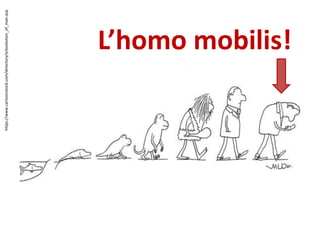
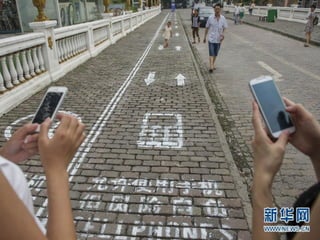
L’homo mobilis!
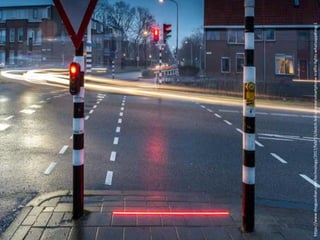
https://www.theguardian.com/technology/2017/feb/15/dutch-led-scheme-smartphone-traffic-lights-whatsapp#img-1
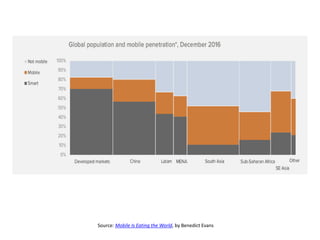
Source: Mobile Is Eating the World, by Benedict Evans
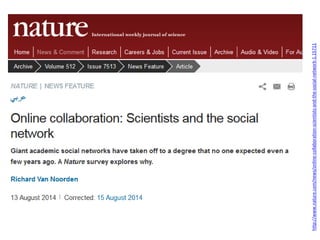
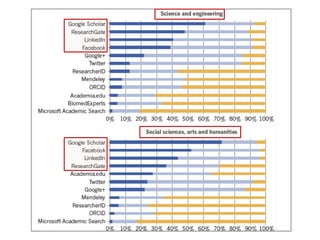
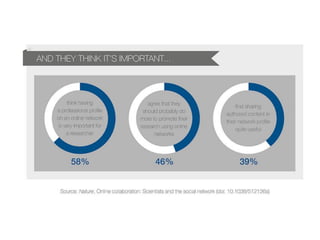
http://www.nature.com/news/online-collaboration-scientists-and-the-social-network-1.15711
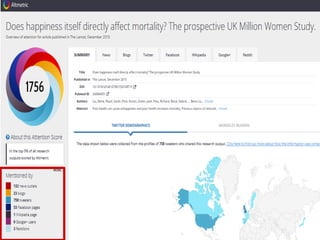
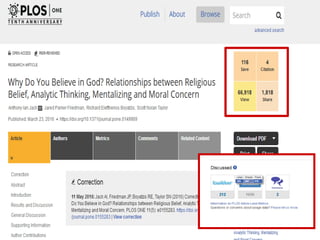
Altmetrics!
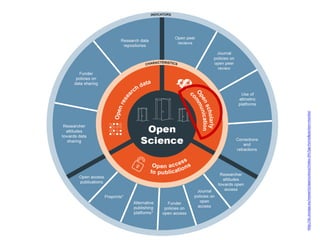
http://ec.europa.eu/research/openscience/index.cfm?pg=home&section=monitor
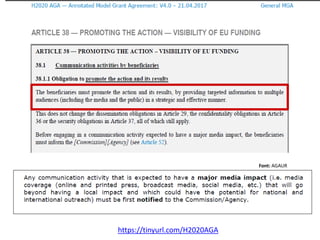
https://tinyurl.com/H2020AGA
Font: AGAUR
https://www.flickr.com/photos/funksoup/403990660
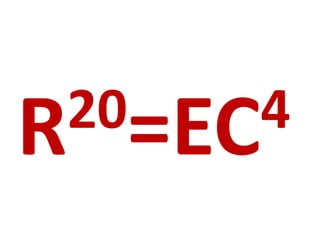
R20=EC4
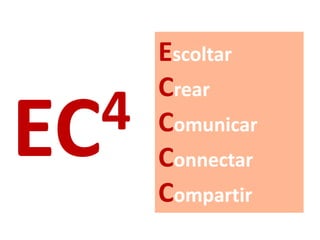
EC4
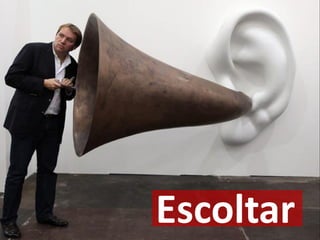
Escoltar
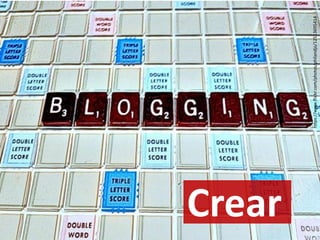
Crear
Comunicar
Connectar
Compartir
Escoltar
Crear
https://www.flickr.com/photos/philandjo/12513695414
http://www.altmetric.com/blog/interactions-here-in-the-blogosphere/
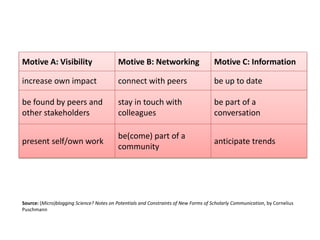
Motive A: Visibility Motive B: Networking Motive C: Information
increase own impact connect with peers be up to date
be found by peers and
other stakeholders
stay in touch with
colleagues
be part of a
conversation
present self/own work
be(come) part of a
community
anticipate trends
Source: (Micro)blogging Science? Notes on Potentials and Constraints of New Forms of Scholarly Communication, by Cornelius
Puschmann
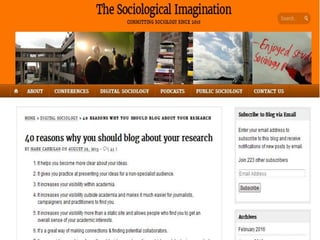
http://sociologicalimagination.org/archives/13910
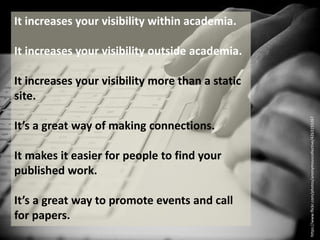
It increases your visibility within academia.
It increases your visibility outside academia.
It increases your visibility more than a static
site.
It’s a great way of making connections.
It makes it easier for people to find your
published work.
It’s a great way to promote events and call
for papers.
https://www.flickr.com/photos/anonymouscollective/4263193267
https://www.flickr.com/photos/miuenski/5887393036/
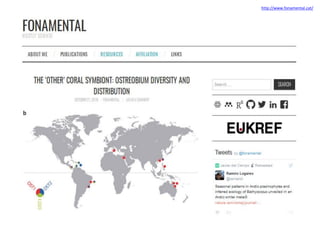
http://www.fonamental.cat/
http://blogs.lse.ac.uk/impactofsocialsciences/
Comunicar
https://www.flickr.com/photos/30767852@N00/3460078384/
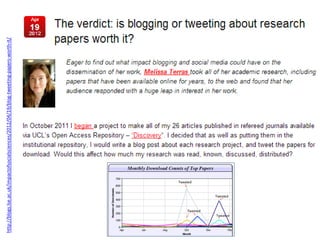
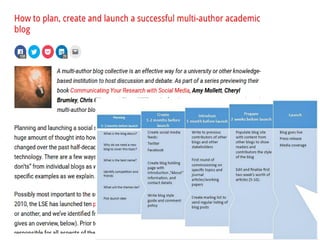
http://blogs.lse.ac.uk/impactofsocialsciences/2012/04/19/blog-tweeting-papers-worth-it/
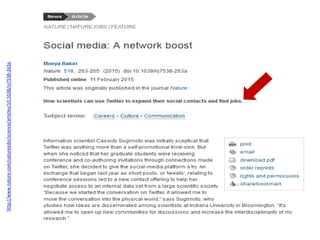
http://www.nature.com/naturejobs/science/articles/10.1038/nj7538-263a
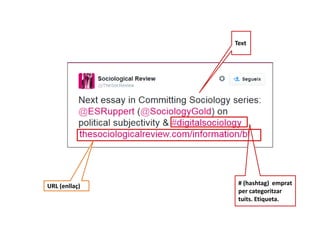
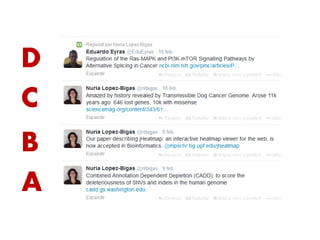
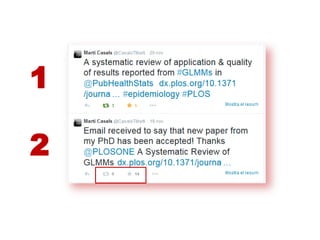
# (hashtag) emprat
per categoritzar
tuits. Etiqueta.
Text
URL (enllaç)
A
B
C
D
1
2
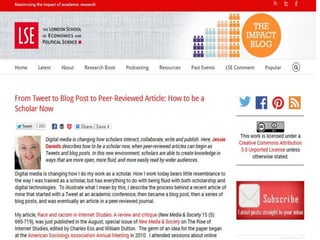
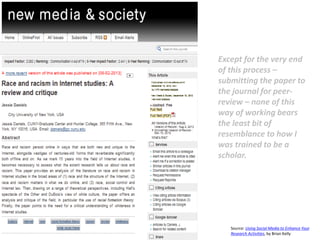
Except for the very end
of this process –
submitting the paper to
the journal for peer-
review – none of this
way of working bears
the least bit of
resemblance to how I
was trained to be a
scholar.
Source: Using Social Media to Enhance Your
Research Activities, by Brian Kelly
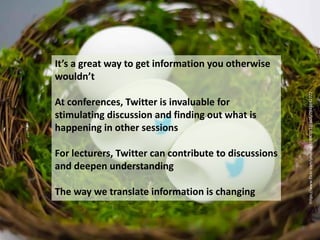
It’s a great way to get information you otherwise
wouldn’t
At conferences, Twitter is invaluable for
stimulating discussion and finding out what is
happening in other sessions
For lecturers, Twitter can contribute to discussions
and deepen understanding
The way we translate information is changing
https://www.flickr.com/photos/47400163@N05/7846842772
#AS17
http://blogs.lse.ac.uk/impactofsocialsciences/2011/09/29/twitter-guide/
http://www.lwec.org.uk/sites/default/files/TwitterTips.pdf
Connectar
https://www.flickr.com/photos/58754750
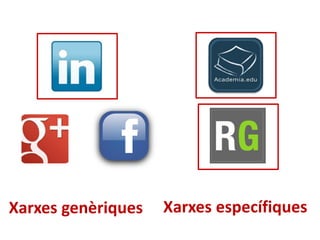
Xarxes genèriques Xarxes específiques
Compartir
https://www.flickr.com/photos/rohitchhiber/6038689637
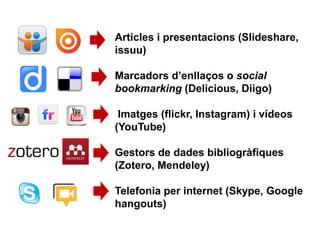
Articles i presentacions (Slideshare,
issuu)
Marcadors d’enllaços o social
bookmarking (Delicious, Diigo)
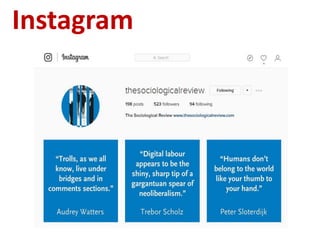
Imatges (flickr, Instagram) i vídeos
(YouTube)
Gestors de dades bibliogràfiques
(Zotero, Mendeley)
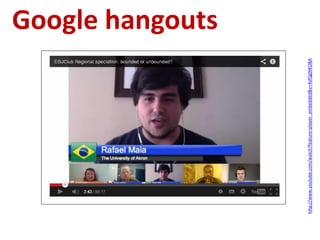
Telefonia per internet (Skype, Google
hangouts)
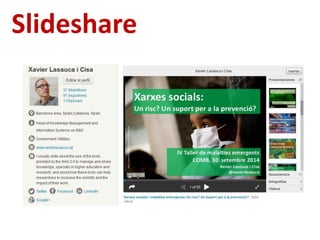
Slideshare
Google hangouts
http://www.youtube.com/watch?feature=player_embedded&v=4sfQg9IKO8A
Instagram
Els deu manaments
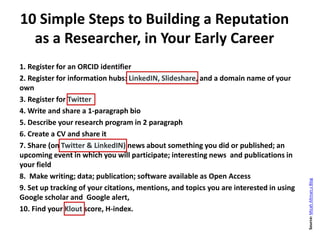
10 Simple Steps to Building a Reputation
as a Researcher, in Your Early Career
1. Register for an ORCID identifier
2. Register for information hubs: LinkedIN, Slideshare, and a domain name of your
own
3. Register for Twitter
4. Write and share a 1-paragraph bio
5. Describe your research program in 2 paragraph
6. Create a CV and share it
7. Share (on Twitter & LinkedIN) news about something you did or published; an
upcoming event in which you will participate; interesting news and publications in
your field
8. Make writing; data; publication; software available as Open Access
9. Set up tracking of your citations, mentions, and topics you are interested in using
Google scholar and Google alert,
10. Find your Klout score, H-index.
Source:MicahAltman,sBlog
http://nepalireporter.com/21956/paul-van-dyk-returns-uae/
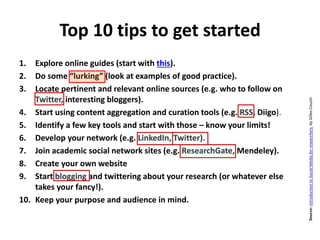
Top 10 tips to get started
1. Explore online guides (start with this).
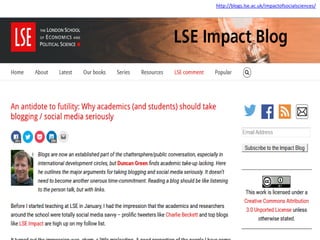
2. Do some “lurking” (look at examples of good practice).
3. Locate pertinent and relevant online sources (e.g. who to follow on
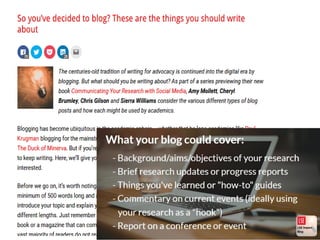
Twitter, interesting bloggers).
4. Start using content aggregation and curation tools (e.g. RSS, Diigo).
5. Identify a few key tools and start with those – know your limits!
6. Develop your network (e.g. LinkedIn, Twitter).
7. Join academic social network sites (e.g. ResearchGate, Mendeley).
8. Create your own website
9. Start blogging and twittering about your research (or whatever else
takes your fancy!).
10. Keep your purpose and audience in mind.
Source:IntroductiontoSocialMediaforresearchers,byGillesCouzin
http://www.forbes.com/pictures/eeel45jfeg/1-tiesto-22-million/
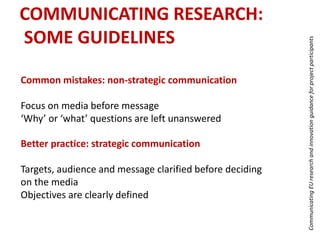
Common mistakes: non-strategic communication
Focus on media before message
‘Why’ or ‘what’ questions are left unanswered
CommunicatingEUresearchandinnovationguidanceforprojectparticipants
Better practice: strategic communication
Targets, audience and message clarified before deciding
on the media
Objectives are clearly defined
COMMUNICATING RESEARCH:
SOME GUIDELINES
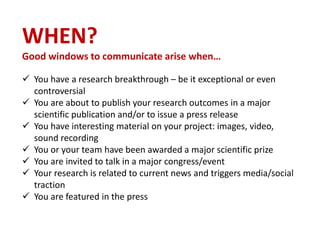
WHEN?
Good windows to communicate arise when…
 You have a research breakthrough – be it exceptional or even
controversial
 You are about to publish your research outcomes in a major
scientific publication and/or to issue a press release
 You have interesting material on your project: images, video,
sound recording
 You or your team have been awarded a major scientific prize
 You are invited to talk in a major congress/event
 Your research is related to current news and triggers media/social
traction
 You are featured in the press
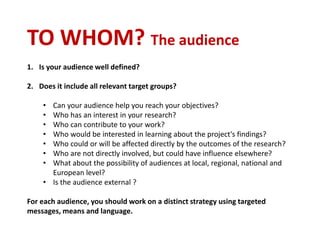
TO WHOM? The audience
1. Is your audience well defined?
2. Does it include all relevant target groups?
• Can your audience help you reach your objectives?
• Who has an interest in your research?
• Who can contribute to your work?
• Who would be interested in learning about the project's findings?
• Who could or will be affected directly by the outcomes of the research?
• Who are not directly involved, but could have influence elsewhere?
• What about the possibility of audiences at local, regional, national and
European level?
• Is the audience external ?
For each audience, you should work on a distinct strategy using targeted
messages, means and language.
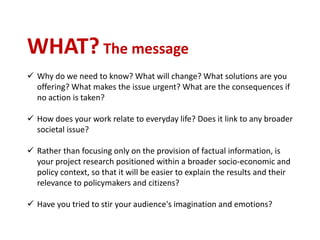
WHAT? The message
 Why do we need to know? What will change? What solutions are you
offering? What makes the issue urgent? What are the consequences if
no action is taken?
 How does your work relate to everyday life? Does it link to any broader
societal issue?
 Rather than focusing only on the provision of factual information, is
your project research positioned within a broader socio-economic and
policy context, so that it will be easier to explain the results and their
relevance to policymakers and citizens?
 Have you tried to stir your audience's imagination and emotions?
The power of storytelling
Tell a story, don’t just list facts
 A story is an effective way to make people remember your message.
Why not tell one to disseminate your results?
Which stories work best?
 A good story consists of a succession of events with a beginning, a
middle and an end, a scene setter and a plot, a climax and a
conclusion, all of this in a rich context. It is hence more than a list of
results achieved. A good story is one with which others can identify,
with the project content as a basis, and focused on a person (for
example: the researcher). Such stories also allow your message to be
conveyed through shared values that will touch people's hearts and
provoke emotion, and the promise of a better future.
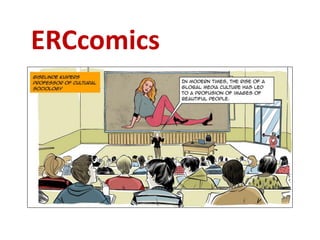
ERCcomics
HOW? The channels…
 The shape of your communication needs to adapt to your
audiences and the channels you will use
 While social media are good to reach wide audiences
through punchy content and visuals, a blog will allow you
to explain your research more in depth
 A media mix can be very an effective way forward,
allowing you to combine traditional supports, as printed
material, articles and press releases, public talks, with
audio-visual tools, web 2.0 and social media
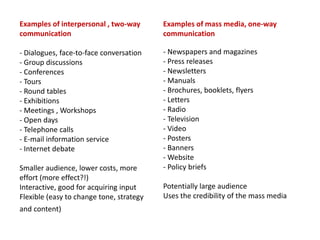
Examples of mass media, one-way
communication
- Newspapers and magazines
- Press releases
- Newsletters
- Manuals
- Brochures, booklets, flyers
- Letters
- Radio
- Television
- Video
- Posters
- Banners
- Website
- Policy briefs
Potentially large audience
Uses the credibility of the mass media
Examples of interpersonal , two-way
communication
- Dialogues, face-to-face conversation
- Group discussions
- Conferences
- Tours
- Round tables
- Exhibitions
- Meetings , Workshops
- Open days
- Telephone calls
- E-mail information service
- Internet debate
Smaller audience, lower costs, more
effort (more effect?!)
Interactive, good for acquiring input
Flexible (easy to change tone, strategy
and content)
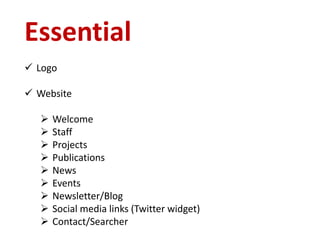
Essential
 Logo
 Website
 Welcome
 Staff
 Projects
 Publications
 News
 Events
 Newsletter/Blog
 Social media links (Twitter widget)
 Contact/Searcher
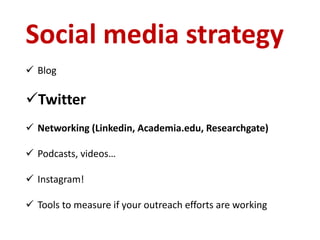
Social media strategy
 Blog
Twitter
 Networking (Linkedin, Academia.edu, Researchgate)
 Podcasts, videos…
 Instagram!
 Tools to measure if your outreach efforts are working
http://www.flickr.com/photos/ybot84/7850997682/
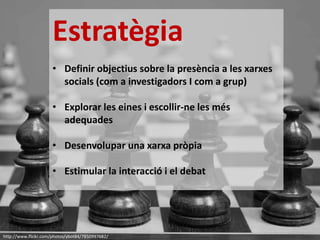
Estratègia
• Definir objectius sobre la presència a les xarxes
socials (com a investigadors I com a grup)
• Explorar les eines i escollir-ne les més
adequades
• Desenvolupar una xarxa pròpia
• Estimular la interacció i el debat
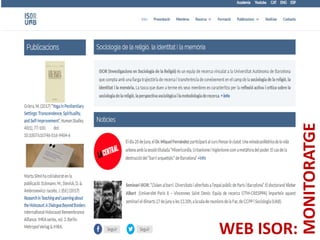
WEB ISOR:
MONITORATGE
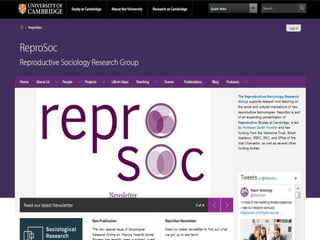
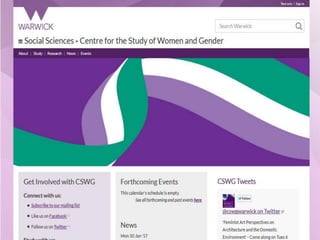
Benchmarking
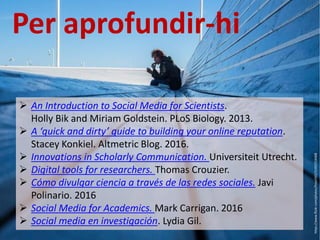
 An Introduction to Social Media for Scientists.
Holly Bik and Miriam Goldstein. PLoS Biology. 2013.
 A ‘quick and dirty’ guide to building your online reputation.
Stacey Konkiel. Altmetric Blog. 2016.
 Innovations in Scholarly Communication. Universiteit Utrecht.
 Digital tools for researchers. Thomas Crouzier.
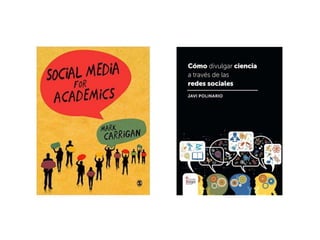
 Cómo divulgar ciencia a través de las redes sociales. Javi
Polinario. 2016
 Social Media for Academics. Mark Carrigan. 2016
 Social media en investigación. Lydia Gil.
Per aprofundir-hi
https://www.flickr.com/photos/frosch50/21492514468
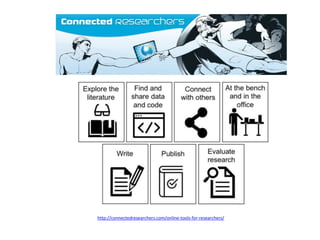
http://connectedresearchers.com/online-tools-for-researchers/
 Public Consultation: ‘Science 2.0’: Science in Transition
European Commission. 2014
 Emerging reputation mechanisms for scholars
European Commission. 2015
 Making Open Science a Reality
OECD. 2015
 Open Innovation, Open Science, Open to the World: a vision
for Europe
European Commission. 2016
 Next generation metrics
European Commission. 2017
https://www.flickr.com/photos/european_parliament/10943216394
Conclusions
https://www.flickr.com/photos/niaid/14861104355
.
https://www.flickr.com/photos/67623309@N07/6286036061
Xavier Lasauca i Cisa
www.xavierlasauca.cat
@xavierlasauca

Estratègies per comunicar la recerca

  • 1.
    https://www.flickr.com/photos/fabionik/15237356926/ Estratègies per comunicarla recerca @xavierlasauca GrupISOR(InvestigacionsenSociologiadelaReligió) FacultatdeCiènciesPolítiquesiSociologiaUAB 26.09.2017
  • 3.
  • 5.
  • 6.
    Source: Mobile IsEating the World, by Benedict Evans
  • 10.
  • 14.
  • 17.
  • 18.
  • 19.
  • 20.
  • 21.
  • 22.
  • 25.
  • 28.
  • 29.
    Motive A: VisibilityMotive B: Networking Motive C: Information increase own impact connect with peers be up to date be found by peers and other stakeholders stay in touch with colleagues be part of a conversation present self/own work be(come) part of a community anticipate trends Source: (Micro)blogging Science? Notes on Potentials and Constraints of New Forms of Scholarly Communication, by Cornelius Puschmann
  • 30.
  • 31.
    It increases yourvisibility within academia. It increases your visibility outside academia. It increases your visibility more than a static site. It’s a great way of making connections. It makes it easier for people to find your published work. It’s a great way to promote events and call for papers. https://www.flickr.com/photos/anonymouscollective/4263193267
  • 32.
  • 33.
  • 36.
  • 39.
  • 40.
  • 41.
  • 42.
    # (hashtag) emprat percategoritzar tuits. Etiqueta. Text URL (enllaç)
  • 44.
  • 46.
  • 49.
    Except for thevery end of this process – submitting the paper to the journal for peer- review – none of this way of working bears the least bit of resemblance to how I was trained to be a scholar. Source: Using Social Media to Enhance Your Research Activities, by Brian Kelly
  • 51.
    It’s a greatway to get information you otherwise wouldn’t At conferences, Twitter is invaluable for stimulating discussion and finding out what is happening in other sessions For lecturers, Twitter can contribute to discussions and deepen understanding The way we translate information is changing https://www.flickr.com/photos/47400163@N05/7846842772
  • 52.
  • 53.
  • 56.
  • 57.
  • 61.
  • 62.
    Articles i presentacions(Slideshare, issuu) Marcadors d’enllaços o social bookmarking (Delicious, Diigo) Imatges (flickr, Instagram) i vídeos (YouTube) Gestors de dades bibliogràfiques (Zotero, Mendeley) Telefonia per internet (Skype, Google hangouts)
  • 63.
  • 64.
  • 65.
  • 68.
  • 69.
    10 Simple Stepsto Building a Reputation as a Researcher, in Your Early Career 1. Register for an ORCID identifier 2. Register for information hubs: LinkedIN, Slideshare, and a domain name of your own 3. Register for Twitter 4. Write and share a 1-paragraph bio 5. Describe your research program in 2 paragraph 6. Create a CV and share it 7. Share (on Twitter & LinkedIN) news about something you did or published; an upcoming event in which you will participate; interesting news and publications in your field 8. Make writing; data; publication; software available as Open Access 9. Set up tracking of your citations, mentions, and topics you are interested in using Google scholar and Google alert, 10. Find your Klout score, H-index. Source:MicahAltman,sBlog http://nepalireporter.com/21956/paul-van-dyk-returns-uae/
  • 70.
    Top 10 tipsto get started 1. Explore online guides (start with this). 2. Do some “lurking” (look at examples of good practice). 3. Locate pertinent and relevant online sources (e.g. who to follow on Twitter, interesting bloggers). 4. Start using content aggregation and curation tools (e.g. RSS, Diigo). 5. Identify a few key tools and start with those – know your limits! 6. Develop your network (e.g. LinkedIn, Twitter). 7. Join academic social network sites (e.g. ResearchGate, Mendeley). 8. Create your own website 9. Start blogging and twittering about your research (or whatever else takes your fancy!). 10. Keep your purpose and audience in mind. Source:IntroductiontoSocialMediaforresearchers,byGillesCouzin http://www.forbes.com/pictures/eeel45jfeg/1-tiesto-22-million/
  • 73.
    Common mistakes: non-strategiccommunication Focus on media before message ‘Why’ or ‘what’ questions are left unanswered CommunicatingEUresearchandinnovationguidanceforprojectparticipants Better practice: strategic communication Targets, audience and message clarified before deciding on the media Objectives are clearly defined COMMUNICATING RESEARCH: SOME GUIDELINES
  • 74.
    WHEN? Good windows tocommunicate arise when…  You have a research breakthrough – be it exceptional or even controversial  You are about to publish your research outcomes in a major scientific publication and/or to issue a press release  You have interesting material on your project: images, video, sound recording  You or your team have been awarded a major scientific prize  You are invited to talk in a major congress/event  Your research is related to current news and triggers media/social traction  You are featured in the press
  • 75.
    TO WHOM? Theaudience 1. Is your audience well defined? 2. Does it include all relevant target groups? • Can your audience help you reach your objectives? • Who has an interest in your research? • Who can contribute to your work? • Who would be interested in learning about the project's findings? • Who could or will be affected directly by the outcomes of the research? • Who are not directly involved, but could have influence elsewhere? • What about the possibility of audiences at local, regional, national and European level? • Is the audience external ? For each audience, you should work on a distinct strategy using targeted messages, means and language.
  • 76.
    WHAT? The message Why do we need to know? What will change? What solutions are you offering? What makes the issue urgent? What are the consequences if no action is taken?  How does your work relate to everyday life? Does it link to any broader societal issue?  Rather than focusing only on the provision of factual information, is your project research positioned within a broader socio-economic and policy context, so that it will be easier to explain the results and their relevance to policymakers and citizens?  Have you tried to stir your audience's imagination and emotions?
  • 77.
    The power ofstorytelling Tell a story, don’t just list facts  A story is an effective way to make people remember your message. Why not tell one to disseminate your results? Which stories work best?  A good story consists of a succession of events with a beginning, a middle and an end, a scene setter and a plot, a climax and a conclusion, all of this in a rich context. It is hence more than a list of results achieved. A good story is one with which others can identify, with the project content as a basis, and focused on a person (for example: the researcher). Such stories also allow your message to be conveyed through shared values that will touch people's hearts and provoke emotion, and the promise of a better future.
  • 79.
  • 80.
    HOW? The channels… The shape of your communication needs to adapt to your audiences and the channels you will use  While social media are good to reach wide audiences through punchy content and visuals, a blog will allow you to explain your research more in depth  A media mix can be very an effective way forward, allowing you to combine traditional supports, as printed material, articles and press releases, public talks, with audio-visual tools, web 2.0 and social media
  • 81.
    Examples of massmedia, one-way communication - Newspapers and magazines - Press releases - Newsletters - Manuals - Brochures, booklets, flyers - Letters - Radio - Television - Video - Posters - Banners - Website - Policy briefs Potentially large audience Uses the credibility of the mass media Examples of interpersonal , two-way communication - Dialogues, face-to-face conversation - Group discussions - Conferences - Tours - Round tables - Exhibitions - Meetings , Workshops - Open days - Telephone calls - E-mail information service - Internet debate Smaller audience, lower costs, more effort (more effect?!) Interactive, good for acquiring input Flexible (easy to change tone, strategy and content)
  • 82.
    Essential  Logo  Website Welcome  Staff  Projects  Publications  News  Events  Newsletter/Blog  Social media links (Twitter widget)  Contact/Searcher
  • 83.
    Social media strategy Blog Twitter  Networking (Linkedin, Academia.edu, Researchgate)  Podcasts, videos…  Instagram!  Tools to measure if your outreach efforts are working
  • 84.
    http://www.flickr.com/photos/ybot84/7850997682/ Estratègia • Definir objectiussobre la presència a les xarxes socials (com a investigadors I com a grup) • Explorar les eines i escollir-ne les més adequades • Desenvolupar una xarxa pròpia • Estimular la interacció i el debat
  • 85.
  • 86.
  • 89.
     An Introductionto Social Media for Scientists. Holly Bik and Miriam Goldstein. PLoS Biology. 2013.  A ‘quick and dirty’ guide to building your online reputation. Stacey Konkiel. Altmetric Blog. 2016.  Innovations in Scholarly Communication. Universiteit Utrecht.  Digital tools for researchers. Thomas Crouzier.  Cómo divulgar ciencia a través de las redes sociales. Javi Polinario. 2016  Social Media for Academics. Mark Carrigan. 2016  Social media en investigación. Lydia Gil. Per aprofundir-hi https://www.flickr.com/photos/frosch50/21492514468
  • 90.
  • 92.
     Public Consultation:‘Science 2.0’: Science in Transition European Commission. 2014  Emerging reputation mechanisms for scholars European Commission. 2015  Making Open Science a Reality OECD. 2015  Open Innovation, Open Science, Open to the World: a vision for Europe European Commission. 2016  Next generation metrics European Commission. 2017 https://www.flickr.com/photos/european_parliament/10943216394
  • 93.
  • 95.
  • 96.