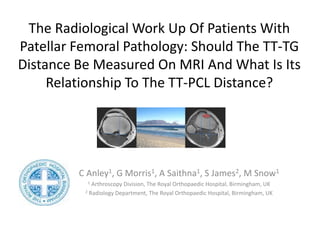
The Radiological Work Up Of Patients With
Patellar Femoral Pathology: Should The TT-TG
Distance Be Measured On MRI And What Is Its
Relationship To The TT-PCL Distance?
C Anley1, G Morris1, A Saithna1, S James2, M Snow1
1 Arthroscopy Division, The Royal Orthopaedic Hospital, Birmingham, UK
2 Radiology Department, The Royal Orthopaedic Hospital, Birmingham, UK
Disclosures
The authors have no financial
conflicts related to this poster to
disclose
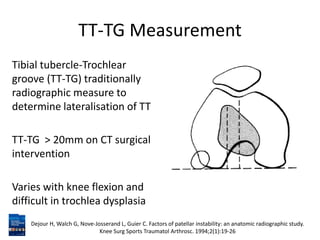
TT-TG Measurement
Tibial tubercle-Trochlear
groove (TT-TG) traditionally
radiographic measure to
determine lateralisation of TT
TT-TG > 20mm on CT surgical
intervention
Varies with knee flexion and
difficult in trochlea dysplasia
Dejour H, Walch G, Nove-Josserand L, Guier C. Factors of patellar instability: an anatomic radiographic study.
Knee Surg Sports Traumatol Arthrosc. 1994;2(1):19-26
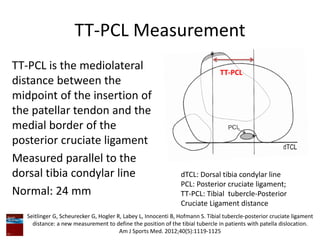
TT-PCL Measurement
TT-PCL is the mediolateral
distance between the
midpoint of the insertion of
the patellar tendon and the
medial border of the
posterior cruciate ligament
Measured parallel to the
dorsal tibia condylar line
Normal: 24 mm
dTCL: Dorsal tibia condylar line
PCL: Posterior cruciate ligament;
TT-PCL: Tibial tubercle-Posterior
Cruciate Ligament distance
Seitlinger G, Scheurecker G, Hogler R, Labey L, Innocenti B, Hofmann S. Tibial tubercle-posterior cruciate ligament
distance: a new measurement to define the position of the tibial tubercle in patients with patella dislocation.
Am J Sports Med. 2012;40(5):1119-1125
TT-PCL
Objective
Radiographic study to:
1. Review whether TT-TG on CT and MRI are
interchangeable
2. Establish if there is a correlation between TT
lateralisation as indicated by TT-TG and TT-PCL
Methods
141 scans (108F 33M) with patellar pathology and both
MRI and CT scan, were identified on the hospital PACS
system. Ave age: 28.5 yrs (10-59, SD ±11.13 yrs)
TT-TG, TT-PCL and Knee Joint Rotation were measured
independently by two fellowship trained orthopaedic
surgeons according to the methods used by Seitlinger et
al and Shoettle
Thirty measurements where repeated on a separate
occasion to allow for an assessment of the intrarater
reliability
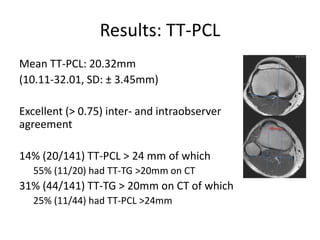
Results: TT-PCL
Mean TT-PCL: 20.32mm
(10.11-32.01, SD: ± 3.45mm)
Excellent (> 0.75) inter- and intraobserver
agreement
14% (20/141) TT-PCL > 24 mm of which
55% (11/20) had TT-TG >20mm on CT
31% (44/141) TT-TG > 20mm on CT of which
25% (11/44) had TT-PCL >24mm
Results: TT-TG CT vs MRI
Interobserver and
intraobserver agreement
was considered excellent
(> 0.75) for both MRI and
CT (0.98 and 0.97)
ICC for each rater
comparing the two
imaging modalities was
only fair (0.54 and 0.48)
Measurements are not
interchangeable between
the two modalities
CT MRI
Mean 17.72mm 13.56mm
Mean difference: 4.16mm
Range 6.97-31.33mm 2-30.04mm
SD ±5.15 ±6.07
P value p<0.001
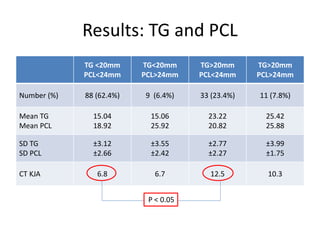
Results
Based on the TT-TG and TT-PCL measurements,
4 groups of patients can be established.
When comparing knee joint rotation (KJR)
between groups, we noted that an increased TT-
TG may result from either true lateralisation of
the TT, an increased knee joint rotation or a
combination of both.
Results: TG and PCL
TG <20mm
PCL<24mm
TG<20mm
PCL>24mm
TG>20mm
PCL<24mm
TG>20mm
PCL>24mm
Number (%) 88 (62.4%) 9 (6.4%) 33 (23.4%) 11 (7.8%)
Mean TG
Mean PCL
15.04
18.92
15.06
25.92
23.22
20.82
25.42
25.88
SD TG
SD PCL
±3.12
±2.66
±3.55
±2.42
±2.77
±2.27
±3.99
±1.75
CT KJA 6.8 6.7 12.5 10.3
P < 0.05
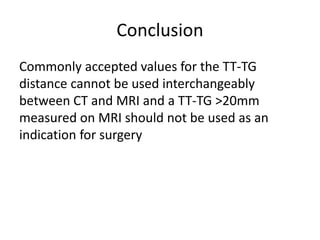
Conclusion
Commonly accepted values for the TT-TG
distance cannot be used interchangeably
between CT and MRI and a TT-TG >20mm
measured on MRI should not be used as an
indication for surgery
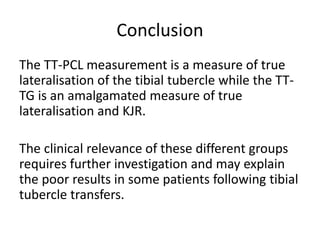
Conclusion
The TT-PCL measurement is a measure of true
lateralisation of the tibial tubercle while the TT-
TG is an amalgamated measure of true
lateralisation and KJR.
The clinical relevance of these different groups
requires further investigation and may explain
the poor results in some patients following tibial
tubercle transfers.
References
Dejour H, Walch G, Nove-Josserand L, Guier C. Factors of patellar
instability: an anatomic radiographic study. Knee Surg Sports Traumatol
Arthrosc. 1994;2(1):19-26
Seitlinger G, Scheurecker G, Hogler R, Labey L, Innocenti B, Hofmann S.
Tibial tubercle-posterior cruciate ligament distance: a new measurement
to define the position of the tibial tubercle in patients with patella
dislocation. Am J Sports Med. 2012;40(5):1119-1125
Schoettle PB, Zanetti M, Seifert B, Pfirrmann CW, Fucentese SF, Romero J.
The tibial tuberosity–trochlear groove distance: a comparative study
between CT and MRI scanning. Knee. 2006;13:26-31.

The Radiological Work Up of Patients With Patellofemoral Pathology: ISAKOS 2015

  • 1.
    The Radiological WorkUp Of Patients With Patellar Femoral Pathology: Should The TT-TG Distance Be Measured On MRI And What Is Its Relationship To The TT-PCL Distance? C Anley1, G Morris1, A Saithna1, S James2, M Snow1 1 Arthroscopy Division, The Royal Orthopaedic Hospital, Birmingham, UK 2 Radiology Department, The Royal Orthopaedic Hospital, Birmingham, UK
  • 2.
    Disclosures The authors haveno financial conflicts related to this poster to disclose
  • 3.
    TT-TG Measurement Tibial tubercle-Trochlear groove(TT-TG) traditionally radiographic measure to determine lateralisation of TT TT-TG > 20mm on CT surgical intervention Varies with knee flexion and difficult in trochlea dysplasia Dejour H, Walch G, Nove-Josserand L, Guier C. Factors of patellar instability: an anatomic radiographic study. Knee Surg Sports Traumatol Arthrosc. 1994;2(1):19-26
  • 4.
    TT-PCL Measurement TT-PCL isthe mediolateral distance between the midpoint of the insertion of the patellar tendon and the medial border of the posterior cruciate ligament Measured parallel to the dorsal tibia condylar line Normal: 24 mm dTCL: Dorsal tibia condylar line PCL: Posterior cruciate ligament; TT-PCL: Tibial tubercle-Posterior Cruciate Ligament distance Seitlinger G, Scheurecker G, Hogler R, Labey L, Innocenti B, Hofmann S. Tibial tubercle-posterior cruciate ligament distance: a new measurement to define the position of the tibial tubercle in patients with patella dislocation. Am J Sports Med. 2012;40(5):1119-1125 TT-PCL
  • 5.
    Objective Radiographic study to: 1.Review whether TT-TG on CT and MRI are interchangeable 2. Establish if there is a correlation between TT lateralisation as indicated by TT-TG and TT-PCL
  • 6.
    Methods 141 scans (108F33M) with patellar pathology and both MRI and CT scan, were identified on the hospital PACS system. Ave age: 28.5 yrs (10-59, SD ±11.13 yrs) TT-TG, TT-PCL and Knee Joint Rotation were measured independently by two fellowship trained orthopaedic surgeons according to the methods used by Seitlinger et al and Shoettle Thirty measurements where repeated on a separate occasion to allow for an assessment of the intrarater reliability
  • 7.
    Results: TT-PCL Mean TT-PCL:20.32mm (10.11-32.01, SD: ± 3.45mm) Excellent (> 0.75) inter- and intraobserver agreement 14% (20/141) TT-PCL > 24 mm of which 55% (11/20) had TT-TG >20mm on CT 31% (44/141) TT-TG > 20mm on CT of which 25% (11/44) had TT-PCL >24mm
  • 8.
    Results: TT-TG CTvs MRI Interobserver and intraobserver agreement was considered excellent (> 0.75) for both MRI and CT (0.98 and 0.97) ICC for each rater comparing the two imaging modalities was only fair (0.54 and 0.48) Measurements are not interchangeable between the two modalities CT MRI Mean 17.72mm 13.56mm Mean difference: 4.16mm Range 6.97-31.33mm 2-30.04mm SD ±5.15 ±6.07 P value p<0.001
  • 9.
    Results Based on theTT-TG and TT-PCL measurements, 4 groups of patients can be established. When comparing knee joint rotation (KJR) between groups, we noted that an increased TT- TG may result from either true lateralisation of the TT, an increased knee joint rotation or a combination of both.
  • 10.
    Results: TG andPCL TG <20mm PCL<24mm TG<20mm PCL>24mm TG>20mm PCL<24mm TG>20mm PCL>24mm Number (%) 88 (62.4%) 9 (6.4%) 33 (23.4%) 11 (7.8%) Mean TG Mean PCL 15.04 18.92 15.06 25.92 23.22 20.82 25.42 25.88 SD TG SD PCL ±3.12 ±2.66 ±3.55 ±2.42 ±2.77 ±2.27 ±3.99 ±1.75 CT KJA 6.8 6.7 12.5 10.3 P < 0.05
  • 11.
    Conclusion Commonly accepted valuesfor the TT-TG distance cannot be used interchangeably between CT and MRI and a TT-TG >20mm measured on MRI should not be used as an indication for surgery
  • 12.
    Conclusion The TT-PCL measurementis a measure of true lateralisation of the tibial tubercle while the TT- TG is an amalgamated measure of true lateralisation and KJR. The clinical relevance of these different groups requires further investigation and may explain the poor results in some patients following tibial tubercle transfers.
  • 13.
    References Dejour H, WalchG, Nove-Josserand L, Guier C. Factors of patellar instability: an anatomic radiographic study. Knee Surg Sports Traumatol Arthrosc. 1994;2(1):19-26 Seitlinger G, Scheurecker G, Hogler R, Labey L, Innocenti B, Hofmann S. Tibial tubercle-posterior cruciate ligament distance: a new measurement to define the position of the tibial tubercle in patients with patella dislocation. Am J Sports Med. 2012;40(5):1119-1125 Schoettle PB, Zanetti M, Seifert B, Pfirrmann CW, Fucentese SF, Romero J. The tibial tuberosity–trochlear groove distance: a comparative study between CT and MRI scanning. Knee. 2006;13:26-31.