Structural Targets for Prevention of
Post Traumatic OA
David Hunter MBBS, PhD, FRACP
Florance and Cope Chair of Rheumatology, Professor of Medicine
University of Sydney and Royal North Shore Hospital
Chair, Institute of Bone and Joint Research
Chair, Musculoskeletal, Sydney Medical Program
Consultant Rheumatologist, North Sydney Orthopedic and Sports Medicine
David.Hunter@sydney.edu.au
@ProfDavidHunter
Declaration of interest
I declare that in the past three years I have:
• Consulted for Pfizer, TLCBio, Tissuegene, Merck Serono
• Supported by an NHMRC Health Practitioner Fellowship.
References
• The health and structural consequences of acute knee
injuries involving rupture of the anterior cruciate ligament.
Rheum Dis Clin North Am. 2013 Feb;39(1):107-22.
• Pathogenesis of post-traumatic OA with a view to
intervention. Best Pract Res Clin Rheumatol. 2014
Feb;28(1):17-30.
• OARSI Clinical Trials Recommendations: Knee imaging in
clinical trials in osteoarthritis. Osteoarthritis Cartilage. 2015
May;23(5):698-715.
• Definition of osteoarthritis on MRI: results of a Delphi
exercise. Osteoarthritis Cartilage. 2011 Aug;19(8):963-9.
Outline
Limitations of radiography
Course of OA, Whole Joint Disease
MRI definition
Quantitative Imaging
What is osteoarthritis?
Disease of the whole joint
Hunter DJ. NEJM. 2015;372:1040-1047.
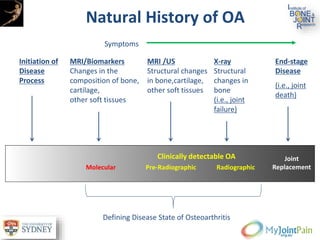
Natural History of OA
X-ray
Structural
changes in
bone
(i.e., joint
failure)
End-stage
Disease
(i.e., joint
death)
Initiation of
Disease
Process
MRI/Biomarkers
Changes in the
composition of bone,
cartilage,
other soft tissues
Symptoms
MRI /US
Structural changes
in bone,cartilage,
other soft tissues
Clinically detectable OA Joint
ReplacementRadiographicPre-Radiographic
Defining Disease State of Osteoarthritis
Molecular
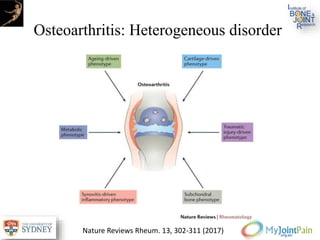
Osteoarthritis: Heterogeneous disorder
Nature Reviews Rheum. 13, 302-311 (2017)
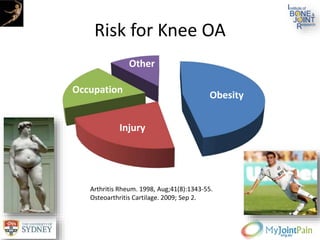
Risk for Knee OA
Obesity
Injury
Occupation
Other
Arthritis Rheum. 1998, Aug;41(8):1343-55.
Osteoarthritis Cartilage. 2009; Sep 2.
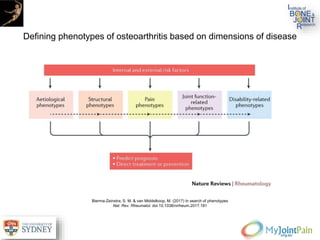
Defining phenotypes of osteoarthritis based on dimensions of disease
Bierma-Zeinstra, S. M. & van Middelkoop, M. (2017) In search of phenotypes
Nat. Rev. Rheumatol. doi:10.1038/nrrheum.2017.181
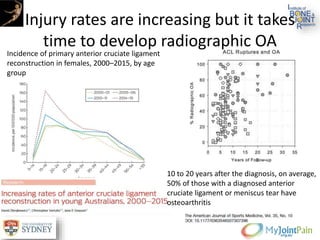
Injury rates are increasing but it takes
time to develop radiographic OA
Incidence of primary anterior cruciate ligament
reconstruction in females, 2000–2015, by age
group
10 to 20 years after the diagnosis, on average,
50% of those with a diagnosed anterior
cruciate ligament or meniscus tear have
osteoarthritis
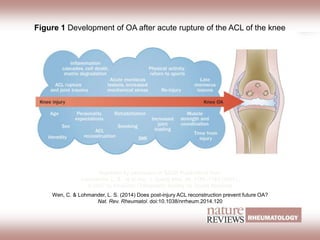
Figure 1 Development of OA after acute rupture of the ACL of the knee
Wen, C. & Lohmander, L. S. (2014) Does post-injury ACL reconstruction prevent future OA?
Nat. Rev. Rheumatol. doi:10.1038/nrrheum.2014.120
Reprinted by permission of SAGE Publications from
Lohmander, L. S. et al. Am. J. Sports Med. 35, 1756–1769 (2007),
© 2007 by American Orthopaedic Society for Sports Medicine
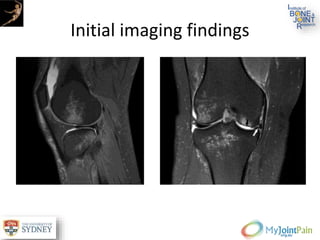
Initial imaging findings
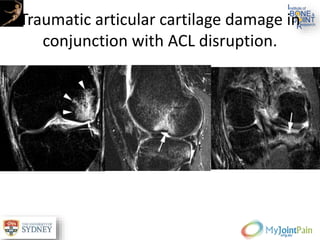
Traumatic articular cartilage damage in
conjunction with ACL disruption.
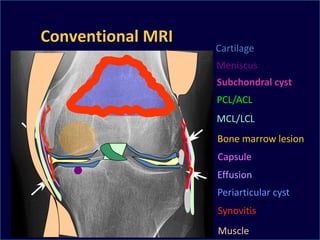
Meniscus
Subchondral cyst
Bone marrow lesion
Effusion
Muscle
PCL/ACL
MCL/LCL
Capsule
Periarticular cyst
Synovitis
Cartilage
Conventional MRI
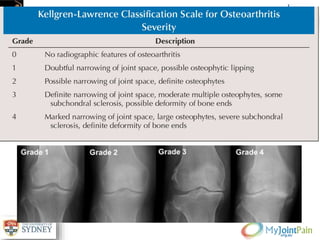
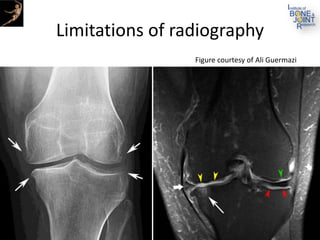
Limitations of radiography
Figure courtesy of Ali Guermazi
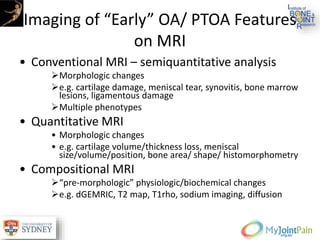
Imaging of “Early” OA/ PTOA Features
on MRI
• Conventional MRI – semiquantitative analysis
Morphologic changes
e.g. cartilage damage, meniscal tear, synovitis, bone marrow
lesions, ligamentous damage
Multiple phenotypes
• Quantitative MRI
• Morphologic changes
• e.g. cartilage volume/thickness loss, meniscal
size/volume/position, bone area/ shape/ histomorphometry
• Compositional MRI
“pre-morphologic” physiologic/biochemical changes
e.g. dGEMRIC, T2 map, T1rho, sodium imaging, diffusion
Accepted propositions for definition of
OA on MRI
A definition of tibiofemoral osteoarthritis on MRI would be:
The presence of both group [A] features or one group [A] feature and two or more group [B]
features
Group [A] after exclusion of joint trauma within the last 6 months (by history) and exclusion
of inflammatory arthritis (by radiographs, history and laboratory parameters):
i) Definite osteophyte formation§
ii) Full thickness cartilage loss
Group [B]:
i) Subchondral bone marrow lesion or cyst not associated with meniscal or ligamentous
attachments
ii) Meniscal subluxation, maceration or degenerative (horizontal) tear
iii) Partial thickness cartilage loss (where full thickness loss is not present)
iv) Bone attrition
Definition of PF OA requires all of the following involving the patella and/or anterior femur:
i) A definite osteophyte
ii) Partial or full thickness cartilage loss
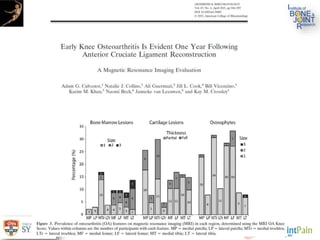
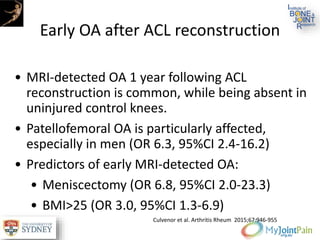
Early OA after ACL reconstruction
• MRI-detected OA 1 year following ACL
reconstruction is common, while being absent in
uninjured control knees.
• Patellofemoral OA is particularly affected,
especially in men (OR 6.3, 95%CI 2.4-16.2)
• Predictors of early MRI-detected OA:
• Meniscectomy (OR 6.8, 95%CI 2.0-23.3)
• BMI>25 (OR 3.0, 95%CI 1.3-6.9)
Culvenor et al. Arthritis Rheum 2015;67:946-955
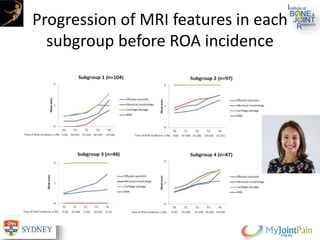
What comes first? Multi-tissue involvement
leading to radiographic osteoarthritis
• Predictors of ROA at P-2:
• Hoffa synovitis (HR 1.76 [95% CI 1.18-2.64])
• Effusion synovitis (HR 1.81 [95% CI 1.18-2.78])
• Medial meniscal damage (HR 1.83 [95% CI 1.17-
2.89]).
• At P -1, all features but meniscal extrusion
predicted radiographic OA, with highest odds for
medial BMLs (HR 6.50 [95% CI 2.27-18.62]) and
effusion synovitis (HR 2.50 [95% CI 1.76-3.54]).
Roemer et al. Arthritis Rheumatol. 2015 May;67(8):2085-96
Progression of MRI features in each
subgroup before ROA incidence
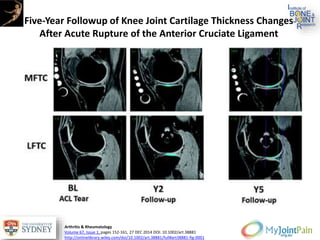
Five‐Year Followup of Knee Joint Cartilage Thickness Changes
After Acute Rupture of the Anterior Cruciate Ligament
Arthritis & Rheumatology
Volume 67, Issue 1, pages 152-161, 27 DEC 2014 DOI: 10.1002/art.38881
http://onlinelibrary.wiley.com/doi/10.1002/art.38881/full#art38881-fig-0001
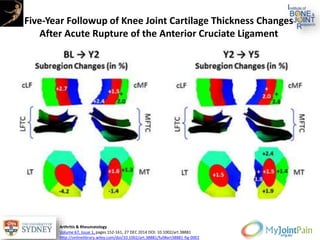
Five‐Year Followup of Knee Joint Cartilage Thickness Changes
After Acute Rupture of the Anterior Cruciate Ligament
Arthritis & Rheumatology
Volume 67, Issue 1, pages 152-161, 27 DEC 2014 DOI: 10.1002/art.38881
http://onlinelibrary.wiley.com/doi/10.1002/art.38881/full#art38881-fig-0002
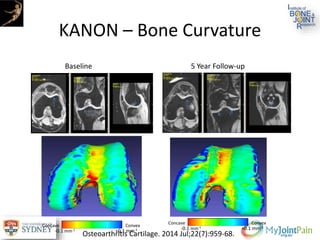
KANON – Bone Curvature
-0.1 mm-1 +0.1 mm-1
Concave Convex
-0.1 mm-1 +0.1 mm-1
Concave Convex
Baseline 5 Year Follow-up
Osteoarthritis Cartilage. 2014 Jul;22(7):959-68.
LateralMedial
Trochlea
LateralMedial
Trochlea
Femur
Tibia
Baseline
2 Year Change 5 Year Change
Raw
Change
SRM
Raw
Change
SRM
-0.1 mm-1 +0.1 mm-1
-0.1 mm-1 +0.1 mm-1
-0.01mm-1
+0.01mm-1
-1.0 z
+1.0 z
-0.01mm-1
+0.01mm-1
-1.0 z
+1.0 z
Concave Convex
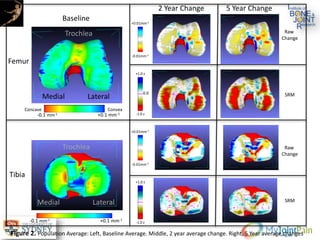
Figure 2. Population Average: Left, Baseline Average. Middle, 2 year average change. Right, 5 Year average changes
0.0
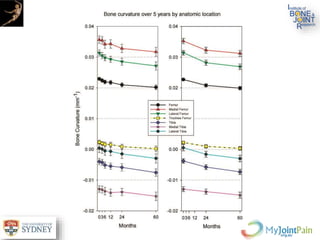
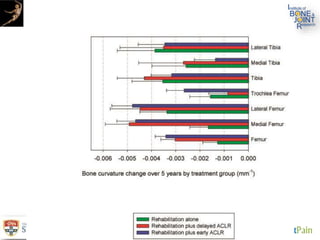
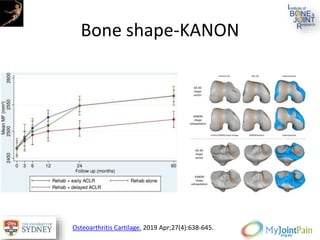
Bone shape-KANON
Osteoarthritis Cartilage. 2019 Apr;27(4):638-645.
Compositional MRI
• Initial histological and biochemical changes of cartilage
damage involve disruption of the collagen network,
decrease in proteoglycan content and increase in
permeability to water.
• Compositional MRI techniques enable detection of these
biochemical changes in the cartilage ECM before
morphological change occurs.
• Efforts toward developing MRI techniques to interrogate
cartilage macromolecules have focused on collagen and
GAG.
T2 mapping
• Articular cartilage T2 reflects the water content, collagen
content and collagen fiber orientation in the ECM, with longer
T2 values thought to represent cartilage degeneration
• Kijowski et al. Radiology 2013;267:503-513.
 The addition of a T2 mapping sequence to
a routine MR protocol at 3.0 T improved sensitivity in the
detection of cartilage lesions within the knee joint from
74.6% to 88.9%, with only a small reduction in specificity.
 The greatest improvement in sensitivity with use of
the T2 maps was in the identification of
early cartilage degeneration.
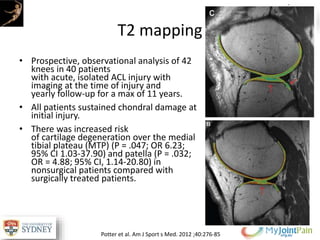
• Prospective, observational analysis of 42
knees in 40 patients
with acute, isolated ACL injury with
imaging at the time of injury and
yearly follow-up for a max of 11 years.
• All patients sustained chondral damage at
initial injury.
• There was increased risk
of cartilage degeneration over the medial
tibial plateau (MTP) (P = .047; OR 6.23;
95% CI 1.03-37.90) and patella (P = .032;
OR = 4.88; 95% CI, 1.14-20.80) in
nonsurgical patients compared with
surgically treated patients.
T2 mapping
Potter et al. Am J Sport s Med. 2012 ;40:276-85
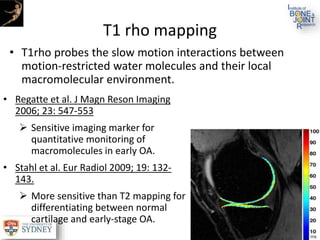
T1 rho mapping
• T1rho probes the slow motion interactions between
motion-restricted water molecules and their local
macromolecular environment.
• Regatte et al. J Magn Reson Imaging
2006; 23: 547-553
 Sensitive imaging marker for
quantitative monitoring of
macromolecules in early OA.
• Stahl et al. Eur Radiol 2009; 19: 132-
143.
 More sensitive than T2 mapping for
differentiating between normal
cartilage and early-stage OA.
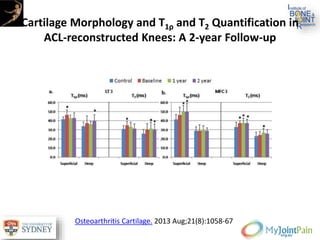
Cartilage Morphology and T1ρ and T2 Quantification in
ACL-reconstructed Knees: A 2-year Follow-up
Osteoarthritis Cartilage. 2013 Aug;21(8):1058-67
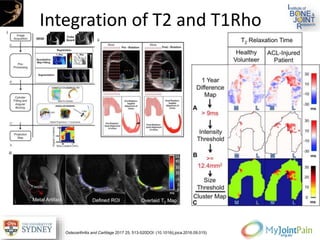
Fig. 2
Osteoarthritis and Cartilage 2017 25, 513-520DOI: (10.1016/j.joca.2016.09.015)
Integration of T2 and T1Rho
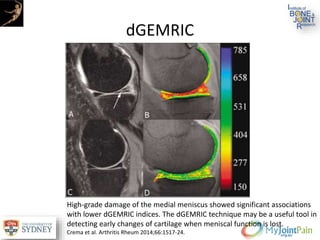
dGEMRIC
High-grade damage of the medial meniscus showed significant associations
with lower dGEMRIC indices. The dGEMRIC technique may be a useful tool in
detecting early changes of cartilage when meniscal function is lost.
Crema et al. Arthritis Rheum 2014;66:1517-24.
Summary of compositional MRI
• Compositional MRI techniques seem to have the
potential to supplement clinical MRI sequences in
identifying cartilage degeneration at an earlier stage
than is possible today
• Different techniques are complementary, in that some
focus on isotropy or the collagen network (e.g., T2
mapping and T1rho) while others focus on tissue
composition, e.g., dGEMRIC, that conveys information
on the GAG concentration
• While some, such as T2 mapping, are easily applied on
standard clinical platforms using 1.5 or 3T systems,
others require dedicated hardware or software
Guermazi et al. J Rheum 2016;43:7-11
Cartilage adaptation after anterior cruciate ligament injury and
reconstruction: implications for clinical management and
research? A systematic review of longitudinal MRI studies.
Clinical management
Chondral defects are commonly detected in ACL-injured
and reconstructed knees
Gross MRI-detected morphological change requires
approximately 2 years
Prevention should focus on ultra-structural deterioration
accelerating cartilage loss
In the lateral compartment, morphological and/or ultra-
structural damage most likely progresses from blunt
trauma onwards. Medially, changes presumably start
during the first year, hitherto recorded the soonest at 3
weeks follow-up
Moderate-to-strong evidence exist for baseline factors
meniscal lesion/meniscectomy, BML, time from injury
and persistent altered biomechanics as influencing rate
of cartilage change after ACL reconstruction
(Late) post-operative rehabilitation should also consider
cartilage status in return to play decisions
ACL-reconstructed knees may benefit from longer
recovery than non-surgically treated knees. After 1 year,
treatment effects disappear and, so far, no treatment
option appears convincingly superior in view of structural
longevity of the knee
Future research directions
Longitudinal follow-up studies of cartilage ultra-
structural changes during the first year(s)
following injury or reconstruction. UTE and UTE-
T2* and T1rho imaging may be more sensitive
than standard T2 mapping in this respect
Validation of MRI biomarkers in long-term studies
in view of the prediction of future radiographic
and/or symptomatic OA
Prospective risk factor studies to support
identification of patients treated with ACL
reconstruction at risk for accelerated cartilage
degeneration
High quality (multi-center) Randomized
Controlled Trials (RCT's) on the efficacy and safety
of biological, surgical, and rehabilitation
techniques in mediating cartilage morphological
and ultra-structural deterioration following ACL
injury and reconstruction both in the short- and
long-term
Osteoarthritis Cartilage. 2013 Aug;21(8):1009-24.
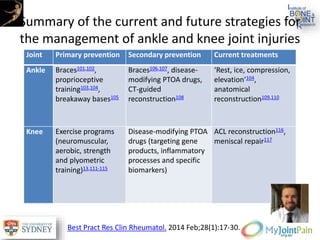
Summary of the current and future strategies for
the management of ankle and knee joint injuries
Joint Primary prevention Secondary prevention Current treatments
Ankle Braces101,102,
proprioceptive
training103,104,
breakaway bases105
Braces106,107, disease-
modifying PTOA drugs,
CT-guided
reconstruction108
‘Rest, ice, compression,
elevation’104,
anatomical
reconstruction109,110
Knee Exercise programs
(neuromuscular,
aerobic, strength
and plyometric
training)13,111-115
Disease-modifying PTOA
drugs (targeting gene
products, inflammatory
processes and specific
biomarkers)
ACL reconstruction116,
meniscal repair117
Best Pract Res Clin Rheumatol. 2014 Feb;28(1):17-30.
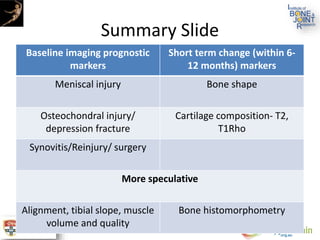
Summary Slide
Baseline imaging prognostic
markers
Short term change (within 6-
12 months) markers
Meniscal injury Bone shape
Osteochondral injury/
depression fracture
Cartilage composition- T2,
T1Rho
Synovitis/Reinjury/ surgery
More speculative
Alignment, tibial slope, muscle
volume and quality
Bone histomorphometry
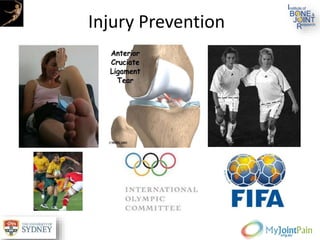
Injury Prevention
Conclusions
 Conventional MRI can show “pre-radiographic”
changes
 Morphologic changes that are not seen on radiography
 Validity and reliability well established now
 Compositional MRI shows “pre-morphologic”
physiologic changes
 e.g. morphologically normal cartilage with changes in
dGEMRIC index, T2 or T1rho values
 Promising future, but needs more longitudinal studies for
validation
Recommendations
• The utility of plain radiography in early OA is limited due to
inability to detect early structural changes.
• MRI has superior sensitivity to change and validity in the
context of early OA.
• Further MRI research on the predictive validity (related to
longer term development of OA) and utility in clinical trials
(both as a prognostic but also as efficacy of intervention
markers) is required before making defined
recommendations about one MRI measure over another.
• Features that do appear to be worthy of focusing on are:
meniscal morphology, synovitis, bone shape, compositional
imaging
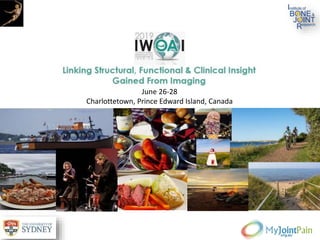
June 26-28
Charlottetown, Prince Edward Island, Canada
What's happening at IWOAI 2019?
• Clinical & Imaging Parameters for DMOAD Trials & Update on DMOAD
Developments
• Pre-workshop on Machine Learning Segmentation Challenge
• Novel Analytics and Computational Approaches
• Linking Imaging with Tissue and Joint Function
• Imaging Early Osteoarthritis
• Phenotypes/Subgroups of Osteoarthritis
• Updates & Insight from APPROACH / OAI / MOST
• Pre-Congress Boat Trip (June 25th) & Post-Congress Bike/Beach Trip (June 29th)
June 26-28
Charlottetown, Prince Edward Island, Canada
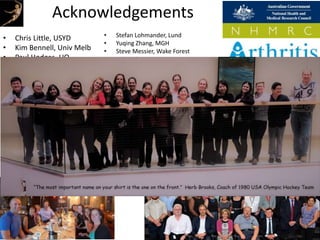
Acknowledgements
• Chris Little, USYD
• Kim Bennell, Univ Melb
• Paul Hodges, UQ
• Bill Vicenzino, UQ
• Manuela Ferreira, USYD
• Rana Hinman, Univ Melb
• Changhai Ding, UTAS
• James Linklater, USYD
• Peter Choong, Univ Melb
• Michelle Dowsey, Univ
Melb
• Justin Roe, UNSW
• David Lloyd, Griffith
• Stefan Lohmander, Lund
• Yuqing Zhang, MGH
• Steve Messier, Wake Forest
• Felix Eckstein, PMU
• Nigel Arden, Oxford
• Kent Kwoh, Arizona
• Virginia Kraus, Duke
• Ali Guermazi, Boston Univ
• Frank Roemer, Erlangen
• Grace Lo, Baylor
• Elena Losina, Harvard
• Jeff Katz, Harvard
• Michael Nevitt, UCSF
• Richard Loeser, UNC
• Tim McAlindon, Tufts
• David Wilson, UBC
• Young Jo Kim, Harvard
David.Hunter@sydney.edu.au
@ProfDavidHunter
Acknowledge James Linklater, Garry
Gold and Ed Riordan for feedback

Structural Targets for Prevention of Post Traumatic OA

  • 1.
    Structural Targets forPrevention of Post Traumatic OA David Hunter MBBS, PhD, FRACP Florance and Cope Chair of Rheumatology, Professor of Medicine University of Sydney and Royal North Shore Hospital Chair, Institute of Bone and Joint Research Chair, Musculoskeletal, Sydney Medical Program Consultant Rheumatologist, North Sydney Orthopedic and Sports Medicine David.Hunter@sydney.edu.au @ProfDavidHunter
  • 2.
    Declaration of interest Ideclare that in the past three years I have: • Consulted for Pfizer, TLCBio, Tissuegene, Merck Serono • Supported by an NHMRC Health Practitioner Fellowship.
  • 3.
    References • The healthand structural consequences of acute knee injuries involving rupture of the anterior cruciate ligament. Rheum Dis Clin North Am. 2013 Feb;39(1):107-22. • Pathogenesis of post-traumatic OA with a view to intervention. Best Pract Res Clin Rheumatol. 2014 Feb;28(1):17-30. • OARSI Clinical Trials Recommendations: Knee imaging in clinical trials in osteoarthritis. Osteoarthritis Cartilage. 2015 May;23(5):698-715. • Definition of osteoarthritis on MRI: results of a Delphi exercise. Osteoarthritis Cartilage. 2011 Aug;19(8):963-9.
  • 4.
    Outline Limitations of radiography Courseof OA, Whole Joint Disease MRI definition Quantitative Imaging
  • 5.
    What is osteoarthritis? Diseaseof the whole joint Hunter DJ. NEJM. 2015;372:1040-1047.
  • 6.
    Natural History ofOA X-ray Structural changes in bone (i.e., joint failure) End-stage Disease (i.e., joint death) Initiation of Disease Process MRI/Biomarkers Changes in the composition of bone, cartilage, other soft tissues Symptoms MRI /US Structural changes in bone,cartilage, other soft tissues Clinically detectable OA Joint ReplacementRadiographicPre-Radiographic Defining Disease State of Osteoarthritis Molecular
  • 7.
    Osteoarthritis: Heterogeneous disorder NatureReviews Rheum. 13, 302-311 (2017)
  • 8.
    Risk for KneeOA Obesity Injury Occupation Other Arthritis Rheum. 1998, Aug;41(8):1343-55. Osteoarthritis Cartilage. 2009; Sep 2.
  • 9.
    Defining phenotypes ofosteoarthritis based on dimensions of disease Bierma-Zeinstra, S. M. & van Middelkoop, M. (2017) In search of phenotypes Nat. Rev. Rheumatol. doi:10.1038/nrrheum.2017.181
  • 11.
    Injury rates areincreasing but it takes time to develop radiographic OA Incidence of primary anterior cruciate ligament reconstruction in females, 2000–2015, by age group 10 to 20 years after the diagnosis, on average, 50% of those with a diagnosed anterior cruciate ligament or meniscus tear have osteoarthritis
  • 12.
    Figure 1 Developmentof OA after acute rupture of the ACL of the knee Wen, C. & Lohmander, L. S. (2014) Does post-injury ACL reconstruction prevent future OA? Nat. Rev. Rheumatol. doi:10.1038/nrrheum.2014.120 Reprinted by permission of SAGE Publications from Lohmander, L. S. et al. Am. J. Sports Med. 35, 1756–1769 (2007), © 2007 by American Orthopaedic Society for Sports Medicine
  • 13.
  • 14.
    Traumatic articular cartilagedamage in conjunction with ACL disruption.
  • 17.
    Meniscus Subchondral cyst Bone marrowlesion Effusion Muscle PCL/ACL MCL/LCL Capsule Periarticular cyst Synovitis Cartilage Conventional MRI
  • 18.
    Limitations of radiography Figurecourtesy of Ali Guermazi
  • 20.
    Imaging of “Early”OA/ PTOA Features on MRI • Conventional MRI – semiquantitative analysis Morphologic changes e.g. cartilage damage, meniscal tear, synovitis, bone marrow lesions, ligamentous damage Multiple phenotypes • Quantitative MRI • Morphologic changes • e.g. cartilage volume/thickness loss, meniscal size/volume/position, bone area/ shape/ histomorphometry • Compositional MRI “pre-morphologic” physiologic/biochemical changes e.g. dGEMRIC, T2 map, T1rho, sodium imaging, diffusion
  • 21.
    Accepted propositions fordefinition of OA on MRI A definition of tibiofemoral osteoarthritis on MRI would be: The presence of both group [A] features or one group [A] feature and two or more group [B] features Group [A] after exclusion of joint trauma within the last 6 months (by history) and exclusion of inflammatory arthritis (by radiographs, history and laboratory parameters): i) Definite osteophyte formation§ ii) Full thickness cartilage loss Group [B]: i) Subchondral bone marrow lesion or cyst not associated with meniscal or ligamentous attachments ii) Meniscal subluxation, maceration or degenerative (horizontal) tear iii) Partial thickness cartilage loss (where full thickness loss is not present) iv) Bone attrition Definition of PF OA requires all of the following involving the patella and/or anterior femur: i) A definite osteophyte ii) Partial or full thickness cartilage loss
  • 23.
    Early OA afterACL reconstruction • MRI-detected OA 1 year following ACL reconstruction is common, while being absent in uninjured control knees. • Patellofemoral OA is particularly affected, especially in men (OR 6.3, 95%CI 2.4-16.2) • Predictors of early MRI-detected OA: • Meniscectomy (OR 6.8, 95%CI 2.0-23.3) • BMI>25 (OR 3.0, 95%CI 1.3-6.9) Culvenor et al. Arthritis Rheum 2015;67:946-955
  • 24.
    What comes first?Multi-tissue involvement leading to radiographic osteoarthritis • Predictors of ROA at P-2: • Hoffa synovitis (HR 1.76 [95% CI 1.18-2.64]) • Effusion synovitis (HR 1.81 [95% CI 1.18-2.78]) • Medial meniscal damage (HR 1.83 [95% CI 1.17- 2.89]). • At P -1, all features but meniscal extrusion predicted radiographic OA, with highest odds for medial BMLs (HR 6.50 [95% CI 2.27-18.62]) and effusion synovitis (HR 2.50 [95% CI 1.76-3.54]). Roemer et al. Arthritis Rheumatol. 2015 May;67(8):2085-96
  • 25.
    Progression of MRIfeatures in each subgroup before ROA incidence
  • 27.
    Five‐Year Followup ofKnee Joint Cartilage Thickness Changes After Acute Rupture of the Anterior Cruciate Ligament Arthritis & Rheumatology Volume 67, Issue 1, pages 152-161, 27 DEC 2014 DOI: 10.1002/art.38881 http://onlinelibrary.wiley.com/doi/10.1002/art.38881/full#art38881-fig-0001
  • 28.
    Five‐Year Followup ofKnee Joint Cartilage Thickness Changes After Acute Rupture of the Anterior Cruciate Ligament Arthritis & Rheumatology Volume 67, Issue 1, pages 152-161, 27 DEC 2014 DOI: 10.1002/art.38881 http://onlinelibrary.wiley.com/doi/10.1002/art.38881/full#art38881-fig-0002
  • 29.
    KANON – BoneCurvature -0.1 mm-1 +0.1 mm-1 Concave Convex -0.1 mm-1 +0.1 mm-1 Concave Convex Baseline 5 Year Follow-up Osteoarthritis Cartilage. 2014 Jul;22(7):959-68.
  • 30.
    LateralMedial Trochlea LateralMedial Trochlea Femur Tibia Baseline 2 Year Change5 Year Change Raw Change SRM Raw Change SRM -0.1 mm-1 +0.1 mm-1 -0.1 mm-1 +0.1 mm-1 -0.01mm-1 +0.01mm-1 -1.0 z +1.0 z -0.01mm-1 +0.01mm-1 -1.0 z +1.0 z Concave Convex Figure 2. Population Average: Left, Baseline Average. Middle, 2 year average change. Right, 5 Year average changes 0.0
  • 33.
  • 34.
    Compositional MRI • Initialhistological and biochemical changes of cartilage damage involve disruption of the collagen network, decrease in proteoglycan content and increase in permeability to water. • Compositional MRI techniques enable detection of these biochemical changes in the cartilage ECM before morphological change occurs. • Efforts toward developing MRI techniques to interrogate cartilage macromolecules have focused on collagen and GAG.
  • 35.
    T2 mapping • Articularcartilage T2 reflects the water content, collagen content and collagen fiber orientation in the ECM, with longer T2 values thought to represent cartilage degeneration • Kijowski et al. Radiology 2013;267:503-513.  The addition of a T2 mapping sequence to a routine MR protocol at 3.0 T improved sensitivity in the detection of cartilage lesions within the knee joint from 74.6% to 88.9%, with only a small reduction in specificity.  The greatest improvement in sensitivity with use of the T2 maps was in the identification of early cartilage degeneration.
  • 36.
    • Prospective, observationalanalysis of 42 knees in 40 patients with acute, isolated ACL injury with imaging at the time of injury and yearly follow-up for a max of 11 years. • All patients sustained chondral damage at initial injury. • There was increased risk of cartilage degeneration over the medial tibial plateau (MTP) (P = .047; OR 6.23; 95% CI 1.03-37.90) and patella (P = .032; OR = 4.88; 95% CI, 1.14-20.80) in nonsurgical patients compared with surgically treated patients. T2 mapping Potter et al. Am J Sport s Med. 2012 ;40:276-85
  • 37.
    T1 rho mapping •T1rho probes the slow motion interactions between motion-restricted water molecules and their local macromolecular environment. • Regatte et al. J Magn Reson Imaging 2006; 23: 547-553  Sensitive imaging marker for quantitative monitoring of macromolecules in early OA. • Stahl et al. Eur Radiol 2009; 19: 132- 143.  More sensitive than T2 mapping for differentiating between normal cartilage and early-stage OA.
  • 38.
    Cartilage Morphology andT1ρ and T2 Quantification in ACL-reconstructed Knees: A 2-year Follow-up Osteoarthritis Cartilage. 2013 Aug;21(8):1058-67
  • 39.
    Fig. 2 Osteoarthritis andCartilage 2017 25, 513-520DOI: (10.1016/j.joca.2016.09.015) Integration of T2 and T1Rho
  • 40.
    dGEMRIC High-grade damage ofthe medial meniscus showed significant associations with lower dGEMRIC indices. The dGEMRIC technique may be a useful tool in detecting early changes of cartilage when meniscal function is lost. Crema et al. Arthritis Rheum 2014;66:1517-24.
  • 41.
    Summary of compositionalMRI • Compositional MRI techniques seem to have the potential to supplement clinical MRI sequences in identifying cartilage degeneration at an earlier stage than is possible today • Different techniques are complementary, in that some focus on isotropy or the collagen network (e.g., T2 mapping and T1rho) while others focus on tissue composition, e.g., dGEMRIC, that conveys information on the GAG concentration • While some, such as T2 mapping, are easily applied on standard clinical platforms using 1.5 or 3T systems, others require dedicated hardware or software Guermazi et al. J Rheum 2016;43:7-11
  • 42.
    Cartilage adaptation afteranterior cruciate ligament injury and reconstruction: implications for clinical management and research? A systematic review of longitudinal MRI studies. Clinical management Chondral defects are commonly detected in ACL-injured and reconstructed knees Gross MRI-detected morphological change requires approximately 2 years Prevention should focus on ultra-structural deterioration accelerating cartilage loss In the lateral compartment, morphological and/or ultra- structural damage most likely progresses from blunt trauma onwards. Medially, changes presumably start during the first year, hitherto recorded the soonest at 3 weeks follow-up Moderate-to-strong evidence exist for baseline factors meniscal lesion/meniscectomy, BML, time from injury and persistent altered biomechanics as influencing rate of cartilage change after ACL reconstruction (Late) post-operative rehabilitation should also consider cartilage status in return to play decisions ACL-reconstructed knees may benefit from longer recovery than non-surgically treated knees. After 1 year, treatment effects disappear and, so far, no treatment option appears convincingly superior in view of structural longevity of the knee Future research directions Longitudinal follow-up studies of cartilage ultra- structural changes during the first year(s) following injury or reconstruction. UTE and UTE- T2* and T1rho imaging may be more sensitive than standard T2 mapping in this respect Validation of MRI biomarkers in long-term studies in view of the prediction of future radiographic and/or symptomatic OA Prospective risk factor studies to support identification of patients treated with ACL reconstruction at risk for accelerated cartilage degeneration High quality (multi-center) Randomized Controlled Trials (RCT's) on the efficacy and safety of biological, surgical, and rehabilitation techniques in mediating cartilage morphological and ultra-structural deterioration following ACL injury and reconstruction both in the short- and long-term Osteoarthritis Cartilage. 2013 Aug;21(8):1009-24.
  • 43.
    Summary of thecurrent and future strategies for the management of ankle and knee joint injuries Joint Primary prevention Secondary prevention Current treatments Ankle Braces101,102, proprioceptive training103,104, breakaway bases105 Braces106,107, disease- modifying PTOA drugs, CT-guided reconstruction108 ‘Rest, ice, compression, elevation’104, anatomical reconstruction109,110 Knee Exercise programs (neuromuscular, aerobic, strength and plyometric training)13,111-115 Disease-modifying PTOA drugs (targeting gene products, inflammatory processes and specific biomarkers) ACL reconstruction116, meniscal repair117 Best Pract Res Clin Rheumatol. 2014 Feb;28(1):17-30.
  • 44.
    Summary Slide Baseline imagingprognostic markers Short term change (within 6- 12 months) markers Meniscal injury Bone shape Osteochondral injury/ depression fracture Cartilage composition- T2, T1Rho Synovitis/Reinjury/ surgery More speculative Alignment, tibial slope, muscle volume and quality Bone histomorphometry
  • 45.
  • 46.
    Conclusions  Conventional MRIcan show “pre-radiographic” changes  Morphologic changes that are not seen on radiography  Validity and reliability well established now  Compositional MRI shows “pre-morphologic” physiologic changes  e.g. morphologically normal cartilage with changes in dGEMRIC index, T2 or T1rho values  Promising future, but needs more longitudinal studies for validation
  • 47.
    Recommendations • The utilityof plain radiography in early OA is limited due to inability to detect early structural changes. • MRI has superior sensitivity to change and validity in the context of early OA. • Further MRI research on the predictive validity (related to longer term development of OA) and utility in clinical trials (both as a prognostic but also as efficacy of intervention markers) is required before making defined recommendations about one MRI measure over another. • Features that do appear to be worthy of focusing on are: meniscal morphology, synovitis, bone shape, compositional imaging
  • 48.
    June 26-28 Charlottetown, PrinceEdward Island, Canada
  • 49.
    What's happening atIWOAI 2019? • Clinical & Imaging Parameters for DMOAD Trials & Update on DMOAD Developments • Pre-workshop on Machine Learning Segmentation Challenge • Novel Analytics and Computational Approaches • Linking Imaging with Tissue and Joint Function • Imaging Early Osteoarthritis • Phenotypes/Subgroups of Osteoarthritis • Updates & Insight from APPROACH / OAI / MOST • Pre-Congress Boat Trip (June 25th) & Post-Congress Bike/Beach Trip (June 29th) June 26-28 Charlottetown, Prince Edward Island, Canada
  • 50.
    Acknowledgements • Chris Little,USYD • Kim Bennell, Univ Melb • Paul Hodges, UQ • Bill Vicenzino, UQ • Manuela Ferreira, USYD • Rana Hinman, Univ Melb • Changhai Ding, UTAS • James Linklater, USYD • Peter Choong, Univ Melb • Michelle Dowsey, Univ Melb • Justin Roe, UNSW • David Lloyd, Griffith • Stefan Lohmander, Lund • Yuqing Zhang, MGH • Steve Messier, Wake Forest • Felix Eckstein, PMU • Nigel Arden, Oxford • Kent Kwoh, Arizona • Virginia Kraus, Duke • Ali Guermazi, Boston Univ • Frank Roemer, Erlangen • Grace Lo, Baylor • Elena Losina, Harvard • Jeff Katz, Harvard • Michael Nevitt, UCSF • Richard Loeser, UNC • Tim McAlindon, Tufts • David Wilson, UBC • Young Jo Kim, Harvard
  • 51.