Jeffrey A. Hart
                  Indiana University

Paper presented at the annual meeting of the International Studies
Association, San Diego, California, April 1-4, 2012,
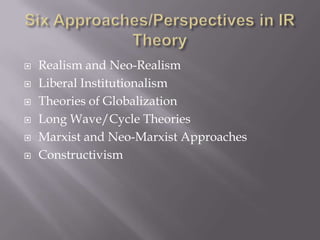
   Realism and Neo-Realism
   Liberal Institutionalism
   Theories of Globalization
   Long Wave/Cycle Theories
   Marxist and Neo-Marxist Approaches
   Constructivism
   The primacy of the state (effectively the
    governments of nation-states) vs. the increased
    power of non-state actors
   Focus on capabilities and relational power
   Dealing with Cyberwar and Cybersecurity
    within the old framework
   Continuing difficulties associated with
    superficial attention to the role of technological
    change and other forms of social and economic
    change
   New ICT-related regimes
   New push for multi-stakeholder regimes
   Do ICTs make MNCs and NGOs more
    powerful relative to governments?
   New opportunities for studying ICT-based
    monitoring of regime compliance
   Need to understand how ICTs affect the
    diffusion of liberal norms and practices
   Inherently global natures of the Internet vs.
    Success of various governments in limiting
    access
   Effect of ICTs on communications and
    transactions costs
   Rise of global production networks and big box
    retailing (undermining national production
    and retailing networks)
   Impact of ICTs on diasporic communities,
    journalism and media environments
   How does the wave of innovation associated
    with ICTs resemble or differ from previous
    waves of innovation?
   Network economies vs. economies of scale
   Has the ICT wave crested? (Is a Bio-Tech,
    Nano-Tech, or Enviro-Tech wave beginning?)
   Who are the new winners and losers
    (nationally and sub-nationally)?
   Is there new Mode of Production or Mode of
    Information (Poster)?
   How is “consumer capitalism” altered?
   Are ICTs simply a manifestation of the
    reassertion of US-dominated (capitalist) global
    imperialism/hegemony?
   Is political opposition to globalization via ICT-
    mediated communication the way to keep the
    Left alive and relevant?
   Many flavors of constructivism
   ICTs and ICT-related regimes are socially
    constructed (human agency)
   ICTs permit the fostering of new meanings and
    identities for individuals and social group
   Potentially transformative nature of ICTs in
    domestic and international politics vs. the
    tendency of power structures to adapt
    successfully to technological change
   New forms of capability (access to resources)
    with the diffusion of ICTs
   New ways of exercising power: e.g., through
    the creation and control of new technological
    infrastructures and platforms (the PC, iTunes,
    Facebook, etc.)
   Structural power (most relevant to IPE) in the
    form of new regimes and regimes imbedded in
    hardware/software (as argued by Lessig and
    others)
   Meta-power
   New forms of power associated with the
    diffusion of ICTs
   Key aspect of ICTs: reduction of the role of
    distance and cost in communications among
    like-minded people and groups
   All IR theories need to address the above and
    to study continuing barriers to flows of
    information/knowledge
   Realism seems least likely to take diffusion of
    ICTs seriously

Isa12b

  • 1.
    Jeffrey A. Hart Indiana University Paper presented at the annual meeting of the International Studies Association, San Diego, California, April 1-4, 2012,
  • 2.
    Realism and Neo-Realism  Liberal Institutionalism  Theories of Globalization  Long Wave/Cycle Theories  Marxist and Neo-Marxist Approaches  Constructivism
  • 5.
    The primacy of the state (effectively the governments of nation-states) vs. the increased power of non-state actors  Focus on capabilities and relational power  Dealing with Cyberwar and Cybersecurity within the old framework  Continuing difficulties associated with superficial attention to the role of technological change and other forms of social and economic change
  • 6.
    New ICT-related regimes  New push for multi-stakeholder regimes  Do ICTs make MNCs and NGOs more powerful relative to governments?  New opportunities for studying ICT-based monitoring of regime compliance  Need to understand how ICTs affect the diffusion of liberal norms and practices
  • 7.
    Inherently global natures of the Internet vs. Success of various governments in limiting access  Effect of ICTs on communications and transactions costs  Rise of global production networks and big box retailing (undermining national production and retailing networks)  Impact of ICTs on diasporic communities, journalism and media environments
  • 8.
    How does the wave of innovation associated with ICTs resemble or differ from previous waves of innovation?  Network economies vs. economies of scale  Has the ICT wave crested? (Is a Bio-Tech, Nano-Tech, or Enviro-Tech wave beginning?)  Who are the new winners and losers (nationally and sub-nationally)?
  • 9.
    Is there new Mode of Production or Mode of Information (Poster)?  How is “consumer capitalism” altered?  Are ICTs simply a manifestation of the reassertion of US-dominated (capitalist) global imperialism/hegemony?  Is political opposition to globalization via ICT- mediated communication the way to keep the Left alive and relevant?
  • 10.
    Many flavors of constructivism  ICTs and ICT-related regimes are socially constructed (human agency)  ICTs permit the fostering of new meanings and identities for individuals and social group  Potentially transformative nature of ICTs in domestic and international politics vs. the tendency of power structures to adapt successfully to technological change
  • 11.
    New forms of capability (access to resources) with the diffusion of ICTs  New ways of exercising power: e.g., through the creation and control of new technological infrastructures and platforms (the PC, iTunes, Facebook, etc.)  Structural power (most relevant to IPE) in the form of new regimes and regimes imbedded in hardware/software (as argued by Lessig and others)  Meta-power
  • 12.
    New forms of power associated with the diffusion of ICTs  Key aspect of ICTs: reduction of the role of distance and cost in communications among like-minded people and groups  All IR theories need to address the above and to study continuing barriers to flows of information/knowledge  Realism seems least likely to take diffusion of ICTs seriously