Web Censorship and Public Awareness:
The case of Internet regulation in Japan


              Chris Salzberg
To censor:

to examine in order to suppress or delete anything 
            considered objectionable

               (Merriam­Webster)
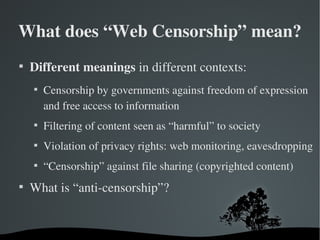
What does “Web Censorship” mean?

    Different meanings in different contexts:
    
        Censorship by governments against freedom of expression 
        and free access to information
    
        Filtering of content seen as “harmful” to society
    
        Violation of privacy rights: web monitoring, eavesdropping
    
        “Censorship” against file sharing (copyrighted content)

    What is “anti­censorship”?
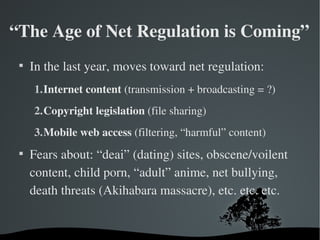
“The Age of Net Regulation is Coming”
 
     In the last year, moves toward net regulation:
     1.Internet content (transmission + broadcasting = ?)
     2.Copyright legislation (file sharing)
     3.Mobile web access (filtering, “harmful” content)
 
     Fears about: “deai” (dating) sites, obscene/voilent 
     content, child porn, “adult” anime, net bullying, 
     death threats (Akihabara massacre), etc. etc. etc.
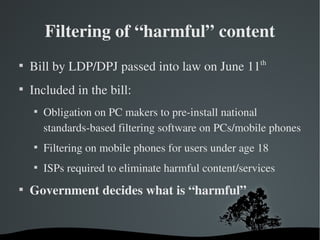
Filtering of “harmful” content

    Bill by LDP/DPJ passed into law on June 11th

    Included in the bill:
    
        Obligation on PC makers to pre­install national 
        standards­based filtering software on PCs/mobile phones
    
        Filtering on mobile phones for users under age 18
    
        ISPs required to eliminate harmful content/services

    Government decides what is “harmful”
Support for Regulation

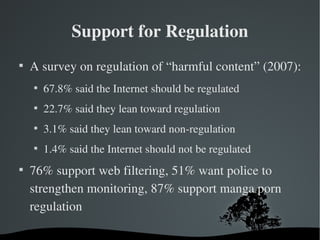
    A survey on regulation of “harmful content” (2007):
    
        67.8% said the Internet should be regulated
    
        22.7% said they lean toward regulation
    
        3.1% said they lean toward non­regulation
    
        1.4% said the Internet should not be regulated

    76% support web filtering, 51% want police to 
    strengthen monitoring, 87% support manga porn 
    regulation
Opposition to Regulation



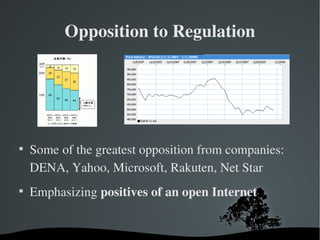
    Some of the greatest opposition from companies: 
    DENA, Yahoo, Microsoft, Rakuten, Net Star

    Emphasizing positives of an open Internet
Opposition strategies

    More so than free access to information, opposition 
    strategies emphasize economic considerations:
    
        Regulation will stop innovation/creativity
    
        Japan will be left behind, outcompeted

    Also emphasizes knowledge issues:
    
        Many proposals are technologically contradictory
    
        Lack of transparency in legislation
The “people” are killing the Internet

    Oppression of the people by governments and 
    corporations is not seen as a major concern

    Conern is about other citizens:
    
        Bullying, death threats, dating sites, obscene content, 
        copyright violation, etc. etc.

    Conclusion: it is the people who are killing the 
    Internet, gov't needs to step in and regulate
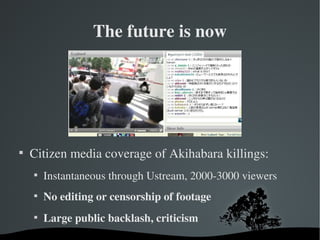
The future is now



    Citizen media coverage of Akihabara killings:
    
        Instantaneous through Ustream, 2000­3000 viewers
    
        No editing or censorship of footage
    
        Large public backlash, criticism
Summary

    “Web censorship” means different things to 
    different people/groups/nations

    Different opposition strategies:
    
        Technological problems with censorship
    
        Lack of transparency in process
    
        Economic considerations, innovation/creativity

    Awareness and literacy are key

Internetregulationjapan

  • 1.
  • 2.
  • 3.
    What does “Web Censorship” mean?  Different meanings in different contexts:  Censorship by governments against freedom of expression  and free access to information  Filtering of content seen as “harmful” to society  Violation of privacy rights: web monitoring, eavesdropping  “Censorship” against file sharing (copyrighted content)  What is “anti­censorship”?
  • 4.
    “The Age of Net Regulation is Coming”  In the last year, moves toward net regulation: 1.Internet content (transmission + broadcasting = ?) 2.Copyright legislation (file sharing) 3.Mobile web access (filtering, “harmful” content)  Fears about: “deai” (dating) sites, obscene/voilent  content, child porn, “adult” anime, net bullying,  death threats (Akihabara massacre), etc. etc. etc.
  • 5.
    Filtering of “harmful” content  Bill by LDP/DPJ passed into law on June 11th  Included in the bill:  Obligation on PC makers to pre­install national  standards­based filtering software on PCs/mobile phones  Filtering on mobile phones for users under age 18  ISPs required to eliminate harmful content/services  Government decides what is “harmful”
  • 9.
    Support for Regulation  A survey on regulation of “harmful content” (2007):  67.8% said the Internet should be regulated  22.7% said they lean toward regulation  3.1% said they lean toward non­regulation  1.4% said the Internet should not be regulated  76% support web filtering, 51% want police to  strengthen monitoring, 87% support manga porn  regulation
  • 10.
    Opposition to Regulation  Some of the greatest opposition from companies:  DENA, Yahoo, Microsoft, Rakuten, Net Star  Emphasizing positives of an open Internet
  • 11.
    Opposition strategies  More so than free access to information, opposition  strategies emphasize economic considerations:  Regulation will stop innovation/creativity  Japan will be left behind, outcompeted  Also emphasizes knowledge issues:  Many proposals are technologically contradictory  Lack of transparency in legislation
  • 12.
    The “people” are killing the Internet  Oppression of the people by governments and  corporations is not seen as a major concern  Conern is about other citizens:  Bullying, death threats, dating sites, obscene content,  copyright violation, etc. etc.  Conclusion: it is the people who are killing the  Internet, gov't needs to step in and regulate
  • 13.
    The future is now  Citizen media coverage of Akihabara killings:  Instantaneous through Ustream, 2000­3000 viewers  No editing or censorship of footage  Large public backlash, criticism
  • 14.
    Summary  “Web censorship” means different things to  different people/groups/nations  Different opposition strategies:  Technological problems with censorship  Lack of transparency in process  Economic considerations, innovation/creativity  Awareness and literacy are key