THE INTERNATIONAL
  SYSTEM, US FOREIGN
  POLICY & DIGITAL CIVIL
        SOCIETY
DIFFUSION OF POWER AND LEGITIMACY IN AN E-ERA


            by Daniel Aguirre Azócar
Historical and New Structural
                Context
 New era in the International System: lacking
  exclusive power and influence by state actors
 The Age of Nonpolarity (Haass, 2008)
 Globalization and its effects

 Expansion and reach of new forms of

  communication
 Internet, digital citizen participation, bottom-up
  & up-bottom interactions in the public „cyber‟
  sphere
A New Age
   Haass‟ questions:

How does nonpolarity differ from other forms of
 international order?

How and why did it materialize?

What are its likely consequences?

And how should the United States respond?
Multipolarity vs. Nonpolarity
  Multipolarity, several distinct poles or concentrations of
   powers
vs.
 Nonpolarity, numerous centers with meaningful power


Nonpolarity international system is defined by some of the
    following characteristics:
-- Erosion of effective power exerted solely by state actors
-- Empowerment and growing influence of non-state actors
    (namely: ONGs, terrorist organizations, and as of recent
    citizen-level movements)
-- In sum: fragmented centers of power at various levels
Caveat & Enter the Digital Space
Caveat: the United States remains the dominant
 power based on military capacity
But at the economic level has lost dominance due to
 a poor energy policy (oil dependence)
And overstretch theory, wars in Afghanistan and Iraq

Haass sees the proliferation of information as
 another important cause that has led to this new
 age
Proliferation of information enabled by new
 technology, namely growing access to information
 via the Internet by individuals everywhere
Globalization Reinforces
             Nonpolarity
Globalization has enabled:
 Transnational flows that are invisible to the

  State
 Transnational flows empower all kinds of non-

  state actors (terrorist, corporations, drug-
  trafficking networks, etc.)
Therefore, weaking State actors
Faced with an Age of Nonpolarity

 Might be assumable that the international
  system will enter a state of anarchy
 But cooperation through multilateral
  organizations, efforts to navigate this new era
  can help maintain a stable system (at the UN,
  G8, etc)
 Initiatives to engage with citizens digitally by
  the US Government and other nations have
  become more prominent:
Ex. US State Department, the e>G8 in France
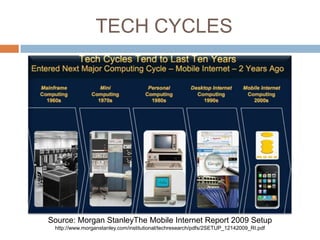
TECH CYCLES


Source: Morgan StanleyThe Mobile Internet Report 2009 Setup
 http://www.morganstanley.com/institutional/techresearch/pdfs/2SETUP_12142009_RI.pdf
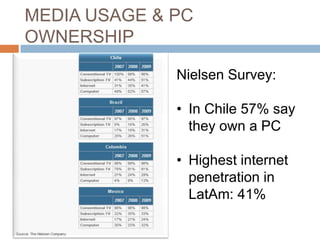
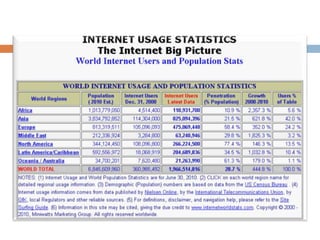
MEDIA USAGE & PC
OWNERSHIP

              Nielsen Survey:

              • In Chile 57% say
                they own a PC

              • Highest internet
                penetration in
                LatAm: 41%
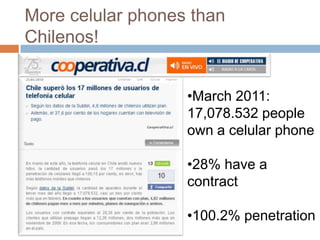
More celular phones than
Chilenos!


                   •March 2011:
                   17,078.532 people
                   own a celular phone

                   •28% have a
                   contract

                   •100.2% penetration
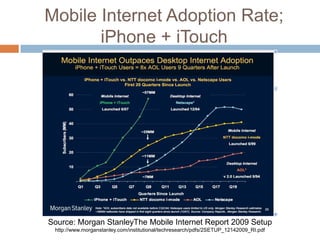
Mobile Internet Adoption Rate;
       iPhone + iTouch


Source: Morgan StanleyThe Mobile Internet Report 2009 Setup
 http://www.morganstanley.com/institutional/techresearch/pdfs/2SETUP_12142009_RI.pdf
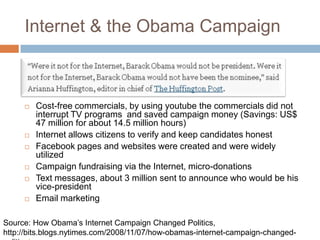
Internet & the Obama Campaign


        Cost-free commercials, by using youtube the commercials did not
         interrupt TV programs and saved campaign money (Savings: US$
         47 million for about 14.5 million hours)
        Internet allows citizens to verify and keep candidates honest
        Facebook pages and websites were created and were widely
         utilized
        Campaign fundraising via the Internet, micro-donations
        Text messages, about 3 million sent to announce who would be his
         vice-president
        Email marketing

Source: How Obama‟s Internet Campaign Changed Politics,
http://bits.blogs.nytimes.com/2008/11/07/how-obamas-internet-campaign-changed-
POLITICAL SATIRE IN 2008
      ELECTIONS
http://www.youtube.com/v/adc3MSS5Ydc&feature=relmfu


        http://www.youtube.com/v/adc3MSS5Ydc&
        feature=relmfu
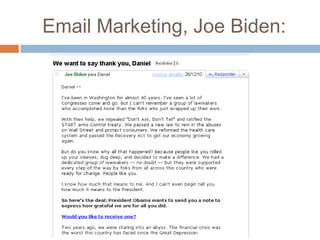
Email Marketing, Joe Biden:
CAMPAIGN COMMERCIALS
http://www.youtube.com/v/Ry9LnAazwMg
CAMPAIGN COMMERCIALS
http://www.youtube.com/v/-DZIwklOWEE&NR=1
FP TOWARD LATIN AMERICA
http://www.youtube.com/v/UamWnyxfKjI
DURING OBAMA VISIT TO CHILE

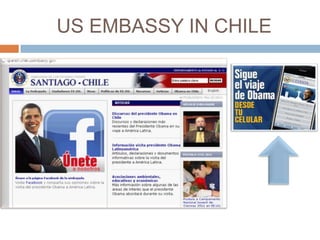
   IN CHILE, THE US EMBASSY UTILIZED
    MUCH OF THE AVAILABLE & POPULAR
    PLATFORMS
     FACEBOOK

     YOUTUBE

     TWITTER

     FLICKER

     DIPNOTE
US EMBASSY IN CHILE
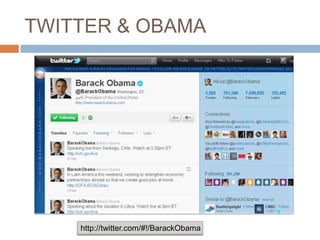
TWITTER & OBAMA


    http://twitter.com/#!/BarackObama
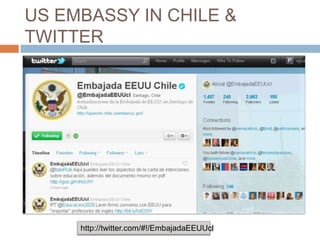
US EMBASSY IN CHILE &
TWITTER


     http://twitter.com/#!/EmbajadaEEUUcl
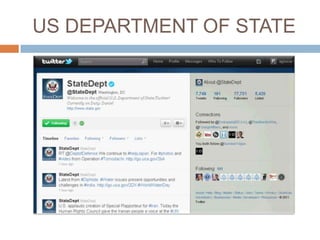
US DEPARTMENT OF STATE
Remarks by Sec. Hillary Clinton on
             Internet Freedom
January 21, 2010
“The spread of information networks is forming a new nervous system for our planet.”
“Now, in many respects, information has never been so free. There are more ways to
   spread more ideas to more people than at any moment in history. And even in
   authoritarian countries, information networks are helping people discover new facts
   and making governments more accountable.”
“Because amid this unprecedented surge in connectivity, we must also recognize that
   these technologies are not an unmitigated blessing. These tools are also being
   exploited to undermine human progress and political rights. Just as steel can be used
   to build hospitals or machine guns, or nuclear power can either energize a city or
   destroy it, modern information networks and the technologies they support can be
   harnessed for good or for ill.”
“The same networks that help organize movements for freedom also enable al-Qaida to
   spew hatred and incite violence against the innocent. And technologies with the
   potential to open up access to government and promote transparency can also be
   hijacked by governments to crush dissent and deny human rights. ”
“We stand for a single internet where all of humanity has equal access to knowledge and
   ideas. And we recognize that the world‟s information infrastructure will become what
   we and others make of it. Now, this challenge may be new, but our responsibility to
   help ensure the free exchange of ideas goes back to the birth of our republic.”
Spreading American Democratic
               Values
   “The US is for one version of the internet for
    the whole world, all of humanity should have
    equal access to knowledge and ideas”
   Follows the 1st Amendment of the US
    Constitution
   Considered a human right as declared by the
    UN Declaration of Universal Human Rights
   “Freedom to connect will transform societies”
   The State Department has several initiatives to
    promote a Digital Civil Society

http://www.state.gov/secretary/rm/2010/01/135519.htm
SOCIAL NETWORKS:
      FACEBOOK, ORKUT, ETC.
   SOCIAL NETWORKS SUCH AS FACEBOOK,
    ASSIST USERS BY GROUPING INTERESTS,
   USERS ARE NOT JUST INDIVIDUALS, BUT
    ALSO ORGANIZATIONS, GROUPS,
    GOVERNMENT, CANDIDATES…, ETC
   COMUNICATION ADOPTS MARKETING
    TACTICS : WITH TARGETED MESSAGES
    AND HIGHLY PERSONALIZED (WEB 2.0)
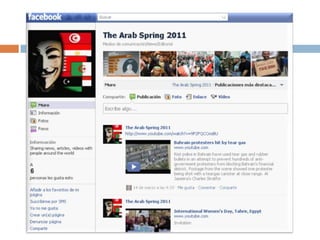
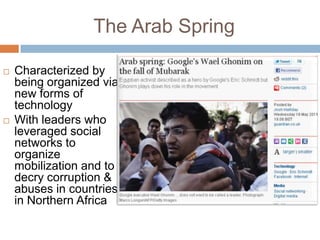
The Arab Spring

   Characterized by
    being organized via
    new forms of
    technology
   With leaders who
    leveraged social
    networks to
    organize
    mobilization and to
    decry corruption &
    abuses in countries
    in Northern Africa
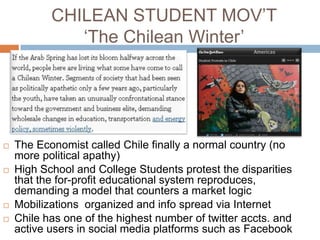
CHILEAN STUDENT MOV‟T
              „The Chilean Winter‟


   The Economist called Chile finally a normal country (no
    more political apathy)
   High School and College Students protest the disparities
    that the for-profit educational system reproduces,
    demanding a model that counters a market logic
   Mobilizations organized and info spread via Internet
   Chile has one of the highest number of twitter accts. and
    active users in social media platforms such as Facebook
SMS, TEXT MESSAGES
   DESPITE SMARTPHONE PENETRATION ON
    THE RISE, CONVENTIONAL CELULAR
    PHONES, WITH THE STANDARD TEXT
    MESSAGE IS STILL HIGHLY USED,
    COMMUNICATING AND ENABLING CIVIL
    MOBILIZATION AROUND SPECIFIC ISSUES
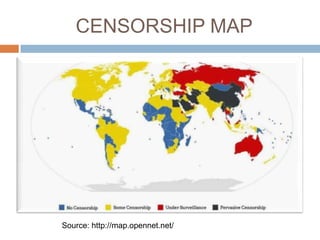
CENSORSHIP MAP


Source: http://map.opennet.net/
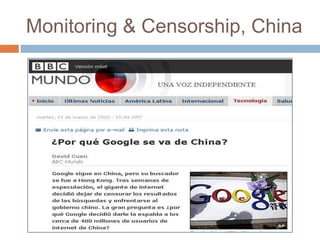
Monitoring & Censorship, China
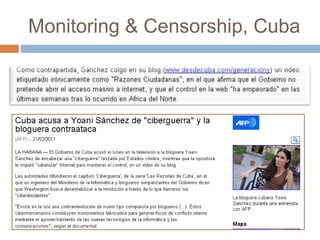
Monitoring & Censorship, Cuba

E era ir-us-fp

  • 1.
    THE INTERNATIONAL SYSTEM, US FOREIGN POLICY & DIGITAL CIVIL SOCIETY DIFFUSION OF POWER AND LEGITIMACY IN AN E-ERA by Daniel Aguirre Azócar
  • 2.
    Historical and NewStructural Context  New era in the International System: lacking exclusive power and influence by state actors  The Age of Nonpolarity (Haass, 2008)  Globalization and its effects  Expansion and reach of new forms of communication  Internet, digital citizen participation, bottom-up & up-bottom interactions in the public „cyber‟ sphere
  • 3.
    A New Age  Haass‟ questions: How does nonpolarity differ from other forms of international order? How and why did it materialize? What are its likely consequences? And how should the United States respond?
  • 4.
    Multipolarity vs. Nonpolarity  Multipolarity, several distinct poles or concentrations of powers vs.  Nonpolarity, numerous centers with meaningful power Nonpolarity international system is defined by some of the following characteristics: -- Erosion of effective power exerted solely by state actors -- Empowerment and growing influence of non-state actors (namely: ONGs, terrorist organizations, and as of recent citizen-level movements) -- In sum: fragmented centers of power at various levels
  • 5.
    Caveat & Enterthe Digital Space Caveat: the United States remains the dominant power based on military capacity But at the economic level has lost dominance due to a poor energy policy (oil dependence) And overstretch theory, wars in Afghanistan and Iraq Haass sees the proliferation of information as another important cause that has led to this new age Proliferation of information enabled by new technology, namely growing access to information via the Internet by individuals everywhere
  • 6.
    Globalization Reinforces Nonpolarity Globalization has enabled:  Transnational flows that are invisible to the State  Transnational flows empower all kinds of non- state actors (terrorist, corporations, drug- trafficking networks, etc.) Therefore, weaking State actors
  • 7.
    Faced with anAge of Nonpolarity  Might be assumable that the international system will enter a state of anarchy  But cooperation through multilateral organizations, efforts to navigate this new era can help maintain a stable system (at the UN, G8, etc)  Initiatives to engage with citizens digitally by the US Government and other nations have become more prominent: Ex. US State Department, the e>G8 in France
  • 8.
    TECH CYCLES Source: MorganStanleyThe Mobile Internet Report 2009 Setup http://www.morganstanley.com/institutional/techresearch/pdfs/2SETUP_12142009_RI.pdf
  • 9.
    MEDIA USAGE &PC OWNERSHIP Nielsen Survey: • In Chile 57% say they own a PC • Highest internet penetration in LatAm: 41%
  • 11.
    More celular phonesthan Chilenos! •March 2011: 17,078.532 people own a celular phone •28% have a contract •100.2% penetration
  • 12.
    Mobile Internet AdoptionRate; iPhone + iTouch Source: Morgan StanleyThe Mobile Internet Report 2009 Setup http://www.morganstanley.com/institutional/techresearch/pdfs/2SETUP_12142009_RI.pdf
  • 13.
    Internet & theObama Campaign  Cost-free commercials, by using youtube the commercials did not interrupt TV programs and saved campaign money (Savings: US$ 47 million for about 14.5 million hours)  Internet allows citizens to verify and keep candidates honest  Facebook pages and websites were created and were widely utilized  Campaign fundraising via the Internet, micro-donations  Text messages, about 3 million sent to announce who would be his vice-president  Email marketing Source: How Obama‟s Internet Campaign Changed Politics, http://bits.blogs.nytimes.com/2008/11/07/how-obamas-internet-campaign-changed-
  • 14.
    POLITICAL SATIRE IN2008 ELECTIONS http://www.youtube.com/v/adc3MSS5Ydc&feature=relmfu http://www.youtube.com/v/adc3MSS5Ydc& feature=relmfu
  • 15.
  • 16.
  • 17.
  • 18.
    FP TOWARD LATINAMERICA http://www.youtube.com/v/UamWnyxfKjI
  • 19.
    DURING OBAMA VISITTO CHILE  IN CHILE, THE US EMBASSY UTILIZED MUCH OF THE AVAILABLE & POPULAR PLATFORMS  FACEBOOK  YOUTUBE  TWITTER  FLICKER  DIPNOTE
  • 20.
  • 21.
    TWITTER & OBAMA http://twitter.com/#!/BarackObama
  • 22.
    US EMBASSY INCHILE & TWITTER http://twitter.com/#!/EmbajadaEEUUcl
  • 23.
  • 24.
    Remarks by Sec.Hillary Clinton on Internet Freedom January 21, 2010 “The spread of information networks is forming a new nervous system for our planet.” “Now, in many respects, information has never been so free. There are more ways to spread more ideas to more people than at any moment in history. And even in authoritarian countries, information networks are helping people discover new facts and making governments more accountable.” “Because amid this unprecedented surge in connectivity, we must also recognize that these technologies are not an unmitigated blessing. These tools are also being exploited to undermine human progress and political rights. Just as steel can be used to build hospitals or machine guns, or nuclear power can either energize a city or destroy it, modern information networks and the technologies they support can be harnessed for good or for ill.” “The same networks that help organize movements for freedom also enable al-Qaida to spew hatred and incite violence against the innocent. And technologies with the potential to open up access to government and promote transparency can also be hijacked by governments to crush dissent and deny human rights. ” “We stand for a single internet where all of humanity has equal access to knowledge and ideas. And we recognize that the world‟s information infrastructure will become what we and others make of it. Now, this challenge may be new, but our responsibility to help ensure the free exchange of ideas goes back to the birth of our republic.”
  • 25.
    Spreading American Democratic Values  “The US is for one version of the internet for the whole world, all of humanity should have equal access to knowledge and ideas”  Follows the 1st Amendment of the US Constitution  Considered a human right as declared by the UN Declaration of Universal Human Rights  “Freedom to connect will transform societies”  The State Department has several initiatives to promote a Digital Civil Society http://www.state.gov/secretary/rm/2010/01/135519.htm
  • 26.
    SOCIAL NETWORKS: FACEBOOK, ORKUT, ETC.  SOCIAL NETWORKS SUCH AS FACEBOOK, ASSIST USERS BY GROUPING INTERESTS,  USERS ARE NOT JUST INDIVIDUALS, BUT ALSO ORGANIZATIONS, GROUPS, GOVERNMENT, CANDIDATES…, ETC  COMUNICATION ADOPTS MARKETING TACTICS : WITH TARGETED MESSAGES AND HIGHLY PERSONALIZED (WEB 2.0)
  • 28.
    The Arab Spring  Characterized by being organized via new forms of technology  With leaders who leveraged social networks to organize mobilization and to decry corruption & abuses in countries in Northern Africa
  • 29.
    CHILEAN STUDENT MOV‟T „The Chilean Winter‟  The Economist called Chile finally a normal country (no more political apathy)  High School and College Students protest the disparities that the for-profit educational system reproduces, demanding a model that counters a market logic  Mobilizations organized and info spread via Internet  Chile has one of the highest number of twitter accts. and active users in social media platforms such as Facebook
  • 30.
    SMS, TEXT MESSAGES  DESPITE SMARTPHONE PENETRATION ON THE RISE, CONVENTIONAL CELULAR PHONES, WITH THE STANDARD TEXT MESSAGE IS STILL HIGHLY USED, COMMUNICATING AND ENABLING CIVIL MOBILIZATION AROUND SPECIFIC ISSUES
  • 31.
  • 32.
  • 33.