GREEN WALLS & XERISCAPING
LANDSCAPE DESIGN
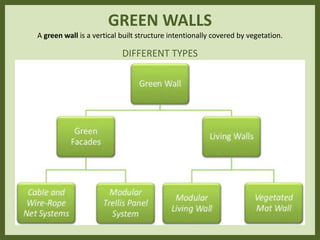
GREEN WALLS
A green wall is a vertical built structure intentionally covered by vegetation.
DIFFERENT TYPES
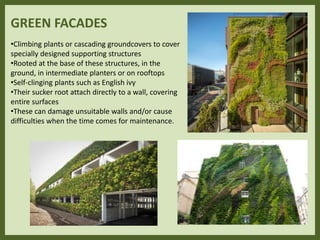
GREEN FACADES
•Climbing plants or cascading groundcovers to cover
specially designed supporting structures
•Rooted at the base of these structures, in the
ground, in intermediate planters or on rooftops
•Self-clinging plants such as English ivy
•Their sucker root attach directly to a wall, covering
entire surfaces
•These can damage unsuitable walls and/or cause
difficulties when the time comes for maintenance.
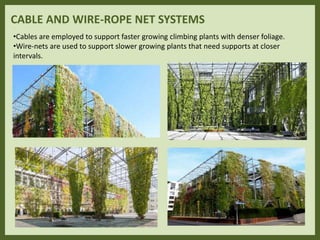
CABLE AND WIRE-ROPE NET SYSTEMS
•Cables are employed to support faster growing climbing plants with denser foliage.
•Wire-nets are used to support slower growing plants that need supports at closer
intervals.
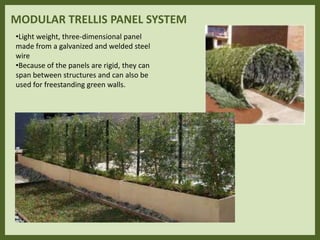
MODULAR TRELLIS PANEL SYSTEM
•Light weight, three-dimensional panel
made from a galvanized and welded steel
wire
•Because of the panels are rigid, they can
span between structures and can also be
used for freestanding green walls.
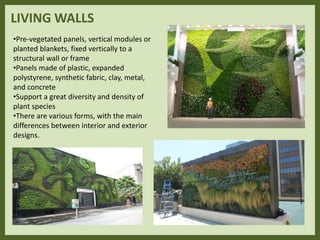
LIVING WALLS
•Pre-vegetated panels, vertical modules or
planted blankets, fixed vertically to a
structural wall or frame
•Panels made of plastic, expanded
polystyrene, synthetic fabric, clay, metal,
and concrete
•Support a great diversity and density of
plant species
•There are various forms, with the main
differences between interior and exterior
designs.
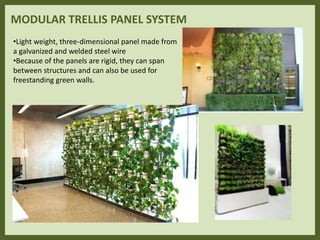
MODULAR TRELLIS PANEL SYSTEM
•Light weight, three-dimensional panel made from
a galvanized and welded steel wire
•Because of the panels are rigid, they can span
between structures and can also be used for
freestanding green walls.
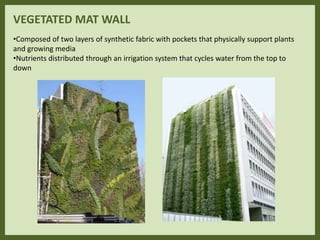
VEGETATED MAT WALL
•Composed of two layers of synthetic fabric with pockets that physically support plants
and growing media
•Nutrients distributed through an irrigation system that cycles water from the top to
down
Environmental Benefits
•Offer cooling in the city through direct shading and evaporate transpiration.
•Filters gaseous and particulate pollutants from the atmosphere in the urban environment.
Economical Benefits
•Reduce climatic stress on building and increase the service and practical life of buildings
and reduce cost on the painting materials.
•Reduce energy used for cooling vastly.
Aesthetics
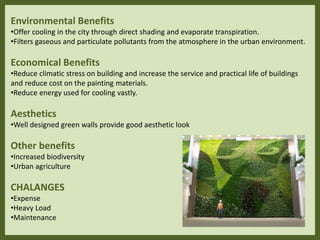
•Well designed green walls provide good aesthetic look
Other benefits
•Increased biodiversity
•Urban agriculture
CHALANGES
•Expense
•Heavy Load
•Maintenance
XERISCAPING
INTRODUCTION
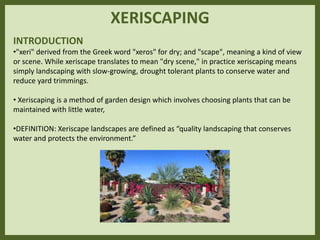
•"xeri" derived from the Greek word "xeros" for dry; and "scape", meaning a kind of view
or scene. While xeriscape translates to mean "dry scene," in practice xeriscaping means
simply landscaping with slow-growing, drought tolerant plants to conserve water and
reduce yard trimmings.
• Xeriscaping is a method of garden design which involves choosing plants that can be
maintained with little water,
•DEFINITION: Xeriscape landscapes are defined as “quality landscaping that conserves
water and protects the environment.”
• It can be applied to any landscape design, from formal to informal.
•Although it may take two to three years to establish, a xeric
landscape aims to reduce the amount of water being used.
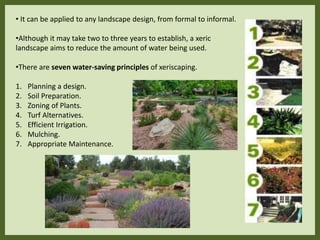
•There are seven water-saving principles of xeriscaping.
1. Planning a design.
2. Soil Preparation.
3. Zoning of Plants.
4. Turf Alternatives.
5. Efficient Irrigation.
6. Mulching.
7. Appropriate Maintenance.
Planning a design (1st Step)
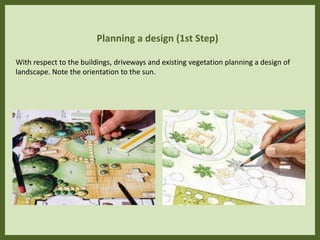
With respect to the buildings, driveways and existing vegetation planning a design of
landscape. Note the orientation to the sun.
Soil analysis (2nd Step)
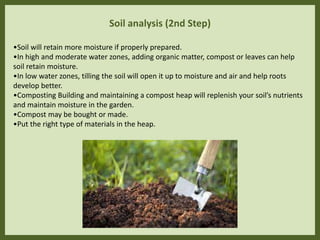
•Soil will retain more moisture if properly prepared.
•In high and moderate water zones, adding organic matter, compost or leaves can help
soil retain moisture.
•In low water zones, tilling the soil will open it up to moisture and air and help roots
develop better.
•Composting Building and maintaining a compost heap will replenish your soil’s nutrients
and maintain moisture in the garden.
•Compost may be bought or made.
•Put the right type of materials in the heap.
Appropriate plant selection (3rd Step)
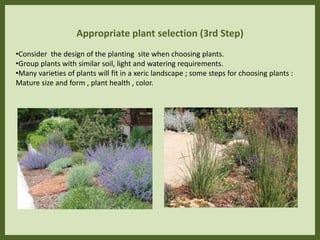
•Consider the design of the planting site when choosing plants.
•Group plants with similar soil, light and watering requirements.
•Many varieties of plants will fit in a xeric landscape ; some steps for choosing plants :
Mature size and form , plant health , color.
Turf planning (4th Step)
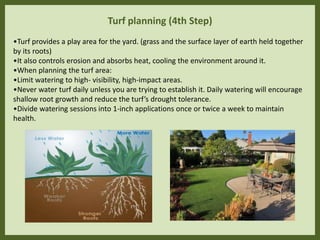
•Turf provides a play area for the yard. (grass and the surface layer of earth held together
by its roots)
•It also controls erosion and absorbs heat, cooling the environment around it.
•When planning the turf area:
•Limit watering to high- visibility, high-impact areas.
•Never water turf daily unless you are trying to establish it. Daily watering will encourage
shallow root growth and reduce the turf’s drought tolerance.
•Divide watering sessions into 1-inch applications once or twice a week to maintain
health.
Efficient Irrigation (5th Step)
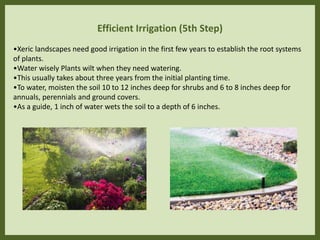
•Xeric landscapes need good irrigation in the first few years to establish the root systems
of plants.
•Water wisely Plants wilt when they need watering.
•This usually takes about three years from the initial planting time.
•To water, moisten the soil 10 to 12 inches deep for shrubs and 6 to 8 inches deep for
annuals, perennials and ground covers.
•As a guide, 1 inch of water wets the soil to a depth of 6 inches.
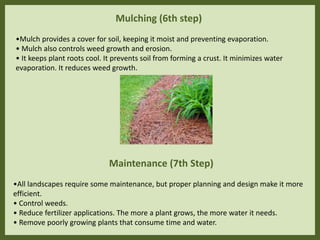
Mulching (6th step)
•Mulch provides a cover for soil, keeping it moist and preventing evaporation.
• Mulch also controls weed growth and erosion.
• It keeps plant roots cool. It prevents soil from forming a crust. It minimizes water
evaporation. It reduces weed growth.
Maintenance (7th Step)
•All landscapes require some maintenance, but proper planning and design make it more
efficient.
• Control weeds.
• Reduce fertilizer applications. The more a plant grows, the more water it needs.
• Remove poorly growing plants that consume time and water.
XERISCAPE BENEFITS
•Saves Water
•Less Maintenance
•No Fertilizers or Pesticides
•Improves Property Value
•Pollution Free
•Provides Wildlife Habitat
THANK YOU

Green walls & xeriscaping

  • 1.
    GREEN WALLS &XERISCAPING LANDSCAPE DESIGN
  • 2.
    GREEN WALLS A greenwall is a vertical built structure intentionally covered by vegetation. DIFFERENT TYPES
  • 3.
    GREEN FACADES •Climbing plantsor cascading groundcovers to cover specially designed supporting structures •Rooted at the base of these structures, in the ground, in intermediate planters or on rooftops •Self-clinging plants such as English ivy •Their sucker root attach directly to a wall, covering entire surfaces •These can damage unsuitable walls and/or cause difficulties when the time comes for maintenance.
  • 4.
    CABLE AND WIRE-ROPENET SYSTEMS •Cables are employed to support faster growing climbing plants with denser foliage. •Wire-nets are used to support slower growing plants that need supports at closer intervals.
  • 5.
    MODULAR TRELLIS PANELSYSTEM •Light weight, three-dimensional panel made from a galvanized and welded steel wire •Because of the panels are rigid, they can span between structures and can also be used for freestanding green walls.
  • 6.
    LIVING WALLS •Pre-vegetated panels,vertical modules or planted blankets, fixed vertically to a structural wall or frame •Panels made of plastic, expanded polystyrene, synthetic fabric, clay, metal, and concrete •Support a great diversity and density of plant species •There are various forms, with the main differences between interior and exterior designs.
  • 7.
    MODULAR TRELLIS PANELSYSTEM •Light weight, three-dimensional panel made from a galvanized and welded steel wire •Because of the panels are rigid, they can span between structures and can also be used for freestanding green walls.
  • 8.
    VEGETATED MAT WALL •Composedof two layers of synthetic fabric with pockets that physically support plants and growing media •Nutrients distributed through an irrigation system that cycles water from the top to down
  • 9.
    Environmental Benefits •Offer coolingin the city through direct shading and evaporate transpiration. •Filters gaseous and particulate pollutants from the atmosphere in the urban environment. Economical Benefits •Reduce climatic stress on building and increase the service and practical life of buildings and reduce cost on the painting materials. •Reduce energy used for cooling vastly. Aesthetics •Well designed green walls provide good aesthetic look Other benefits •Increased biodiversity •Urban agriculture CHALANGES •Expense •Heavy Load •Maintenance
  • 10.
    XERISCAPING INTRODUCTION •"xeri" derived fromthe Greek word "xeros" for dry; and "scape", meaning a kind of view or scene. While xeriscape translates to mean "dry scene," in practice xeriscaping means simply landscaping with slow-growing, drought tolerant plants to conserve water and reduce yard trimmings. • Xeriscaping is a method of garden design which involves choosing plants that can be maintained with little water, •DEFINITION: Xeriscape landscapes are defined as “quality landscaping that conserves water and protects the environment.”
  • 11.
    • It canbe applied to any landscape design, from formal to informal. •Although it may take two to three years to establish, a xeric landscape aims to reduce the amount of water being used. •There are seven water-saving principles of xeriscaping. 1. Planning a design. 2. Soil Preparation. 3. Zoning of Plants. 4. Turf Alternatives. 5. Efficient Irrigation. 6. Mulching. 7. Appropriate Maintenance.
  • 12.
    Planning a design(1st Step) With respect to the buildings, driveways and existing vegetation planning a design of landscape. Note the orientation to the sun.
  • 13.
    Soil analysis (2ndStep) •Soil will retain more moisture if properly prepared. •In high and moderate water zones, adding organic matter, compost or leaves can help soil retain moisture. •In low water zones, tilling the soil will open it up to moisture and air and help roots develop better. •Composting Building and maintaining a compost heap will replenish your soil’s nutrients and maintain moisture in the garden. •Compost may be bought or made. •Put the right type of materials in the heap.
  • 14.
    Appropriate plant selection(3rd Step) •Consider the design of the planting site when choosing plants. •Group plants with similar soil, light and watering requirements. •Many varieties of plants will fit in a xeric landscape ; some steps for choosing plants : Mature size and form , plant health , color.
  • 15.
    Turf planning (4thStep) •Turf provides a play area for the yard. (grass and the surface layer of earth held together by its roots) •It also controls erosion and absorbs heat, cooling the environment around it. •When planning the turf area: •Limit watering to high- visibility, high-impact areas. •Never water turf daily unless you are trying to establish it. Daily watering will encourage shallow root growth and reduce the turf’s drought tolerance. •Divide watering sessions into 1-inch applications once or twice a week to maintain health.
  • 16.
    Efficient Irrigation (5thStep) •Xeric landscapes need good irrigation in the first few years to establish the root systems of plants. •Water wisely Plants wilt when they need watering. •This usually takes about three years from the initial planting time. •To water, moisten the soil 10 to 12 inches deep for shrubs and 6 to 8 inches deep for annuals, perennials and ground covers. •As a guide, 1 inch of water wets the soil to a depth of 6 inches.
  • 17.
    Mulching (6th step) •Mulchprovides a cover for soil, keeping it moist and preventing evaporation. • Mulch also controls weed growth and erosion. • It keeps plant roots cool. It prevents soil from forming a crust. It minimizes water evaporation. It reduces weed growth. Maintenance (7th Step) •All landscapes require some maintenance, but proper planning and design make it more efficient. • Control weeds. • Reduce fertilizer applications. The more a plant grows, the more water it needs. • Remove poorly growing plants that consume time and water.
  • 18.
    XERISCAPE BENEFITS •Saves Water •LessMaintenance •No Fertilizers or Pesticides •Improves Property Value •Pollution Free •Provides Wildlife Habitat
  • 19.