planting trees   in urban areas
Slideshow Content Site assessment for urban tree planting Basic planting design Special considerations for urban tree planting Site preparation Planting and maintenance techniques
Site Assessment for Urban Tree Planting Collect detailed information about conditions at previously identified planting sites Use information to: develop planting plan, determine what to plant, where to plant and what special methods are needed to reduce urban impacts on trees
Impacts of Urbanization on Trees Air pollution Poor soils Exposure to wind Drought Flooding/standing water Increased temperature Competition Disease Damage from humans Damage from animals Salt from roads Inadequate soil volume Improper maintenance Conflicts with infrastructure
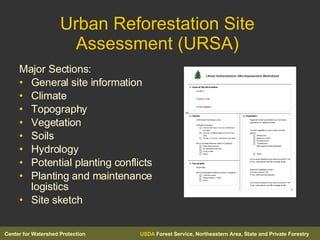
Urban Reforestation Site Assessment (URSA) Major Sections: General site information Climate Topography Vegetation Soils Hydrology Potential planting conflicts Planting and maintenance logistics Site sketch
Basic Planting Design Plant species  – diversity is important, select species that are appropriate for the site and tolerant of urban conditions Plant materials  – select from balled and burlapped, container grown, bare root  Plant spacing  – based on desired density, should account for plant survival rates Planting plan  – should include species list, sketch, planting dimensions, instructions, supply list, site preparation, schedule and cost estimate
Urban Tree Selection Guide Specific to the mid-Atlantic and Northeastern U.S. Used to select species that can tolerate the environmental conditions at the site and perform specific functions Chart 1: Environmental Conditions -  hardiness zone, soil moisture, sun exposure, soil composition, and tolerance of drought, inundation, pests/disease, soil compaction , salt, and pH Chart 2: Tree Characteristics  – growth rate, mature height, canopy spread, form/habit, root structure, fruits, flowers
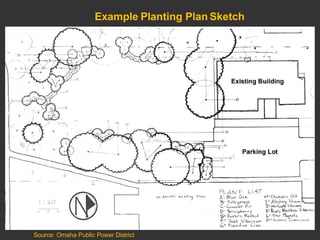
Example Planting Plan Sketch Source: Omaha Public Power District
Special Considerations for Urban Tree Planting Calculate soil volume Evaluate potential for stormwater treatment Recommend setbacks between trees and infrastructure Other methods to reduce infrastructure conflicts Protect trees from human and animal impacts
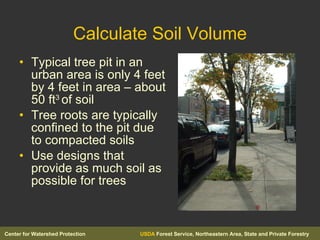
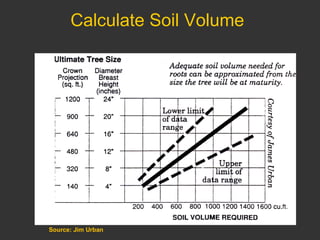
Calculate Soil Volume Typical tree pit in an urban area is only 4 feet by 4 feet in area – about 50 ft 3  of soil Tree roots are typically confined to the pit due to compacted soils Use designs that provide as much soil as possible for trees
Calculate Soil Volume Source: Jim Urban
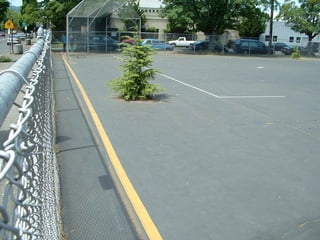
Evaluate Potential for Stormwater Treatment Many urban trees either receive too much stormwater runoff or do not receive enough water because surrounding pipes and pavement direct water away Stormwater management and planting strategies should be used to manage runoff at planting sites that receive too much water and to direct runoff to other planting sites to provide treatment and reduce irrigation needs
Evaluating Potential for Stormwater Treatment Sites should be evaluated to determine if they are: Under-capacity : currently does not receive runoff; runoff bypasses the site in pipe/ditch or is infiltrated At-capacity : receive sheetflow only Over-capacity : receive excessive runoff
 
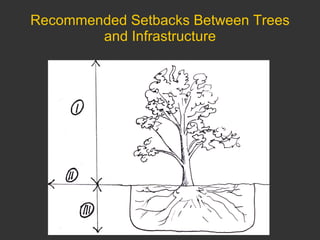
Recommended Setbacks Between Trees and Infrastructure
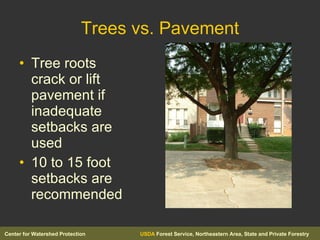
Trees vs. Pavement Tree roots crack or lift pavement if inadequate setbacks are used 10 to 15 foot setbacks are recommended
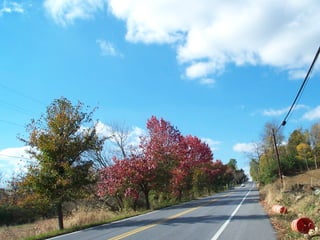
Trees vs. Utilities Falling limbs can cause power outages, trees can grow into wires  Maintenance/repair of utilities can damage tree Recommended setbacks from overhead wires: 10 feet for small trees 15-20 feet for medium trees 20 to 40 feet for large trees Trees planted under overhead wires must be 10 to 15 feet below the height of the wires at maturity Recommended setback from underground utilities is 10-15 feet
 
Trees vs. Sewer and Drainage Pipes Tree roots can clog or break sewer and drainage pipes –although most damage occurs with older sewer systems Trees that cause damage to sewer pipes are often removed Recommended setbacks: 15-25 feet between trees and perforated pipes 10 feet between trees and sewer lines
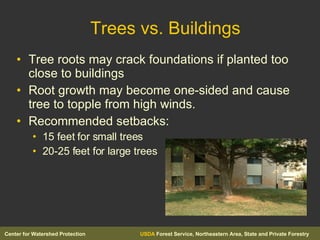
Trees vs. Buildings Tree roots may crack foundations if planted too close to buildings Root growth may become one-sided and cause tree to topple from high winds. Recommended setbacks: 15 feet for small trees 20-25 feet for large trees
Other Recommended Setbacks 10 foot setback between trees and lighting 10 foot setbacks between trees/shrubs and the centerline of trails (for safety)
Other Methods to Reduce Infrastructure Conflicts Species selection Alternative sidewalk design Alternative sidewalk materials Root guidance systems Structural soils Maintenance strategies
Species Selection “ The right tree in the right place” Selecting species with specific characteristics can reduce infrastructure conflicts: Choose shallow-rooted species when planting near sewer or drainage pipes When planting near overhead wires, choose species with columnar form Species with a small trunk flare or root buttress characteristics are ideal for planting next to pavement
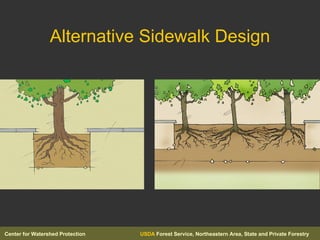
Alternative Sidewalk Design
Alternative Sidewalk Materials Reinforced or thicker concrete slabs Asphalt Pervious concrete Decomposed granite and compacted gravel Permeable pavers Recycled rubber Mulch
Root Guidance Systems Direct root growth away from infrastructure by restricting root growth laterally or radially, or by directing roots to appropriate areas Examples: root barriers, root paths, steel plates, root channels, continuous soil trench
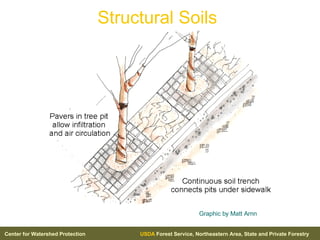
Structural Soils Graphic by Matt Arnn
Maintenance Strategies Use directional pruning instead of topping when pruning trees near overhead wires Use tunneling as an alternative to trenching when installing or repairing underground utilities near trees Use alternatives to root pruning to minimize damage to trees
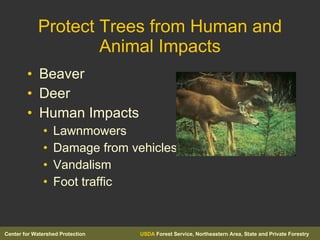
Protect Trees from Human and Animal Impacts Beaver Deer Human Impacts Lawnmowers Damage from vehicles Vandalism Foot traffic
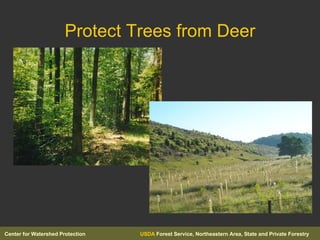
Protect Trees from Deer
Site Preparation Methods Trash and debris cleanup Invasive plant control Soil amendments
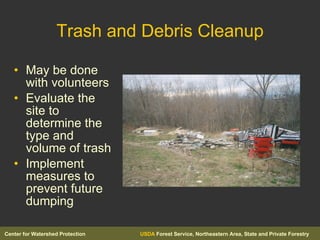
Trash and Debris Cleanup May be done with volunteers Evaluate the site to determine the type and volume of trash Implement measures to prevent future dumping
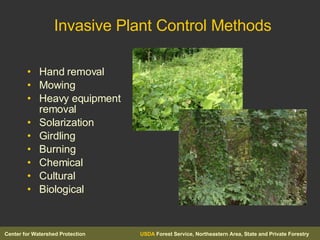
Invasive Plant Control Methods Hand removal Mowing Heavy equipment removal Solarization Girdling Burning Chemical Cultural  Biological
Soil Amendments Compost : improves water and nutrient-holding capacity, increases nutrients, reduces compaction Gypsum : decreases soil salinity, increases calcium and sulfur without affecting pH, enhances structure of clay soils Limestone:  decreases soil acidity Peat:  increases organic matter, acidity, and water and nutrient-holding capacity without increasing nutrient content Sulphur:  increases soil acidity
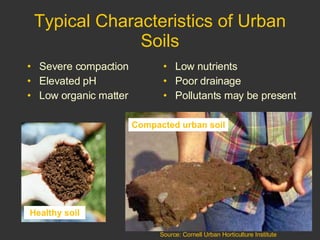
Typical Characteristics of Urban Soils Severe compaction Elevated pH Low organic matter Low nutrients Poor drainage Pollutants may be present Source: Cornell Urban Horticulture Institute Healthy soil Compacted urban soil
Planting and Maintenance Techniques Tree planting techniques Encourage natural regeneration Maintenance techniques
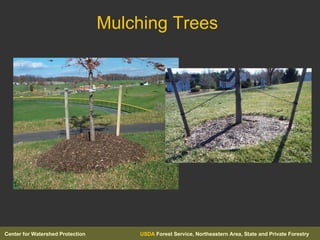
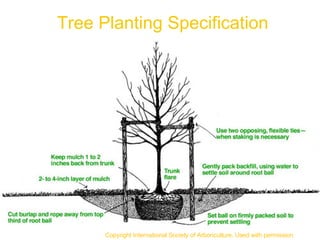
Tree Planting Techniques Planting hole must be 2 to 3 times wider than the root ball because roots spread out laterally rather than going deep Do not plant tree too deep Technique varies with plant materials and when planting on slopes Use tree shelters and mulch to protect tree if necessary Stake only on very windy sites or with top-heavy trees
Tree Planting Specification Copyright International Society of Arboriculture. Used with permission.
Mulching Trees
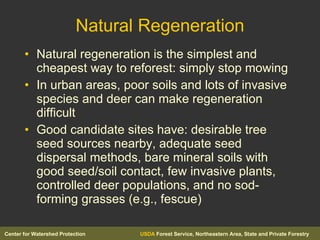
Natural Regeneration Natural regeneration is the simplest and cheapest way to reforest: simply stop mowing In urban areas, poor soils and lots of invasive species and deer can make regeneration difficult Good candidate sites have: desirable tree seed sources nearby, adequate seed dispersal methods, bare mineral soils with good seed/soil contact, few invasive plants, controlled deer populations, and no sod-forming grasses (e.g., fescue)
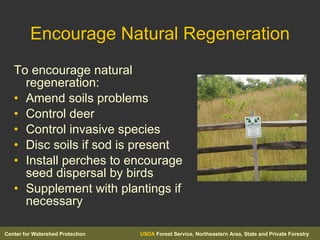
Encourage Natural Regeneration To encourage natural regeneration: Amend soils problems Control deer Control invasive species Disc soils if sod is present Install perches to encourage seed dispersal by birds Supplement with plantings if necessary
Tree Inspection and Maintenance Post planting and long-term inspection Watering Pruning Weed control Integrated Pest Management

Planting Trees in Urban Areas

  • 1.
    planting trees in urban areas
  • 2.
    Slideshow Content Siteassessment for urban tree planting Basic planting design Special considerations for urban tree planting Site preparation Planting and maintenance techniques
  • 3.
    Site Assessment forUrban Tree Planting Collect detailed information about conditions at previously identified planting sites Use information to: develop planting plan, determine what to plant, where to plant and what special methods are needed to reduce urban impacts on trees
  • 4.
    Impacts of Urbanizationon Trees Air pollution Poor soils Exposure to wind Drought Flooding/standing water Increased temperature Competition Disease Damage from humans Damage from animals Salt from roads Inadequate soil volume Improper maintenance Conflicts with infrastructure
  • 5.
    Urban Reforestation SiteAssessment (URSA) Major Sections: General site information Climate Topography Vegetation Soils Hydrology Potential planting conflicts Planting and maintenance logistics Site sketch
  • 6.
    Basic Planting DesignPlant species – diversity is important, select species that are appropriate for the site and tolerant of urban conditions Plant materials – select from balled and burlapped, container grown, bare root Plant spacing – based on desired density, should account for plant survival rates Planting plan – should include species list, sketch, planting dimensions, instructions, supply list, site preparation, schedule and cost estimate
  • 7.
    Urban Tree SelectionGuide Specific to the mid-Atlantic and Northeastern U.S. Used to select species that can tolerate the environmental conditions at the site and perform specific functions Chart 1: Environmental Conditions - hardiness zone, soil moisture, sun exposure, soil composition, and tolerance of drought, inundation, pests/disease, soil compaction , salt, and pH Chart 2: Tree Characteristics – growth rate, mature height, canopy spread, form/habit, root structure, fruits, flowers
  • 8.
    Example Planting PlanSketch Source: Omaha Public Power District
  • 9.
    Special Considerations forUrban Tree Planting Calculate soil volume Evaluate potential for stormwater treatment Recommend setbacks between trees and infrastructure Other methods to reduce infrastructure conflicts Protect trees from human and animal impacts
  • 10.
    Calculate Soil VolumeTypical tree pit in an urban area is only 4 feet by 4 feet in area – about 50 ft 3 of soil Tree roots are typically confined to the pit due to compacted soils Use designs that provide as much soil as possible for trees
  • 11.
    Calculate Soil VolumeSource: Jim Urban
  • 12.
    Evaluate Potential forStormwater Treatment Many urban trees either receive too much stormwater runoff or do not receive enough water because surrounding pipes and pavement direct water away Stormwater management and planting strategies should be used to manage runoff at planting sites that receive too much water and to direct runoff to other planting sites to provide treatment and reduce irrigation needs
  • 13.
    Evaluating Potential forStormwater Treatment Sites should be evaluated to determine if they are: Under-capacity : currently does not receive runoff; runoff bypasses the site in pipe/ditch or is infiltrated At-capacity : receive sheetflow only Over-capacity : receive excessive runoff
  • 14.
  • 15.
    Recommended Setbacks BetweenTrees and Infrastructure
  • 16.
    Trees vs. PavementTree roots crack or lift pavement if inadequate setbacks are used 10 to 15 foot setbacks are recommended
  • 17.
    Trees vs. UtilitiesFalling limbs can cause power outages, trees can grow into wires Maintenance/repair of utilities can damage tree Recommended setbacks from overhead wires: 10 feet for small trees 15-20 feet for medium trees 20 to 40 feet for large trees Trees planted under overhead wires must be 10 to 15 feet below the height of the wires at maturity Recommended setback from underground utilities is 10-15 feet
  • 18.
  • 19.
    Trees vs. Sewerand Drainage Pipes Tree roots can clog or break sewer and drainage pipes –although most damage occurs with older sewer systems Trees that cause damage to sewer pipes are often removed Recommended setbacks: 15-25 feet between trees and perforated pipes 10 feet between trees and sewer lines
  • 20.
    Trees vs. BuildingsTree roots may crack foundations if planted too close to buildings Root growth may become one-sided and cause tree to topple from high winds. Recommended setbacks: 15 feet for small trees 20-25 feet for large trees
  • 21.
    Other Recommended Setbacks10 foot setback between trees and lighting 10 foot setbacks between trees/shrubs and the centerline of trails (for safety)
  • 22.
    Other Methods toReduce Infrastructure Conflicts Species selection Alternative sidewalk design Alternative sidewalk materials Root guidance systems Structural soils Maintenance strategies
  • 23.
    Species Selection “The right tree in the right place” Selecting species with specific characteristics can reduce infrastructure conflicts: Choose shallow-rooted species when planting near sewer or drainage pipes When planting near overhead wires, choose species with columnar form Species with a small trunk flare or root buttress characteristics are ideal for planting next to pavement
  • 24.
  • 25.
    Alternative Sidewalk MaterialsReinforced or thicker concrete slabs Asphalt Pervious concrete Decomposed granite and compacted gravel Permeable pavers Recycled rubber Mulch
  • 26.
    Root Guidance SystemsDirect root growth away from infrastructure by restricting root growth laterally or radially, or by directing roots to appropriate areas Examples: root barriers, root paths, steel plates, root channels, continuous soil trench
  • 27.
  • 28.
    Maintenance Strategies Usedirectional pruning instead of topping when pruning trees near overhead wires Use tunneling as an alternative to trenching when installing or repairing underground utilities near trees Use alternatives to root pruning to minimize damage to trees
  • 29.
    Protect Trees fromHuman and Animal Impacts Beaver Deer Human Impacts Lawnmowers Damage from vehicles Vandalism Foot traffic
  • 30.
  • 31.
    Site Preparation MethodsTrash and debris cleanup Invasive plant control Soil amendments
  • 32.
    Trash and DebrisCleanup May be done with volunteers Evaluate the site to determine the type and volume of trash Implement measures to prevent future dumping
  • 33.
    Invasive Plant ControlMethods Hand removal Mowing Heavy equipment removal Solarization Girdling Burning Chemical Cultural Biological
  • 34.
    Soil Amendments Compost: improves water and nutrient-holding capacity, increases nutrients, reduces compaction Gypsum : decreases soil salinity, increases calcium and sulfur without affecting pH, enhances structure of clay soils Limestone: decreases soil acidity Peat: increases organic matter, acidity, and water and nutrient-holding capacity without increasing nutrient content Sulphur: increases soil acidity
  • 35.
    Typical Characteristics ofUrban Soils Severe compaction Elevated pH Low organic matter Low nutrients Poor drainage Pollutants may be present Source: Cornell Urban Horticulture Institute Healthy soil Compacted urban soil
  • 36.
    Planting and MaintenanceTechniques Tree planting techniques Encourage natural regeneration Maintenance techniques
  • 37.
    Tree Planting TechniquesPlanting hole must be 2 to 3 times wider than the root ball because roots spread out laterally rather than going deep Do not plant tree too deep Technique varies with plant materials and when planting on slopes Use tree shelters and mulch to protect tree if necessary Stake only on very windy sites or with top-heavy trees
  • 38.
    Tree Planting SpecificationCopyright International Society of Arboriculture. Used with permission.
  • 39.
  • 40.
    Natural Regeneration Naturalregeneration is the simplest and cheapest way to reforest: simply stop mowing In urban areas, poor soils and lots of invasive species and deer can make regeneration difficult Good candidate sites have: desirable tree seed sources nearby, adequate seed dispersal methods, bare mineral soils with good seed/soil contact, few invasive plants, controlled deer populations, and no sod-forming grasses (e.g., fescue)
  • 41.
    Encourage Natural RegenerationTo encourage natural regeneration: Amend soils problems Control deer Control invasive species Disc soils if sod is present Install perches to encourage seed dispersal by birds Supplement with plantings if necessary
  • 42.
    Tree Inspection andMaintenance Post planting and long-term inspection Watering Pruning Weed control Integrated Pest Management