Welcome to   Trees for Abington Abington’s Community Tree  Program March 26, 2011
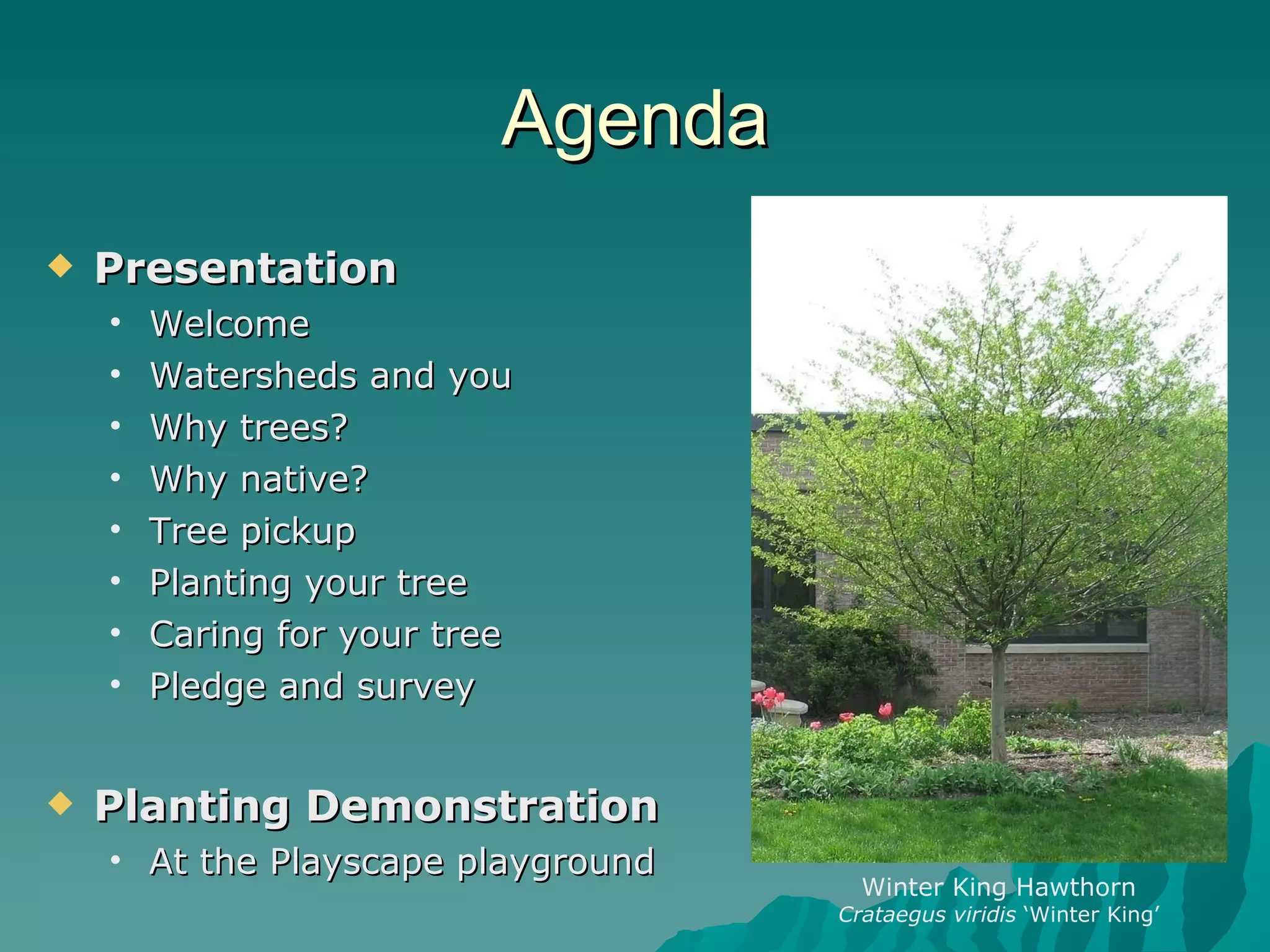
Agenda Presentation  Welcome Watersheds and you Why trees? Why native? Tree pickup Planting your tree Caring for your tree Pledge and survey Planting Demonstration At the Playscape playground Winter King Hawthorn Crataegus viridis  ‘Winter King’
Welcome Commissioner Lori Schreiber (Ward 14), the EAC & the STC welcome you Program created by Abington volunteer panels: Environmental Advisory Council (EAC) Shade Tree Commission Over 240 trees planted since 2005 Funded by: Water Resources Education Network grant A program of the League of Women Voters of Pennsylvania Citizen Education Fund, through a Section 319 federal Clean Water Act grant from the Pennsylvania Department of Environmental Protection, administered by the US Environmental Protection Agency.  http ://wren.palwv.org / Abington Twp Green Program Trees provided by: Pennsylvania Horticultural Society TreeVitalize Workshop hosted by: Briar Bush Nature Center
Abington Volunteer Panels Environmental Advisory Council Cakky Braun-Evans Donna Brewer Joelle Greenland Emma Gutzler Michele Kaczalek Susan Myerov Jennifer Sherwood Shade Tree Commission John Kennedy Jeff Pyle Bill Riemschneider Elaine Rosenberg Rita Stevens www.eac-abington.org
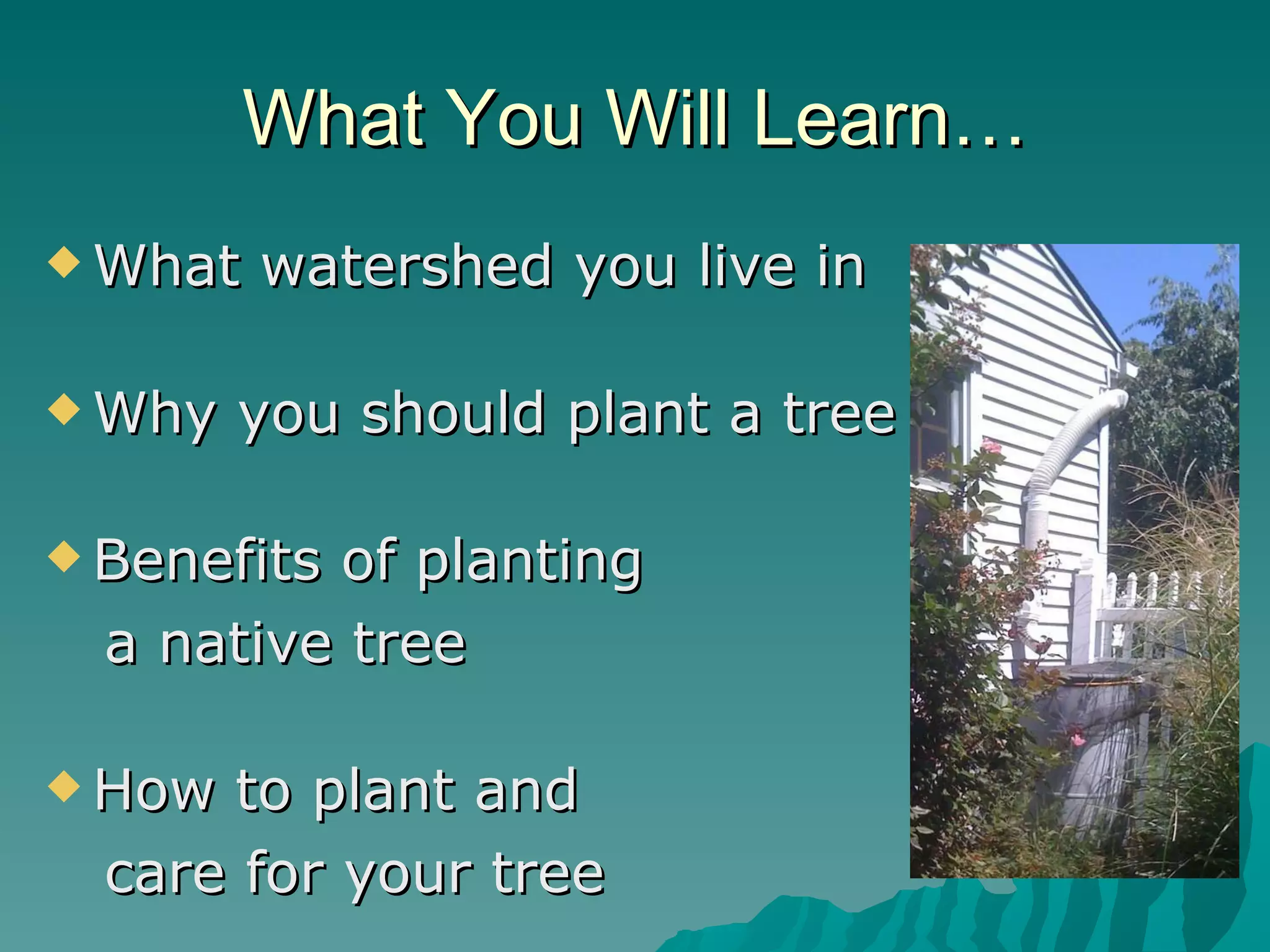
What You Will Learn… What watershed you live in  Why you should plant a tree Benefits of planting a native tree How to plant and  care for your tree
Watersheds  and  You
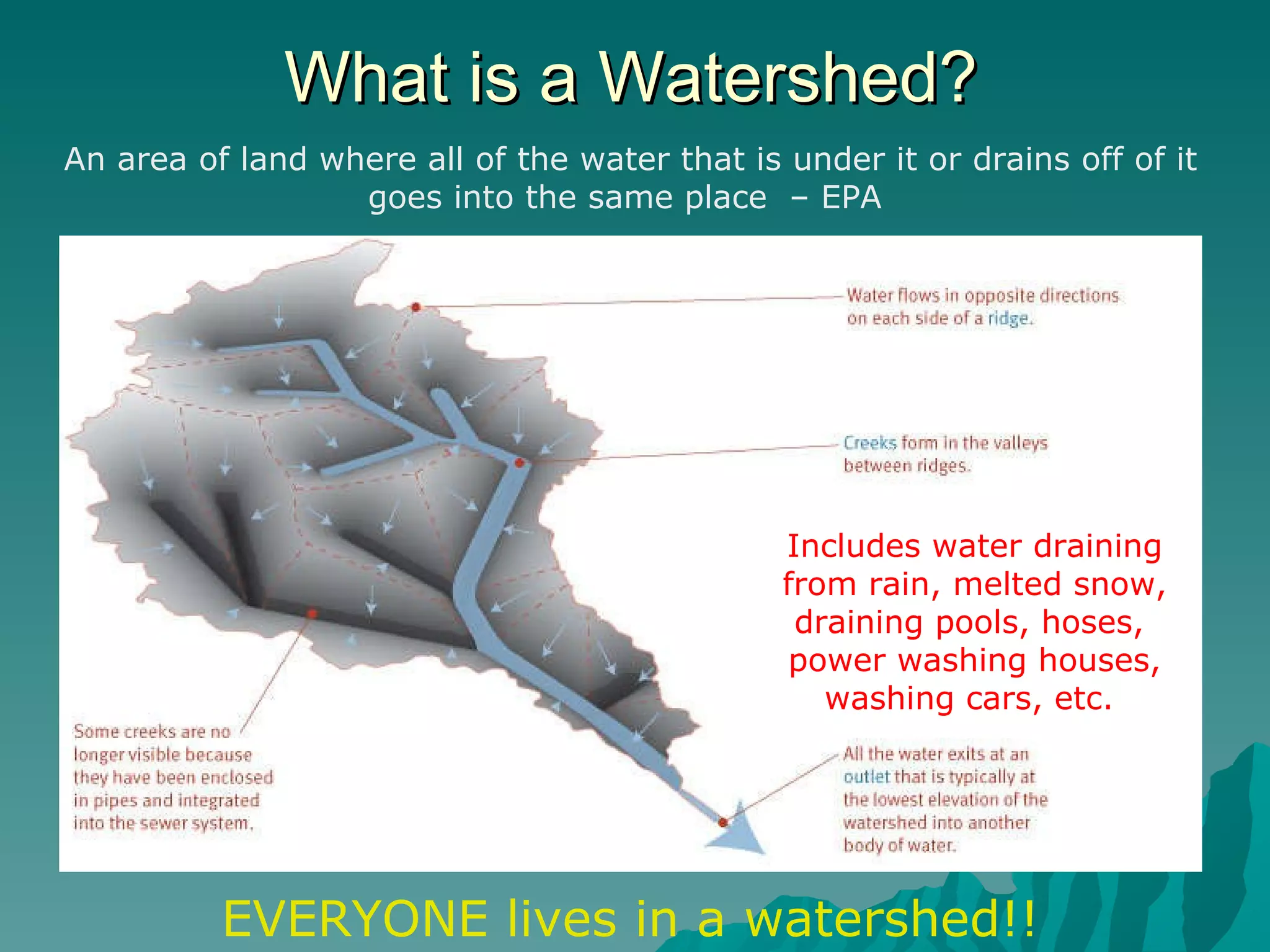
What is a Watershed? An area of land where all of the water that is under it or drains off of it goes into the same place  – EPA  EVERYONE lives in a watershed!! Includes water draining from rain, melted snow, draining pools, hoses,  power washing houses, washing cars, etc.
Why Is Your Watershed Important? It is your natural community It links you with all other living organisms in the watershed What you do effects others What others do effects you It is one part of the entire drainage system
Water running off your property affects local stream levels (increases flooding)  Chemicals and pollutants are washed into the local stream Polluted water affects our: Drinking water supply Sewage treatment Fish and other wildlife Recreational water activities Why Is Your Watershed Important?
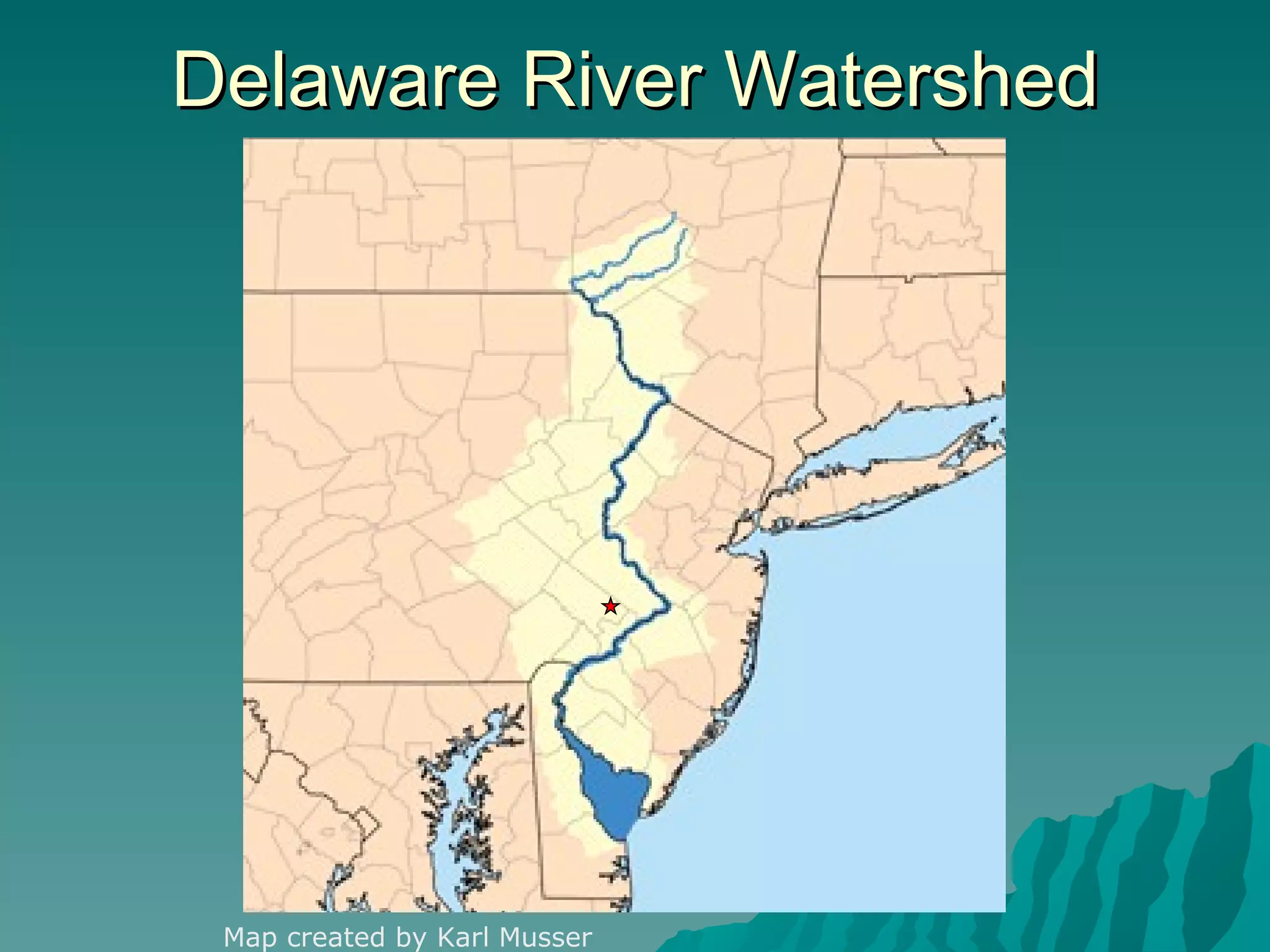
Delaware River Watershed Map created by Karl Musser
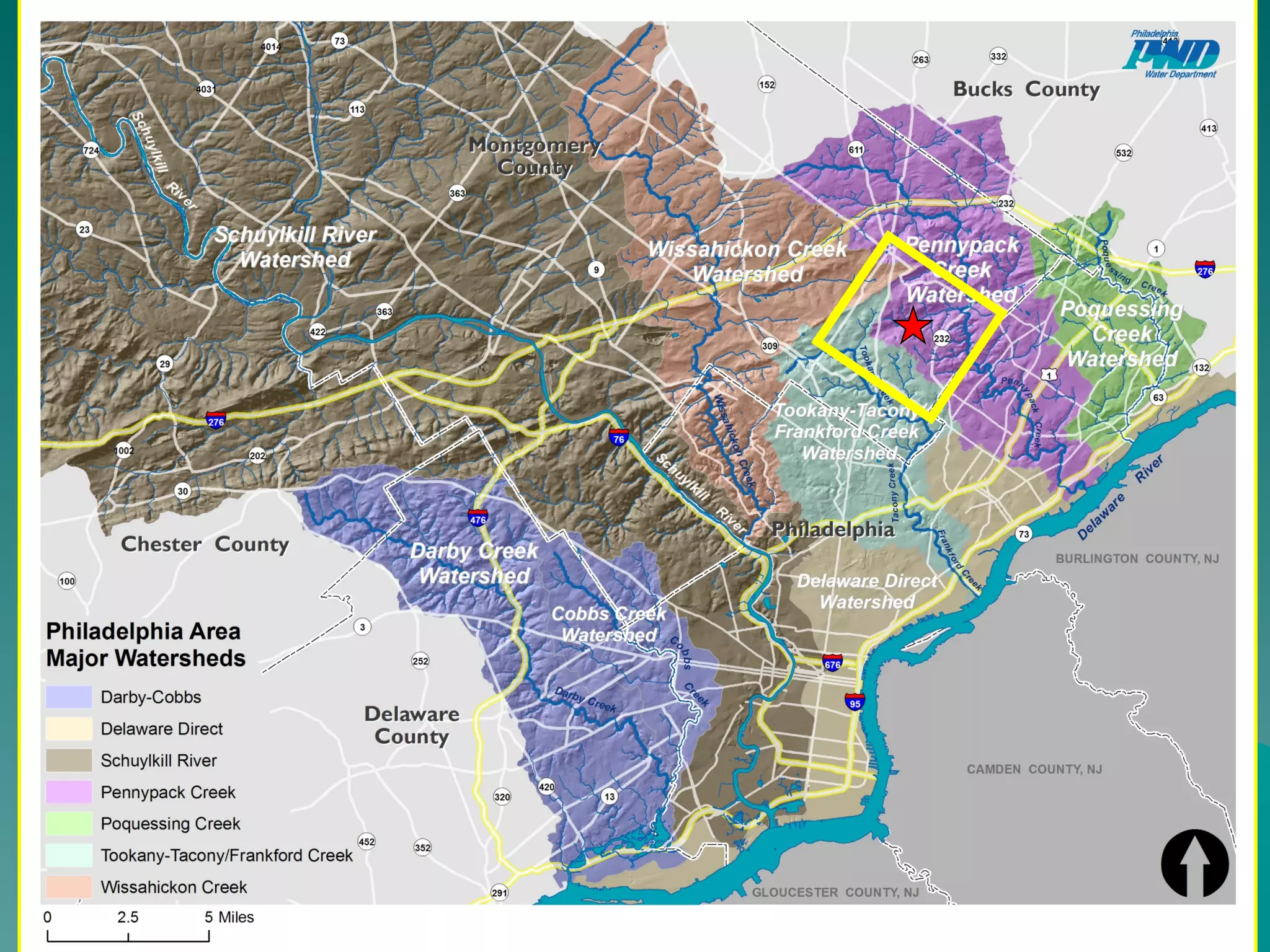
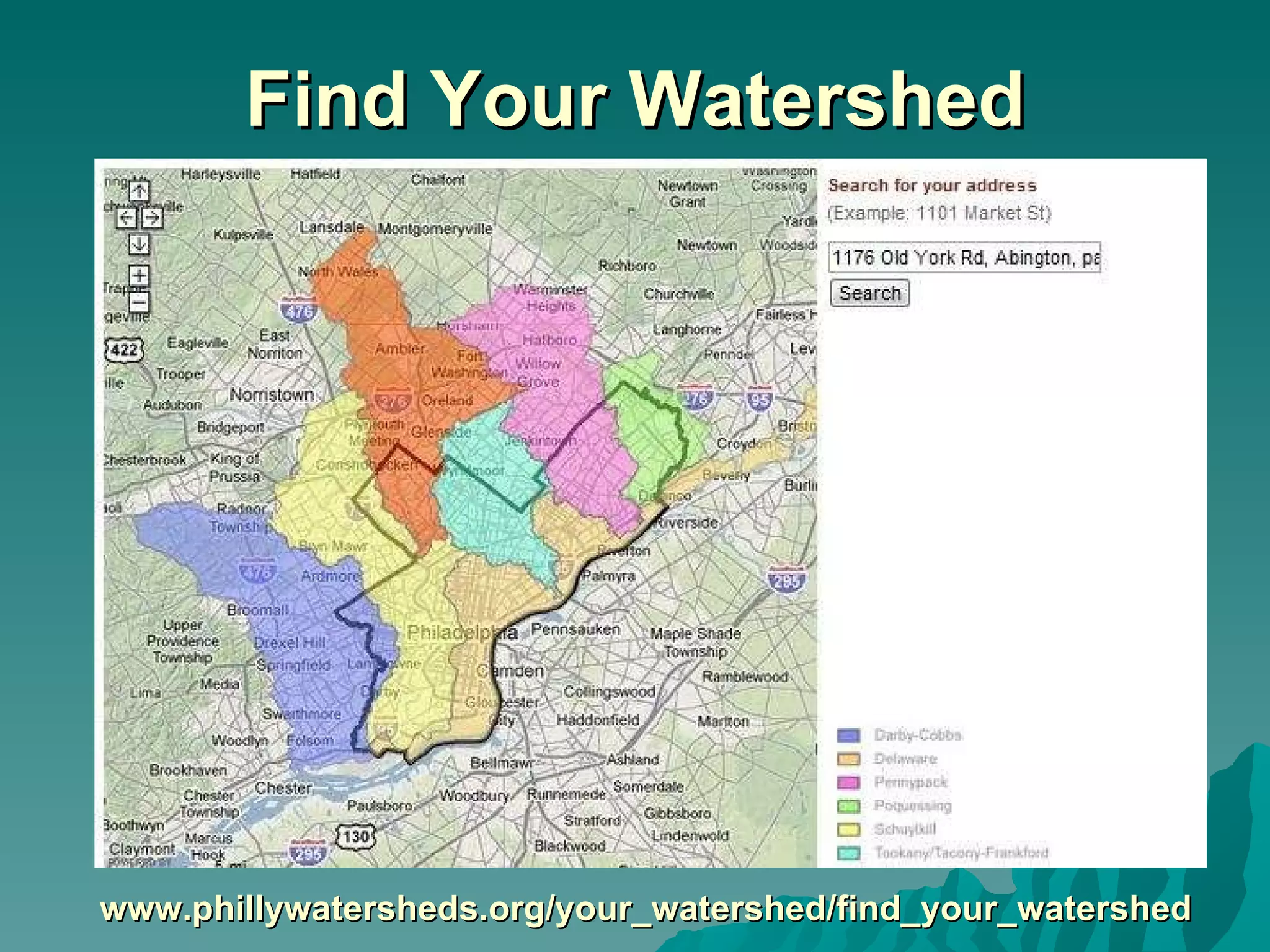
Philadelphia Area Watersheds
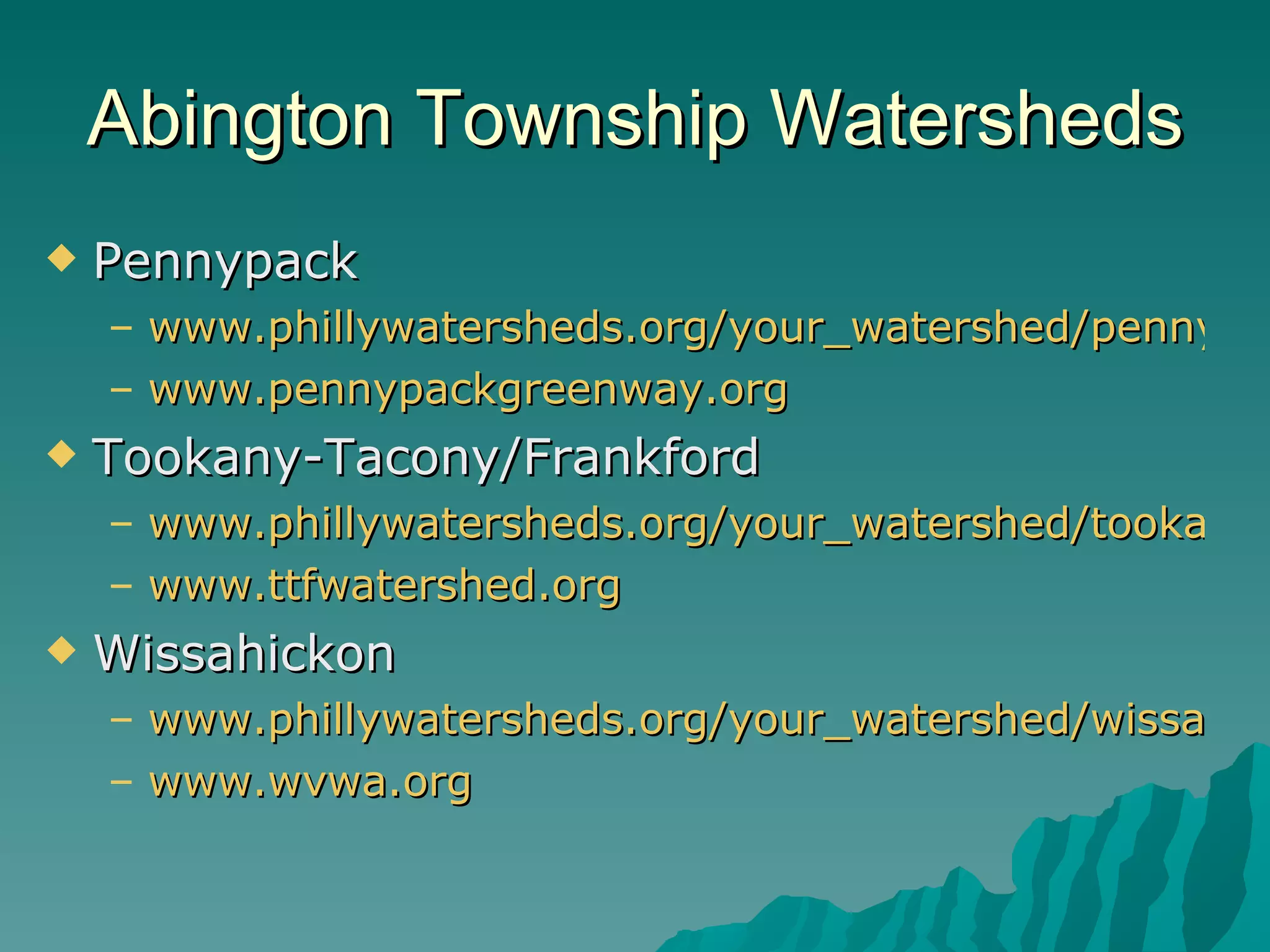
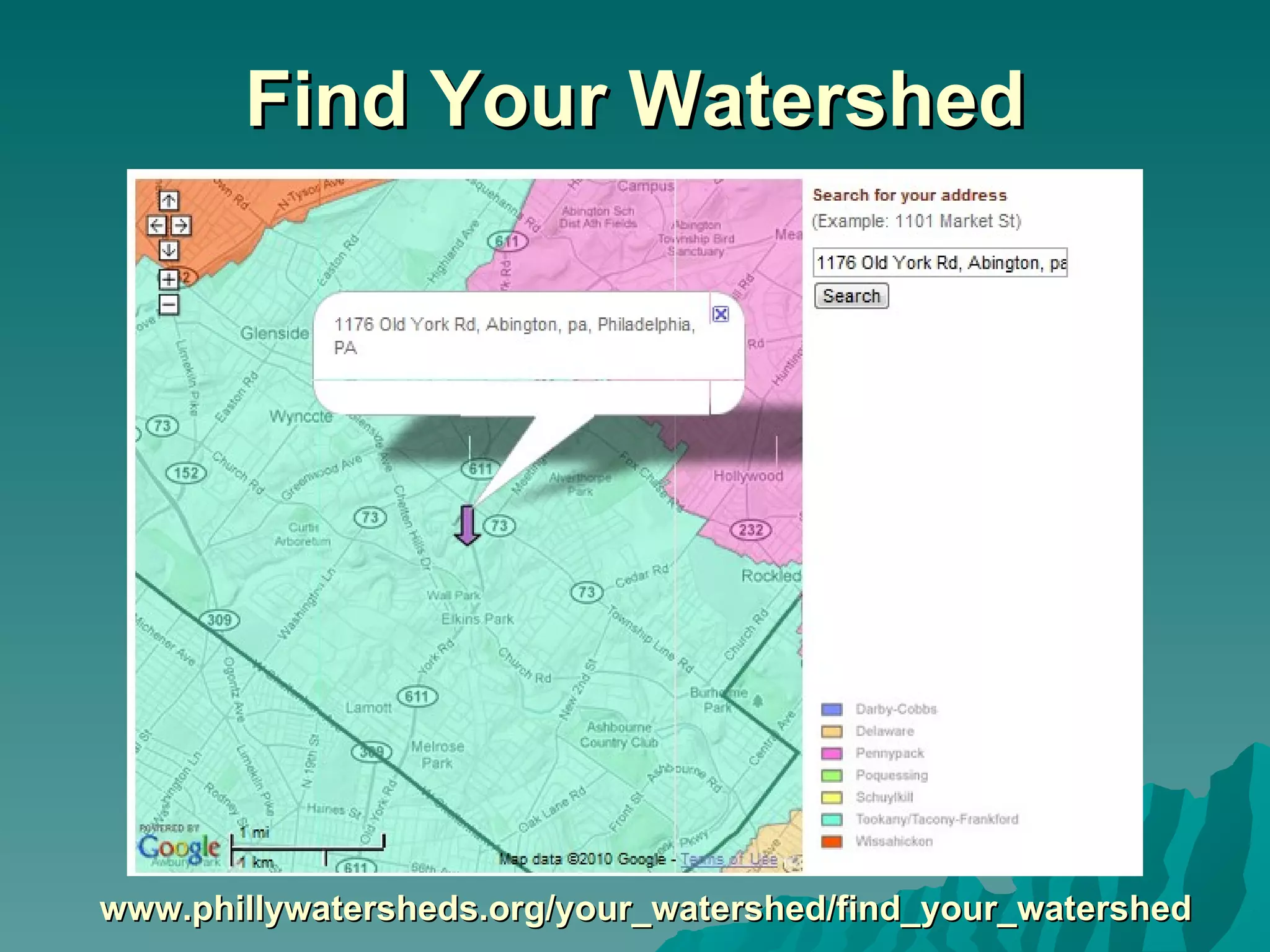
Abington Township Watersheds Pennypack  www.phillywatersheds.org/your_watershed/pennypack www.pennypackgreenway.org  Tookany-Tacony/Frankford www.phillywatersheds.org/your_watershed/tookany_tacony_frankford www.ttfwatershed.org Wissahickon www.phillywatersheds.org/your_watershed/wissahickon www.wvwa.org
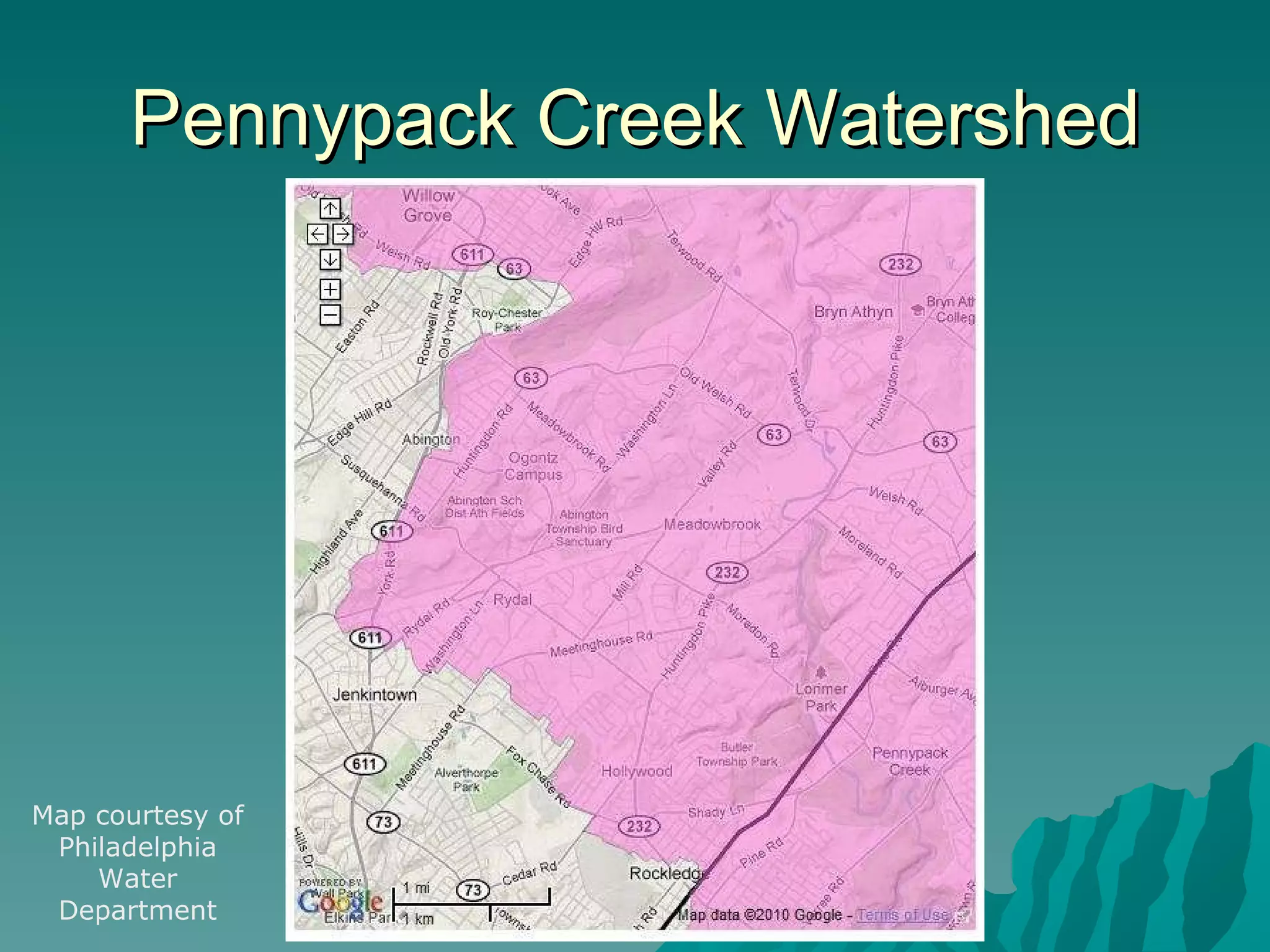
Pennypack Creek Watershed Map courtesy of Philadelphia Water Department
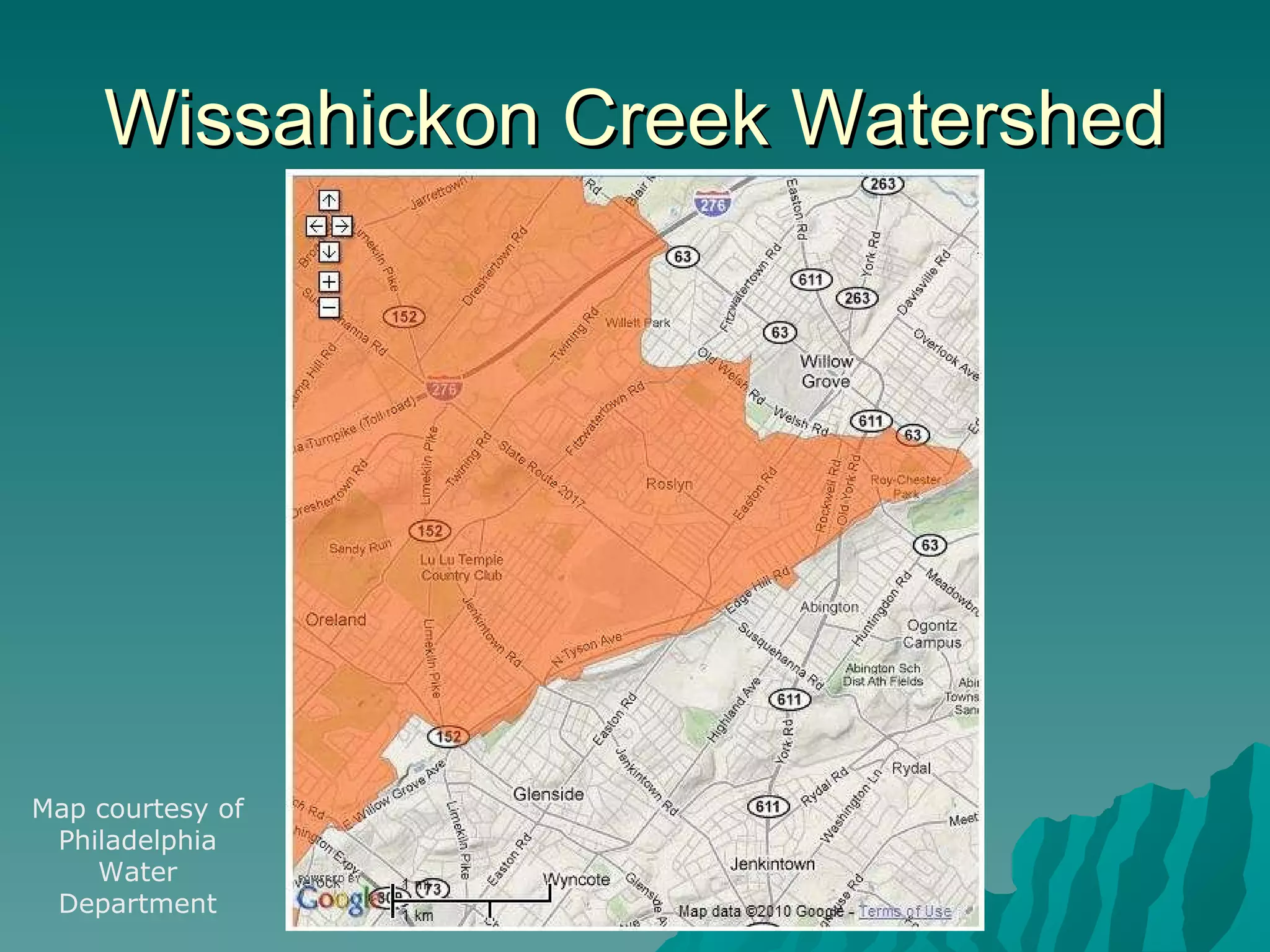
Wissahickon Creek Watershed Map courtesy of Philadelphia Water Department
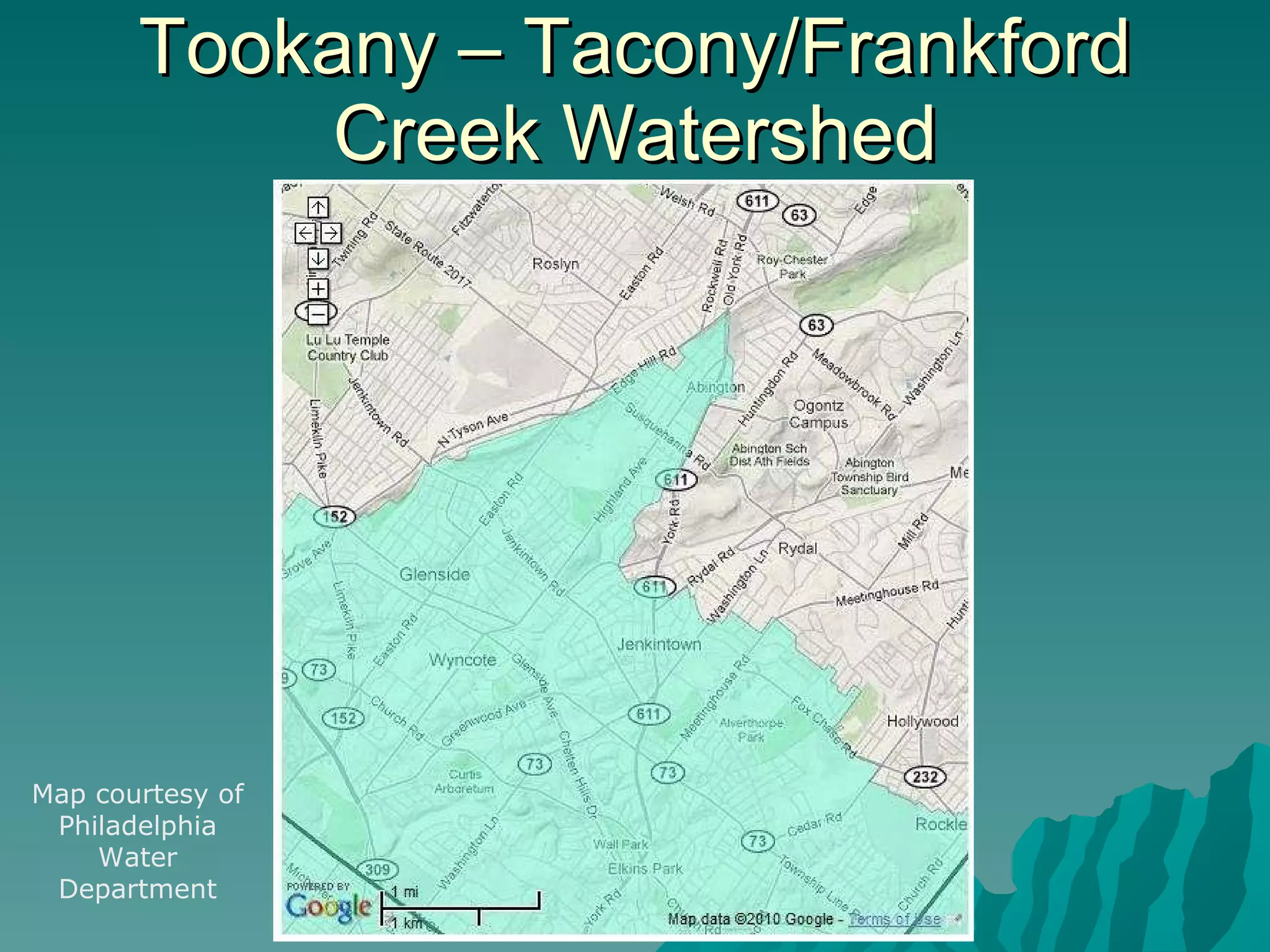
Tookany – Tacony/Frankford Creek Watershed Map courtesy of Philadelphia Water Department
www.phillywatersheds.org/your_watershed/find_your_watershed Find Your Watershed
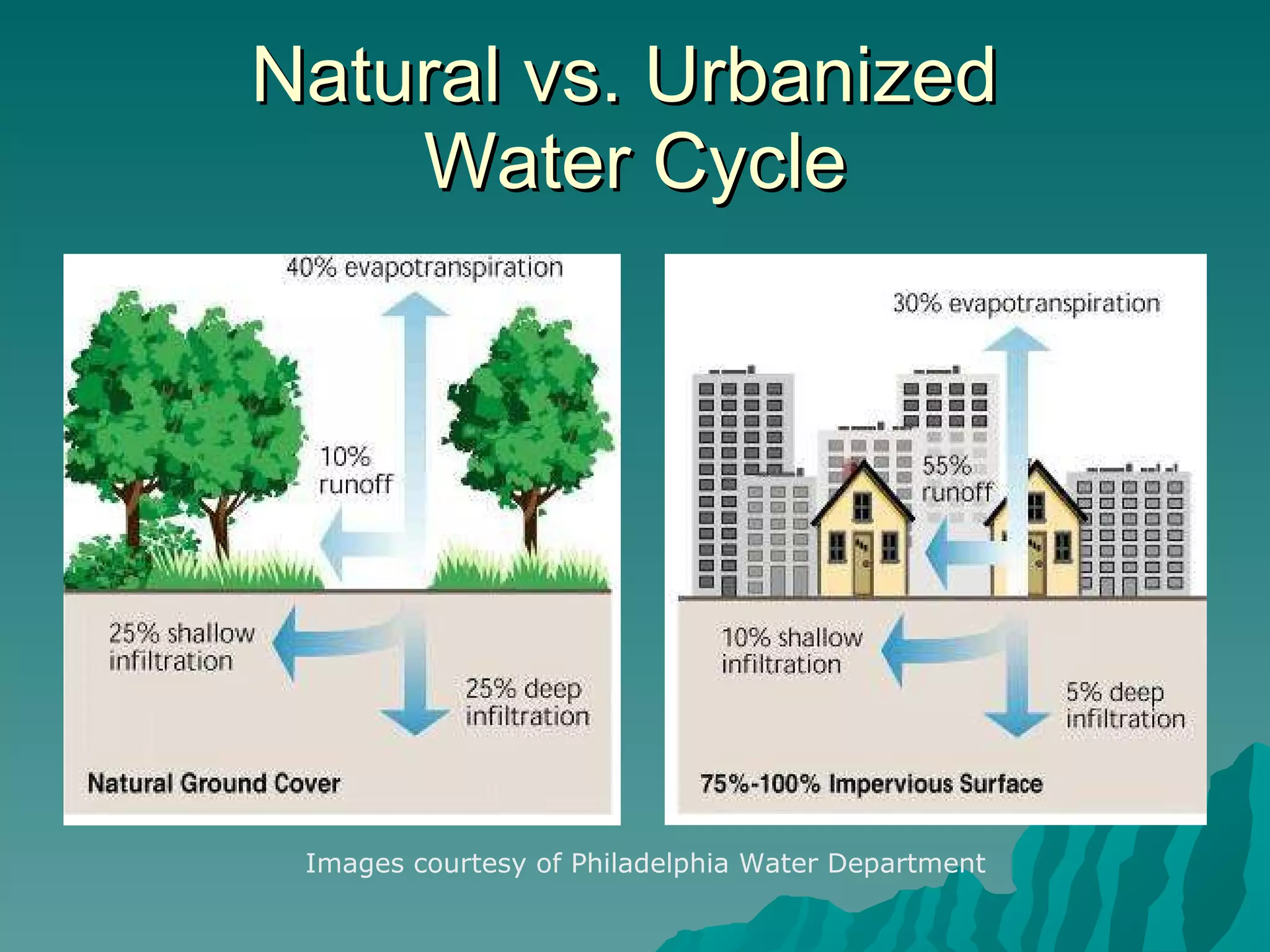
Natural vs. Urbanized  Water Cycle Images courtesy of Philadelphia Water Department
Why plant trees? Trees help keep our water healthy   How? Trees absorb rainwater Reduce the amount of water flowing off of your property and into creeks (run-off) Less run-off results in: Less flooding Less property damage Less erosion Fewer pollutants washed into streams Chemicals wash off streets & lawns and into creeks Excess fertilizers cause algae blooms & kill fish and wildlife Trees save money and taxes by keeping water out of sewer systems and by helping clean the water It all adds up to a healthier world
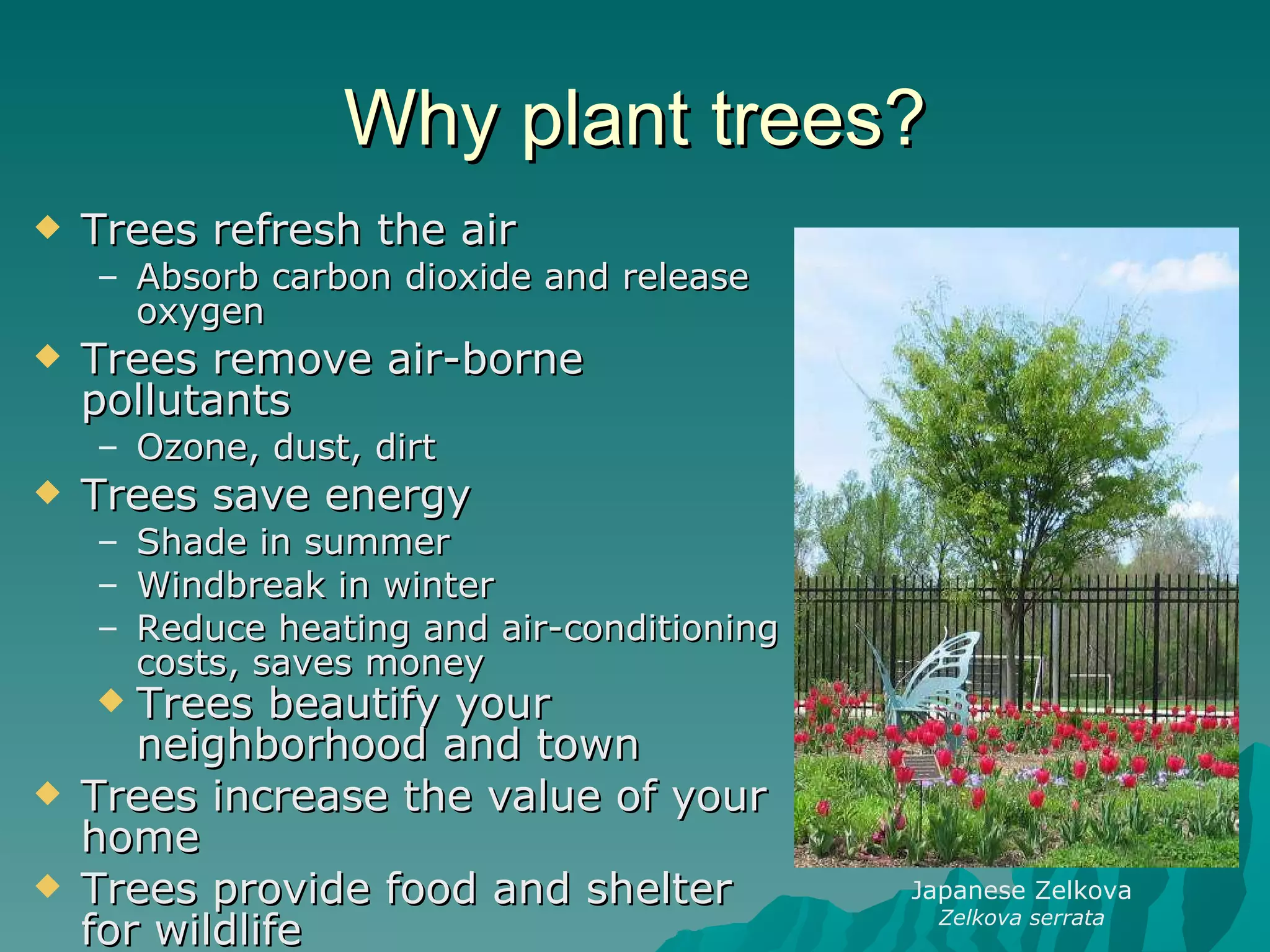
Why plant trees? Trees refresh the air Absorb carbon dioxide and release oxygen Trees remove air-borne pollutants Ozone, dust, dirt Trees save energy Shade in summer Windbreak in winter Reduce heating and air-conditioning costs, saves money Trees beautify your neighborhood and town   Trees increase the value of your home Trees provide food and shelter for wildlife Japanese Zelkova Zelkova serrata
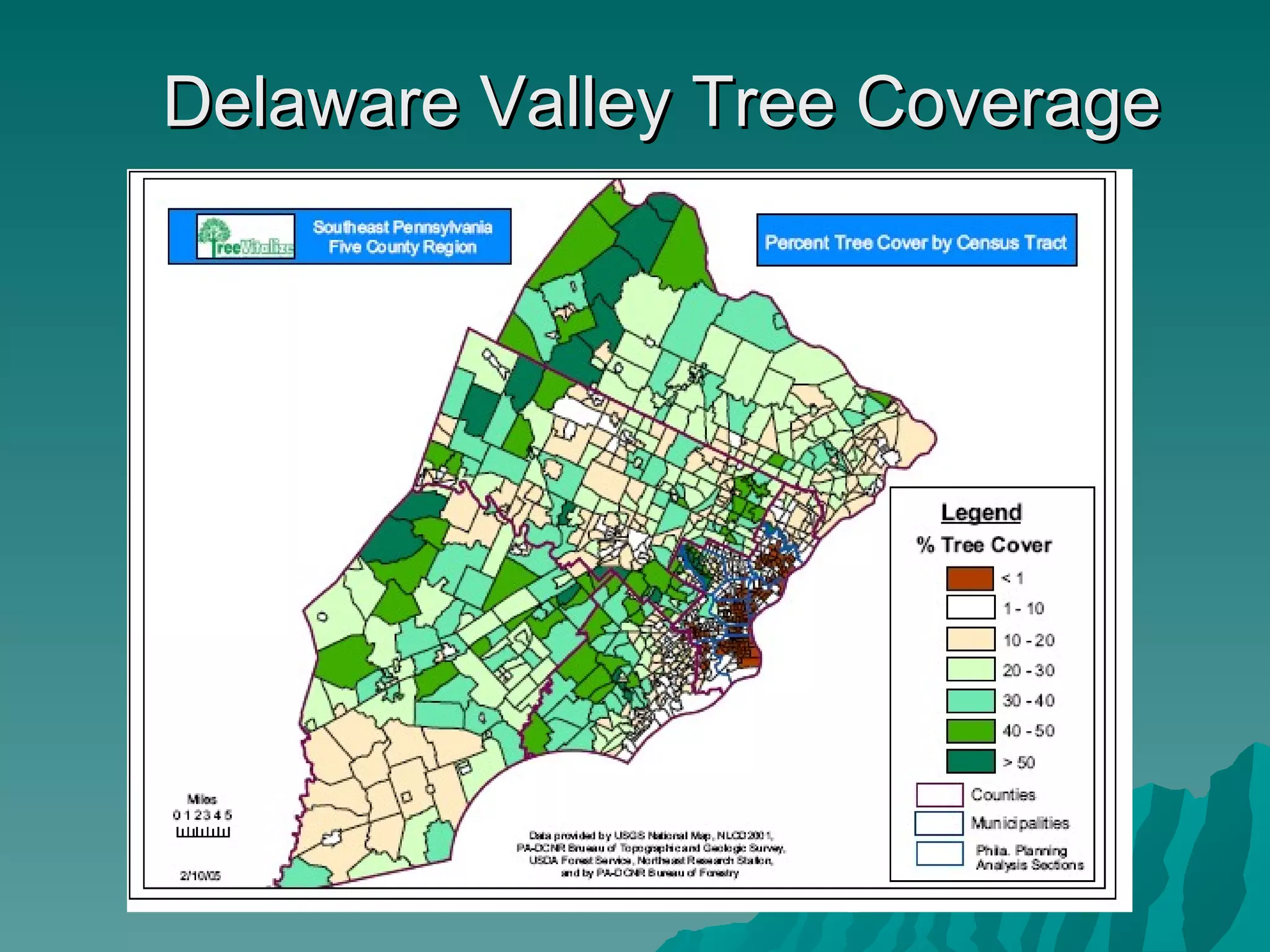
Delaware Valley Tree Coverage
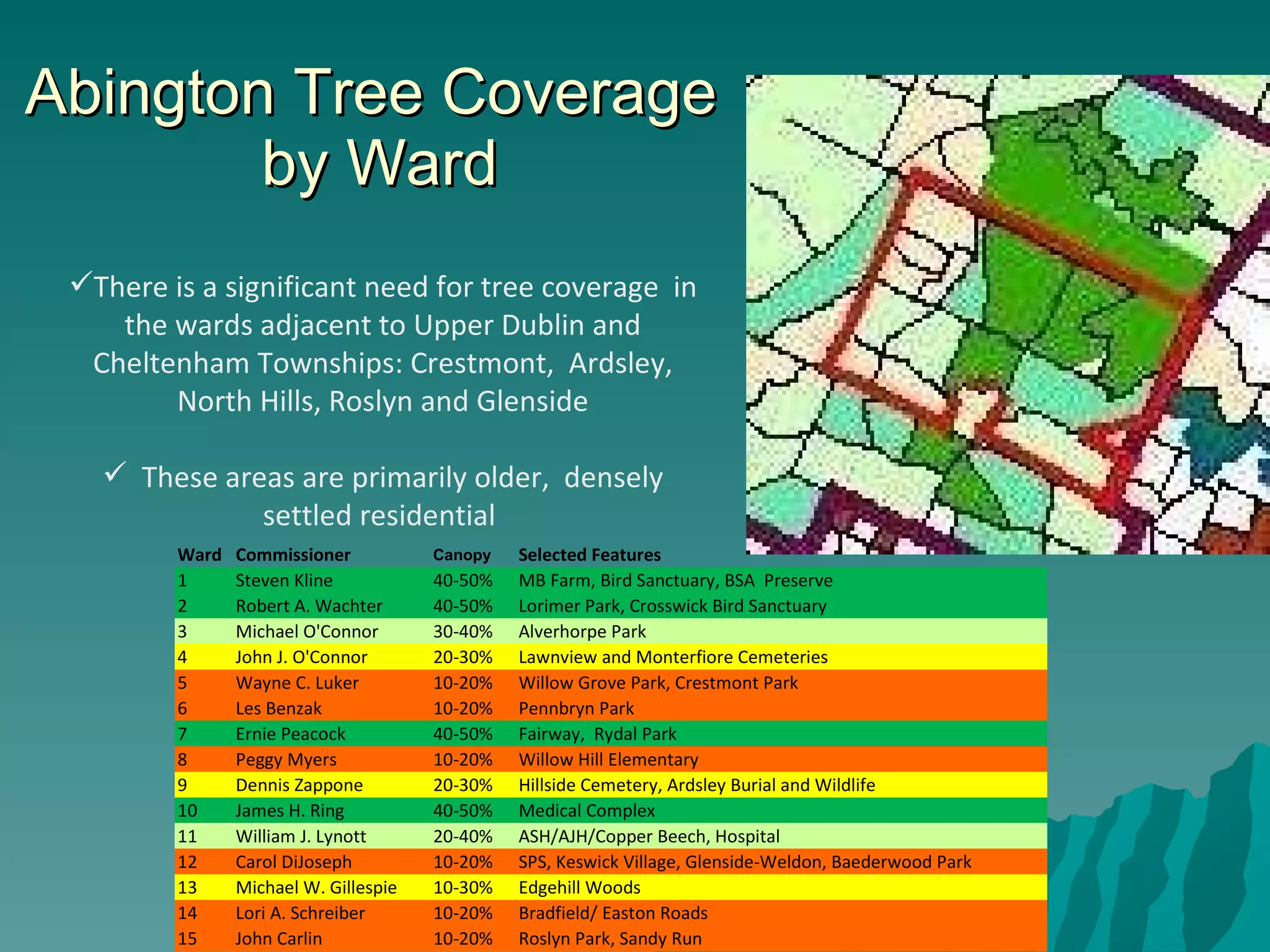
Abington Tree Coverage  by Ward There is a significant need for tree coverage  in the wards adjacent to Upper Dublin and Cheltenham Townships: Crestmont,  Ardsley, North Hills, Roslyn and Glenside These areas are primarily older,  densely settled residential
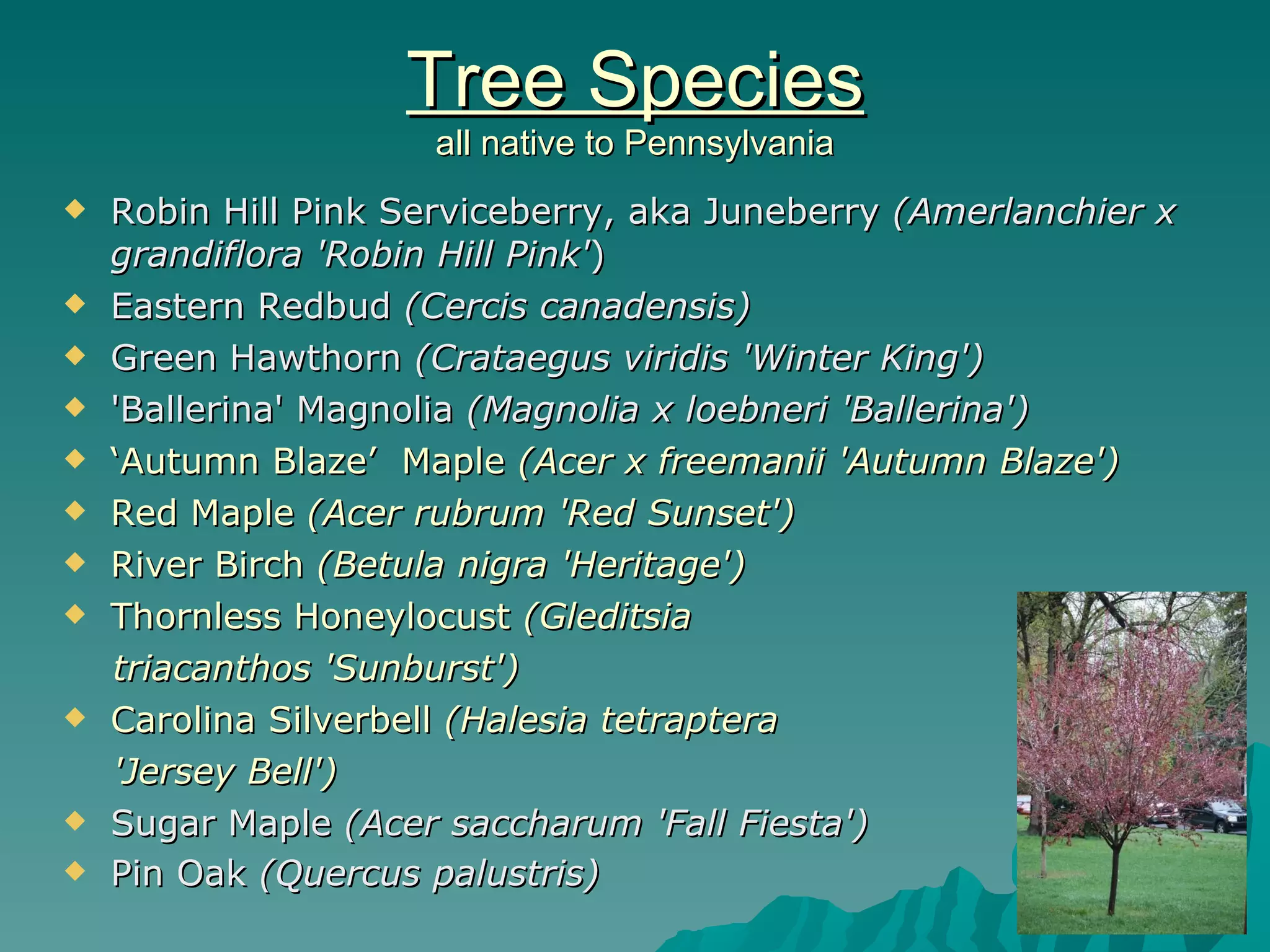
Tree Species all native to Pennsylvania Robin Hill Pink Serviceberry, aka Juneberry  (Amerlanchier x grandiflora 'Robin Hill Pink' )  Eastern Redbud  (Cercis canadensis)  Green Hawthorn  (Crataegus viridis 'Winter King')  'Ballerina' Magnolia  (Magnolia x loebneri 'Ballerina')  ‘ Autumn Blaze’  Maple  (Acer x freemanii 'Autumn Blaze')  Red Maple  (Acer rubrum 'Red Sunset')  River Birch  (Betula nigra 'Heritage')  Thornless Honeylocust  (Gleditsia  triacanthos 'Sunburst')  Carolina Silverbell  (Halesia tetraptera  'Jersey Bell')  Sugar Maple  (Acer saccharum 'Fall Fiesta')  Pin Oak  (Quercus palustris)
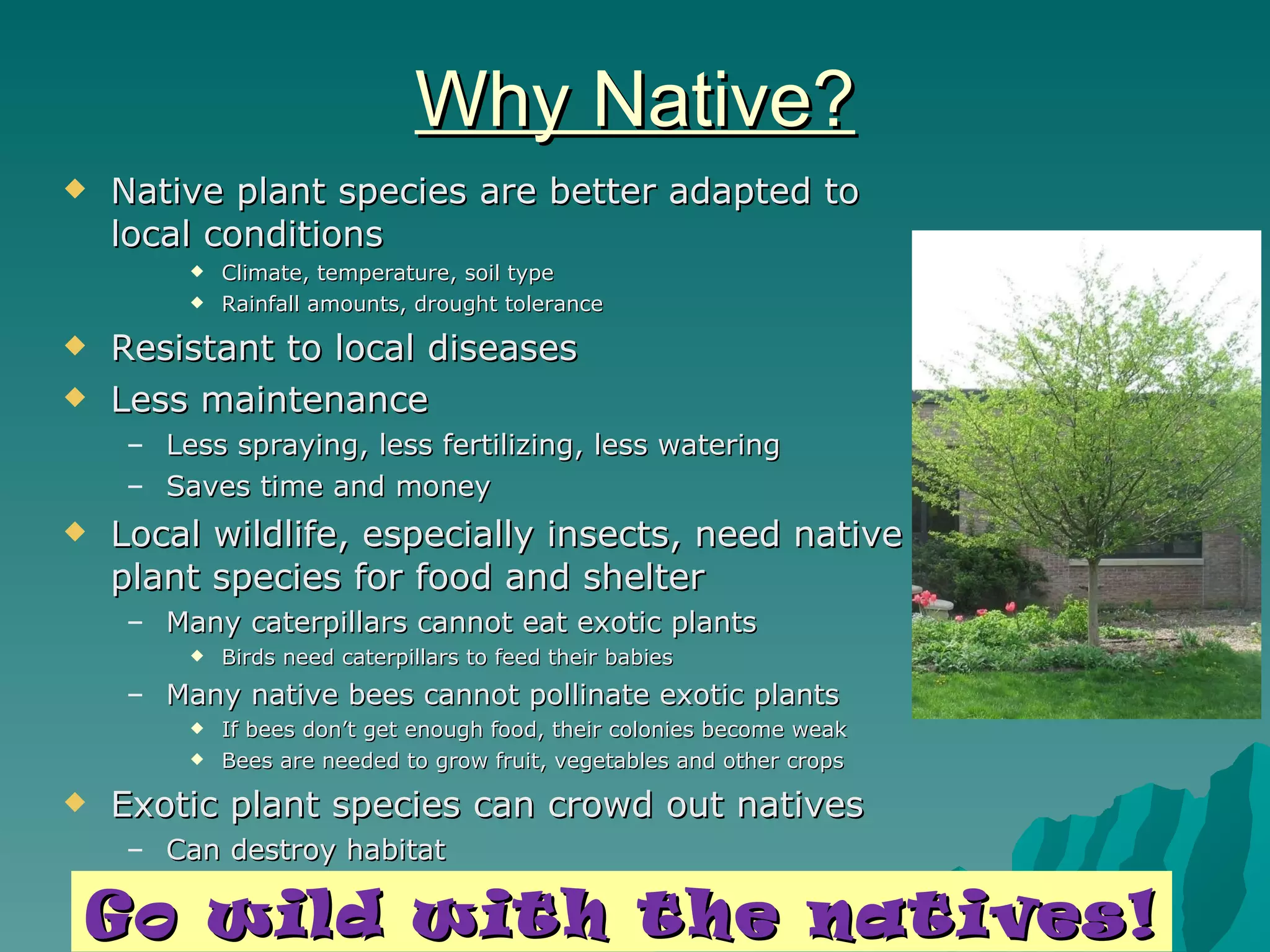
Why Native? Native plant species are better adapted to local conditions Climate, temperature, soil type Rainfall amounts, drought tolerance Resistant to local diseases Less maintenance Less spraying, less fertilizing, less watering Saves time and money Local wildlife, especially insects, need native plant species for food and shelter Many caterpillars cannot eat exotic plants Birds need caterpillars to feed their babies Many native bees cannot pollinate exotic plants If bees don’t get enough food, their colonies become weak Bees are needed to grow fruit, vegetables and other crops Exotic plant species can crowd out natives Can destroy habitat Go wild with the natives!
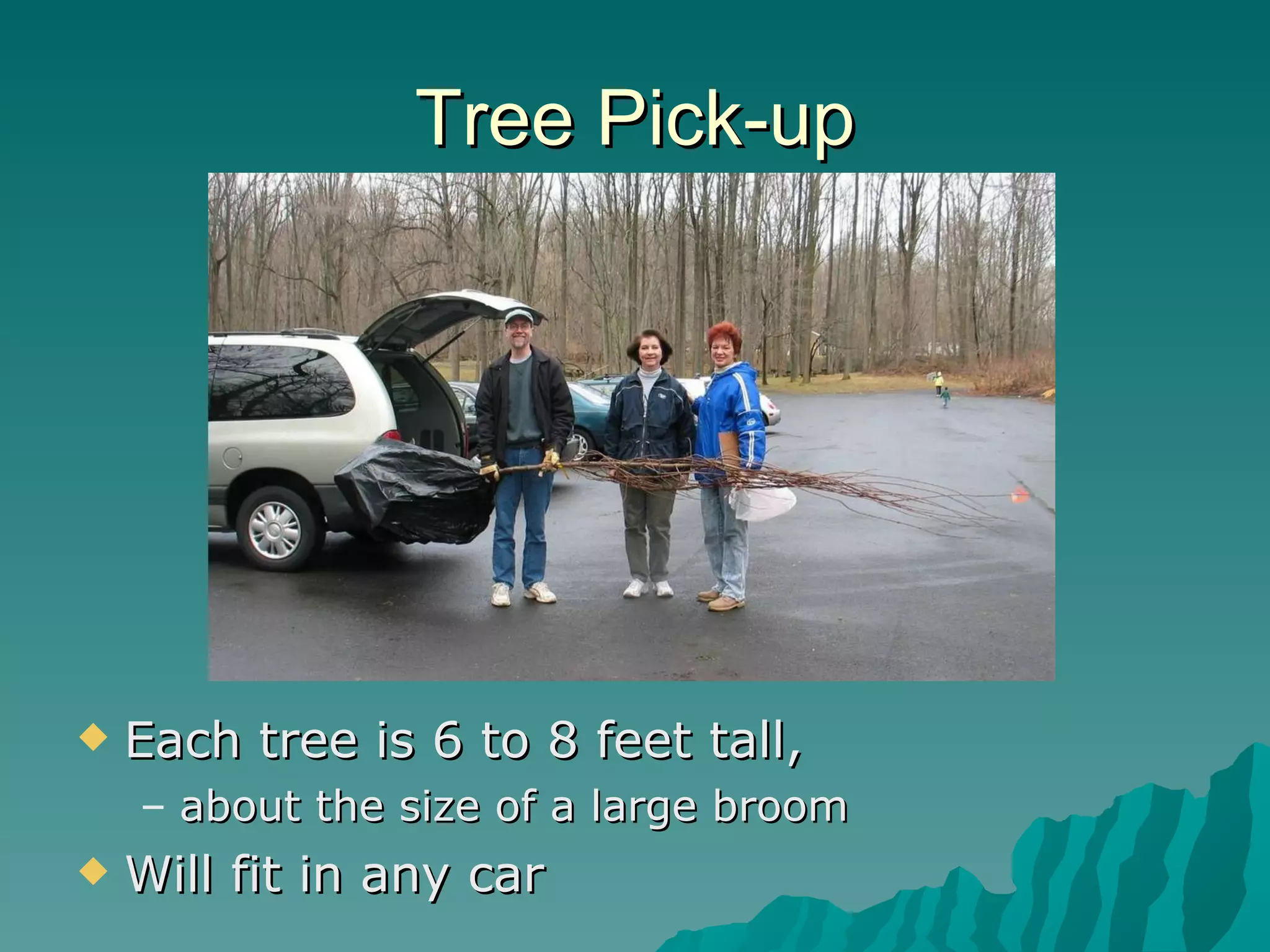
Tree Pick-up Each tree is 6 to 8 feet tall,  about the size of a large broom  Will fit in any car
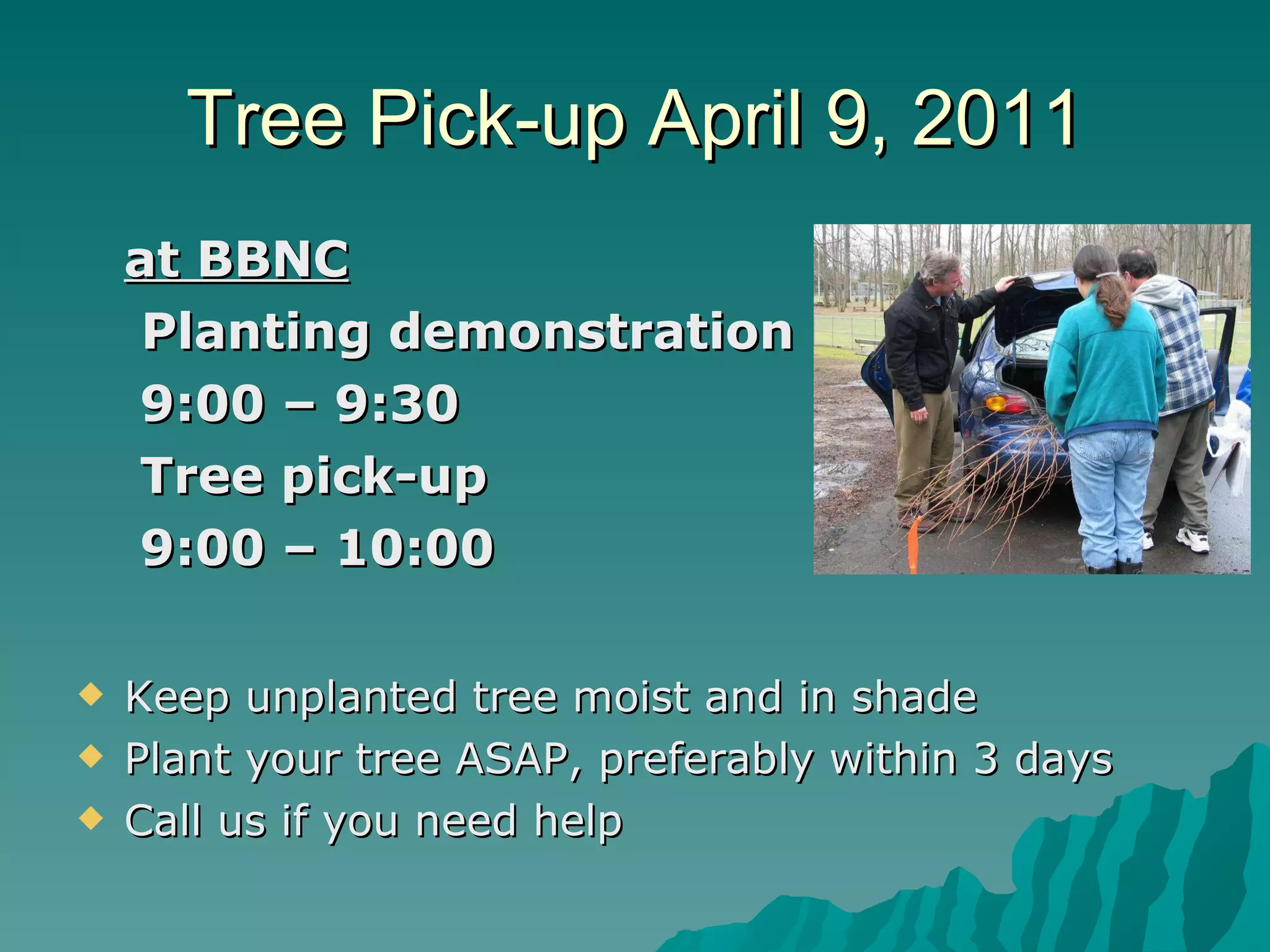
Tree Pick-up April 9, 2011 at BBNC   Planting demonstration  9:00 – 9:30 Tree pick-up  9:00 – 10:00  Keep unplanted tree moist and in shade Plant your tree ASAP, preferably within 3 days Call us if you need help
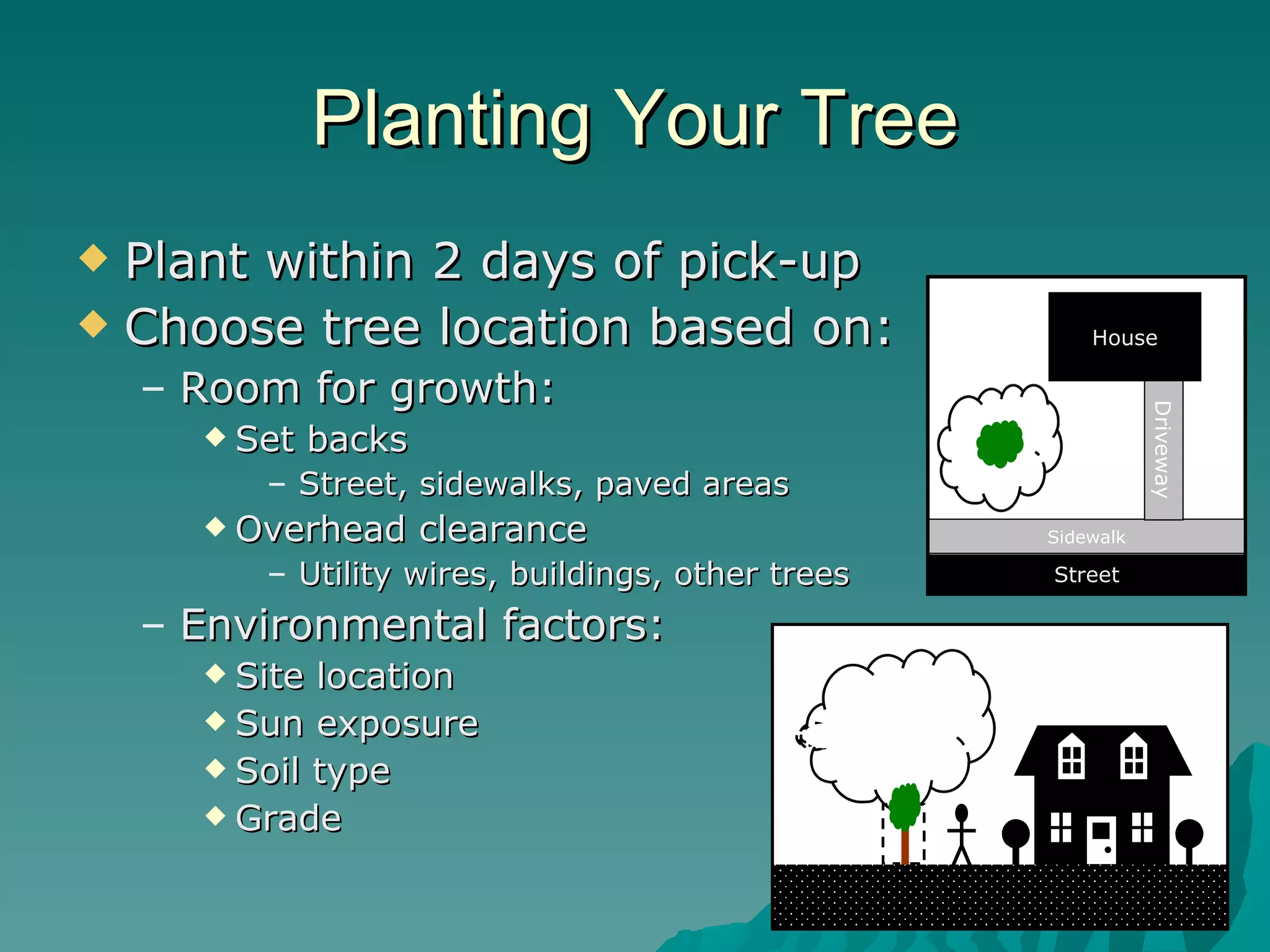
Planting Your Tree Plant within 2 days of pick-up Choose tree location based on: Room for growth: Set backs Street, sidewalks, paved areas Overhead clearance Utility wires, buildings, other trees Environmental factors: Site location Sun exposure Soil type Grade Sidewalk Street Driveway House
Call before you dig Call at least  3 to 10 business days ahead Pennsylvania One Call System Dial 8-1-1 or 1-800-242-1776 www.pa811.org   www.pa1call.org
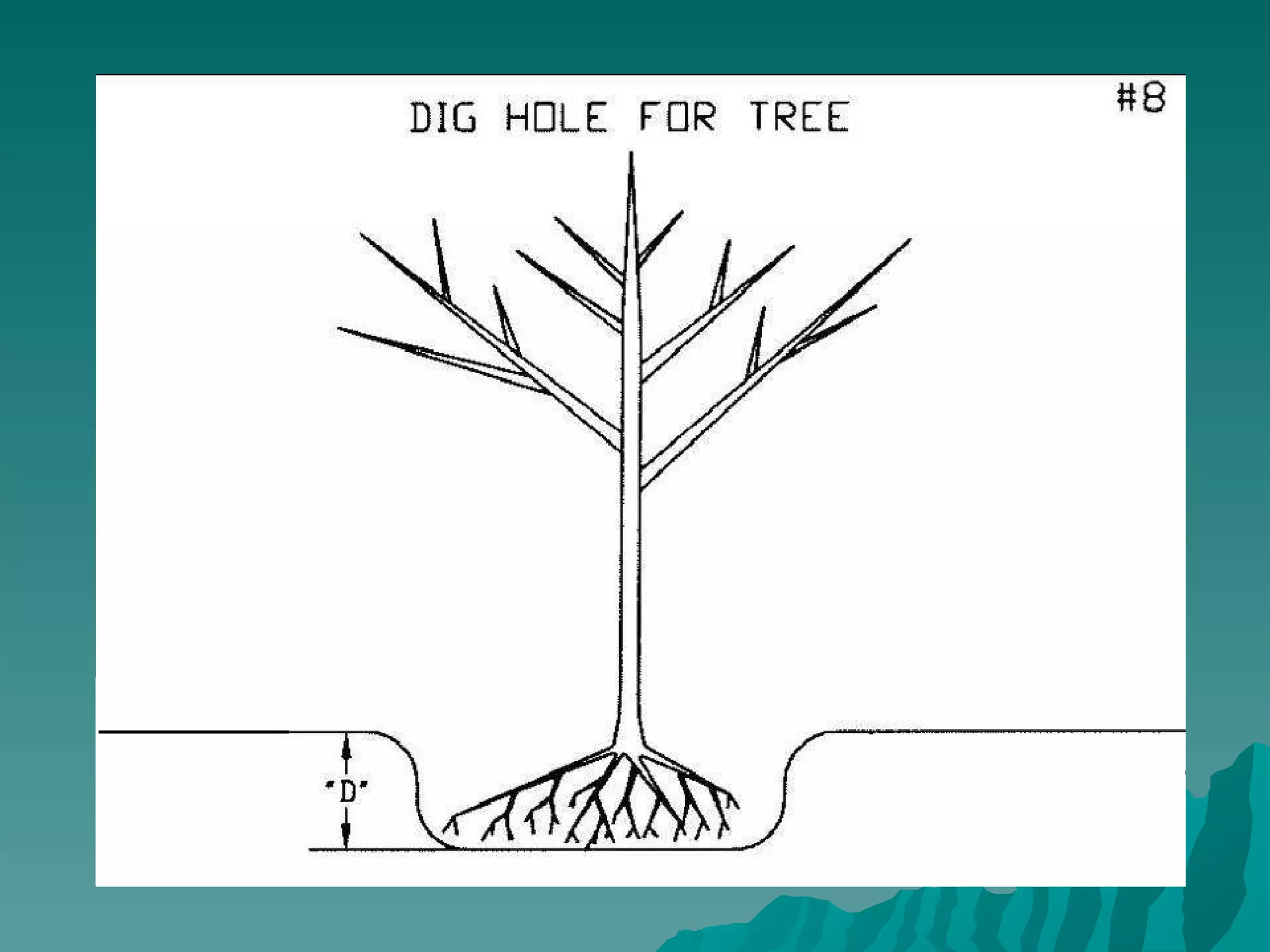
How to plant  a bare root tree The following slides were adapted from UCGreen: www.ucgreen.org/pdfs/bareroot.pdf
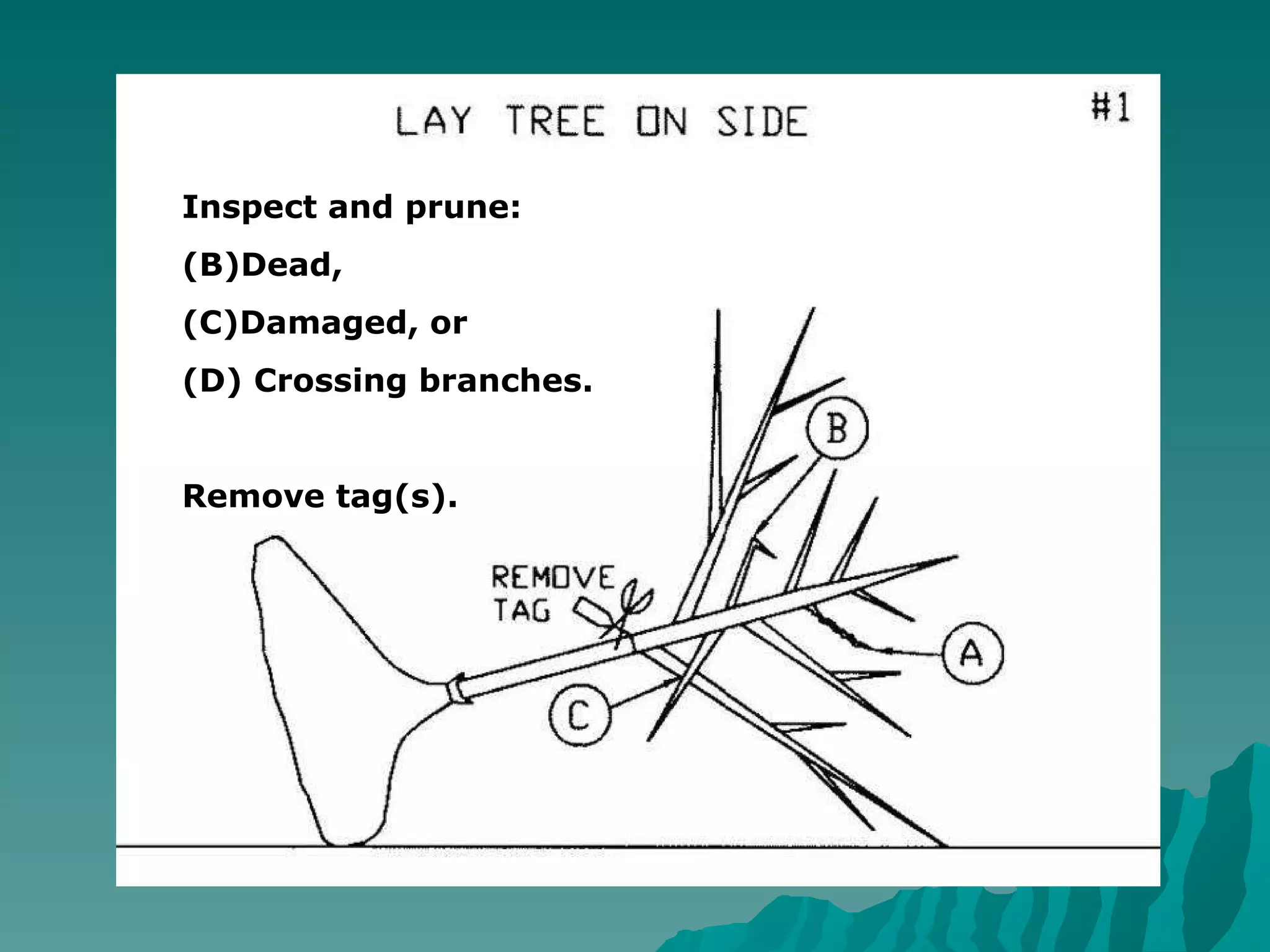
Inspect and prune: Dead, Damaged, or Crossing branches. Remove tag(s).
 
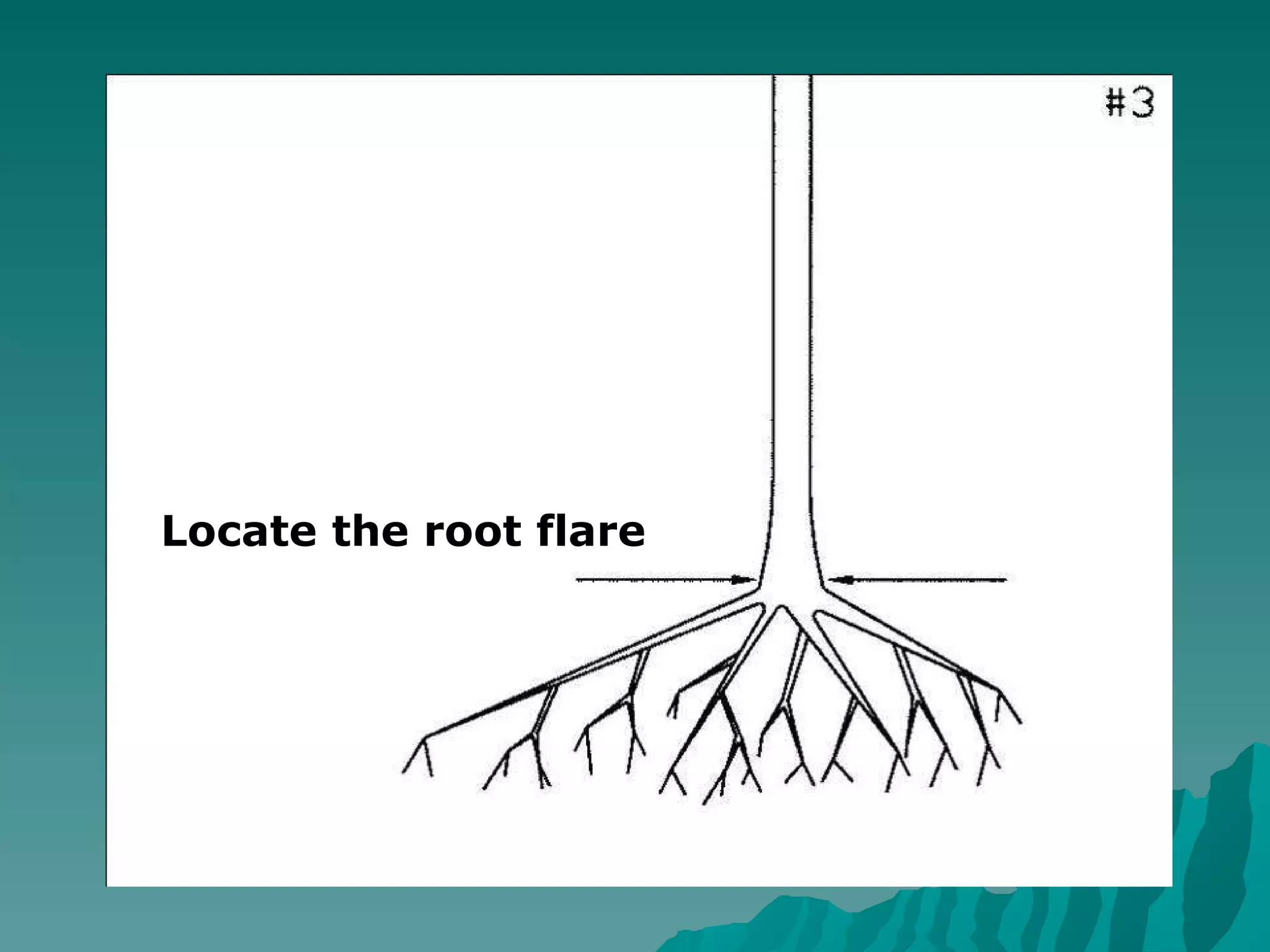
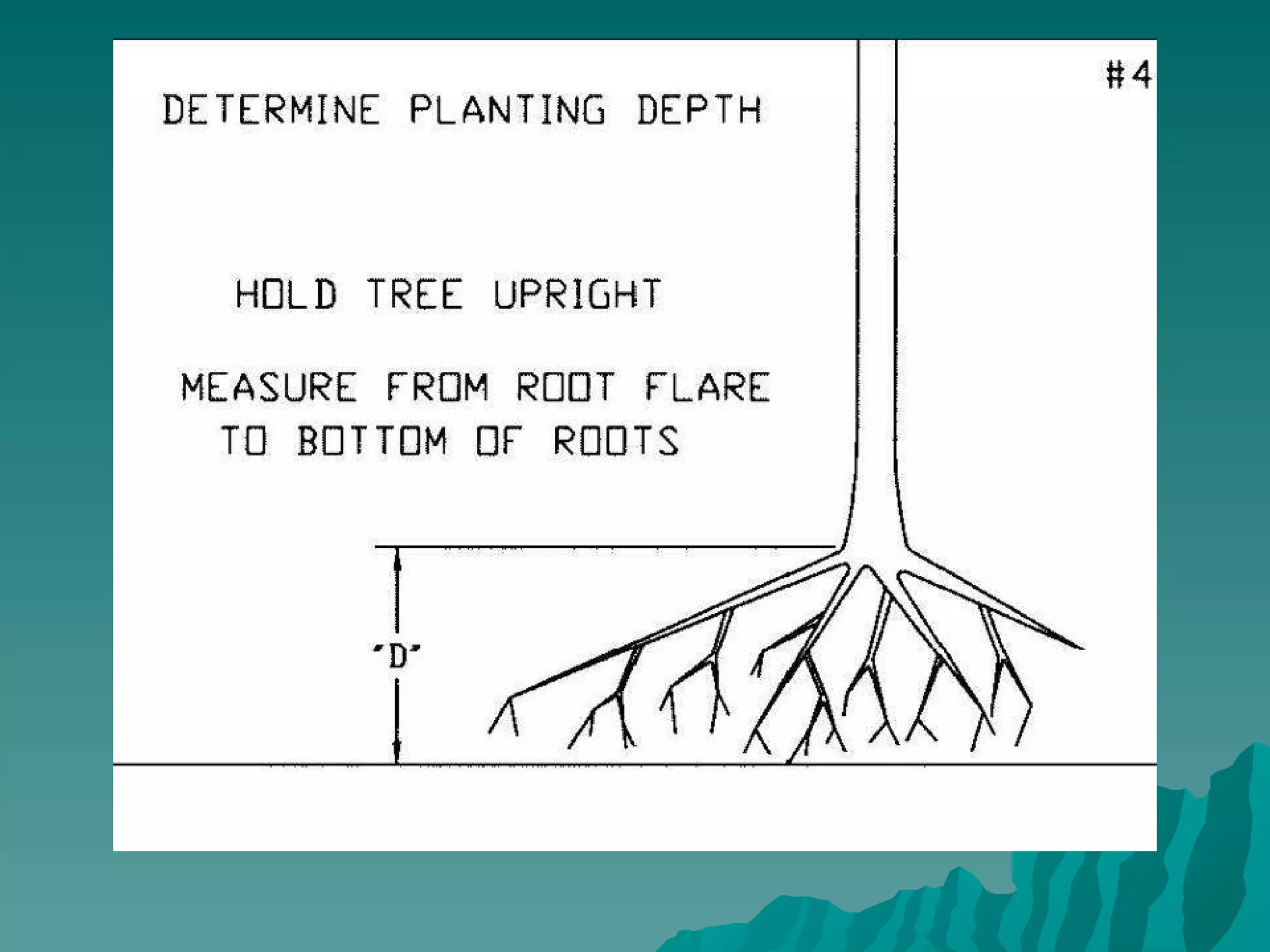
Locate the root flare
 
VIEWED FROM ABOVE [NOTE: 3 FT. MINIMUM GIVES CLEARANCE FOR CAR DOORS]
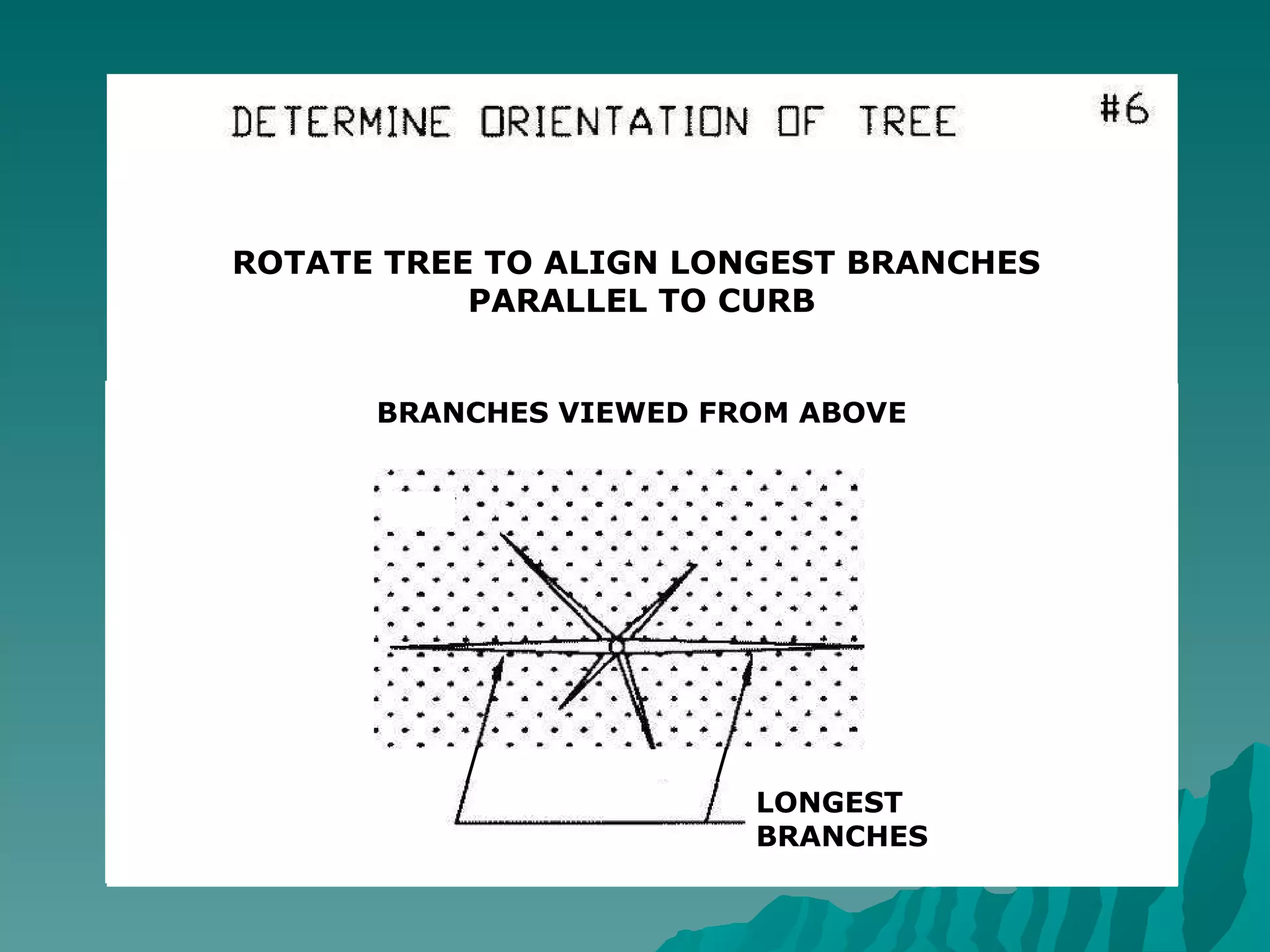
LONGEST BRANCHES ROTATE TREE TO ALIGN LONGEST BRANCHES  PARALLEL TO CURB BRANCHES VIEWED FROM ABOVE
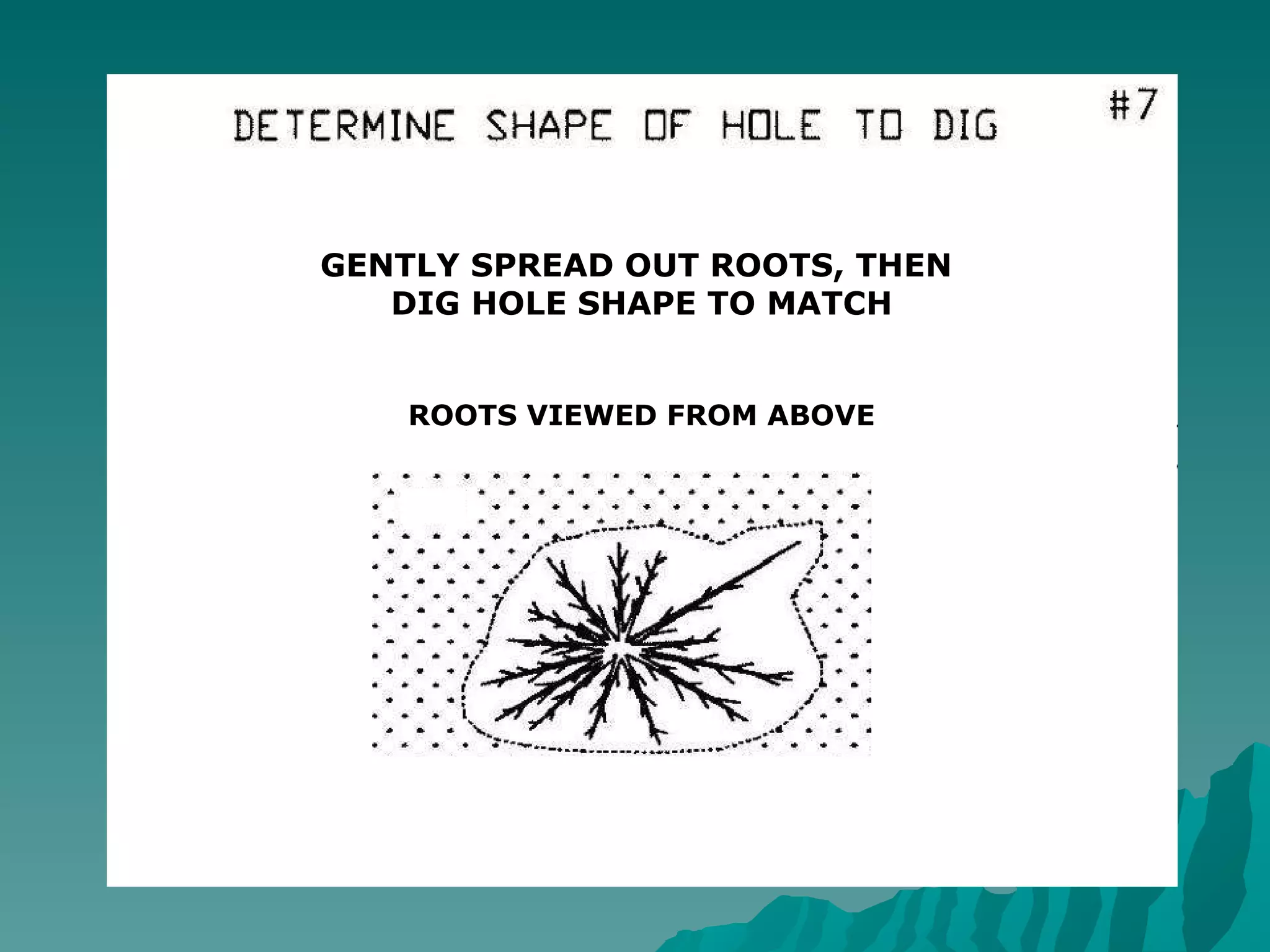
GENTLY SPREAD OUT ROOTS, THEN  DIG HOLE SHAPE TO MATCH ROOTS VIEWED FROM ABOVE


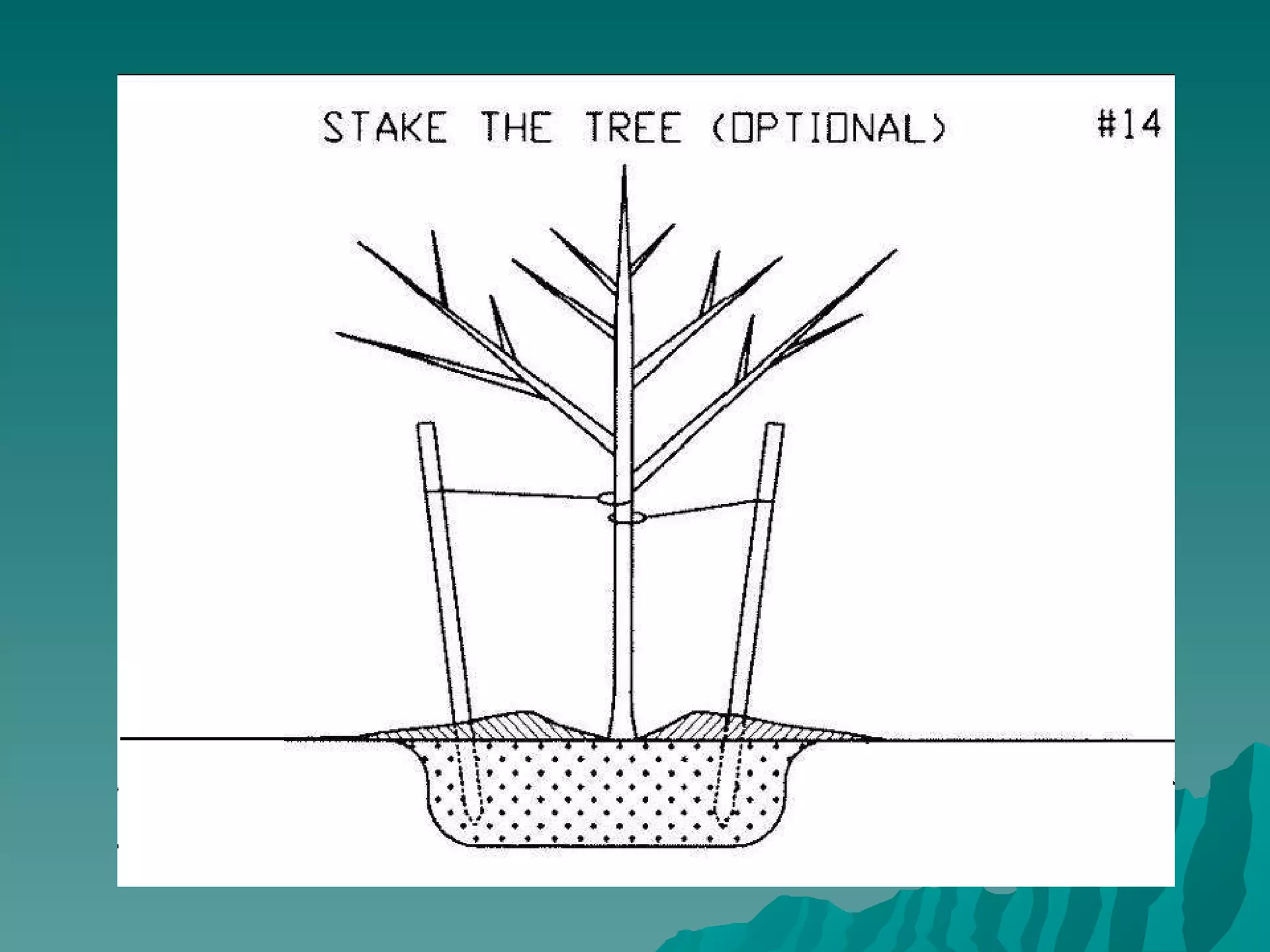
Enjoy your tree!
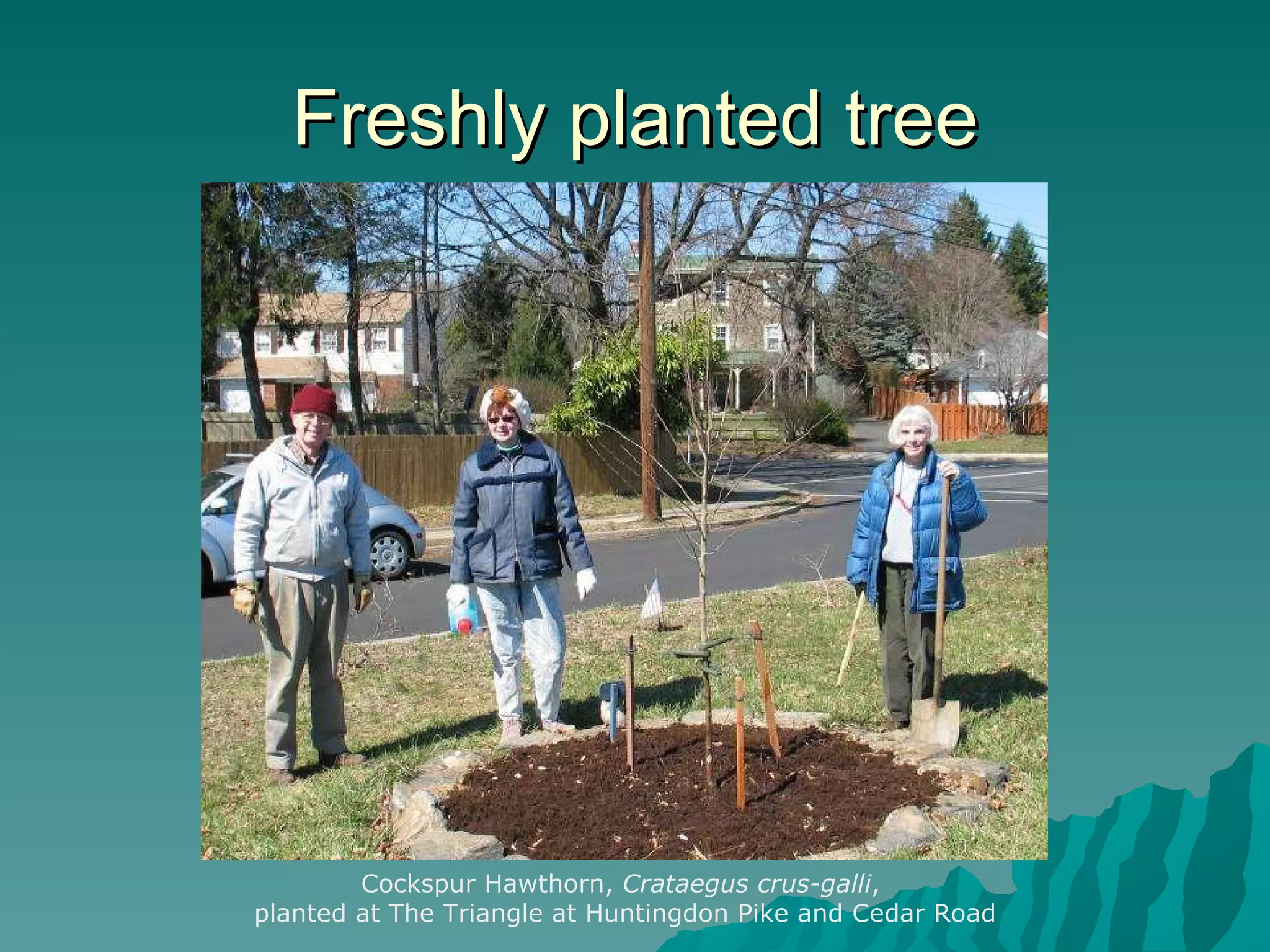
Freshly planted tree Cockspur Hawthorn,  Crataegus crus-galli ,  planted at The Triangle at Huntingdon Pike and Cedar Road
Caring for your tree Watering Mulching Protecting
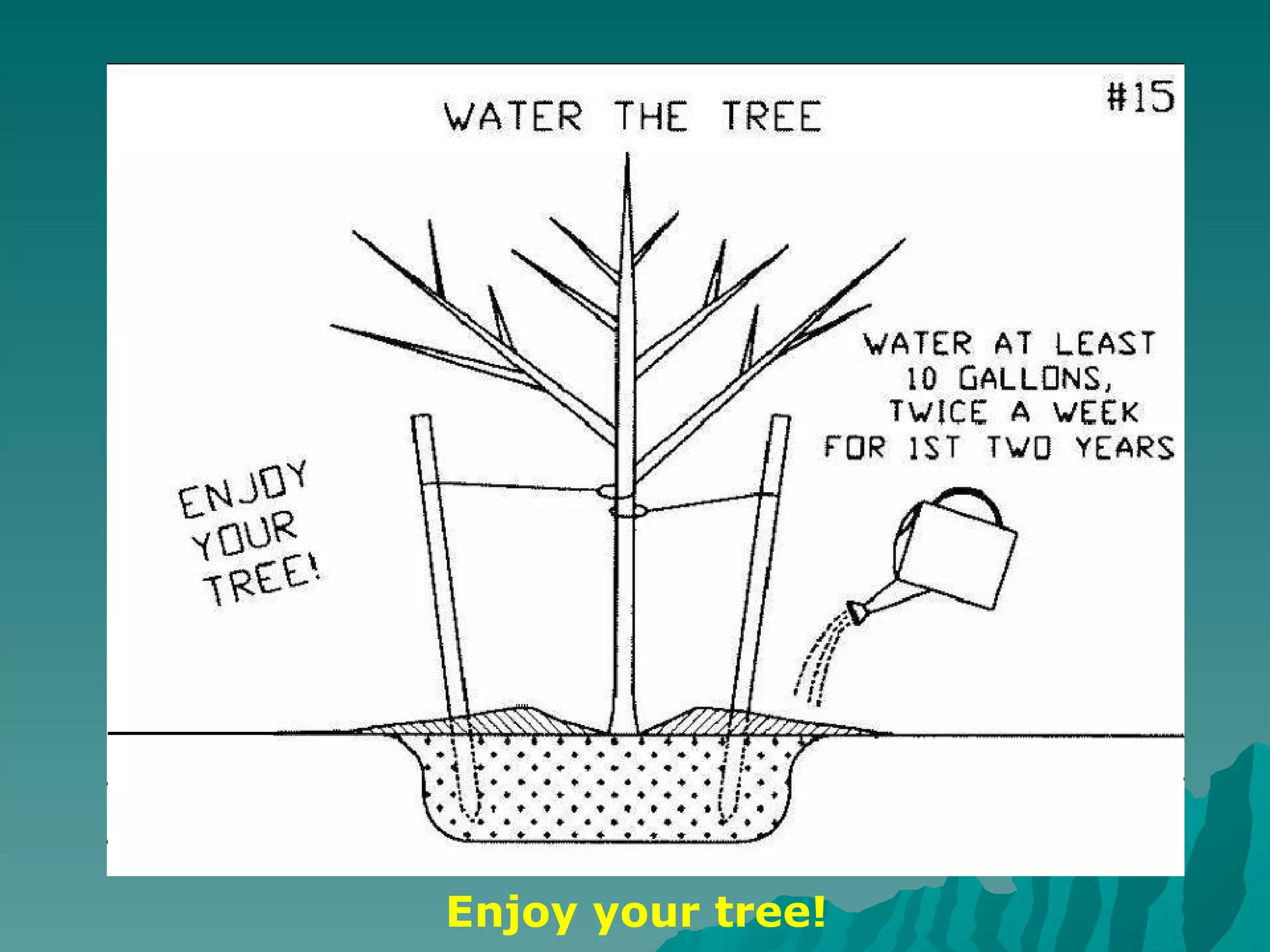
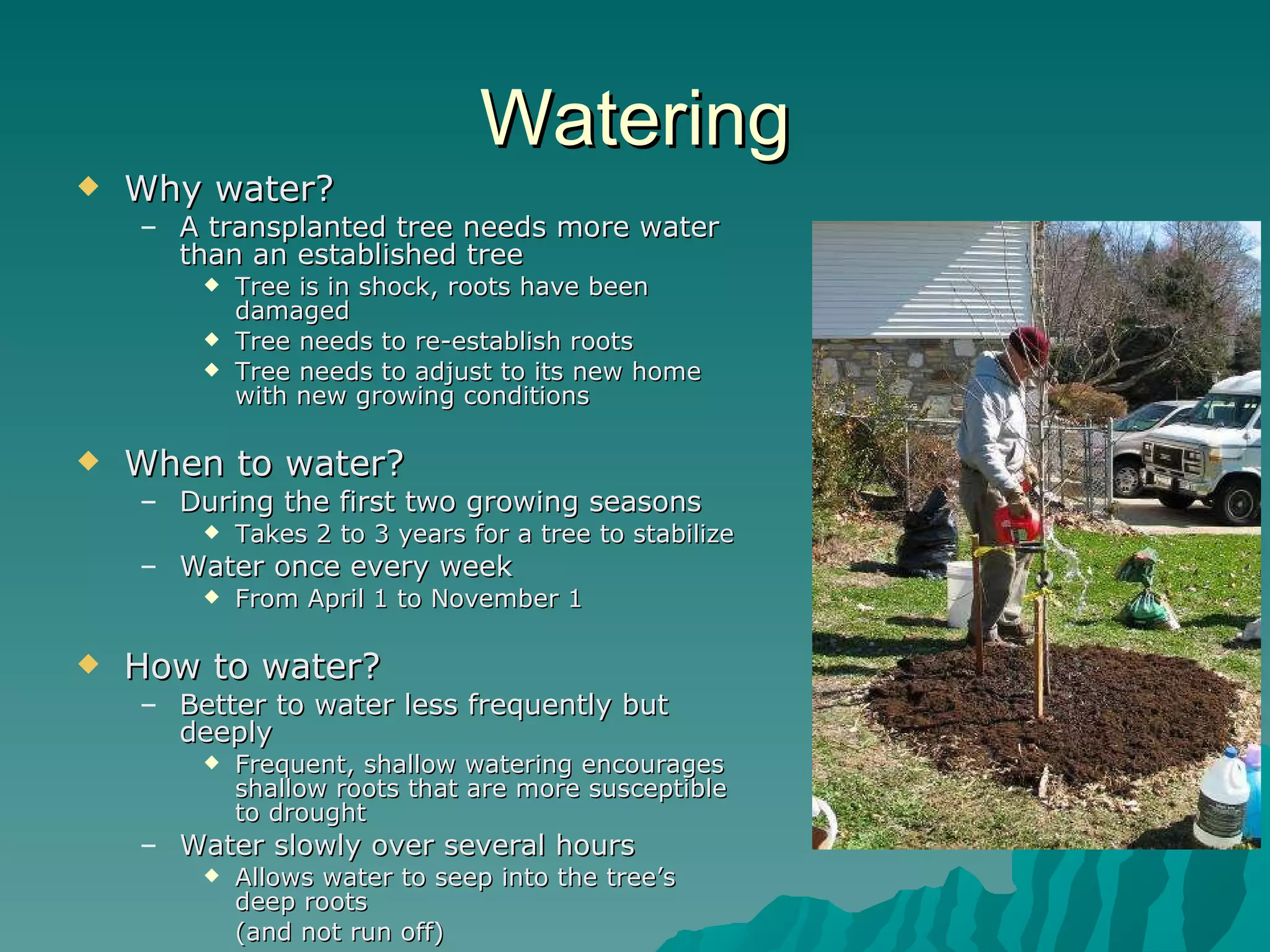
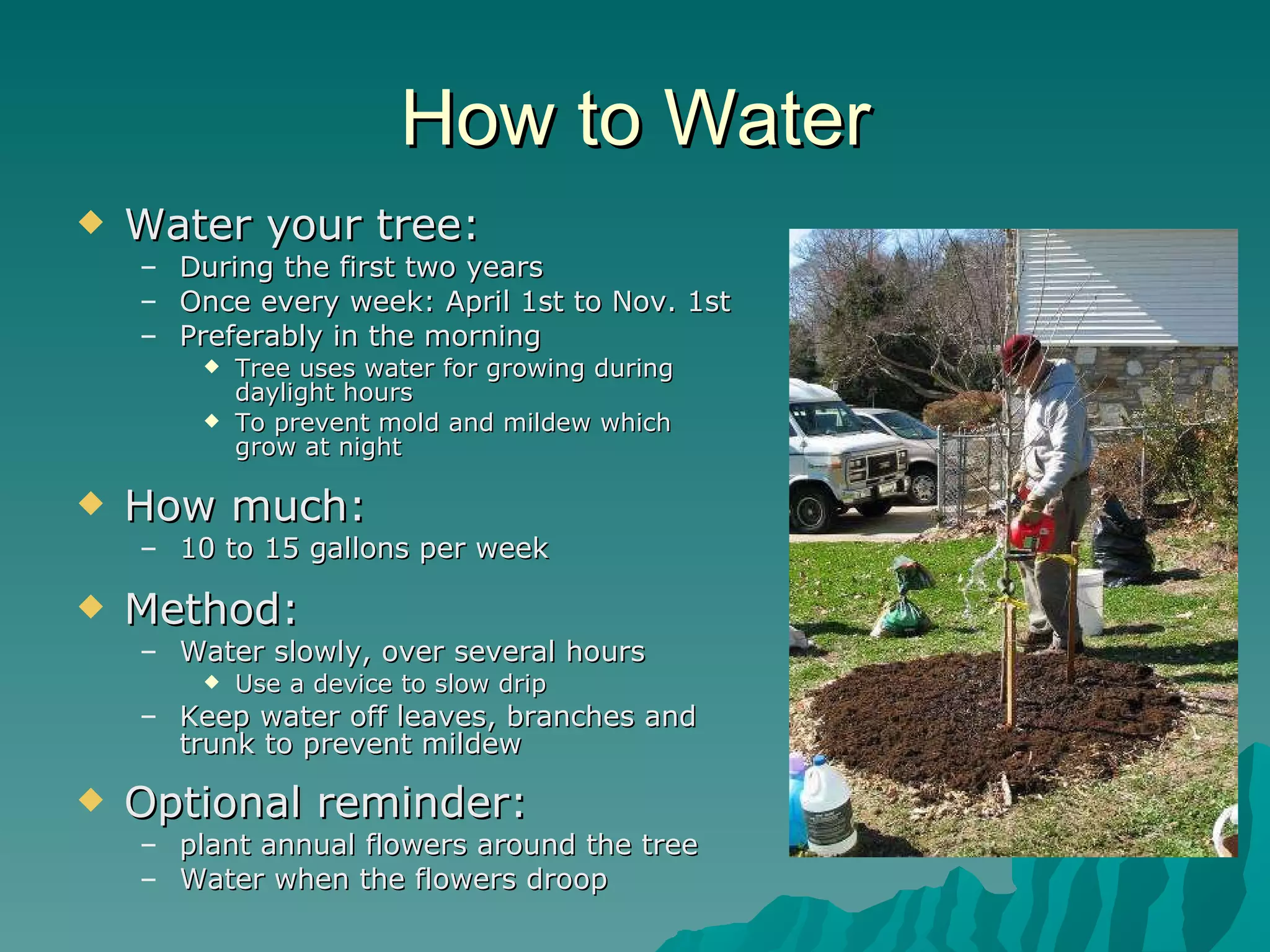
Watering Why water? A transplanted tree needs more water than an established tree Tree is in shock, roots have been damaged Tree needs to re-establish roots Tree needs to adjust to its new home with new growing conditions When to water? During the first two growing seasons Takes 2 to 3 years for a tree to stabilize Water once every week From April 1 to November 1 How to water? Better to water less frequently but deeply Frequent, shallow watering encourages shallow roots that are more susceptible to drought Water slowly over several hours Allows water to seep into the tree’s deep roots  (and not run off)
How to Water Water your tree: During the first two years Once every week: April 1st to Nov. 1st Preferably in the morning Tree uses water for growing during daylight hours To prevent mold and mildew which grow at night How much: 10 to 15 gallons per week Method: Water slowly, over several hours Use a device to slow drip Keep water off leaves, branches and trunk to prevent mildew Optional reminder: plant annual flowers around the tree Water when the flowers droop
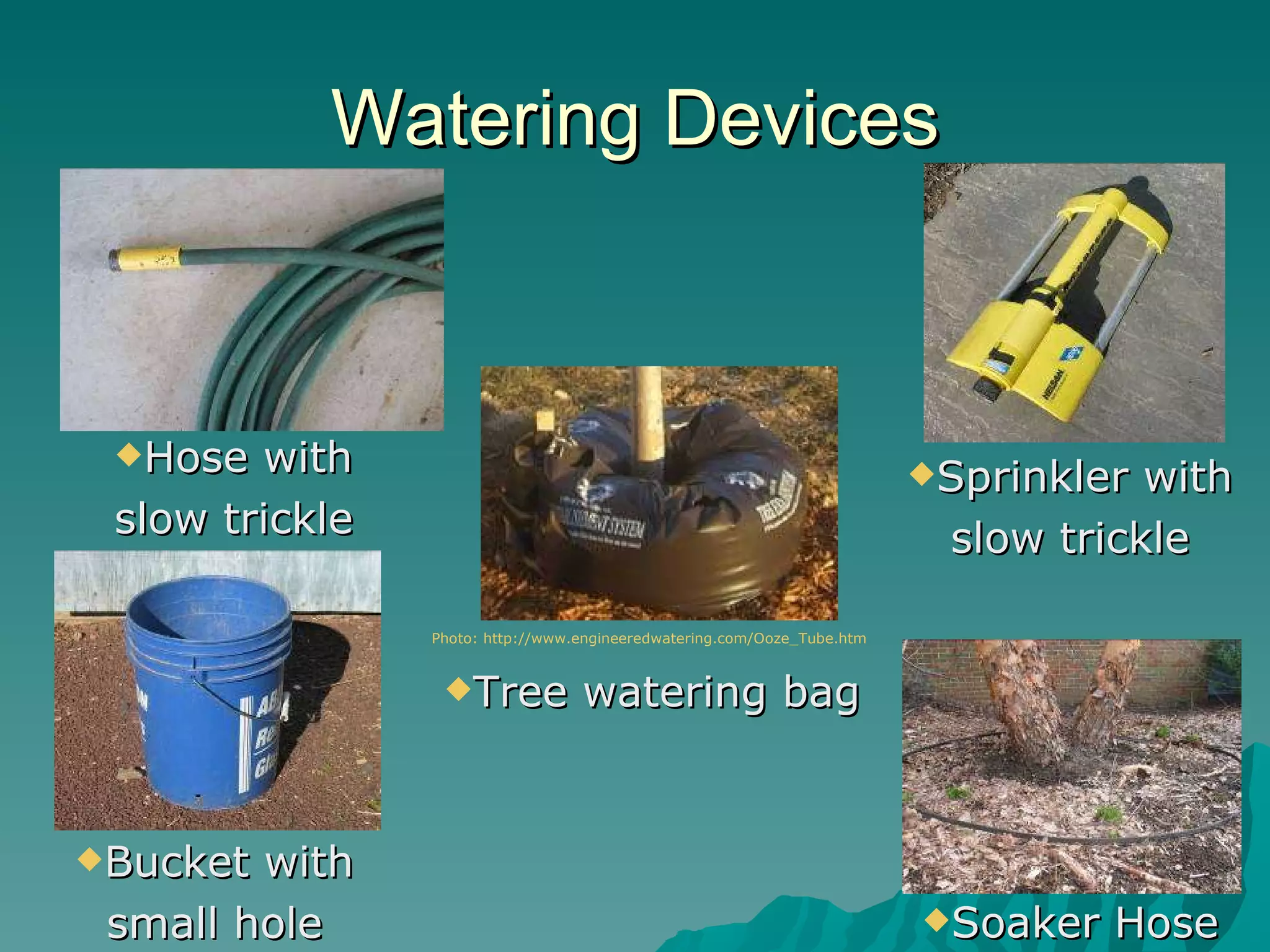
Watering Devices Hose with slow trickle Sprinkler with slow trickle Photo:   http://www.engineeredwatering.com/Ooze_Tube.htm Tree watering bag Bucket with small hole Soaker Hose
Mulching Why mulch? Keeps lawnmowers and weed-whackers away from trunk Keeps roots moist Controls weeds Keeps lawn grass away from roots Grass will compete for nutrients Provides nutrients Reduces soil compaction Types of mulch: Leaf mulch/compost (free from township)  Woodchips Hardwood mulch (bark, root) Shredded Newspaper
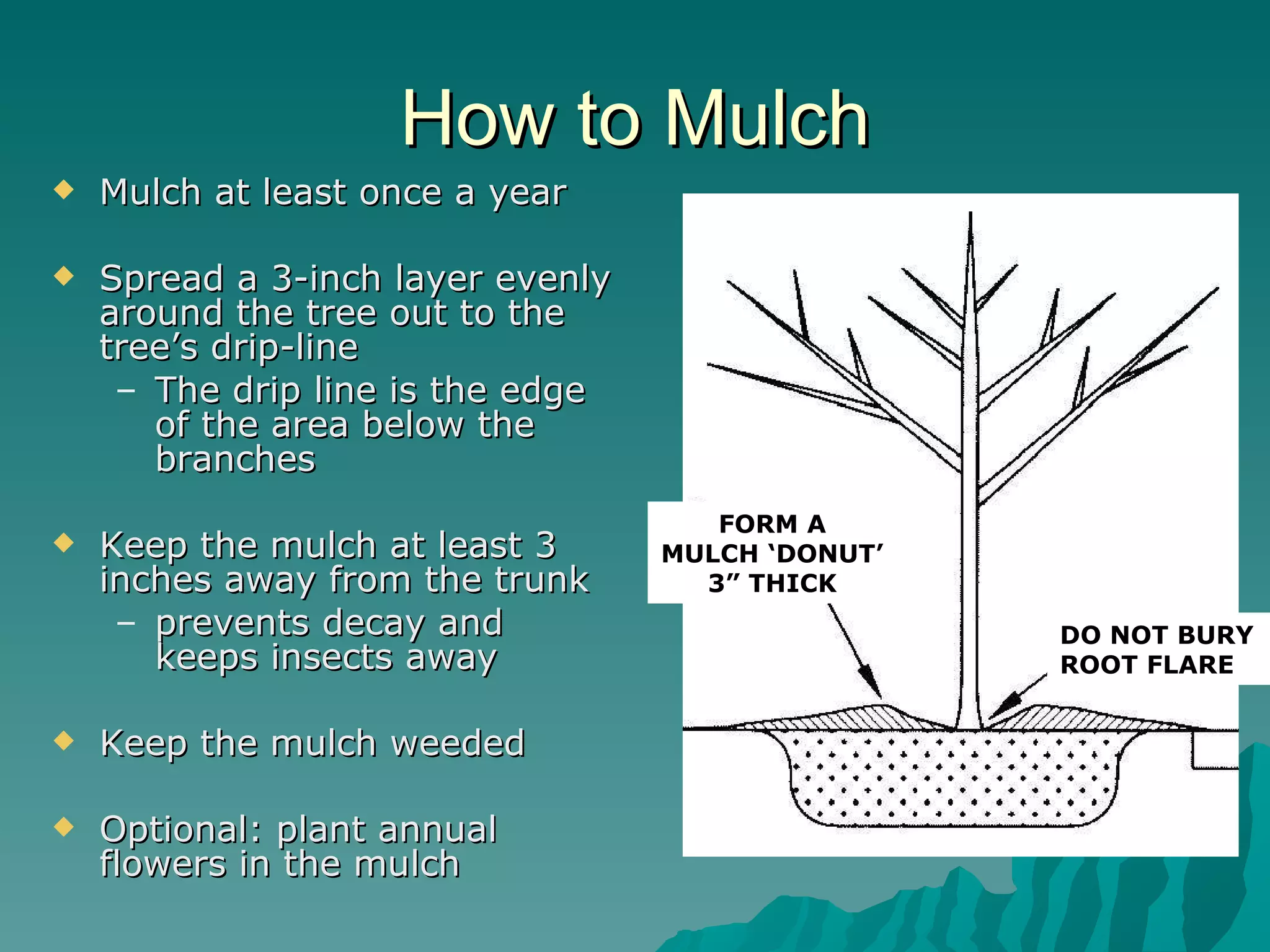
How to Mulch Mulch at least once a year Spread a 3-inch layer evenly around the tree out to the tree’s drip-line The drip line is the edge of the area below the branches Keep the mulch at least 3 inches away from the trunk  prevents decay and keeps insects away Keep the mulch weeded Optional: plant annual flowers in the mulch FORM A MULCH ‘DONUT’ 3” THICK DO NOT BURY ROOT FLARE
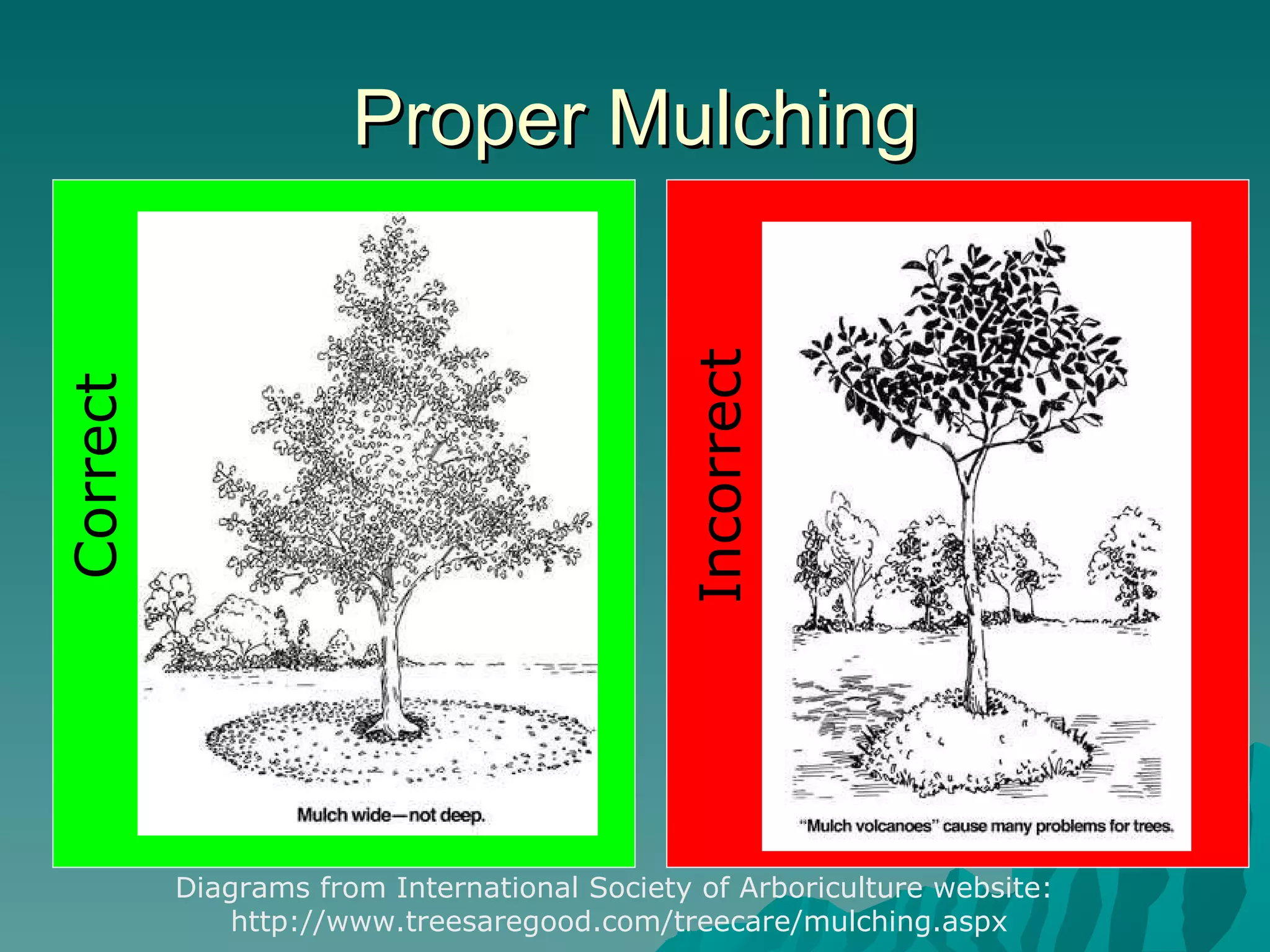
Proper Mulching Diagrams from International Society of Arboriculture website:  http://www.treesaregood.com/treecare/mulching.aspx Correct Incorrect
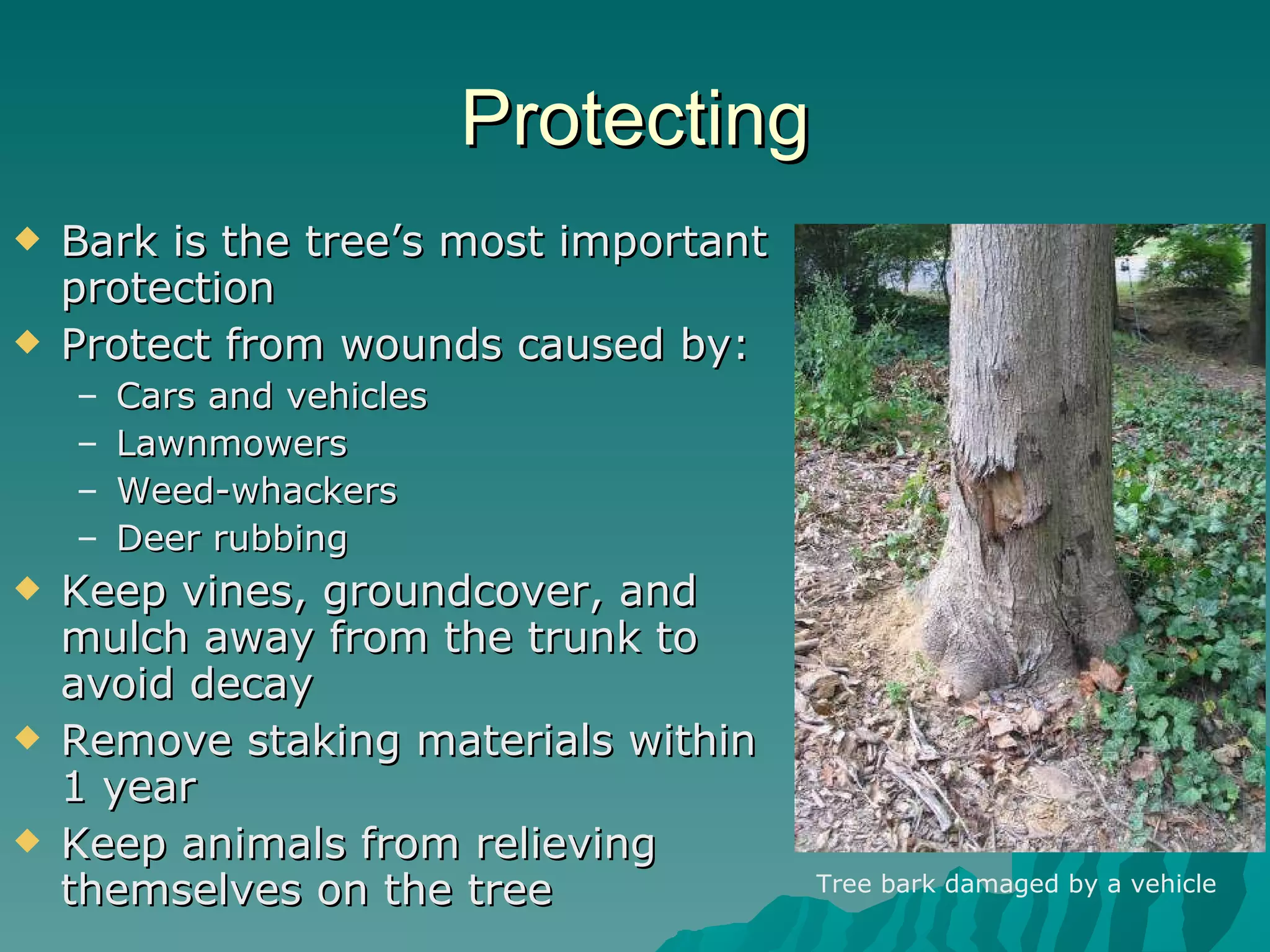
Protecting Bark is the tree’s most important protection Protect from wounds caused by: Cars and vehicles Lawnmowers Weed-whackers Deer rubbing Keep vines, groundcover, and mulch away from the trunk to avoid decay Remove staking materials within 1 year Keep animals from relieving themselves on the tree Tree bark damaged by a vehicle
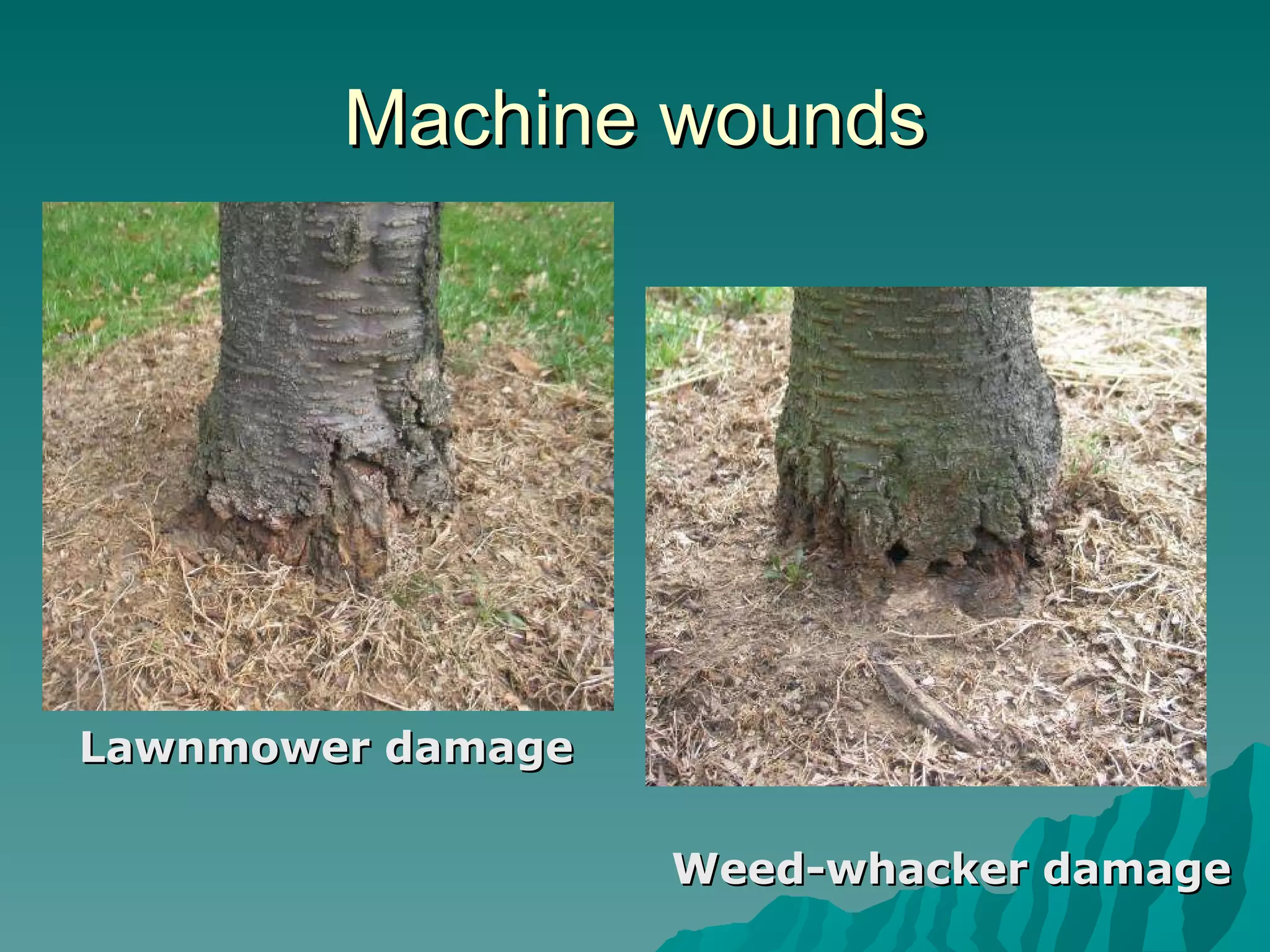
Machine wounds Lawnmower damage Weed-whacker damage
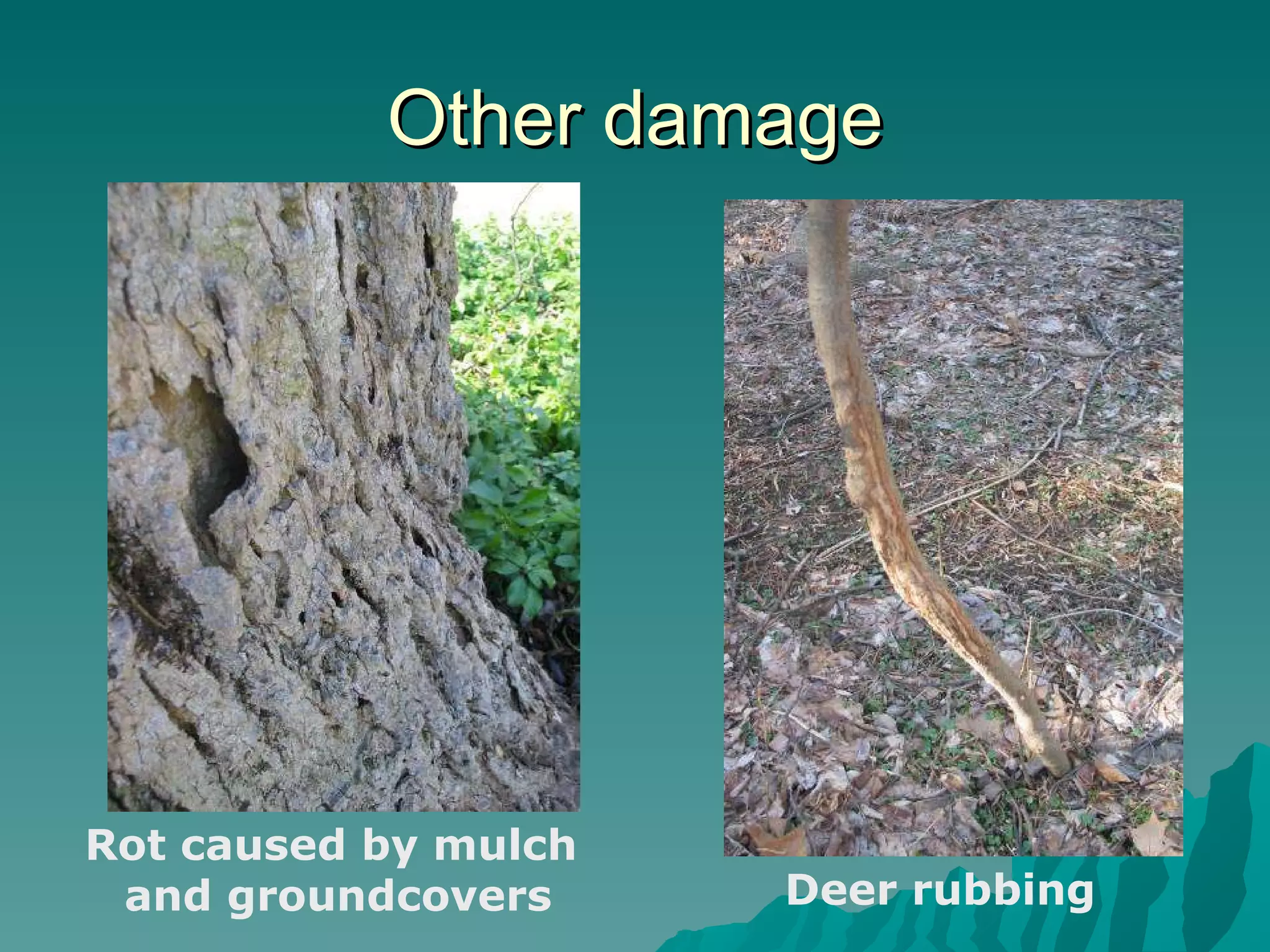
Other damage Rot caused by mulch  and groundcovers Deer rubbing
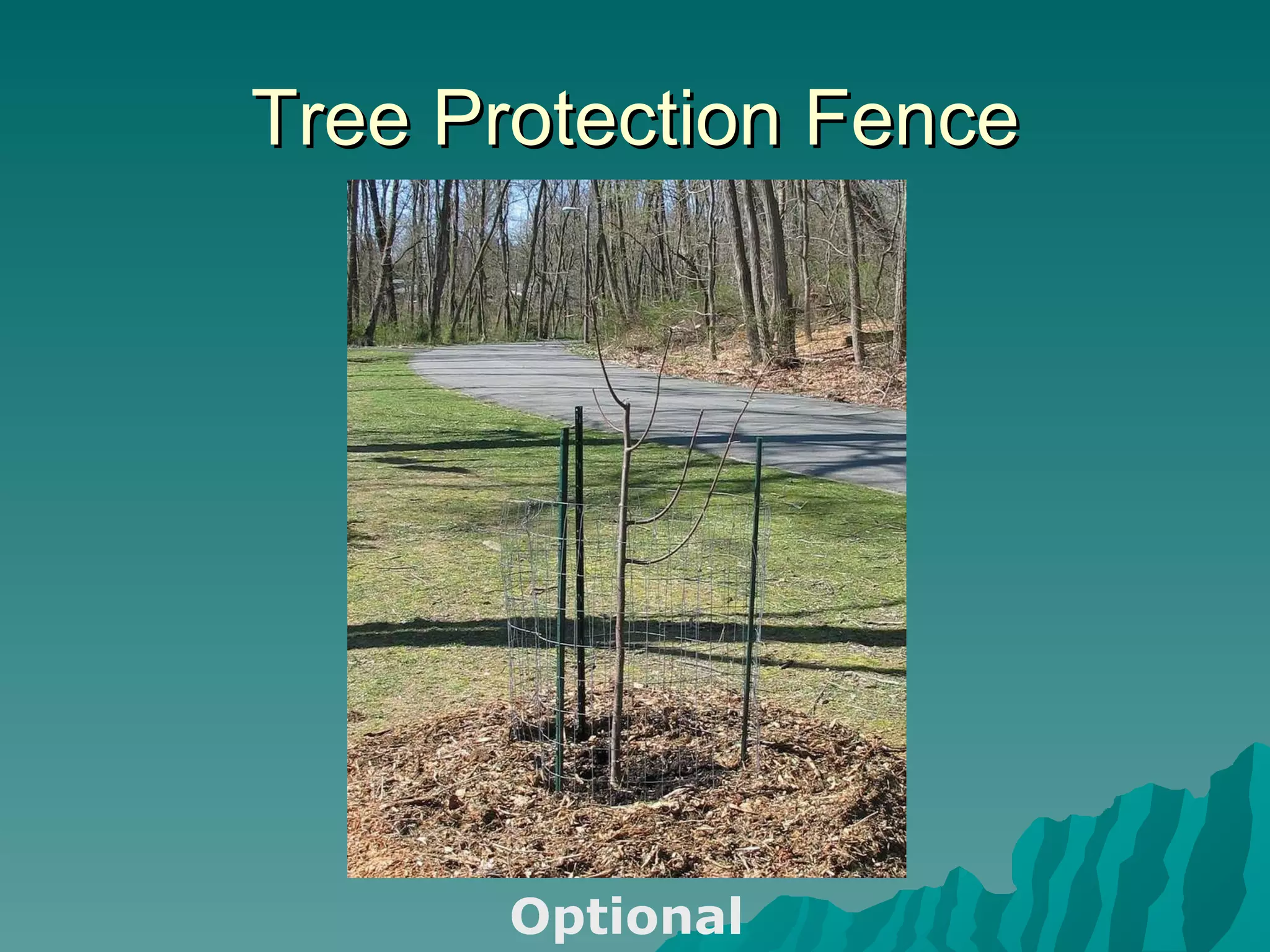
Tree Protection Fence Optional
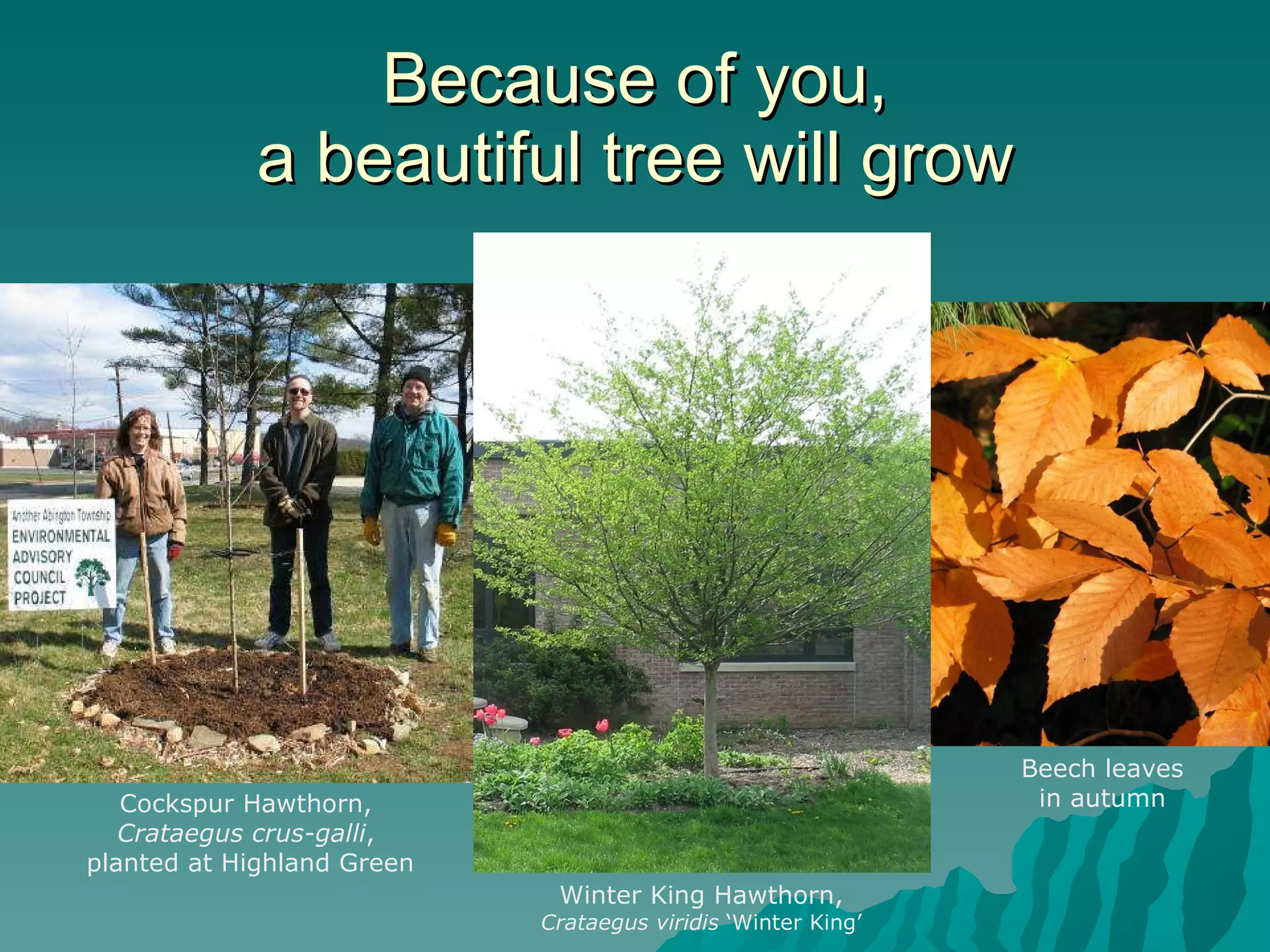
Because of you, a beautiful tree will grow Cockspur Hawthorn,  Crataegus crus-galli ,  planted at Highland Green Beech leaves in autumn Winter King Hawthorn, Crataegus viridis  ‘Winter King’
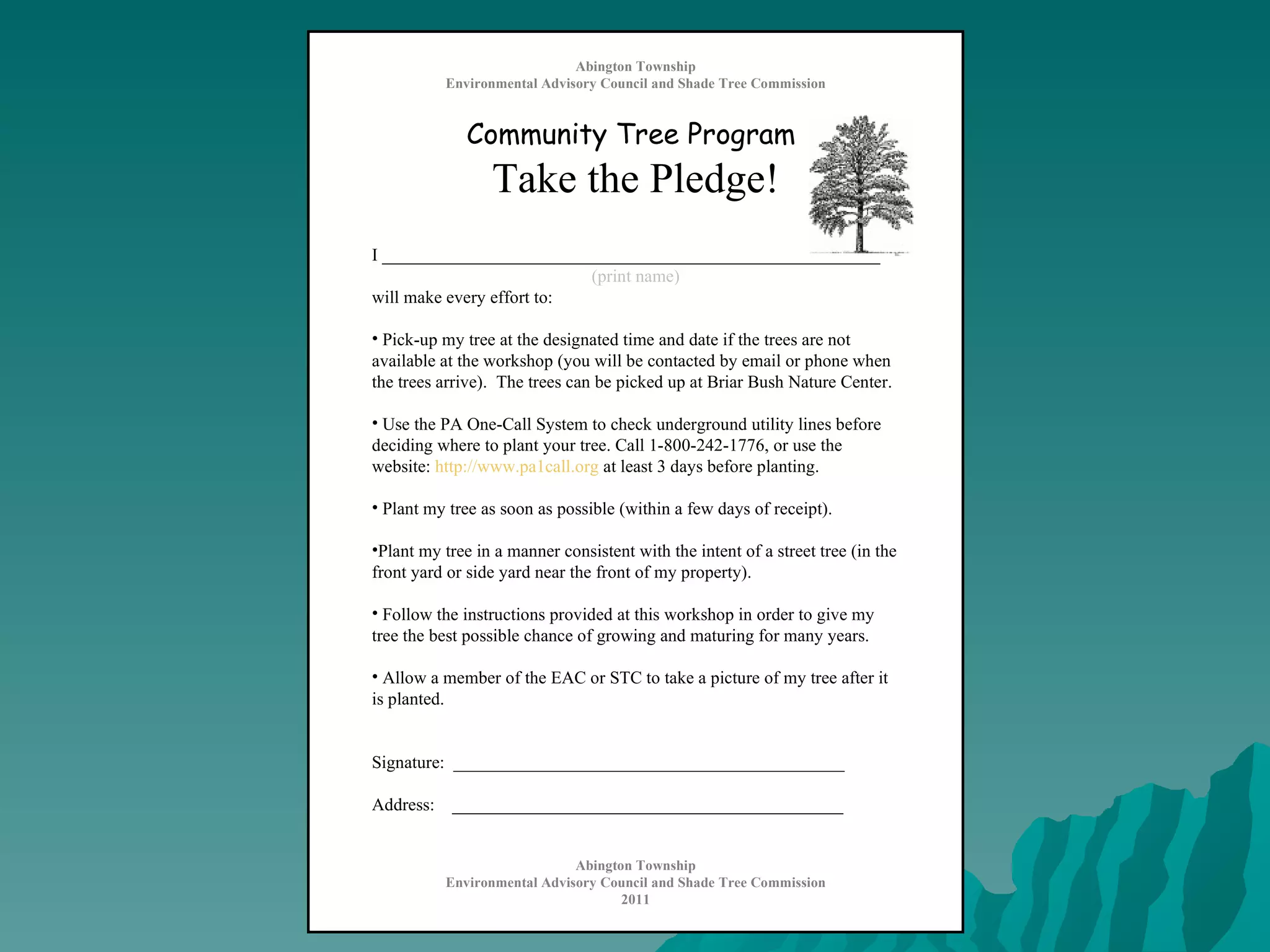
Abington Township Environmental Advisory Council and Shade Tree Commission Community Tree Program   Take the Pledge! I ________________________________________________________ (print name) will make every effort to: Pick-up my tree at the designated time and date if the trees are not available at the workshop (you will be contacted by email or phone when the trees arrive).  The trees can be picked up at Briar Bush Nature Center. Use the PA One-Call System to check underground utility lines before deciding where to plant your tree. Call 1-800-242-1776, or use the website:  http://www.pa1call.org  at least 3 days before planting. Plant my tree as soon as possible (within a few days of receipt). Plant my tree in a manner consistent with the intent of a street tree (in the front yard or side yard near the front of my property). Follow the instructions provided at this workshop in order to give my tree the best possible chance of growing and maturing for many years.  Allow a member of the EAC or STC to take a picture of my tree after it is planted. Signature:  ____________________________________________ Address:  ____________________________________________ Abington Township Environmental Advisory Council and Shade Tree Commission 2011
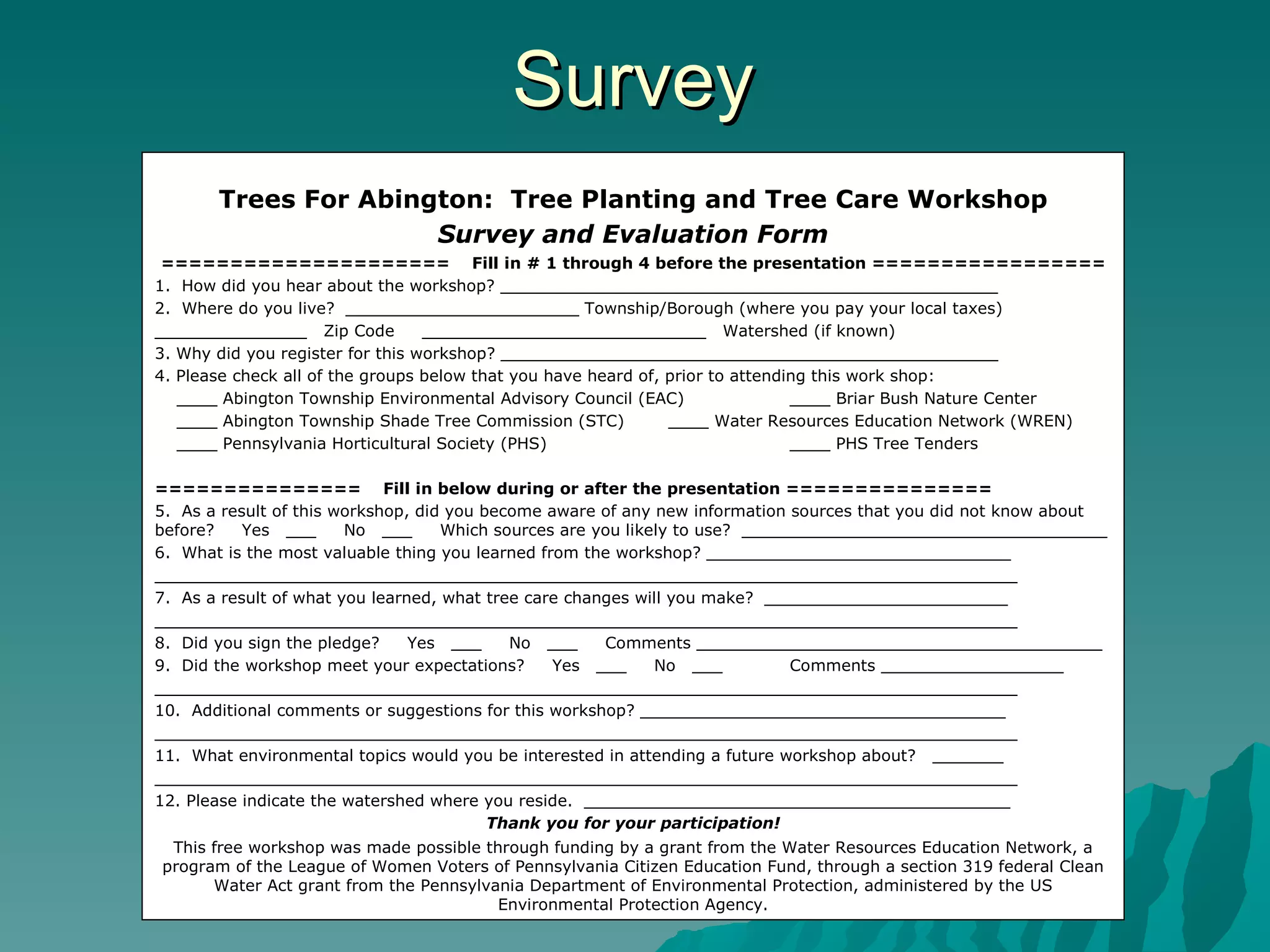
Survey Trees For Abington:  Tree Planting and Tree Care Workshop Survey and Evaluation Form =====================  Fill in # 1 through 4 before the presentation ================= 1.  How did you hear about the workshop? _________________________________________________ 2.  Where do you live?  _______________________ Township/Borough (where you pay your local taxes) _______________  Zip Code  ____________________________  Watershed (if known) 3. Why did you register for this workshop? _________________________________________________ 4. Please check all of the groups below that you have heard of, prior to attending this work shop: ____ Abington Township Environmental Advisory Council (EAC) ____ Briar Bush Nature Center ____ Abington Township Shade Tree Commission (STC)  ____ Water Resources Education Network (WREN) ____ Pennsylvania Horticultural Society (PHS) ____ PHS Tree Tenders ===============  Fill in below during or after the presentation =============== 5.  As a result of this workshop, did you become aware of any new information sources that you did not know about before?  Yes  ___  No  ___  Which sources are you likely to use?  ____________________________________ 6.  What is the most valuable thing you learned from the workshop? ______________________________ _____________________________________________________________________________________ 7.  As a result of what you learned, what tree care changes will you make?  ________________________ _____________________________________________________________________________________ 8.  Did you sign the pledge?  Yes  ___  No  ___  Comments ________________________________________ 9.  Did the workshop meet your expectations?  Yes  ___  No  ___ Comments __________________ _____________________________________________________________________________________ 10.  Additional comments or suggestions for this workshop? ____________________________________ _____________________________________________________________________________________ 11.  What environmental topics would you be interested in attending a future workshop about?  _______ _____________________________________________________________________________________ 12. Please indicate the watershed where you reside.  __________________________________________ Thank you for your participation! This free workshop was made possible through funding by a grant from the Water Resources Education Network, a program of the League of Women Voters of Pennsylvania Citizen Education Fund, through a section 319 federal Clean Water Act grant from the Pennsylvania Department of Environmental Protection, administered by the US Environmental Protection Agency.
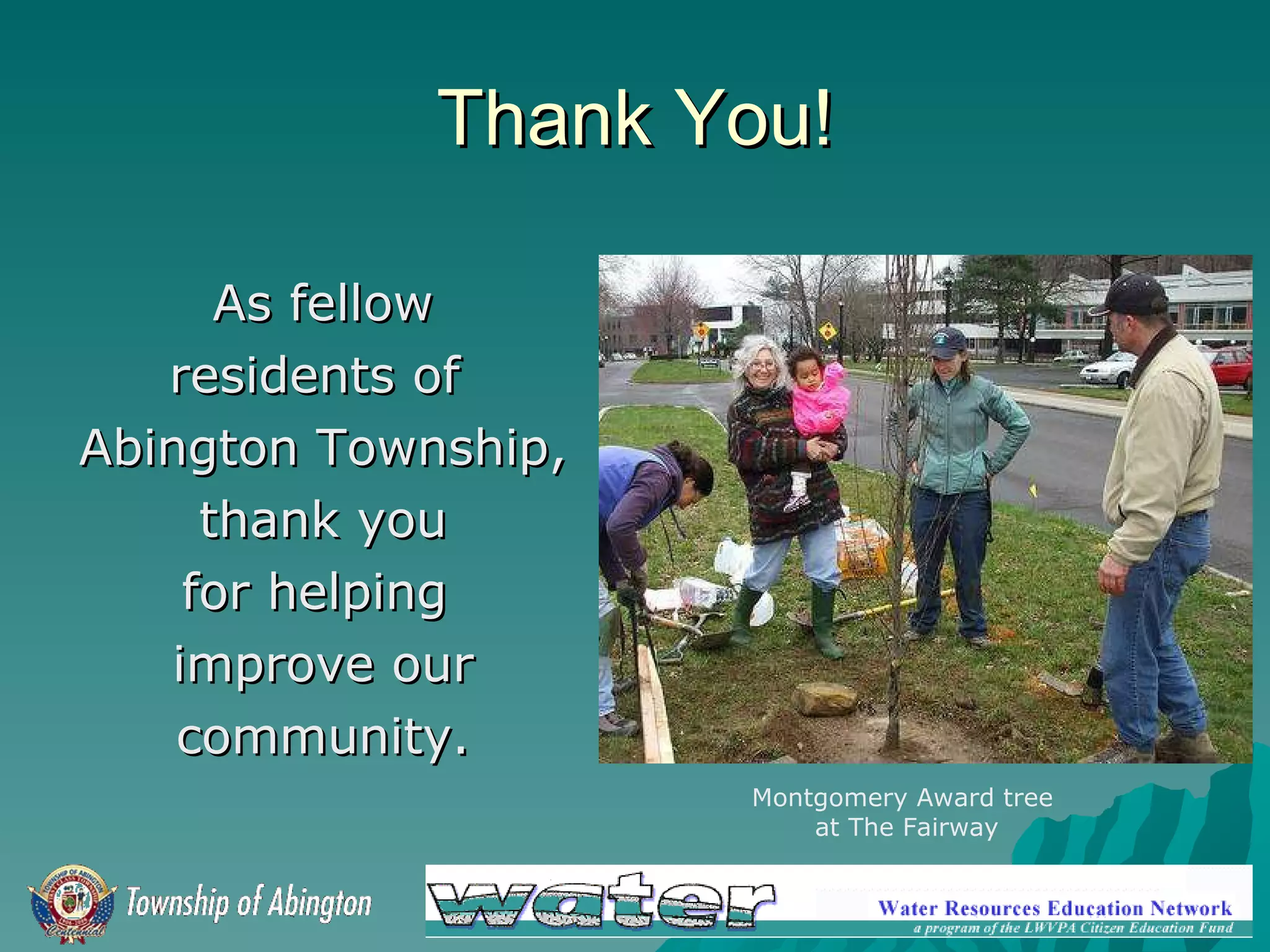
Thank You! As fellow residents of  Abington Township, thank you for helping  improve our community. Montgomery Award tree  at The Fairway
Need more info? Attend our planting demonstration in the Playscape playground after this presentation Talk to one of our volunteers: Tree pick up Where to plant Species information How to plant Tools and techniques for planting a tree How to dig a hole, dealing with old roots and rocks Volunteer with the EAC or STC Assist with environmental projects in Abington Become a Tree Tender Coordinate tree plantings in your neighborhood
If you have questions Shade Tree Commission  Rita Stevens (215) 435-2781    [email_address]   Environmental Advisory Council Jennifer Sherwood (215) 663-8798 [email_address] Website:  www.eac-abington.org
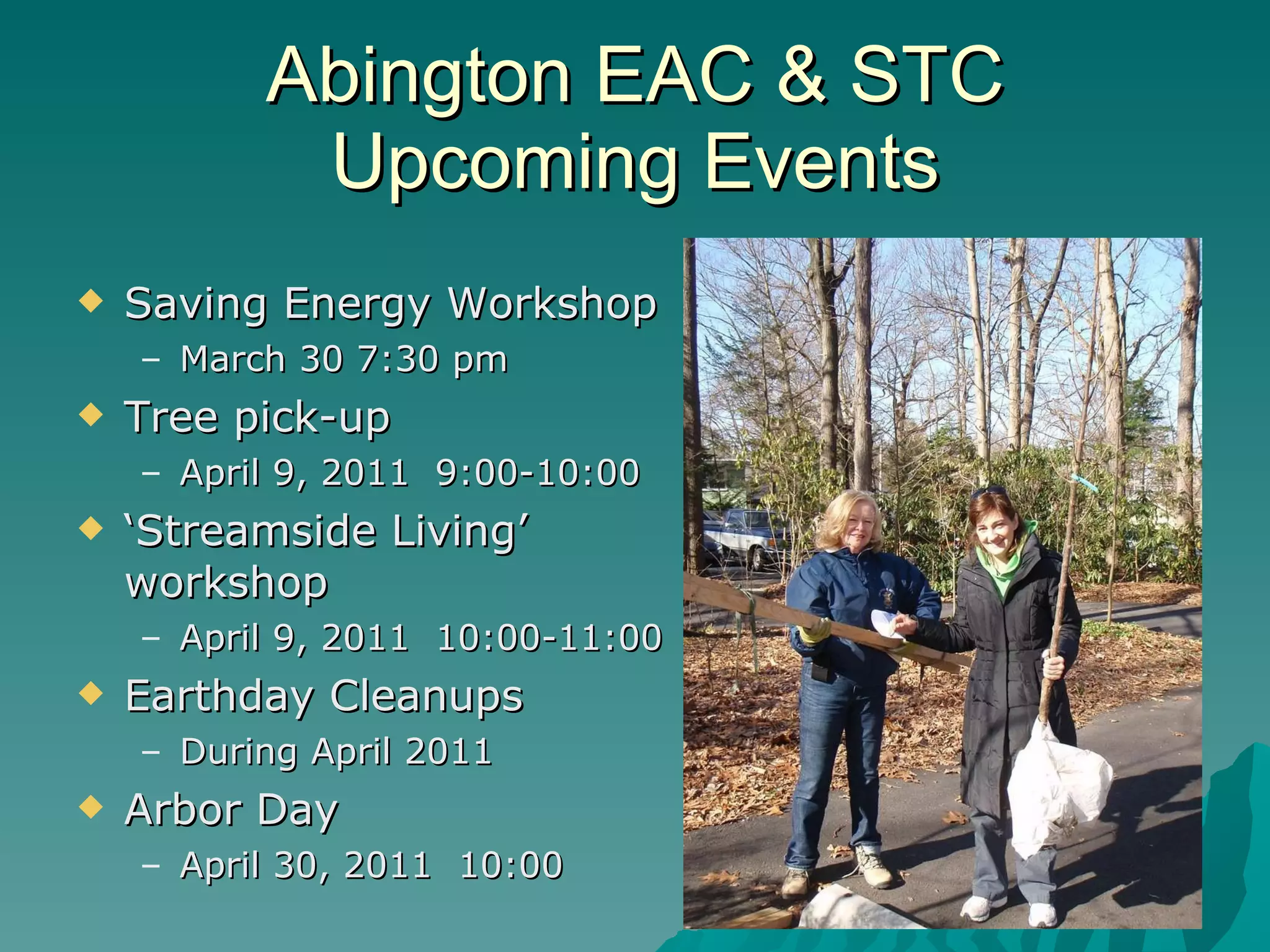
Abington EAC & STC Upcoming Events Saving Energy Workshop March 30 7:30 pm Tree pick-up April 9, 2011  9:00-10:00 ‘ Streamside Living’ workshop April 9, 2011  10:00-11:00 Earthday Cleanups During April 2011 Arbor Day April 30, 2011  10:00
Abington EAC – Stay Involved www.eac-abington.org Join our Facebook group: www.facebook.com/pages/Abington-PA-Environmental-Advisory-Council/316868693175 Public meetings on the second Wednesday of each month at 7:30 at the Abington Twp building

Native Trees and Their Impact on Watersheds: How to plant and care for your tree

  • 1.
    Welcome to Trees for Abington Abington’s Community Tree Program March 26, 2011
  • 2.
    Agenda Presentation Welcome Watersheds and you Why trees? Why native? Tree pickup Planting your tree Caring for your tree Pledge and survey Planting Demonstration At the Playscape playground Winter King Hawthorn Crataegus viridis ‘Winter King’
  • 3.
    Welcome Commissioner LoriSchreiber (Ward 14), the EAC & the STC welcome you Program created by Abington volunteer panels: Environmental Advisory Council (EAC) Shade Tree Commission Over 240 trees planted since 2005 Funded by: Water Resources Education Network grant A program of the League of Women Voters of Pennsylvania Citizen Education Fund, through a Section 319 federal Clean Water Act grant from the Pennsylvania Department of Environmental Protection, administered by the US Environmental Protection Agency. http ://wren.palwv.org / Abington Twp Green Program Trees provided by: Pennsylvania Horticultural Society TreeVitalize Workshop hosted by: Briar Bush Nature Center
  • 4.
    Abington Volunteer PanelsEnvironmental Advisory Council Cakky Braun-Evans Donna Brewer Joelle Greenland Emma Gutzler Michele Kaczalek Susan Myerov Jennifer Sherwood Shade Tree Commission John Kennedy Jeff Pyle Bill Riemschneider Elaine Rosenberg Rita Stevens www.eac-abington.org
  • 5.
    What You WillLearn… What watershed you live in Why you should plant a tree Benefits of planting a native tree How to plant and care for your tree
  • 6.
  • 7.
    What is aWatershed? An area of land where all of the water that is under it or drains off of it goes into the same place – EPA EVERYONE lives in a watershed!! Includes water draining from rain, melted snow, draining pools, hoses, power washing houses, washing cars, etc.
  • 8.
    Why Is YourWatershed Important? It is your natural community It links you with all other living organisms in the watershed What you do effects others What others do effects you It is one part of the entire drainage system
  • 9.
    Water running offyour property affects local stream levels (increases flooding) Chemicals and pollutants are washed into the local stream Polluted water affects our: Drinking water supply Sewage treatment Fish and other wildlife Recreational water activities Why Is Your Watershed Important?
  • 10.
    Delaware River WatershedMap created by Karl Musser
  • 11.
  • 12.
    Abington Township WatershedsPennypack www.phillywatersheds.org/your_watershed/pennypack www.pennypackgreenway.org Tookany-Tacony/Frankford www.phillywatersheds.org/your_watershed/tookany_tacony_frankford www.ttfwatershed.org Wissahickon www.phillywatersheds.org/your_watershed/wissahickon www.wvwa.org
  • 13.
    Pennypack Creek WatershedMap courtesy of Philadelphia Water Department
  • 14.
    Wissahickon Creek WatershedMap courtesy of Philadelphia Water Department
  • 15.
    Tookany – Tacony/FrankfordCreek Watershed Map courtesy of Philadelphia Water Department
  • 16.
  • 17.
  • 18.
    Natural vs. Urbanized Water Cycle Images courtesy of Philadelphia Water Department
  • 19.
    Why plant trees?Trees help keep our water healthy How? Trees absorb rainwater Reduce the amount of water flowing off of your property and into creeks (run-off) Less run-off results in: Less flooding Less property damage Less erosion Fewer pollutants washed into streams Chemicals wash off streets & lawns and into creeks Excess fertilizers cause algae blooms & kill fish and wildlife Trees save money and taxes by keeping water out of sewer systems and by helping clean the water It all adds up to a healthier world
  • 20.
    Why plant trees?Trees refresh the air Absorb carbon dioxide and release oxygen Trees remove air-borne pollutants Ozone, dust, dirt Trees save energy Shade in summer Windbreak in winter Reduce heating and air-conditioning costs, saves money Trees beautify your neighborhood and town Trees increase the value of your home Trees provide food and shelter for wildlife Japanese Zelkova Zelkova serrata
  • 21.
  • 22.
    Abington Tree Coverage by Ward There is a significant need for tree coverage in the wards adjacent to Upper Dublin and Cheltenham Townships: Crestmont, Ardsley, North Hills, Roslyn and Glenside These areas are primarily older, densely settled residential
  • 23.
    Tree Species allnative to Pennsylvania Robin Hill Pink Serviceberry, aka Juneberry (Amerlanchier x grandiflora 'Robin Hill Pink' ) Eastern Redbud (Cercis canadensis) Green Hawthorn (Crataegus viridis 'Winter King') 'Ballerina' Magnolia (Magnolia x loebneri 'Ballerina') ‘ Autumn Blaze’  Maple (Acer x freemanii 'Autumn Blaze') Red Maple (Acer rubrum 'Red Sunset') River Birch (Betula nigra 'Heritage') Thornless Honeylocust (Gleditsia triacanthos 'Sunburst') Carolina Silverbell (Halesia tetraptera 'Jersey Bell') Sugar Maple (Acer saccharum 'Fall Fiesta') Pin Oak (Quercus palustris)
  • 24.
    Why Native? Nativeplant species are better adapted to local conditions Climate, temperature, soil type Rainfall amounts, drought tolerance Resistant to local diseases Less maintenance Less spraying, less fertilizing, less watering Saves time and money Local wildlife, especially insects, need native plant species for food and shelter Many caterpillars cannot eat exotic plants Birds need caterpillars to feed their babies Many native bees cannot pollinate exotic plants If bees don’t get enough food, their colonies become weak Bees are needed to grow fruit, vegetables and other crops Exotic plant species can crowd out natives Can destroy habitat Go wild with the natives!
  • 25.
    Tree Pick-up Eachtree is 6 to 8 feet tall, about the size of a large broom Will fit in any car
  • 26.
    Tree Pick-up April9, 2011 at BBNC Planting demonstration 9:00 – 9:30 Tree pick-up 9:00 – 10:00 Keep unplanted tree moist and in shade Plant your tree ASAP, preferably within 3 days Call us if you need help
  • 27.
    Planting Your TreePlant within 2 days of pick-up Choose tree location based on: Room for growth: Set backs Street, sidewalks, paved areas Overhead clearance Utility wires, buildings, other trees Environmental factors: Site location Sun exposure Soil type Grade Sidewalk Street Driveway House
  • 28.
    Call before youdig Call at least 3 to 10 business days ahead Pennsylvania One Call System Dial 8-1-1 or 1-800-242-1776 www.pa811.org www.pa1call.org
  • 29.
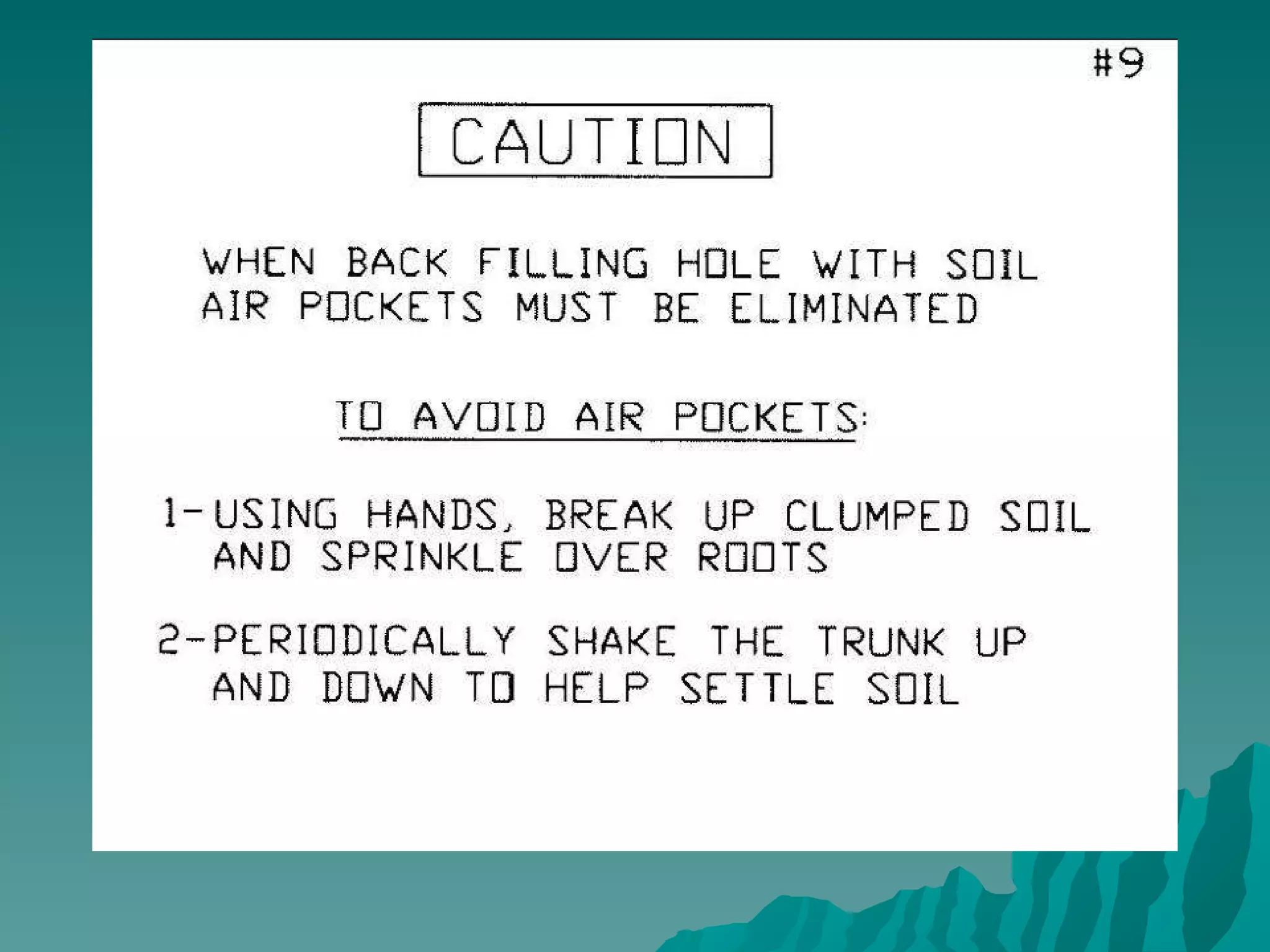
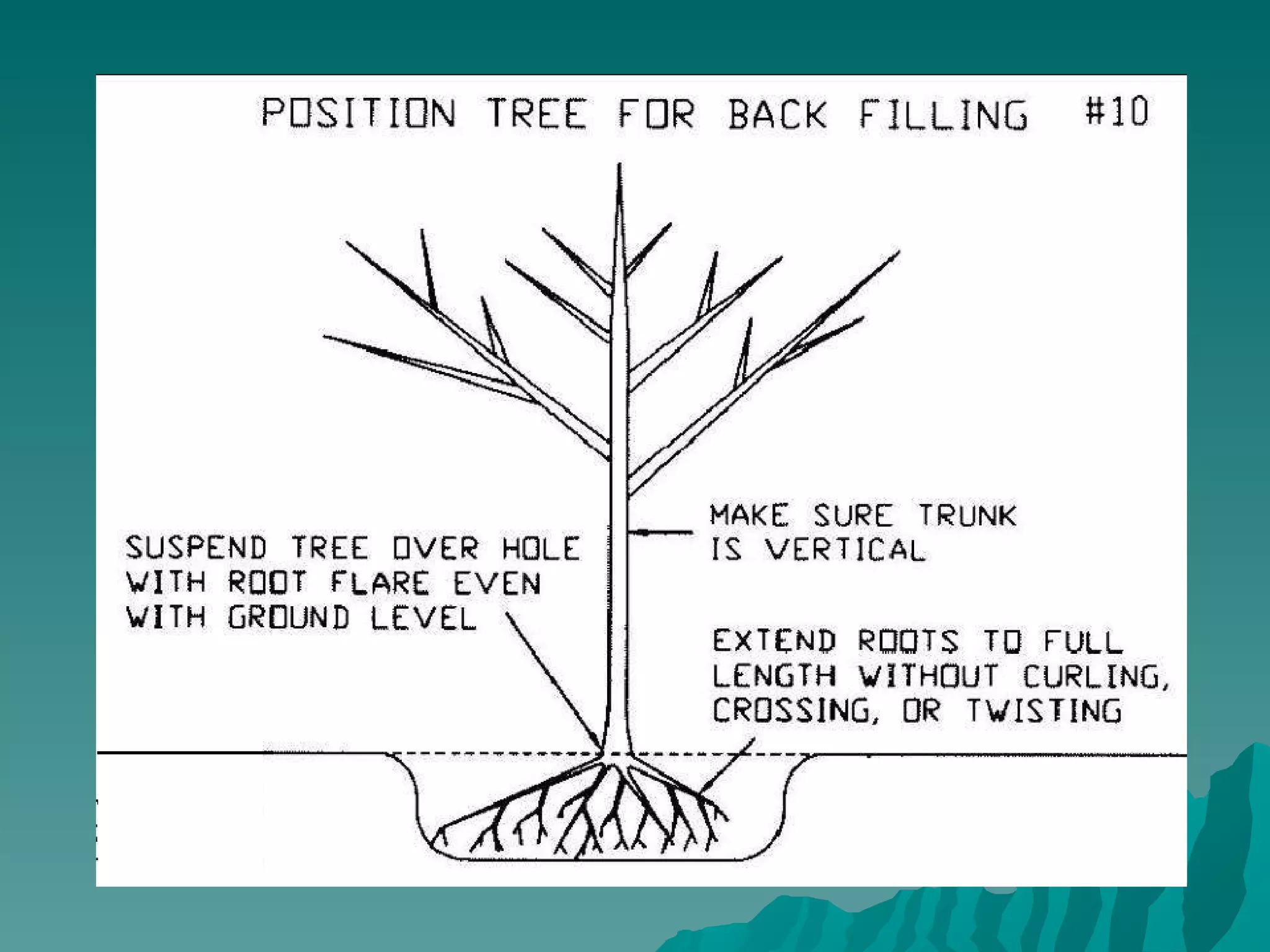
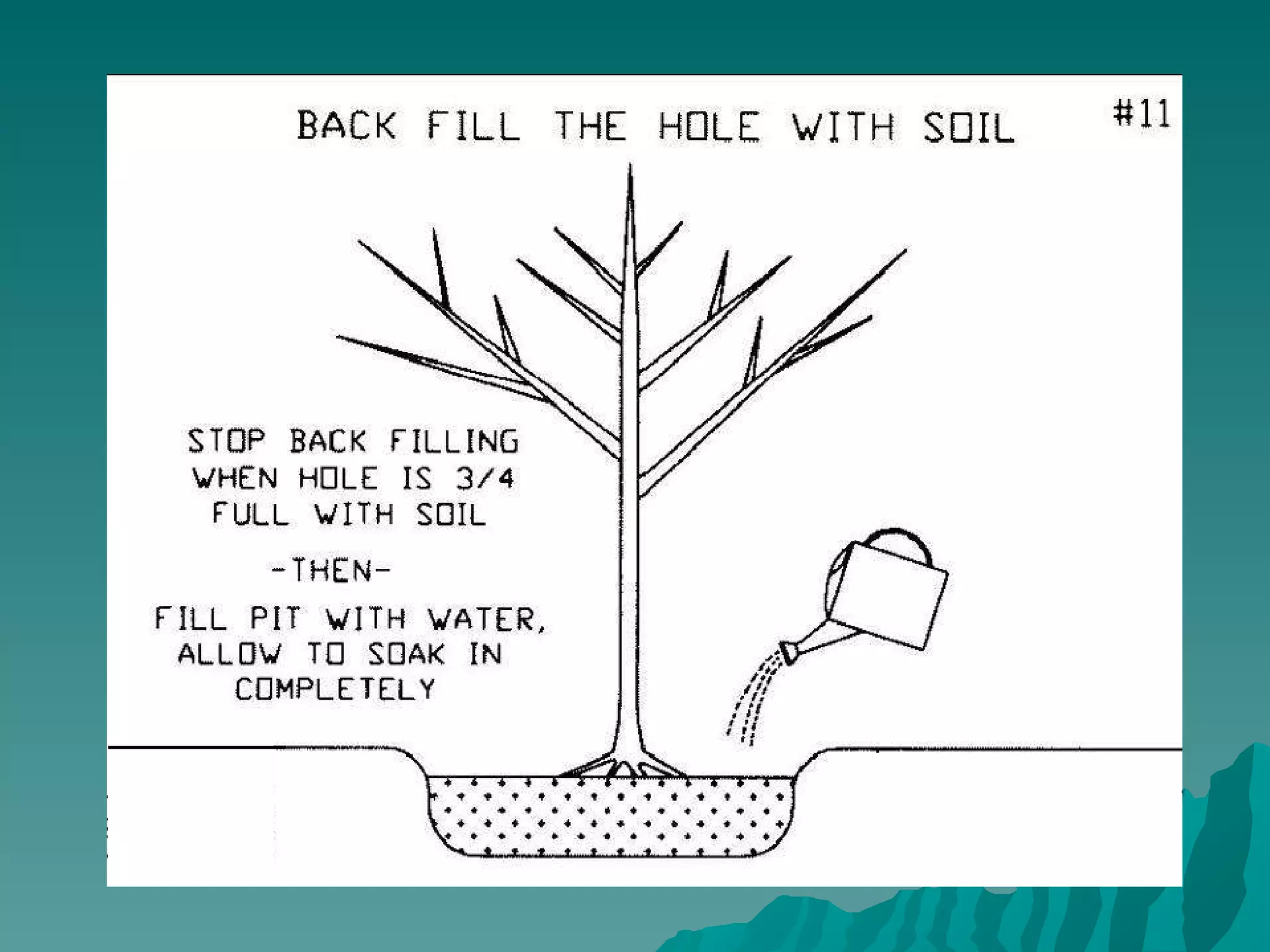
    How to plant a bare root tree The following slides were adapted from UCGreen: www.ucgreen.org/pdfs/bareroot.pdf
  • 30.
    Inspect and prune:Dead, Damaged, or Crossing branches. Remove tag(s).
  • 31.
  • 32.
  • 33.
  • 34.
    VIEWED FROM ABOVE[NOTE: 3 FT. MINIMUM GIVES CLEARANCE FOR CAR DOORS]
  • 35.
    LONGEST BRANCHES ROTATETREE TO ALIGN LONGEST BRANCHES PARALLEL TO CURB BRANCHES VIEWED FROM ABOVE
  • 36.
    GENTLY SPREAD OUTROOTS, THEN DIG HOLE SHAPE TO MATCH ROOTS VIEWED FROM ABOVE
  • 37.
  • 38.
  • 39.
  • 40.
  • 41.
  • 42.
  • 43.
  • 44.
  • 45.
    Freshly planted treeCockspur Hawthorn, Crataegus crus-galli , planted at The Triangle at Huntingdon Pike and Cedar Road
  • 46.
    Caring for yourtree Watering Mulching Protecting
  • 47.
    Watering Why water?A transplanted tree needs more water than an established tree Tree is in shock, roots have been damaged Tree needs to re-establish roots Tree needs to adjust to its new home with new growing conditions When to water? During the first two growing seasons Takes 2 to 3 years for a tree to stabilize Water once every week From April 1 to November 1 How to water? Better to water less frequently but deeply Frequent, shallow watering encourages shallow roots that are more susceptible to drought Water slowly over several hours Allows water to seep into the tree’s deep roots (and not run off)
  • 48.
    How to WaterWater your tree: During the first two years Once every week: April 1st to Nov. 1st Preferably in the morning Tree uses water for growing during daylight hours To prevent mold and mildew which grow at night How much: 10 to 15 gallons per week Method: Water slowly, over several hours Use a device to slow drip Keep water off leaves, branches and trunk to prevent mildew Optional reminder: plant annual flowers around the tree Water when the flowers droop
  • 49.
    Watering Devices Hosewith slow trickle Sprinkler with slow trickle Photo: http://www.engineeredwatering.com/Ooze_Tube.htm Tree watering bag Bucket with small hole Soaker Hose
  • 50.
    Mulching Why mulch?Keeps lawnmowers and weed-whackers away from trunk Keeps roots moist Controls weeds Keeps lawn grass away from roots Grass will compete for nutrients Provides nutrients Reduces soil compaction Types of mulch: Leaf mulch/compost (free from township) Woodchips Hardwood mulch (bark, root) Shredded Newspaper
  • 51.
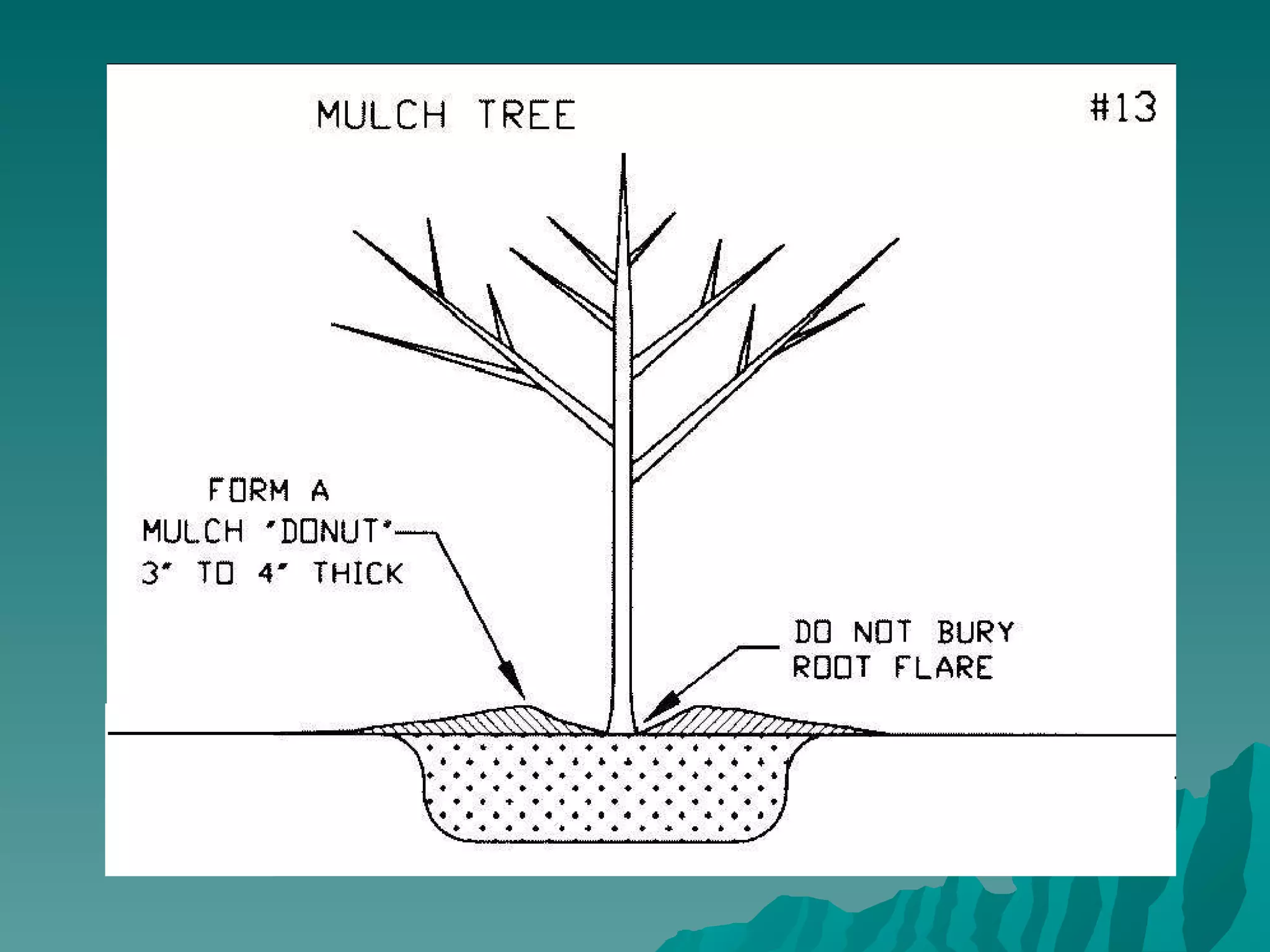
    How to MulchMulch at least once a year Spread a 3-inch layer evenly around the tree out to the tree’s drip-line The drip line is the edge of the area below the branches Keep the mulch at least 3 inches away from the trunk prevents decay and keeps insects away Keep the mulch weeded Optional: plant annual flowers in the mulch FORM A MULCH ‘DONUT’ 3” THICK DO NOT BURY ROOT FLARE
  • 52.
    Proper Mulching Diagramsfrom International Society of Arboriculture website: http://www.treesaregood.com/treecare/mulching.aspx Correct Incorrect
  • 53.
    Protecting Bark isthe tree’s most important protection Protect from wounds caused by: Cars and vehicles Lawnmowers Weed-whackers Deer rubbing Keep vines, groundcover, and mulch away from the trunk to avoid decay Remove staking materials within 1 year Keep animals from relieving themselves on the tree Tree bark damaged by a vehicle
  • 54.
    Machine wounds Lawnmowerdamage Weed-whacker damage
  • 55.
    Other damage Rotcaused by mulch and groundcovers Deer rubbing
  • 56.
  • 57.
    Because of you,a beautiful tree will grow Cockspur Hawthorn, Crataegus crus-galli , planted at Highland Green Beech leaves in autumn Winter King Hawthorn, Crataegus viridis ‘Winter King’
  • 58.
    Abington Township EnvironmentalAdvisory Council and Shade Tree Commission Community Tree Program Take the Pledge! I ________________________________________________________ (print name) will make every effort to: Pick-up my tree at the designated time and date if the trees are not available at the workshop (you will be contacted by email or phone when the trees arrive). The trees can be picked up at Briar Bush Nature Center. Use the PA One-Call System to check underground utility lines before deciding where to plant your tree. Call 1-800-242-1776, or use the website: http://www.pa1call.org at least 3 days before planting. Plant my tree as soon as possible (within a few days of receipt). Plant my tree in a manner consistent with the intent of a street tree (in the front yard or side yard near the front of my property). Follow the instructions provided at this workshop in order to give my tree the best possible chance of growing and maturing for many years. Allow a member of the EAC or STC to take a picture of my tree after it is planted. Signature: ____________________________________________ Address: ____________________________________________ Abington Township Environmental Advisory Council and Shade Tree Commission 2011
  • 59.
    Survey Trees ForAbington: Tree Planting and Tree Care Workshop Survey and Evaluation Form ===================== Fill in # 1 through 4 before the presentation ================= 1. How did you hear about the workshop? _________________________________________________ 2. Where do you live? _______________________ Township/Borough (where you pay your local taxes) _______________ Zip Code ____________________________ Watershed (if known) 3. Why did you register for this workshop? _________________________________________________ 4. Please check all of the groups below that you have heard of, prior to attending this work shop: ____ Abington Township Environmental Advisory Council (EAC) ____ Briar Bush Nature Center ____ Abington Township Shade Tree Commission (STC) ____ Water Resources Education Network (WREN) ____ Pennsylvania Horticultural Society (PHS) ____ PHS Tree Tenders =============== Fill in below during or after the presentation =============== 5. As a result of this workshop, did you become aware of any new information sources that you did not know about before? Yes ___ No ___ Which sources are you likely to use? ____________________________________ 6. What is the most valuable thing you learned from the workshop? ______________________________ _____________________________________________________________________________________ 7. As a result of what you learned, what tree care changes will you make? ________________________ _____________________________________________________________________________________ 8. Did you sign the pledge? Yes ___ No ___ Comments ________________________________________ 9. Did the workshop meet your expectations? Yes ___ No ___ Comments __________________ _____________________________________________________________________________________ 10. Additional comments or suggestions for this workshop? ____________________________________ _____________________________________________________________________________________ 11. What environmental topics would you be interested in attending a future workshop about? _______ _____________________________________________________________________________________ 12. Please indicate the watershed where you reside. __________________________________________ Thank you for your participation! This free workshop was made possible through funding by a grant from the Water Resources Education Network, a program of the League of Women Voters of Pennsylvania Citizen Education Fund, through a section 319 federal Clean Water Act grant from the Pennsylvania Department of Environmental Protection, administered by the US Environmental Protection Agency.
  • 60.
    Thank You! Asfellow residents of Abington Township, thank you for helping improve our community. Montgomery Award tree at The Fairway
  • 61.
    Need more info?Attend our planting demonstration in the Playscape playground after this presentation Talk to one of our volunteers: Tree pick up Where to plant Species information How to plant Tools and techniques for planting a tree How to dig a hole, dealing with old roots and rocks Volunteer with the EAC or STC Assist with environmental projects in Abington Become a Tree Tender Coordinate tree plantings in your neighborhood
  • 62.
    If you havequestions Shade Tree Commission Rita Stevens (215) 435-2781 [email_address] Environmental Advisory Council Jennifer Sherwood (215) 663-8798 [email_address] Website: www.eac-abington.org
  • 63.
    Abington EAC &STC Upcoming Events Saving Energy Workshop March 30 7:30 pm Tree pick-up April 9, 2011 9:00-10:00 ‘ Streamside Living’ workshop April 9, 2011 10:00-11:00 Earthday Cleanups During April 2011 Arbor Day April 30, 2011 10:00
  • 64.
    Abington EAC –Stay Involved www.eac-abington.org Join our Facebook group: www.facebook.com/pages/Abington-PA-Environmental-Advisory-Council/316868693175 Public meetings on the second Wednesday of each month at 7:30 at the Abington Twp building

Editor's Notes

  • #22 Let’s look at our part of the Commonwealth. Orient the audience to the state of the urban forest, measured by % tree cover, in Philadelphia and surrounding counties.
  • #23 Here is more details bout Abington tree coverage by ward/commissioner, noting special features that contribute to the % tree coverage.