Cindy Allen-Stuckey


            www.makingperformancematter.com
Objectives
 Describe “organizational alignment”
 Discuss the business benefits to an aligned
  organization
 Recognize the symptoms of not being aligned
 Know how organizational alignment works
 Know the five (5) vital questions needed to align
  your organization

               www.makingperformancematter.com
Organizational Alignment
 The process and practice of putting everyone
  in the organization on the same page.
 All facets of the organization focuses on a
  common objective – achieving business
  results
 A step-by-step process for getting everyone
  in the organization “rowing in the
  right direction”.


               www.makingperformancematter.com
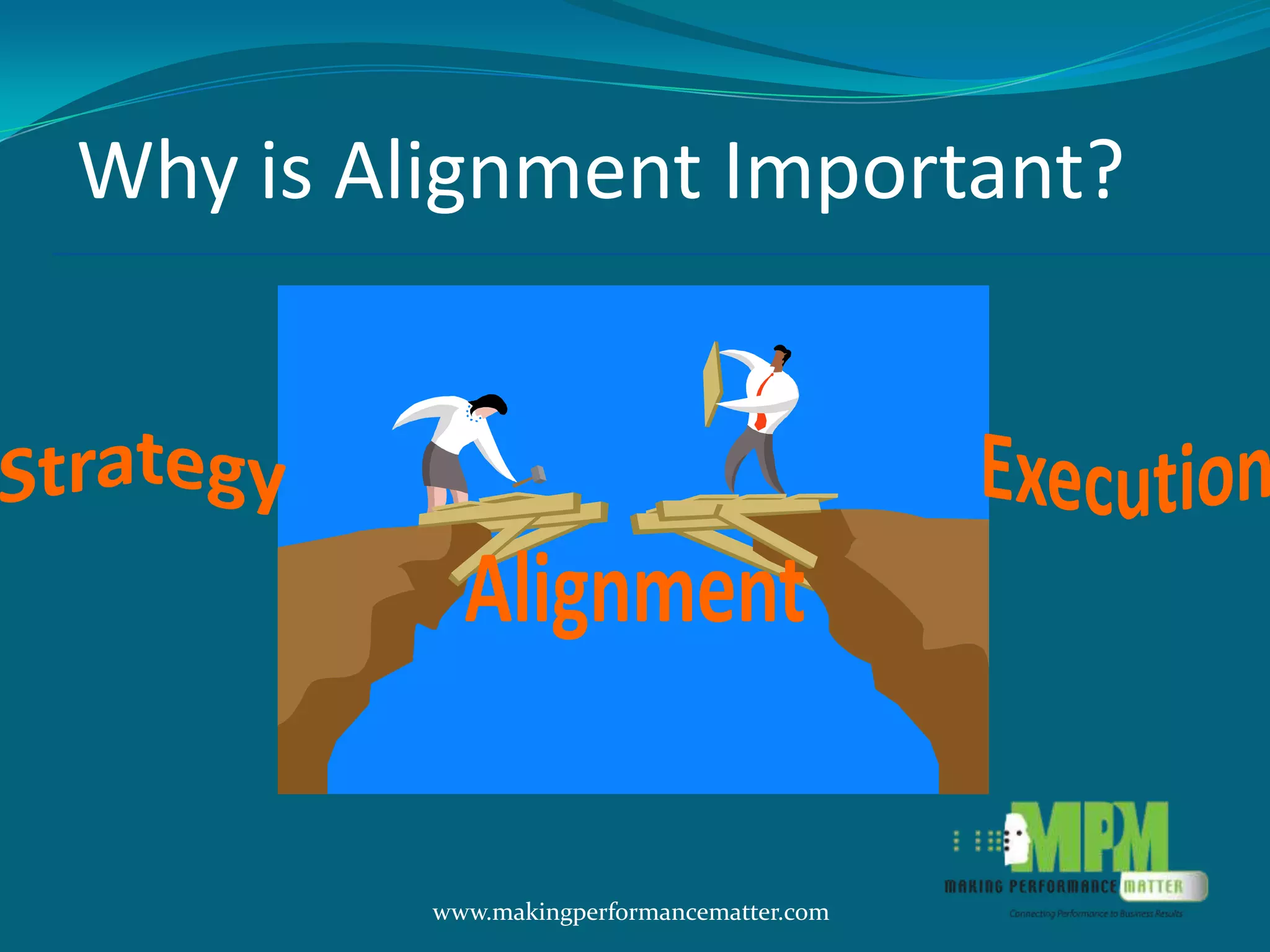
Why is Alignment Important?
        Strategy


          www.makingperformancematter.com
Top Business Benefits
 Increased Operating Margins

 Quicker Execution of Company Strategy

 Reduced Employee Turnover


              www.makingperformancematter.com
Power of Organizational Alignment
“A mere 7% of employees today fully
understand their company’s business strategies
and what’s expected of them in order to help
achieve company goals.”
Robert S. Kaplan and David P. Norton, “The Strategy-Focused Organization,”
Harvard Business School Press, 2001


                        www.makingperformancematter.com
Your Organization Might be
Misaligned if:
 Strategies are not getting the results expected
 Not where you thought you would be
 Problems fixed to keep things moving right
  now
 Departments hitting goals, company is not
 Finger pointing because of this

               www.makingperformancematter.com
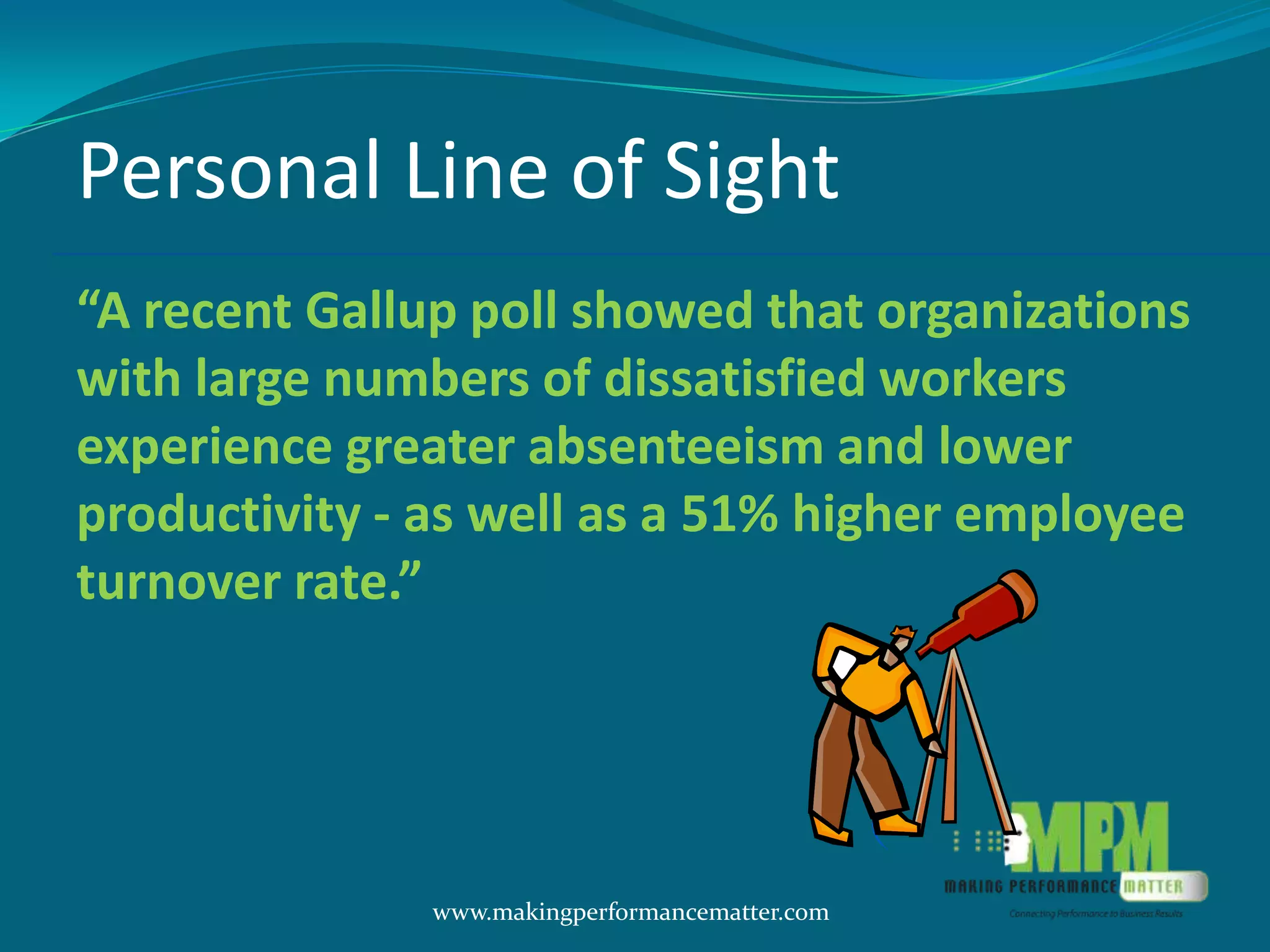
Personal Line of Sight
“A recent Gallup poll showed that organizations
with large numbers of dissatisfied workers
experience greater absenteeism and lower
productivity - as well as a 51% higher employee
turnover rate.”


               www.makingperformancematter.com
Align Four Business Elements
 The leadership – develop and deploy the
  strategy; monitor results
 The organization – structure, processes, and
  operations by which strategy is deployed
 The jobs – necessary roles and responsibilities
 The people – experience, skills and
  competencies needed to execute                the
  strategy    www.makingperformancematter.com
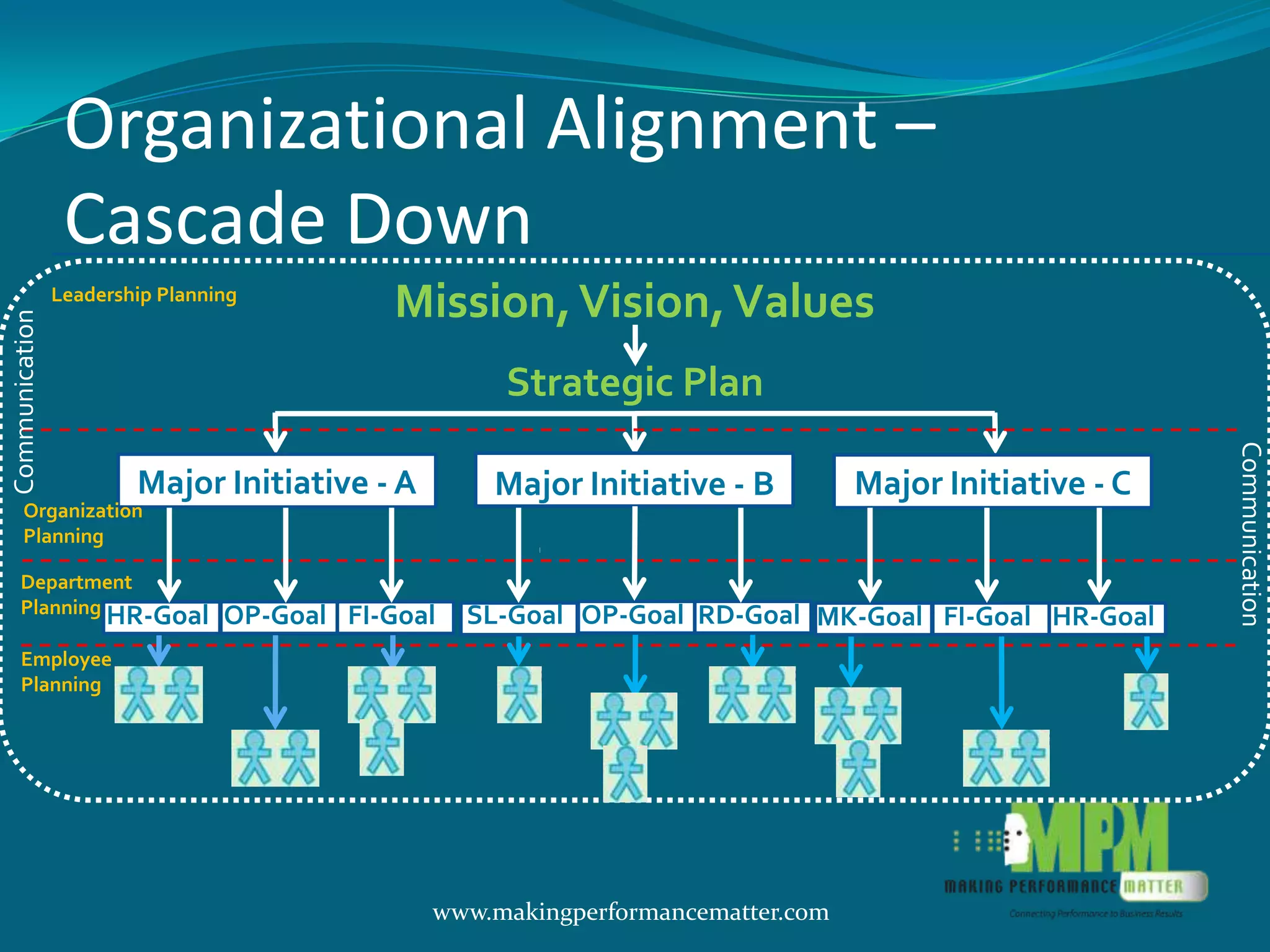
Organizational Alignment –
                 Cascade Down
                Leadership Planning
                                             Mission, Vision, Values
Communication


                                                     Strategic Plan


                                                                                                        Communication
                        Major Initiative - A        Major Initiative - B         Major Initiative - C
     Organization
     Planning

    Department
    Planning HR-Goal             OP-Goal FI-Goal   SL-Goal OP-Goal RD-Goal MK-Goal FI-Goal HR-Goal
    Employee
    Planning


                                               www.makingperformancematter.com
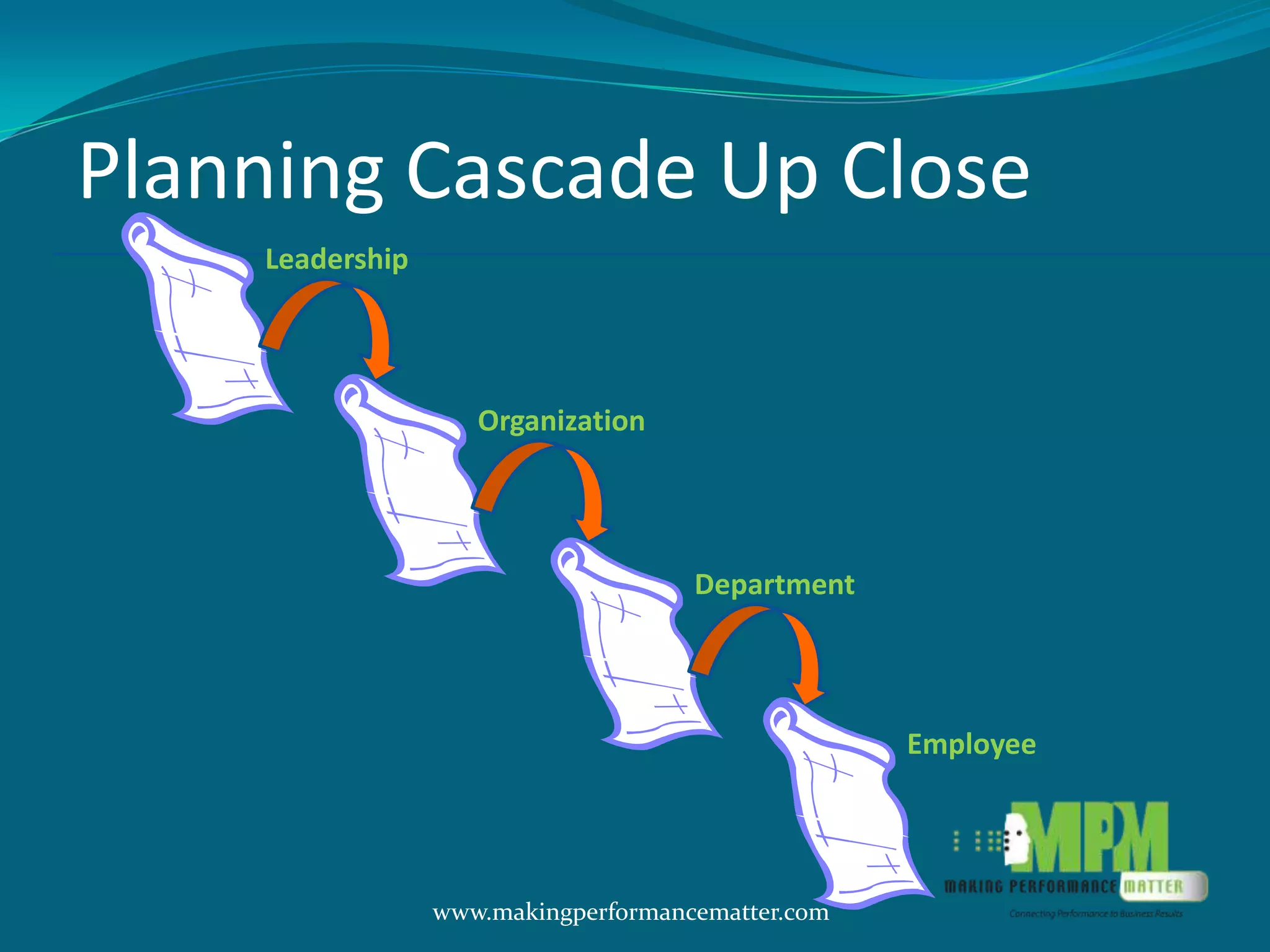
Planning Cascade Up Close
    Leadership


                    Organization


                                     Department


                                                   Employee


                 www.makingperformancematter.com
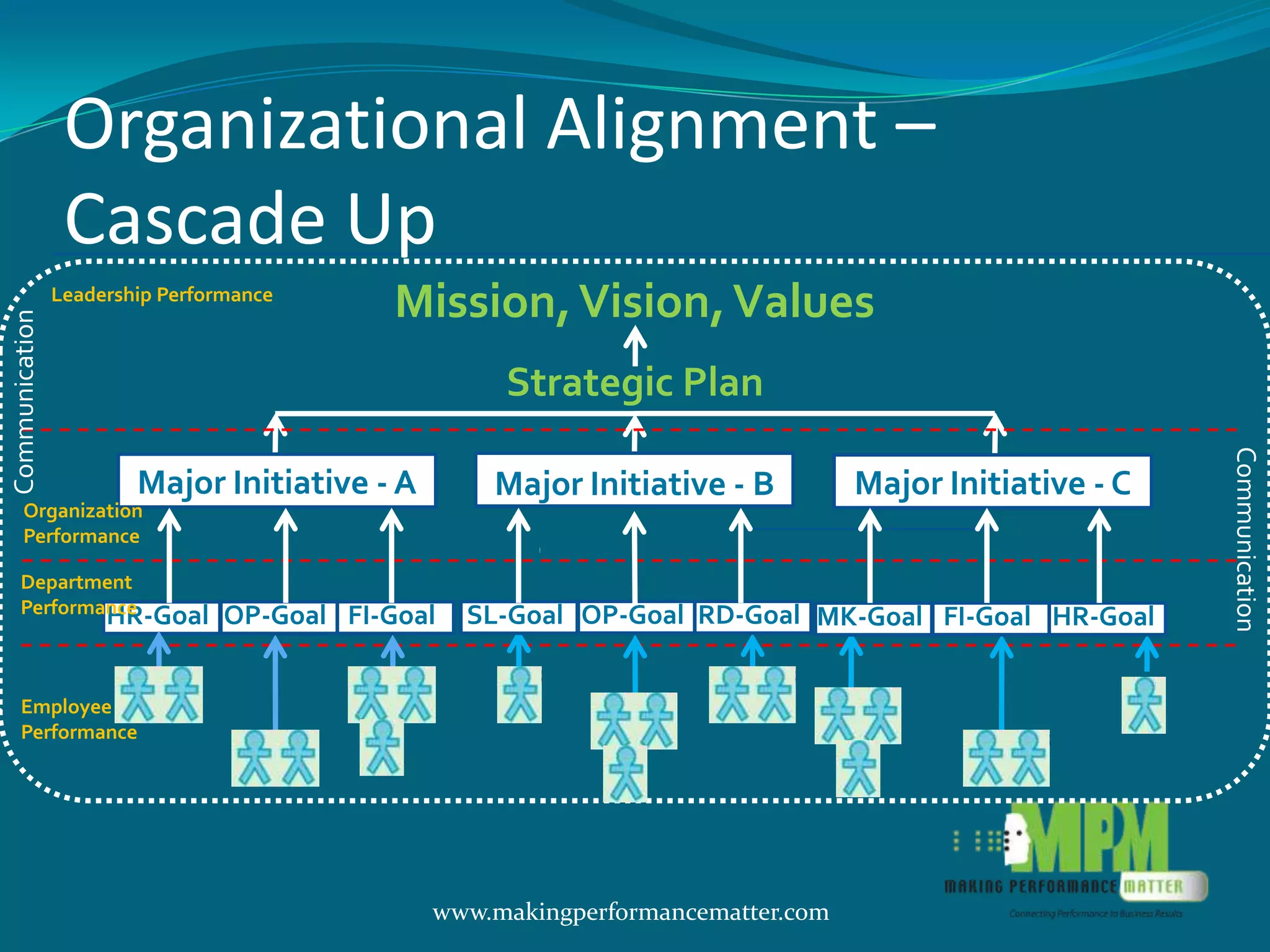
Organizational Alignment –
                 Cascade Up
                Leadership Performance
                                             Mission, Vision, Values
Communication


                                                     Strategic Plan


                                                                                                        Communication
                        Major Initiative - A        Major Initiative - B         Major Initiative - C
     Organization
     Performance

    Department
    Performance
            HR-Goal              OP-Goal FI-Goal   SL-Goal OP-Goal RD-Goal MK-Goal FI-Goal HR-Goal


    Employee
    Performance


                                               www.makingperformancematter.com
Alignment-Performance Pitfalls
 Developing strategy and throwing it over the
  wall for implementation (execution)
 Heads-down focus
 Blaming the hired help
 Perpetuating the silo perspective
 Micromanagement
 Ill-defined roles, responsibilities
                www.makingperformancematter.com
Questions to Keep You Aligned
 What is my role in the organization?
 What is my work responsibility?
 What is my job’s purpose
 What are the goals that guide my job’s
  purpose
 What are the company goals?

              www.makingperformancematter.com
Example of Personal Line of Sight
 My role - Problem Solving Instructor
 My work responsibility - learn, understand,
  and practice problem solving thinking &
  how the company values/principles
  intertwine with that thinking
 Job purpose - effectively deliver to any
  level/role that ignites culture

               www.makingperformancematter.com
Example of Personal Line of Sight
 Goals that guide my job’s purpose - my
  participants to
  learn, understand, practice, and develop
  their people in problem solving to fulfill
 company’s values and customers’
  Company goals - fulfill vision.
  expectations by providing high quality
  training enabling to do business differently
  by changing how their people think
  and do business
              www.makingperformancematter.com
Overcoming Execution Pitfalls
 Communicate and engage


 Sharpen the organization’s capability to
  listen, observe, learn, and act


 Look up and out as well as down

               www.makingperformancematter.com
Top Business Benefits
 Increased Operating Margins

 Quicker Execution of Company Strategy

 Reduced Employee Turnover


              www.makingperformancematter.com
Summarize
 Describe “organizational alignment”
 Discuss the business benefits to an aligned
  organization
 Recognize the symptoms of not being aligned
 Know how organizational alignment works
 Know the five (5) vital questions needed to align
  your organization

               www.makingperformancematter.com
Making Performance Matter
www.makingperformancematter.com
(812) 343-4366

Cindy Allen-Stuckey, MSED, MSM
cindy@makingperformancematter.com


             www.makingperformancematter.com

Is Your Line of Sight Aligned?

  • 1.
    Cindy Allen-Stuckey www.makingperformancematter.com
  • 2.
    Objectives  Describe “organizationalalignment”  Discuss the business benefits to an aligned organization  Recognize the symptoms of not being aligned  Know how organizational alignment works  Know the five (5) vital questions needed to align your organization www.makingperformancematter.com
  • 3.
    Organizational Alignment  Theprocess and practice of putting everyone in the organization on the same page.  All facets of the organization focuses on a common objective – achieving business results  A step-by-step process for getting everyone in the organization “rowing in the right direction”. www.makingperformancematter.com
  • 4.
    Why is AlignmentImportant? Strategy www.makingperformancematter.com
  • 5.
    Top Business Benefits Increased Operating Margins  Quicker Execution of Company Strategy  Reduced Employee Turnover www.makingperformancematter.com
  • 6.
    Power of OrganizationalAlignment “A mere 7% of employees today fully understand their company’s business strategies and what’s expected of them in order to help achieve company goals.” Robert S. Kaplan and David P. Norton, “The Strategy-Focused Organization,” Harvard Business School Press, 2001 www.makingperformancematter.com
  • 7.
    Your Organization Mightbe Misaligned if:  Strategies are not getting the results expected  Not where you thought you would be  Problems fixed to keep things moving right now  Departments hitting goals, company is not  Finger pointing because of this www.makingperformancematter.com
  • 8.
    Personal Line ofSight “A recent Gallup poll showed that organizations with large numbers of dissatisfied workers experience greater absenteeism and lower productivity - as well as a 51% higher employee turnover rate.” www.makingperformancematter.com
  • 9.
    Align Four BusinessElements  The leadership – develop and deploy the strategy; monitor results  The organization – structure, processes, and operations by which strategy is deployed  The jobs – necessary roles and responsibilities  The people – experience, skills and competencies needed to execute the strategy www.makingperformancematter.com
  • 10.
    Organizational Alignment – Cascade Down Leadership Planning Mission, Vision, Values Communication Strategic Plan Communication Major Initiative - A Major Initiative - B Major Initiative - C Organization Planning Department Planning HR-Goal OP-Goal FI-Goal SL-Goal OP-Goal RD-Goal MK-Goal FI-Goal HR-Goal Employee Planning www.makingperformancematter.com
  • 11.
    Planning Cascade UpClose Leadership Organization Department Employee www.makingperformancematter.com
  • 12.
    Organizational Alignment – Cascade Up Leadership Performance Mission, Vision, Values Communication Strategic Plan Communication Major Initiative - A Major Initiative - B Major Initiative - C Organization Performance Department Performance HR-Goal OP-Goal FI-Goal SL-Goal OP-Goal RD-Goal MK-Goal FI-Goal HR-Goal Employee Performance www.makingperformancematter.com
  • 13.
    Alignment-Performance Pitfalls  Developingstrategy and throwing it over the wall for implementation (execution)  Heads-down focus  Blaming the hired help  Perpetuating the silo perspective  Micromanagement  Ill-defined roles, responsibilities www.makingperformancematter.com
  • 14.
    Questions to KeepYou Aligned  What is my role in the organization?  What is my work responsibility?  What is my job’s purpose  What are the goals that guide my job’s purpose  What are the company goals? www.makingperformancematter.com
  • 15.
    Example of PersonalLine of Sight  My role - Problem Solving Instructor  My work responsibility - learn, understand, and practice problem solving thinking & how the company values/principles intertwine with that thinking  Job purpose - effectively deliver to any level/role that ignites culture www.makingperformancematter.com
  • 16.
    Example of PersonalLine of Sight  Goals that guide my job’s purpose - my participants to learn, understand, practice, and develop their people in problem solving to fulfill  company’s values and customers’ Company goals - fulfill vision. expectations by providing high quality training enabling to do business differently by changing how their people think and do business www.makingperformancematter.com
  • 17.
    Overcoming Execution Pitfalls Communicate and engage  Sharpen the organization’s capability to listen, observe, learn, and act  Look up and out as well as down www.makingperformancematter.com
  • 18.
    Top Business Benefits Increased Operating Margins  Quicker Execution of Company Strategy  Reduced Employee Turnover www.makingperformancematter.com
  • 19.
    Summarize  Describe “organizationalalignment”  Discuss the business benefits to an aligned organization  Recognize the symptoms of not being aligned  Know how organizational alignment works  Know the five (5) vital questions needed to align your organization www.makingperformancematter.com
  • 20.
    Making Performance Matter www.makingperformancematter.com (812)343-4366 Cindy Allen-Stuckey, MSED, MSM cindy@makingperformancematter.com www.makingperformancematter.com