

Developing Direct Reports
Dr. John Persico Jr.
612-310-3803
Agenda: Developing Direct Reports
 Learning Objectives
 Introduction of Participants
 Definition of Direct Reports
 Organizational Responsibility
 Three Stages of DR Development
 Activity: Peak Performance
 Intro to Performance Measurement
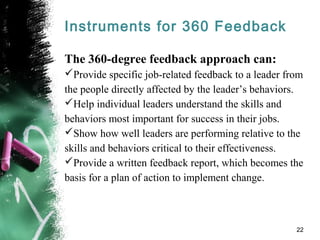
 Standardized Instruments for 360 Feedback
 Activity: Performance Debate
 Characteristics of Good Performance Measures
2
Agenda, Cont.
 Types of Performance Measures
 Discussion: Current Performance Measures
 Activity: Performance Measure Assessment
 Good to Great and the Social Sectors
 Discussion: Data-Driven Decision Making
 Reward and Recognition Guidelines
 Possible Pitfalls in Use of Data
 Small Group Activity: Recognition and Rewards
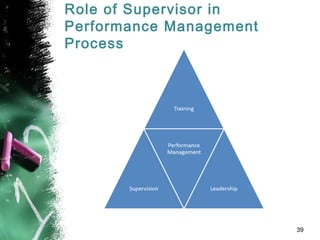
 Role of the Supervisor in the PM Process
3
Agenda, Cont.
 Afternoon Activity: Coaching
 Overview of Coaching
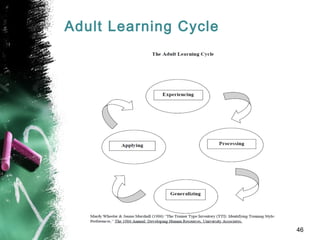
 The Adult Learning Cycle
 Mentoring
4
Welcome
The process of developing new skills should include
the following:
•Identify a needed skill area.
•Agree on a learning method for improvement.
•Practice and receive feedback.
•Increase awareness of the effects of performance on
others.
•Measure change within a well-defined timeframe.
•Recognize and reward skill enhancement.
Introduction of Participants
• Who are you?
• Why are you here?
• What are you most proud of in your
educational career to date?
• Tell about a time you lost a job.
• What would you like to take away
from this two day session?
Learning Objectives
 Understand what direct reports entail
 Define direct reports
 Understand the purpose of direct reports across an
organization
 Name the 3 stages of direct report development
 Develop a set of performance measurements
 Identify available data that is useful in measuring
results
 List what other data they should be collecting
 State ways in which data can be used in making
decisions
7
Learning Objectives, Cont.
 Explain possible pitfalls in failing to use data in
context
 State the impact of recognizing team and individual
performance
 Establish a reward and recognition system
 Coach staff for improved performance
 Prepare a succession plan
 Develop mentoring relationships
 State the various dimensions of wellness
 Design training based on an adult learning model
8
Promote Lifelong Learning
You can develop lifelong learning traits:
• By showing curiosity about human nature and how
the world works.
• By seeking and valuing diversity.
• By persisting in seeking out new solutions.
• By using your unique talents and intelligence to
promote positive change.
• By learning and applying technology tools to solve
problems.
Show Respect
• Value yourself. Be honest and ethical, and
practice strong moral values.
• Treat all members of the school community
with politeness and respect.
• Honor the ideas and opinions of others.
• Offer to help.
• Be responsible for keeping an open mind.
Policies
• Ask questions at any time.
• Listen to all ideas and opinions.
• Leave for restroom when needed.
• Please be back from lunch and breaks on
time.
• Let us know if the day is not working for you.
Direct Reports Defined
Developing Direct Reports:
A direct report is any individual who
reports directly to a supervisor or
manager
12
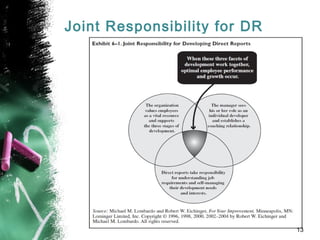
Joint Responsibility for DR
13
Organizational Responsibility
• Valuing Direct Report Development
Organizations that operate under the
premise that employees are their most
valuable resource are more likely to
promote training and development as a
process.
14
Three Stages of DR
Development
• Acquiring Basic Skills
New Hires
• Provide division/department/workgroup
orientation or onboarding.
• Teach knowledge and skills for current tasks
• Create growth and development opportunities
for practice and feedback
• Set clear, measureable performance standards
• Complete quarterly performance updates and
review progress to plan development.
15
Acquiring Basic Skills
Staff or Individual Contributor– Level
Employees Moving into Supervisory
Positions
• Help individuals make the transition to
management
• Identify new expectations
• Create opportunities for practice and feedback
16
Enhancing Performance
• Identify a specific skill area
• Agree on a learning method for improvement
• Let practice and give feedback
• Increase awareness of the effects of performance on
others
• Measure change within a well-defined timeframe
• Recognize and reward skill enhancement
17
Preparing for Future Roles
• Mutually create a career path plan and agreed on by
the direct report and the manager
• Offer the direct report a “big picture” view of future
possibilities both as a leader or individual
contributer in the absence of immediately
advancement opportunities
• Provide 360 feedback for offering individuals a new
perspective on their performance and on areas that
need
• Offer new learning opportunities both inside and
outside current job responsibilities
18
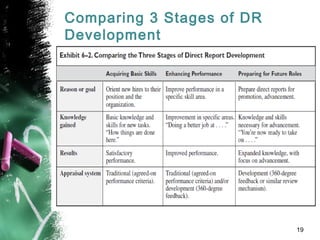
Comparing 3 Stages of DR
Development
19
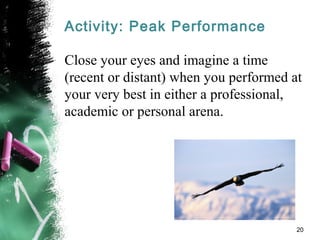
Activity: Peak Performance
Close your eyes and imagine a time
(recent or distant) when you performed at
your very best in either a professional,
academic or personal arena.
20
Intro to Performance
Measurement
Strengthen Management and inform decision
making
Achieve results
Improve overall performance
““What gets measured, gets done. If you don’tWhat gets measured, gets done. If you don’t
measure results, you can’t tell success frommeasure results, you can’t tell success from
failure.” - Peter Druckerfailure.” - Peter Drucker
21
Instruments for 360 Feedback
The 360-degree feedback approach can:
Provide specific job-related feedback to a leader from
the people directly affected by the leader’s behaviors.
Help individual leaders understand the skills and
behaviors most important for success in their jobs.
Show how well leaders are performing relative to the
skills and behaviors critical to their effectiveness.
Provide a written feedback report, which becomes the
basis for a plan of action to implement change.
22
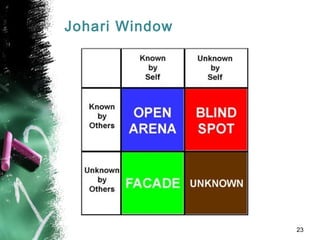
Johari Window
23
Johari Window, Four
Perspectives
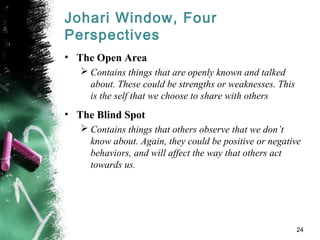
• The Open Area
 Contains things that are openly known and talked
about. These could be strengths or weaknesses. This
is the self that we choose to share with others
• The Blind Spot
 Contains things that others observe that we don’t
know about. Again, they could be positive or negative
behaviors, and will affect the way that others act
towards us.
24
Four Perspectives, Cont.
• The Hidden Area
 Contains aspects of our self that we know about and
keep hidden from others.
• The Unknown Area
 Contains things that nobody knows about us –
including ourselves. This may be because we’ve never
exposed those areas of our personality, or because
they’re buried deep in the subconscious. These
unknown’s may influence our behaviors, we are just
not consciously aware of them.
25
Activity: Employee Performance
Management Debate
• Each group will be assigned one of two
positions: (1) It is important to measure
employee performance as an organization or
(2) Measuring employee performance is an
unnecessary activity.
26
Characteristics of Good
Performance Measures
1. They are informative
2. They communicate valuable
information
3. They are practical tools
27
Types of Performance
Measures
 Inputs
 Outputs
 Outcomes
 Efficiencies
 Quality
28
Discussion: Current
Performance Measures
• Make a list of current performance measures
collected by the school district
29
Individual Activity: Performance
Measure Assessment
• Refer to the PMA in your manual and
complete the assessment of your current
performance measures. Be prepared to share
ideas.
30
Good to Great and the Social
Sectors
• In this monograph he discusses how the
definition of greatness varies between
businesses and social agencies.
• Success, he says, can be calibrated without
using business metrics, such as profit margin.
• An important distinction is that of inputs vs.
outputs.
31
Good to Great, Cont.
Collins addresses the challenges that the public sector
has in quantifying results as follows:
• It doesn’t really matter whether you can quantify your
results.
• What matters is that you rigorously assemble
evidence—quantitative or qualitative—to track your
progress.
• If the evidence is qualitative, he says, think like a trial
lawyer assembling the combined body of evidence.
32
Good to Great, Cont.
• What matters is not finding the perfect indicator, but
settling upon a consistent and intelligent method of
assessing your output results, and then tracking your
trajectory with rigor.
What do you mean by great performance?
Have you established a baseline?
Are you improving?
If not, why not?
How can you improve even faster toward your
audacious goals?
33
Discussion: Data-Driven
Decision Making
• In your small groups, discuss and record your
answers to the following questions: What are
examples of some decisions that supervisors must
make?
1. How do you currently make decisions?
2. How could valid and reliable data assist you in
making better decisions?
3. What additional data would help in your decision
making process?
4. How can you obtain that data?
34
Reward and Recognition
Guidelines
Reasons there isn’t enough time to address R &
R:
• Not enough time
• No funds available
• Negative behaviors get more attention
• Belief that people should not be rewarded for
doing their jobs
• Can you think of any others?
35
R & R Guidelines
Factors to Keep in Mind
1.Match the reward to the person
2.Match the reward to the achievement
3.Be timely and specific
For every four informal rewards (e.g., a special thank
you note), there should be a more official
acknowledgement (e.g., a letter of recognition); and
For every four of those, there should be a still more
official reward (e.g., a certificate or public praise at a
department meeting or a newsletter article).
36
Pitfalls in Use of Data
• Data overload – collecting too much data as opposed
to focusing on the most informative and meaningful
measures
• Spending too much time collecting data and not
enough time analyzing it
• Using data out of context
• Using data as an “axe” as in going beyond
accountability to use it as punishment
37
Small Group Activity: R & R
In small groups, brainstorm recognition and
rewards that you have either used in the past or
could use in the future.
38
Role of Supervisor in
Performance Management
Process
39
Role of Supervisor, Cont.
• Leadership
• Training
• Supervision
40
Adult Learning Quiz
Let’s examine how much you know about how adults
learn.
Circle either True or False for each of the following
statements.
Refer to your manual for a copy of the quiz
41
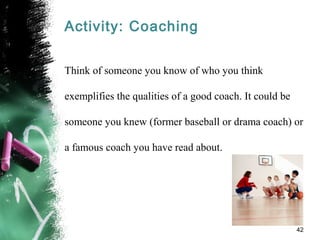
Activity: Coaching
Think of someone you know of who you think
exemplifies the qualities of a good coach. It could be
someone you knew (former baseball or drama coach) or
a famous coach you have read about.
42
Overview of Coaching
Coach Defined: Someone who champions your
success
•Coaching can occur with either individuals or groups.
•Have a game-plan:
A clear vision and action plan ensure that all
"players" are focused on the same end-result.
As the coach, this will help you more quickly see
when the group is off-course and needs to re-calibrate
its efforts.
43
Coaching, Cont.
 What happens if you lack a vision and action plan?
Just imagine a football coach trying to coordinate
each player's movements without a predetermined
play.
 Ensure that the staff member or team is clear on the
nature of the performance gap(s).
 What are your expectations and exactly how are they
meeting and not meeting those expectations?
44
Coaching, Cont.
Associate the game-plan with individuals’
goals
Use appropriate communication modes and
content
CELEBRATE!!!
45
Adult Learning Cycle
46
Mentoring
Defined: A trusted counselor or guide
How to set up a mentoring program:
1.State the objectives
2.List the benefits for each of the following
1. Organization
2. Mentor
3. Protégé
3.Which mentoring method(s) can help you achieve
your goals?
1. One – to – one mentoring
2. Group mentoring
3. Virtual mentoring
47
Mentoring, Cont.
4. Who are the key stakeholders in the mentoring
initiative?
5. Consider the following questions concerning the
structure of your mentoring program
•What criteria will you use to select mentors?
•What criteria will you use to select protégés?
•What role do you see for the managers of the
proteges?
•How will you match mentors and protégés?
48
Mentoring, Cont.
• How will you evaluate the program?
• How did the program affect the proteges?
 Attitudinal effect:
 Behavioral effect:
 Accomplishments:
• How did the program affect the mentors?
 Attitudinal effect:
 Behavioral effect:
 Accomplishments:
 How did the program affect the organization?
 Overall performance rating:
 Productivity:
 Condition of corporate climate:
49
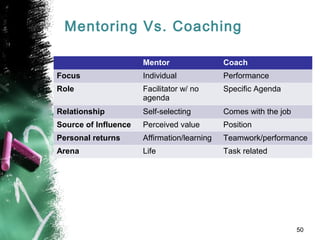
Mentoring Vs. Coaching
Mentor Coach
Focus Individual Performance
Role Facilitator w/ no
agenda
Specific Agenda
Relationship Self-selecting Comes with the job
Source of Influence Perceived value Position
Personal returns Affirmation/learning Teamwork/performance
Arena Life Task related
50
• WRAP UP AND
EVALUATION
51

Developing Direct Reports

  • 1.
    Developing Direct Reports Dr.John Persico Jr. 612-310-3803
  • 2.
    Agenda: Developing DirectReports  Learning Objectives  Introduction of Participants  Definition of Direct Reports  Organizational Responsibility  Three Stages of DR Development  Activity: Peak Performance  Intro to Performance Measurement  Standardized Instruments for 360 Feedback  Activity: Performance Debate  Characteristics of Good Performance Measures 2
  • 3.
    Agenda, Cont.  Typesof Performance Measures  Discussion: Current Performance Measures  Activity: Performance Measure Assessment  Good to Great and the Social Sectors  Discussion: Data-Driven Decision Making  Reward and Recognition Guidelines  Possible Pitfalls in Use of Data  Small Group Activity: Recognition and Rewards  Role of the Supervisor in the PM Process 3
  • 4.
    Agenda, Cont.  AfternoonActivity: Coaching  Overview of Coaching  The Adult Learning Cycle  Mentoring 4
  • 5.
    Welcome The process ofdeveloping new skills should include the following: •Identify a needed skill area. •Agree on a learning method for improvement. •Practice and receive feedback. •Increase awareness of the effects of performance on others. •Measure change within a well-defined timeframe. •Recognize and reward skill enhancement.
  • 6.
    Introduction of Participants •Who are you? • Why are you here? • What are you most proud of in your educational career to date? • Tell about a time you lost a job. • What would you like to take away from this two day session?
  • 7.
    Learning Objectives  Understandwhat direct reports entail  Define direct reports  Understand the purpose of direct reports across an organization  Name the 3 stages of direct report development  Develop a set of performance measurements  Identify available data that is useful in measuring results  List what other data they should be collecting  State ways in which data can be used in making decisions 7
  • 8.
    Learning Objectives, Cont. Explain possible pitfalls in failing to use data in context  State the impact of recognizing team and individual performance  Establish a reward and recognition system  Coach staff for improved performance  Prepare a succession plan  Develop mentoring relationships  State the various dimensions of wellness  Design training based on an adult learning model 8
  • 9.
    Promote Lifelong Learning Youcan develop lifelong learning traits: • By showing curiosity about human nature and how the world works. • By seeking and valuing diversity. • By persisting in seeking out new solutions. • By using your unique talents and intelligence to promote positive change. • By learning and applying technology tools to solve problems.
  • 10.
    Show Respect • Valueyourself. Be honest and ethical, and practice strong moral values. • Treat all members of the school community with politeness and respect. • Honor the ideas and opinions of others. • Offer to help. • Be responsible for keeping an open mind.
  • 11.
    Policies • Ask questionsat any time. • Listen to all ideas and opinions. • Leave for restroom when needed. • Please be back from lunch and breaks on time. • Let us know if the day is not working for you.
  • 12.
    Direct Reports Defined DevelopingDirect Reports: A direct report is any individual who reports directly to a supervisor or manager 12
  • 13.
  • 14.
    Organizational Responsibility • ValuingDirect Report Development Organizations that operate under the premise that employees are their most valuable resource are more likely to promote training and development as a process. 14
  • 15.
    Three Stages ofDR Development • Acquiring Basic Skills New Hires • Provide division/department/workgroup orientation or onboarding. • Teach knowledge and skills for current tasks • Create growth and development opportunities for practice and feedback • Set clear, measureable performance standards • Complete quarterly performance updates and review progress to plan development. 15
  • 16.
    Acquiring Basic Skills Staffor Individual Contributor– Level Employees Moving into Supervisory Positions • Help individuals make the transition to management • Identify new expectations • Create opportunities for practice and feedback 16
  • 17.
    Enhancing Performance • Identifya specific skill area • Agree on a learning method for improvement • Let practice and give feedback • Increase awareness of the effects of performance on others • Measure change within a well-defined timeframe • Recognize and reward skill enhancement 17
  • 18.
    Preparing for FutureRoles • Mutually create a career path plan and agreed on by the direct report and the manager • Offer the direct report a “big picture” view of future possibilities both as a leader or individual contributer in the absence of immediately advancement opportunities • Provide 360 feedback for offering individuals a new perspective on their performance and on areas that need • Offer new learning opportunities both inside and outside current job responsibilities 18
  • 19.
    Comparing 3 Stagesof DR Development 19
  • 20.
    Activity: Peak Performance Closeyour eyes and imagine a time (recent or distant) when you performed at your very best in either a professional, academic or personal arena. 20
  • 21.
    Intro to Performance Measurement StrengthenManagement and inform decision making Achieve results Improve overall performance ““What gets measured, gets done. If you don’tWhat gets measured, gets done. If you don’t measure results, you can’t tell success frommeasure results, you can’t tell success from failure.” - Peter Druckerfailure.” - Peter Drucker 21
  • 22.
    Instruments for 360Feedback The 360-degree feedback approach can: Provide specific job-related feedback to a leader from the people directly affected by the leader’s behaviors. Help individual leaders understand the skills and behaviors most important for success in their jobs. Show how well leaders are performing relative to the skills and behaviors critical to their effectiveness. Provide a written feedback report, which becomes the basis for a plan of action to implement change. 22
  • 23.
  • 24.
    Johari Window, Four Perspectives •The Open Area  Contains things that are openly known and talked about. These could be strengths or weaknesses. This is the self that we choose to share with others • The Blind Spot  Contains things that others observe that we don’t know about. Again, they could be positive or negative behaviors, and will affect the way that others act towards us. 24
  • 25.
    Four Perspectives, Cont. •The Hidden Area  Contains aspects of our self that we know about and keep hidden from others. • The Unknown Area  Contains things that nobody knows about us – including ourselves. This may be because we’ve never exposed those areas of our personality, or because they’re buried deep in the subconscious. These unknown’s may influence our behaviors, we are just not consciously aware of them. 25
  • 26.
    Activity: Employee Performance ManagementDebate • Each group will be assigned one of two positions: (1) It is important to measure employee performance as an organization or (2) Measuring employee performance is an unnecessary activity. 26
  • 27.
    Characteristics of Good PerformanceMeasures 1. They are informative 2. They communicate valuable information 3. They are practical tools 27
  • 28.
    Types of Performance Measures Inputs  Outputs  Outcomes  Efficiencies  Quality 28
  • 29.
    Discussion: Current Performance Measures •Make a list of current performance measures collected by the school district 29
  • 30.
    Individual Activity: Performance MeasureAssessment • Refer to the PMA in your manual and complete the assessment of your current performance measures. Be prepared to share ideas. 30
  • 31.
    Good to Greatand the Social Sectors • In this monograph he discusses how the definition of greatness varies between businesses and social agencies. • Success, he says, can be calibrated without using business metrics, such as profit margin. • An important distinction is that of inputs vs. outputs. 31
  • 32.
    Good to Great,Cont. Collins addresses the challenges that the public sector has in quantifying results as follows: • It doesn’t really matter whether you can quantify your results. • What matters is that you rigorously assemble evidence—quantitative or qualitative—to track your progress. • If the evidence is qualitative, he says, think like a trial lawyer assembling the combined body of evidence. 32
  • 33.
    Good to Great,Cont. • What matters is not finding the perfect indicator, but settling upon a consistent and intelligent method of assessing your output results, and then tracking your trajectory with rigor. What do you mean by great performance? Have you established a baseline? Are you improving? If not, why not? How can you improve even faster toward your audacious goals? 33
  • 34.
    Discussion: Data-Driven Decision Making •In your small groups, discuss and record your answers to the following questions: What are examples of some decisions that supervisors must make? 1. How do you currently make decisions? 2. How could valid and reliable data assist you in making better decisions? 3. What additional data would help in your decision making process? 4. How can you obtain that data? 34
  • 35.
    Reward and Recognition Guidelines Reasonsthere isn’t enough time to address R & R: • Not enough time • No funds available • Negative behaviors get more attention • Belief that people should not be rewarded for doing their jobs • Can you think of any others? 35
  • 36.
    R & RGuidelines Factors to Keep in Mind 1.Match the reward to the person 2.Match the reward to the achievement 3.Be timely and specific For every four informal rewards (e.g., a special thank you note), there should be a more official acknowledgement (e.g., a letter of recognition); and For every four of those, there should be a still more official reward (e.g., a certificate or public praise at a department meeting or a newsletter article). 36
  • 37.
    Pitfalls in Useof Data • Data overload – collecting too much data as opposed to focusing on the most informative and meaningful measures • Spending too much time collecting data and not enough time analyzing it • Using data out of context • Using data as an “axe” as in going beyond accountability to use it as punishment 37
  • 38.
    Small Group Activity:R & R In small groups, brainstorm recognition and rewards that you have either used in the past or could use in the future. 38
  • 39.
    Role of Supervisorin Performance Management Process 39
  • 40.
    Role of Supervisor,Cont. • Leadership • Training • Supervision 40
  • 41.
    Adult Learning Quiz Let’sexamine how much you know about how adults learn. Circle either True or False for each of the following statements. Refer to your manual for a copy of the quiz 41
  • 42.
    Activity: Coaching Think ofsomeone you know of who you think exemplifies the qualities of a good coach. It could be someone you knew (former baseball or drama coach) or a famous coach you have read about. 42
  • 43.
    Overview of Coaching CoachDefined: Someone who champions your success •Coaching can occur with either individuals or groups. •Have a game-plan: A clear vision and action plan ensure that all "players" are focused on the same end-result. As the coach, this will help you more quickly see when the group is off-course and needs to re-calibrate its efforts. 43
  • 44.
    Coaching, Cont.  Whathappens if you lack a vision and action plan? Just imagine a football coach trying to coordinate each player's movements without a predetermined play.  Ensure that the staff member or team is clear on the nature of the performance gap(s).  What are your expectations and exactly how are they meeting and not meeting those expectations? 44
  • 45.
    Coaching, Cont. Associate thegame-plan with individuals’ goals Use appropriate communication modes and content CELEBRATE!!! 45
  • 46.
  • 47.
    Mentoring Defined: A trustedcounselor or guide How to set up a mentoring program: 1.State the objectives 2.List the benefits for each of the following 1. Organization 2. Mentor 3. Protégé 3.Which mentoring method(s) can help you achieve your goals? 1. One – to – one mentoring 2. Group mentoring 3. Virtual mentoring 47
  • 48.
    Mentoring, Cont. 4. Whoare the key stakeholders in the mentoring initiative? 5. Consider the following questions concerning the structure of your mentoring program •What criteria will you use to select mentors? •What criteria will you use to select protégés? •What role do you see for the managers of the proteges? •How will you match mentors and protégés? 48
  • 49.
    Mentoring, Cont. • Howwill you evaluate the program? • How did the program affect the proteges?  Attitudinal effect:  Behavioral effect:  Accomplishments: • How did the program affect the mentors?  Attitudinal effect:  Behavioral effect:  Accomplishments:  How did the program affect the organization?  Overall performance rating:  Productivity:  Condition of corporate climate: 49
  • 50.
    Mentoring Vs. Coaching MentorCoach Focus Individual Performance Role Facilitator w/ no agenda Specific Agenda Relationship Self-selecting Comes with the job Source of Influence Perceived value Position Personal returns Affirmation/learning Teamwork/performance Arena Life Task related 50
  • 51.
    • WRAP UPAND EVALUATION 51

Editor's Notes

  • #6 Welcome students and introduce facilitators and the logic for this class as shown on the Welcome slide. This slides shows what is the process for change in an organization. The facilitator can explain how the course materials relate to this slide. The needed skill area for educators is leadership.
  • #7 At this point, it is time to ask the participants to introduce themselves. This slide is used to help challenge students and to start a process of disclosure and transparency to help them be more comfortable as they interact with the other class participants.
  • #10 This is still introductory material and is used to show the rationale for this training session.
  • #11 Class room etiquette is briefly described in this slide. Facilitators may add to his list at their discretion.
  • #12 Continuation of class room etiquette and expectations.
  • #21 Facilitator begins by sharing a peak performance experience with the class.   Each participant (or select participants) then shares his or her peak performance.
  • #22 Think of the sports analogy: how do you know if you are winning or losing if you don’t keep score? In what other areas of life is measuring performance important? • School grades (controversy over pass/fail systems, many educators’ still favor letter grades) • College entrance exams (being eliminated by some major colleges as they have proven to be an inadequate predictor of future performance) • Employee selection techniques (new hires and promotions) • Weight control • Credit scores • Any other examples? Measuring performance allows us to monitor progress, make adjustments as needed, and celebrate successes.
  • #24 The Johari Window is a technique created by Joseph Luft and Harry Ingham in 1955 in the United States, used to help people better understand their relationship with self and others.
  • #27 Your group will have 25 minutes to develop a set of thoughts and ideas that back up your position. You should also anticipate what the other side of the argument may be and devise counterpoints. Select a spokesperson to represent your group. The spokespeople will then engage in an informal debate in which they provide points and counterpoints to argue their positions. Other members of the group may assist the spokesperson, if needed, during the debate.
  • #28 After each numbered heading describe each of the subheadings in the manual
  • #30 The list should also indicate the type of measure (input, output, outcome, efficiency, or quality). Performance measurement may also go by different names in the agency: quality assurance, Results-Based Accountability, Organization, etc. MPS Examples (Results MSP, SOEI, Rubrics, MCAD data, etc.)
  • #31 Participants are referred to the PMA
  • #35 One of the reasons for establishing performance measures is to be able to collect data for use in making sound decisions
  • #36 Behavioral science has consistently demonstrated the powerful effect of rewarding behavior that is desired; much more effective than punishing undesirable behavior. And yet supervisors almost universally admit that they do not spend enough time engaged in doing this. Some reasons given include:
  • #37 Describe each numbered heading with the lettered subheadings underneath each of the factors Some important considerations: What is done Who does it Who should be present The context of the achievement The stories that are shared to give relevance and bring the achievement to life for everyone involved A good rule of thumb: recognition should be progressive:
  • #38 We have spent a lot of time discussing the importance of collecting valid and reliable data and in how this data can be used. Let’s look at some possible pitfalls.
  • #39 Put participants into appropriate sized groups and give them 15 minutes to complete the activity
  • #40 It is important to recognize that the performance management process consists of three elements, all of which must be in place for an organization’s performance to remain high. You may think of this as a triangle:
  • #41 Address each of the subheadings underneath the three roles
  • #42 Answers for the quiz: False – our ability to learn diminishes in direct proportion to the amount of time we spend sitting False – the person doing the most talking or moving or writing is doing the most learning False – we remember only 10-20% of what we hear False – We learn and remember 80-90% of what we say and do. In order to learn anything well, we need to talk about it with each other True – your trainees need to be doing most of the talking, moving, writing, not you False – we learn – and remember – best when we are having fun during the process True – after about 30 minutes your participants need to do something False – not only do we learn best and remember more when we are having fun, we also will be more willing to seek out other challenging learning experiences False – we are all experts at something, and much learning occurs as participants share experiences True – active bodies equal active brains. Get students out of their chairs and moving at regular intervals
  • #46 Again, describe each of the subheadings underneath the three main headings regarding coaching